PAIN
Presented by –Ekta Dwivedi
MDS –FIRST YEAR
CONTENTS
 INTRODUCTION
 DEFINITIONS
 FAST PAIN AND SLOW PAIN
 RECEPTORS ANS STIMULUS
 PROCESS OF PAIN PHYSIOLOGY
 PAIN PATHWAY
 ANALGESIC PATHWAY
 GATE CONTROL THEORY
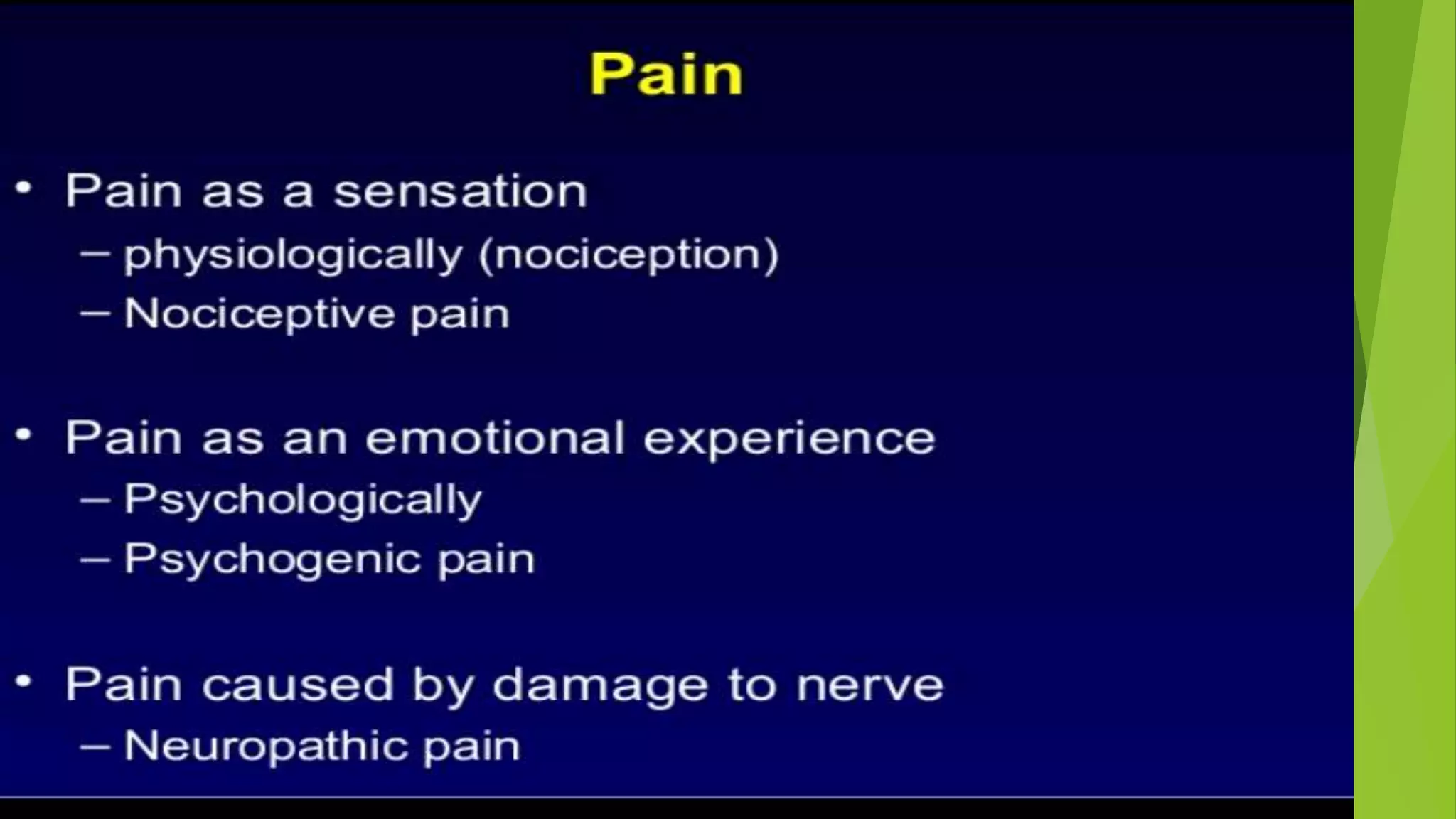
 VARIETIES OF PAIN
 ASSESSMENT OF PAIN
 MANAGEMENT OF PAIN
 CONCLUSION
 REFERENCES
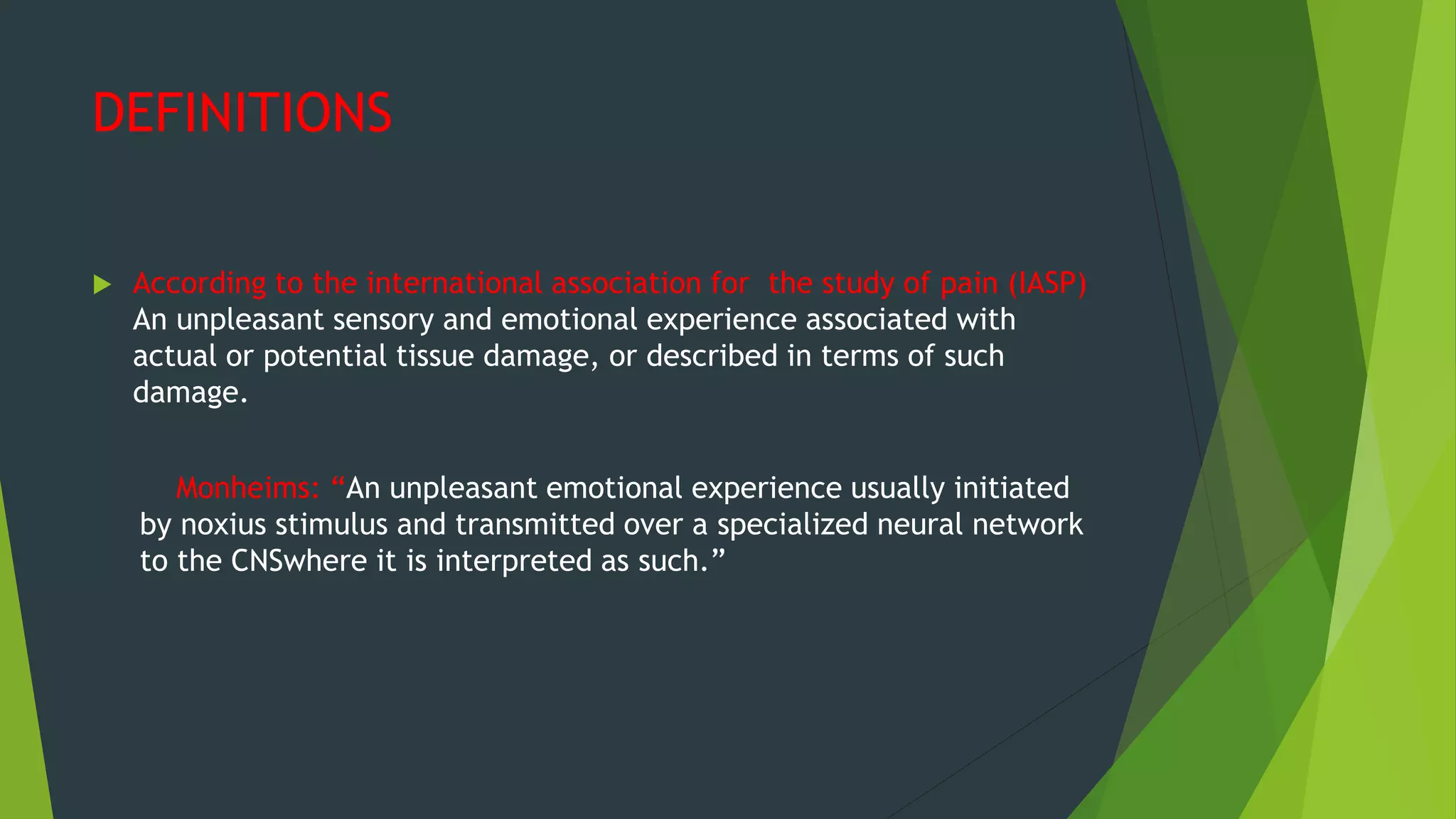
DEFINITIONS
 According to the international association for the study of pain (IASP)
An unpleasant sensory and emotional experience associated with
actual or potential tissue damage, or described in terms of such
damage.
Monheims: “An unpleasant emotional experience usually initiated
by noxius stimulus and transmitted over a specialized neural network
to the CNSwhere it is interpreted as such.”
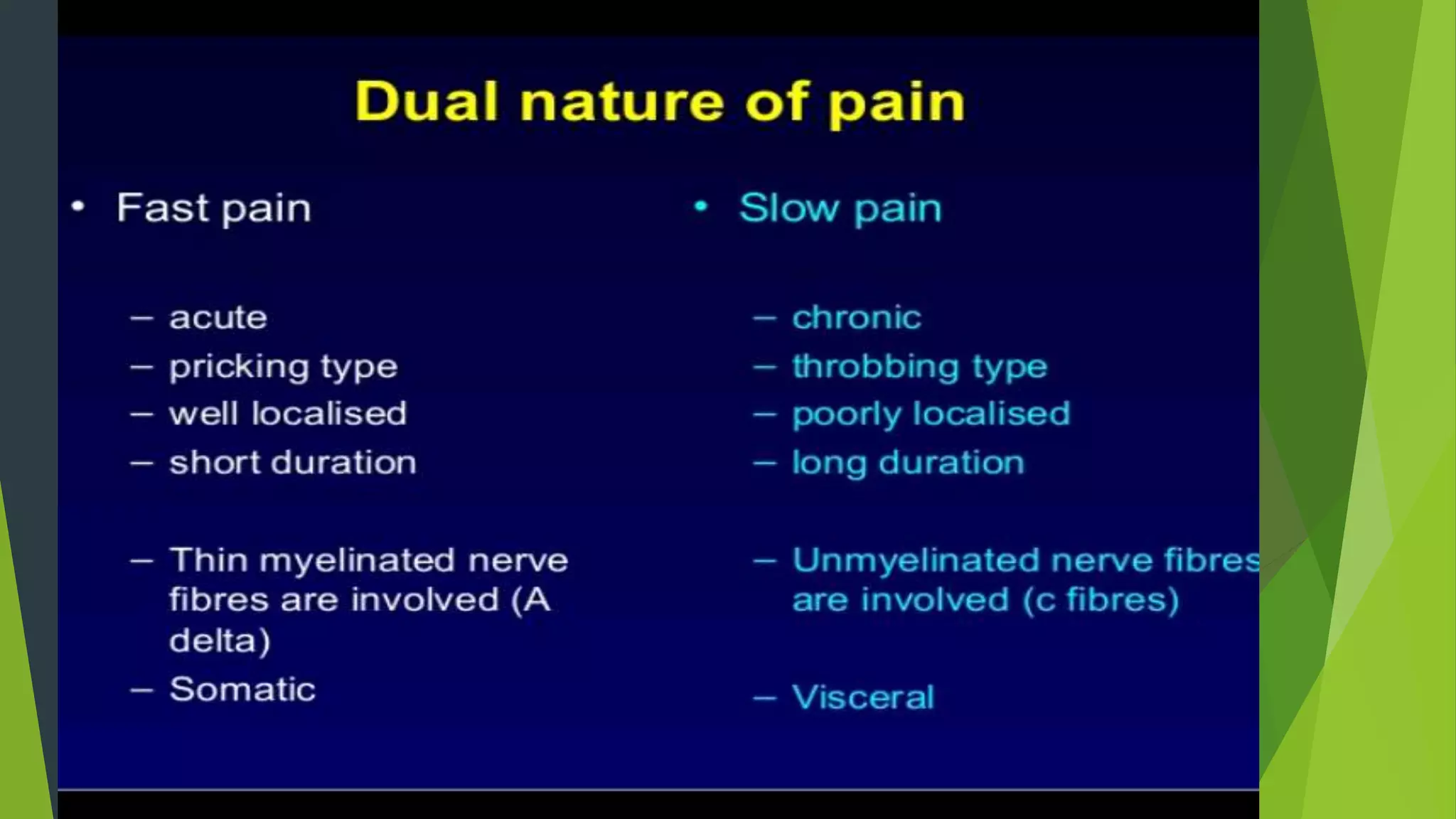
 Fast pain is due to the activity of mylinated
Aδ fibers and it is appreciated as sharp
bright and localized sensation.
 Slow pain is due to activity of unmyelinated
C fibers and it is appreciated as dull aching
and more diffuse
 FAST PAIN is also described as sharp pain ,pricking
pain , electric pain.it is elicited by mechanical and
thermal type of stimuli.
 SLOW PAIN is also called as, slow burning pain,aching
pain, throbbing pain,nauseous pain,chronic pain.
slow pain can be elicited by mechanical,thermal
and chemical stimuli.
PAIN RECEPTORS AND THEIR
STIMULATION
 Pain Receptors (NOCICEPTORS) Are Free Nerve
Endings: The pain receptors in the skin and other
tissues are free nerve endings.
 They are widespread in the superficial layers of
the skin as well as in certain internal tissues, such
as the periosteum , the arterial walls ,the joint
surfaces and the falx and tentorium of the brain.
THREE TYPES OF STIMULI EXCITES PAIN RECEPTORS
Pain can be elicited by multiple type of stimuli they
are classified as:
 MECHANICAL
 THERMAL
 CHEMICAL
In general fast pain is elicited by the mechanical and
thermal stimuli, whereas the slow pain is elicited by all
three types.
NEUROTRANSMITTERS INVOLVED IN PAIN
SENSATION
 Glutamate and substance P are neurotransmitters
secreted by the pain nerve endings. The A$ afferent fibers
which transmit impulses of fast pain secrete glutamate.
 C type fibers which transmit impulses of slow pain secrete
substance P
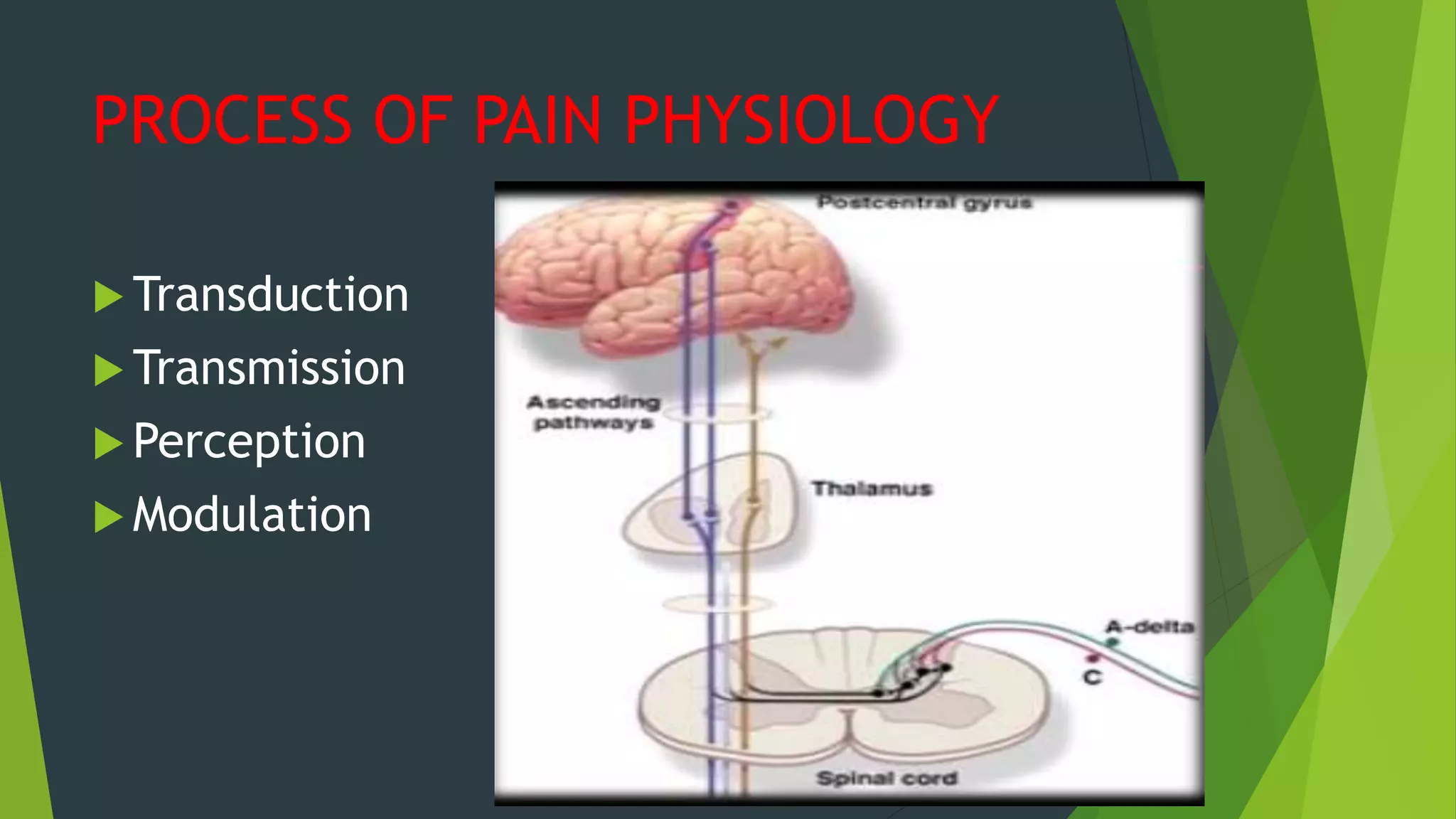
PROCESS OF PAIN PHYSIOLOGY
 Transduction
 Transmission
 Perception
 Modulation
TRANSDUCTION
Pain stimuli is converted to
electrical energy .This
electrical energy is known as
transduction .This stimulus
sends an impulse across a
peripheral nerve
fiber(nociceptor)
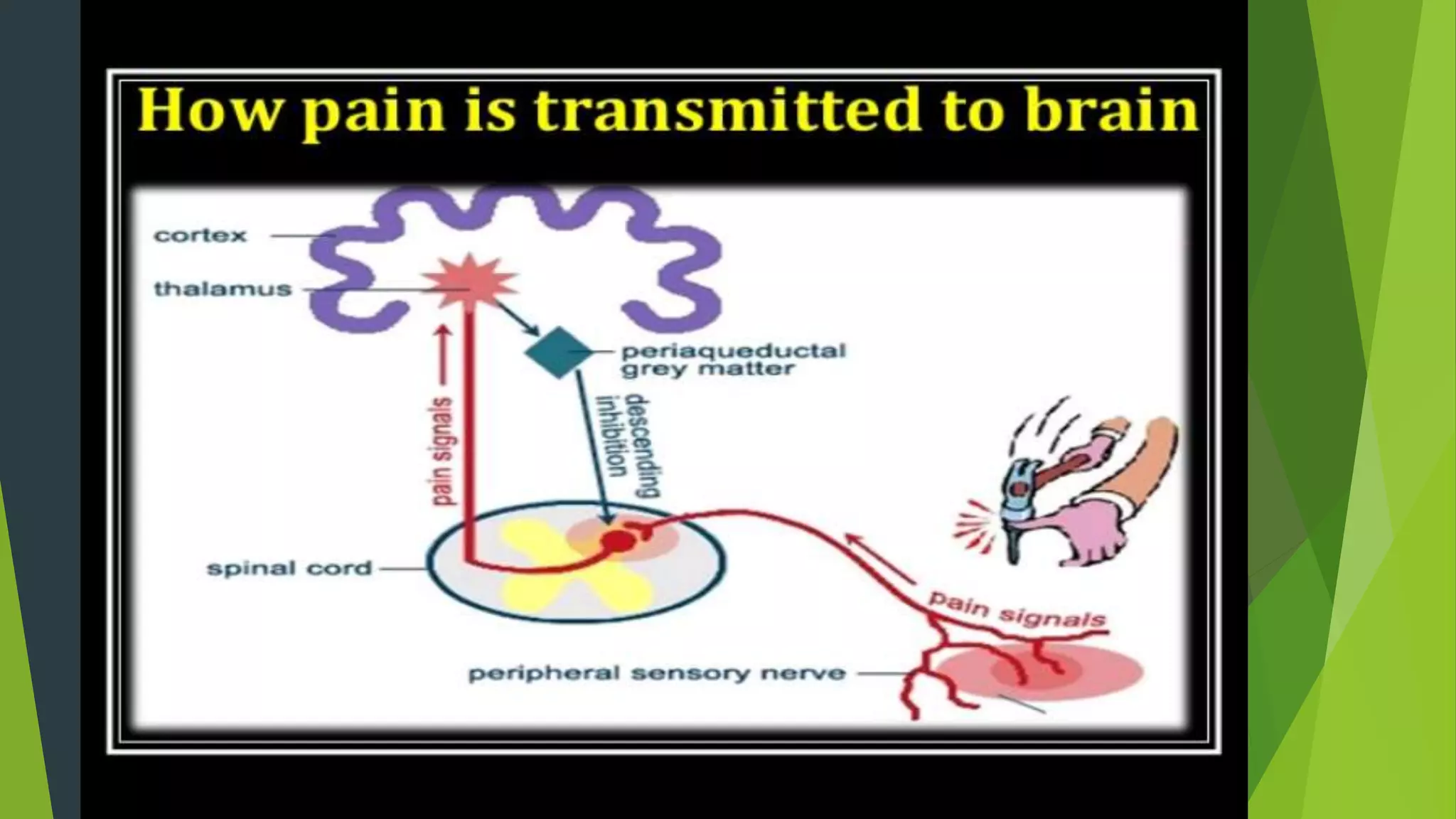
HOW PAIN IS TRANSMITTED TO THE
BRAIN
DUAL TRANSMISSION OF PAIN SIGNALS
INTO THE CENTRAL NERVOUS SYSTEM
 Peripheral pain fibers- “Fast” and “slow” fibers.
The fast-sharp pain signals are elicited by either mechanical
or thermal pain stimuli; they are transmitted in the
peripheral nerves to the spinal cord by small type A$ fibers
at velocity between 6 to 30m/sec.
The slow chronic pain is transmitted by type c fibers at
velocity between 0.5 to 2m/sec.
PAIN PATHWAY
THE DUAL PAIN PATHWAY IN THE
SPINAL CORD AND BRAIN STEM
 On entering the spinal cord the pain signals take two
pathways to the brain ,
through:----
1.THE NEOSPINOTHALAMIC TRACT(for fast
pain)
2.THE PALEOSPINOTHALAMIC TRACT(for slow
pain)
NEOSPINOTHALAMIC PATHWAY
 The fast TYPE A$ PAIN FIBERS transmit mainly
mechanical and acute thermal pain .
 They terminate mainly in lamina 1(LAMINA MARGINALIS)
of the dorsal horns, and their excite second order
neurons of the neospinothalamic tract.
 These gives rise to long fibers that cross immediately to
the opposite side of the cord through the anterior
commissure and then pass upward to the brain stem in
the anterolateral columns.
NEOSPINOTHALAMIC PATHWAY
PALEOSPINOTHALAMIC PATHWAY
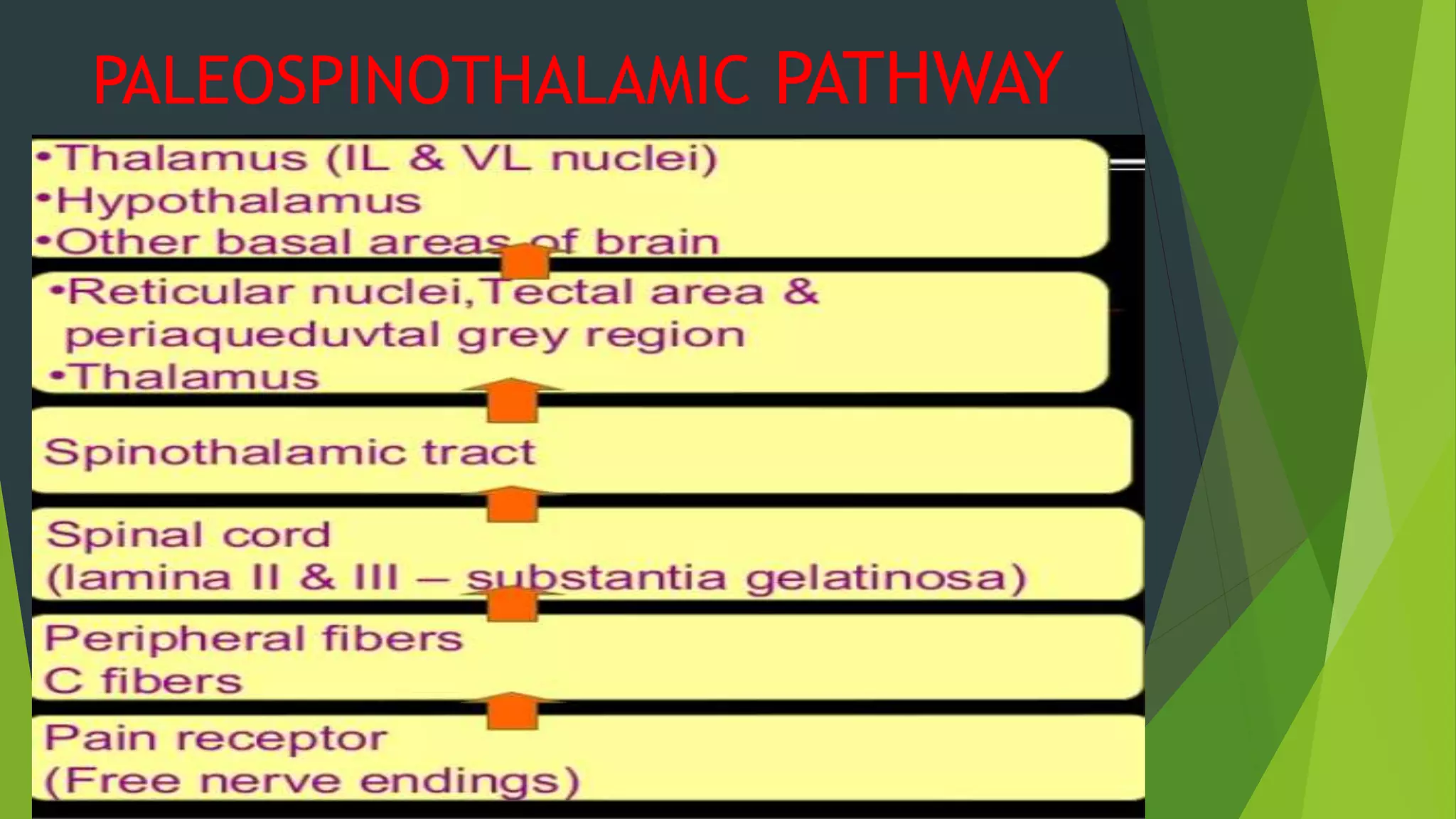
 It transmits pain mainly from the peripheral slow-chronic
type c pain fibers,although it transmit some signals from
type from type A$ fibers as well.
 In this pathway , the peripheral fibers terminate almost
entirely in Laminae 2 and 3 of the dorsal horns,which
together are called the SUBSTANTIA GELATINOSA.
PALEOSPINOTHALAMIC PATHWAY
ANALGESIA SYSTEM
 Analgesia system means pain control system.
 The body has its own analgesia system in brain which
provide short term relief from pain .It is also called
endogenous analgesia system
 It is also called endogenous analgesia system.
 The analgesia system has got its own pathway through
which it blocks the synaptic transmission of pain sensation
in spinal cord and thus attenuates the experience of pain.
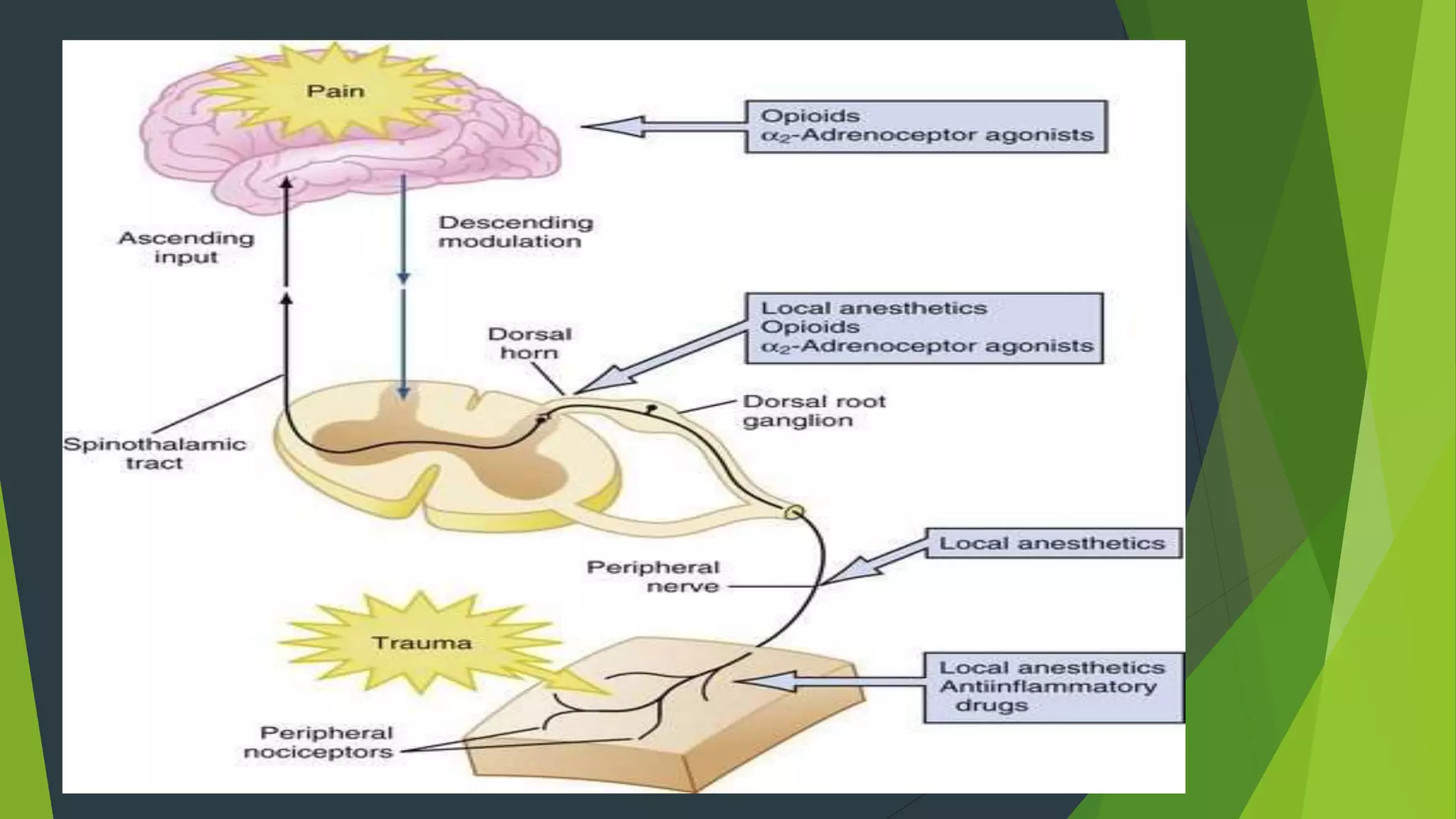
 Analgesic drugs such as opiods act through this system and
provide a controlled pain relief.
Analgesic pathway:-
(DESCENDING PAIN PATHWAY)
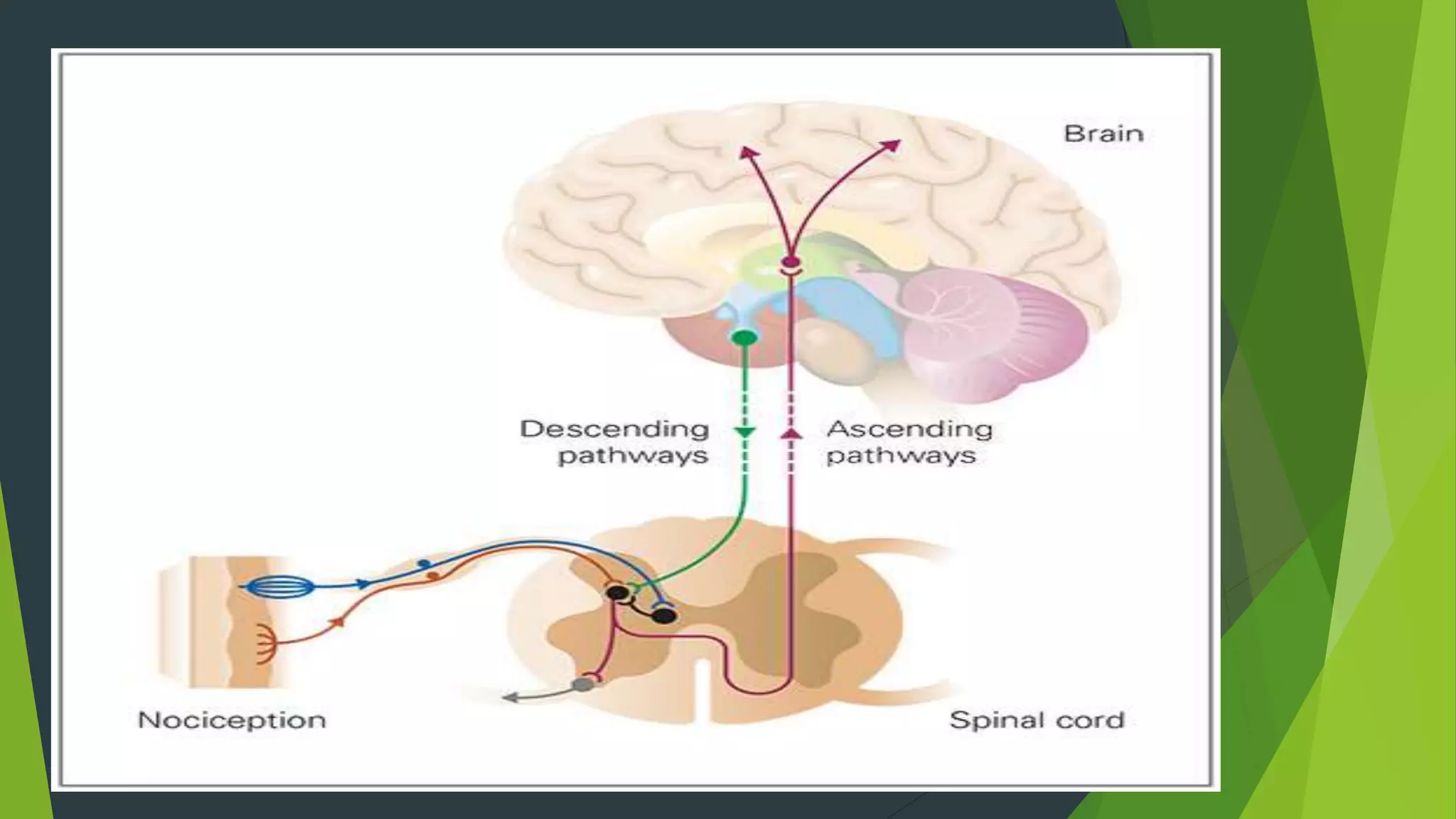
 The analgesic pathway that interferes with pain
transmission is often considered as descending
pain pathway and fibers are the efferent fibers.
 The ascending pain pathway being the afferent
fibers that transmit pain sensation to the brain.
Role of analgesic pathway in inhibiting
pain transmission:-
 1.fibers of analgesic pathway arise from frontal lobe of
cerebral cortex and hypothalamus.
 2.These fibers terminate in the gray matter surrounding
the third ventricle and aqueduct of sylvius
(periaqueductal gray matter)
 The fibers from here descend down to brainstem and
terminate on
a) Raphe magnus nucleus situated in
reticular formation of lower pons and upper medulla
b)Nuclus reticularis paragigantocellularis
situated in medulla
 4.The fibers from these reticular nuclei descends through
lateral white column of spinal cord and reach the
synapses of the neurons in afferent pain pathway situated
in anterior gray horn.
The synapses of the afferent pain pathway are between:
a)A$ type afferent fibers and neurons of marginal
nucleus
b) C type afferent fibers and neurons of substantia
gelatinosa of Rolando
5.At the synaptic level ,the analgesic fibers release the
neurotransmitters and inhibit the pain transmission before
relayed to brain.
Neurotransmitters of analgesic
pathway:-
 The neurotransmitters released by the fibers of
analgesic pathway are serotonin and opiate
receptor substances namely encephalin, dinorphin
and endorphin.
THEORIES OF PAIN:-
SPECIFICITY THEORY
PATTERN THEORY
GATE CONTROL THEORY
GATE CONTROL THEORY
 The psychologist Ronald Melzack and anatomist
Patrick Wall Gate proposed the gate control
theory for pain in 1965 to explain the pain
suppression.
 According to them ,the pain stimuli transmitted
by afferent pain fibers are blocked by gate
mechanism located at the posterior gray horn of
spinal cord.If the gate is opened,pain is felt.If the
gate is closed ,pain is suppressed.
Mechanism of gate control at spinal
level:-
 When pain stimulus is applied on any part of body,
besides pain receptors, the receptors of other
sensation such as touch are stimulated.
 When all these impulses reach the spinal cord through
posterior nerve root , the fibers of touch sensation
send collarerals to the neurons of pain pathway i.e.
cells of marginal nucleus and substantia gelatinosa.
 The impulses of touch sensation passing through these collaterals inhibit the
release of glutamate and substance P from the pain fibers.
 The impulses of touch sensation passing through
these collaterals inhibit the release of glutamate
and substance P from the pain fibers.
 This closes the gate and the pain transmission is
blocked.
Role of brain in gate control
mechanism:-
 According to MELZACK and WALL Brain also
plays some important role in the gate
control system of spinal cord as follows-
 1.If the gate in spinal cord are not closed,
the pain signals reach the thalamus through
lateral spinothalamic tract.
 2. The signals are processed in thalamus
and sent to sensory cortex
3.The perception of pain occurs in cortical
level in context of the person’s emotional
status and previous experiences
 4.The person responds to the pain based on the
integration of all these information in the brain
.Thus ,the brain determines the severity and extent
of pain
 5.To minimize the severity and extent of pain ,
brain sends message back to spinal cord to close the
gate by releasing pain relievers such as opiate
peptides
 6.Now the pain stimulus is blocked and the person
feels less pain
VARIETIES OF PAIN
 ACUTE PAIN
 CHRRONIC PAIN
 CUTANEOUS PAIN
 DEEP SOMATIC PAIN
 VISCERAL PAIN
 REFERRED PAIN
 NEUROPATHIC PAIN
 PHANTOM PAIN
ACUTE PAIN
 Sudden onset
 Lasts less than 3 to 6 months.
 Temporary (disappears once stimulus is removed)
 Can be somatic ,visceral or referred
CHRONIC PAIN
 Persistent-Usually lasting more than six months
 Cause unknown-may be due to neural stimulation
 Physiological responses are less obvious especially
adaptation
 Psychological responses may include depression
SOMATIC VS VISCERAL
 SOMATIC PAIN-
Superficial :stimulation of receptors in
skin
Deep: stimulation of receptors in
muscles, joints and tendons
 VISCERAL PAIN-
Pain from viscera is
unpleasant. It is poorly localized.
-Stimulation of receptors in internal organs
,abdomen ,and skeleton
-Visceral pain can be referred
Cause of visceral pain
 1.Ischaemia
 2.Chemical stimuli
 3.Spasm of hollow organs
REFFERED PAIN
 Referred pain is the pain that is perceived at a site
adjacent to or away from the site of origin.
 The deep pain and some visceral pain are referred to
other areas. But the superficial pain is not referred.
Examples of referred pain
 1.Cardiac pain is felt at the inner part of left arm
and left shoulder
 2.Pain in ovary is referred to umbilicus
 3.Pain from testis is felt in abdomen
 4.Pain in diaphragm is referred to right shoulder
 5.Pain in gallbladder is referred to epigastric
region
 6.Renal pain is referred to loin
ASSESSMENT OF PAIN
 In the assessment of pain intensity ,rating scale
techniques are often used. The most commonly used
techniques are:-
 NUMERICAL RATING SCALE
 VISUAL ANALOGUE SCALE
 McGILL PAIN QUESTIONNAIRE
 BEHAVIOUR RATING SCALE
NUMERICAL RATING SCALE
VISUAL ANALOGUE SCALE
McGILL PAIN QUESTIONNAIRE
 It is also known as McGILL pain index ,is a scale of rating
pain developed at McGILL University by Melzack and
Torgerson in 1971.
 It is self report questionnaire that allows indivisual to give
their doctor a good description of the quality and
intensity of pain that they are experiencing.
 It is very widely used questionnaire.
BEHAVIOUR RATING SCALE
For patient unable to provide a
self report of pain ,a score from 0
to 10 is assigned based on clinical
observation
MANAGEMENT
OF PAIN
NON-PHARMACOLOGICAL MANAGEMENT
 PHSIOTHERAPY
 PSYCHOLOGICAL TECHNIQUES
 STIMULATION THERAPIES –ACUPUNCTURE AND TENS
SURGICAL PROCEDURE FOR THE RELIEF
OF PAIN
 CORDOTOMY
 THALAMOTOMY
 SYMPATHECTOMY
 RHIZOTOMY
 FRONTAL LOBOTOMY
PAIN INHIBITING MECHANISM
 It can be-
ENDOGENOUS
EXOGENOUS
 ENDOGENOUS METHOD OF CONTROLLING PAIN INCLUDES:-
1. REMOVING THE CAUSE-
The original causative factor had been eliminated
2.BLOCKING THE PATHWAY OF PAIN IMPULSE-
This can be done by injecting drug possessing local analgesic
property in proximity to the nerve involved.
Thus preventing those particular fibers from conducting any
impulses centrally beyond that point.
 3.RAISING THE PAIN THRESOLD-
Raising pain threshold depends on the pharmacological
activity of drugs possessing analgesic properties.
These drugs raise pain threshold and alter pain reaction.
 4. PREVENTING PAIN REACTION BY CORTICAL DEPRESSION-
Eliminating pain by cortical depression is by the use of
general anesthesia.
 5.USING PSYCHOMATIC METHOD-
This method affects both pain perception and pain reaction .
It includes audio analgesia.
PHARMACOLOGICAL
MANAGEMENT
PAIN PATHWAYS AND MEDICATION
REFERENCES
 Monheims -local anesthesia and pain control in
dental practice.
 GUYTON and HALL -Textbook of medical physiology.
 K SEMBULINGAM –Essentials of medical physiology
 INDU KHURANA- Textbook of human physiology
Pain definition, pathway,analgesic pathway

Pain definition, pathway,analgesic pathway

  • 1.
    PAIN Presented by –EktaDwivedi MDS –FIRST YEAR
  • 2.
    CONTENTS  INTRODUCTION  DEFINITIONS FAST PAIN AND SLOW PAIN  RECEPTORS ANS STIMULUS  PROCESS OF PAIN PHYSIOLOGY  PAIN PATHWAY  ANALGESIC PATHWAY  GATE CONTROL THEORY  VARIETIES OF PAIN  ASSESSMENT OF PAIN  MANAGEMENT OF PAIN  CONCLUSION  REFERENCES
  • 4.
    DEFINITIONS  According tothe international association for the study of pain (IASP) An unpleasant sensory and emotional experience associated with actual or potential tissue damage, or described in terms of such damage. Monheims: “An unpleasant emotional experience usually initiated by noxius stimulus and transmitted over a specialized neural network to the CNSwhere it is interpreted as such.”
  • 6.
     Fast painis due to the activity of mylinated Aδ fibers and it is appreciated as sharp bright and localized sensation.  Slow pain is due to activity of unmyelinated C fibers and it is appreciated as dull aching and more diffuse
  • 8.
     FAST PAINis also described as sharp pain ,pricking pain , electric pain.it is elicited by mechanical and thermal type of stimuli.  SLOW PAIN is also called as, slow burning pain,aching pain, throbbing pain,nauseous pain,chronic pain. slow pain can be elicited by mechanical,thermal and chemical stimuli.
  • 9.
    PAIN RECEPTORS ANDTHEIR STIMULATION  Pain Receptors (NOCICEPTORS) Are Free Nerve Endings: The pain receptors in the skin and other tissues are free nerve endings.  They are widespread in the superficial layers of the skin as well as in certain internal tissues, such as the periosteum , the arterial walls ,the joint surfaces and the falx and tentorium of the brain.
  • 11.
    THREE TYPES OFSTIMULI EXCITES PAIN RECEPTORS Pain can be elicited by multiple type of stimuli they are classified as:  MECHANICAL  THERMAL  CHEMICAL In general fast pain is elicited by the mechanical and thermal stimuli, whereas the slow pain is elicited by all three types.
  • 13.
    NEUROTRANSMITTERS INVOLVED INPAIN SENSATION  Glutamate and substance P are neurotransmitters secreted by the pain nerve endings. The A$ afferent fibers which transmit impulses of fast pain secrete glutamate.  C type fibers which transmit impulses of slow pain secrete substance P
  • 14.
    PROCESS OF PAINPHYSIOLOGY  Transduction  Transmission  Perception  Modulation
  • 16.
    TRANSDUCTION Pain stimuli isconverted to electrical energy .This electrical energy is known as transduction .This stimulus sends an impulse across a peripheral nerve fiber(nociceptor)
  • 20.
    HOW PAIN ISTRANSMITTED TO THE BRAIN
  • 22.
    DUAL TRANSMISSION OFPAIN SIGNALS INTO THE CENTRAL NERVOUS SYSTEM  Peripheral pain fibers- “Fast” and “slow” fibers. The fast-sharp pain signals are elicited by either mechanical or thermal pain stimuli; they are transmitted in the peripheral nerves to the spinal cord by small type A$ fibers at velocity between 6 to 30m/sec. The slow chronic pain is transmitted by type c fibers at velocity between 0.5 to 2m/sec.
  • 24.
  • 25.
    THE DUAL PAINPATHWAY IN THE SPINAL CORD AND BRAIN STEM  On entering the spinal cord the pain signals take two pathways to the brain , through:---- 1.THE NEOSPINOTHALAMIC TRACT(for fast pain) 2.THE PALEOSPINOTHALAMIC TRACT(for slow pain)
  • 26.
    NEOSPINOTHALAMIC PATHWAY  Thefast TYPE A$ PAIN FIBERS transmit mainly mechanical and acute thermal pain .  They terminate mainly in lamina 1(LAMINA MARGINALIS) of the dorsal horns, and their excite second order neurons of the neospinothalamic tract.  These gives rise to long fibers that cross immediately to the opposite side of the cord through the anterior commissure and then pass upward to the brain stem in the anterolateral columns.
  • 27.
  • 28.
    PALEOSPINOTHALAMIC PATHWAY  Ittransmits pain mainly from the peripheral slow-chronic type c pain fibers,although it transmit some signals from type from type A$ fibers as well.  In this pathway , the peripheral fibers terminate almost entirely in Laminae 2 and 3 of the dorsal horns,which together are called the SUBSTANTIA GELATINOSA.
  • 29.
  • 31.
    ANALGESIA SYSTEM  Analgesiasystem means pain control system.  The body has its own analgesia system in brain which provide short term relief from pain .It is also called endogenous analgesia system  It is also called endogenous analgesia system.  The analgesia system has got its own pathway through which it blocks the synaptic transmission of pain sensation in spinal cord and thus attenuates the experience of pain.  Analgesic drugs such as opiods act through this system and provide a controlled pain relief.
  • 32.
    Analgesic pathway:- (DESCENDING PAINPATHWAY)  The analgesic pathway that interferes with pain transmission is often considered as descending pain pathway and fibers are the efferent fibers.  The ascending pain pathway being the afferent fibers that transmit pain sensation to the brain.
  • 34.
    Role of analgesicpathway in inhibiting pain transmission:-  1.fibers of analgesic pathway arise from frontal lobe of cerebral cortex and hypothalamus.  2.These fibers terminate in the gray matter surrounding the third ventricle and aqueduct of sylvius (periaqueductal gray matter)  The fibers from here descend down to brainstem and terminate on a) Raphe magnus nucleus situated in reticular formation of lower pons and upper medulla b)Nuclus reticularis paragigantocellularis situated in medulla
  • 35.
     4.The fibersfrom these reticular nuclei descends through lateral white column of spinal cord and reach the synapses of the neurons in afferent pain pathway situated in anterior gray horn. The synapses of the afferent pain pathway are between: a)A$ type afferent fibers and neurons of marginal nucleus b) C type afferent fibers and neurons of substantia gelatinosa of Rolando 5.At the synaptic level ,the analgesic fibers release the neurotransmitters and inhibit the pain transmission before relayed to brain.
  • 36.
    Neurotransmitters of analgesic pathway:- The neurotransmitters released by the fibers of analgesic pathway are serotonin and opiate receptor substances namely encephalin, dinorphin and endorphin.
  • 38.
    THEORIES OF PAIN:- SPECIFICITYTHEORY PATTERN THEORY GATE CONTROL THEORY
  • 39.
    GATE CONTROL THEORY The psychologist Ronald Melzack and anatomist Patrick Wall Gate proposed the gate control theory for pain in 1965 to explain the pain suppression.  According to them ,the pain stimuli transmitted by afferent pain fibers are blocked by gate mechanism located at the posterior gray horn of spinal cord.If the gate is opened,pain is felt.If the gate is closed ,pain is suppressed.
  • 42.
    Mechanism of gatecontrol at spinal level:-  When pain stimulus is applied on any part of body, besides pain receptors, the receptors of other sensation such as touch are stimulated.  When all these impulses reach the spinal cord through posterior nerve root , the fibers of touch sensation send collarerals to the neurons of pain pathway i.e. cells of marginal nucleus and substantia gelatinosa.  The impulses of touch sensation passing through these collaterals inhibit the release of glutamate and substance P from the pain fibers.
  • 43.
     The impulsesof touch sensation passing through these collaterals inhibit the release of glutamate and substance P from the pain fibers.  This closes the gate and the pain transmission is blocked.
  • 44.
    Role of brainin gate control mechanism:-  According to MELZACK and WALL Brain also plays some important role in the gate control system of spinal cord as follows-  1.If the gate in spinal cord are not closed, the pain signals reach the thalamus through lateral spinothalamic tract.
  • 45.
     2. Thesignals are processed in thalamus and sent to sensory cortex 3.The perception of pain occurs in cortical level in context of the person’s emotional status and previous experiences
  • 46.
     4.The personresponds to the pain based on the integration of all these information in the brain .Thus ,the brain determines the severity and extent of pain  5.To minimize the severity and extent of pain , brain sends message back to spinal cord to close the gate by releasing pain relievers such as opiate peptides  6.Now the pain stimulus is blocked and the person feels less pain
  • 47.
    VARIETIES OF PAIN ACUTE PAIN  CHRRONIC PAIN  CUTANEOUS PAIN  DEEP SOMATIC PAIN  VISCERAL PAIN  REFERRED PAIN  NEUROPATHIC PAIN  PHANTOM PAIN
  • 48.
    ACUTE PAIN  Suddenonset  Lasts less than 3 to 6 months.  Temporary (disappears once stimulus is removed)  Can be somatic ,visceral or referred
  • 49.
    CHRONIC PAIN  Persistent-Usuallylasting more than six months  Cause unknown-may be due to neural stimulation  Physiological responses are less obvious especially adaptation  Psychological responses may include depression
  • 50.
    SOMATIC VS VISCERAL SOMATIC PAIN- Superficial :stimulation of receptors in skin Deep: stimulation of receptors in muscles, joints and tendons  VISCERAL PAIN- Pain from viscera is unpleasant. It is poorly localized. -Stimulation of receptors in internal organs ,abdomen ,and skeleton -Visceral pain can be referred
  • 51.
    Cause of visceralpain  1.Ischaemia  2.Chemical stimuli  3.Spasm of hollow organs
  • 52.
    REFFERED PAIN  Referredpain is the pain that is perceived at a site adjacent to or away from the site of origin.  The deep pain and some visceral pain are referred to other areas. But the superficial pain is not referred.
  • 53.
    Examples of referredpain  1.Cardiac pain is felt at the inner part of left arm and left shoulder  2.Pain in ovary is referred to umbilicus  3.Pain from testis is felt in abdomen  4.Pain in diaphragm is referred to right shoulder  5.Pain in gallbladder is referred to epigastric region  6.Renal pain is referred to loin
  • 55.
    ASSESSMENT OF PAIN In the assessment of pain intensity ,rating scale techniques are often used. The most commonly used techniques are:-  NUMERICAL RATING SCALE  VISUAL ANALOGUE SCALE  McGILL PAIN QUESTIONNAIRE  BEHAVIOUR RATING SCALE
  • 56.
  • 57.
  • 58.
    McGILL PAIN QUESTIONNAIRE It is also known as McGILL pain index ,is a scale of rating pain developed at McGILL University by Melzack and Torgerson in 1971.  It is self report questionnaire that allows indivisual to give their doctor a good description of the quality and intensity of pain that they are experiencing.  It is very widely used questionnaire.
  • 59.
    BEHAVIOUR RATING SCALE Forpatient unable to provide a self report of pain ,a score from 0 to 10 is assigned based on clinical observation
  • 60.
  • 61.
    NON-PHARMACOLOGICAL MANAGEMENT  PHSIOTHERAPY PSYCHOLOGICAL TECHNIQUES  STIMULATION THERAPIES –ACUPUNCTURE AND TENS
  • 62.
    SURGICAL PROCEDURE FORTHE RELIEF OF PAIN  CORDOTOMY  THALAMOTOMY  SYMPATHECTOMY  RHIZOTOMY  FRONTAL LOBOTOMY
  • 63.
    PAIN INHIBITING MECHANISM It can be- ENDOGENOUS EXOGENOUS
  • 64.
     ENDOGENOUS METHODOF CONTROLLING PAIN INCLUDES:- 1. REMOVING THE CAUSE- The original causative factor had been eliminated 2.BLOCKING THE PATHWAY OF PAIN IMPULSE- This can be done by injecting drug possessing local analgesic property in proximity to the nerve involved. Thus preventing those particular fibers from conducting any impulses centrally beyond that point.
  • 65.
     3.RAISING THEPAIN THRESOLD- Raising pain threshold depends on the pharmacological activity of drugs possessing analgesic properties. These drugs raise pain threshold and alter pain reaction.
  • 66.
     4. PREVENTINGPAIN REACTION BY CORTICAL DEPRESSION- Eliminating pain by cortical depression is by the use of general anesthesia.  5.USING PSYCHOMATIC METHOD- This method affects both pain perception and pain reaction . It includes audio analgesia.
  • 67.
  • 68.
  • 69.
    REFERENCES  Monheims -localanesthesia and pain control in dental practice.  GUYTON and HALL -Textbook of medical physiology.  K SEMBULINGAM –Essentials of medical physiology  INDU KHURANA- Textbook of human physiology