
*Pain Management
An overview
Prepared & Presented by
Kamrujjaman mondal
“An unpleasant sensory and emotional experience associated
with actual or potential tissue damage, or described in terms
of such damage.”
International Association for the Study of Pain
*
*
Diagnostic classification
A. Nociceptive pain
B. Neuropathic pain
C. Psychogenic pain
Clinical types
A. Acute pain
B. Chronic pain
*
A. Nociceptive pain
I. Somatic: well localized;
Superficial (from skin & subcutaneous tissue)
e.g. superficial cuts/burns.
Deep (from muscles/bones)
e.g. fractures/arthritis/ fibrositis.
II. Visceral: Poorly localized; (from viscera)
e.g. angina pectoris, peptic ulcer, intestinal colic.
B. Neuropathic pain
I. Central: Localized and diffused; burning, stabbing pain
e.g. CNS
II. Peripheral: localized neuropathies
C. Psychogenic pain
caused, increased, or prolonged by mental, emotional, or behavioral
factors.
*
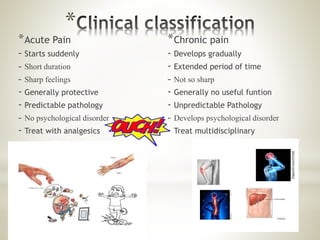
*Acute Pain
- Starts suddenly
- Short duration
- Sharp feelings
- Generally protective
- Predictable pathology
- No psychological disorder
- Treat with analgesics
*Chronic pain
- Develops gradually
- Extended period of time
- Not so sharp
- Generally no useful funtion
- Unpredictable Pathology
- Develops psychological disorder
- Treat multidisciplinary
*
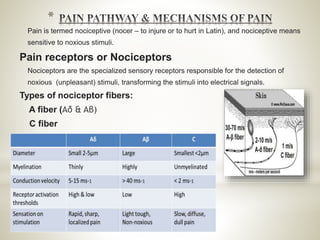
Pain is termed nociceptive (nocer – to injure or to hurt in Latin), and nociceptive means
sensitive to noxious stimuli.
Pain receptors or Nociceptors
Nociceptors are the specialized sensory receptors responsible for the detection of
noxious (unpleasant) stimuli, transforming the stimuli into electrical signals.
Types of nociceptor fibers:
A fiber (Aδ & Aβ)
C fiber
*
Wong- Baker FACES Scale
*
• Heat/cold
• Relaxation
• TENS
• Distraction
• Acupuncture/vaccum
• Repositioning
*NSAIDS
*Compound analgesics
*Opioid analgesics
*Local anesthetics
*Anti-seizure medications
*Anti-depressants
*
*
Adjuvants
Non-opioids
Opioids
*
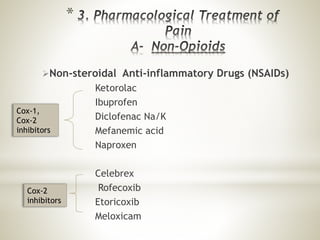
Non-steroidal Anti-inflammatory Drugs (NSAIDs)
Ketorolac
Ibuprofen
Diclofenac Na/K
Mefanemic acid
Naproxen
Celebrex
Rofecoxib
Etoricoxib
Meloxicam
Cox-1,
Cox-2
inhibitors
Cox-2
inhibitors
*
**MOA:
A. Decreased Ca++ entry
B. Increased outward movement of K+
C. Inhibition of adenylate cyclase
Adenylate cyclase is an enzyme that breaks down adenosine
triphosphate (ATP) to form cyclic adenosine monophosphate (cAMP).
All 3 types of opioid receptors couple to adenylate cyclase. Inhibition
of adenylate cyclase may result in inhibition of neurotransmitter
release.
Mild opioid : Codeine,
Hydrocodone,
Oxycodone
Mejor opioid: Morphie
Meperidine
Fentanyl
*
Agents used to induce analgesic effect indirectly
 Local Anesthetic
Local anesthetic drugs act mainly by inhibiting sodium influx
through sodium-specific ion channels in the neuronal cell membrane,
in particular the so-called voltage-gated sodium channels. When the
influx of sodium is interrupted, an action potential cannot arise and
signal conduction is inhibited
e.g.- Cocaine, Benzocaine
Muscle relaxant
A muscle relaxant is a drug which affects skeletal muscle function and
decreases themuscle tone. It may be used to alleviate symptoms such
as muscle spasms, pain, and hyperreflexia.
e.g- Diazepam, Cyclobenzaprine
Corticosteroids
* Corticosteroids reduce the mucus secretion by inhibiting the release of secretagogue from
macrophages
* Enhance the beta-adrenergic response to relieve the muscle spasm.
e.g.- Beclomethasone, Fluticasone
Antidepressants
Anticonvulsants
Anti histamines
*Willow bark (Salix alba):
contains Salicin and salicortin, acts as COX inhibitor.
Capsicum: this heating effect reduces the amount of substance P, a chemical that
acts as a pain messenger in the body.
Arnica
.
*Boswellia serrata:
contains boswellic acid.
Which is useful for Rheumatoid arthritis
Thank you

Pain management.

  • 1.
    *Pain Management An overview Prepared& Presented by Kamrujjaman mondal
  • 2.
    “An unpleasant sensoryand emotional experience associated with actual or potential tissue damage, or described in terms of such damage.” International Association for the Study of Pain *
  • 3.
    * Diagnostic classification A. Nociceptivepain B. Neuropathic pain C. Psychogenic pain Clinical types A. Acute pain B. Chronic pain
  • 4.
    * A. Nociceptive pain I.Somatic: well localized; Superficial (from skin & subcutaneous tissue) e.g. superficial cuts/burns. Deep (from muscles/bones) e.g. fractures/arthritis/ fibrositis. II. Visceral: Poorly localized; (from viscera) e.g. angina pectoris, peptic ulcer, intestinal colic. B. Neuropathic pain I. Central: Localized and diffused; burning, stabbing pain e.g. CNS II. Peripheral: localized neuropathies C. Psychogenic pain caused, increased, or prolonged by mental, emotional, or behavioral factors.
  • 5.
    * *Acute Pain - Startssuddenly - Short duration - Sharp feelings - Generally protective - Predictable pathology - No psychological disorder - Treat with analgesics *Chronic pain - Develops gradually - Extended period of time - Not so sharp - Generally no useful funtion - Unpredictable Pathology - Develops psychological disorder - Treat multidisciplinary
  • 6.
    * Pain is termednociceptive (nocer – to injure or to hurt in Latin), and nociceptive means sensitive to noxious stimuli. Pain receptors or Nociceptors Nociceptors are the specialized sensory receptors responsible for the detection of noxious (unpleasant) stimuli, transforming the stimuli into electrical signals. Types of nociceptor fibers: A fiber (Aδ & Aβ) C fiber
  • 8.
  • 9.
  • 10.
    • Heat/cold • Relaxation •TENS • Distraction • Acupuncture/vaccum • Repositioning *NSAIDS *Compound analgesics *Opioid analgesics *Local anesthetics *Anti-seizure medications *Anti-depressants *
  • 11.
  • 12.
    * Non-steroidal Anti-inflammatory Drugs(NSAIDs) Ketorolac Ibuprofen Diclofenac Na/K Mefanemic acid Naproxen Celebrex Rofecoxib Etoricoxib Meloxicam Cox-1, Cox-2 inhibitors Cox-2 inhibitors
  • 13.
  • 14.
    **MOA: A. Decreased Ca++entry B. Increased outward movement of K+ C. Inhibition of adenylate cyclase Adenylate cyclase is an enzyme that breaks down adenosine triphosphate (ATP) to form cyclic adenosine monophosphate (cAMP). All 3 types of opioid receptors couple to adenylate cyclase. Inhibition of adenylate cyclase may result in inhibition of neurotransmitter release. Mild opioid : Codeine, Hydrocodone, Oxycodone Mejor opioid: Morphie Meperidine Fentanyl
  • 15.
    * Agents used toinduce analgesic effect indirectly  Local Anesthetic Local anesthetic drugs act mainly by inhibiting sodium influx through sodium-specific ion channels in the neuronal cell membrane, in particular the so-called voltage-gated sodium channels. When the influx of sodium is interrupted, an action potential cannot arise and signal conduction is inhibited e.g.- Cocaine, Benzocaine
  • 16.
    Muscle relaxant A musclerelaxant is a drug which affects skeletal muscle function and decreases themuscle tone. It may be used to alleviate symptoms such as muscle spasms, pain, and hyperreflexia. e.g- Diazepam, Cyclobenzaprine Corticosteroids * Corticosteroids reduce the mucus secretion by inhibiting the release of secretagogue from macrophages * Enhance the beta-adrenergic response to relieve the muscle spasm. e.g.- Beclomethasone, Fluticasone Antidepressants Anticonvulsants Anti histamines
  • 18.
    *Willow bark (Salixalba): contains Salicin and salicortin, acts as COX inhibitor. Capsicum: this heating effect reduces the amount of substance P, a chemical that acts as a pain messenger in the body. Arnica .
  • 19.
    *Boswellia serrata: contains boswellicacid. Which is useful for Rheumatoid arthritis
  • 20.

Editor's Notes

  • #7 6.1 Pain Receptors. Pain is termed nociceptive (nocer – to injure or to hurt in Latin), and nociceptive means sensitive to noxious stimuli. Noxious stimuli are stimuli that elicit tissue damage and activate nociceptors t is the afferent activity in the peripheral and central nervous systems produced by stimulation of specialized free nerve endings called nociceptors or "pain receptors" that only respond to tissue damage caused by intense chemical (e.g., chilli powder in the eyes), mechanical (e.g., pinching, crushing) or therma
  • #13 NSAID: Used in the inflammation, analgesics for pain of mild to moderate severity, or spasm, some agents have a role in prolonging bleeding time Should not be combined in therapy due to increase of GI side effects.