







Illness
Anxiety
Disorder
D r S a t y a j e e t S i n g h , M D
N e u r o p sy c h i a t r i st ,
A i i m s Pa t n a
Case study
 A 45-year-old white male
engineer presents to a
primary care clinic armed
with multiple internet
searches on the topic of
cancer
 He states that he “just
knows” he has a GI
cancer, "probably the
colon or maybe the
pancreas."
 When asked how long this
concern has bothered him
he says "for years I have
been concerned that I
have cancer."
Case study
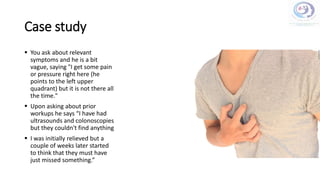
 You ask about relevant
symptoms and he is a bit
vague, saying "I get some pain
or pressure right here (he
points to the left upper
quadrant) but it is not there all
the time."
 Upon asking about prior
workups he says “I have had
ultrasounds and colonoscopies
but they couldn't find anything
 I was initially relieved but a
couple of weeks later started
to think that they must have
just missed something.”
Case study
 When you ask about the
patient's goals for today’s visit
he is emphatic.
 "I think what I really need is
another colonoscopy and
abdominal CT scan."
 Since his past examination
were unrevealing, you will like
suggest a less invasive
approach, he brings up error
rates of the other evaluations
& shows literature endorsing
how abdominal CT is the
criterion standard
Case study
 He is anxious at
baseline and
increasingly irritable
when you propose
less invasive
evaluation
 He ends the
encounter by stating
that he will “find
another doctor who
sees my point and
will get me what I
need.”
No offence, If you are not getting my point, I will like to seek
an yet another opinion
Background
 Hypochondriasis, which is now
known as illness anxiety
disorder, are among the most
difficult & most complex psychiatric
disorders to treat in the general
medical setting
 On the basis of many new
developments, the DMS 5 has
revised diagnostic criteria to
facilitate clinical care & research
 While illness anxiety disorder is
included in the category of
"somatoform disorder”, it continues
to have much overlap with
obsessive-compulsive disorder
Background
 As with all psychiatric disorders,
illness anxiety disorder demands
creative, rich bio-psycho-social
treatment planning by a team that
includes primary care physicians, sub-
specialists & mental health
professionals
 In this class, our aim is to describe
illness anxiety disorder, its diagnosis,
and an overview of treatment
approaches
 Finally, we will reviews new
developments in psycho-
pharmacologic and psycho-
therapeutic treatments
Epidemiology – Frequency
 Based on the previously defined
"hypochondriasis," the DSM
estimates that the community 1-2
year prevalence is 1.3-10%, while
the 6-month to 1-year prevalence in
medical outpatients is 3-8%
 Some degree of preoccupation with
disease is apparently common,
because 10-20% of people who are
healthy and 45% of people without a
major psychiatric disorder have
intermittent unfounded worries
about illness
Epidemiology – International/cultural effects
 Rates of illness anxiety disorders are
heavily influenced by the diagnostic
criteria involved & how studies are
conducted
 Researchers have also worked to define
how culture & ethnicity interact to
determine "idioms" of distress
Epidemiology – Mortality/Morbidity
 Illness anxiety disorder is usually episodic, with symptoms that last from months to years and
equally long quiescent periods
 One third of patients with illness anxiety disorder are believed to eventually improve significantly
 A good prognosis appears to be associated with
1. High socioeconomic status
2. Treatment-responsive anxiety or depression
3. Absence of a personality disorder
4. Absence of a related non-psychiatric medical condition
 Most children are believed to recover by adolescence or early adulthood, but empiric studies
have not been carried out
Epidemiology – Mortality/Morbidity
 Patients with illness anxiety disorder appear to
have no differences in age or gender than patients
without this disorder
 There have been several studies that have found
patients with illness anxiety disorder to have
decreased educational and income levels
 These individuals use medical care at high rates,
making frequent visits to the emergency
department, the doctor, and other health care
providers and undergoing frequent physical
examinations, laboratory testing, and other
costly, invasive, and potentially dangerous
procedures
Doctor, I sustained head injury
at the age of three, now I am 30
but I think my heaviness of
head for last four year is due to
that past event of head trauma.
Also I think you should prescribe
CT scan brain as it is being
conducted free of cost here at
AIIMS Patna
Epidemiology – Mortality/Morbidity
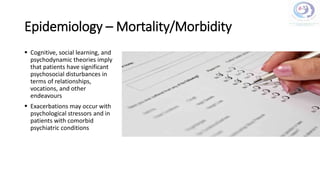
 Cognitive, social learning, and
psychodynamic theories imply
that patients have significant
psychosocial disturbances in
terms of relationships,
vocations, and other
endeavours
 Exacerbations may occur with
psychological stressors and in
patients with comorbid
psychiatric conditions
Epidemiology – Mortality/Morbidity
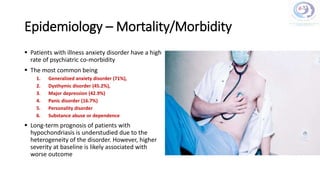
 Patients with illness anxiety disorder have a high
rate of psychiatric co-morbidity
 The most common being
1. Generalized anxiety disorder (71%),
2. Dysthymic disorder (45.2%),
3. Major depression (42.9%)
4. Panic disorder (16.7%)
5. Personality disorder
6. Substance abuse or dependence
 Long-term prognosis of patients with
hypochondriasis is understudied due to the
heterogeneity of the disorder. However, higher
severity at baseline is likely associated with
worse outcome
Epidemiology
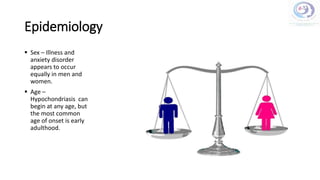
 Sex – Illness and
anxiety disorder
appears to occur
equally in men and
women.
 Age –
Hypochondriasis can
begin at any age, but
the most common
age of onset is early
adulthood.
Clinical Presentation – DSM V – IAD
 The DSM-5 criteria for illness anxiety disorder are as follows:
1. The individual is preoccupied with having or acquiring a serious illness.
2. Somatic symptoms are not present or, if present, are only mild in intensity. If another medical
condition is present or there is a high risk for developing a medical condition (eg, strong family
history is present), the preoccupation is clearly excessive or disproportionate.
3. The individual has a high level of anxiety about health, and is easily alarmed about personal
health status.
4. The individual performs excessive health-related behaviours or exhibits maladaptive
avoidance.
5. The individual has been preoccupied with illness for at least 6 months.
6. The individual's preoccupation is not better explained by another mental disorder
Clinical Presentation – MSE– IAD
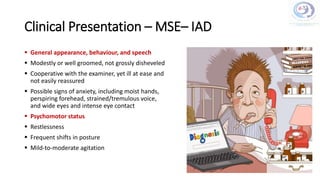
 General appearance, behaviour, and speech
 Modestly or well groomed, not grossly disheveled
 Cooperative with the examiner, yet ill at ease and
not easily reassured
 Possible signs of anxiety, including moist hands,
perspiring forehead, strained/tremulous voice,
and wide eyes and intense eye contact
 Psychomotor status
 Restlessness
 Frequent shifts in posture
 Mild-to-moderate agitation
Clinical Presentation – MSE– IAD
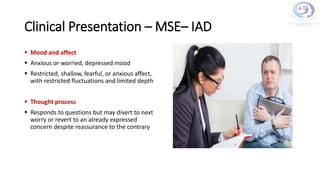
 Mood and affect
 Anxious or worried, depressed mood
 Restricted, shallow, fearful, or anxious affect,
with restricted fluctuations and limited depth
 Thought process
 Responds to questions but may divert to next
worry or revert to an already expressed
concern despite reassurance to the contrary
Clinical Presentation – MSE– IAD
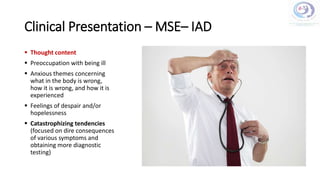
 Thought content
 Preoccupation with being ill
 Anxious themes concerning
what in the body is wrong,
how it is wrong, and how it is
experienced
 Feelings of despair and/or
hopelessness
 Catastrophizing tendencies
(focused on dire consequences
of various symptoms and
obtaining more diagnostic
testing)
Clinical Presentation – MSE– IAD
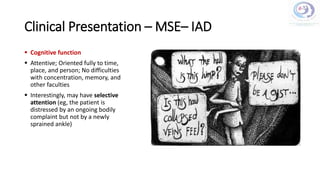
 Cognitive function
 Attentive; Oriented fully to time,
place, and person; No difficulties
with concentration, memory, and
other faculties
 Interestingly, may have selective
attention (eg, the patient is
distressed by an ongoing bodily
complaint but not by a newly
sprained ankle)
Clinical Presentation – MSE– IAD
 Insight
 Able to recognize bodily sensations
 Lack full understanding of underlying
psychological concerns
 They tends to see the "trees" rather than the
"forest"
 Judgment
 Capable of social greetings and other
behaviors
 Persistence in discussing and evaluating
continuing preoccupations (due to limited
insight)
Cause – IAD
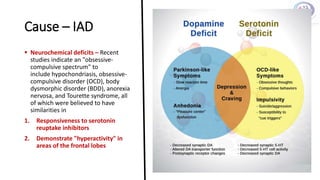
 Neurochemical deficits – Recent
studies indicate an "obsessive-
compulsive spectrum" to
include hypochondriasis, obsessive-
compulsive disorder (OCD), body
dysmorphic disorder (BDD), anorexia
nervosa, and Tourette syndrome, all
of which were believed to have
similarities in
1. Responsiveness to serotonin
reuptake inhibitors
2. Demonstrate "hyperactivity" in
areas of the frontal lobes
NEUROTROPHIN 3
NT - 3
Cause – IAD
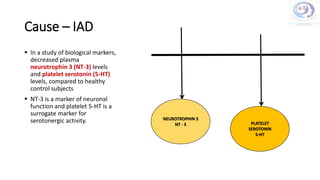
 In a study of biological markers,
decreased plasma
neurotrophin 3 (NT-3) levels
and platelet serotonin (5-HT)
levels, compared to healthy
control subjects
 NT-3 is a marker of neuronal
function and platelet 5-HT is a
surrogate marker for
serotonergic activity. PLATELET
SEROTONIN
5-HT
Cause – IAD
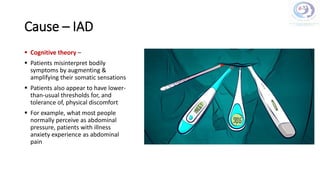
 Cognitive theory –
 Patients misinterpret bodily
symptoms by augmenting &
amplifying their somatic sensations
 Patients also appear to have lower-
than-usual thresholds for, and
tolerance of, physical discomfort
 For example, what most people
normally perceive as abdominal
pressure, patients with illness
anxiety experience as abdominal
pain
Cause – IAD
 Social learning theory –
 Proposes illness anxiety disorder
as a request for admission to the
sick role made by a person facing
seemingly insurmountable and
insolvable problems
 This role may allow them to
avoid noxious obligations,
postpone unwelcome
challenges, and be relieved from
duties and obligations
Cause – IAD
 Psychodynamic theory –
 Implies that aggressive and
hostile wishes toward others are
transferred via repression and
displacement into physical
complaints
 The somatic symptoms serve to
"undo" guilt felt about the anger
and serve as a punishment for
being "bad."
Differential Diagnosis – IAD
1. Physical & neurological illness
2. Anxiety Disorders
3. Body Dysmorphic Disorder
4. Conversion Disorders
5. Delusional Disorder
6. Depression
7. Personality Disorders
8. Schizophrenia
9. Somatic Symptom Disorders
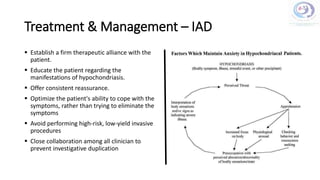
Treatment & Management – IAD
 Establish a firm therapeutic alliance with the
patient.
 Educate the patient regarding the
manifestations of hypochondriasis.
 Offer consistent reassurance.
 Optimize the patient's ability to cope with the
symptoms, rather than trying to eliminate the
symptoms
 Avoid performing high-risk, low-yield invasive
procedures
 Close collaboration among all clinician to
prevent investigative duplication
Treatment & Management – IAD
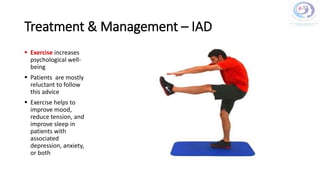
 Exercise increases
psychological well-
being
 Patients are mostly
reluctant to follow
this advice
 Exercise helps to
improve mood,
reduce tension, and
improve sleep in
patients with
associated
depression, anxiety,
or both
Treatment & Management – IAD
 RCT indicates that
cognitive-behavioral
therapy (CBT) is
efficacious in the
treatment of
hypochondriasis
 In clinical settings, both
the availability of CBT
and treatment
adherence of patients
with hypochondriasis to
psychotherapy in general
are major barriers to
successful outcomes
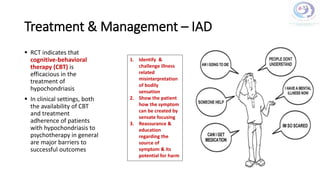
1. Identify &
challenge illness
related
misinterpretation
of bodily
sensation
2. Show the patient
how the symptom
can be created by
sensate focusing
3. Reassurance &
education
regarding the
source of
symptom & its
potential for harm
Treatment & Management – IAD
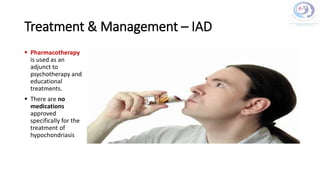
 Pharmacotherapy
is used as an
adjunct to
psychotherapy and
educational
treatments.
 There are no
medications
approved
specifically for the
treatment of
hypochondriasis
Treatment & Management – IAD
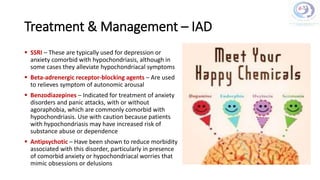
 SSRI – These are typically used for depression or
anxiety comorbid with hypochondriasis, although in
some cases they alleviate hypochondriacal symptoms
 Beta-adrenergic receptor-blocking agents – Are used
to relieves symptom of autonomic arousal
 Benzodiazepines – Indicated for treatment of anxiety
disorders and panic attacks, with or without
agoraphobia, which are commonly comorbid with
hypochondriasis. Use with caution because patients
with hypochondriasis may have increased risk of
substance abuse or dependence
 Antipsychotic – Have been shown to reduce morbidity
associated with this disorder, particularly in presence
of comorbid anxiety or hypochondriacal worries that
mimic obsessions or delusions
Illness anxiety disorder pps

Illness anxiety disorder pps

  • 1.
    Illness Anxiety Disorder D r Sa t y a j e e t S i n g h , M D N e u r o p sy c h i a t r i st , A i i m s Pa t n a
  • 2.
    Case study  A45-year-old white male engineer presents to a primary care clinic armed with multiple internet searches on the topic of cancer  He states that he “just knows” he has a GI cancer, "probably the colon or maybe the pancreas."  When asked how long this concern has bothered him he says "for years I have been concerned that I have cancer."
  • 3.
    Case study  Youask about relevant symptoms and he is a bit vague, saying "I get some pain or pressure right here (he points to the left upper quadrant) but it is not there all the time."  Upon asking about prior workups he says “I have had ultrasounds and colonoscopies but they couldn't find anything  I was initially relieved but a couple of weeks later started to think that they must have just missed something.”
  • 4.
    Case study  Whenyou ask about the patient's goals for today’s visit he is emphatic.  "I think what I really need is another colonoscopy and abdominal CT scan."  Since his past examination were unrevealing, you will like suggest a less invasive approach, he brings up error rates of the other evaluations & shows literature endorsing how abdominal CT is the criterion standard
  • 5.
    Case study  Heis anxious at baseline and increasingly irritable when you propose less invasive evaluation  He ends the encounter by stating that he will “find another doctor who sees my point and will get me what I need.” No offence, If you are not getting my point, I will like to seek an yet another opinion
  • 6.
    Background  Hypochondriasis, whichis now known as illness anxiety disorder, are among the most difficult & most complex psychiatric disorders to treat in the general medical setting  On the basis of many new developments, the DMS 5 has revised diagnostic criteria to facilitate clinical care & research  While illness anxiety disorder is included in the category of "somatoform disorder”, it continues to have much overlap with obsessive-compulsive disorder
  • 7.
    Background  As withall psychiatric disorders, illness anxiety disorder demands creative, rich bio-psycho-social treatment planning by a team that includes primary care physicians, sub- specialists & mental health professionals  In this class, our aim is to describe illness anxiety disorder, its diagnosis, and an overview of treatment approaches  Finally, we will reviews new developments in psycho- pharmacologic and psycho- therapeutic treatments
  • 8.
    Epidemiology – Frequency Based on the previously defined "hypochondriasis," the DSM estimates that the community 1-2 year prevalence is 1.3-10%, while the 6-month to 1-year prevalence in medical outpatients is 3-8%  Some degree of preoccupation with disease is apparently common, because 10-20% of people who are healthy and 45% of people without a major psychiatric disorder have intermittent unfounded worries about illness
  • 9.
    Epidemiology – International/culturaleffects  Rates of illness anxiety disorders are heavily influenced by the diagnostic criteria involved & how studies are conducted  Researchers have also worked to define how culture & ethnicity interact to determine "idioms" of distress
  • 10.
    Epidemiology – Mortality/Morbidity Illness anxiety disorder is usually episodic, with symptoms that last from months to years and equally long quiescent periods  One third of patients with illness anxiety disorder are believed to eventually improve significantly  A good prognosis appears to be associated with 1. High socioeconomic status 2. Treatment-responsive anxiety or depression 3. Absence of a personality disorder 4. Absence of a related non-psychiatric medical condition  Most children are believed to recover by adolescence or early adulthood, but empiric studies have not been carried out
  • 11.
    Epidemiology – Mortality/Morbidity Patients with illness anxiety disorder appear to have no differences in age or gender than patients without this disorder  There have been several studies that have found patients with illness anxiety disorder to have decreased educational and income levels  These individuals use medical care at high rates, making frequent visits to the emergency department, the doctor, and other health care providers and undergoing frequent physical examinations, laboratory testing, and other costly, invasive, and potentially dangerous procedures Doctor, I sustained head injury at the age of three, now I am 30 but I think my heaviness of head for last four year is due to that past event of head trauma. Also I think you should prescribe CT scan brain as it is being conducted free of cost here at AIIMS Patna
  • 12.
    Epidemiology – Mortality/Morbidity Cognitive, social learning, and psychodynamic theories imply that patients have significant psychosocial disturbances in terms of relationships, vocations, and other endeavours  Exacerbations may occur with psychological stressors and in patients with comorbid psychiatric conditions
  • 13.
    Epidemiology – Mortality/Morbidity Patients with illness anxiety disorder have a high rate of psychiatric co-morbidity  The most common being 1. Generalized anxiety disorder (71%), 2. Dysthymic disorder (45.2%), 3. Major depression (42.9%) 4. Panic disorder (16.7%) 5. Personality disorder 6. Substance abuse or dependence  Long-term prognosis of patients with hypochondriasis is understudied due to the heterogeneity of the disorder. However, higher severity at baseline is likely associated with worse outcome
  • 14.
    Epidemiology  Sex –Illness and anxiety disorder appears to occur equally in men and women.  Age – Hypochondriasis can begin at any age, but the most common age of onset is early adulthood.
  • 15.
    Clinical Presentation –DSM V – IAD  The DSM-5 criteria for illness anxiety disorder are as follows: 1. The individual is preoccupied with having or acquiring a serious illness. 2. Somatic symptoms are not present or, if present, are only mild in intensity. If another medical condition is present or there is a high risk for developing a medical condition (eg, strong family history is present), the preoccupation is clearly excessive or disproportionate. 3. The individual has a high level of anxiety about health, and is easily alarmed about personal health status. 4. The individual performs excessive health-related behaviours or exhibits maladaptive avoidance. 5. The individual has been preoccupied with illness for at least 6 months. 6. The individual's preoccupation is not better explained by another mental disorder
  • 16.
    Clinical Presentation –MSE– IAD  General appearance, behaviour, and speech  Modestly or well groomed, not grossly disheveled  Cooperative with the examiner, yet ill at ease and not easily reassured  Possible signs of anxiety, including moist hands, perspiring forehead, strained/tremulous voice, and wide eyes and intense eye contact  Psychomotor status  Restlessness  Frequent shifts in posture  Mild-to-moderate agitation
  • 17.
    Clinical Presentation –MSE– IAD  Mood and affect  Anxious or worried, depressed mood  Restricted, shallow, fearful, or anxious affect, with restricted fluctuations and limited depth  Thought process  Responds to questions but may divert to next worry or revert to an already expressed concern despite reassurance to the contrary
  • 18.
    Clinical Presentation –MSE– IAD  Thought content  Preoccupation with being ill  Anxious themes concerning what in the body is wrong, how it is wrong, and how it is experienced  Feelings of despair and/or hopelessness  Catastrophizing tendencies (focused on dire consequences of various symptoms and obtaining more diagnostic testing)
  • 19.
    Clinical Presentation –MSE– IAD  Cognitive function  Attentive; Oriented fully to time, place, and person; No difficulties with concentration, memory, and other faculties  Interestingly, may have selective attention (eg, the patient is distressed by an ongoing bodily complaint but not by a newly sprained ankle)
  • 20.
    Clinical Presentation –MSE– IAD  Insight  Able to recognize bodily sensations  Lack full understanding of underlying psychological concerns  They tends to see the "trees" rather than the "forest"  Judgment  Capable of social greetings and other behaviors  Persistence in discussing and evaluating continuing preoccupations (due to limited insight)
  • 21.
    Cause – IAD Neurochemical deficits – Recent studies indicate an "obsessive- compulsive spectrum" to include hypochondriasis, obsessive- compulsive disorder (OCD), body dysmorphic disorder (BDD), anorexia nervosa, and Tourette syndrome, all of which were believed to have similarities in 1. Responsiveness to serotonin reuptake inhibitors 2. Demonstrate "hyperactivity" in areas of the frontal lobes
  • 22.
    NEUROTROPHIN 3 NT -3 Cause – IAD  In a study of biological markers, decreased plasma neurotrophin 3 (NT-3) levels and platelet serotonin (5-HT) levels, compared to healthy control subjects  NT-3 is a marker of neuronal function and platelet 5-HT is a surrogate marker for serotonergic activity. PLATELET SEROTONIN 5-HT
  • 23.
    Cause – IAD Cognitive theory –  Patients misinterpret bodily symptoms by augmenting & amplifying their somatic sensations  Patients also appear to have lower- than-usual thresholds for, and tolerance of, physical discomfort  For example, what most people normally perceive as abdominal pressure, patients with illness anxiety experience as abdominal pain
  • 24.
    Cause – IAD Social learning theory –  Proposes illness anxiety disorder as a request for admission to the sick role made by a person facing seemingly insurmountable and insolvable problems  This role may allow them to avoid noxious obligations, postpone unwelcome challenges, and be relieved from duties and obligations
  • 25.
    Cause – IAD Psychodynamic theory –  Implies that aggressive and hostile wishes toward others are transferred via repression and displacement into physical complaints  The somatic symptoms serve to "undo" guilt felt about the anger and serve as a punishment for being "bad."
  • 26.
    Differential Diagnosis –IAD 1. Physical & neurological illness 2. Anxiety Disorders 3. Body Dysmorphic Disorder 4. Conversion Disorders 5. Delusional Disorder 6. Depression 7. Personality Disorders 8. Schizophrenia 9. Somatic Symptom Disorders
  • 27.
    Treatment & Management– IAD  Establish a firm therapeutic alliance with the patient.  Educate the patient regarding the manifestations of hypochondriasis.  Offer consistent reassurance.  Optimize the patient's ability to cope with the symptoms, rather than trying to eliminate the symptoms  Avoid performing high-risk, low-yield invasive procedures  Close collaboration among all clinician to prevent investigative duplication
  • 28.
    Treatment & Management– IAD  Exercise increases psychological well- being  Patients are mostly reluctant to follow this advice  Exercise helps to improve mood, reduce tension, and improve sleep in patients with associated depression, anxiety, or both
  • 29.
    Treatment & Management– IAD  RCT indicates that cognitive-behavioral therapy (CBT) is efficacious in the treatment of hypochondriasis  In clinical settings, both the availability of CBT and treatment adherence of patients with hypochondriasis to psychotherapy in general are major barriers to successful outcomes 1. Identify & challenge illness related misinterpretation of bodily sensation 2. Show the patient how the symptom can be created by sensate focusing 3. Reassurance & education regarding the source of symptom & its potential for harm
  • 30.
    Treatment & Management– IAD  Pharmacotherapy is used as an adjunct to psychotherapy and educational treatments.  There are no medications approved specifically for the treatment of hypochondriasis
  • 31.
    Treatment & Management– IAD  SSRI – These are typically used for depression or anxiety comorbid with hypochondriasis, although in some cases they alleviate hypochondriacal symptoms  Beta-adrenergic receptor-blocking agents – Are used to relieves symptom of autonomic arousal  Benzodiazepines – Indicated for treatment of anxiety disorders and panic attacks, with or without agoraphobia, which are commonly comorbid with hypochondriasis. Use with caution because patients with hypochondriasis may have increased risk of substance abuse or dependence  Antipsychotic – Have been shown to reduce morbidity associated with this disorder, particularly in presence of comorbid anxiety or hypochondriacal worries that mimic obsessions or delusions