FACIAL PAIN AND
HEADACHE
INTRODUCTION
 Patients with facial pain are
frequently referred to ENT
 Most have initial diagnosis of sinusitis
 In reality few have sinogenic pain
SINONASAL INNERVATION
 Sinonasal mucosa innervated by
ophthalmic and maxillary division of
trigeminal nerve
 Minor contribution by greater
superficial petrosal branch of facial
nerve
 Ostiomeatal complex > turbinates >
septum > sinus mucosa (order of
sensitivity to pain)
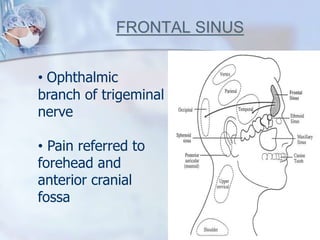
FRONTAL SINUS
• Ophthalmic
branch of trigeminal
nerve
• Pain referred to
forehead and
anterior cranial
fossa
ANTERIOR ETHMOIDAL SINUS
 Innervated by
ophtalmic division of
trigeminal via anterior
ethmoidal nerve (an
offshoot of nasociliary
nerve)
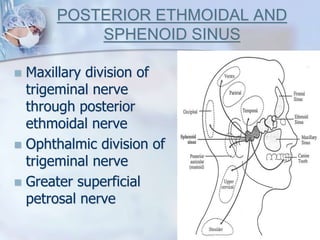
POSTERIOR ETHMOIDAL AND
SPHENOID SINUS
 Maxillary division of
trigeminal nerve
through posterior
ethmoidal nerve
 Ophthalmic division of
trigeminal nerve
 Greater superficial
petrosal nerve
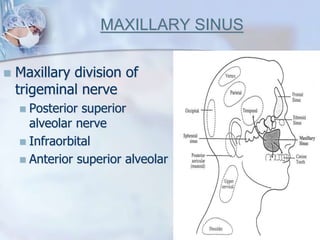
MAXILLARY SINUS
 Maxillary division of
trigeminal nerve
 Posterior superior
alveolar nerve
 Infraorbital
 Anterior superior alveolar
Pain afferents
 Majority of painful stimuli from face
are transmitted via afferents in the
trigeminal nerve
 Rest through 7, 8,9 and 10th nerves
 Facial pain from deep structures dull
due to unmyelinated afferent nerves
 From superficial structures, it is sharp
due to myelinated fibers
CLASSIFICATION
 Rhinological pain
 Sinusitis
 Post trauma or surgery
 Dental pain
 Painful teeth
 Phantom tooth pain
 TM joint dysfunction
 Myofascial pain
CLASSIFICATION
 Vascular pain
 Migraine
 Cluster headache
 Paroxysmal hemicrania
 Temporal arteritis
 Sluder’s neuralgia
 Neuralgias
 Trigeminal neuralgia
 Glossopharyngeal neuralgia
 Postherpetic neuralgia
CLASSIFICATION
 Misc
 Pain caused by tumours
 Tension type headache
 Midfacial segmental pain
 Atypical facial pain
HISTORY
 Where is the pain and does it radiate?
 Is the pain continuous or
intermittent?
 Character of the pain?
 Precipitating factors?
 Relieving factors?
 Effect on daily life?
 where is the pain and does it
radiate anywhere?
 Asking the patient to point to where the pain is most Sever
is usefuL Often this will differ from information contained in
the referral letter. So-called'sinus' pain may be headache or
pain from the cervical spine or temporomandibular joint
(TMJ). Bilateral facial pain is commonly midfacial segment
pain. Sinogenic pain may be unilateral or bilateral,whereas
migrainous pain and TMJ dysfunction tend to be unilateral.
The manner in which a patient outlines their pain,and the
gestures used, can inform the examiner about the emotional
significance of the symptom.
 • Is the pain continuous or
intermittent?
Pain described as continuous or present on a daily basis is
unlikely to be sinogenic or migrainous in origin, and more likely
to represent midfacial segment pain or atypical facial pain.
Migraine often happens with increased frequency
premenstrually, and cluster headaches do indeed cluster, with
patients often having weeks or months of remission. Pain that
is constant, predominantly unilateral, and particularly if it is
progressive, can be due to a tumour and this possibility must be
considere
 •What precipitates or is
associated with the pain?
Sinogenic pain is associated with the rhinological symptoms
of nasal obstruction and infected catarrh,and tends to be worse
with upper respiratory tract infections. Vascular pain may have
a preceding aura and is often associated with nausea. Trigger
factors,such as certain foods, withdrawal of stress and sleep
disruption, are well recognized. Cluster headaches are
frequently triggered by alcohol and wake the patient.
The pain of TMJ dysfunction is exacerbated by chewing and
trigeminal neuralgia provoked by trigger points.
 •What relieves the pain?
Patients with facial pain due to sinusitis generally respond to
medical treatment such as antibiotics. Although midfacial
segment pain initially responds to simple analgesics, patients
with this condition often report that these drugs are
unhelpful by the time they are referred for a specialist
opinion. Patients with migraine will retreat to a darkened room
and lie down to help cope with t~eir symptoms.
•
 What effect does the pain have
on daily life?
Patients with atypical facial pain often describe their
pain in dramatic detailas severe and unrelenting despite
sleeping well and living a relatively normal life. In contrast,
some patients with this condition are unable to work and blame
the pain for a breakdown in a close relationship. Severe
crippling pain that wakes the patient, often a man,is typical of
cluster headache.
PAST MEDICAL HISTORY
 Head injuries, infections, surgeries?
 Psychiatric illness?
 Alcohol, tobacco use?
 Medications?
 Oral contraceptives
 Antihypertensive
 Herbal medications
EXAMINATION
 General physical examination
 Complete head and neck examination
 TMJ & muscles of mastication
 Trigger points
 Neurological examination
SINUSITIS
 In acute sinusitis there is nasal
obstruction, rhinorrhoea, facial
pain in association with URTI
 Chronic sinusitis often painless
except during acute exacerbations
 Pain often unilateral and dull and
increases in intensity on bending
forward
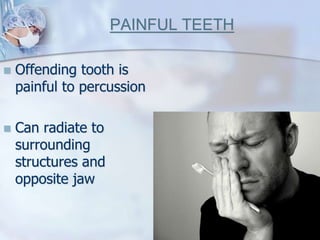
PAINFUL TEETH
 Offending tooth is
painful to percussion
 Can radiate to
surrounding
structures and
opposite jaw
TMJ DYSFUNCTION
 May be localized to the joint or
extend over the periauricular area
extending to the temporoparietal and
cervical regions
 May present with deep otalgia
 Chewing exacerbates pain
 TMJ and surrounding muscles may be
tender on direct palpation
MYOFASCIAL PAIN
 Five times more common in post
menopausal women and strong
association with stress
 Poorly defined aching in the neck, jaw
and ear
 Tender points in the
sternocleidomastoid and trapezius
muscles
MIGRAINE
 Aura precedes onset of headache
 Visual disturbances
 Unusual tastes and aromas
 Throbbing unilateral pain
 Can last upto 72 hours
 Trigger factors
 Various foods
 Sleep disturbance
 Withdrawal of stress
 (Saturday morning headaches)
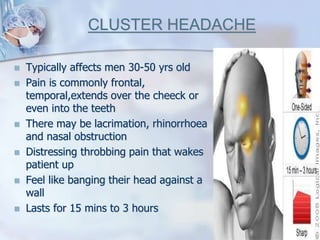
CLUSTER HEADACHE
 Typically affects men 30-50 yrs old
 Pain is commonly frontal,
temporal,extends over the cheeck or
even into the teeth
 There may be lacrimation, rhinorrhoea
and nasal obstruction
 Distressing throbbing pain that wakes
patient up
 Feel like banging their head against a
wall
 Lasts for 15 mins to 3 hours
SLUDER’S NEURALGIA
 Vascular origin
 A collective group of neuralgic,
motor,sensory and gustatory
symptoms and signs including facial
pain
 Caused by inflammation of
sphenopalatine ganglion and mucosal
contact with the lateral nasal wall
causing facial pain
Trigeminal neuralgia
 Paroxysms of severe lancinating pain
induced by a specific trigger point
 In more than one third pain arises in
both the maxillary and mandibular
divisions
 One fifth is confined to the maxillary
division
 In small number ophthalmic division
affected
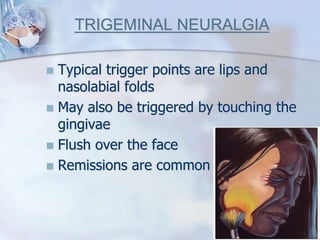
TRIGEMINAL NEURALGIA
 Typical trigger points are lips and
nasolabial folds
 May also be triggered by touching the
gingivae
 Flush over the face
 Remissions are common
TENSION TYPE HEADACHE
 Feeling of thightness, pressure or
constriction which varies in intensity,
frequency and duration
 May be at vertex,eyes or temple and
often an occipital component
 Usually present on waking
 Does not worsen with routine physical
activity
 Rarely interferes with patient getting
to sleep
MIDFACIAL SEGMENT PAIN
 Similar to tension type headache
except that symmetrical facial pain
involves the midface and retro-orbital
region
 Hyperaesthesia of the skin and soft
tissues in the area affected
 Pain lasts for hours on daily basis
 Pain reduces in stress free
environment (weekends)
ATYPICAL FACIAL PAIN
 Diagnosis of exclusion
 History often vague and inconsistent
 Pain moves from one part of face to
other between different consultations
 Feeling of “Mucus moving” in the
sinuses
 Patients have completely fixed ideas
about their condition
 History of depression and significant
psychological disturbance
SUMMARY
 History taking key to accurate diagnosis
 Sinusitis is a rare cause of chronic facial
pain and most patients with facial pain do
not warrant surgery
 Sinogenic pain is intermittent and
associated with rhinological symptoms
 Sinus mucosal thickening on a CT scan
does not indicate that pain is sinogenic
SUMMARY
 Vascular pain such as migraine and
cluster headaches can cause
rhinorrhoea and nasal congestion
 Many patients with chronic facial pain
benefit from the appropriate
‘neurological’ medication
THANK YOU

Facial pain

  • 1.
  • 2.
    INTRODUCTION  Patients withfacial pain are frequently referred to ENT  Most have initial diagnosis of sinusitis  In reality few have sinogenic pain
  • 3.
    SINONASAL INNERVATION  Sinonasalmucosa innervated by ophthalmic and maxillary division of trigeminal nerve  Minor contribution by greater superficial petrosal branch of facial nerve  Ostiomeatal complex > turbinates > septum > sinus mucosa (order of sensitivity to pain)
  • 4.
    FRONTAL SINUS • Ophthalmic branchof trigeminal nerve • Pain referred to forehead and anterior cranial fossa
  • 5.
    ANTERIOR ETHMOIDAL SINUS Innervated by ophtalmic division of trigeminal via anterior ethmoidal nerve (an offshoot of nasociliary nerve)
  • 6.
    POSTERIOR ETHMOIDAL AND SPHENOIDSINUS  Maxillary division of trigeminal nerve through posterior ethmoidal nerve  Ophthalmic division of trigeminal nerve  Greater superficial petrosal nerve
  • 7.
    MAXILLARY SINUS  Maxillarydivision of trigeminal nerve  Posterior superior alveolar nerve  Infraorbital  Anterior superior alveolar
  • 8.
    Pain afferents  Majorityof painful stimuli from face are transmitted via afferents in the trigeminal nerve  Rest through 7, 8,9 and 10th nerves  Facial pain from deep structures dull due to unmyelinated afferent nerves  From superficial structures, it is sharp due to myelinated fibers
  • 9.
    CLASSIFICATION  Rhinological pain Sinusitis  Post trauma or surgery  Dental pain  Painful teeth  Phantom tooth pain  TM joint dysfunction  Myofascial pain
  • 10.
    CLASSIFICATION  Vascular pain Migraine  Cluster headache  Paroxysmal hemicrania  Temporal arteritis  Sluder’s neuralgia  Neuralgias  Trigeminal neuralgia  Glossopharyngeal neuralgia  Postherpetic neuralgia
  • 11.
    CLASSIFICATION  Misc  Paincaused by tumours  Tension type headache  Midfacial segmental pain  Atypical facial pain
  • 12.
    HISTORY  Where isthe pain and does it radiate?  Is the pain continuous or intermittent?  Character of the pain?  Precipitating factors?  Relieving factors?  Effect on daily life?
  • 13.
     where isthe pain and does it radiate anywhere?  Asking the patient to point to where the pain is most Sever is usefuL Often this will differ from information contained in the referral letter. So-called'sinus' pain may be headache or pain from the cervical spine or temporomandibular joint (TMJ). Bilateral facial pain is commonly midfacial segment pain. Sinogenic pain may be unilateral or bilateral,whereas migrainous pain and TMJ dysfunction tend to be unilateral. The manner in which a patient outlines their pain,and the gestures used, can inform the examiner about the emotional significance of the symptom.
  • 14.
     • Isthe pain continuous or intermittent? Pain described as continuous or present on a daily basis is unlikely to be sinogenic or migrainous in origin, and more likely to represent midfacial segment pain or atypical facial pain. Migraine often happens with increased frequency premenstrually, and cluster headaches do indeed cluster, with patients often having weeks or months of remission. Pain that is constant, predominantly unilateral, and particularly if it is progressive, can be due to a tumour and this possibility must be considere
  • 15.
     •What precipitatesor is associated with the pain? Sinogenic pain is associated with the rhinological symptoms of nasal obstruction and infected catarrh,and tends to be worse with upper respiratory tract infections. Vascular pain may have a preceding aura and is often associated with nausea. Trigger factors,such as certain foods, withdrawal of stress and sleep disruption, are well recognized. Cluster headaches are frequently triggered by alcohol and wake the patient. The pain of TMJ dysfunction is exacerbated by chewing and trigeminal neuralgia provoked by trigger points.
  • 16.
     •What relievesthe pain? Patients with facial pain due to sinusitis generally respond to medical treatment such as antibiotics. Although midfacial segment pain initially responds to simple analgesics, patients with this condition often report that these drugs are unhelpful by the time they are referred for a specialist opinion. Patients with migraine will retreat to a darkened room and lie down to help cope with t~eir symptoms. •
  • 17.
     What effectdoes the pain have on daily life? Patients with atypical facial pain often describe their pain in dramatic detailas severe and unrelenting despite sleeping well and living a relatively normal life. In contrast, some patients with this condition are unable to work and blame the pain for a breakdown in a close relationship. Severe crippling pain that wakes the patient, often a man,is typical of cluster headache.
  • 18.
    PAST MEDICAL HISTORY Head injuries, infections, surgeries?  Psychiatric illness?  Alcohol, tobacco use?  Medications?  Oral contraceptives  Antihypertensive  Herbal medications
  • 19.
    EXAMINATION  General physicalexamination  Complete head and neck examination  TMJ & muscles of mastication  Trigger points  Neurological examination
  • 20.
    SINUSITIS  In acutesinusitis there is nasal obstruction, rhinorrhoea, facial pain in association with URTI  Chronic sinusitis often painless except during acute exacerbations  Pain often unilateral and dull and increases in intensity on bending forward
  • 21.
    PAINFUL TEETH  Offendingtooth is painful to percussion  Can radiate to surrounding structures and opposite jaw
  • 22.
    TMJ DYSFUNCTION  Maybe localized to the joint or extend over the periauricular area extending to the temporoparietal and cervical regions  May present with deep otalgia  Chewing exacerbates pain  TMJ and surrounding muscles may be tender on direct palpation
  • 23.
    MYOFASCIAL PAIN  Fivetimes more common in post menopausal women and strong association with stress  Poorly defined aching in the neck, jaw and ear  Tender points in the sternocleidomastoid and trapezius muscles
  • 24.
    MIGRAINE  Aura precedesonset of headache  Visual disturbances  Unusual tastes and aromas  Throbbing unilateral pain  Can last upto 72 hours  Trigger factors  Various foods  Sleep disturbance  Withdrawal of stress  (Saturday morning headaches)
  • 25.
    CLUSTER HEADACHE  Typicallyaffects men 30-50 yrs old  Pain is commonly frontal, temporal,extends over the cheeck or even into the teeth  There may be lacrimation, rhinorrhoea and nasal obstruction  Distressing throbbing pain that wakes patient up  Feel like banging their head against a wall  Lasts for 15 mins to 3 hours
  • 26.
    SLUDER’S NEURALGIA  Vascularorigin  A collective group of neuralgic, motor,sensory and gustatory symptoms and signs including facial pain  Caused by inflammation of sphenopalatine ganglion and mucosal contact with the lateral nasal wall causing facial pain
  • 27.
    Trigeminal neuralgia  Paroxysmsof severe lancinating pain induced by a specific trigger point  In more than one third pain arises in both the maxillary and mandibular divisions  One fifth is confined to the maxillary division  In small number ophthalmic division affected
  • 28.
    TRIGEMINAL NEURALGIA  Typicaltrigger points are lips and nasolabial folds  May also be triggered by touching the gingivae  Flush over the face  Remissions are common
  • 29.
    TENSION TYPE HEADACHE Feeling of thightness, pressure or constriction which varies in intensity, frequency and duration  May be at vertex,eyes or temple and often an occipital component  Usually present on waking  Does not worsen with routine physical activity  Rarely interferes with patient getting to sleep
  • 30.
    MIDFACIAL SEGMENT PAIN Similar to tension type headache except that symmetrical facial pain involves the midface and retro-orbital region  Hyperaesthesia of the skin and soft tissues in the area affected  Pain lasts for hours on daily basis  Pain reduces in stress free environment (weekends)
  • 31.
    ATYPICAL FACIAL PAIN Diagnosis of exclusion  History often vague and inconsistent  Pain moves from one part of face to other between different consultations  Feeling of “Mucus moving” in the sinuses  Patients have completely fixed ideas about their condition  History of depression and significant psychological disturbance
  • 32.
    SUMMARY  History takingkey to accurate diagnosis  Sinusitis is a rare cause of chronic facial pain and most patients with facial pain do not warrant surgery  Sinogenic pain is intermittent and associated with rhinological symptoms  Sinus mucosal thickening on a CT scan does not indicate that pain is sinogenic
  • 33.
    SUMMARY  Vascular painsuch as migraine and cluster headaches can cause rhinorrhoea and nasal congestion  Many patients with chronic facial pain benefit from the appropriate ‘neurological’ medication
  • 34.