PAIN and ANALGESIA www.freelivedoctor.com
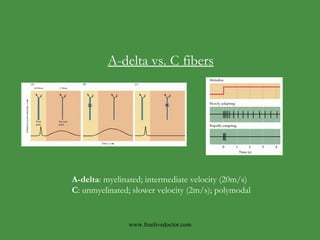
Experimental evidence that nociceptive fibers are distinct from other sensory fibers www.freelivedoctor.com
A-delta vs. C fibers A-delta : myelinated; intermediate velocity (20m/s) C : unmyelinated; slower velocity (2m/s); polymodal www.freelivedoctor.com
Anterolateral Pathway www.freelivedoctor.com
1. Lissauer’s tract 2. substantia gelatinosa 3. nucleus proprius 4. anterior commissure 5. anterolateral tract www.freelivedoctor.com
2 sensory pathways: Anterolateral and Dorsal Column www.freelivedoctor.com
3 Types of Pain: www.freelivedoctor.com
Free Nerve Ending www.freelivedoctor.com
1. Tissue damage leads to release of inflammatory/sensitizing agents: bradykinin, protons, histamine, PGE2, nerve growth factor 2. Bind receptors (TrkA, EP), leads to G-protein cascade, releasing  PKA, PKC 3. PKA phosphorylates  Na v 1.8/1.9 ; PKC phosphorylates  noxious stimuli receptors  (TRPV, ASIC) 4. Result:  increased ion influx  per depolarization;  lowered activation threshold Peripheral Sensitization www.freelivedoctor.com
www.freelivedoctor.com
Central Sensitization 1. At presynapse(s),  glutamate  release, plus  substance P , CGRP, BDNF 2. Bind to postsynaptic  AMPA, NMDA, mGluR, NK1 , trigger ion influx and depolarization, or to signal cascade that activates kinases 3. Immediate: phosphorylation of AMPA receptors increases glutamate signaling ; phosphorylation of NMDA relieves Mg 2+  block 4. Later: phosphorylation of gene regulatory proteins can  alter gene expression  (e.g. DREAM, a repressor of the endogenous opioid dynorphin, is activated) www.freelivedoctor.com
Analgesia Analgesia  = absence of pain sensation Anesthesia  = absence of sensation Analgesic possibilities suggested by anterolateral tract: inhibitors of Na +  channels (anticonvulsants, local anesthetics, etc.) inhibitors of inflammatory mediators (NSAIDS, etc.) inhibitors of NMDA receptors (NMDA antagonists) inhibitors of other targets: AMPA, Na v 1.8/1.9, NK1, TRPV, etc. www.freelivedoctor.com
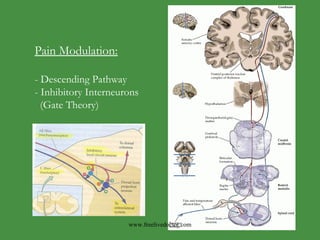
Pain Modulation: - Descending Pathway - Inhibitory Interneurons (Gate Theory) www.freelivedoctor.com
Overview of Descending Pathways : Midbrain Pons Medulla www.freelivedoctor.com
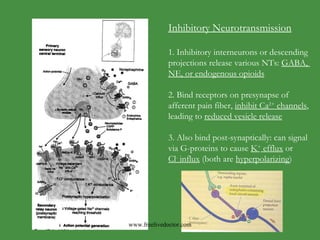
Inhibitory Neurotransmission 1. Inhibitory interneurons or descending projections release various NTs:  GABA,  NE, or endogenous opioids 2. Bind receptors on presynapse of afferent pain fiber,  inhibit Ca 2+  channels , leading to  reduced vesicle release 3. Also bind post-synaptically: can signal via G-proteins to cause  K +  efflux  or Cl -  influx  (both are  hyperpolarizing ) www.freelivedoctor.com
Opioids Clinically : morphine, codeine, oxycodone, fentanyl, methadone, (heroin) Endogenous : beta-endorphins:  mu receptors 1 & 2 ( endo genous m orphine ) enkephalins: delta receptors dynorphins: kappa receptors Receptor Location: mu: supraspinal (insula, amygdala, hypothalamus, PAG, medulla) kappa: spinal cord delta: spinal cord and supraspinal www.freelivedoctor.com
Ongoing studies to determine conditions leading to endogenous opioid release.  Emotional states seem to play a role, especially fear/stress as relates to pain. Some implicated areas: PAG, medulla, cingulate, nucleus accumbens www.freelivedoctor.com
Opioid agonists, like morphine, have broader systemic effects due to  opioid receptors in other siginificant areas : - chemoreceptor trigger zone (CTZ) in medullary area postrema vomiting center in medullary lateral reticular formation respiratory control center in medulla GI tract www.freelivedoctor.com
Summary: Analgesic Targets www.freelivedoctor.com
Sources: Purves Neuroscience textbook Pharm textbook Woolf lecture notes & articles Rainville paper cited in Purves’s ‘Pain’ chapter www.freelivedoctor.com

Pain & analgesia

  • 1.
    PAIN and ANALGESIAwww.freelivedoctor.com
  • 2.
    Experimental evidence thatnociceptive fibers are distinct from other sensory fibers www.freelivedoctor.com
  • 3.
    A-delta vs. Cfibers A-delta : myelinated; intermediate velocity (20m/s) C : unmyelinated; slower velocity (2m/s); polymodal www.freelivedoctor.com
  • 4.
  • 5.
    1. Lissauer’s tract2. substantia gelatinosa 3. nucleus proprius 4. anterior commissure 5. anterolateral tract www.freelivedoctor.com
  • 6.
    2 sensory pathways:Anterolateral and Dorsal Column www.freelivedoctor.com
  • 7.
    3 Types ofPain: www.freelivedoctor.com
  • 8.
    Free Nerve Endingwww.freelivedoctor.com
  • 9.
    1. Tissue damageleads to release of inflammatory/sensitizing agents: bradykinin, protons, histamine, PGE2, nerve growth factor 2. Bind receptors (TrkA, EP), leads to G-protein cascade, releasing PKA, PKC 3. PKA phosphorylates Na v 1.8/1.9 ; PKC phosphorylates noxious stimuli receptors (TRPV, ASIC) 4. Result: increased ion influx per depolarization; lowered activation threshold Peripheral Sensitization www.freelivedoctor.com
  • 10.
  • 11.
    Central Sensitization 1.At presynapse(s), glutamate release, plus substance P , CGRP, BDNF 2. Bind to postsynaptic AMPA, NMDA, mGluR, NK1 , trigger ion influx and depolarization, or to signal cascade that activates kinases 3. Immediate: phosphorylation of AMPA receptors increases glutamate signaling ; phosphorylation of NMDA relieves Mg 2+ block 4. Later: phosphorylation of gene regulatory proteins can alter gene expression (e.g. DREAM, a repressor of the endogenous opioid dynorphin, is activated) www.freelivedoctor.com
  • 12.
    Analgesia Analgesia = absence of pain sensation Anesthesia = absence of sensation Analgesic possibilities suggested by anterolateral tract: inhibitors of Na + channels (anticonvulsants, local anesthetics, etc.) inhibitors of inflammatory mediators (NSAIDS, etc.) inhibitors of NMDA receptors (NMDA antagonists) inhibitors of other targets: AMPA, Na v 1.8/1.9, NK1, TRPV, etc. www.freelivedoctor.com
  • 13.
    Pain Modulation: -Descending Pathway - Inhibitory Interneurons (Gate Theory) www.freelivedoctor.com
  • 14.
    Overview of DescendingPathways : Midbrain Pons Medulla www.freelivedoctor.com
  • 15.
    Inhibitory Neurotransmission 1.Inhibitory interneurons or descending projections release various NTs: GABA, NE, or endogenous opioids 2. Bind receptors on presynapse of afferent pain fiber, inhibit Ca 2+ channels , leading to reduced vesicle release 3. Also bind post-synaptically: can signal via G-proteins to cause K + efflux or Cl - influx (both are hyperpolarizing ) www.freelivedoctor.com
  • 16.
    Opioids Clinically :morphine, codeine, oxycodone, fentanyl, methadone, (heroin) Endogenous : beta-endorphins: mu receptors 1 & 2 ( endo genous m orphine ) enkephalins: delta receptors dynorphins: kappa receptors Receptor Location: mu: supraspinal (insula, amygdala, hypothalamus, PAG, medulla) kappa: spinal cord delta: spinal cord and supraspinal www.freelivedoctor.com
  • 17.
    Ongoing studies todetermine conditions leading to endogenous opioid release. Emotional states seem to play a role, especially fear/stress as relates to pain. Some implicated areas: PAG, medulla, cingulate, nucleus accumbens www.freelivedoctor.com
  • 18.
    Opioid agonists, likemorphine, have broader systemic effects due to opioid receptors in other siginificant areas : - chemoreceptor trigger zone (CTZ) in medullary area postrema vomiting center in medullary lateral reticular formation respiratory control center in medulla GI tract www.freelivedoctor.com
  • 19.
    Summary: Analgesic Targetswww.freelivedoctor.com
  • 20.
    Sources: Purves Neurosciencetextbook Pharm textbook Woolf lecture notes & articles Rainville paper cited in Purves’s ‘Pain’ chapter www.freelivedoctor.com