Page-Rank Algorithm
Brandon B, Abbie H, Billy K, Hannah S
Overview
• History and Background
• Importance and Problems
• Algorithm and Variations of it
• Our Application of PageRank
Background
• Mathematical equation designed to measure the importance of web
pages
• Developed in 1996 at Stanford University by Larry Page and Sergey
Brin, the founders of Google
• Started as a research project
Background
• PageRank is a trademark of Google
• PageRank algorithm has been patented
• Exact algorithm used today is unknown
• Algorithm is still tweaked each day to improve search
results
Background
• Algorithm is one of ~200 factors that determines the order web pages
are reported to the users
• Results are reported based on relevance to a search and overall importance
• Previously, internet search engines linked to pages that had the
highest keyword density
Problem with Previously Used Method
• Possible for websites to easily increase their rank in search results
• Did not take into account the relevancy of the results to the search,
therefore was not very useful
The Algorithm
• Measures a web page’s overall importance
• Importance of a page is based on the number of links into it from
other web pages
• Links can be viewed as votes
• Quality of the web pages linked into the page is taken into
consideration too
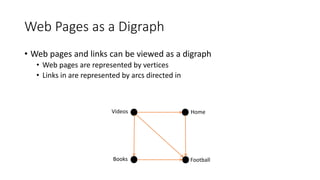
Web Pages as a Digraph
• Web pages and links can be viewed as a digraph
• Web pages are represented by vertices
• Links in are represented by arcs directed in
Videos
Books
Home
Football
Adjacency Matrix of Digraph
• After creating a digraph with the web pages and links, an adjacency
matrix is constructed
• Algorithm is then applied using this matrix and PageRank values are
determined
• On Google, pages are ranked from 1 to 10
Importance of PageRank
• PageRank is main factor used daily by Google to deliver the best
results to a Google search
• Can also be applied to other sets of data
• Many real-life applications of the algorithm are possible (i.e. ranking NFL
teams based on wins and losses)
Problems with the Algorithm
• Some websites look for a way to increase their own PageRank
• Called search engine optimization (SEO)
• Two specific examples of cheating:
• Google Bomb
• Link Farming
Google Bomb
• Occurs when a group of people conspire to increase PageRank
artificially by linking a particular word or phrase to the website
• Prevention: alter algorithm to rank pages by relevancy
Link Farming
• Linking without the thought of relevance of pages being linked
• i.e. a website with a collection of random links to other websites
• Prevention: alter calculations to filter out possible link farms
Real Life Examples of Cheating
• JC Penny (furniture)
• BMW German Car Sales Website
• Bing uses Google’s search engine ranking system to improve their
own
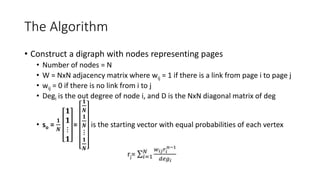
The Algorithm
• Construct a digraph with nodes representing pages
• Number of nodes = N
• W = NxN adjacency matrix where wij = 1 if there is a link from page i to page j
• wij = 0 if there is no link from i to j
• Degi is the out degree of node i, and D is the NxN diagonal matrix of deg
• so =
𝟏
𝑵
𝟏
𝟏
⋮
𝟏
=
𝟏
𝑵
𝟏
𝑵
⋮
𝟏
𝑵
is the starting vector with equal probabilities of each vertex
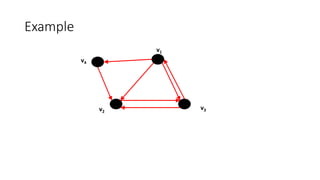
Example
v1
v2
v4
v3
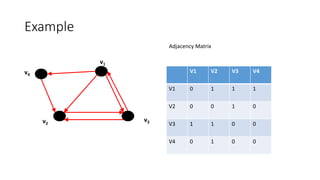
Example
Adjacency Matrix
v1
v2
v4
v3
V1 V2 V3 V4
V1 0 1 1 1
V2 0 0 1 0
V3 1 1 0 0
V4 0 1 0 0
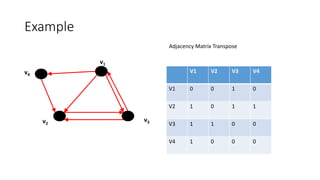
Example
Adjacency Matrix Transpose
v1
v2
v4
v3
V1 V2 V3 V4
V1 0 0 1 0
V2 1 0 1 1
V3 1 1 0 0
V4 1 0 0 0
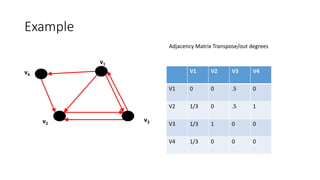
Example
Adjacency Matrix Transpose/out degrees
v1
v2
v4
v3
V1 V2 V3 V4
V1 0 0 .5 0
V2 1/3 0 .5 1
V3 1/3 1 0 0
V4 1/3 0 0 0
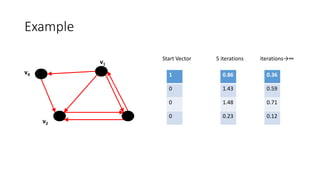
Example
Start Vector
1
0
0
0
5 iterations
0.86
1.43
1.48
0.23
v1
v2
v4
iterations→∞
0.36
0.59
0.71
0.12
PageRank as a Stochastic Process
• Markov Chain
• Discrete-time stochastic process
• Consisting of N states and a transition probability matrix Pϵ RNxN
• At each step, we are in exactly one of the states
PageRank as a Stochastic Process
• Markov Chain - Transition Probability Matrix
• Each entry is in the interval [0, 1]
• Pij = probability of j being the next state, given we are currently in state i ,
for 1  i,j  n
• A stochastic matrix has non-negative entries and satisfies
• Each entry is known as a transition probability and depends only on the
current state i.
PageRank as a Stochastic Process
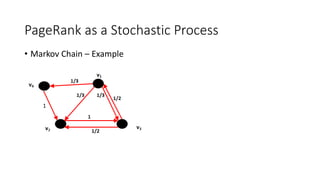
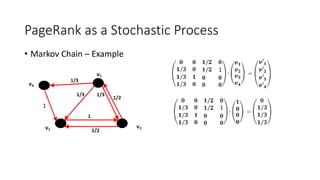
• Markov Chain – Example
1
PageRank as a Stochastic Process
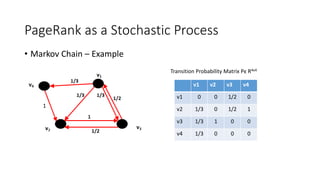
• Markov Chain – Example
v1 v2 v3 v4
v1 0 0 1/2 0
v2 1/3 0 1/2 1
v3 1/3 1 0 0
v4 1/3 0 0 0
Transition Probability Matrix Pϵ R4x4
1
PageRank as a Stochastic Process
• Markov Chain – Example
1
1
1
PageRank as a Stochastic Process
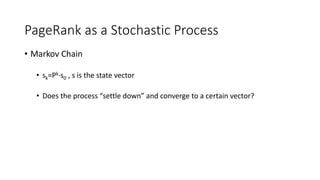
• Markov Chain
• sk=Pk∙s0 , s is the state vector
• Does the process “settle down” and converge to a certain vector?
Linear Algebra
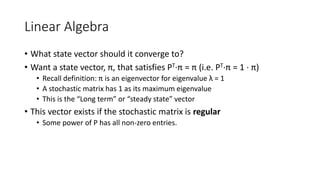
• What state vector should it converge to?
• Want a state vector, π, that satisfies PT∙π = π (i.e. PT∙π = 1 ∙ π)
• Recall definition: π is an eigenvector for eigenvalue λ = 1
• A stochastic matrix has 1 as its maximum eigenvalue
• This is the “Long term” or “steady state” vector
• This vector exists if the stochastic matrix is regular
• Some power of P has all non-zero entries.
Random Walk
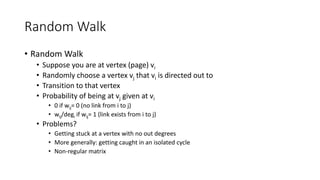
• Random Walk
• Suppose you are at vertex (page) vi
• Randomly choose a vertex vj that vi is directed out to
• Transition to that vertex
• Probability of being at vj given at vi
• 0 if wij= 0 (no link from i to j)
• wij/degi if wij= 1 (link exists from i to j)
• Problems?
• Getting stuck at a vertex with no out degrees
• More generally: getting caught in an isolated cycle
• Non-regular matrix
Teleporting Random Walk
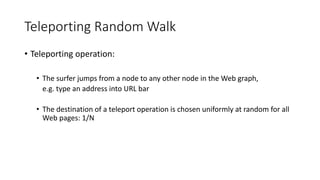
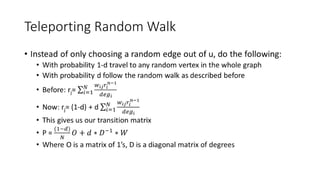
• Teleporting operation:
• The surfer jumps from a node to any other node in the Web graph,
e.g. type an address into URL bar
• The destination of a teleport operation is chosen uniformly at random for all
Web pages: 1/N
Teleporting Random Walk
Application of PageRank to the NFL
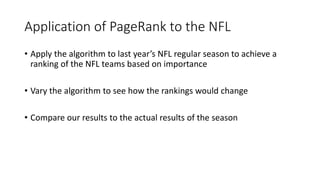
• Apply the algorithm to last year’s NFL regular season to achieve a
ranking of the NFL teams based on importance
• Vary the algorithm to see how the rankings would change
• Compare our results to the actual results of the season
Compiling the Data
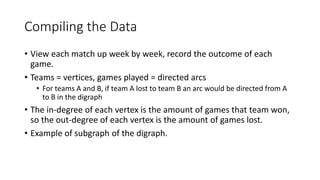
• View each match up week by week, record the outcome of each
game.
• Teams = vertices, games played = directed arcs
• For teams A and B, if team A lost to team B an arc would be directed from A
to B in the digraph
• The in-degree of each vertex is the amount of games that team won,
so the out-degree of each vertex is the amount of games lost.
• Example of subgraph of the digraph.
Compiling the Data
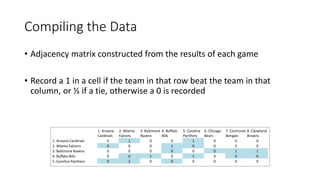
• Adjacency matrix constructed from the results of each game
• Record a 1 in a cell if the team in that row beat the team in that
column, or ½ if a tie, otherwise a 0 is recorded
1. Arizona
Cardinals
2. Atlanta
Falcons
3. Baltimore
Ravens
4. Buffalo
Bills
5. Carolina
Panthers
6. Chicago
Bears
7. Cincinnati
Bengals
8. Cleveland
Browns
1. Arizona Cardinals 0 1 0 0 1 0 0 0
2. Atlanta Falcons 0 0 0 1 0 0 0 0
3. Baltimore Ravens 0 0 0 0 0 0 1 1
4. Buffalo Bills 0 0 1 0 1 0 0 0
5. Carolina Panthers 0 2 0 0 0 0 0 0
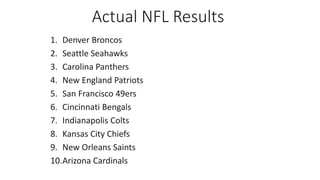
Actual NFL Results
1. Denver Broncos
2. Seattle Seahawks
3. Carolina Panthers
4. New England Patriots
5. San Francisco 49ers
6. Cincinnati Bengals
7. Indianapolis Colts
8. Kansas City Chiefs
9. New Orleans Saints
10.Arizona Cardinals
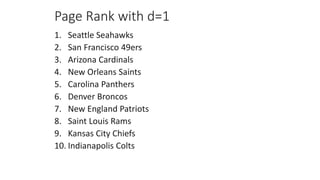
Page Rank with d=1
1. Seattle Seahawks
2. San Francisco 49ers
3. Arizona Cardinals
4. New Orleans Saints
5. Carolina Panthers
6. Denver Broncos
7. New England Patriots
8. Saint Louis Rams
9. Kansas City Chiefs
10. Indianapolis Colts
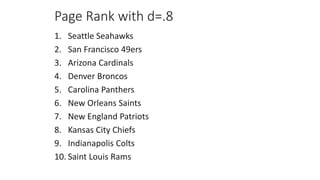
Page Rank with d=.8
1. Seattle Seahawks
2. San Francisco 49ers
3. Arizona Cardinals
4. Denver Broncos
5. Carolina Panthers
6. New Orleans Saints
7. New England Patriots
8. Kansas City Chiefs
9. Indianapolis Colts
10. Saint Louis Rams
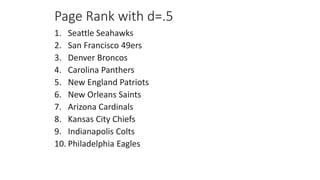
Page Rank with d=.5
1. Seattle Seahawks
2. San Francisco 49ers
3. Denver Broncos
4. Carolina Panthers
5. New England Patriots
6. New Orleans Saints
7. Arizona Cardinals
8. Kansas City Chiefs
9. Indianapolis Colts
10. Philadelphia Eagles
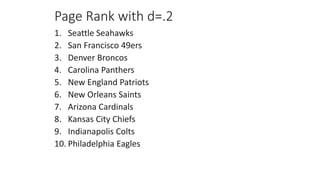
Page Rank with d=.2
1. Seattle Seahawks
2. San Francisco 49ers
3. Denver Broncos
4. Carolina Panthers
5. New England Patriots
6. New Orleans Saints
7. Arizona Cardinals
8. Kansas City Chiefs
9. Indianapolis Colts
10. Philadelphia Eagles

Page-Rank Algorithm Final

  • 1.
    Page-Rank Algorithm Brandon B,Abbie H, Billy K, Hannah S
  • 2.
    Overview • History andBackground • Importance and Problems • Algorithm and Variations of it • Our Application of PageRank
  • 3.
    Background • Mathematical equationdesigned to measure the importance of web pages • Developed in 1996 at Stanford University by Larry Page and Sergey Brin, the founders of Google • Started as a research project
  • 4.
    Background • PageRank isa trademark of Google • PageRank algorithm has been patented • Exact algorithm used today is unknown • Algorithm is still tweaked each day to improve search results
  • 5.
    Background • Algorithm isone of ~200 factors that determines the order web pages are reported to the users • Results are reported based on relevance to a search and overall importance • Previously, internet search engines linked to pages that had the highest keyword density
  • 6.
    Problem with PreviouslyUsed Method • Possible for websites to easily increase their rank in search results • Did not take into account the relevancy of the results to the search, therefore was not very useful
  • 7.
    The Algorithm • Measuresa web page’s overall importance • Importance of a page is based on the number of links into it from other web pages • Links can be viewed as votes • Quality of the web pages linked into the page is taken into consideration too
  • 8.
    Web Pages asa Digraph • Web pages and links can be viewed as a digraph • Web pages are represented by vertices • Links in are represented by arcs directed in Videos Books Home Football
  • 9.
    Adjacency Matrix ofDigraph • After creating a digraph with the web pages and links, an adjacency matrix is constructed • Algorithm is then applied using this matrix and PageRank values are determined • On Google, pages are ranked from 1 to 10
  • 10.
    Importance of PageRank •PageRank is main factor used daily by Google to deliver the best results to a Google search • Can also be applied to other sets of data • Many real-life applications of the algorithm are possible (i.e. ranking NFL teams based on wins and losses)
  • 11.
    Problems with theAlgorithm • Some websites look for a way to increase their own PageRank • Called search engine optimization (SEO) • Two specific examples of cheating: • Google Bomb • Link Farming
  • 12.
    Google Bomb • Occurswhen a group of people conspire to increase PageRank artificially by linking a particular word or phrase to the website • Prevention: alter algorithm to rank pages by relevancy
  • 13.
    Link Farming • Linkingwithout the thought of relevance of pages being linked • i.e. a website with a collection of random links to other websites • Prevention: alter calculations to filter out possible link farms
  • 14.
    Real Life Examplesof Cheating • JC Penny (furniture) • BMW German Car Sales Website • Bing uses Google’s search engine ranking system to improve their own
  • 15.
    The Algorithm • Constructa digraph with nodes representing pages • Number of nodes = N • W = NxN adjacency matrix where wij = 1 if there is a link from page i to page j • wij = 0 if there is no link from i to j • Degi is the out degree of node i, and D is the NxN diagonal matrix of deg • so = 𝟏 𝑵 𝟏 𝟏 ⋮ 𝟏 = 𝟏 𝑵 𝟏 𝑵 ⋮ 𝟏 𝑵 is the starting vector with equal probabilities of each vertex
  • 16.
  • 17.
    Example Adjacency Matrix v1 v2 v4 v3 V1 V2V3 V4 V1 0 1 1 1 V2 0 0 1 0 V3 1 1 0 0 V4 0 1 0 0
  • 18.
    Example Adjacency Matrix Transpose v1 v2 v4 v3 V1V2 V3 V4 V1 0 0 1 0 V2 1 0 1 1 V3 1 1 0 0 V4 1 0 0 0
  • 19.
    Example Adjacency Matrix Transpose/outdegrees v1 v2 v4 v3 V1 V2 V3 V4 V1 0 0 .5 0 V2 1/3 0 .5 1 V3 1/3 1 0 0 V4 1/3 0 0 0
  • 20.
  • 21.
    PageRank as aStochastic Process • Markov Chain • Discrete-time stochastic process • Consisting of N states and a transition probability matrix Pϵ RNxN • At each step, we are in exactly one of the states
  • 22.
    PageRank as aStochastic Process • Markov Chain - Transition Probability Matrix • Each entry is in the interval [0, 1] • Pij = probability of j being the next state, given we are currently in state i , for 1  i,j  n • A stochastic matrix has non-negative entries and satisfies • Each entry is known as a transition probability and depends only on the current state i.
  • 23.
    PageRank as aStochastic Process • Markov Chain – Example 1
  • 24.
    PageRank as aStochastic Process • Markov Chain – Example v1 v2 v3 v4 v1 0 0 1/2 0 v2 1/3 0 1/2 1 v3 1/3 1 0 0 v4 1/3 0 0 0 Transition Probability Matrix Pϵ R4x4 1
  • 25.
    PageRank as aStochastic Process • Markov Chain – Example 1 1 1
  • 26.
    PageRank as aStochastic Process • Markov Chain • sk=Pk∙s0 , s is the state vector • Does the process “settle down” and converge to a certain vector?
  • 27.
    Linear Algebra • Whatstate vector should it converge to? • Want a state vector, π, that satisfies PT∙π = π (i.e. PT∙π = 1 ∙ π) • Recall definition: π is an eigenvector for eigenvalue λ = 1 • A stochastic matrix has 1 as its maximum eigenvalue • This is the “Long term” or “steady state” vector • This vector exists if the stochastic matrix is regular • Some power of P has all non-zero entries.
  • 28.
    Random Walk • RandomWalk • Suppose you are at vertex (page) vi • Randomly choose a vertex vj that vi is directed out to • Transition to that vertex • Probability of being at vj given at vi • 0 if wij= 0 (no link from i to j) • wij/degi if wij= 1 (link exists from i to j) • Problems? • Getting stuck at a vertex with no out degrees • More generally: getting caught in an isolated cycle • Non-regular matrix
  • 29.
    Teleporting Random Walk •Teleporting operation: • The surfer jumps from a node to any other node in the Web graph, e.g. type an address into URL bar • The destination of a teleport operation is chosen uniformly at random for all Web pages: 1/N
  • 30.
  • 31.
    Application of PageRankto the NFL • Apply the algorithm to last year’s NFL regular season to achieve a ranking of the NFL teams based on importance • Vary the algorithm to see how the rankings would change • Compare our results to the actual results of the season
  • 32.
    Compiling the Data •View each match up week by week, record the outcome of each game. • Teams = vertices, games played = directed arcs • For teams A and B, if team A lost to team B an arc would be directed from A to B in the digraph • The in-degree of each vertex is the amount of games that team won, so the out-degree of each vertex is the amount of games lost. • Example of subgraph of the digraph.
  • 33.
    Compiling the Data •Adjacency matrix constructed from the results of each game • Record a 1 in a cell if the team in that row beat the team in that column, or ½ if a tie, otherwise a 0 is recorded 1. Arizona Cardinals 2. Atlanta Falcons 3. Baltimore Ravens 4. Buffalo Bills 5. Carolina Panthers 6. Chicago Bears 7. Cincinnati Bengals 8. Cleveland Browns 1. Arizona Cardinals 0 1 0 0 1 0 0 0 2. Atlanta Falcons 0 0 0 1 0 0 0 0 3. Baltimore Ravens 0 0 0 0 0 0 1 1 4. Buffalo Bills 0 0 1 0 1 0 0 0 5. Carolina Panthers 0 2 0 0 0 0 0 0
  • 34.
    Actual NFL Results 1.Denver Broncos 2. Seattle Seahawks 3. Carolina Panthers 4. New England Patriots 5. San Francisco 49ers 6. Cincinnati Bengals 7. Indianapolis Colts 8. Kansas City Chiefs 9. New Orleans Saints 10.Arizona Cardinals
  • 35.
    Page Rank withd=1 1. Seattle Seahawks 2. San Francisco 49ers 3. Arizona Cardinals 4. New Orleans Saints 5. Carolina Panthers 6. Denver Broncos 7. New England Patriots 8. Saint Louis Rams 9. Kansas City Chiefs 10. Indianapolis Colts
  • 36.
    Page Rank withd=.8 1. Seattle Seahawks 2. San Francisco 49ers 3. Arizona Cardinals 4. Denver Broncos 5. Carolina Panthers 6. New Orleans Saints 7. New England Patriots 8. Kansas City Chiefs 9. Indianapolis Colts 10. Saint Louis Rams
  • 37.
    Page Rank withd=.5 1. Seattle Seahawks 2. San Francisco 49ers 3. Denver Broncos 4. Carolina Panthers 5. New England Patriots 6. New Orleans Saints 7. Arizona Cardinals 8. Kansas City Chiefs 9. Indianapolis Colts 10. Philadelphia Eagles
  • 38.
    Page Rank withd=.2 1. Seattle Seahawks 2. San Francisco 49ers 3. Denver Broncos 4. Carolina Panthers 5. New England Patriots 6. New Orleans Saints 7. Arizona Cardinals 8. Kansas City Chiefs 9. Indianapolis Colts 10. Philadelphia Eagles