ISCI Future Avenues Local Renewables Conference Freiburg, 14 June 2007 Chiel Boonstra ISCI Secretary-General
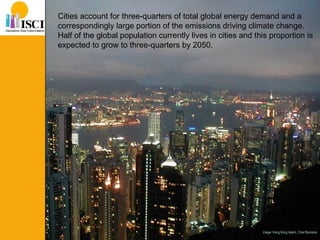
Image: Hong Kong Island, Chiel Boonstra Cities account for three-quarters of total global energy demand and a  correspondingly large portion of the emissions driving climate change.  Half of the global population currently lives in cities and this proportion is expected to grow to three-quarters by 2050.
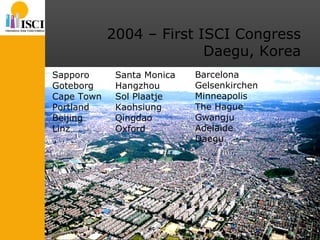
2004 – First ISCI Congress Daegu, Korea Sapporo Goteborg Cape Town Portland Beijing Linz Santa Monica Hangzhou Sol Plaatje Kaohsiung Qingdao Oxford Barcelona Gelsenkirchen Minneapolis The Hague Gwangju Adelaide Daegu
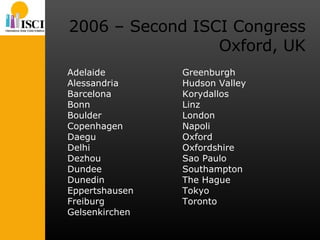
2006 – Second ISCI Congress Oxford, UK Adelaide Alessandria Barcelona Bonn Boulder Copenhagen Daegu Delhi Dezhou Dundee Dunedin Eppertshausen Freiburg Gelsenkirchen Greenburgh Hudson Valley Korydallos Linz London Napoli Oxford Oxfordshire Sao Paulo Southampton The Hague Tokyo Toronto
Third International Solar Cities Congress 17 – 21 February 2008 Adelaide, South Australia www.solarcitiescongress.com.au
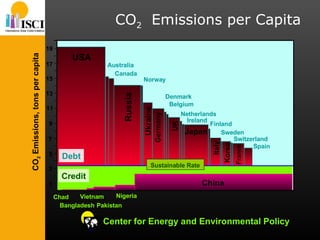
CO 2   Emissions per Capita Center for Energy and Environmental Policy 1 3 5 7 9 11 13 15 17 19 USA Russia Canada Australia Bangladesh Pakistan Chad Nigeria Debt Credit Norway Denmark Vietnam China CO 2  Emissions, tons per capita Germany UK Netherlands Belgium Japan France Switzerland Italy Sweden Spain Finland Korea Ukraine Ireland Sustainable  Rate Sustainable Rate
 
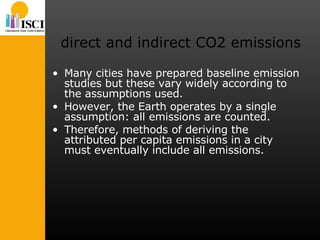
direct and indirect CO2 emissions Many cities have prepared baseline emission studies but these vary widely according to the assumptions used.  However, the Earth operates by a single assumption: all emissions are counted.  Therefore, methods of deriving the attributed per capita emissions in a city must eventually include all emissions.
  [tonne CO 2  per year] now future actions: Space heating passive house technology Warm water 6 2 watersaving + solar boiler Electricity electricity saving + solar, wind, biomass  Mobility 5 1,5 from car to car sharing + public transport + bicycle +  regional living-working-leisure Food 6 1,5 regional food production and market Goods 3 1 regional and sustainable purchasing Services 5 1,5 sustainable services ____ ____ 25 7,5   [ = 3 tonne CO2 per year / person] CO 2  emission European household  [2,5 persons]
 
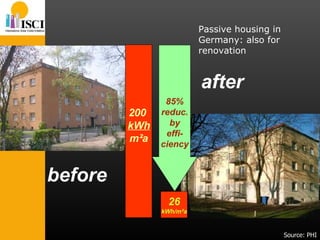
200  kWh m²a before after  Source: PHI Passive housing in Germany: also for renovation 26 kWh/m²a 85% reduc. by effi- ciency
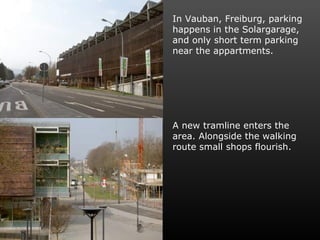
In Vauban, Freiburg, parking happens in the Solargarage, and only short term parking near the appartments. A new tramline enters the area. Alongside the walking route small shops flourish.
The school is located in safe, green space, adjacent to mix of social housing and individual architecture. The parking garage offers space for car sharing (three car types). Reservation and payment via regional public transport card, and Internet.
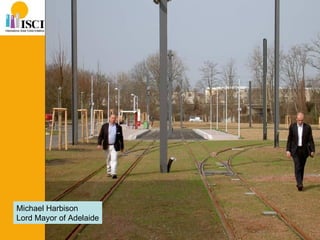
Michael Harbison Lord Mayor of Adelaide
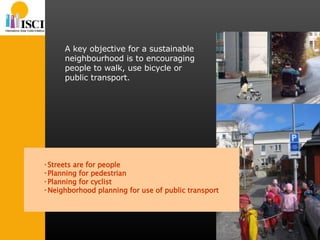
A key objective for a sustainable neighbourhood is to encouraging people to walk, use bicycle or public transport. Streets are for people Planning for pedestrian Planning for cyclist Neighborhood planning for use of public transport
Communities and mobility Shorter distances Services and shops by foot and bicycle New communities Optimum density, function mix Attractive mixed use living, leisure and working environment Tram network between nodes Train for long distance
ISCI objectives to support UN energy and climate policies by stimulating the interest of cities into becoming benchmark cities that commit to ambitious emission reduction goals;  help cities systematically integrate renewable energy and energy efficient technologies and industries into environmental, economic and city planning;  and provide scientific support for the validation and design of effective measures and policies for Solar Cities.
ISCI Executive Board Chris Zijdeveld – Chair Anne Grete Hestnes – Vice Chair Chiel Boonstra – Secretary General Monica Oliphant Jong-dal Kim Iida Tetsunari John Byrne David Mills
2006 ISCI Declaration at Oxford Agreement achieved in front of Mayors Forum, and in city consultations INTRODUCTION Cities account for three-quarters of total global energy … Cities have great potential to avert the growing climate crisis   In the second International Solar Cities Congress hosted by Oxford  …
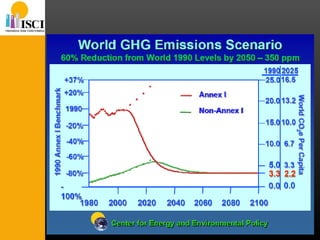
2006 ISCI Declaration at Oxford TARGETS AND TRAJECTORIES It is agreed  that all ISCI Cities create, as a long-term target, per capita emissions reduction trajectories consistent with the 2050 per capita global target of a 60% or greater reduction from 1990 levels. Trajectories may differ for cities with currently low per capita emissions compared to those with higher emissions. It is agreed  that Cities will work together and, with support from the ISCI Executive, find consensus on trajectories by 2008, when the 3rd International Solar Cities Congress will convene in Adelaide, Australia.
2006 ISCI Declaration at Oxford BASELINE DEVELOPMENT It is agreed  that ISCI Cities use mathematical methods to create a continually updated per capita emissions figure as the benchmark for monitoring and verification of community progress in lowering emissions. It is agreed  that ISCI Cities will move toward a complete counting method in their reporting of progress in per capita emissions reduction.
2006 ISCI Declaration at Oxford ACTIONS TO REDUCE EMISSIONS It is agreed  that, beginning in 2008, ISCI Cities will report bi-annually at each Congress their per capita emissions and the method used to measure this indicator. It is agreed  that, beginning in 2008, ISCI Cities will report bi-annually at each Congress, action plans to reduce emissions in the near (next five years) and long terms.
2006 ISCI Declaration at Oxford ACTION PROGRAMME EVALUATION It is agreed  that analysis methods employed by ISCI Cities should be comparable, transparent, and complete, and will be reported to the ISCI Executive in its role as clearing house for ISCI activity.  It is agreed  that results of programmes will be published in a simple and common format allowing inter-city comparison of approaches.
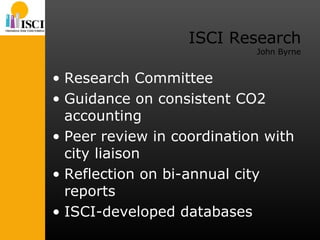
ISCI Research John Byrne Research Committee Guidance on consistent CO2 accounting Peer review in coordination with city liaison Reflection on bi-annual city reports ISCI-developed databases
ISCI City Liaison actions Chiel Boonstra 2004 Daegu Declaration 2006 ISCI Declaration at Oxford Cities and ISCI cooperate: Bi-annual reporting City Action plan development  Programme exchange between cities ISCI technical assistance, coordination and consulting services
ISCI dissemination Publication Newsletter Each City featured in newsletter, annually Website, including city pages
Case Story development -  Collaboration offered by Eric Martinot; information channeled via ISCI Research and ISCI City Liaison
Other organisations ISES  - cooperation in conference development ICLEI  - conversations to establish working relations .
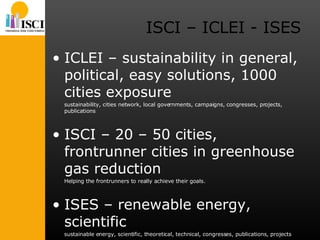
ISCI – ICLEI - ISES ICLEI – sustainability in general, political, easy solutions, 1000 cities exposure sustainability, cities network, local governments, campaigns, congresses, projects, publications ISCI – 20 – 50 cities, frontrunner cities in greenhouse gas reduction Helping the frontrunners to really achieve their goals. ISES – renewable energy, scientific sustainable energy, scientific, theoretical, technical, congresses, publications, projects
Solar City examples Solar City Copenhagen Adelaide Solar City Solar City Alessandria Dezhou Solar City …
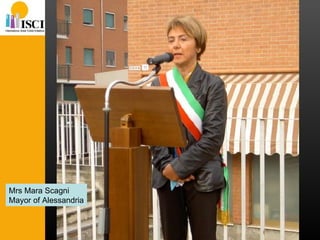
Mrs Mara Scagni Mayor of Alessandria
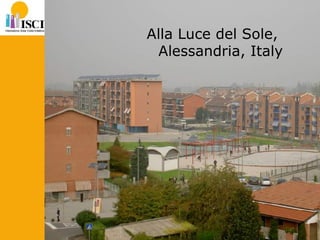
Alla Luce del Sole,  Alessandria, Italy
 
Third International Solar Cities Congress 17 – 21 February 2008 Adelaide, South Australia www.solarcitiescongress.com.au
International Solar Cities Initiative Thank you,  You are more than welcome  to join [email_address]

P4_Boonstra

  • 1.
    ISCI Future AvenuesLocal Renewables Conference Freiburg, 14 June 2007 Chiel Boonstra ISCI Secretary-General
  • 2.
    Image: Hong KongIsland, Chiel Boonstra Cities account for three-quarters of total global energy demand and a correspondingly large portion of the emissions driving climate change. Half of the global population currently lives in cities and this proportion is expected to grow to three-quarters by 2050.
  • 3.
    2004 – FirstISCI Congress Daegu, Korea Sapporo Goteborg Cape Town Portland Beijing Linz Santa Monica Hangzhou Sol Plaatje Kaohsiung Qingdao Oxford Barcelona Gelsenkirchen Minneapolis The Hague Gwangju Adelaide Daegu
  • 4.
    2006 – SecondISCI Congress Oxford, UK Adelaide Alessandria Barcelona Bonn Boulder Copenhagen Daegu Delhi Dezhou Dundee Dunedin Eppertshausen Freiburg Gelsenkirchen Greenburgh Hudson Valley Korydallos Linz London Napoli Oxford Oxfordshire Sao Paulo Southampton The Hague Tokyo Toronto
  • 5.
    Third International SolarCities Congress 17 – 21 February 2008 Adelaide, South Australia www.solarcitiescongress.com.au
  • 6.
    CO 2 Emissions per Capita Center for Energy and Environmental Policy 1 3 5 7 9 11 13 15 17 19 USA Russia Canada Australia Bangladesh Pakistan Chad Nigeria Debt Credit Norway Denmark Vietnam China CO 2 Emissions, tons per capita Germany UK Netherlands Belgium Japan France Switzerland Italy Sweden Spain Finland Korea Ukraine Ireland Sustainable Rate Sustainable Rate
  • 7.
  • 8.
    direct and indirectCO2 emissions Many cities have prepared baseline emission studies but these vary widely according to the assumptions used. However, the Earth operates by a single assumption: all emissions are counted. Therefore, methods of deriving the attributed per capita emissions in a city must eventually include all emissions.
  • 9.
    [tonneCO 2 per year] now future actions: Space heating passive house technology Warm water 6 2 watersaving + solar boiler Electricity electricity saving + solar, wind, biomass Mobility 5 1,5 from car to car sharing + public transport + bicycle + regional living-working-leisure Food 6 1,5 regional food production and market Goods 3 1 regional and sustainable purchasing Services 5 1,5 sustainable services ____ ____ 25 7,5 [ = 3 tonne CO2 per year / person] CO 2 emission European household [2,5 persons]
  • 10.
  • 11.
    200 kWhm²a before after Source: PHI Passive housing in Germany: also for renovation 26 kWh/m²a 85% reduc. by effi- ciency
  • 12.
    In Vauban, Freiburg,parking happens in the Solargarage, and only short term parking near the appartments. A new tramline enters the area. Alongside the walking route small shops flourish.
  • 13.
    The school islocated in safe, green space, adjacent to mix of social housing and individual architecture. The parking garage offers space for car sharing (three car types). Reservation and payment via regional public transport card, and Internet.
  • 14.
    Michael Harbison LordMayor of Adelaide
  • 15.
    A key objectivefor a sustainable neighbourhood is to encouraging people to walk, use bicycle or public transport. Streets are for people Planning for pedestrian Planning for cyclist Neighborhood planning for use of public transport
  • 16.
    Communities and mobilityShorter distances Services and shops by foot and bicycle New communities Optimum density, function mix Attractive mixed use living, leisure and working environment Tram network between nodes Train for long distance
  • 17.
    ISCI objectives tosupport UN energy and climate policies by stimulating the interest of cities into becoming benchmark cities that commit to ambitious emission reduction goals; help cities systematically integrate renewable energy and energy efficient technologies and industries into environmental, economic and city planning; and provide scientific support for the validation and design of effective measures and policies for Solar Cities.
  • 18.
    ISCI Executive BoardChris Zijdeveld – Chair Anne Grete Hestnes – Vice Chair Chiel Boonstra – Secretary General Monica Oliphant Jong-dal Kim Iida Tetsunari John Byrne David Mills
  • 19.
    2006 ISCI Declarationat Oxford Agreement achieved in front of Mayors Forum, and in city consultations INTRODUCTION Cities account for three-quarters of total global energy … Cities have great potential to avert the growing climate crisis In the second International Solar Cities Congress hosted by Oxford …
  • 20.
    2006 ISCI Declarationat Oxford TARGETS AND TRAJECTORIES It is agreed that all ISCI Cities create, as a long-term target, per capita emissions reduction trajectories consistent with the 2050 per capita global target of a 60% or greater reduction from 1990 levels. Trajectories may differ for cities with currently low per capita emissions compared to those with higher emissions. It is agreed that Cities will work together and, with support from the ISCI Executive, find consensus on trajectories by 2008, when the 3rd International Solar Cities Congress will convene in Adelaide, Australia.
  • 21.
    2006 ISCI Declarationat Oxford BASELINE DEVELOPMENT It is agreed that ISCI Cities use mathematical methods to create a continually updated per capita emissions figure as the benchmark for monitoring and verification of community progress in lowering emissions. It is agreed that ISCI Cities will move toward a complete counting method in their reporting of progress in per capita emissions reduction.
  • 22.
    2006 ISCI Declarationat Oxford ACTIONS TO REDUCE EMISSIONS It is agreed that, beginning in 2008, ISCI Cities will report bi-annually at each Congress their per capita emissions and the method used to measure this indicator. It is agreed that, beginning in 2008, ISCI Cities will report bi-annually at each Congress, action plans to reduce emissions in the near (next five years) and long terms.
  • 23.
    2006 ISCI Declarationat Oxford ACTION PROGRAMME EVALUATION It is agreed that analysis methods employed by ISCI Cities should be comparable, transparent, and complete, and will be reported to the ISCI Executive in its role as clearing house for ISCI activity. It is agreed that results of programmes will be published in a simple and common format allowing inter-city comparison of approaches.
  • 24.
    ISCI Research JohnByrne Research Committee Guidance on consistent CO2 accounting Peer review in coordination with city liaison Reflection on bi-annual city reports ISCI-developed databases
  • 25.
    ISCI City Liaisonactions Chiel Boonstra 2004 Daegu Declaration 2006 ISCI Declaration at Oxford Cities and ISCI cooperate: Bi-annual reporting City Action plan development Programme exchange between cities ISCI technical assistance, coordination and consulting services
  • 26.
    ISCI dissemination PublicationNewsletter Each City featured in newsletter, annually Website, including city pages
  • 27.
    Case Story development- Collaboration offered by Eric Martinot; information channeled via ISCI Research and ISCI City Liaison
  • 28.
    Other organisations ISES - cooperation in conference development ICLEI - conversations to establish working relations .
  • 29.
    ISCI – ICLEI- ISES ICLEI – sustainability in general, political, easy solutions, 1000 cities exposure sustainability, cities network, local governments, campaigns, congresses, projects, publications ISCI – 20 – 50 cities, frontrunner cities in greenhouse gas reduction Helping the frontrunners to really achieve their goals. ISES – renewable energy, scientific sustainable energy, scientific, theoretical, technical, congresses, publications, projects
  • 30.
    Solar City examplesSolar City Copenhagen Adelaide Solar City Solar City Alessandria Dezhou Solar City …
  • 31.
    Mrs Mara ScagniMayor of Alessandria
  • 32.
    Alla Luce delSole, Alessandria, Italy
  • 33.
  • 34.
    Third International SolarCities Congress 17 – 21 February 2008 Adelaide, South Australia www.solarcitiescongress.com.au
  • 35.
    International Solar CitiesInitiative Thank you, You are more than welcome to join [email_address]