OPTIONS FOR MAKING CITIES ZERO CARBON
*Jit Kumar Gupta
Introduction
Siphoning off the major share, cities of the world
are rapidly transforming in terms of, distribution
of population; apportioning wealth; promoting
economy, generating employment; distributing
services, creating amenities; locating institutions;
housing means of production, distribution and
consumption, of goods and services. Housing
more than half of humanity (3.5 billion people) ;
with number projected to rise to 5 billion by 2030
and 70 per cent by 2050 , cities are fast emerging
as areas of concentration of large population,
employment, state of art institutions, wealth and
services. While one in eight people live in 33
megacities worldwide, close to half of the world’s
urban dwellers reside in much smaller settlements
with fewer than 500,000 inhabitants. By 2030, it is estimated that the world will have six out of
ten people living in cities, besides having 43 megacities with each housing more than 10 million
inhabitants. Most of these megacities will have location in the developing regions of the world.
Globally it has also been estimated that 95 per cent of urban expansion in the next decades will
take place in developing world with 90 per cent of urban growth forecasted to happen only in Asia
and Africa, in the next 30 years. By 2060, more than a billion people, projected at ten per cent of
the world's projected population, will be living in low-lying urban coastal areas, with majority
housed in developing countries. (UNCH)
Cities, largely a manmade conglomerate, remain most complex, most powerful, never defined,
never static, ever evolving and ever devolving among human settlements. Occupying just 3 per
cent of the earth’s land, providing home to more than 3.5 billion people, cities are known to be
responsible for generating as much as 70 -75 per cent of human-induced greenhouse gas emissions.
Cities are globally known for their positivities, negativities, dualities and contradictions. Cities are
also valued as economic powerhouses and major drivers of economy and generators of wealth for
the nations ,
making large contribution to the world economy and employment. Known for higher order of
productivity, 600 major cities of the world generate more than half of global GDP. Looking at the
existing and future scenario, urban areas will continue to dictate economy and contribute
disproportionately to future wealth creation. Looking at the manner in which cities are structured,
operate and grow, If future prosperity of the world is going to be determined by the urban world,
then future of the world’s climate, ecology and sustainability will also be dictated, defined and
decided by our cities.
Generating 70% of the global greenhouse gas emissions and housing more than 55% of global
population, cities are adversely impacting global climate. Cities are known to be major actors in
climate change; promoting global warming; consuming large energy and natural resources;
generating large volume of human induced waste; producing alarmingly high levels of air
pollution and generating large carbon emissions from the production of goods and services ; using
large amount of fossil-fuel based energy for transportation and heating and cooling of large
number of buildings and apartments. As people around the world live increasingly in the urban
areas, cities will be at the forefront of any long-term climate solution. Role of cities in making this
world more sustainable or unsustainable is likely to increase in the coming decade. Since billions
more people will move to make cities their preferred place of residence and work and urbanization
driving global economic growth and rapid migration, it will be critical and vital to focus on
improving conditions in cities to make them safe, more productive and healthier spaces for people
to live in. Considering the entire fabric of cities including their role, importance, structure,
operation, growth and development, from the standpoint of both climate change and sustainability,
cities represent both a challenge and an opportunity to make this world more sustainable, livable,
productive, effective and efficient.
Inter-governmental Panel on Climate Change (IPCC)’, in its report, October 2018, has placed
critical threshold increase in the earth's average temperature at 1.5 ºC ,as against 2 ºC, specified in
the Paris agreement. Crossing this threshold, will lead to nations facing major disasters, both
natural and manmade, involving; loss of entire ecosystems and species, melting polar ice caps ;
rising sea levels; intense heat waves and droughts besides increased intensity and frequency of
extreme weather events. For limiting global warming to 1.5 °C, it would be essential to reduce net
global carbon dioxide (CO2) emissions by about forty-five per cent (of 2010 levels) by 2030, and
achieve net-zero carbon emissions by 2050.
Urbanization Challenges/issues
In the face of rapid and massive urbanization, majority of cities are undergoing crisis of
infrastructures, development and management. Rapid, unplanned and haphazard
urbanization is exerting pressure on essential basic infrastructure and services including supply of
fresh water, sewage, waste management,
transportation and environment. Rapidly
growing urban world is experiencing
congestion, lack of basic services, shortage of
adequate housing, and declining
infrastructure. With 828 million
people living in slums; half of the global
urban population breathing air, that is 2.5
times more polluted than
standards defined by the World Health
Organization and majority of cities spilling
beyond their formal boundaries, leading to
unplanned urban sprawl; cities are treading
on a path and scripting an agenda, which appears to be detrimental to achieving the global goals
for sustainable development. Urban spaces offer enormous opportunities and multiple options for
people to prosper economically and socially, only when cities can accommodate people in a
sustainable manner. Achieving urban sustainability will be a mirage without significantly
transforming the way we plan, develop, build and manage our urban spaces. Making cities
sustainable, livable, safe and resilient will mean; creating options for safe, affordable carbon
neutral housing; building resilient societies and economies; making public transport green ;
efficiently managing waste; providing green infrastructures; creating green public spaces, and
making urban planning and management, both participatory and inclusive.
The United Nations in 2015 defined and adopted 17 Sustainable Development Goals (SDGs), also
known as a universal call for nations across globe , to take actions to end poverty, protect the
planet, and ensure that all people enjoy peace and prosperity by the year 2030. To achieve these
objectives; UNDP exclusively dedicated Goal 11, to cities and communities to make this planet
more inclusive, safe and sustainable. In order to make cities and community resilient and
promoters of sustainability, UNDP has mandated nations to achieve following targets;
 By 2030, ensure access for all to adequate, safe and affordable housing and basic services
and upgrade slums.
 By 2030, provide access to safe, affordable, accessible and sustainable transport systems
for all, improving road safety, expanding public transport, with focus on women, children,
persons with disabilities and older persons.
 By 2030, enhance inclusive and sustainable urbanization and capacity for participatory,
integrated and sustainable human settlement planning and management.
 Strengthen efforts to protect and safeguard the world’s cultural and natural heritage.
 By 2030, significantly reduce the number of deaths and the number of people affected and
substantially decrease the direct economic losses relative to global gross domestic product
caused by disasters, including water-related disasters, with a focus on protecting the poor
and people in vulnerable situations.
 By 2030, reduce the adverse per capita environmental impact of cities, by paying special
attention to air quality and municipal and other waste management.
 By 2030, provide universal access to safe, inclusive and accessible, green and public
spaces, in particular for women and children, older persons and persons with disabilities.
 Support positive economic, social and environmental links between urban, peri-urban and
rural areas by strengthening national and regional development planning.
 By 2020, substantially increase the number of cities and human settlements adopting and
implementing integrated policies and plans towards inclusion, resource efficiency,
mitigation and adaptation to climate change, resilience to disasters, and develop and
implement, in line with the Sendai Framework for Disaster Risk Reduction 2015-2030,
holistic disaster risk management at all levels.
Support least developed countries, through financial and technical assistance, in creating
sustainable and resilient buildings utilizing local materials.
Approaching Zero Carbon Cities
Numerous challenges posed to by rapid growth of cities; unplanned, urbanization; inadequate basic
infrastructure etc., can be effectively overcome by creating realistic and rational options for
improving optimum use of resource; focusing on reducing pollution and poverty; providing
universal access to basic services, housing, transportation; optimizing and reducing energy
consumption and adopting green energy systems. Considering enormous potential cities possess,
realistic and rational options must be put in place to make cities active partners i n creating
solution to climate change. Existing patterns of operation and functioning of cities, remain
inappropriate and unsuitable to overcome the climate based crisis. Considering the fact that 75
percent of the urban infrastructures required by 2050, are yet to be built, there exists huge
opportunity for decarbonizing the cities , which has genesis in unsustainable consumption pattern
involving irrational consumption of large resources; using fossil fuel for meeting the energy
demand and generation of huge waste. For promoting global sustainability, cities need to be
decarbonized and made zero-energy settlements by empowering them to become more resource-
efficient, sustainable and least consumers of energy and resources. Cities need to be reshaped,
restructured, replanned, reconstructed, developed and managed innovatively, objectively and
rationally, based on an agenda with focus on resources, climate, environment, ecology and
sustainability, as defined in SDG11.Studies made and analysis carried out globally, have revealed
that, investment made in ‘low-carbon city projects , carry lot of value and create win-win situation
both for residents,
communities, cities, state, nation and planets. A seminal study by New Climate Economy found
that $1 trillion spent per year by cities on low carbon projects, would produce $17 trillion in net
present financial value through 2050, just from the energy saving besides economic and social
benefits provided by improvements in citizen health, creating jobs, reducing poverty and
inequality, reckoned to be many times greater even than the $17 trillion value. Thus, decarbonizing
cities will be critical, essential and vital for not only healthy growth and development of humanity
but also for making planet earth more safe, livable and sustainable.
Evolving a Climate Action Plan;
Making city zero -carbon will essentially involve, evolving a climate action plan for each city on
priority to be structured around reducing CO2 emissions, increasing resilience, and creating
awareness to limit global warming to 1.5 °C. Unless such a roadmap is prepared and made
operational, at local level, making cities zero-carbon shall remain on papers. For preparing city-
centric climate action plans, cities need to be empowered with appropriate level of manpower,
expertise and resources. State has to play a pro-active role in enabling cities not only to prepare
climate action plan but also implement the plan. However, task appears to be both difficult and
complex, for majority of cities and nations.
Shifting to Renewable Energy;
Studies made globally have revealed that majority of CO2 emissions in cities come from just
four types of activities involving; power generation; designing, construction and operation of
buildings; transportation and waste management. Accordingly, cities following the net-zero
carbon route to reduce CO2 emissions, must use the options of; getting rid of use of fossil fuels
for urban operations; shift to renewable energy; transition of transport systems- using more
electrical/ non-polluting public buses & cleaner private vehicles; promoting highest degree of
energy efficiency; implementing decentralized energy systems for the production, distribution and
marketing of renewable energy ; designing and constructing green buildings; putting in position
sustainable urban infrastructure; smarter management of waste and water, using integrated waste
management , promotion of recycling; evolving best of urban design ;using cutting-edge digital
technologies; making city planning climate centric; promoting risk management and prevention;
strengthening circular and local economy systems; educating all stakeholders for achieving
speedier transitions in an orderly and accelerated manner. Emitting carbon by cities has genesis
in burning coal, oil and gas for generating and sourcing their energy requirement because
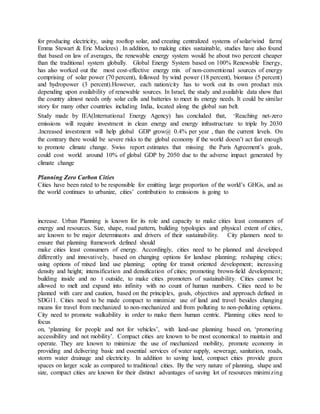
almost all human based activities are known to
be consumer of energy. All zero-carbon cities,
primarily and essentially, have to run entirely
on renewable energy; accordingly, making
urban settlements zero-carbon and harmless to
the planet, cities will require not only sourcing
energy exclusively from non-conventional
sources but also making/ empowering them to
be self-sufficient and self-sustaining in
meeting all their energy needs from non-conventional sources. All practices that emit greenhouse
gases will have to be removed and replaced from the operation of such cities. For decarbonizing
cities, renewable energy must supersede other non-renewable energy sources to become the
exclusive source of energy. However, to meet the target of making cities run entirely on renewable
energy, not only growth rate of installed capacity of solar photovoltaic systems should be made to
exceed that of all other energy sources but also to make new installations and storage of solar
photovoltaic and wind energy, both cost-effective and operationally efficient. Promoting optimum
use of available urban energy would essentially involve; making it more efficient across all sectors;
particularly in buildings and transportation, to achieve zero-carbon cities. Energy efficiency
remains the best option because it is easy and cheapest to achieve. Replacing outdated equipment
and using efficient lighting like LED lighting has helped in promoting efficiency in use of energy.
Cities would need to be incentivized for making transition to clean, zero-carbon energy sources
for producing electricity, using rooftop solar, and creating centralized systems of solar/wind farm(
Emma Stewart & Eric Mackres) . In addition, to making cities sustainable, studies have also found
that based on law of averages, the renewable energy system would be about two percent cheaper
than the traditional system globally. Global Energy System based on 100% Renewable Energy,
has also worked out the most cost-effective energy mix of non-conventional sources of energy
comprising of solar power (70 percent), followed by wind power (18 percent), biomass (5 percent)
and hydropower (3 percent).However, each nation/city has to work out its own product mix
depending upon availability of renewable sources. In Israel, the study and available data show that
the country almost needs only solar cells and batteries to meet its energy needs. It could be similar
story for many other countries including India, located along the global sun belt.
Study made by IEA(International Energy Agency) has concluded that, ‘Reaching net-zero
emissions will require investment in clean energy and energy infrastructure to triple by 2030
.Increased investment will help global GDP grow@ 0.4% per year , than the current levels. On
the contrary there would be severe risks to the global economy if the world doesn’t act fast enough
to promote climate change. Swiss report estimates that missing the Paris Agreement’s goals,
could cost world around 10% of global GDP by 2050 due to the adverse impact generated by
climate change
Planning Zero Carbon Cities
Cities have been rated to be responsible for emitting large proportion of the world’s GHGs, and as
the world continues to urbanize, cities’ contribution to emissions is going to
increase. Urban Planning is known for its role and capacity to make cities least consumers of
energy and resources. Size, shape, road pattern, building typologies and physical extent of cities,
are known to be major determinants and drivers of their sustainability. City planners need to
ensure that planning framework defined should
make cities least consumers of energy. Accordingly, cities need to be planned and developed
differently and innovatively, based on changing options for landuse planning; reshaping cities;
using options of mixed land use planning; opting for transit oriented development; increasing
density and height; intensification and densification of cities; promoting brown-field development;
building inside and no t outside, to make cities promoters of sustainability. Cities cannot be
allowed to melt and expand into infinity with no count of human numbers. Cities need to be
planned with care and caution, based on the principles, goals, objectives and approach defined in
SDG11. Cities need to be made compact to minimize use of land and travel besides changing
means for travel from mechanized to non-mechanized and from polluting to non-polluting options.
City need to promote walkability in order to make them human centric. Planning cities need to
focus
on, ‘planning for people and not for vehicles’, with land-use planning based on, ‘promoting
accessibility and not mobility’. Compact cities are known to be most economical to maintain and
operate. They are known to minimize the use of mechanized mobility, promote economy in
providing and delivering basic and essential services of water supply, sewerage, sanitation, roads,
storm water drainage and electricity. In addition to saving land, compact cities provide green
spaces on larger scale as compared to traditional cities. By the very nature of planning, shape and
size, compact cities are known for their distinct advantages of saving lot of resources minimizing
use of conventional energy, when compared with traditional cities and provide best of the planning
options to make cities carbon neutral. Existing cities can also be planned by using a system of
decentralized planning for creating compact self-contained neighborhoods to minimize mobility
and use of fossil fuel driven vehicles besides lowering their carbon footprints.
For making urban planning supportive of de-carbonizing the cities, first version of ‘Guiding
Principles for City Climate Action Planning ’ ,has already been published by the ,’The Carbon
Neutral Cities Alliance’, and released during the Paris Climate Summit, to put cities on the path
of fast trajectory of achieving decarbonization .Guiding principles defined in the action planning
include; de-carbonizing electricity; increasing sources of renewable electricity; making urban
transport zero-emission ; reducing particulate CO2 emissions; recycling organic waste for
reducing landfills and generate clean energy; partnering and collaborating with higher levels of
governments, other cities and private sector to meet the defined targets of GHG emissions.
For making cities role model of sustainability and carbon neutrality, planning must move away
from urban development that is power-hungry and creates ecological risks, towards a new order
of urban model that is more productive, safe and generator of least GHG emissions. Pre-requisites
for low-carbon and resilient cities should revolve around and based on sound and innovative urban
planning, rational and logical legal frameworks and an efficient model of urban finance -that can
provide for climate-friendly infrastructures, -while promoting a compact and diverse urban
structure in which economic prosperity is
encouraged. Transit- oriented development and
linear cites can also be explored as planning and
development options to promote use of public
transport and minimize carbon footprints of the
cities besides decentralizing the existing cities
and making them self-contained in all basic and
essential human needs. Creating appropriate
options for working, education, healthcare,
leisure, shopping, green spaces, playgrounds
etc., at neighbourhood level can also help in reducing intra-city traffic to make cities cleaner and
greener.
Cities also need to harness the enormous potential of public spaces and parks besides managing
public rights of way with landscaping techniques for deploying biochar to create a storehouse for
GHGs and make cities carbon negative. For removing carbon from the air, while protecting the
city from extreme weather events and sea level rise and providing outdoor recreation area, Coastal
cities should promote restoring wetlands and offshore agriculture projects based on “Green Float”
concept, for achieving emissions reductions. Creating city forests and using all public spaces,
areas along water bodies and low lying /derelict areas, for tree plantation and landscaping on
massive scale, can make valuable contribution to promote decarbonization of cities.
Redefining and Reinventing urban mobility
Mobility remains one of the basic necessities of human living because all human activities of
living, working, learning, healthcare, leisure etc. remain travel centric. With cities acting as large
labour market, effectiveness and operational efficiency of cities is largely contingent upon how
quickly and efficiently, human beings, good and services can be made to move from origin and
reach/delivered at destination, in the minimum timeframe. If cities have been termed as engines of
economic growth, transportation is known to be wheels of the said engine. However, considering
the existing pattern of urban growth and development, traffic and travel have emerged as the two
worst gifts of urbanization. With rapid urbanization and uncontrolled physical expansion of cities,
distances between place of living, working and leisure have increased enormously. Increased
distances and increased travel demand, have led to ushering an era of uncontrolled growth of
vehicles on the urban roads. Unfortunately, technology used in propelling mechanized means of
travel on the urban roads , remains largely fossil fuel centric.
Transport systems are known to be not only major consumers of conventional sources but also
emitters, promoters and responsible for large greenhouse gasses ( estimated to be, 23% of world
energy related GHG emissions) ,with three-quarter coming only from
road vehicles. Currently 95% of transport energy comes from petroleum. Energy is consumed
both in the making and operation of mechanized vehicles and as such fossil fuel remains embedded
in the transport infrastructure. Known to consume large proportion of fossil fuel, traffic and
transportation have emerged as the main culprits in making cities unsustainable, promoters of
global warming and generators of large carbon footprints because entire mechanism of urban
road mobility is based on the use of the conventional fossil fuel. Accordingly, current urban
transport models create supportive options of making cities most unsustainable and carbon-
friendly. No city on this planet can be made carbon neutral and zero-carbon, unless its mobility
pattern is rationalized and travel systems are shifted to alternate non- conventional and non-
polluting sources of energy. If genesis of global warming and large carbon footprints of cities is
embedded in unsustainable transportation then solutions for decarbonizing cities is also embedded
in making transportation options green and supportive of urban environment.
In search for finding appropriate solutions to make cities carbon neutral, a multi-pronged strategy
will have to evolved. Such a strategy should be driven by not only minimizing the
need to travel but also putting in place options for mobility based on non-polluting energy when
travel becomes essential. In order to minimize travel, as already stated, urban planning needs to be
driven by adopting the principles of, ‘planning for people and not vehicles, and ‘promoting
accessibility not mobility’, which can be achieved by changing the typologies and pattern of
planning by making cities both compact and cities as spaces of short distances. Compact cities
are known for their inherent quality of creating ideal conditions to encourage walking or cycling.
Good cycling infrastructure, bike parking and dedicated cycle lanes help make people feel safe
and encourage cycling. Decarbonizing cities will require limiting the number of cars within the
city and moving/shifting people to more economical, efficient and eco-friendly system of mass
transportation. Cars, now being used as a preferred means of urban transport, remain most
inefficient among mechanized system in terms of consumption of fossil fuel and number of persons
transported. For promoting green transportation, cities will have to get rid of vehicles using fossil-
fuels and replaced by battery-powered and auto piloted personal rapid transit systems (PRT). 20
percent reduction in carbon footprints can be achieved simply by making operational, effective
and efficient public transportation systems or switching out personal cars for drive-
shares/carpooling.For reducing carbon footprints, transport vehicles will need to run on batteries
or hydrogen-fuel cells and not using any diesel or petrol.Copenhagen has already mandated to
perform 75% of city journeys made by using bicycle or public transport. Making public transport
reasonably-priced, will encourages people leaving cars at home. Increased
viability of electric vehicles will help accelerate transition. City of London has already invested
heavily in making operational electric buses . Restricting non-essential traffic from cities or
introducing a charge to enter cities will help in accelerated use of public
transport for intra-city travel. For limiting
the number of private vehicles, visitors to
the city must be made to park their cars
outside the city on the fringe and made to
use public transport. Electrification of
private and public transport, and the
deployment of electrical vehicles will
remain critical and valuable to reduce
carbon footprints of the cities.
Making Buildings Green
Consuming large amount of water, wood, steel, energy, resources and generating construction and
demolition waste, buildings are known to contribute more than one-third (39%) of global
greenhouse gas emissions, including 28% as operational emissions and 11% in building materials
and construction. Considering the rapid growth of population, massive migration and rapid
urbanization, global building floorspace are projected to double by 2060. Looking at the addition
of large building footprints, energy and environment implications of built environment are going
to be enormous. Occupying large urban spaces and constituting manmade environment, buildings
are known to be major determinant of urban sustainability. Looking at the role and context,
decarbonizing buildings will be most critical to achieve the Paris climate goal of net zero emissions
by 2050. Decarbonizing buildings will require adopting rational policies and programs; creating a
supportive legal framework; creating awareness among professionals involved in planning,
designing, construction and maintenance of buildings; involving industry, promoters, developers
and other stakeholders in the building industry etc. to ensure that all new buildings, are
constructed to the highest environmental standards for reducing their carbon emissions to net-zero
by 2030 – with the measure applying to all buildings by 2050. Efficient, zero-carbon buildings
take advantage of available, cost-effective technologies to reduce emissions while increasing
health, equity and economic prosperity in local communities. Planning zero-carbon buildings
should essentially involve and revolve around considerations of prevailing climate at regional,
city and site levels; intimate study of orientation, movement of sun and flow of wind; prevailing
flora and fauna; local culture; designing with nature and using natural sources of energy, reducing
the use of high global warming potential refrigerants and using low-carbon, reused or recycled
materials in construction; using materials in natural form available at local level and materials
made form waste; using state of art, cost-effective and energy efficient construction technologies;
using skilled manpower etc. In addition to looking at the initial construction cost, buildings also
need to be viewed in the larger context of its entire life span by looking at the its energy and
resource implications in operation and
maintenance, over its entire life span. Buildings can achieve zero carbon/ made zero carbon ready,
by eliminating fossil fuel used for heating, cooling and ventilation ,reducing the use of
conventional energy and by using on-site and/or off-site generation of renewable energy, The
physical structures of our buildings hold great potential to lock away carbon and make cities zero-
carbon. It has been estimated that 30 percent of all urban emissions could be cut by 2050 by
making buildings more efficient; another 30 percent could be gained by replacing fossil fuel
based energy with renewable sources like solar or wind. Green walls and rooftop gardens could
also be used, both in open and congested localities, as an option not only to suck carbon out of
the air, but also to provide healthy local produce, reduce storm water runoff and decrease the urban
heat island effect. While the potential for rooftop gardens may be limited considering the number
of suitable roofs, the sky could be the limit for carbon-consuming vertical farms. Re-designing
and retrofitting existing buildings will also be a pre-requisite to make buildings free from carbon
generation. For reaching the Paris targets, It is estimated that buildings around the world need to
made about 3 percent more efficient each year.
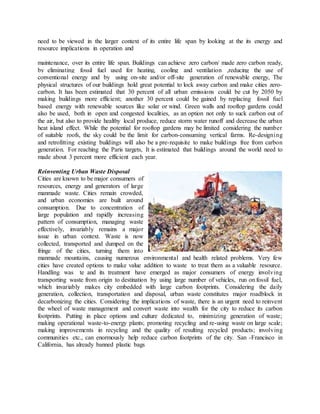
Reinventing Urban Waste Disposal
Cities are known to be major consumers of
resources, energy and generators of large
manmade waste. Cities remain crowded,
and urban economies are built around
consumption. Due to concentration of
large population and rapidly increasing
pattern of consumption, managing waste
effectively, invariably remains a major
issue in urban context. Waste is now
collected, transported and dumped on the
fringe of the cities, turning them into
manmade mountains, causing numerous environmental and health related problems. Very few
cities have created options to make value addition to waste to treat them as a valuable resource.
Handling was te and its treatment have emerged as major consumers of energy involving
transporting waste from origin to destination by using large number of vehicles, run on fossil fuel,
which invariably makes city embedded with large carbon footprints. Considering the daily
generation, collection, transportation and disposal, urban waste constitutes major roadblock in
decarbonizing the cities. Considering the implications of waste, there is an urgent need to reinvent
the wheel of waste management and convert waste into wealth for the city to reduce its carbon
footprints. Putting in place options and culture dedicated to, minimizing generation of waste;
making operational waste-to-energy plants; promoting recycling and re-using waste on large scale;
making improvements in recycling and the quality of resulting recycled products; involving
communities etc., can enormously help reduce carbon footprints of the city. San -Francisco in
California, has already banned plastic bags
and water bottles with the objective to stop sending any waste to landfill. Curitiba in Brazil,
by offering incentives to residents to recycle has achieving a massive 70% recycling rate.
Involving large corporate houses, industrial houses and institutions generating large waste can
help leading the way to reduce waste. Supporting decarbonizing movement, Disney has
committed to achieve - zero emissions; Starbucks is stopping the use of plastic straws and plastic
lids; McDonald’s is switching to more efficient appliances and to recycled materials entirely by
2025. However, it is mandated that cities must come out with an agenda to reduce amount of waste
generated by at least fifteen per cent per capita by 2030, and to reduce the volume of municipal
solid waste sent to landfills or incinerators by at least half, in order to minimize their carbon
footprints. Cities need to reinvent and involve people, communities, CBOs, NGOs and other
stakeholders, to come on a common platform and evolve best of options to make optimum use of
waste generated and to convert waste into energy and other products for meeting essential needs
of people. Cities need to be made zero- waste using mechanism of circular economy.
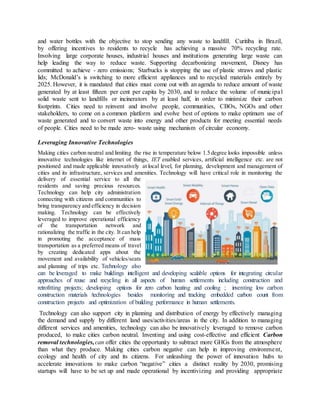
Leveraging Innovative Technologies
Making cities carbon neutral and limiting the rise in temperature below 1.5 degree looks impossible unless
innovative technologies like internet of things, IET enabled services, artificial intelligence etc. are not
positioned and made applicable innovatively at local level, for planning, development and management of
cities and its infrastructure, services and amenities. Technology will have critical role in monitoring the
delivery of essential service to all the
residents and saving precious resources.
Technology can help city administration
connecting with citizens and communities to
bring transparency and efficiency in decision
making. Technology can be effectively
leveraged to improve operational efficiency
of the transportation network and
rationalizing the traffic in the city. It can help
in promoting the acceptance of mass
transportation as a preferred means of travel
by creating dedicated apps about the
movement and availability of vehicles/seats
and planning of trips etc. Technology also
can be leveraged to make buildings intelligent and developing scalable options for integrating circular
approaches of reuse and recycling in all aspects of human settlements including construction and
retrofitting projects; developing options for zero carbon heating and cooling ; inventing low carbon
construction materials /technologies besides monitoring and tracking embedded carbon count from
construction projects and optimization of building performance in human settlements.
Technology can also support city in planning and distribution of energy by effectively managing
the demand and supply by different land uses/activities/areas in the city. In addition to managing
different services and amenities, technology can also be innovatively leveraged to remove carbon
produced, to make cities carbon neutral. Inventing and using cost-effective and efficient Carbon
removal technologies,can offer cities the opportunity to subtract more GHGs from the atmosphere
than what they produce. Making cities carbon negative can help in improving environment,
ecology and health of city and its citizens. For unleashing the power of innovation hubs to
accelerate innovations to make carbon “negative” cities a distinct reality by 2030, promising
startups will have to be set up and made operational by incentivizing and providing appropriate
workspaces and seed funding. Exiting from traditional coal, oil and gas businesses will inevitably
lead to job losses in the fossil fuel industry but it will also lead to creating more employment
opportunities provided by new technologies not only in the shape of new industries established
for producing large quantities of solar cells and batteries, but also by setting up and making
operational decentralized solar systems and wind farms. As against loss of 5 million job in the
fossil fuel sector, 30 million new jobs will be created in the new/emerging technologies and its
application on the ground, by 2050. Technologies are changing rapidly creating spaces for opening
new windows of knowledge, accessibility, information and expertise, which need to be effectively
leveraged in the domain of planning, designing and managing cities; rationalizing traffic and
transportation; minimizing mobility; designing and constructing buildings; managing waste ;
generating green energy from natural/renewable sources. Technology also needs to be effectively
used for making large number of services accessible to the citizens within four walls of their
homes etc., to make cities zero-carbon and carbon neutral enabling them to become better places
to live and work..
Conclusion
Joan Clos , Secretary-General, Habitat III, has stated that; “Considering the enormous threat posed
by global warming, climate change and rising global temperature, nations must look closely at
cities for making a collective and effective response to climate change, Urbanization, he said, is
a powerful accelerator of growth and prosperity. But cities also consume 78 per cent of the world’s
energy and emit substantial portion of the planet’s greenhouse gases (GHGs) that are brought
about by human activities. With this in mind, cities need to increasingly devise strategies and take
action to curb their emissions. In the Third UN Conference on Housing and Sustainable Urban
Development, Habitat III, theme of low-emission development is emerging strongly in the New
Urban Agenda (Habitat III’s proposed outcome document). There is a consensus among world
leaders in favour of promoting environmentally sound and resilient cities and human settlements,
and mitigation of emissions from GHGs. 21 cities, including some of the largest cities in the
world, have already committed to become carbon neutral by becoming members of the Carbon
Neutral Cities Alliance(CNCA). As part of the decarbonization strategy Singapore's has already
evolved Green Plan for 2030 , which provides for; quadruplating solar energy deployment for
achieving 2GWp of solar energy; mandating 80% of new buildings to be ‘Super Low Energy
buildings’ by 2030, with an 80% improvement in energy efficiency levels of 2005 with minimum
of 20% of schools to be carbon neutral by 2030
Looking at the entire context of cities and urbanization, it is possible to avoid 1.5 C global
warming by getting to cost- effective net-zero greenhouse gases emission by 2050, through
production of renewable energies ; removing subsidies on fossil fuels and nuclear energy ;taxing
polluting technologies; promoting electric vehicles ; encouraging decentralized renewables, such
as solar and wind; creating trans- national non-conventional energy grid etc. With the "push" of
the policy and "pull" of the technologies, cities can promote zero- carbon urban infrastructure on
a large scale. However, becoming/achieving zero-carbon will require not only massive changes in
the prevailing pattern of infrastructure; utility generation systems, but will also involve updating
the built environment on regular basis; focusing on energy, mobility, food and waste systems;
connecting with net-zero power grids; promoting circular economy and sustainable agriculture.
Decarbonizing cities will also require initiating dialogue, on continued basis, between researchers
, practitioners, users and all the stakeholders , to find best way-forward and search for best options
to make cities livable and sustainable,
Considering the fact, India ranks high among nations having large carbon footprints, country
needs to work hard and innovate for evolving realistic options to make cities carbon neutral.
Despite the fact, lot of attention is being paid and number of programs have been launched to
minimize the generation of GHGs and make city growth rational and orderly, but the efforts
remains largely confined at the central level. Very little effort is made by the states and local level
authorities existing and operating at urban and rural levels. India has already announced the target
of generating 450GW of solar/wind/geo-thermal energy for meeting the energy needs of the
country. In addition, to addressing the environmental issues; promoting planned and orderly
urban development, creating appropriate/sustainable urban infrastructures; managing solid waste
and providing shelter to all, Government of India has already launched number of city centric
yojnas and missions including, Smart Cities Mission, Jawaharlal Nehru National Urban Renewal
Mission, Swachh Bharat Mission; National Urban Livelihood Mission, HRIDAY ,Atal Mission
for Rejuvenation and Urban Transformation(AMRUT) and Pradhan Mantri Awas Yojana.
However, the impact of these yojnas and missions remains limited and slow. Considering the
rapidly growing population, massive urbanization, rapid migration, haphazard and unplanned
growth and ever rising issues of traffic & transportation and waste management, India needs to
plan and act in a mission mode to achieve the targets defined in Paris Agreement for the year 2030
&2050. In addition to enormous work being done by the central government, states also need to
play pro-active role in empowering urban local bodies and Village Panchayats, to prepare/evolve
specific agenda of making their cities/village carbon neutral. To achieve the defined targets India
must also put in place by 2025, a roadmaps for decarbonizing the new buildings by 2030 and mandating
that all buildings be made net zero by 2050.’; implement policies that promote the responsible production
and consumption of low carbon products. In addition, institutions of higher learning, universities and
professional institution/bodies operating in the country, should also be actively involved and
made part of the mission net-zero. Promoting sustainability and achieving zero carbon should be
made integral part of the study curricula for both lower and higher education for making students
carbon warriors for decarbonizing their local areas. Dedicated funds should be earmarked for
funding different programs, aiming at reducing carbon foot prints. India needs to institutionalize
and adopt a multi-pronged strategy to fight global warming, GHG emissions for achieving carbon-
neutrality by 2030 and make cities safe, resilient, inclusive and sustainable, as mandated in the
SDG11.
Bibliography;
 UN-Habitat: Guiding Principles for City Climate Action Planning: Nairobi: UN-Habitat,
2015
 Heise Michael; How can we make our cities carbon-free ;World Economic Forum; July
4,2014 https://www.weforum.org/agenda/2014/07/growing-green-cities/
 Wikipedia; Zero-carbon city
 www.climate2020.org.uk ›;creating-low-carbon-cities
 Hennessey Guzman; UNESCO: Water and mega cities: September 14, 2016
 https://ecofriendlylink.com/blog/carbon-neutral-cities/
 https://www.greenbiz.com/article/3-ways-cities-go-carbon-negative-2030
 https://insidesources.com/carbon-free-by-205-lofty-goal-or-pie-in-the-sky-for-
washington-and-boston/
 Stewart Emma & Eric Mackres ; The 3 steps to thriving, zero-carbon cities; April 9,
2019.https://www.greenbiz.com/article/3-steps-thriving-zero-carbon-cities
 New York City Mayor’s Office. “New York City’s Pathways to Deep Carbon Reductions.”
December 2013. http://s-media.nyc.gov/agencies/planyc2030/pdf/nyc_pathways.pdf
 New York City. “One City, Built to Last. 2014.
www.nyc.gov/html/builttolast/assets/downloads/pdf/OneCity.pdf
 Carbon Neutral Cities Alliance:Unlocking Climate Action in Megacities.” 2016.
 “Framework for Long-Term Deep Carbon ReductionPlanning.”2015.
http://usdn.org/uploads/cms/documents/cnca-framework-12-16-15.pdf
Author;
Ar Jit Kumar Gupta
#344/40-a, Chandigarh-160036
Former, Director, College of Architecture IET Bhaddal (Pb)
mail-jit.kumar1944@gmail.com

Making our cCties Carbon Free

  • 1.
    OPTIONS FOR MAKINGCITIES ZERO CARBON *Jit Kumar Gupta Introduction Siphoning off the major share, cities of the world are rapidly transforming in terms of, distribution of population; apportioning wealth; promoting economy, generating employment; distributing services, creating amenities; locating institutions; housing means of production, distribution and consumption, of goods and services. Housing more than half of humanity (3.5 billion people) ; with number projected to rise to 5 billion by 2030 and 70 per cent by 2050 , cities are fast emerging as areas of concentration of large population, employment, state of art institutions, wealth and services. While one in eight people live in 33 megacities worldwide, close to half of the world’s urban dwellers reside in much smaller settlements with fewer than 500,000 inhabitants. By 2030, it is estimated that the world will have six out of ten people living in cities, besides having 43 megacities with each housing more than 10 million inhabitants. Most of these megacities will have location in the developing regions of the world. Globally it has also been estimated that 95 per cent of urban expansion in the next decades will take place in developing world with 90 per cent of urban growth forecasted to happen only in Asia and Africa, in the next 30 years. By 2060, more than a billion people, projected at ten per cent of the world's projected population, will be living in low-lying urban coastal areas, with majority housed in developing countries. (UNCH) Cities, largely a manmade conglomerate, remain most complex, most powerful, never defined, never static, ever evolving and ever devolving among human settlements. Occupying just 3 per cent of the earth’s land, providing home to more than 3.5 billion people, cities are known to be responsible for generating as much as 70 -75 per cent of human-induced greenhouse gas emissions. Cities are globally known for their positivities, negativities, dualities and contradictions. Cities are also valued as economic powerhouses and major drivers of economy and generators of wealth for the nations ,
  • 2.
    making large contributionto the world economy and employment. Known for higher order of productivity, 600 major cities of the world generate more than half of global GDP. Looking at the existing and future scenario, urban areas will continue to dictate economy and contribute disproportionately to future wealth creation. Looking at the manner in which cities are structured, operate and grow, If future prosperity of the world is going to be determined by the urban world, then future of the world’s climate, ecology and sustainability will also be dictated, defined and decided by our cities. Generating 70% of the global greenhouse gas emissions and housing more than 55% of global population, cities are adversely impacting global climate. Cities are known to be major actors in climate change; promoting global warming; consuming large energy and natural resources; generating large volume of human induced waste; producing alarmingly high levels of air pollution and generating large carbon emissions from the production of goods and services ; using large amount of fossil-fuel based energy for transportation and heating and cooling of large number of buildings and apartments. As people around the world live increasingly in the urban areas, cities will be at the forefront of any long-term climate solution. Role of cities in making this world more sustainable or unsustainable is likely to increase in the coming decade. Since billions more people will move to make cities their preferred place of residence and work and urbanization driving global economic growth and rapid migration, it will be critical and vital to focus on improving conditions in cities to make them safe, more productive and healthier spaces for people to live in. Considering the entire fabric of cities including their role, importance, structure, operation, growth and development, from the standpoint of both climate change and sustainability, cities represent both a challenge and an opportunity to make this world more sustainable, livable, productive, effective and efficient. Inter-governmental Panel on Climate Change (IPCC)’, in its report, October 2018, has placed critical threshold increase in the earth's average temperature at 1.5 ºC ,as against 2 ºC, specified in the Paris agreement. Crossing this threshold, will lead to nations facing major disasters, both natural and manmade, involving; loss of entire ecosystems and species, melting polar ice caps ; rising sea levels; intense heat waves and droughts besides increased intensity and frequency of extreme weather events. For limiting global warming to 1.5 °C, it would be essential to reduce net global carbon dioxide (CO2) emissions by about forty-five per cent (of 2010 levels) by 2030, and achieve net-zero carbon emissions by 2050. Urbanization Challenges/issues In the face of rapid and massive urbanization, majority of cities are undergoing crisis of infrastructures, development and management. Rapid, unplanned and haphazard
  • 3.
    urbanization is exertingpressure on essential basic infrastructure and services including supply of fresh water, sewage, waste management, transportation and environment. Rapidly growing urban world is experiencing congestion, lack of basic services, shortage of adequate housing, and declining infrastructure. With 828 million people living in slums; half of the global urban population breathing air, that is 2.5 times more polluted than standards defined by the World Health Organization and majority of cities spilling beyond their formal boundaries, leading to unplanned urban sprawl; cities are treading on a path and scripting an agenda, which appears to be detrimental to achieving the global goals for sustainable development. Urban spaces offer enormous opportunities and multiple options for people to prosper economically and socially, only when cities can accommodate people in a sustainable manner. Achieving urban sustainability will be a mirage without significantly transforming the way we plan, develop, build and manage our urban spaces. Making cities sustainable, livable, safe and resilient will mean; creating options for safe, affordable carbon neutral housing; building resilient societies and economies; making public transport green ; efficiently managing waste; providing green infrastructures; creating green public spaces, and making urban planning and management, both participatory and inclusive. The United Nations in 2015 defined and adopted 17 Sustainable Development Goals (SDGs), also known as a universal call for nations across globe , to take actions to end poverty, protect the planet, and ensure that all people enjoy peace and prosperity by the year 2030. To achieve these objectives; UNDP exclusively dedicated Goal 11, to cities and communities to make this planet more inclusive, safe and sustainable. In order to make cities and community resilient and promoters of sustainability, UNDP has mandated nations to achieve following targets;  By 2030, ensure access for all to adequate, safe and affordable housing and basic services and upgrade slums.  By 2030, provide access to safe, affordable, accessible and sustainable transport systems for all, improving road safety, expanding public transport, with focus on women, children, persons with disabilities and older persons.  By 2030, enhance inclusive and sustainable urbanization and capacity for participatory, integrated and sustainable human settlement planning and management.  Strengthen efforts to protect and safeguard the world’s cultural and natural heritage.  By 2030, significantly reduce the number of deaths and the number of people affected and substantially decrease the direct economic losses relative to global gross domestic product caused by disasters, including water-related disasters, with a focus on protecting the poor and people in vulnerable situations.  By 2030, reduce the adverse per capita environmental impact of cities, by paying special attention to air quality and municipal and other waste management.
  • 4.
     By 2030,provide universal access to safe, inclusive and accessible, green and public spaces, in particular for women and children, older persons and persons with disabilities.  Support positive economic, social and environmental links between urban, peri-urban and rural areas by strengthening national and regional development planning.  By 2020, substantially increase the number of cities and human settlements adopting and implementing integrated policies and plans towards inclusion, resource efficiency, mitigation and adaptation to climate change, resilience to disasters, and develop and implement, in line with the Sendai Framework for Disaster Risk Reduction 2015-2030, holistic disaster risk management at all levels. Support least developed countries, through financial and technical assistance, in creating sustainable and resilient buildings utilizing local materials. Approaching Zero Carbon Cities Numerous challenges posed to by rapid growth of cities; unplanned, urbanization; inadequate basic infrastructure etc., can be effectively overcome by creating realistic and rational options for improving optimum use of resource; focusing on reducing pollution and poverty; providing universal access to basic services, housing, transportation; optimizing and reducing energy consumption and adopting green energy systems. Considering enormous potential cities possess, realistic and rational options must be put in place to make cities active partners i n creating solution to climate change. Existing patterns of operation and functioning of cities, remain inappropriate and unsuitable to overcome the climate based crisis. Considering the fact that 75 percent of the urban infrastructures required by 2050, are yet to be built, there exists huge opportunity for decarbonizing the cities , which has genesis in unsustainable consumption pattern involving irrational consumption of large resources; using fossil fuel for meeting the energy demand and generation of huge waste. For promoting global sustainability, cities need to be decarbonized and made zero-energy settlements by empowering them to become more resource- efficient, sustainable and least consumers of energy and resources. Cities need to be reshaped, restructured, replanned, reconstructed, developed and managed innovatively, objectively and rationally, based on an agenda with focus on resources, climate, environment, ecology and sustainability, as defined in SDG11.Studies made and analysis carried out globally, have revealed that, investment made in ‘low-carbon city projects , carry lot of value and create win-win situation both for residents, communities, cities, state, nation and planets. A seminal study by New Climate Economy found that $1 trillion spent per year by cities on low carbon projects, would produce $17 trillion in net present financial value through 2050, just from the energy saving besides economic and social benefits provided by improvements in citizen health, creating jobs, reducing poverty and inequality, reckoned to be many times greater even than the $17 trillion value. Thus, decarbonizing cities will be critical, essential and vital for not only healthy growth and development of humanity but also for making planet earth more safe, livable and sustainable. Evolving a Climate Action Plan; Making city zero -carbon will essentially involve, evolving a climate action plan for each city on priority to be structured around reducing CO2 emissions, increasing resilience, and creating
  • 5.
    awareness to limitglobal warming to 1.5 °C. Unless such a roadmap is prepared and made operational, at local level, making cities zero-carbon shall remain on papers. For preparing city- centric climate action plans, cities need to be empowered with appropriate level of manpower, expertise and resources. State has to play a pro-active role in enabling cities not only to prepare climate action plan but also implement the plan. However, task appears to be both difficult and complex, for majority of cities and nations. Shifting to Renewable Energy; Studies made globally have revealed that majority of CO2 emissions in cities come from just four types of activities involving; power generation; designing, construction and operation of buildings; transportation and waste management. Accordingly, cities following the net-zero carbon route to reduce CO2 emissions, must use the options of; getting rid of use of fossil fuels for urban operations; shift to renewable energy; transition of transport systems- using more electrical/ non-polluting public buses & cleaner private vehicles; promoting highest degree of energy efficiency; implementing decentralized energy systems for the production, distribution and marketing of renewable energy ; designing and constructing green buildings; putting in position sustainable urban infrastructure; smarter management of waste and water, using integrated waste management , promotion of recycling; evolving best of urban design ;using cutting-edge digital technologies; making city planning climate centric; promoting risk management and prevention; strengthening circular and local economy systems; educating all stakeholders for achieving speedier transitions in an orderly and accelerated manner. Emitting carbon by cities has genesis in burning coal, oil and gas for generating and sourcing their energy requirement because almost all human based activities are known to be consumer of energy. All zero-carbon cities, primarily and essentially, have to run entirely on renewable energy; accordingly, making urban settlements zero-carbon and harmless to the planet, cities will require not only sourcing energy exclusively from non-conventional sources but also making/ empowering them to be self-sufficient and self-sustaining in meeting all their energy needs from non-conventional sources. All practices that emit greenhouse gases will have to be removed and replaced from the operation of such cities. For decarbonizing cities, renewable energy must supersede other non-renewable energy sources to become the exclusive source of energy. However, to meet the target of making cities run entirely on renewable energy, not only growth rate of installed capacity of solar photovoltaic systems should be made to exceed that of all other energy sources but also to make new installations and storage of solar photovoltaic and wind energy, both cost-effective and operationally efficient. Promoting optimum use of available urban energy would essentially involve; making it more efficient across all sectors; particularly in buildings and transportation, to achieve zero-carbon cities. Energy efficiency remains the best option because it is easy and cheapest to achieve. Replacing outdated equipment and using efficient lighting like LED lighting has helped in promoting efficiency in use of energy. Cities would need to be incentivized for making transition to clean, zero-carbon energy sources
  • 6.
    for producing electricity,using rooftop solar, and creating centralized systems of solar/wind farm( Emma Stewart & Eric Mackres) . In addition, to making cities sustainable, studies have also found that based on law of averages, the renewable energy system would be about two percent cheaper than the traditional system globally. Global Energy System based on 100% Renewable Energy, has also worked out the most cost-effective energy mix of non-conventional sources of energy comprising of solar power (70 percent), followed by wind power (18 percent), biomass (5 percent) and hydropower (3 percent).However, each nation/city has to work out its own product mix depending upon availability of renewable sources. In Israel, the study and available data show that the country almost needs only solar cells and batteries to meet its energy needs. It could be similar story for many other countries including India, located along the global sun belt. Study made by IEA(International Energy Agency) has concluded that, ‘Reaching net-zero emissions will require investment in clean energy and energy infrastructure to triple by 2030 .Increased investment will help global GDP grow@ 0.4% per year , than the current levels. On the contrary there would be severe risks to the global economy if the world doesn’t act fast enough to promote climate change. Swiss report estimates that missing the Paris Agreement’s goals, could cost world around 10% of global GDP by 2050 due to the adverse impact generated by climate change Planning Zero Carbon Cities Cities have been rated to be responsible for emitting large proportion of the world’s GHGs, and as the world continues to urbanize, cities’ contribution to emissions is going to increase. Urban Planning is known for its role and capacity to make cities least consumers of energy and resources. Size, shape, road pattern, building typologies and physical extent of cities, are known to be major determinants and drivers of their sustainability. City planners need to ensure that planning framework defined should make cities least consumers of energy. Accordingly, cities need to be planned and developed differently and innovatively, based on changing options for landuse planning; reshaping cities; using options of mixed land use planning; opting for transit oriented development; increasing density and height; intensification and densification of cities; promoting brown-field development; building inside and no t outside, to make cities promoters of sustainability. Cities cannot be allowed to melt and expand into infinity with no count of human numbers. Cities need to be planned with care and caution, based on the principles, goals, objectives and approach defined in SDG11. Cities need to be made compact to minimize use of land and travel besides changing means for travel from mechanized to non-mechanized and from polluting to non-polluting options. City need to promote walkability in order to make them human centric. Planning cities need to focus on, ‘planning for people and not for vehicles’, with land-use planning based on, ‘promoting accessibility and not mobility’. Compact cities are known to be most economical to maintain and operate. They are known to minimize the use of mechanized mobility, promote economy in providing and delivering basic and essential services of water supply, sewerage, sanitation, roads, storm water drainage and electricity. In addition to saving land, compact cities provide green spaces on larger scale as compared to traditional cities. By the very nature of planning, shape and size, compact cities are known for their distinct advantages of saving lot of resources minimizing
  • 7.
    use of conventionalenergy, when compared with traditional cities and provide best of the planning options to make cities carbon neutral. Existing cities can also be planned by using a system of decentralized planning for creating compact self-contained neighborhoods to minimize mobility and use of fossil fuel driven vehicles besides lowering their carbon footprints. For making urban planning supportive of de-carbonizing the cities, first version of ‘Guiding Principles for City Climate Action Planning ’ ,has already been published by the ,’The Carbon Neutral Cities Alliance’, and released during the Paris Climate Summit, to put cities on the path of fast trajectory of achieving decarbonization .Guiding principles defined in the action planning include; de-carbonizing electricity; increasing sources of renewable electricity; making urban transport zero-emission ; reducing particulate CO2 emissions; recycling organic waste for reducing landfills and generate clean energy; partnering and collaborating with higher levels of governments, other cities and private sector to meet the defined targets of GHG emissions. For making cities role model of sustainability and carbon neutrality, planning must move away from urban development that is power-hungry and creates ecological risks, towards a new order of urban model that is more productive, safe and generator of least GHG emissions. Pre-requisites for low-carbon and resilient cities should revolve around and based on sound and innovative urban planning, rational and logical legal frameworks and an efficient model of urban finance -that can provide for climate-friendly infrastructures, -while promoting a compact and diverse urban structure in which economic prosperity is encouraged. Transit- oriented development and linear cites can also be explored as planning and development options to promote use of public transport and minimize carbon footprints of the cities besides decentralizing the existing cities and making them self-contained in all basic and essential human needs. Creating appropriate options for working, education, healthcare, leisure, shopping, green spaces, playgrounds etc., at neighbourhood level can also help in reducing intra-city traffic to make cities cleaner and greener. Cities also need to harness the enormous potential of public spaces and parks besides managing public rights of way with landscaping techniques for deploying biochar to create a storehouse for GHGs and make cities carbon negative. For removing carbon from the air, while protecting the city from extreme weather events and sea level rise and providing outdoor recreation area, Coastal cities should promote restoring wetlands and offshore agriculture projects based on “Green Float” concept, for achieving emissions reductions. Creating city forests and using all public spaces, areas along water bodies and low lying /derelict areas, for tree plantation and landscaping on massive scale, can make valuable contribution to promote decarbonization of cities. Redefining and Reinventing urban mobility Mobility remains one of the basic necessities of human living because all human activities of living, working, learning, healthcare, leisure etc. remain travel centric. With cities acting as large
  • 8.
    labour market, effectivenessand operational efficiency of cities is largely contingent upon how quickly and efficiently, human beings, good and services can be made to move from origin and reach/delivered at destination, in the minimum timeframe. If cities have been termed as engines of economic growth, transportation is known to be wheels of the said engine. However, considering the existing pattern of urban growth and development, traffic and travel have emerged as the two worst gifts of urbanization. With rapid urbanization and uncontrolled physical expansion of cities, distances between place of living, working and leisure have increased enormously. Increased distances and increased travel demand, have led to ushering an era of uncontrolled growth of vehicles on the urban roads. Unfortunately, technology used in propelling mechanized means of travel on the urban roads , remains largely fossil fuel centric. Transport systems are known to be not only major consumers of conventional sources but also emitters, promoters and responsible for large greenhouse gasses ( estimated to be, 23% of world energy related GHG emissions) ,with three-quarter coming only from road vehicles. Currently 95% of transport energy comes from petroleum. Energy is consumed both in the making and operation of mechanized vehicles and as such fossil fuel remains embedded in the transport infrastructure. Known to consume large proportion of fossil fuel, traffic and transportation have emerged as the main culprits in making cities unsustainable, promoters of global warming and generators of large carbon footprints because entire mechanism of urban road mobility is based on the use of the conventional fossil fuel. Accordingly, current urban transport models create supportive options of making cities most unsustainable and carbon- friendly. No city on this planet can be made carbon neutral and zero-carbon, unless its mobility pattern is rationalized and travel systems are shifted to alternate non- conventional and non- polluting sources of energy. If genesis of global warming and large carbon footprints of cities is embedded in unsustainable transportation then solutions for decarbonizing cities is also embedded in making transportation options green and supportive of urban environment. In search for finding appropriate solutions to make cities carbon neutral, a multi-pronged strategy will have to evolved. Such a strategy should be driven by not only minimizing the need to travel but also putting in place options for mobility based on non-polluting energy when travel becomes essential. In order to minimize travel, as already stated, urban planning needs to be driven by adopting the principles of, ‘planning for people and not vehicles, and ‘promoting accessibility not mobility’, which can be achieved by changing the typologies and pattern of planning by making cities both compact and cities as spaces of short distances. Compact cities are known for their inherent quality of creating ideal conditions to encourage walking or cycling. Good cycling infrastructure, bike parking and dedicated cycle lanes help make people feel safe and encourage cycling. Decarbonizing cities will require limiting the number of cars within the city and moving/shifting people to more economical, efficient and eco-friendly system of mass transportation. Cars, now being used as a preferred means of urban transport, remain most inefficient among mechanized system in terms of consumption of fossil fuel and number of persons transported. For promoting green transportation, cities will have to get rid of vehicles using fossil- fuels and replaced by battery-powered and auto piloted personal rapid transit systems (PRT). 20 percent reduction in carbon footprints can be achieved simply by making operational, effective
  • 9.
    and efficient publictransportation systems or switching out personal cars for drive- shares/carpooling.For reducing carbon footprints, transport vehicles will need to run on batteries or hydrogen-fuel cells and not using any diesel or petrol.Copenhagen has already mandated to perform 75% of city journeys made by using bicycle or public transport. Making public transport reasonably-priced, will encourages people leaving cars at home. Increased viability of electric vehicles will help accelerate transition. City of London has already invested heavily in making operational electric buses . Restricting non-essential traffic from cities or introducing a charge to enter cities will help in accelerated use of public transport for intra-city travel. For limiting the number of private vehicles, visitors to the city must be made to park their cars outside the city on the fringe and made to use public transport. Electrification of private and public transport, and the deployment of electrical vehicles will remain critical and valuable to reduce carbon footprints of the cities. Making Buildings Green Consuming large amount of water, wood, steel, energy, resources and generating construction and demolition waste, buildings are known to contribute more than one-third (39%) of global greenhouse gas emissions, including 28% as operational emissions and 11% in building materials and construction. Considering the rapid growth of population, massive migration and rapid urbanization, global building floorspace are projected to double by 2060. Looking at the addition of large building footprints, energy and environment implications of built environment are going to be enormous. Occupying large urban spaces and constituting manmade environment, buildings are known to be major determinant of urban sustainability. Looking at the role and context, decarbonizing buildings will be most critical to achieve the Paris climate goal of net zero emissions by 2050. Decarbonizing buildings will require adopting rational policies and programs; creating a supportive legal framework; creating awareness among professionals involved in planning, designing, construction and maintenance of buildings; involving industry, promoters, developers and other stakeholders in the building industry etc. to ensure that all new buildings, are constructed to the highest environmental standards for reducing their carbon emissions to net-zero by 2030 – with the measure applying to all buildings by 2050. Efficient, zero-carbon buildings take advantage of available, cost-effective technologies to reduce emissions while increasing health, equity and economic prosperity in local communities. Planning zero-carbon buildings should essentially involve and revolve around considerations of prevailing climate at regional, city and site levels; intimate study of orientation, movement of sun and flow of wind; prevailing flora and fauna; local culture; designing with nature and using natural sources of energy, reducing the use of high global warming potential refrigerants and using low-carbon, reused or recycled materials in construction; using materials in natural form available at local level and materials made form waste; using state of art, cost-effective and energy efficient construction technologies; using skilled manpower etc. In addition to looking at the initial construction cost, buildings also
  • 10.
    need to beviewed in the larger context of its entire life span by looking at the its energy and resource implications in operation and maintenance, over its entire life span. Buildings can achieve zero carbon/ made zero carbon ready, by eliminating fossil fuel used for heating, cooling and ventilation ,reducing the use of conventional energy and by using on-site and/or off-site generation of renewable energy, The physical structures of our buildings hold great potential to lock away carbon and make cities zero- carbon. It has been estimated that 30 percent of all urban emissions could be cut by 2050 by making buildings more efficient; another 30 percent could be gained by replacing fossil fuel based energy with renewable sources like solar or wind. Green walls and rooftop gardens could also be used, both in open and congested localities, as an option not only to suck carbon out of the air, but also to provide healthy local produce, reduce storm water runoff and decrease the urban heat island effect. While the potential for rooftop gardens may be limited considering the number of suitable roofs, the sky could be the limit for carbon-consuming vertical farms. Re-designing and retrofitting existing buildings will also be a pre-requisite to make buildings free from carbon generation. For reaching the Paris targets, It is estimated that buildings around the world need to made about 3 percent more efficient each year. Reinventing Urban Waste Disposal Cities are known to be major consumers of resources, energy and generators of large manmade waste. Cities remain crowded, and urban economies are built around consumption. Due to concentration of large population and rapidly increasing pattern of consumption, managing waste effectively, invariably remains a major issue in urban context. Waste is now collected, transported and dumped on the fringe of the cities, turning them into manmade mountains, causing numerous environmental and health related problems. Very few cities have created options to make value addition to waste to treat them as a valuable resource. Handling was te and its treatment have emerged as major consumers of energy involving transporting waste from origin to destination by using large number of vehicles, run on fossil fuel, which invariably makes city embedded with large carbon footprints. Considering the daily generation, collection, transportation and disposal, urban waste constitutes major roadblock in decarbonizing the cities. Considering the implications of waste, there is an urgent need to reinvent the wheel of waste management and convert waste into wealth for the city to reduce its carbon footprints. Putting in place options and culture dedicated to, minimizing generation of waste; making operational waste-to-energy plants; promoting recycling and re-using waste on large scale; making improvements in recycling and the quality of resulting recycled products; involving communities etc., can enormously help reduce carbon footprints of the city. San -Francisco in California, has already banned plastic bags
  • 11.
    and water bottleswith the objective to stop sending any waste to landfill. Curitiba in Brazil, by offering incentives to residents to recycle has achieving a massive 70% recycling rate. Involving large corporate houses, industrial houses and institutions generating large waste can help leading the way to reduce waste. Supporting decarbonizing movement, Disney has committed to achieve - zero emissions; Starbucks is stopping the use of plastic straws and plastic lids; McDonald’s is switching to more efficient appliances and to recycled materials entirely by 2025. However, it is mandated that cities must come out with an agenda to reduce amount of waste generated by at least fifteen per cent per capita by 2030, and to reduce the volume of municipal solid waste sent to landfills or incinerators by at least half, in order to minimize their carbon footprints. Cities need to reinvent and involve people, communities, CBOs, NGOs and other stakeholders, to come on a common platform and evolve best of options to make optimum use of waste generated and to convert waste into energy and other products for meeting essential needs of people. Cities need to be made zero- waste using mechanism of circular economy. Leveraging Innovative Technologies Making cities carbon neutral and limiting the rise in temperature below 1.5 degree looks impossible unless innovative technologies like internet of things, IET enabled services, artificial intelligence etc. are not positioned and made applicable innovatively at local level, for planning, development and management of cities and its infrastructure, services and amenities. Technology will have critical role in monitoring the delivery of essential service to all the residents and saving precious resources. Technology can help city administration connecting with citizens and communities to bring transparency and efficiency in decision making. Technology can be effectively leveraged to improve operational efficiency of the transportation network and rationalizing the traffic in the city. It can help in promoting the acceptance of mass transportation as a preferred means of travel by creating dedicated apps about the movement and availability of vehicles/seats and planning of trips etc. Technology also can be leveraged to make buildings intelligent and developing scalable options for integrating circular approaches of reuse and recycling in all aspects of human settlements including construction and retrofitting projects; developing options for zero carbon heating and cooling ; inventing low carbon construction materials /technologies besides monitoring and tracking embedded carbon count from construction projects and optimization of building performance in human settlements. Technology can also support city in planning and distribution of energy by effectively managing the demand and supply by different land uses/activities/areas in the city. In addition to managing different services and amenities, technology can also be innovatively leveraged to remove carbon produced, to make cities carbon neutral. Inventing and using cost-effective and efficient Carbon removal technologies,can offer cities the opportunity to subtract more GHGs from the atmosphere than what they produce. Making cities carbon negative can help in improving environment, ecology and health of city and its citizens. For unleashing the power of innovation hubs to accelerate innovations to make carbon “negative” cities a distinct reality by 2030, promising startups will have to be set up and made operational by incentivizing and providing appropriate
  • 12.
    workspaces and seedfunding. Exiting from traditional coal, oil and gas businesses will inevitably lead to job losses in the fossil fuel industry but it will also lead to creating more employment opportunities provided by new technologies not only in the shape of new industries established for producing large quantities of solar cells and batteries, but also by setting up and making operational decentralized solar systems and wind farms. As against loss of 5 million job in the fossil fuel sector, 30 million new jobs will be created in the new/emerging technologies and its application on the ground, by 2050. Technologies are changing rapidly creating spaces for opening new windows of knowledge, accessibility, information and expertise, which need to be effectively leveraged in the domain of planning, designing and managing cities; rationalizing traffic and transportation; minimizing mobility; designing and constructing buildings; managing waste ; generating green energy from natural/renewable sources. Technology also needs to be effectively used for making large number of services accessible to the citizens within four walls of their homes etc., to make cities zero-carbon and carbon neutral enabling them to become better places to live and work.. Conclusion Joan Clos , Secretary-General, Habitat III, has stated that; “Considering the enormous threat posed by global warming, climate change and rising global temperature, nations must look closely at cities for making a collective and effective response to climate change, Urbanization, he said, is a powerful accelerator of growth and prosperity. But cities also consume 78 per cent of the world’s energy and emit substantial portion of the planet’s greenhouse gases (GHGs) that are brought about by human activities. With this in mind, cities need to increasingly devise strategies and take action to curb their emissions. In the Third UN Conference on Housing and Sustainable Urban Development, Habitat III, theme of low-emission development is emerging strongly in the New Urban Agenda (Habitat III’s proposed outcome document). There is a consensus among world leaders in favour of promoting environmentally sound and resilient cities and human settlements, and mitigation of emissions from GHGs. 21 cities, including some of the largest cities in the world, have already committed to become carbon neutral by becoming members of the Carbon Neutral Cities Alliance(CNCA). As part of the decarbonization strategy Singapore's has already evolved Green Plan for 2030 , which provides for; quadruplating solar energy deployment for achieving 2GWp of solar energy; mandating 80% of new buildings to be ‘Super Low Energy buildings’ by 2030, with an 80% improvement in energy efficiency levels of 2005 with minimum of 20% of schools to be carbon neutral by 2030 Looking at the entire context of cities and urbanization, it is possible to avoid 1.5 C global warming by getting to cost- effective net-zero greenhouse gases emission by 2050, through production of renewable energies ; removing subsidies on fossil fuels and nuclear energy ;taxing polluting technologies; promoting electric vehicles ; encouraging decentralized renewables, such as solar and wind; creating trans- national non-conventional energy grid etc. With the "push" of the policy and "pull" of the technologies, cities can promote zero- carbon urban infrastructure on a large scale. However, becoming/achieving zero-carbon will require not only massive changes in the prevailing pattern of infrastructure; utility generation systems, but will also involve updating the built environment on regular basis; focusing on energy, mobility, food and waste systems; connecting with net-zero power grids; promoting circular economy and sustainable agriculture.
  • 13.
    Decarbonizing cities willalso require initiating dialogue, on continued basis, between researchers , practitioners, users and all the stakeholders , to find best way-forward and search for best options to make cities livable and sustainable, Considering the fact, India ranks high among nations having large carbon footprints, country needs to work hard and innovate for evolving realistic options to make cities carbon neutral. Despite the fact, lot of attention is being paid and number of programs have been launched to minimize the generation of GHGs and make city growth rational and orderly, but the efforts remains largely confined at the central level. Very little effort is made by the states and local level authorities existing and operating at urban and rural levels. India has already announced the target of generating 450GW of solar/wind/geo-thermal energy for meeting the energy needs of the country. In addition, to addressing the environmental issues; promoting planned and orderly urban development, creating appropriate/sustainable urban infrastructures; managing solid waste and providing shelter to all, Government of India has already launched number of city centric yojnas and missions including, Smart Cities Mission, Jawaharlal Nehru National Urban Renewal Mission, Swachh Bharat Mission; National Urban Livelihood Mission, HRIDAY ,Atal Mission for Rejuvenation and Urban Transformation(AMRUT) and Pradhan Mantri Awas Yojana. However, the impact of these yojnas and missions remains limited and slow. Considering the rapidly growing population, massive urbanization, rapid migration, haphazard and unplanned growth and ever rising issues of traffic & transportation and waste management, India needs to plan and act in a mission mode to achieve the targets defined in Paris Agreement for the year 2030 &2050. In addition to enormous work being done by the central government, states also need to play pro-active role in empowering urban local bodies and Village Panchayats, to prepare/evolve specific agenda of making their cities/village carbon neutral. To achieve the defined targets India must also put in place by 2025, a roadmaps for decarbonizing the new buildings by 2030 and mandating that all buildings be made net zero by 2050.’; implement policies that promote the responsible production and consumption of low carbon products. In addition, institutions of higher learning, universities and professional institution/bodies operating in the country, should also be actively involved and made part of the mission net-zero. Promoting sustainability and achieving zero carbon should be made integral part of the study curricula for both lower and higher education for making students carbon warriors for decarbonizing their local areas. Dedicated funds should be earmarked for funding different programs, aiming at reducing carbon foot prints. India needs to institutionalize and adopt a multi-pronged strategy to fight global warming, GHG emissions for achieving carbon- neutrality by 2030 and make cities safe, resilient, inclusive and sustainable, as mandated in the SDG11. Bibliography;  UN-Habitat: Guiding Principles for City Climate Action Planning: Nairobi: UN-Habitat, 2015  Heise Michael; How can we make our cities carbon-free ;World Economic Forum; July 4,2014 https://www.weforum.org/agenda/2014/07/growing-green-cities/  Wikipedia; Zero-carbon city  www.climate2020.org.uk ›;creating-low-carbon-cities  Hennessey Guzman; UNESCO: Water and mega cities: September 14, 2016  https://ecofriendlylink.com/blog/carbon-neutral-cities/
  • 14.
     https://www.greenbiz.com/article/3-ways-cities-go-carbon-negative-2030  https://insidesources.com/carbon-free-by-205-lofty-goal-or-pie-in-the-sky-for- washington-and-boston/ Stewart Emma & Eric Mackres ; The 3 steps to thriving, zero-carbon cities; April 9, 2019.https://www.greenbiz.com/article/3-steps-thriving-zero-carbon-cities  New York City Mayor’s Office. “New York City’s Pathways to Deep Carbon Reductions.” December 2013. http://s-media.nyc.gov/agencies/planyc2030/pdf/nyc_pathways.pdf  New York City. “One City, Built to Last. 2014. www.nyc.gov/html/builttolast/assets/downloads/pdf/OneCity.pdf  Carbon Neutral Cities Alliance:Unlocking Climate Action in Megacities.” 2016.  “Framework for Long-Term Deep Carbon ReductionPlanning.”2015. http://usdn.org/uploads/cms/documents/cnca-framework-12-16-15.pdf Author; Ar Jit Kumar Gupta #344/40-a, Chandigarh-160036 Former, Director, College of Architecture IET Bhaddal (Pb) mail-jit.kumar1944@gmail.com