Nottingham City, Meadows Ozone Project An area based approach, developing sustainable energy communities
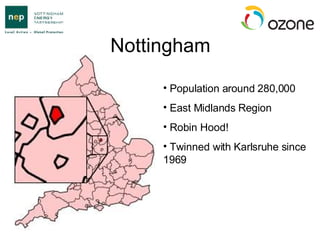
Nottingham Population around 280,000 East Midlands Region Robin Hood! Twinned with Karlsruhe since 1969
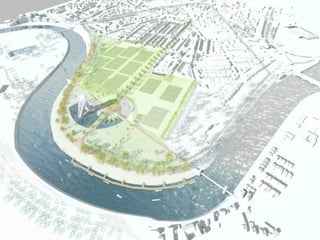
What is the Ozone National Lottery Funding bid lead by Nottingham City Council for £38m. Built around regenerating a rundown inner city park and creation of community facilities Headline aims: Lowering the carbon footprint of the Meadows Community Creating training and learning opportunities Revitalising Victoria Embankment Park area as a community resource Health Improvements ( through park sport facilities ) Generating low cost heat and power to Meadows Community
Our role To assess the possible scope in moving this community towards low carbon - targets To identify opportunities for sustainable energy technologies + their integration into social and economic regeneration. To develop programmes and tools to enable community to reduce its carbon footprint.
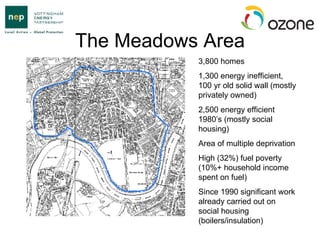
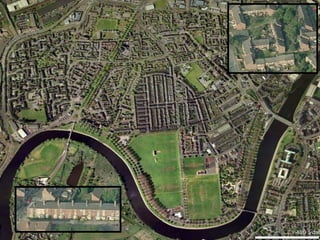
The Meadows Area 3,800 homes 1,300 energy inefficient, 100 yr old solid wall (mostly privately owned) 2,500 energy efficient 1980’s (mostly social housing) Area of multiple deprivation High (32%) fuel poverty (10%+ household income spent on fuel) Since 1990 significant work already carried out on social housing (boilers/insulation)
 
Why The Meadows area UK target- 60% CO2 reduction on 1990 by 2050  Building regulations and planning- all new housing to Zero Carbon by 2016 60% of current housing stock will still be here in 2050. Mixture of new + old housing, social + private ownership Greater appetite for energy/money saving measures Need to support communities to adapt, especially low income. Global/national issue reduced to a manageable scale. Local social pressure and empowerment, identity + cohesion.
Lots of data needed Range/distribution of property types Range/distribution of tenancy types Renewable resource potential in area Renewables supply chain potential Relevant National domestic funding streams Energy assessment of typical property types Suitable domestic carbon saving measures Potential carbon savings from all applicable measures Carbon savings already made since 1990 Total potential carbon savings and costs Community consultation/involvement on options
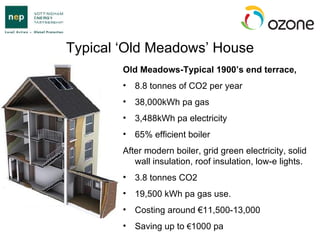
Typical ‘Old Meadows’ House Old Meadows-Typical 1900’s end terrace, 8.8 tonnes of CO2 per year 38,000kWh pa gas 3,488kWh pa electricity 65% efficient boiler After modern boiler, grid green electricity, solid wall insulation, roof insulation, low-e lights. 3.8 tonnes CO2  19,500 kWh pa gas use. Costing around  € 11,500-13,000 Saving up to  € 1000 pa
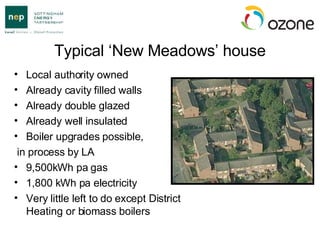
Typical ‘New Meadows’ house Local authority owned Already cavity filled walls Already double glazed Already well insulated Boiler upgrades possible, in process by LA 9,500kWh pa gas 1,800 kWh pa electricity Very little left to do except District Heating or biomass boilers
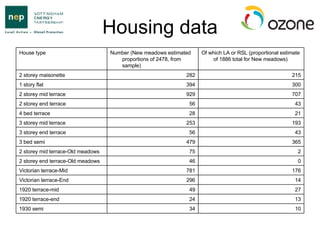
Housing data 10 34 1930 semi 13 24 1920 terrace-end 27 49 1920 terrace-mid 14 296 Victorian terrace-End 176 781 Victorian terrace-Mid 0 46 2 storey end terrace-Old meadows 2 75 2 storey mid terrace-Old meadows 365 479 3 bed semi 43 56 3 storey end terrace 193 253 3 storey mid terrace 21 28 4 bed terrace 43 56 2 storey end terrace 707 929 2 storey mid terrace 300 394 1 story flat 215 282 2 storey maisonette Of which LA or RSL (proportional estimate of 1886 total for New meadows) Number (New meadows estimated proportions of 2478, from sample) House type
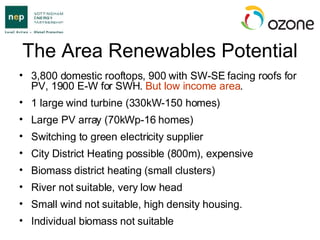
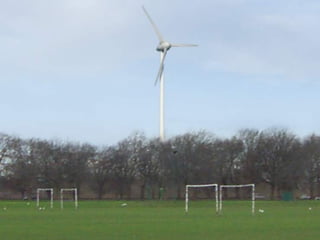
The Area Renewables Potential 3,800 domestic rooftops, 900 with SW-SE facing roofs for PV, 1900 E-W for SWH.  But low income area . 1 large wind turbine (330kW-150 homes) Large PV array (70kWp-16 homes) Switching to green electricity supplier City District Heating possible (800m), expensive Biomass district heating (small clusters) River not suitable, very low head Small wind not suitable, high density housing. Individual biomass not suitable
 
Energy efficiency opportunities Boiler and control upgrades covered by building regulations; people just repair though, don’t replace. Access to financing/grants as and when needed. Loft insulation Solid wall insulation, expensive and disruptive, needs to be done as and when possible. Access to financing/grants. Energy efficient appliances-affordable financing needed Education
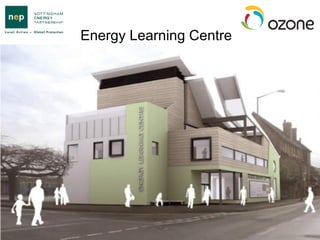
Programmes to suit community Turbine revenue to fund Community Energy Manager, who will work towards setting up a community energy company with energy industry partner. Set up local Energy Learning Centre linked with community training  and schools Local refurbished (almost!) Zero Carbon exemplar house. Later turbine subsidises a green electricity switch incentive fund.  Green loans programme 0%/low interest finance for renewables and energy efficiency measures. Interest rebated annually.  Local energy advisor/visitor
Achievable target Realistically (without buying everyone SWH and dry lining) likely to be able to reduce footprint by around 44% on 1990 Intensive education maybe a little more District heating could push this further, major investment. Community biomass also with major investment.
Energy Learning Centre
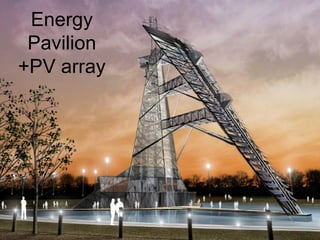
Energy Pavilion +PV array
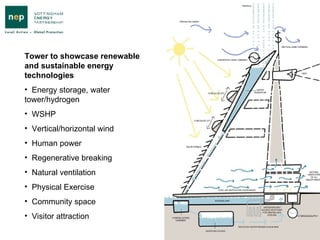
Tower to showcase renewable and sustainable energy technologies Energy storage, water tower/hydrogen WSHP Vertical/horizontal wind Human power Regenerative breaking Natural ventilation Physical Exercise Community space Visitor attraction
 
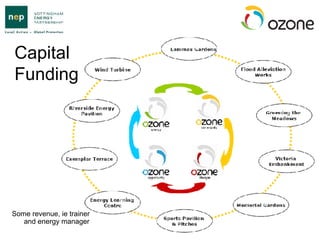
Capital Funding Some revenue, ie trainer and energy manager
Revenue funding Seeking partners for IEE bid to establish a Sustainable Energy Community. Fund local energy advisors/champions and volunteer programme. With NEA + local community to develop a Community Energy Company to sell green electricity and manage loans for energy efficiency locally, with energy company partner. Results of capital bid known in November

P7_Baddley

  • 1.
    Nottingham City, MeadowsOzone Project An area based approach, developing sustainable energy communities
  • 2.
    Nottingham Population around280,000 East Midlands Region Robin Hood! Twinned with Karlsruhe since 1969
  • 3.
    What is theOzone National Lottery Funding bid lead by Nottingham City Council for £38m. Built around regenerating a rundown inner city park and creation of community facilities Headline aims: Lowering the carbon footprint of the Meadows Community Creating training and learning opportunities Revitalising Victoria Embankment Park area as a community resource Health Improvements ( through park sport facilities ) Generating low cost heat and power to Meadows Community
  • 4.
    Our role Toassess the possible scope in moving this community towards low carbon - targets To identify opportunities for sustainable energy technologies + their integration into social and economic regeneration. To develop programmes and tools to enable community to reduce its carbon footprint.
  • 5.
    The Meadows Area3,800 homes 1,300 energy inefficient, 100 yr old solid wall (mostly privately owned) 2,500 energy efficient 1980’s (mostly social housing) Area of multiple deprivation High (32%) fuel poverty (10%+ household income spent on fuel) Since 1990 significant work already carried out on social housing (boilers/insulation)
  • 6.
  • 7.
    Why The Meadowsarea UK target- 60% CO2 reduction on 1990 by 2050 Building regulations and planning- all new housing to Zero Carbon by 2016 60% of current housing stock will still be here in 2050. Mixture of new + old housing, social + private ownership Greater appetite for energy/money saving measures Need to support communities to adapt, especially low income. Global/national issue reduced to a manageable scale. Local social pressure and empowerment, identity + cohesion.
  • 8.
    Lots of dataneeded Range/distribution of property types Range/distribution of tenancy types Renewable resource potential in area Renewables supply chain potential Relevant National domestic funding streams Energy assessment of typical property types Suitable domestic carbon saving measures Potential carbon savings from all applicable measures Carbon savings already made since 1990 Total potential carbon savings and costs Community consultation/involvement on options
  • 9.
    Typical ‘Old Meadows’House Old Meadows-Typical 1900’s end terrace, 8.8 tonnes of CO2 per year 38,000kWh pa gas 3,488kWh pa electricity 65% efficient boiler After modern boiler, grid green electricity, solid wall insulation, roof insulation, low-e lights. 3.8 tonnes CO2 19,500 kWh pa gas use. Costing around € 11,500-13,000 Saving up to € 1000 pa
  • 10.
    Typical ‘New Meadows’house Local authority owned Already cavity filled walls Already double glazed Already well insulated Boiler upgrades possible, in process by LA 9,500kWh pa gas 1,800 kWh pa electricity Very little left to do except District Heating or biomass boilers
  • 11.
    Housing data 1034 1930 semi 13 24 1920 terrace-end 27 49 1920 terrace-mid 14 296 Victorian terrace-End 176 781 Victorian terrace-Mid 0 46 2 storey end terrace-Old meadows 2 75 2 storey mid terrace-Old meadows 365 479 3 bed semi 43 56 3 storey end terrace 193 253 3 storey mid terrace 21 28 4 bed terrace 43 56 2 storey end terrace 707 929 2 storey mid terrace 300 394 1 story flat 215 282 2 storey maisonette Of which LA or RSL (proportional estimate of 1886 total for New meadows) Number (New meadows estimated proportions of 2478, from sample) House type
  • 12.
    The Area RenewablesPotential 3,800 domestic rooftops, 900 with SW-SE facing roofs for PV, 1900 E-W for SWH. But low income area . 1 large wind turbine (330kW-150 homes) Large PV array (70kWp-16 homes) Switching to green electricity supplier City District Heating possible (800m), expensive Biomass district heating (small clusters) River not suitable, very low head Small wind not suitable, high density housing. Individual biomass not suitable
  • 13.
  • 14.
    Energy efficiency opportunitiesBoiler and control upgrades covered by building regulations; people just repair though, don’t replace. Access to financing/grants as and when needed. Loft insulation Solid wall insulation, expensive and disruptive, needs to be done as and when possible. Access to financing/grants. Energy efficient appliances-affordable financing needed Education
  • 15.
    Programmes to suitcommunity Turbine revenue to fund Community Energy Manager, who will work towards setting up a community energy company with energy industry partner. Set up local Energy Learning Centre linked with community training and schools Local refurbished (almost!) Zero Carbon exemplar house. Later turbine subsidises a green electricity switch incentive fund. Green loans programme 0%/low interest finance for renewables and energy efficiency measures. Interest rebated annually. Local energy advisor/visitor
  • 16.
    Achievable target Realistically(without buying everyone SWH and dry lining) likely to be able to reduce footprint by around 44% on 1990 Intensive education maybe a little more District heating could push this further, major investment. Community biomass also with major investment.
  • 17.
  • 18.
  • 19.
    Tower to showcaserenewable and sustainable energy technologies Energy storage, water tower/hydrogen WSHP Vertical/horizontal wind Human power Regenerative breaking Natural ventilation Physical Exercise Community space Visitor attraction
  • 20.
  • 21.
    Capital Funding Somerevenue, ie trainer and energy manager
  • 22.
    Revenue funding Seekingpartners for IEE bid to establish a Sustainable Energy Community. Fund local energy advisors/champions and volunteer programme. With NEA + local community to develop a Community Energy Company to sell green electricity and manage loans for energy efficiency locally, with energy company partner. Results of capital bid known in November