Strategic Planning Responses to City Vulnerability 3rd International Urban Design Conference August 2010 - National Convention Centre, Canberra Darren Bilsborough, Director of Sustainability A-P Adjunct Professor of Sustainability, Curtin University
More potential problems than you can poke a stick at relating to:- City Vulnerability Identifying the issues Climate Change Global Population and Consumption  Leading to Resource Depletion and;- Peak Oil Peak Water Peak Food Pollution (air, water and soil) Health and Well Being (future liabilities)
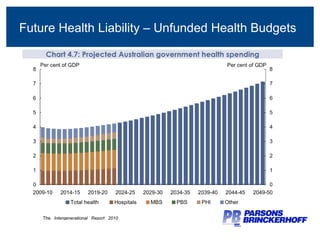
Future Health Liability Future Health Liability – Unfunded Health Budgets
PB-CUSP Alliance Research Costs to government $86 million (or approximately $80,000 per block) – or the cost to provide power, water, sewerage, schools, hospitals and local government services for fringe developments. Road infrastructure is the most significant cost. Cost to people $250 million in transport costs over 50 years – people in fringe developments drive more frequently and own more cars $ 4.23 million in health costs – people in fringe developments have higher risk of obesity related to lower levels of physical activity for people. Cost to the planet 4,400 tons of greenhouse gas is saved for 1,000 urban dwellings, which is roughly equal to the amount emitted from 200 homes – an estimated dollar value of approximately $19.32 million. Productivity Opportunity A 6% improvement in productivity due to active travel Lifestyle. PB-CUSP Alliance Research
Status Quo Melbourne @ 5 million Will cost  $110,080,000,000  extra over 50 years assuming that half of all future housing is built on the periphery of Melbourne PB-CUSP Alliance Research
New Ways Needed – A Change in Direction Sustainable Energy Future Urban Form Sustainable Land Use (how to grow?) Green Buildings (next steps) Sustainable Transport Biophillic city concept Planning Responses
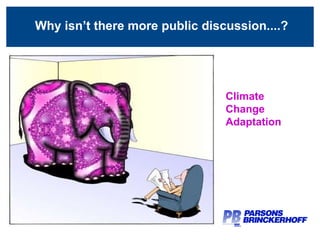
The Elephant in the Room Climate Change Adaptation Why isn’t there more public discussion....?
Planning Responses New Ways Needed – A Change in Direction Sustainable Built Form and Land Use Fewer cars (less roads), more public transport…..pedestrian and cycling priorities
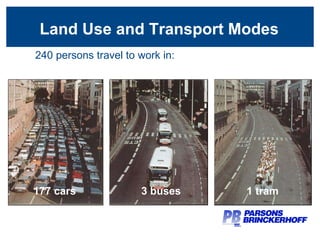
240 persons travel to work in: 177 cars    3 buses  1 tram Land Use and Transport Modes
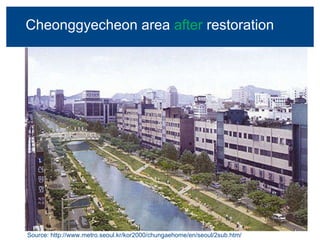
Green Transport infrastructure? A number of cities in US and elsewhere now  pulling down inner city expressways New concept in the US of  “Road Diet”   – removing some traffic lanes to limit traffic flows and speeds to environmental capacity Singapore, London, Stockholm  congestion charging   and other cities looking at following Roadspace is increasingly being allocated to  public transport, bicycles and other small vehicles Big investments are being made in public transport Green Transport infrastructure?
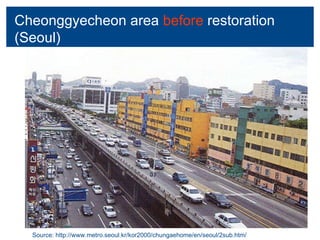
Cheonggyecheon area  before  restoration (Seoul) Source: http://www.metro.seoul.kr/kor2000/chungaehome/en/seoul/2sub.htm/ Cheonggyecheon area  before  restoration (Seoul)
Cheonggyecheon area after restoration Source: http://www.metro.seoul.kr/kor2000/chungaehome/en/seoul/2sub.htm/ Cheonggyecheon area  after  restoration
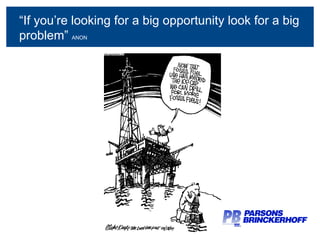
“ If you’re looking for a big opportunity look for a big problem”  ANON
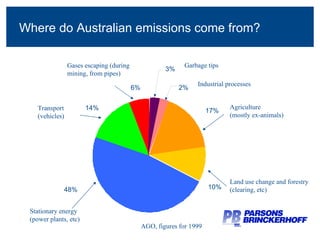
Where do Australian emissions come from? 48% 14% Stationary energy (power plants, etc) Transport (vehicles) AGO, figures for 1999 6% 3% 2% Garbage tips Industrial processes Gases escaping (during mining, from pipes) 17% 10% Land use change and forestry (clearing ,  etc) Agriculture  (mostly ex-animals)
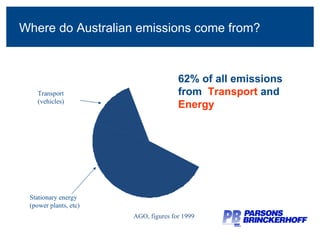
Where do Australian emissions come from? Stationary energy (power plants, etc) Transport (vehicles) AGO, figures for 1999 62%   of all emissions from  Transport   and   Energy
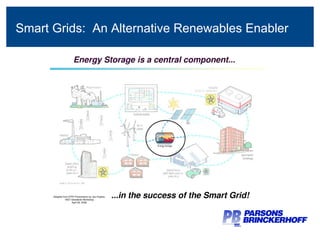
Smart Grids:  An Alternative Renewables Enabler
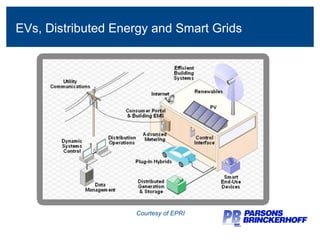
EVs, Distributed Energy and Smart Grids Courtesy of EPRI
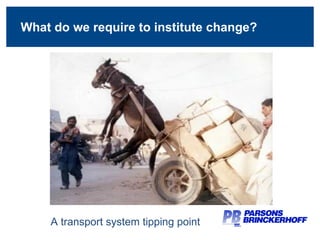
A Tipping Point? What do we require to institute change? A transport system tipping point
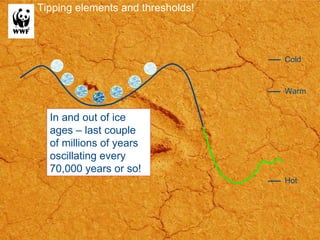
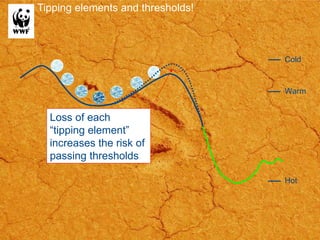
Tipping elements and thresholds! In and out of ice ages – last couple of millions of years oscillating every 70,000 years or so! Cold Warm Hot
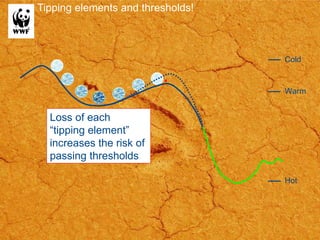
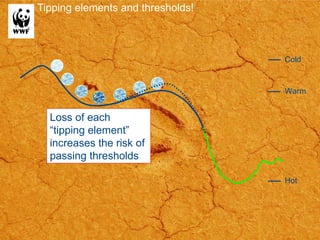
Tipping elements and thresholds! Cold Warm Hot Loss of each “tipping element” increases the risk of passing thresholds
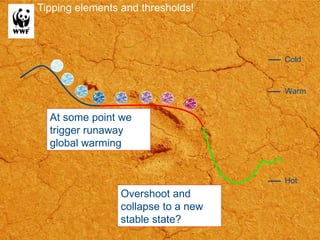
Tipping elements and thresholds! Cold Warm Hot At some point we trigger runaway global warming Overshoot and collapse to a new stable state?
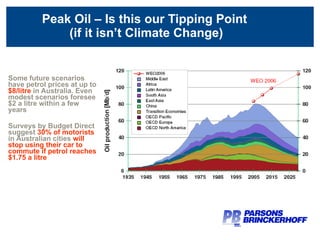
Peak Oil – Is this our Tipping Point  (if it isn’t Climate Change) Some future scenarios have petrol prices at up to  $8/litre  in Australia. Even modest scenarios foresee $2 a litre within a few years Surveys by Budget Direct suggest  30% of motorists  in Australian cities  will stop using their car to commute if petrol reaches $1.75 a litre
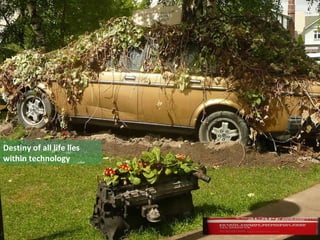
Destiny of all life lies within technology
 
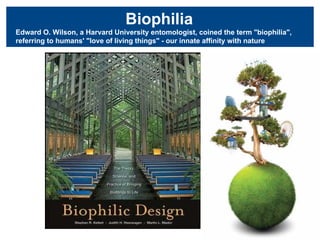
What is Biophilia?  Biophilia   Edward O. Wilson, a Harvard University entomologist, coined the term "biophilia", referring to humans' "love of living things" - our innate affinity with nature
The Biophilic City Concept  Increase Biodiversity and Stabilise Ecological Systems
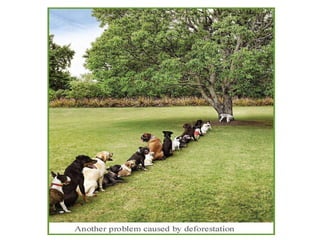
Deforestation
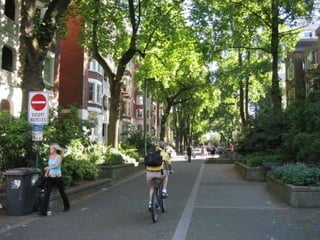
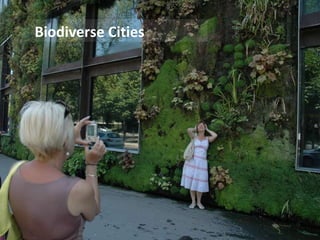
Biodiverse Cities
 
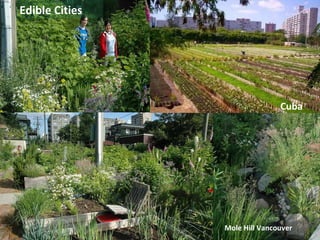
The Biophilic City Concept  Increase Biodiversity and Stabilise Ecological Systems Introduction of Urban Farming (including Vertical Farms) Catering for Local Food Requirements and Reduction in Food Miles
Mole Hill Vancouver Edible Cities Cuba
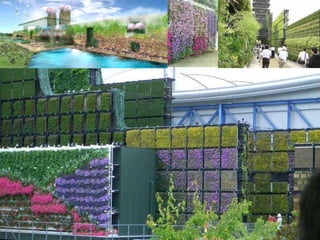
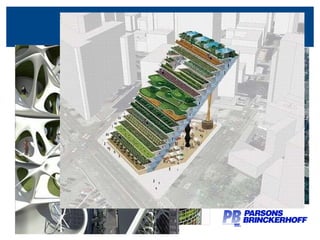
Vertical Farms
The Biophilic City Concept  Increase Biodiversity and Stabilise Ecological Systems Introduction of Urban Farming (including Vertical Farms) Catering for Local Food Requirements and Reduction in Food Miles Improvement in Water Management, Efficiency and Recycling Decreased Energy Intensity through Reduced Heat Island Effect – Consideration of Climate Change Adaptation due to ▲ ºC into the Future Improved Health and Well Being (Biophilia and Reduced Pollution) and Associated Productivity Improvements Bio-sequestration of Legacy CO²
Conclusions  New Ways Needed – A Change in Direction Sustainable Built Form and Land Use Fewer cars (less roads), more public transport…..pedestrian and cycling priorities Urban growth containment Transit Oriented Development (TODS, PODS, CODS and GODS) Urban farming, local food supply Biophilic cities

3rd Int Urban Design Conf

  • 1.
    Strategic Planning Responsesto City Vulnerability 3rd International Urban Design Conference August 2010 - National Convention Centre, Canberra Darren Bilsborough, Director of Sustainability A-P Adjunct Professor of Sustainability, Curtin University
  • 2.
    More potential problemsthan you can poke a stick at relating to:- City Vulnerability Identifying the issues Climate Change Global Population and Consumption Leading to Resource Depletion and;- Peak Oil Peak Water Peak Food Pollution (air, water and soil) Health and Well Being (future liabilities)
  • 3.
    Future Health LiabilityFuture Health Liability – Unfunded Health Budgets
  • 4.
    PB-CUSP Alliance ResearchCosts to government $86 million (or approximately $80,000 per block) – or the cost to provide power, water, sewerage, schools, hospitals and local government services for fringe developments. Road infrastructure is the most significant cost. Cost to people $250 million in transport costs over 50 years – people in fringe developments drive more frequently and own more cars $ 4.23 million in health costs – people in fringe developments have higher risk of obesity related to lower levels of physical activity for people. Cost to the planet 4,400 tons of greenhouse gas is saved for 1,000 urban dwellings, which is roughly equal to the amount emitted from 200 homes – an estimated dollar value of approximately $19.32 million. Productivity Opportunity A 6% improvement in productivity due to active travel Lifestyle. PB-CUSP Alliance Research
  • 5.
    Status Quo Melbourne@ 5 million Will cost $110,080,000,000 extra over 50 years assuming that half of all future housing is built on the periphery of Melbourne PB-CUSP Alliance Research
  • 6.
    New Ways Needed– A Change in Direction Sustainable Energy Future Urban Form Sustainable Land Use (how to grow?) Green Buildings (next steps) Sustainable Transport Biophillic city concept Planning Responses
  • 7.
    The Elephant inthe Room Climate Change Adaptation Why isn’t there more public discussion....?
  • 8.
    Planning Responses NewWays Needed – A Change in Direction Sustainable Built Form and Land Use Fewer cars (less roads), more public transport…..pedestrian and cycling priorities
  • 9.
    240 persons travelto work in: 177 cars 3 buses 1 tram Land Use and Transport Modes
  • 10.
    Green Transport infrastructure?A number of cities in US and elsewhere now pulling down inner city expressways New concept in the US of “Road Diet” – removing some traffic lanes to limit traffic flows and speeds to environmental capacity Singapore, London, Stockholm congestion charging and other cities looking at following Roadspace is increasingly being allocated to public transport, bicycles and other small vehicles Big investments are being made in public transport Green Transport infrastructure?
  • 11.
    Cheonggyecheon area before restoration (Seoul) Source: http://www.metro.seoul.kr/kor2000/chungaehome/en/seoul/2sub.htm/ Cheonggyecheon area before restoration (Seoul)
  • 12.
    Cheonggyecheon area afterrestoration Source: http://www.metro.seoul.kr/kor2000/chungaehome/en/seoul/2sub.htm/ Cheonggyecheon area after restoration
  • 13.
    “ If you’relooking for a big opportunity look for a big problem” ANON
  • 14.
    Where do Australianemissions come from? 48% 14% Stationary energy (power plants, etc) Transport (vehicles) AGO, figures for 1999 6% 3% 2% Garbage tips Industrial processes Gases escaping (during mining, from pipes) 17% 10% Land use change and forestry (clearing , etc) Agriculture (mostly ex-animals)
  • 15.
    Where do Australianemissions come from? Stationary energy (power plants, etc) Transport (vehicles) AGO, figures for 1999 62% of all emissions from Transport and Energy
  • 16.
    Smart Grids: An Alternative Renewables Enabler
  • 17.
    EVs, Distributed Energyand Smart Grids Courtesy of EPRI
  • 18.
    A Tipping Point?What do we require to institute change? A transport system tipping point
  • 19.
    Tipping elements andthresholds! In and out of ice ages – last couple of millions of years oscillating every 70,000 years or so! Cold Warm Hot
  • 20.
    Tipping elements andthresholds! Cold Warm Hot Loss of each “tipping element” increases the risk of passing thresholds
  • 21.
    Tipping elements andthresholds! Cold Warm Hot Loss of each “tipping element” increases the risk of passing thresholds
  • 22.
    Tipping elements andthresholds! Cold Warm Hot Loss of each “tipping element” increases the risk of passing thresholds
  • 23.
    Tipping elements andthresholds! Cold Warm Hot At some point we trigger runaway global warming Overshoot and collapse to a new stable state?
  • 24.
    Peak Oil –Is this our Tipping Point (if it isn’t Climate Change) Some future scenarios have petrol prices at up to $8/litre in Australia. Even modest scenarios foresee $2 a litre within a few years Surveys by Budget Direct suggest 30% of motorists in Australian cities will stop using their car to commute if petrol reaches $1.75 a litre
  • 25.
    Destiny of alllife lies within technology
  • 26.
  • 27.
    What is Biophilia? Biophilia Edward O. Wilson, a Harvard University entomologist, coined the term "biophilia", referring to humans' "love of living things" - our innate affinity with nature
  • 28.
    The Biophilic CityConcept Increase Biodiversity and Stabilise Ecological Systems
  • 29.
  • 30.
  • 31.
  • 32.
    The Biophilic CityConcept Increase Biodiversity and Stabilise Ecological Systems Introduction of Urban Farming (including Vertical Farms) Catering for Local Food Requirements and Reduction in Food Miles
  • 33.
    Mole Hill VancouverEdible Cities Cuba
  • 34.
  • 35.
    The Biophilic CityConcept Increase Biodiversity and Stabilise Ecological Systems Introduction of Urban Farming (including Vertical Farms) Catering for Local Food Requirements and Reduction in Food Miles Improvement in Water Management, Efficiency and Recycling Decreased Energy Intensity through Reduced Heat Island Effect – Consideration of Climate Change Adaptation due to ▲ ºC into the Future Improved Health and Well Being (Biophilia and Reduced Pollution) and Associated Productivity Improvements Bio-sequestration of Legacy CO²
  • 36.
    Conclusions NewWays Needed – A Change in Direction Sustainable Built Form and Land Use Fewer cars (less roads), more public transport…..pedestrian and cycling priorities Urban growth containment Transit Oriented Development (TODS, PODS, CODS and GODS) Urban farming, local food supply Biophilic cities