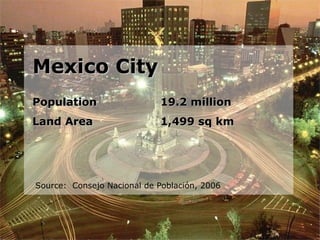
Mexico City Population 19.2 million Land Area 1,499 sq km Source:  Consejo Nacional de Población, 2006
 
Purpose To modify the course and redirect Mexico City in the path of sustainability.
Commitments Tangible environmental improvement Social responsibility World commitment
Principles Sustainable Development Regulatory Policy Environmental Education Transparency and Accountability  Metropolitan Dynamic Conscious Civic Participation Polluter Pays
Comprehensive 1. of large  scope;  covering  or involving  much;  inclusive 2. comprehending mentally;  having an extensive mental range or grasp.
Challenges Urban mobility Land conservation Lack of green spaces Drinking water demand Water erosion Air quality Solid waste management Climate change
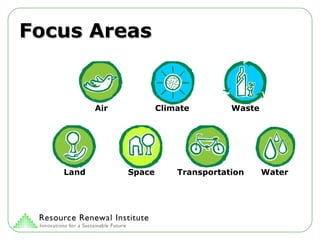
Focus Areas Water Air Climate Transportation Space Land Waste
Water Objective: To achieve water self-sufficiency and improve water management in Mexico City.
Goals To attain a balance of aquifer extraction and replenishment To reduce residential water consumption To reduce losses in water mains To increase re0use and treatment of water To create two lakeside parks
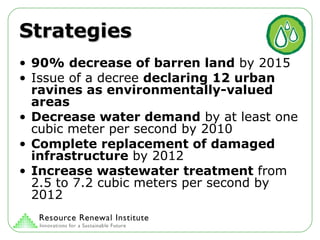
Strategies 90%   decrease of barren land  by 2015 Issue of a decree  declaring 12 urban ravines as environmentally-valued areas Decrease water demand  by at least one cubic meter per second by 2010 Complete replacement of damaged infrastructure  by 2012 Increase wastewater treatment  from 2.5 to 7.2 cubic meters per second by 2012
Air Objective: To control the most prevalent, noxious atmospheric pollutants (ozone and particulate matter), and to reduce emissions of toxic pollutants.
Goals To reduce emissions of pollutants  To increase both passenger and freight transportation efficiency  To enforce the actions proposed by transportation and energy plans, and to measure the benefits yielded by the Green Plan in terms of air quality
Strategies 50% reduction of NOX and VOCs  by 2012 Reduction  of 10,000 tons per year of  industry-generated pollutants  by 2012 Enforcement of mandatory emissions testing  for freight vehicles by 2009 Replacement of all taxis  with less polluting units by 2012 Introduction of ultra low sulfur diesel  in public transportation starting in 2008-09 Replacement of all government vehicles  with less polluting fuel-efficient units by 2012
Climate Objective: To reduce greenhouse gas emissions, to foster the establishment of renewable energy markets, and to promote adaptations to climate change among the population.
Goals To deliver the Climate Change Action Plan for Mexico City  To endorse all actions proposed by the transportation, water, air, public spaces, waste and energy plans aimed at the reduction of greenhouse gas emissions  To reduce Mexico City’s vulnerability to climate change by implementing measures that allow the general population to adapt to it
Strategies Development of actions by the  forestry sector  aimed at reducing levels of carbon dioxide Use carbon bonds  to reduce GHG emissions Develop adaptive actions  to avoid potential health and safety risks for the population
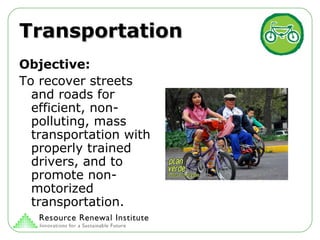
Transportation Objective: To recover streets and roads for efficient, non-polluting, mass transportation with properly trained drivers, and to promote non-motorized transportation.
Goals To encourage efficient, non-polluting, mass transportation with properly trained drivers; and to recover the streets and roads for the majority of the population  To reduce the number of vehicles in circulation  To offer incentives to those who use non-motorized transportation  To improve transit and traffic To foster transit and pedestrian awareness culture aimed at a more harmonious coexistence Transportation
Strategies Increase subway coverage  by 2012 Mandatory school bus transportation  for private schools by 2012 Circulation restrictions for taxis  carrying no passengers Create pedestrian-zones  in historic downtowns areas Bicycles  should account for at least 5% of all individual trips made in the city prior to 2012 Build 4,000 kilometers of bicycle lanes  by 2012
Space Objective: To recover and create public spaces in order to transform Mexico City into a place suitable for social integration and capable of offering better habitability, comfort, and equity.
Goals To implement projects aimed at re-organizing and regulating large public spaces, designed according to sustainability and habitability criteria  To recover and improve existing public spaces in order to incorporate them into Integration and Development corridors for recreational and environmental purposes  To increase green areas and provide public spaces with outdoor furniture and greater accessibility
Strategies Implement a “ Clean Building Guarantee ” in all new service facilities by 2010 Create a 36,000-square meter urban park  in Iztapalapa by 2010 Reach a target of nine square meters of  green areas  per inhabitant by creating new parks and corridors
Strategies Installation of 30,000 square meters per year of green roofs
Conservation Land Objective: To recover and create public spaces in order to transform Mexico City into a place suitable for social integration and capable of offering better habitability, comfort, and equity.
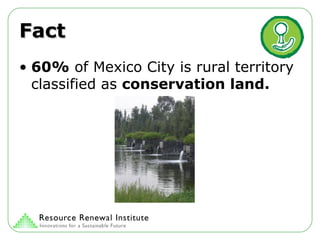
Fact 60%  of Mexico City is rural territory classified as  conservation land.
Goal Zero human settlement growth in conservation lands  Restoration and preservation of ecosystems with high environmental value  Payment of environmental services as a mechanism to compensate for conservation costs  Promotion of agricultural ecosystems and sustainable management of natural resources
Strategies Recovery and restoration  over a six-year period of 150 illegally occupied high-value environmental sites Reforestation  and restoration of 3,000 hectares with 2.5 million plants per year Assess option of using  green taxes Develop sustainable systems of land management and mining and/or quarrying by 2010 Relocation  of 3,200 free-grazing heads of livestock to stable systems by 2012.
Waste Objective: To implement comprehensive and sustainable management of solid waste
Goal Zero human settlement growth in conservation lands  Restoration and preservation of ecosystems with high environmental value  Payment of environmental services as a mechanism to compensate for conservation costs  Promotion of agricultural ecosystems and sustainable management of natural resources
Strategies Sponsor a law initiative to  regulate packing  and packaging of products made/distributed in the Federal District Increase organic waste recycling  from 3% to 30% by 2012 Increase inorganic waste recycling  from 12% to 20% by 2012 Use of  waste for power generation  by 2009 Construct a general waste management center  by 2010
Systemic 1. of or pertaining to a system.   2. Physiology, Pathology.  (a) pertaining to or affecting the body as a whole. (b) pertaining to or affecting a particular body system.
Policy Instruments Mexico City Green Plan Implementation Environmental Technologies Cross-boundary Communication Funding Education International Cooperation Environmental Regulations Civic Participation
Participating Agencies Mexico City Major Administration office Secretary of Governance Secretary of Environment Secretary of Urban Development and Housing Secretary of Transit and Transportation Secretary of Public Works and Services Secretary of Public Security Secretary of Education Secretary of Public Health Services Secretary of Social Development Secretary of Rural Development and Equity for Communities Secretary of Economic Development Secretary of Finances Institute for Youth Efficient Use of Energy Coordinating Office  Mexico City Historic Downtown Authority
2008 Road System Program This is the most ambitious and aggressive road system program in Mexico City to be undertake since the 1980’s. Program will result in  360 kilometers  of new roads, bridges, bypasses, main avenue connectors, highways, and overpasses. Program investment is over  222 million  pesos.
Climate Action Program 2008-2012 Goal is reduction of GHG emissions  12% from 1990 levels by 2012 Program cost is 60 billion pesos ($5.9 million)  Program will be partially funded by the sale of  carbon bonds
Climate Action Program
Integrative 1. to bring together or incorporate (parts) into a whole.  2. to make up, combine, or complete to produce a whole or a larger unit, as parts do.  3. to unite or combine.
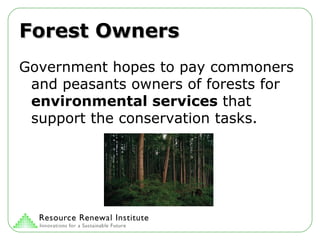
Forest Owners Government hopes to pay commoners and peasants owners of forests for  environmental services  that support the conservation tasks.
Industry Regulations and incentives  to encourage industry to  redesign packing and crating   materials  using biodegradable and easily recyclable materials. Tax incentives  for waste reduction and recycling
Public Opinion A “ Green Survey ” was taken by more than one million residents. 71.9% Adults 71.0% Ballots 21.3% Teenagers 27.5% Telephone 6.7% Children   2.0% Internet
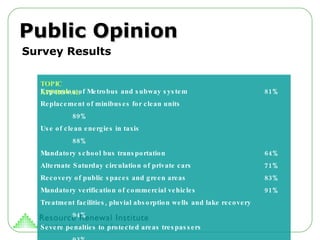
Public Opinion Expansion of Metrobus and subway system 81% Replacement of minibuses for clean units 89% Use of clean energies in taxis 88% Mandatory school bus transportation 64% Alternate Saturday circulation of private cars 71% Recovery of public spaces and green areas 83% Mandatory verification of commercial vehicles 91% Treatment facilities, pluvial absorption wells and lake recovery 94% Severe penalties to protected areas trespassers 93% Improvement on management of solid waste 92% Survey Results TOPIC   APPROVAL
Public Opinion Children’s Survey Results Safe use of bicycles, skates and skateboards in the City 93.5% Separation of waste into organic and inorganic at home 57.0% Use of school bus transport 83.3% Proximity to parks 60.7% Water conservation 91.9% TOPIC   APPROVAL
Accountable 1. subject to the obligation  to report, explain,  or justify something; responsible; answerable.  2. capable of being explained; explicable; explainable.
Green Plan Evaluation and Monitoring Board  The Green Plan is a living instrument which must be permanently evaluated and enhanced.   Board includes a mix of government employees (mostly engineers), business representatives, interest groups, and academics.
 

Mexico City Green Plan

  • 1.
    Mexico City Population19.2 million Land Area 1,499 sq km Source: Consejo Nacional de Población, 2006
  • 2.
  • 3.
    Purpose To modifythe course and redirect Mexico City in the path of sustainability.
  • 4.
    Commitments Tangible environmentalimprovement Social responsibility World commitment
  • 5.
    Principles Sustainable DevelopmentRegulatory Policy Environmental Education Transparency and Accountability Metropolitan Dynamic Conscious Civic Participation Polluter Pays
  • 6.
    Comprehensive 1. oflarge scope; covering or involving much; inclusive 2. comprehending mentally; having an extensive mental range or grasp.
  • 7.
    Challenges Urban mobilityLand conservation Lack of green spaces Drinking water demand Water erosion Air quality Solid waste management Climate change
  • 8.
    Focus Areas WaterAir Climate Transportation Space Land Waste
  • 9.
    Water Objective: Toachieve water self-sufficiency and improve water management in Mexico City.
  • 10.
    Goals To attaina balance of aquifer extraction and replenishment To reduce residential water consumption To reduce losses in water mains To increase re0use and treatment of water To create two lakeside parks
  • 11.
    Strategies 90% decrease of barren land by 2015 Issue of a decree declaring 12 urban ravines as environmentally-valued areas Decrease water demand by at least one cubic meter per second by 2010 Complete replacement of damaged infrastructure by 2012 Increase wastewater treatment from 2.5 to 7.2 cubic meters per second by 2012
  • 12.
    Air Objective: Tocontrol the most prevalent, noxious atmospheric pollutants (ozone and particulate matter), and to reduce emissions of toxic pollutants.
  • 13.
    Goals To reduceemissions of pollutants To increase both passenger and freight transportation efficiency To enforce the actions proposed by transportation and energy plans, and to measure the benefits yielded by the Green Plan in terms of air quality
  • 14.
    Strategies 50% reductionof NOX and VOCs by 2012 Reduction of 10,000 tons per year of industry-generated pollutants by 2012 Enforcement of mandatory emissions testing for freight vehicles by 2009 Replacement of all taxis with less polluting units by 2012 Introduction of ultra low sulfur diesel in public transportation starting in 2008-09 Replacement of all government vehicles with less polluting fuel-efficient units by 2012
  • 15.
    Climate Objective: Toreduce greenhouse gas emissions, to foster the establishment of renewable energy markets, and to promote adaptations to climate change among the population.
  • 16.
    Goals To deliverthe Climate Change Action Plan for Mexico City To endorse all actions proposed by the transportation, water, air, public spaces, waste and energy plans aimed at the reduction of greenhouse gas emissions To reduce Mexico City’s vulnerability to climate change by implementing measures that allow the general population to adapt to it
  • 17.
    Strategies Development ofactions by the forestry sector aimed at reducing levels of carbon dioxide Use carbon bonds to reduce GHG emissions Develop adaptive actions to avoid potential health and safety risks for the population
  • 18.
    Transportation Objective: Torecover streets and roads for efficient, non-polluting, mass transportation with properly trained drivers, and to promote non-motorized transportation.
  • 19.
    Goals To encourageefficient, non-polluting, mass transportation with properly trained drivers; and to recover the streets and roads for the majority of the population To reduce the number of vehicles in circulation To offer incentives to those who use non-motorized transportation To improve transit and traffic To foster transit and pedestrian awareness culture aimed at a more harmonious coexistence Transportation
  • 20.
    Strategies Increase subwaycoverage by 2012 Mandatory school bus transportation for private schools by 2012 Circulation restrictions for taxis carrying no passengers Create pedestrian-zones in historic downtowns areas Bicycles should account for at least 5% of all individual trips made in the city prior to 2012 Build 4,000 kilometers of bicycle lanes by 2012
  • 21.
    Space Objective: Torecover and create public spaces in order to transform Mexico City into a place suitable for social integration and capable of offering better habitability, comfort, and equity.
  • 22.
    Goals To implementprojects aimed at re-organizing and regulating large public spaces, designed according to sustainability and habitability criteria To recover and improve existing public spaces in order to incorporate them into Integration and Development corridors for recreational and environmental purposes To increase green areas and provide public spaces with outdoor furniture and greater accessibility
  • 23.
    Strategies Implement a“ Clean Building Guarantee ” in all new service facilities by 2010 Create a 36,000-square meter urban park in Iztapalapa by 2010 Reach a target of nine square meters of green areas per inhabitant by creating new parks and corridors
  • 24.
    Strategies Installation of30,000 square meters per year of green roofs
  • 25.
    Conservation Land Objective:To recover and create public spaces in order to transform Mexico City into a place suitable for social integration and capable of offering better habitability, comfort, and equity.
  • 26.
    Fact 60% of Mexico City is rural territory classified as conservation land.
  • 27.
    Goal Zero humansettlement growth in conservation lands Restoration and preservation of ecosystems with high environmental value Payment of environmental services as a mechanism to compensate for conservation costs Promotion of agricultural ecosystems and sustainable management of natural resources
  • 28.
    Strategies Recovery andrestoration over a six-year period of 150 illegally occupied high-value environmental sites Reforestation and restoration of 3,000 hectares with 2.5 million plants per year Assess option of using green taxes Develop sustainable systems of land management and mining and/or quarrying by 2010 Relocation of 3,200 free-grazing heads of livestock to stable systems by 2012.
  • 29.
    Waste Objective: Toimplement comprehensive and sustainable management of solid waste
  • 30.
    Goal Zero humansettlement growth in conservation lands Restoration and preservation of ecosystems with high environmental value Payment of environmental services as a mechanism to compensate for conservation costs Promotion of agricultural ecosystems and sustainable management of natural resources
  • 31.
    Strategies Sponsor alaw initiative to regulate packing and packaging of products made/distributed in the Federal District Increase organic waste recycling from 3% to 30% by 2012 Increase inorganic waste recycling from 12% to 20% by 2012 Use of waste for power generation by 2009 Construct a general waste management center by 2010
  • 32.
    Systemic 1. ofor pertaining to a system. 2. Physiology, Pathology. (a) pertaining to or affecting the body as a whole. (b) pertaining to or affecting a particular body system.
  • 33.
    Policy Instruments MexicoCity Green Plan Implementation Environmental Technologies Cross-boundary Communication Funding Education International Cooperation Environmental Regulations Civic Participation
  • 34.
    Participating Agencies MexicoCity Major Administration office Secretary of Governance Secretary of Environment Secretary of Urban Development and Housing Secretary of Transit and Transportation Secretary of Public Works and Services Secretary of Public Security Secretary of Education Secretary of Public Health Services Secretary of Social Development Secretary of Rural Development and Equity for Communities Secretary of Economic Development Secretary of Finances Institute for Youth Efficient Use of Energy Coordinating Office Mexico City Historic Downtown Authority
  • 35.
    2008 Road SystemProgram This is the most ambitious and aggressive road system program in Mexico City to be undertake since the 1980’s. Program will result in 360 kilometers of new roads, bridges, bypasses, main avenue connectors, highways, and overpasses. Program investment is over 222 million pesos.
  • 36.
    Climate Action Program2008-2012 Goal is reduction of GHG emissions 12% from 1990 levels by 2012 Program cost is 60 billion pesos ($5.9 million) Program will be partially funded by the sale of carbon bonds
  • 37.
  • 38.
    Integrative 1. tobring together or incorporate (parts) into a whole. 2. to make up, combine, or complete to produce a whole or a larger unit, as parts do. 3. to unite or combine.
  • 39.
    Forest Owners Governmenthopes to pay commoners and peasants owners of forests for environmental services that support the conservation tasks.
  • 40.
    Industry Regulations andincentives to encourage industry to redesign packing and crating materials using biodegradable and easily recyclable materials. Tax incentives for waste reduction and recycling
  • 41.
    Public Opinion A“ Green Survey ” was taken by more than one million residents. 71.9% Adults 71.0% Ballots 21.3% Teenagers 27.5% Telephone 6.7% Children 2.0% Internet
  • 42.
    Public Opinion Expansionof Metrobus and subway system 81% Replacement of minibuses for clean units 89% Use of clean energies in taxis 88% Mandatory school bus transportation 64% Alternate Saturday circulation of private cars 71% Recovery of public spaces and green areas 83% Mandatory verification of commercial vehicles 91% Treatment facilities, pluvial absorption wells and lake recovery 94% Severe penalties to protected areas trespassers 93% Improvement on management of solid waste 92% Survey Results TOPIC APPROVAL
  • 43.
    Public Opinion Children’sSurvey Results Safe use of bicycles, skates and skateboards in the City 93.5% Separation of waste into organic and inorganic at home 57.0% Use of school bus transport 83.3% Proximity to parks 60.7% Water conservation 91.9% TOPIC APPROVAL
  • 44.
    Accountable 1. subjectto the obligation to report, explain, or justify something; responsible; answerable. 2. capable of being explained; explicable; explainable.
  • 45.
    Green Plan Evaluationand Monitoring Board The Green Plan is a living instrument which must be permanently evaluated and enhanced. Board includes a mix of government employees (mostly engineers), business representatives, interest groups, and academics.
  • 46.