Warmup
 How would a standard system of
measurements, agreed to and used around
the world, make life easier? Give examples.
Objectives:
1. Explain the importance of the International
System of Units.
2. Determine the appropriate units to use for
particular measurements.
3. Identify lab safety symbols, and determine
what they mean.
Making Measurements
 The International System of Units (SI)
 current name for the metric system.
○ Used by most scientists and almost all countries.
 All SI units are based on the number 10.
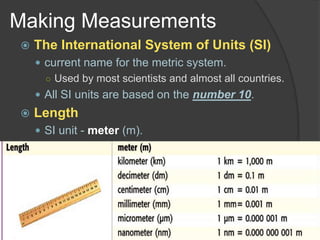
 Length
 SI unit - meter (m).
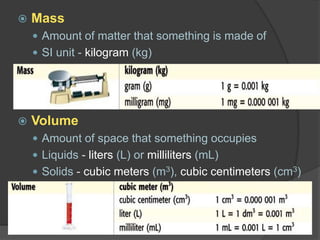
 Mass
 Amount of matter that something is made of
 SI unit - kilogram (kg)
 Volume
 Amount of space that something occupies
 Liquids - liters (L) or milliliters (mL)
 Solids - cubic meters (m3), cubic centimeters (cm3)
 Density
 Amount of matter in a given volume
 SI unit – gram per milliliter (g/mL) or grams per cubic
centimeter (g/cm3).
○ Derived quantity!
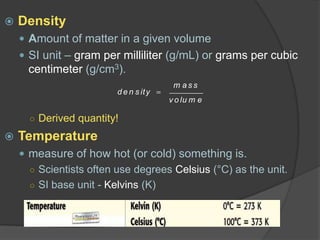
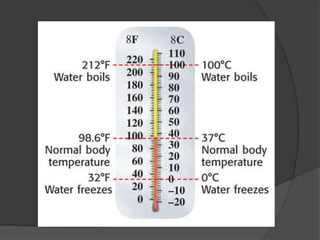
 Temperature
 measure of how hot (or cold) something is.
○ Scientists often use degrees Celsius (°C) as the unit.
○ SI base unit - Kelvins (K)
d e n s ity
m a s s
v o lu m e
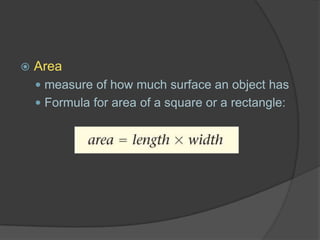
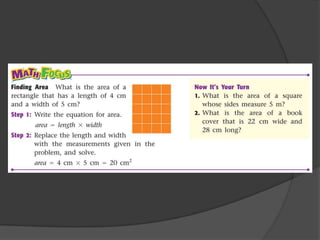
 Area
 measure of how much surface an object has
 Formula for area of a square or a rectangle:
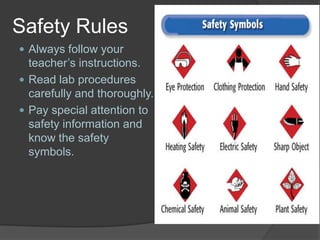
Safety Rules
 Always follow your
teacher’s instructions.
 Read lab procedures
carefully and thoroughly.
 Pay special attention to
safety information and
know the safety
symbols.

P2.4 Measurement and Safety

  • 1.
    Warmup  How woulda standard system of measurements, agreed to and used around the world, make life easier? Give examples.
  • 3.
    Objectives: 1. Explain theimportance of the International System of Units. 2. Determine the appropriate units to use for particular measurements. 3. Identify lab safety symbols, and determine what they mean.
  • 4.
    Making Measurements  TheInternational System of Units (SI)  current name for the metric system. ○ Used by most scientists and almost all countries.  All SI units are based on the number 10.  Length  SI unit - meter (m).
  • 5.
     Mass  Amountof matter that something is made of  SI unit - kilogram (kg)  Volume  Amount of space that something occupies  Liquids - liters (L) or milliliters (mL)  Solids - cubic meters (m3), cubic centimeters (cm3)
  • 6.
     Density  Amountof matter in a given volume  SI unit – gram per milliliter (g/mL) or grams per cubic centimeter (g/cm3). ○ Derived quantity!  Temperature  measure of how hot (or cold) something is. ○ Scientists often use degrees Celsius (°C) as the unit. ○ SI base unit - Kelvins (K) d e n s ity m a s s v o lu m e
  • 8.
     Area  measureof how much surface an object has  Formula for area of a square or a rectangle:
  • 10.
    Safety Rules  Alwaysfollow your teacher’s instructions.  Read lab procedures carefully and thoroughly.  Pay special attention to safety information and know the safety symbols.