Measurement isused to measure quantities.
Quantity is something that has magnitude, size,
or amount (volume).
A quantity is not the same as a measurement.
3.
In thelate 18th
century, scientists used the
metric system. The metric system is a
forerunner to the SI System.
Scientists all over the world use a single
measurement system called Le Systeme
International d’Units, abbreviated SI.
It was adopted in 1960 and has both base
units and derived units.
4.
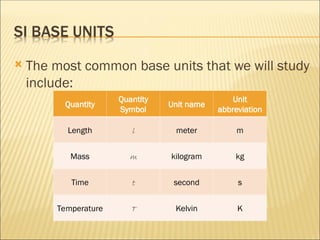
The mostcommon base units that we will study
include:
Quantity
Quantity
Symbol
Unit name
Unit
abbreviation
Length l meter m
Mass m kilogram kg
Time t second s
Temperature T Kelvin K
5.
The SIstandard unit for length is the meter.
A distance of 1m is about the width of an average
doorway.
To express longer distances, the kilometer (km) is
used. One kilometer is equal to 1000 m.
To express shorter distances, the centimeter (cm)
is used. One centimeter is equal to 1/100 of a
meter.
Length can be measured using a meter stick or
rulers or measuring tape .
6.
Mass isa measure of the quantity of matter. The
standard unit for mass is the kilogram (kg).
The gram (g), which is 1/1000 of a kg is used for
measuring masses of small objects such as flasks and
beakers. Mass is typically measured using a balance.
Mass is different from weight. Weight is a measure of
the gravitational pull on matter. The weight of an object
increases as gravity acts on it. The weight of an object
on the moon is about 1/6th
of its weight on Earth. So, a
human on Earth who weighed 60kg. would weight how
much on the moon?
7.
The standardunit of measurement for time is the
second (s).
Time can be measured using stop watches, clocks,
count down timers, and other time pieces.
Larger amounts of time are measured in minutes
and hours.
There are 60 seconds in one minute. There are 60
minutes in one hour. Given that there are 24 hours
in one day, how many seconds are there in one
day?
8.
The standardunit of measurement for
temperature is degrees Kelvin (K).
Temperature can also be measured in degrees
Celsius (°C) and degrees Fahrenheit (°F).
To convert degrees Celsius (°C) to Kelvin
° K= °C + 273
Temperature is measured using a thermometer.
(measures the degree of heat or coolness)
9.
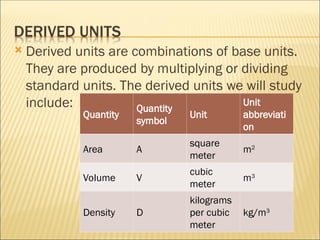
Derived unitsare combinations of base units.
They are produced by multiplying or dividing
standard units. The derived units we will study
include:
Quantity
Quantity
symbol
Unit
Unit
abbreviati
on
Area A
square
meter
m2
Volume V
cubic
meter
m3
Density D
kilograms
per cubic
meter
kg/m3
11.
Volume isthe amount of space occupied by an
object. The derived SI unit for volume is cubic
meters. The cubic meter is rather large, so a more
common unit of cubic centimeters is more
commonly used.
Non-SI units are also used to measure volume
such as the milliliter (mL) and the liter (L), which is
1000 cm3
. There are 1000 mL in 1 L.
Beakers, flasks, and graduated cylinders are often
used to determine the volume of liquids.
12.
Density isthe ratio of mass to volume, or mass
divided by volume. It can be written:
density=mass/volume or D=m/V
Density is a characteristic physical property of a
substance that does not depend on the size of
the sample. As the mass of an object
increases, its volume increases.