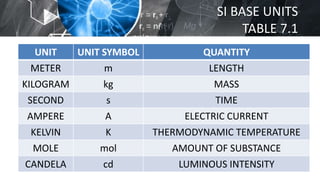
Here are the units and quantities from Table 7.1 on page 208:
Meter - Length
Kilogram - Mass
Second - Time
Ampere - Electric Current
Kelvin - Thermodynamic Temperature
Mole - Amount of Substance
Candela - Luminous Intensity
INTERNATIONAL SYSTEM
OF UNIT(SI)
• Acronym SI came from Systeme Internationale
d’Unites, which is the direct translation of
“International System of Units” in French.
• SI is based on the metric system and is the most
widely used systems of measurements.
• Standard SI units, which are based on the M-K-S
(meter, kilogram, second), where formalized and
published in 1960.
3.
INTERNATIONAL SYSTEM
OF UNIT(SI)
• Acronym SI came from Systeme Internationale
d’Unites, which is the direct translation of
“International System of Units” in French.
• SI is based on the metric system and is the most
widely used systems of measurements.
• Standard SI units, which are based on the M-K-S
(meter, kilogram, second), where formalized and
published in 1960.
4.
INTERNATIONAL SYSTEM
OF UNIT(SI)
• But even as early as the French Revolution, a system
of measurements for mass and length, which made
use of the kilogram and the meter, respectively, was
already in place.
5.
INTERNATIONAL SYSTEM
OF UNIT(SI)
• Other SI Units have consequently been derived from
the properties of natural objects such as water.
• A litter of water weighs 1 kilogram (kg) and measures
1 cubic decimeter (dm3). The Celsius temperature
scale ranges from 0ᴼC (at which point water freezes)
to 100ᴼC (at which point water boils).
6.
SI BASE UNITS
•Are units of measurements defined by
agreement among scientist all over the world.
7.
SI BASE UNITS
•For example, the standard meter used to be
the length of a platinum-iridium alloy bar (90%
platinum and 10% iridium) at melting point of
ice.
• Exact replicates of this length were distributed
to different universities and research
institutions all over the world.
• However, the bars soon became distorted in
different ways and thus, scientist redefined
meter in terms of the distance traveled by light
in a vacuum in a very small friction of a second.
8.
SI BASE UNITS
Thedifference in the standard length of a meter
stick is negligible.
However, for scientist who are who are doing
research and engineers who are developing
technology that need high accuracy, exact and
uniform standard units of measurements are
very important.
9.
SI BASE UNITS
TABLE7.1
UNIT UNIT SYMBOL QUANTITY
METER m LENGTH
KILOGRAM kg MASS
SECOND s TIME
AMPERE A ELECTRIC CURRENT
KELVIN K THERMODYNAMIC TEMPERATURE
MOLE mol AMOUNT OF SUBSTANCE
CANDELA cd LUMINOUS INTENSITY
10.
INTERNATIONAL SYSTEM
OF UNIT(SI)
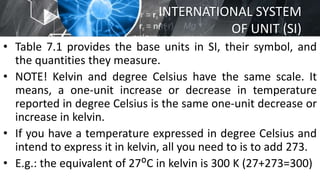
• Table 7.1 provides the base units in SI, their symbol, and
the quantities they measure.
• NOTE! Kelvin and degree Celsius have the same scale. It
means, a one-unit increase or decrease in temperature
reported in degree Celsius is the same one-unit decrease or
increase in kelvin.
• If you have a temperature expressed in degree Celsius and
intend to express it in kelvin, all you need to is to add 273.
• E.g.: the equivalent of 27ᴼC in kelvin is 300 K (27+273=300)
11.
SI DERIVED UNITS
•SI DERIVED UNITS are those units not defined by
consensus among scientist around the world. These units
have acquired their definitions bases on the nature of
the quantity they measure in relation to one of the base
quantities
SI DERIVED UNITS
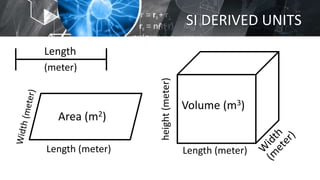
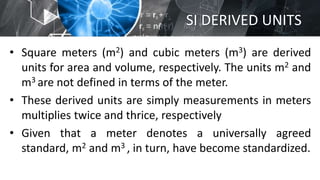
•Square meters (m2) and cubic meters (m3) are derived
units for area and volume, respectively. The units m2 and
m3 are not defined in terms of the meter.
• These derived units are simply measurements in meters
multiplies twice and thrice, respectively
• Given that a meter denotes a universally agreed
standard, m2 and m3 , in turn, have become standardized.
14.
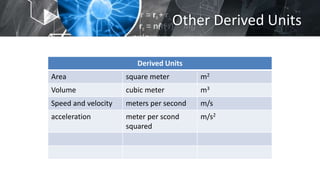
Other Derived Units
DerivedUnits
Area square meter m2
Volume cubic meter m3
Speed and velocity meters per second m/s
acceleration meter per scond
squared
m/s2
15.
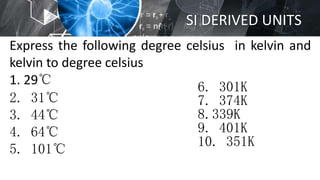
SI DERIVED UNITS
Expressthe following degree celsius in kelvin and
kelvin to degree celsius
1. 29℃
2. 31℃
3. 44℃
4. 64℃
5. 101℃
6. 301K
7. 374K
8.339K
9. 401K
10. 351K
16.
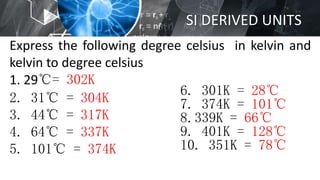
SI DERIVED UNITS
Expressthe following degree celsius in kelvin and
kelvin to degree celsius
1. 29℃= 302K
2. 31℃ = 304K
3. 44℃ = 317K
4. 64℃ = 337K
5. 101℃ = 374K
6. 301K = 28℃
7. 374K = 101℃
8.339K = 66℃
9. 401K = 128℃
10. 351K = 78℃
17.
SI DERIVED UNITS
November5, 2019
Science 5
Exit Ticket
Memorize and Recite the units and its quantity
given from table 7.1 page 208 of your book. (15
points)