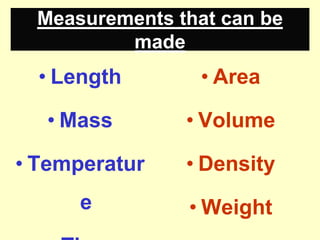
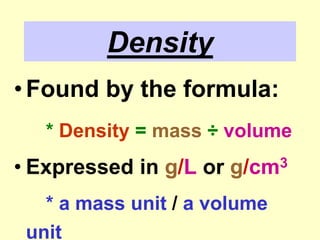
This document discusses measurement standards and the International System of Units (SI). It provides definitions and examples of common units used to measure length, mass, temperature, time, area, volume, density, and weight. Key points covered include:
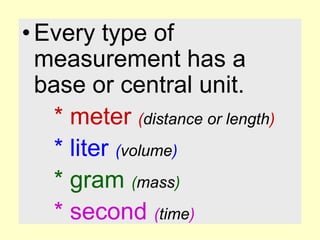
1) Early measurement standards were based on body parts but were inconsistent; the meter and kilogram were established as consistent base SI units.
2) All measurements require both a number and a defined unit, such as "5 meters".
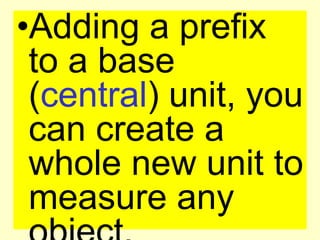
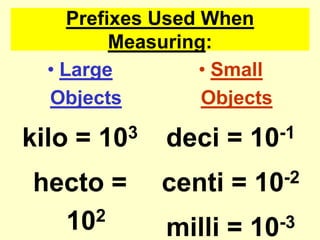
3) Common prefixes are used to modify base units to measure very large or small quantities.
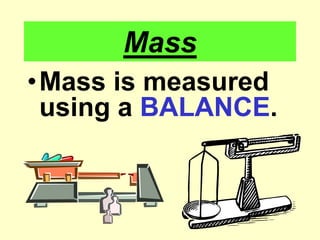
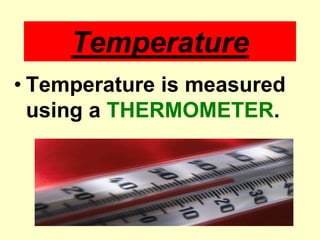
4) Different instruments are used to measure different physical properties, such as thermometers for temperature and balances for mass.
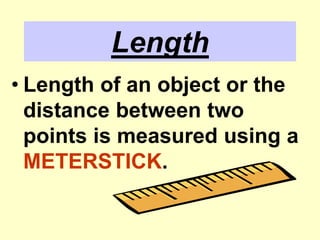
![LengthThe distance between two points.Base (central) units of length* (US) FOOT [ft]* (SI) METER [m]](https://image.slidesharecdn.com/ch02busingsiunits-100820144035-phpapp02/85/Ch02b-using-si-units-10-320.jpg)
![Mass“A body of coherent matter.” * a collection of stuff joined to form an objectBase (central) units of mass* (US) SLUG [slug]* (SI) KILOGRAM [kg] sometimes gram [g]](https://image.slidesharecdn.com/ch02busingsiunits-100820144035-phpapp02/85/Ch02b-using-si-units-12-320.jpg)
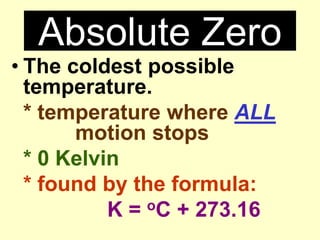
![TemperatureBase (central) units of temperature* (US) FAHRENHEIT [oF]* (SI) CELCIUS [oC] > (SI) KELVIN [K] * this is an absolute scale](https://image.slidesharecdn.com/ch02busingsiunits-100820144035-phpapp02/85/Ch02b-using-si-units-15-320.jpg)
![TimeInterval between two events.Base (central) units of time* (US) SECOND [s]* (SI) SECOND [s]](https://image.slidesharecdn.com/ch02busingsiunits-100820144035-phpapp02/85/Ch02b-using-si-units-18-320.jpg)

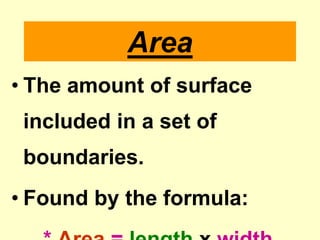
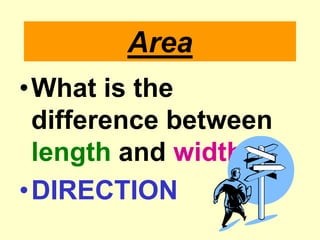
![AreaBase units of area* (US) FEET SQUARED [ft2]* (SI) METERS SQUARED[m2]](https://image.slidesharecdn.com/ch02busingsiunits-100820144035-phpapp02/85/Ch02b-using-si-units-23-320.jpg)
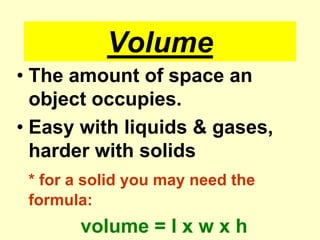
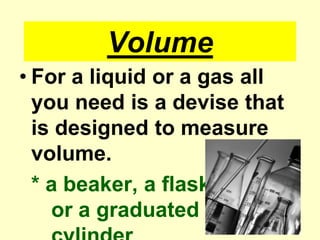
![VolumeBase (central) units of volume* (US) GALLON [gal]* (SI) LITER [L] sometimes centimeters cubed [cm3]](https://image.slidesharecdn.com/ch02busingsiunits-100820144035-phpapp02/85/Ch02b-using-si-units-26-320.jpg)
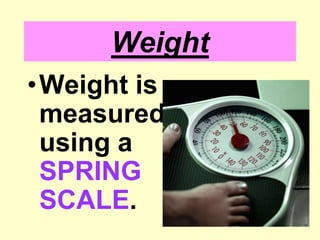
![WeightMeasurement of the force of gravity pulling on the mass of an object.Changes as gravity changes.Base units of weight* (US) POUND [lb]* (SI) NEWTON [N]](https://image.slidesharecdn.com/ch02busingsiunits-100820144035-phpapp02/85/Ch02b-using-si-units-30-320.jpg)