PES/ENG/IX/011


   •   This is FINAL version file.(REVISED)
   •   Pl mark the portion reqd in Punjabi
   •   Total word count – 2,526

    A PUNJAB EDUSAT SOCIETY PRODUCTION

                          CLASS:              IX

                          SUBJECT:            ENGLISH

                          TOPIC:              TENSES
                          (PART II)

ANCHOR-1:

Welcome back! It has not been very long since our last
module on Present Tense. You will find this module on
the Past Tense and the next one on Future Tense a very
similar one. Let us first quickly revise what we did last
time.

SUPER:

LET’S RECALL THE’ PRESENT TENSE’

MM-1

 Show the same coloured diagram,IMAGE 1 , and the
text should pop up along with the VO,AS each text
box is read.

TEXT on SCREEN (show with the diagram) withVO,
reading the text on the diagram


                           1
PES/ENG/IX/011


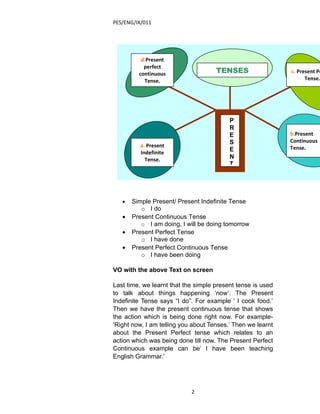
          d.Present
           perfect
         continuous                  TENSES                  c. Present Pe
           Tense.                                                  Tense.


                                          P
                                          R
                                          E                  b.Present
                                          S                  Continuous
         a. Present                                          Tense.
         Indefinite
                                          E
           Tense.                         N
                                          T


   •   Simple Present/ Present Indefinite Tense
          o I do
   •   Present Continuous Tense
          o I am doing, I will be doing tomorrow
   •   Present Perfect Tense
          o I have done
   •   Present Perfect Continuous Tense
          o I have been doing

VO with the above Text on screen

Last time, we learnt that the simple present tense is used
to talk about things happening ‘now’. The Present
Indefinite Tense says “I do”. For example ‘ I cook food.’
Then we have the present continuous tense that shows
the action which is being done right now. For example-
‘Right now, I am telling you about Tenses.’ Then we learnt
about the Present Perfect tense which relates to an
action which was being done till now. The Present Perfect
Continuous example can be’ I have been teaching
English Grammar.’


                            2
PES/ENG/IX/011


ANCHOR 2:

We shall now move on to the Past Tense. The Past Tense
also has the same four forms. But before we go through
them, let us have a look at our Learning Objectives for
this session.

SUPER

Learning Objectives

VO with Text on Screen

After this session, you will be able to

    List the four types of Past tense
    Identify the type of past tense in a given sentence
    Use the different types of past tense correctly in
     spoken and written form

SUPER

FOUR TYPES OF PAST TENSE

VO with Text on Screen

The four types of past tense are-

    Simple Past or Past Indefinite Tense.
    Past Continuous Tense.
    Past Perfect Tense.
    Past Perfect Continuous Tense.


   ANCHOR-3

. We can use several tenses to talk about the past, but
the simple past tense is the one we use most often. How
do we make the simple past tense? Let us have a look.

VO with Text on Screen

To make the past Indefinite tense, we use:


                              3
PES/ENG/IX/011


   •   The Second form of the Verb,

       Subject + V2+ object

Examples of Simple Past Tense

    He played cricket yesterday.
    The teacher punished the student.
    I wrote a letter.

ANCHOR-3: Negative form of Indefinite Past tense
can be

Text with VO

Negative sentences in indefinite past :-

           Subject + Did not + V1 + object

          Examples:

          She did not attend the class.

          You did not help me.

ANCHOR-4

There can be many examples to make the structure of
indefinite past tense clear

           Raj learnt a new poem.
           Raj did not learn a new poem.
           Did Raj learn a new poem?

SUPER

How do we use the Simple Past Tense?

ANCHOR-5

We use the past Indefinite tense to talk about an action
or a situation - an event - in the past.


                           4
PES/ENG/IX/011


TEXT on screen WITH VO.

The event can be short or long.

Here are some short events with the simple past tense:

The     car    exploded       at    9.30am       yesterday.
She           went           to          the          door.
We       did       not       hear      the       telephone.
Did you see that car?

past               present              future


The action is in
the past.

Here are some long events with the simple past tense:

I     lived    in     Bangkok    for    10   years.
The Jurassic period lasted about 62 million years.
We        did    not     sing at     the   concert.
Did you watch TV last night?

past               present              future


The action is in
the past.

Notice that it does not matter how long ago the event
is: it can be a few minutes or seconds in the past, or
millions of years in the past. Also it does not matter
how long the event is. It can be a few milliseconds
(car explosion) or millions of years (Jurassic period).
We use the simple past tense when:

   •   the event is in the past
   •   the event is completely finished
   •   we say (or understand) the time and/or place of
       the event


                             5
PES/ENG/IX/011


   ANCHOR-6

   You have seen that simple past tense is used for the
   past actions. There are some specific cases also
   where we use it. Now look at the screen.

   VO with TEXT ON SCREEN

   Some specific cases where simple past tense can
   be used are:-

              To express an action completed in
                 the past with reference to the time of
                 speaking.

             Eg. I met my teacher in the park yesterday.

                  We visited Jaipur, last year

              To express a regular or habitual
                 action in the past.

             Eg. When he was in school,he always
             stood first in the class.

             I visited the temple every evening to
             offer my prayers.

             I lived in this house when I was young.


                                          Ref. IMAGEII


ANCHOR 7

MM- 2(A colourful image can be given behind the
text. )

Note that when we tell a story, we usually use the simple
past tense. Look at this example of the beginning of a
story:


                            6
PES/ENG/IX/011


"The wind was howling around the hotel and the rain was
pouring down. It was cold. The door opened and James
Bond entered. He took off his coat, which was very wet.
He sat down in the corner of the lounge and quietly drank
his orange juice.”

SUPER

Text with VO on screen.

The Image-III to be shown.

      You can see the colourful picture of Raksha
bandhan festival. Tell the incident in past indefinite
tense

                    IMAGE III

                                                        .


                             7
PES/ENG/IX/011


MM-3

Please show an animated clipping of any incident/
story/ event/ festival which you have ready with you.
The students will have to describe that clipping using
the tense. Kindly email me the clip so that I may write
the answer)

The Past Continuous Tense

ANCHOR-8

The past continuous tense is an important tense in
English. We use it to say what we were in the middle of
doing at a particular moment in the past.

SUPER

It is used

              To denote an action going on some
               time in the past. The time of action
               may or may not be indicated.
              For a persistant habit in the past.

How do we make the past continuous tense?

VO with Text on Screen

The structure of the past continuous tense is:

Subject + was/were + MV1 +ing :

I, he, she, it, singular noun- ‘was’

We,you, they, plural noun- ‘were’.

Eg. Tina was Playing.

We were climbing the hills.


                              8
PES/ENG/IX/011


He was doing his work.

For negative sentences in the past continuous tense,
we insert ‘not’ between the helping verb and main
verb.

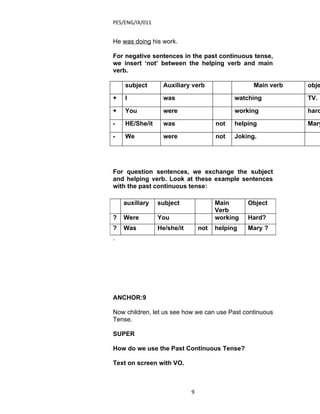
    subject       Auxiliary verb                   Main verb   obje

+   I             was                        watching          TV.

+   You           were                       working           hard

-   HE/She/it     was                  not   helping           Mary

-   We            were                 not   Joking.


For question sentences, we exchange the subject
and helping verb. Look at these example sentences
with the past continuous tense:

    auxiliary    subject               Main      Object
                                       Verb
?   Were         You                   working   Hard?
?   Was          He/she/it       not   helping   Mary ?
⋅


ANCHOR:9

Now children, let us see how we can use Past continuous
Tense.

SUPER

How do we use the Past Continuous Tense?

Text on screen with VO.


                             9
PES/ENG/IX/011


We use Past continuous tense

           To denote an action going on some time
            in the past.
           Examples

                     °We were listening to the Radio.

                    o It was getting darker.
                    o I was watching TV when the
                      phone rang.
                    o The girl was riding a bicycle in
                      the morning.
                    o What were you doing in the
                      school on Sunday?


           This   Tense is       used    with   always,
             continually etc.

                 Examples:

             o He was always grumbling.
             o She was continually teasinh her
               sister.
             o I was working hard last night.
             o I was completing my home work
               whole of yesterday afternoon.
             o He was always disturbing me at
               home.
             o They were always asking for facvours.

                                                         o

ANCHOR-10

Please listen to these few opening lines of an
interesting story. Please note the tense usedWe often
use the past continuous tense to "set the scene" in
stories. We use it to describe the background situation at
the moment when the action begins. Often, the story
starts with the past continuous tense and then moves into
the simple past tense. Here is an example


                             10
PES/ENG/IX/011


(Show with image,VO and text.)

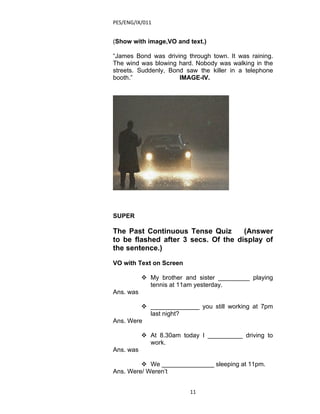
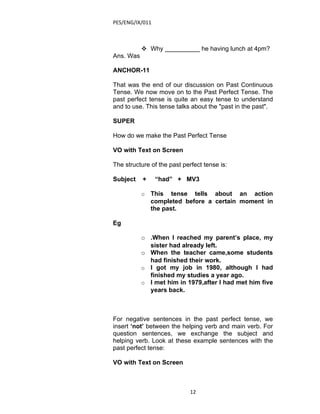
“James Bond was driving through town. It was raining.
The wind was blowing hard. Nobody was walking in the
streets. Suddenly, Bond saw the killer in a telephone
booth.”               IMAGE-IV.


SUPER

The Past Continuous Tense Quiz       (Answer
to be flashed after 3 secs. Of the display of
the sentence.)

VO with Text on Screen

            My brother and sister _________ playing
             tennis at 11am yesterday.
Ans. was

          ______________ you still working at 7pm
           last night?
Ans. Were

            At 8.30am today I __________ driving to
             work.
Ans. was

          We _______________ sleeping at 11pm.
Ans. Were/ Weren’t


                          11
PES/ENG/IX/011


            Why __________ he having lunch at 4pm?
Ans. Was

ANCHOR-11

That was the end of our discussion on Past Continuous
Tense. We now move on to the Past Perfect Tense. The
past perfect tense is quite an easy tense to understand
and to use. This tense talks about the "past in the past".

SUPER

How do we make the Past Perfect Tense

VO with Text on Screen

The structure of the past perfect tense is:

Subject    +     “had” + MV3

           o   This tense tells about an action
               completed before a certain moment in
               the past.

Eg

           o .When I reached my parent’s place, my
             sister had already left.
           o When the teacher came,some students
             had finished their work.
           o I got my job in 1980, although I had
             finished my studies a year ago.
           o I met him in 1979,after I had met him five
             years back.


For negative sentences in the past perfect tense, we
insert ‘not’ between the helping verb and main verb. For
question sentences, we exchange the subject and
helping verb. Look at these example sentences with the
past perfect tense:

VO with Text on Screen


                             12
PES/ENG/IX/011


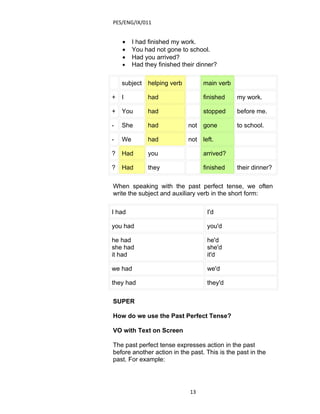
    •    I had finished my work.
    •    You had not gone to school.
    •    Had you arrived?
    •    Had they finished their dinner?

    subject helping verb           main verb

+   I         had                  finished    my work.

+   You       had                  stopped     before me.

-   She       had            not gone          to school.

-   We        had            not left.

?   Had       you                  arrived?

?   Had       they                 finished    their dinner?

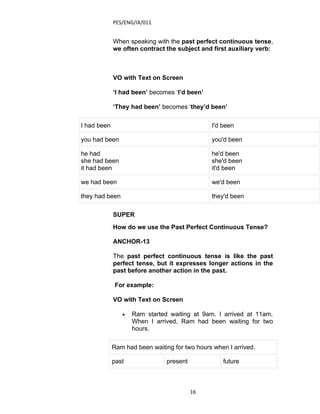
When speaking with the past perfect tense, we often
write the subject and auxiliary verb in the short form:

I had                               I'd

you had                             you'd

he had                              he'd
she had                             she'd
it had                              it'd

we had                              we'd

they had                            they'd

SUPER

How do we use the Past Perfect Tense?

VO with Text on Screen

The past perfect tense expresses action in the past
before another action in the past. This is the past in the
past. For example:


                              13
PES/ENG/IX/011


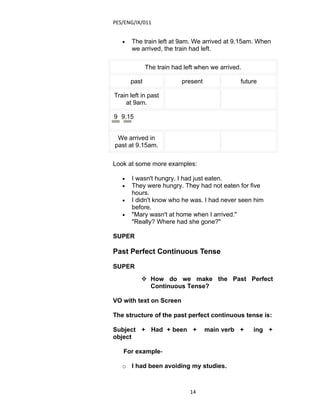
   •   The train left at 9am. We arrived at 9.15am. When
       we arrived, the train had left.

              The train had left when we arrived.

       past                present              future

Train left in past
    at 9am.

9 9.15


 We arrived in
past at 9.15am.

Look at some more examples:

   •   I wasn't hungry. I had just eaten.
   •   They were hungry. They had not eaten for five
       hours.
   •   I didn't know who he was. I had never seen him
       before.
   •   "Mary wasn't at home when I arrived."
       "Really? Where had she gone?"

SUPER

Past Perfect Continuous Tense

SUPER
           How do we make the Past Perfect
            Continuous Tense?

VO with text on Screen

The structure of the past perfect continuous tense is:

Subject + Had + been +               main verb +    ing +
object

   For example-

   o I had been avoiding my studies.


                              14
PES/ENG/IX/011


    o She had been meeting her friend.
    o We had been visiting her at the hospital.


           For negative sentences in the past perfect
            continuous tense, we insert ’ not’ after the
            first helping verb.
           For question sentences, we exchange
            the subject and first auxiliary verb.


           Look at these example sentences with the
            past perfect continuous tense:

          For example-

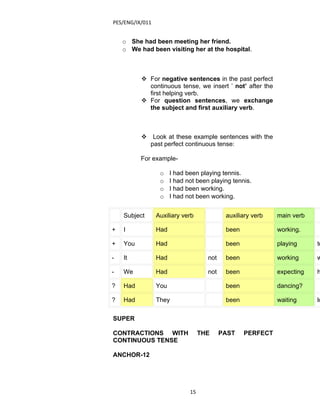
                  o    I had been playing tennis.
                  o    I had not been playing tennis.
                  o    I had been working.
                  o    I had not been working.


    Subject      Auxiliary verb             auxiliary verb   main verb

+   I            Had                        been             working.

+   You          Had                        been             playing     te

-   It           Had                 not    been             working     w

-   We           Had                 not    been             expecting   h

?   Had          You                        been             dancing?

?   Had          They                       been             waiting     lo

SUPER

CONTRACTIONS WITH                  THE     PAST    PERFECT
CONTINUOUS TENSE

ANCHOR-12


                              15
PES/ENG/IX/011


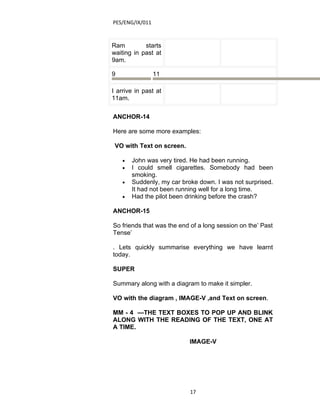
             When speaking with the past perfect continuous tense,
             we often contract the subject and first auxiliary verb:


             VO with Text on Screen

             ‘I had been’ becomes ‘I’d been’

             ‘They had been’ becomes ‘they’d been’

I had been                                     I'd been

you had been                                   you'd been

he had                                         he'd been
she had been                                   she'd been
it had been                                    it'd been

we had been                                    we'd been

they had been                                  they'd been

             SUPER
             How do we use the Past Perfect Continuous Tense?

             ANCHOR-13

             The past perfect continuous tense is like the past
             perfect tense, but it expresses longer actions in the
             past before another action in the past.

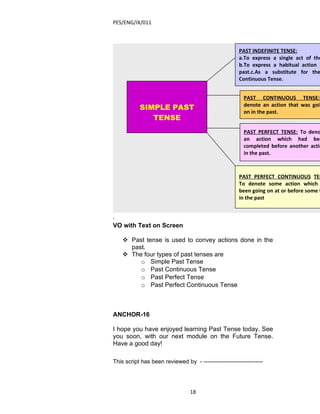
              For example:

             VO with Text on Screen

                •   Ram started waiting at 9am. I arrived at 11am.
                    When I arrived, Ram had been waiting for two
                    hours.

             Ram had been waiting for two hours when I arrived.

             past               present            future


                                          16
PES/ENG/IX/011


Ram         starts
waiting in past at
9am.

9                11

I arrive in past at
11am.

ANCHOR-14

Here are some more examples:

 VO with Text on screen.

    •   John was very tired. He had been running.
    •   I could smell cigarettes. Somebody had been
        smoking.
    •   Suddenly, my car broke down. I was not surprised.
        It had not been running well for a long time.
    •   Had the pilot been drinking before the crash?

ANCHOR-15

So friends that was the end of a long session on the’ Past
Tense’

. Lets quickly summarise everything we have learnt
today.

SUPER

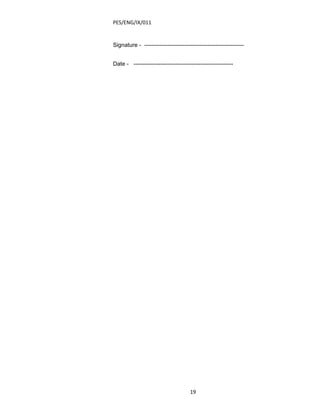
Summary along with a diagram to make it simpler.

VO with the diagram , IMAGE-V ,and Text on screen.

MM - 4 —THE TEXT BOXES TO POP UP AND BLINK
ALONG WITH THE READING OF THE TEXT, ONE AT
A TIME.

                            IMAGE-V


                            17
PES/ENG/IX/011


                                                       PAST INDEFINITE TENSE:
                                                       a.To express a single act of the
                                                       b.To express a habitual action i
                                                       past.c.As a substitute for the
                                                       Continuous Tense.


                                                         PAST CONTINUOUS TENSE:T
                                                         denote an action that was goin
           SIMPLE PAST
                                                         on in the past.
              TENSE
                                                         PAST PERFECT TENSE: To deno
                                                         an action which had bee
                                                         completed before another actio
                                                         in the past.


                                                       PAST PERFECT CONTINUOUS TEN
                                                       To denote some action which
                                                       been going on at or before some t
                                                       in the past


.
VO with Text on Screen

     Past tense is used to convey actions done in the
      past.
     The four types of past tenses are
         o Simple Past Tense
         o Past Continuous Tense
         o Past Perfect Tense
         o Past Perfect Continuous Tense


ANCHOR-16

I hope you have enjoyed learning Past Tense today. See
you soon, with our next module on the Future Tense.
Have a good day!

This script has been reviewed by - -------------------------------


                                 18
PES/ENG/IX/011


Signature - ----------------------------------------------------


Date - ----------------------------------------------------


                                     19

Ix tenses 2

  • 1.
    PES/ENG/IX/011 • This is FINAL version file.(REVISED) • Pl mark the portion reqd in Punjabi • Total word count – 2,526 A PUNJAB EDUSAT SOCIETY PRODUCTION CLASS: IX SUBJECT: ENGLISH TOPIC: TENSES (PART II) ANCHOR-1: Welcome back! It has not been very long since our last module on Present Tense. You will find this module on the Past Tense and the next one on Future Tense a very similar one. Let us first quickly revise what we did last time. SUPER: LET’S RECALL THE’ PRESENT TENSE’ MM-1 Show the same coloured diagram,IMAGE 1 , and the text should pop up along with the VO,AS each text box is read. TEXT on SCREEN (show with the diagram) withVO, reading the text on the diagram 1
  • 2.
    PES/ENG/IX/011 d.Present perfect continuous TENSES c. Present Pe Tense. Tense. P R E b.Present S Continuous a. Present Tense. Indefinite E Tense. N T • Simple Present/ Present Indefinite Tense o I do • Present Continuous Tense o I am doing, I will be doing tomorrow • Present Perfect Tense o I have done • Present Perfect Continuous Tense o I have been doing VO with the above Text on screen Last time, we learnt that the simple present tense is used to talk about things happening ‘now’. The Present Indefinite Tense says “I do”. For example ‘ I cook food.’ Then we have the present continuous tense that shows the action which is being done right now. For example- ‘Right now, I am telling you about Tenses.’ Then we learnt about the Present Perfect tense which relates to an action which was being done till now. The Present Perfect Continuous example can be’ I have been teaching English Grammar.’ 2
  • 3.
    PES/ENG/IX/011 ANCHOR 2: We shallnow move on to the Past Tense. The Past Tense also has the same four forms. But before we go through them, let us have a look at our Learning Objectives for this session. SUPER Learning Objectives VO with Text on Screen After this session, you will be able to  List the four types of Past tense  Identify the type of past tense in a given sentence  Use the different types of past tense correctly in spoken and written form SUPER FOUR TYPES OF PAST TENSE VO with Text on Screen The four types of past tense are-  Simple Past or Past Indefinite Tense.  Past Continuous Tense.  Past Perfect Tense.  Past Perfect Continuous Tense. ANCHOR-3 . We can use several tenses to talk about the past, but the simple past tense is the one we use most often. How do we make the simple past tense? Let us have a look. VO with Text on Screen To make the past Indefinite tense, we use: 3
  • 4.
    PES/ENG/IX/011 • The Second form of the Verb, Subject + V2+ object Examples of Simple Past Tense  He played cricket yesterday.  The teacher punished the student.  I wrote a letter. ANCHOR-3: Negative form of Indefinite Past tense can be Text with VO Negative sentences in indefinite past :-  Subject + Did not + V1 + object Examples: She did not attend the class. You did not help me. ANCHOR-4 There can be many examples to make the structure of indefinite past tense clear  Raj learnt a new poem.  Raj did not learn a new poem.  Did Raj learn a new poem? SUPER How do we use the Simple Past Tense? ANCHOR-5 We use the past Indefinite tense to talk about an action or a situation - an event - in the past. 4
  • 5.
    PES/ENG/IX/011 TEXT on screenWITH VO. The event can be short or long. Here are some short events with the simple past tense: The car exploded at 9.30am yesterday. She went to the door. We did not hear the telephone. Did you see that car? past present future The action is in the past. Here are some long events with the simple past tense: I lived in Bangkok for 10 years. The Jurassic period lasted about 62 million years. We did not sing at the concert. Did you watch TV last night? past present future The action is in the past. Notice that it does not matter how long ago the event is: it can be a few minutes or seconds in the past, or millions of years in the past. Also it does not matter how long the event is. It can be a few milliseconds (car explosion) or millions of years (Jurassic period). We use the simple past tense when: • the event is in the past • the event is completely finished • we say (or understand) the time and/or place of the event 5
  • 6.
    PES/ENG/IX/011 ANCHOR-6 You have seen that simple past tense is used for the past actions. There are some specific cases also where we use it. Now look at the screen. VO with TEXT ON SCREEN Some specific cases where simple past tense can be used are:-  To express an action completed in the past with reference to the time of speaking. Eg. I met my teacher in the park yesterday. We visited Jaipur, last year  To express a regular or habitual action in the past. Eg. When he was in school,he always stood first in the class. I visited the temple every evening to offer my prayers. I lived in this house when I was young. Ref. IMAGEII ANCHOR 7 MM- 2(A colourful image can be given behind the text. ) Note that when we tell a story, we usually use the simple past tense. Look at this example of the beginning of a story: 6
  • 7.
    PES/ENG/IX/011 "The wind washowling around the hotel and the rain was pouring down. It was cold. The door opened and James Bond entered. He took off his coat, which was very wet. He sat down in the corner of the lounge and quietly drank his orange juice.” SUPER Text with VO on screen. The Image-III to be shown. You can see the colourful picture of Raksha bandhan festival. Tell the incident in past indefinite tense IMAGE III . 7
  • 8.
    PES/ENG/IX/011 MM-3 Please show ananimated clipping of any incident/ story/ event/ festival which you have ready with you. The students will have to describe that clipping using the tense. Kindly email me the clip so that I may write the answer) The Past Continuous Tense ANCHOR-8 The past continuous tense is an important tense in English. We use it to say what we were in the middle of doing at a particular moment in the past. SUPER It is used  To denote an action going on some time in the past. The time of action may or may not be indicated.  For a persistant habit in the past. How do we make the past continuous tense? VO with Text on Screen The structure of the past continuous tense is: Subject + was/were + MV1 +ing : I, he, she, it, singular noun- ‘was’ We,you, they, plural noun- ‘were’. Eg. Tina was Playing. We were climbing the hills. 8
  • 9.
    PES/ENG/IX/011 He was doinghis work. For negative sentences in the past continuous tense, we insert ‘not’ between the helping verb and main verb. subject Auxiliary verb Main verb obje + I was watching TV. + You were working hard - HE/She/it was not helping Mary - We were not Joking. For question sentences, we exchange the subject and helping verb. Look at these example sentences with the past continuous tense: auxiliary subject Main Object Verb ? Were You working Hard? ? Was He/she/it not helping Mary ? ⋅ ANCHOR:9 Now children, let us see how we can use Past continuous Tense. SUPER How do we use the Past Continuous Tense? Text on screen with VO. 9
  • 10.
    PES/ENG/IX/011 We use Pastcontinuous tense  To denote an action going on some time in the past.  Examples °We were listening to the Radio. o It was getting darker. o I was watching TV when the phone rang. o The girl was riding a bicycle in the morning. o What were you doing in the school on Sunday?  This Tense is used with always, continually etc. Examples: o He was always grumbling. o She was continually teasinh her sister. o I was working hard last night. o I was completing my home work whole of yesterday afternoon. o He was always disturbing me at home. o They were always asking for facvours. o ANCHOR-10 Please listen to these few opening lines of an interesting story. Please note the tense usedWe often use the past continuous tense to "set the scene" in stories. We use it to describe the background situation at the moment when the action begins. Often, the story starts with the past continuous tense and then moves into the simple past tense. Here is an example 10
  • 11.
    PES/ENG/IX/011 (Show with image,VOand text.) “James Bond was driving through town. It was raining. The wind was blowing hard. Nobody was walking in the streets. Suddenly, Bond saw the killer in a telephone booth.” IMAGE-IV. SUPER The Past Continuous Tense Quiz (Answer to be flashed after 3 secs. Of the display of the sentence.) VO with Text on Screen  My brother and sister _________ playing tennis at 11am yesterday. Ans. was  ______________ you still working at 7pm last night? Ans. Were  At 8.30am today I __________ driving to work. Ans. was  We _______________ sleeping at 11pm. Ans. Were/ Weren’t 11
  • 12.
    PES/ENG/IX/011  Why __________ he having lunch at 4pm? Ans. Was ANCHOR-11 That was the end of our discussion on Past Continuous Tense. We now move on to the Past Perfect Tense. The past perfect tense is quite an easy tense to understand and to use. This tense talks about the "past in the past". SUPER How do we make the Past Perfect Tense VO with Text on Screen The structure of the past perfect tense is: Subject + “had” + MV3 o This tense tells about an action completed before a certain moment in the past. Eg o .When I reached my parent’s place, my sister had already left. o When the teacher came,some students had finished their work. o I got my job in 1980, although I had finished my studies a year ago. o I met him in 1979,after I had met him five years back. For negative sentences in the past perfect tense, we insert ‘not’ between the helping verb and main verb. For question sentences, we exchange the subject and helping verb. Look at these example sentences with the past perfect tense: VO with Text on Screen 12
  • 13.
    PES/ENG/IX/011 • I had finished my work. • You had not gone to school. • Had you arrived? • Had they finished their dinner? subject helping verb main verb + I had finished my work. + You had stopped before me. - She had not gone to school. - We had not left. ? Had you arrived? ? Had they finished their dinner? When speaking with the past perfect tense, we often write the subject and auxiliary verb in the short form: I had I'd you had you'd he had he'd she had she'd it had it'd we had we'd they had they'd SUPER How do we use the Past Perfect Tense? VO with Text on Screen The past perfect tense expresses action in the past before another action in the past. This is the past in the past. For example: 13
  • 14.
    PES/ENG/IX/011 • The train left at 9am. We arrived at 9.15am. When we arrived, the train had left. The train had left when we arrived. past present future Train left in past at 9am. 9 9.15 We arrived in past at 9.15am. Look at some more examples: • I wasn't hungry. I had just eaten. • They were hungry. They had not eaten for five hours. • I didn't know who he was. I had never seen him before. • "Mary wasn't at home when I arrived." "Really? Where had she gone?" SUPER Past Perfect Continuous Tense SUPER  How do we make the Past Perfect Continuous Tense? VO with text on Screen The structure of the past perfect continuous tense is: Subject + Had + been + main verb + ing + object For example- o I had been avoiding my studies. 14
  • 15.
    PES/ENG/IX/011 o She had been meeting her friend. o We had been visiting her at the hospital.  For negative sentences in the past perfect continuous tense, we insert ’ not’ after the first helping verb.  For question sentences, we exchange the subject and first auxiliary verb.  Look at these example sentences with the past perfect continuous tense: For example- o I had been playing tennis. o I had not been playing tennis. o I had been working. o I had not been working. Subject Auxiliary verb auxiliary verb main verb + I Had been working. + You Had been playing te - It Had not been working w - We Had not been expecting h ? Had You been dancing? ? Had They been waiting lo SUPER CONTRACTIONS WITH THE PAST PERFECT CONTINUOUS TENSE ANCHOR-12 15
  • 16.
    PES/ENG/IX/011 When speaking with the past perfect continuous tense, we often contract the subject and first auxiliary verb: VO with Text on Screen ‘I had been’ becomes ‘I’d been’ ‘They had been’ becomes ‘they’d been’ I had been I'd been you had been you'd been he had he'd been she had been she'd been it had been it'd been we had been we'd been they had been they'd been SUPER How do we use the Past Perfect Continuous Tense? ANCHOR-13 The past perfect continuous tense is like the past perfect tense, but it expresses longer actions in the past before another action in the past. For example: VO with Text on Screen • Ram started waiting at 9am. I arrived at 11am. When I arrived, Ram had been waiting for two hours. Ram had been waiting for two hours when I arrived. past present future 16
  • 17.
    PES/ENG/IX/011 Ram starts waiting in past at 9am. 9 11 I arrive in past at 11am. ANCHOR-14 Here are some more examples: VO with Text on screen. • John was very tired. He had been running. • I could smell cigarettes. Somebody had been smoking. • Suddenly, my car broke down. I was not surprised. It had not been running well for a long time. • Had the pilot been drinking before the crash? ANCHOR-15 So friends that was the end of a long session on the’ Past Tense’ . Lets quickly summarise everything we have learnt today. SUPER Summary along with a diagram to make it simpler. VO with the diagram , IMAGE-V ,and Text on screen. MM - 4 —THE TEXT BOXES TO POP UP AND BLINK ALONG WITH THE READING OF THE TEXT, ONE AT A TIME. IMAGE-V 17
  • 18.
    PES/ENG/IX/011 PAST INDEFINITE TENSE: a.To express a single act of the b.To express a habitual action i past.c.As a substitute for the Continuous Tense. PAST CONTINUOUS TENSE:T denote an action that was goin SIMPLE PAST on in the past. TENSE PAST PERFECT TENSE: To deno an action which had bee completed before another actio in the past. PAST PERFECT CONTINUOUS TEN To denote some action which been going on at or before some t in the past . VO with Text on Screen  Past tense is used to convey actions done in the past.  The four types of past tenses are o Simple Past Tense o Past Continuous Tense o Past Perfect Tense o Past Perfect Continuous Tense ANCHOR-16 I hope you have enjoyed learning Past Tense today. See you soon, with our next module on the Future Tense. Have a good day! This script has been reviewed by - ------------------------------- 18
  • 19.
    PES/ENG/IX/011 Signature - ---------------------------------------------------- Date- ---------------------------------------------------- 19