Prepared by: MRINAL DWIVEDI
26
Percy Bysshe Shelley
 Born: 4 August 1792
Field Place, Horsham, England
 Died: 8 July 1822 (aged 29)
Viareggio, Grand Duchy of Tuscany
 Occupation:
Poet, Dramatist, Essayist, Novelist
 written on December 1817
 published in 1818 in the January 11 issue
of The Examiner in London
 frequently anthologised and probably Shelley's
most famous short poem
 written in competition with his friend Horace
Smith, who wrote another sonnet entitled
"Ozymandias"
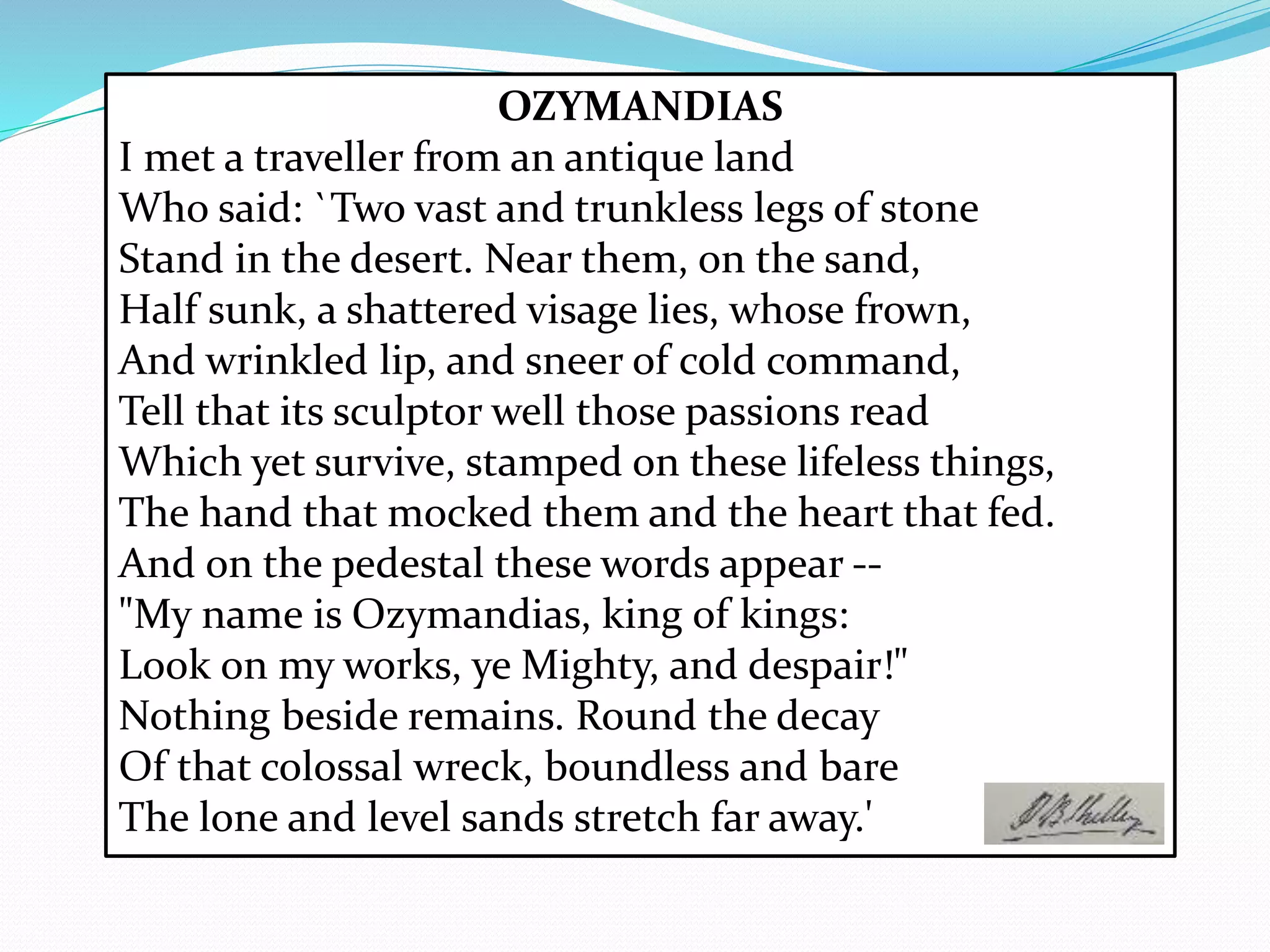
OZYMANDIAS
I met a traveller from an antique land
Who said: `Two vast and trunkless legs of stone
Stand in the desert. Near them, on the sand,
Half sunk, a shattered visage lies, whose frown,
And wrinkled lip, and sneer of cold command,
Tell that its sculptor well those passions read
Which yet survive, stamped on these lifeless things,
The hand that mocked them and the heart that fed.
And on the pedestal these words appear --
"My name is Ozymandias, king of kings:
Look on my works, ye Mighty, and despair!"
Nothing beside remains. Round the decay
Of that colossal wreck, boundless and bare
The lone and level sands stretch far away.'
 iambic pentameter sonnet
 Theme: the inevitable complete decline of all
leaders, and of the empires they build, however
mighty in their own time
 Ozymandias was another name for Ramesses the
Great, Pharaoh of the nineteenth dynasty of
ancient Egypt.
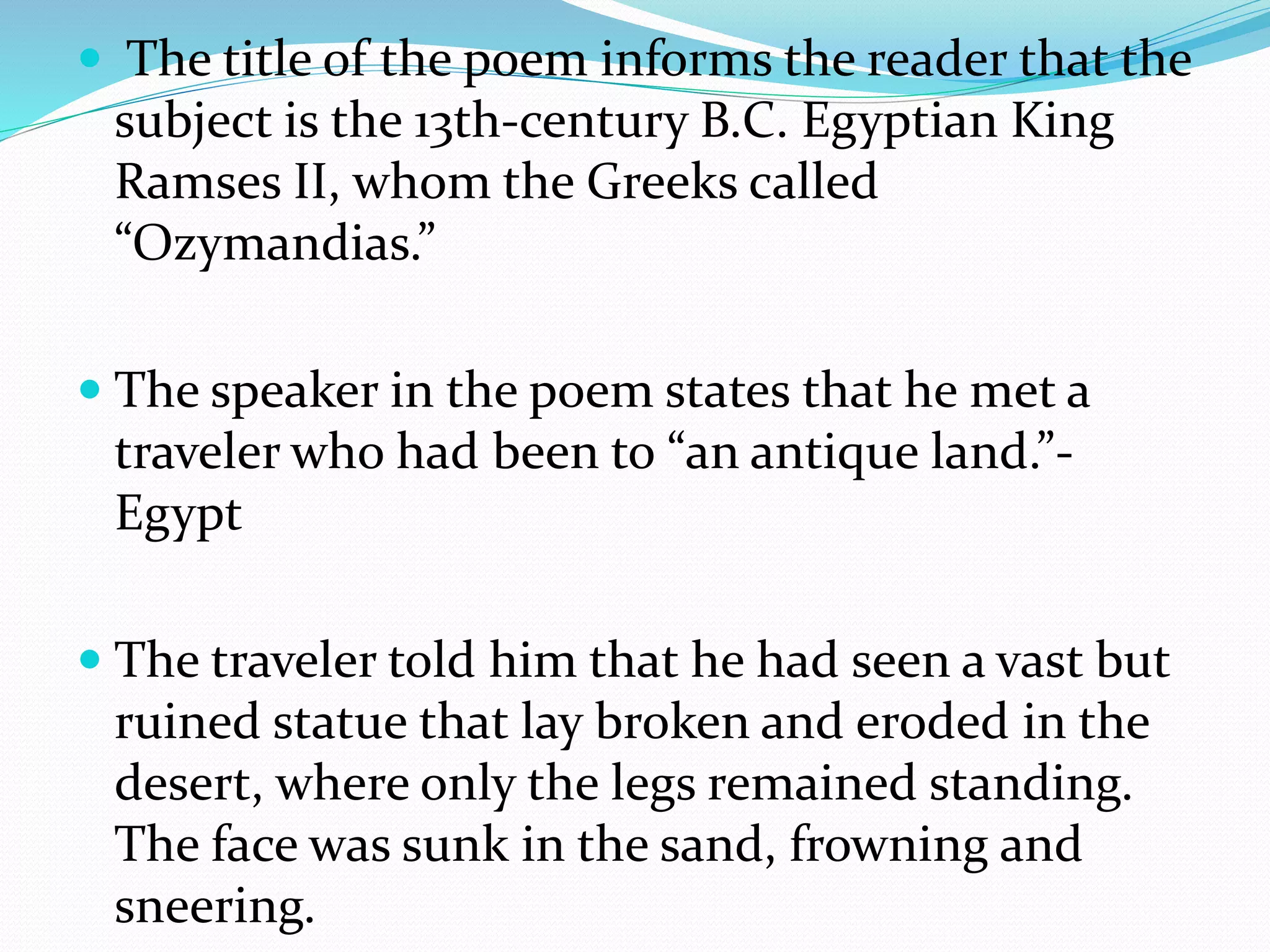
 The title of the poem informs the reader that the
subject is the 13th-century B.C. Egyptian King
Ramses II, whom the Greeks called
“Ozymandias.”
 The speaker in the poem states that he met a
traveler who had been to “an antique land.”-
Egypt
 The traveler told him that he had seen a vast but
ruined statue that lay broken and eroded in the
desert, where only the legs remained standing.
The face was sunk in the sand, frowning and
sneering.
 The traveler describes the great work of the sculptor,
who was able to capture the king’s “passions” and
give meaningful expression to the stone, an
otherwise “lifeless thing.”
 The “mocking hand” in line 8 is that of the sculptor,
who had the artistic ability to “mock” (that is, both
imitate and deride) the passions of the king.
 The “heart” is first of all the king’s, which “fed” the
sculptor’s passions, and in turn the sculptor’s,
sympathetically recapturing the king’s passions in
the stone.
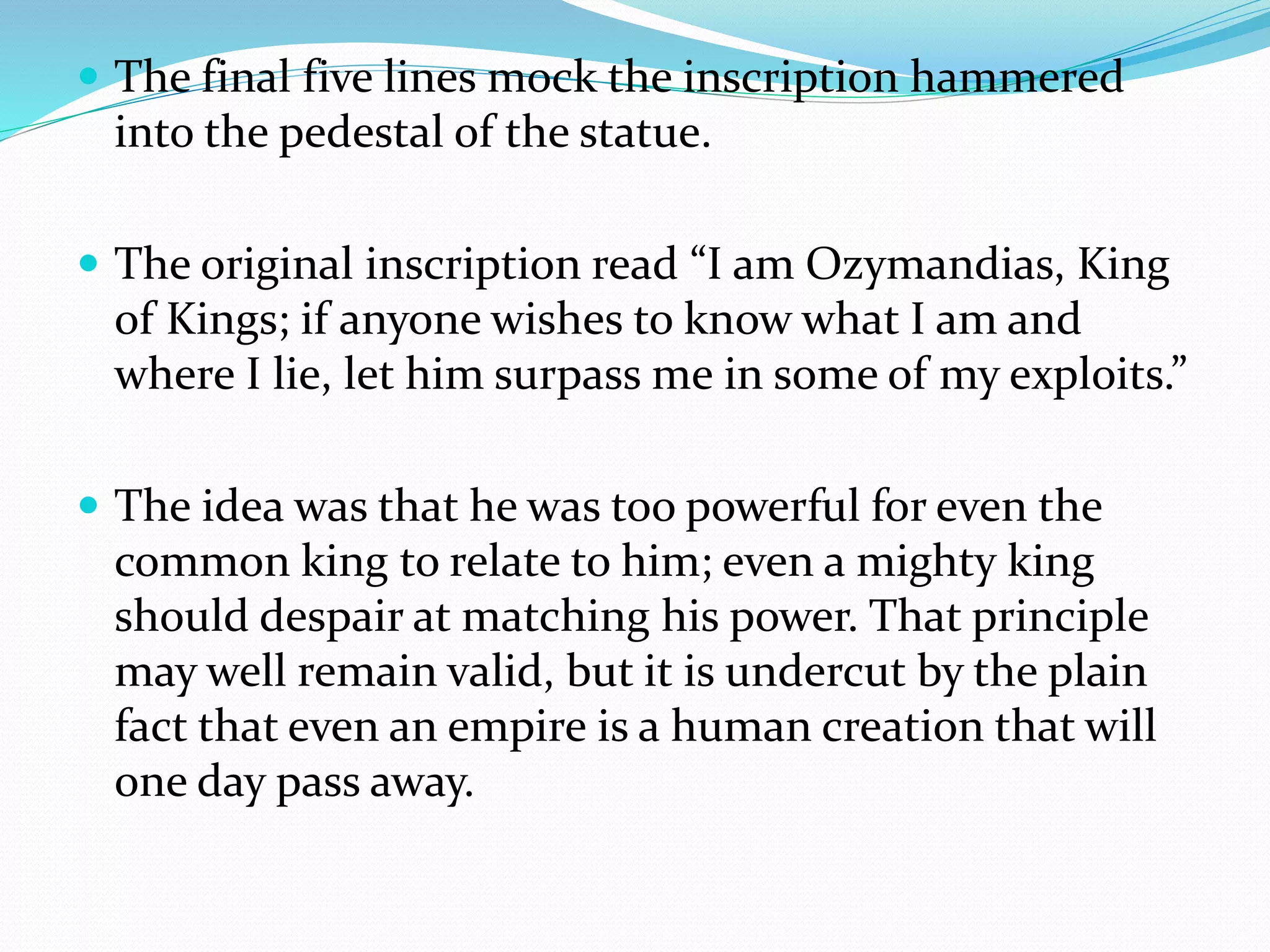
 The final five lines mock the inscription hammered
into the pedestal of the statue.
 The original inscription read “I am Ozymandias, King
of Kings; if anyone wishes to know what I am and
where I lie, let him surpass me in some of my exploits.”
 The idea was that he was too powerful for even the
common king to relate to him; even a mighty king
should despair at matching his power. That principle
may well remain valid, but it is undercut by the plain
fact that even an empire is a human creation that will
one day pass away.
 The statue and surrounding desert constitute a
metaphor for invented power in the face of natural
power. By Shelley’s time, nothing remains but a
shattered bust, eroded “visage,” and “trunkless legs”
surrounded with “nothing” but “level sands” that
“stretch far away.” Shelley thus points out human
mortality and the fate of artificial things.
THANK YOU

chapter Ozymandias class 10

  • 1.
  • 2.
  • 3.
     Born: 4August 1792 Field Place, Horsham, England  Died: 8 July 1822 (aged 29) Viareggio, Grand Duchy of Tuscany  Occupation: Poet, Dramatist, Essayist, Novelist
  • 4.
     written onDecember 1817  published in 1818 in the January 11 issue of The Examiner in London  frequently anthologised and probably Shelley's most famous short poem  written in competition with his friend Horace Smith, who wrote another sonnet entitled "Ozymandias"
  • 5.
    OZYMANDIAS I met atraveller from an antique land Who said: `Two vast and trunkless legs of stone Stand in the desert. Near them, on the sand, Half sunk, a shattered visage lies, whose frown, And wrinkled lip, and sneer of cold command, Tell that its sculptor well those passions read Which yet survive, stamped on these lifeless things, The hand that mocked them and the heart that fed. And on the pedestal these words appear -- "My name is Ozymandias, king of kings: Look on my works, ye Mighty, and despair!" Nothing beside remains. Round the decay Of that colossal wreck, boundless and bare The lone and level sands stretch far away.'
  • 6.
     iambic pentametersonnet  Theme: the inevitable complete decline of all leaders, and of the empires they build, however mighty in their own time  Ozymandias was another name for Ramesses the Great, Pharaoh of the nineteenth dynasty of ancient Egypt.
  • 7.
     The titleof the poem informs the reader that the subject is the 13th-century B.C. Egyptian King Ramses II, whom the Greeks called “Ozymandias.”  The speaker in the poem states that he met a traveler who had been to “an antique land.”- Egypt  The traveler told him that he had seen a vast but ruined statue that lay broken and eroded in the desert, where only the legs remained standing. The face was sunk in the sand, frowning and sneering.
  • 8.
     The travelerdescribes the great work of the sculptor, who was able to capture the king’s “passions” and give meaningful expression to the stone, an otherwise “lifeless thing.”  The “mocking hand” in line 8 is that of the sculptor, who had the artistic ability to “mock” (that is, both imitate and deride) the passions of the king.  The “heart” is first of all the king’s, which “fed” the sculptor’s passions, and in turn the sculptor’s, sympathetically recapturing the king’s passions in the stone.
  • 9.
     The finalfive lines mock the inscription hammered into the pedestal of the statue.  The original inscription read “I am Ozymandias, King of Kings; if anyone wishes to know what I am and where I lie, let him surpass me in some of my exploits.”  The idea was that he was too powerful for even the common king to relate to him; even a mighty king should despair at matching his power. That principle may well remain valid, but it is undercut by the plain fact that even an empire is a human creation that will one day pass away.
  • 10.
     The statueand surrounding desert constitute a metaphor for invented power in the face of natural power. By Shelley’s time, nothing remains but a shattered bust, eroded “visage,” and “trunkless legs” surrounded with “nothing” but “level sands” that “stretch far away.” Shelley thus points out human mortality and the fate of artificial things.
  • 11.