P E R C Y B Y S S H E S H E L L E Y
OZYMANDIAS
“Till the Future dares
Forget the Past, his fate and fame shall be
An echo and a light unto eternity!”
Percy Bysshe Shelley – Adonais (1821)
Introduction
 As a poet
 For what Shelly is famous for
 List of influential writing
 Birth:
4 August 1792 Field Place, Horsham, Sussex,
England.
 Died:
8 July 1822 (aged 29) Lerici, Kingdom of
Sardinia(now Italy)
 Occupation :
Poet, dramatist, essayist, novelist
 Literary movement:
Romanticism
OZYMANDIAS
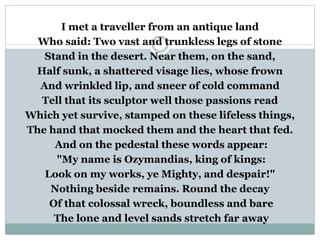
I met a traveller from an antique land
Who said: Two vast and trunkless legs of stone
Stand in the desert. Near them, on the sand,
Half sunk, a shattered visage lies, whose frown
And wrinkled lip, and sneer of cold command
Tell that its sculptor well those passions read
Which yet survive, stamped on these lifeless things,
The hand that mocked them and the heart that fed.
And on the pedestal these words appear:
"My name is Ozymandias, king of kings:
Look on my works, ye Mighty, and despair!"
Nothing beside remains. Round the decay
Of that colossal wreck, boundless and bare
The lone and level sands stretch far away
SYNOPSIS
 The poem is about the futility of arrogance.
Worldly power will die with you and
eventually time will destroy every mark you
have ever made on the world. The giant statue
was the king's attempt at immortal fame but
it is broken and only the legs remain.
ANALYSIS
 Figures of Speech
 Form and Meter
 Setting
 Story behind the title
FIGURES OF SPEECH
 Metaphor
"My name is Ozymandias, king of kings:
Look on my works, ye Mighty, and despair!"
 Alliteration
Of that colossal wreck, boundless and bare
The lone and level sands stretch far away
 Irony
FORM AND METER
 Strange combination of two sonnets:
a) Petrarchan Sonnet
b) Shakespearean/English Sonnet
 Rhyme scheme: (ABABACDCEDEFEF)
Line 1-4 ABAB
Line 5-8 ACDC instead of CDCD
Line 9-12 EDEF instead of EFEF
 Pentameter or Iambic Pentameter ?
I met a traveller from an antique land
Who said: Two vast and trunkless legs of stone
Stand in the desert. Near them, on the sand,
Half sunk, a shattered visage lies, whose frown
And wrinkled lip, and sneer of cold command
Tell that its sculptor well those passions read
Which yet survive, stamped on these lifeless things,
The hand that mocked them and the heart that fed.
And on the pedestal these words appear:
"My name is Ozymandias, king of kings:
Look on my works, ye Mighty, and despair!"
Nothing beside remains. Round the decay
Of that colossal wreck, boundless and bare
The lone and level sands stretch far away
SETTING
 Several settings
 Emptiness all-around
STORY BEHIND THE TITLE
 "Ozymandias" is an ancient Greek name for Ramses
II of Egypt. It is actually a Greek version of the
Egyptian phrase "User-maat-Re," one of Ramses's
Egyptian names.
 it is therefore no surprise that he chooses to use the
Greek name "Ozymandias," rather than the Egyptian
name. Ramses II was one of Egypt's greatest
pharaohs,
 He is known not only for his building program, but
also for several ambitious foreign military campaigns
and for his diplomacy.
THEMES
 Theme of “Art & Culture”
 Theme of Pride
 Theme of Man & the natural
world
THANK YOU

Ozymandias

  • 1.
    P E RC Y B Y S S H E S H E L L E Y OZYMANDIAS
  • 2.
    “Till the Futuredares Forget the Past, his fate and fame shall be An echo and a light unto eternity!” Percy Bysshe Shelley – Adonais (1821)
  • 3.
    Introduction  As apoet  For what Shelly is famous for  List of influential writing
  • 4.
     Birth: 4 August1792 Field Place, Horsham, Sussex, England.  Died: 8 July 1822 (aged 29) Lerici, Kingdom of Sardinia(now Italy)  Occupation : Poet, dramatist, essayist, novelist  Literary movement: Romanticism
  • 5.
  • 6.
    I met atraveller from an antique land Who said: Two vast and trunkless legs of stone Stand in the desert. Near them, on the sand, Half sunk, a shattered visage lies, whose frown And wrinkled lip, and sneer of cold command Tell that its sculptor well those passions read Which yet survive, stamped on these lifeless things, The hand that mocked them and the heart that fed. And on the pedestal these words appear: "My name is Ozymandias, king of kings: Look on my works, ye Mighty, and despair!" Nothing beside remains. Round the decay Of that colossal wreck, boundless and bare The lone and level sands stretch far away
  • 7.
    SYNOPSIS  The poemis about the futility of arrogance. Worldly power will die with you and eventually time will destroy every mark you have ever made on the world. The giant statue was the king's attempt at immortal fame but it is broken and only the legs remain.
  • 8.
    ANALYSIS  Figures ofSpeech  Form and Meter  Setting  Story behind the title
  • 9.
    FIGURES OF SPEECH Metaphor "My name is Ozymandias, king of kings: Look on my works, ye Mighty, and despair!"  Alliteration Of that colossal wreck, boundless and bare The lone and level sands stretch far away  Irony
  • 10.
    FORM AND METER Strange combination of two sonnets: a) Petrarchan Sonnet b) Shakespearean/English Sonnet  Rhyme scheme: (ABABACDCEDEFEF) Line 1-4 ABAB Line 5-8 ACDC instead of CDCD Line 9-12 EDEF instead of EFEF  Pentameter or Iambic Pentameter ?
  • 11.
    I met atraveller from an antique land Who said: Two vast and trunkless legs of stone Stand in the desert. Near them, on the sand, Half sunk, a shattered visage lies, whose frown And wrinkled lip, and sneer of cold command Tell that its sculptor well those passions read Which yet survive, stamped on these lifeless things, The hand that mocked them and the heart that fed. And on the pedestal these words appear: "My name is Ozymandias, king of kings: Look on my works, ye Mighty, and despair!" Nothing beside remains. Round the decay Of that colossal wreck, boundless and bare The lone and level sands stretch far away
  • 12.
  • 13.
    STORY BEHIND THETITLE  "Ozymandias" is an ancient Greek name for Ramses II of Egypt. It is actually a Greek version of the Egyptian phrase "User-maat-Re," one of Ramses's Egyptian names.  it is therefore no surprise that he chooses to use the Greek name "Ozymandias," rather than the Egyptian name. Ramses II was one of Egypt's greatest pharaohs,  He is known not only for his building program, but also for several ambitious foreign military campaigns and for his diplomacy.
  • 14.
    THEMES  Theme of“Art & Culture”  Theme of Pride  Theme of Man & the natural world
  • 15.

Editor's Notes

  • #4 Percy Bysshe Shelley was one of the major English Romantic poets . Shelley did not achieve fame during his lifetime, but recognition for his poetry grew steadily following his death. Shelley was a key member of a close circle of visionary poets and writers that included Lord Byron; Leigh Hunt; Thomas Love Peacock; and his own second wife, Mary Shelley, the author of Frankenstein. Shelley is perhaps best known for such classic poems as Ozymandias, Ode to the West Wind, To a Skylark, and The Masque of Anarchy. His other major works include long, visionary poems such as Queen Mab (later reworked as The Daemon of the World), Alastor, The Revolt of Islam, Adonaïs, the unfinished work The Triumph of Life; and the visionary verse dramas The Cenci (1819) and Prometheus Unbound (1820). Shelley became an idol of the next three or four generations of poets, including important Victorian and Pre-Raphaelite poets such as Robert Browning and Dante Gabriel Rossetti.
  • #6 The famous sonnet of P.B. Shelley mocks at all worldly power, glory and grandeur . The ravages of time reduce even the' king of kings' and the authoritative despots like Ozymandias to dust. Nothing is left of proud and arrogant Ozymandias power and glory except his broken statue and shattered half-buried face in the boundless and bare sand of a desert .
  • #7 Written on December 1817. Published in 1818 in the January 11 issue of The Examiner in London. Frequently anthologised and probably Shelley's most famous short poem. Written in competition with his friend Horace Smith, who wrote another sonnet entitled "Ozymandias“. Thought to be inspired by the arrival of the statue of “Ramses II” in Britain. A ‘classic’ poem which has been studied and dissected countless times in the subject of English ever since its creation.
  • #10 Metaphor: an implied comparison Alliteration: consonants specifically at the beginning of words or stressed syllables are repeated