DR TR SHRESTHA, KMCTH
Pt particulars
▪ 58 yr/ Male
▪ Chief complaint
▪ Increased frequency of micturition X 6 months

History of present illness
▪ Increased frequency of micturition X 6 months
▪ Difficulty in passing urine
▪ Dribbling at the end of micturition
▪ No history of fever, burning micturition
▪ No abdominal pain, urgency, nocturia,
hematuria, back pain, retention
▪ No weight loss, fatigue
Past history
Medical history
No history of any medical illness
No h/o DM, HTN, Asthma, COPD
No bleeding disorders, blood transfusion
Surgical history
No history of anesthetic exposure or any surgeries
Family history:
No history of Hypertension, Diabetes mellitus, Bronchial
Asthma , or any chronic Diseases
Personal history:
Non smoker, does not consume alcohol
Sleep, Appetite-Normal
No any allergic history
Drug History:
Taking Tamsulosin since 6 months
Examination
▪ Conscious, co-operative, well oriented to time, place, person
▪ Weight: 50 kg, Height: 1.60m, BMI:19.53 kg/m2
▪ GC-Normal, lying comfortably on bed, Foley catheter in situ
▪ Pallor, icterus, lymphadenopathy, cyanosis, clubbing, edema and dehydration-
Absent
▪ Oxygen saturation: 98% in room air
▪ Temperature: 97℉
▪ PR-88/min, regular, all peripheral pulses palpable, no radioradial delay, no
radiofemoral delay
▪ Peripheral veins accessible
Airway examination
▪ Nasal patency: Normal, No DNS or visible polyp
▪ Teeth: Normal Dentition
▪ Palate: Normal
▪ Mallampatti: Grade II
▪ Temporomandibular joint movement: Normal
▪ Mouth opening:4 cm
▪ Catch test (upper lip bite test): Class I
▪ Mandibular protrusion test: Class A
▪ Patil’s test (Thyromental distance): 6 cm
▪ Atlantooccipital joint extension movement: Normal
Systemic examination
Gastrointestinal system
Inspection
Abdomen not distended, no scar marks, umbilicus is normal in position
External genitalia: Normal, Foley catheter in situ
Palpation
No tenderness, rebound tenderness, palpable mass or organ palpable
Percussion
Tympanic note present. Fluid thrill and shifting dullness absent
No renal angle tenderness
Auscultation
Normal bowel sound heard
DRE: Anal tone normal. Firmly consistent, smooth prostate felt, no nodules.
Cardiovascular System
Inspection
No surgical marks, visible pulsation, any chest deformities
Palpation
Apex beat over 5th intercostal space, midclavicular line, No heave, thrill
Auscultation
S1 S2 normal, no murmur
Central Nervous System
▪ GCS:15/15, well oriented to time, place and person
▪ Higher mental function: Intact
▪ Sensory, motor: Intact
▪ Reflexes : Intact
▪ Cranial nerves : Intact
Respiratory System
Inspection
Normal shape, bilateral symmetrical, No any scar marks, vascular anomalies
Palpation
Trachea centrally placed, chest expansion bilateral equal, no tenderness or any
other abnormalities
Percussion
Bilateral resonant note heard
Auscultation
Bilateral normal vesicular breath sound heard, No added sound
Investigations
▪ Hb :14.2 gm/dl
▪ TLC: 8800, N-74,L-24,E-0, M-2
▪ Platelet: 165000
▪ RFT: Urea:21,Cr:1.1,Na:134,K:4.0
▪ RBS: 93mmol/l
▪ PT/INR: 14/1.2
▪ Blood group: A+ve
▪ Viral markers: Non reactive
▪ LFT: Normal
▪ Urine RE: WNL
▪ Urine CS: No growth
▪ CXR: Normal lung fields
▪ ECG: 73 / min, regular rhythm, no axis deviation,
no ischemic changes , within normal limits
▪ USG abdomen pelvis
▪ Mildly enlarged prostate with size of 43.5 mm X 42.2
mm X 32 mm, weight 42 gms
Preoperative advice
▪ Graded as ASA I and planned for TURP under Spinal
Anaesthesia
▪ NPO 6 hours for solid foods and 2 hours for clear liquid
▪ Premedication
▪ Tab Ranitidine 150 mg and Tab Metoclopramide 10 mg HS and
6:30am in the morning of surgery
▪ Tab Alprazolam 0.25mg HS
▪ Patient/ patient party counseled about the mode of
anaesthesia
In OT
▪ Ventilator, breathing system checked
▪ Emergency drugs prepared
▪ Airway equipment, intubation set made ready
▪ IV access with 18G cannula LHS, Inj NS started
▪ Monitors attached (ECG, pulse oximeter, NIBP)
▪ Heart Rate, SpO2, BP monitored every 5 min
▪ Baseline vital paramers:
▪ BP 130/76mmHg, HR 82 bpm, SpO2 98%
▪ Under aseptic precautions, 27G Whitacre needle inserted
in L3-L4 space in sitting position
▪ Free flow of CSF appreciated
▪ 0.5% hyperbaric bupivacaine 3 ml given over 30 seconds
▪ Patient turned supine
▪ Sensory level T7
Surgical technique
▪ Lithotomy position
▪ Use of resectoscope, through which diathermy loop passed
▪ Resection of hyperplastic tissue, sparing surgical capsule
▪ Continuous irrigation with glycine (10 L)
▪ At the end, a three-lumen catheter inserted and irrigation
continued
▪ Surgery duration: 40 min
DISCUSSION
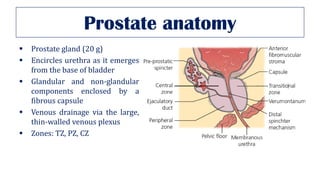
Prostate anatomy
▪ Prostate gland (20 g)
▪ Encircles urethra as it emerges
from the base of bladder
▪ Glandular and non-glandular
components enclosed by a
fibrous capsule
▪ Venous drainage via the large,
thin-walled venous plexus
▪ Zones: TZ, PZ, CZ
Nerve supply
▪ Prostatic plexus (from inferior hypogastric plexus)
carries both SNS and PNS
▪ Pain from prostate, prostatic urethra, and bladder
mucosa →sacral nerves S2 to S4
▪ Pain signals from bladder distension travel with
sympathetic fibers (T11–L2)
Irrigation fluid
▪ Isotonic
▪ Electrically inert
▪ Non-toxic
▪ Transparent
▪ Easy to sterilize
▪ Inexpensive
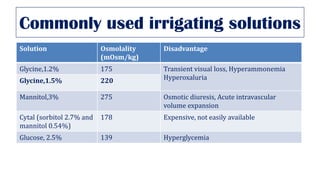
Commonly used irrigating solutions
Solution Osmolality
(mOsm/kg)
Disadvantage
Glycine,1.2% 175 Transient visual loss, Hyperammonemia
Hyperoxaluria
Glycine,1.5% 220
Mannitol,3% 275 Osmotic diuresis, Acute intravascular
volume expansion
Cytal (sorbitol 2.7% and
mannitol 0.54%)
178 Expensive, not easily available
Glucose, 2.5% 139 Hyperglycemia
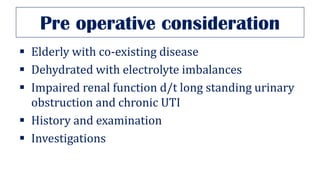
Pre operative consideration
▪ Elderly with co-existing disease
▪ Dehydrated with electrolyte imbalances
▪ Impaired renal function d/t long standing urinary
obstruction and chronic UTI
▪ History and examination
▪ Investigations
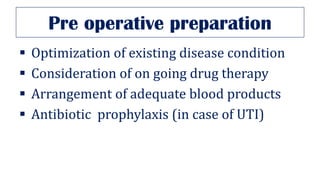
Pre operative preparation
▪ Optimization of existing disease condition
▪ Consideration of on going drug therapy
▪ Arrangement of adequate blood products
▪ Antibiotic prophylaxis (in case of UTI)
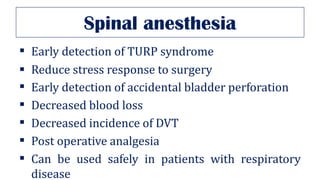
Spinal anesthesia
▪ Early detection of TURP syndrome
▪ Reduce stress response to surgery
▪ Early detection of accidental bladder perforation
▪ Decreased blood loss
▪ Decreased incidence of DVT
▪ Post operative analgesia
▪ Can be used safely in patients with respiratory
disease
Intraoperative problems
▪ TURP syndrome
▪ Haemorrhage
▪ Myocardial ischaemia
▪ Hypothermia
▪ Prostatic capsular perforation
▪ Bladder or urethral perforation
TURP syndrome
▪ 1–8% of Patients
▪ Excessive absorption of irrigating fluid
▪ Changes in intravascular volume, plasma solute
concentrations, and osmolality, and direct effects of the
irrigation fluid used
▪ Early: restlessness, headache, and tachypnea, or a burning
sensation in the face and hands
▪ Increasing severity: respiratory distress, hypoxia,
pulmonary edema, nausea, vomiting, confusion,
convulsion, and coma
A higher rate of absorption
▪ Height of the bag< 60 cm
▪ Low venous pressure
▪ Prolonged surgery, especially>1 h
▪ Large blood loss, implying a large number of open
veins
▪ Capsular perforation, or bladder perforation
Volume changes
▪ Rapid absorption→ Hypertension, Reflex
bradycardia
▪ Acute cardiac failure and pulmonary edema
▪ Rapid equilibration of hypotonic fluid with the
extracellular fluid compartment may precipitate
sudden hypotension in a/w hypovolaemia
Solute changes
▪ Acute hyponatraemia→initially dilutional, later by
natriuresis
▪ Headache, altered level of consciousness, nausea
and vomiting, seizures, coma, and death
▪ Osmolality if normal→no intervention
Glycine and metabolites
▪ Glycine toxicity: nausea, headache, malaise,
weakness, transient blindness
▪ NMDA receptor activity potentiated
→encephalopathy, seizures
▪ Metabolized to ammonia
▪ Cerebral depressant
Treatment
▪ Stop surgery, stop fluids
▪ 100% O2
▪ Airway: Intubate if necessary
▪ Circulation: Vassopressors
▪ Seizures: BZDs
▪ Blood sample: Na+, Hb, osmolality
▪ Pulmonary edema: Furosemide 40mg, mannitol 20% 100 ml
▪ Arterial line, CVP line
▪ Na+<120 mmol/L or severe symptoms→3% NaCl
Bladder perforation
▪ Extraperitoneal: pain in periumbilical, inguinal or
supra-pubic region
▪ Intraperitoneal: pain in the upper part of the
abdomen or referred pain to shoulder
Hypothermia
▪ Heat loss as a result of irrigation and significant
absorption of the fluid
▪ Post-op shivering can lead to dislodgement of clot
leading to excessive bleeding
Haemorrhage
▪ 2.4 - 4.6 ml of blood per minute of resection
▪ Excessive bleeding
▪ Large gland
▪ Extensive resection (>40–60 gm of prostate chippings)
▪ Coexisting infection
▪ Prolonged surgery (>1 h)
▪ Presence of a preoperative urinary catheter
▪ Urokinase from prostate→fibrinolysis→bleeding
Bacteremia and septicemia
▪ Incidence:6-7%
▪ Release of bacteria through prostatic venous
sinuses
▪ Presence of indwelling urinary catheter
Post operative complications
▪ TURP syndrome
▪ Bladder spasm
▪ Ongoing bleeding
▪ Clot retention
▪ Deep venous thrombosis
▪ Myocardial ischaemia
▪ Postoperative cognitive impairment
BPH case undergoing TURP

BPH case undergoing TURP

  • 1.
  • 2.
    Pt particulars ▪ 58yr/ Male ▪ Chief complaint ▪ Increased frequency of micturition X 6 months
  • 3.
    History of presentillness ▪ Increased frequency of micturition X 6 months ▪ Difficulty in passing urine ▪ Dribbling at the end of micturition ▪ No history of fever, burning micturition ▪ No abdominal pain, urgency, nocturia, hematuria, back pain, retention ▪ No weight loss, fatigue
  • 4.
    Past history Medical history Nohistory of any medical illness No h/o DM, HTN, Asthma, COPD No bleeding disorders, blood transfusion Surgical history No history of anesthetic exposure or any surgeries
  • 5.
    Family history: No historyof Hypertension, Diabetes mellitus, Bronchial Asthma , or any chronic Diseases Personal history: Non smoker, does not consume alcohol Sleep, Appetite-Normal No any allergic history Drug History: Taking Tamsulosin since 6 months
  • 6.
    Examination ▪ Conscious, co-operative,well oriented to time, place, person ▪ Weight: 50 kg, Height: 1.60m, BMI:19.53 kg/m2 ▪ GC-Normal, lying comfortably on bed, Foley catheter in situ ▪ Pallor, icterus, lymphadenopathy, cyanosis, clubbing, edema and dehydration- Absent ▪ Oxygen saturation: 98% in room air ▪ Temperature: 97℉ ▪ PR-88/min, regular, all peripheral pulses palpable, no radioradial delay, no radiofemoral delay ▪ Peripheral veins accessible
  • 7.
    Airway examination ▪ Nasalpatency: Normal, No DNS or visible polyp ▪ Teeth: Normal Dentition ▪ Palate: Normal ▪ Mallampatti: Grade II ▪ Temporomandibular joint movement: Normal ▪ Mouth opening:4 cm ▪ Catch test (upper lip bite test): Class I ▪ Mandibular protrusion test: Class A ▪ Patil’s test (Thyromental distance): 6 cm ▪ Atlantooccipital joint extension movement: Normal
  • 8.
    Systemic examination Gastrointestinal system Inspection Abdomennot distended, no scar marks, umbilicus is normal in position External genitalia: Normal, Foley catheter in situ Palpation No tenderness, rebound tenderness, palpable mass or organ palpable Percussion Tympanic note present. Fluid thrill and shifting dullness absent No renal angle tenderness Auscultation Normal bowel sound heard DRE: Anal tone normal. Firmly consistent, smooth prostate felt, no nodules.
  • 9.
    Cardiovascular System Inspection No surgicalmarks, visible pulsation, any chest deformities Palpation Apex beat over 5th intercostal space, midclavicular line, No heave, thrill Auscultation S1 S2 normal, no murmur
  • 10.
    Central Nervous System ▪GCS:15/15, well oriented to time, place and person ▪ Higher mental function: Intact ▪ Sensory, motor: Intact ▪ Reflexes : Intact ▪ Cranial nerves : Intact
  • 11.
    Respiratory System Inspection Normal shape,bilateral symmetrical, No any scar marks, vascular anomalies Palpation Trachea centrally placed, chest expansion bilateral equal, no tenderness or any other abnormalities Percussion Bilateral resonant note heard Auscultation Bilateral normal vesicular breath sound heard, No added sound
  • 12.
    Investigations ▪ Hb :14.2gm/dl ▪ TLC: 8800, N-74,L-24,E-0, M-2 ▪ Platelet: 165000 ▪ RFT: Urea:21,Cr:1.1,Na:134,K:4.0 ▪ RBS: 93mmol/l ▪ PT/INR: 14/1.2 ▪ Blood group: A+ve ▪ Viral markers: Non reactive ▪ LFT: Normal
  • 13.
    ▪ Urine RE:WNL ▪ Urine CS: No growth ▪ CXR: Normal lung fields ▪ ECG: 73 / min, regular rhythm, no axis deviation, no ischemic changes , within normal limits
  • 14.
    ▪ USG abdomenpelvis ▪ Mildly enlarged prostate with size of 43.5 mm X 42.2 mm X 32 mm, weight 42 gms
  • 15.
    Preoperative advice ▪ Gradedas ASA I and planned for TURP under Spinal Anaesthesia ▪ NPO 6 hours for solid foods and 2 hours for clear liquid ▪ Premedication ▪ Tab Ranitidine 150 mg and Tab Metoclopramide 10 mg HS and 6:30am in the morning of surgery ▪ Tab Alprazolam 0.25mg HS ▪ Patient/ patient party counseled about the mode of anaesthesia
  • 16.
    In OT ▪ Ventilator,breathing system checked ▪ Emergency drugs prepared ▪ Airway equipment, intubation set made ready ▪ IV access with 18G cannula LHS, Inj NS started ▪ Monitors attached (ECG, pulse oximeter, NIBP) ▪ Heart Rate, SpO2, BP monitored every 5 min
  • 17.
    ▪ Baseline vitalparamers: ▪ BP 130/76mmHg, HR 82 bpm, SpO2 98% ▪ Under aseptic precautions, 27G Whitacre needle inserted in L3-L4 space in sitting position ▪ Free flow of CSF appreciated ▪ 0.5% hyperbaric bupivacaine 3 ml given over 30 seconds ▪ Patient turned supine ▪ Sensory level T7
  • 18.
    Surgical technique ▪ Lithotomyposition ▪ Use of resectoscope, through which diathermy loop passed ▪ Resection of hyperplastic tissue, sparing surgical capsule ▪ Continuous irrigation with glycine (10 L) ▪ At the end, a three-lumen catheter inserted and irrigation continued ▪ Surgery duration: 40 min
  • 19.
  • 20.
    Prostate anatomy ▪ Prostategland (20 g) ▪ Encircles urethra as it emerges from the base of bladder ▪ Glandular and non-glandular components enclosed by a fibrous capsule ▪ Venous drainage via the large, thin-walled venous plexus ▪ Zones: TZ, PZ, CZ
  • 21.
    Nerve supply ▪ Prostaticplexus (from inferior hypogastric plexus) carries both SNS and PNS ▪ Pain from prostate, prostatic urethra, and bladder mucosa →sacral nerves S2 to S4 ▪ Pain signals from bladder distension travel with sympathetic fibers (T11–L2)
  • 22.
    Irrigation fluid ▪ Isotonic ▪Electrically inert ▪ Non-toxic ▪ Transparent ▪ Easy to sterilize ▪ Inexpensive
  • 23.
    Commonly used irrigatingsolutions Solution Osmolality (mOsm/kg) Disadvantage Glycine,1.2% 175 Transient visual loss, Hyperammonemia Hyperoxaluria Glycine,1.5% 220 Mannitol,3% 275 Osmotic diuresis, Acute intravascular volume expansion Cytal (sorbitol 2.7% and mannitol 0.54%) 178 Expensive, not easily available Glucose, 2.5% 139 Hyperglycemia
  • 24.
    Pre operative consideration ▪Elderly with co-existing disease ▪ Dehydrated with electrolyte imbalances ▪ Impaired renal function d/t long standing urinary obstruction and chronic UTI ▪ History and examination ▪ Investigations
  • 25.
    Pre operative preparation ▪Optimization of existing disease condition ▪ Consideration of on going drug therapy ▪ Arrangement of adequate blood products ▪ Antibiotic prophylaxis (in case of UTI)
  • 26.
    Spinal anesthesia ▪ Earlydetection of TURP syndrome ▪ Reduce stress response to surgery ▪ Early detection of accidental bladder perforation ▪ Decreased blood loss ▪ Decreased incidence of DVT ▪ Post operative analgesia ▪ Can be used safely in patients with respiratory disease
  • 27.
    Intraoperative problems ▪ TURPsyndrome ▪ Haemorrhage ▪ Myocardial ischaemia ▪ Hypothermia ▪ Prostatic capsular perforation ▪ Bladder or urethral perforation
  • 28.
    TURP syndrome ▪ 1–8%of Patients ▪ Excessive absorption of irrigating fluid ▪ Changes in intravascular volume, plasma solute concentrations, and osmolality, and direct effects of the irrigation fluid used ▪ Early: restlessness, headache, and tachypnea, or a burning sensation in the face and hands ▪ Increasing severity: respiratory distress, hypoxia, pulmonary edema, nausea, vomiting, confusion, convulsion, and coma
  • 29.
    A higher rateof absorption ▪ Height of the bag< 60 cm ▪ Low venous pressure ▪ Prolonged surgery, especially>1 h ▪ Large blood loss, implying a large number of open veins ▪ Capsular perforation, or bladder perforation
  • 30.
    Volume changes ▪ Rapidabsorption→ Hypertension, Reflex bradycardia ▪ Acute cardiac failure and pulmonary edema ▪ Rapid equilibration of hypotonic fluid with the extracellular fluid compartment may precipitate sudden hypotension in a/w hypovolaemia
  • 31.
    Solute changes ▪ Acutehyponatraemia→initially dilutional, later by natriuresis ▪ Headache, altered level of consciousness, nausea and vomiting, seizures, coma, and death ▪ Osmolality if normal→no intervention
  • 32.
    Glycine and metabolites ▪Glycine toxicity: nausea, headache, malaise, weakness, transient blindness ▪ NMDA receptor activity potentiated →encephalopathy, seizures ▪ Metabolized to ammonia ▪ Cerebral depressant
  • 33.
    Treatment ▪ Stop surgery,stop fluids ▪ 100% O2 ▪ Airway: Intubate if necessary ▪ Circulation: Vassopressors ▪ Seizures: BZDs ▪ Blood sample: Na+, Hb, osmolality ▪ Pulmonary edema: Furosemide 40mg, mannitol 20% 100 ml ▪ Arterial line, CVP line ▪ Na+<120 mmol/L or severe symptoms→3% NaCl
  • 34.
    Bladder perforation ▪ Extraperitoneal:pain in periumbilical, inguinal or supra-pubic region ▪ Intraperitoneal: pain in the upper part of the abdomen or referred pain to shoulder
  • 35.
    Hypothermia ▪ Heat lossas a result of irrigation and significant absorption of the fluid ▪ Post-op shivering can lead to dislodgement of clot leading to excessive bleeding
  • 36.
    Haemorrhage ▪ 2.4 -4.6 ml of blood per minute of resection ▪ Excessive bleeding ▪ Large gland ▪ Extensive resection (>40–60 gm of prostate chippings) ▪ Coexisting infection ▪ Prolonged surgery (>1 h) ▪ Presence of a preoperative urinary catheter ▪ Urokinase from prostate→fibrinolysis→bleeding
  • 37.
    Bacteremia and septicemia ▪Incidence:6-7% ▪ Release of bacteria through prostatic venous sinuses ▪ Presence of indwelling urinary catheter
  • 38.
    Post operative complications ▪TURP syndrome ▪ Bladder spasm ▪ Ongoing bleeding ▪ Clot retention ▪ Deep venous thrombosis ▪ Myocardial ischaemia ▪ Postoperative cognitive impairment