Teaching and learning development for
Academic Support Librarians at the
University of the Arts London
Leo Appleton, Associate Director of Library Services, UAL
User Education Conference, University of Chester, September 5th 2016
@leoappleton
Background and context
• Library and Academic Support Services
• Focus on value added ‘enhancement’ model of academic support
• The role of the Academic Support Librarian
• Multi-functioning academic librarians (neither fish nor fowl)
• Subject specialsims and teaching requirements
• Teaching and Learning Exchange
• Academic development at UAL
• PGCert/MA in Academic Practice
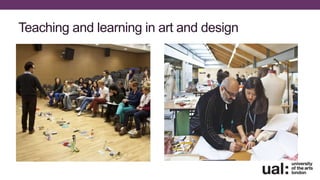
Teaching and learning in art and design
How the programme came about
• Response to demand from curriculum areas
• Increase in requests for support
• Response to staff development requirements for Academic Support
Librarians
• Academic Support Librarians felt that they had skills gaps
• Collaboration between Library Services and Teaching and Learning
Exchange
• Strategic initiative to collaborate and work with Academic Support Librarians
Librarians’ Teaching and Learning Programme
Overall aim of the programme
To introduce librarians involved in teaching to some of the main features of art and design
pedagogy within a context of providing library based academic support
Objectives
• Introduce librarians to learning theories and enable them to contextualise theory into practice
• Raise awareness of the development and design of curriculum within an art and design
context
• Expose librarians to different techniques and styles of teaching
• Increase librarians’ confidence in teaching and presentation skills
• Introduce a range of technology enhanced learning methods and strategies
• Develop librarians as reflective practitioners
Librarians’ Teaching and Learning Programme
Session 1 – Introduction to teaching and learning in the arts
Session 2 – Approaches to teaching and learning
Session 3 - Presentation skills
Session 4 – Educational technology
Session five – Using reflection for professional development and
evaluation
Session 1 – Introduction to teaching and learning in the arts
 Familiarize participants with the
range of formats in which students
are taught at UAL
 Explore theoretical positions to
support understanding of teaching
and learning in arts disciplines
(including approaches to inclusivity)
 Relate these formats and
theoretical positions to participants’
own practice.
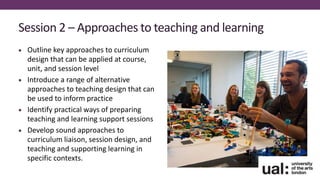
Session 2 – Approaches to teaching and learning
 Outline key approaches to curriculum
design that can be applied at course,
unit, and session level
 Introduce a range of alternative
approaches to teaching design that can
be used to inform practice
 Identify practical ways of preparing
teaching and learning support sessions
 Develop sound approaches to
curriculum liaison, session design, and
teaching and supporting learning in
specific contexts.
Session 3 – Presentation skills
 Build confidence in presentation
skills
 Identify the objectives of
presentations for teaching and
learning
 Explore techniques for effective
presentations
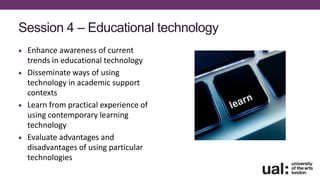
Session 4 – Educational technology
 Enhance awareness of current
trends in educational technology
 Disseminate ways of using
technology in academic support
contexts
 Learn from practical experience of
using contemporary learning
technology
 Evaluate advantages and
disadvantages of using particular
technologies
Session five – Using reflection for professional development
and evaluation
 Provide a rationale for taking a
reflective approach to professional
practice
 Identify a range of reflective
techniques that can enhance teaching
activity (including peer observation or
peer review of teaching)
 Encourage reflective approaches to
practice
 Identify next steps in professional
development - both individual and
collective
Epiphany moments
• Permission to experiment – Can we really use our initiative?
• What librarians teach – But how can we make our type of teaching
interesting?
• Teacher identity – I really am a teacher!
Feedback I thoroughly enjoyed the training, and I’m glad you encouraged me
to attend although I’ll be studying on the PG Cert this coming year.
I found that the sessions in the CDP Programme gave me a really
good idea of what to expect from the actual PG course.
It was excellent to have the opportunity to
talk to librarians across the department,
sharing good practice, challenges and
anxieties. There are a number of practical
things I hope to explore further: using
games, screen recording, using learning
outcomes more formally, using
observations, increasing interactivity and
fun especially in lecture based sessions
Sharing the sessions with so many
colleagues from CSM and other sites
has given me the confidence and
reassurance that I can now approach
other academic support librarians to
discuss the planning and delivery of
information skills sessions. Sharing
ideas and discussing our role in
teaching and learning was the most
valuable part for me.
Impact
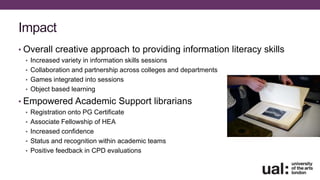
• Overall creative approach to providing information literacy skills
• Increased variety in information skills sessions
• Collaboration and partnership across colleges and departments
• Games integrated into sessions
• Object based learning
• Empowered Academic Support librarians
• Registration onto PG Certificate
• Associate Fellowship of HEA
• Increased confidence
• Status and recognition within academic teams
• Positive feedback in CPD evaluations
Future developments
• Refining programme content and format
• Non accredited 3 day staff development programme
• Attaining professional recognition
• Progression
• Working as whole course teams
• PGCert/MA Academic Practice
Thank you
• Questions…
• Contact:
• l.m.appleton@arts.ac.uk
• Twitter - @leoappleton

Teaching and learnign development for library staff

  • 1.
    Teaching and learningdevelopment for Academic Support Librarians at the University of the Arts London Leo Appleton, Associate Director of Library Services, UAL User Education Conference, University of Chester, September 5th 2016 @leoappleton
  • 2.
    Background and context •Library and Academic Support Services • Focus on value added ‘enhancement’ model of academic support • The role of the Academic Support Librarian • Multi-functioning academic librarians (neither fish nor fowl) • Subject specialsims and teaching requirements • Teaching and Learning Exchange • Academic development at UAL • PGCert/MA in Academic Practice
  • 3.
    Teaching and learningin art and design
  • 4.
    How the programmecame about • Response to demand from curriculum areas • Increase in requests for support • Response to staff development requirements for Academic Support Librarians • Academic Support Librarians felt that they had skills gaps • Collaboration between Library Services and Teaching and Learning Exchange • Strategic initiative to collaborate and work with Academic Support Librarians
  • 5.
    Librarians’ Teaching andLearning Programme Overall aim of the programme To introduce librarians involved in teaching to some of the main features of art and design pedagogy within a context of providing library based academic support Objectives • Introduce librarians to learning theories and enable them to contextualise theory into practice • Raise awareness of the development and design of curriculum within an art and design context • Expose librarians to different techniques and styles of teaching • Increase librarians’ confidence in teaching and presentation skills • Introduce a range of technology enhanced learning methods and strategies • Develop librarians as reflective practitioners
  • 6.
    Librarians’ Teaching andLearning Programme Session 1 – Introduction to teaching and learning in the arts Session 2 – Approaches to teaching and learning Session 3 - Presentation skills Session 4 – Educational technology Session five – Using reflection for professional development and evaluation
  • 7.
    Session 1 –Introduction to teaching and learning in the arts  Familiarize participants with the range of formats in which students are taught at UAL  Explore theoretical positions to support understanding of teaching and learning in arts disciplines (including approaches to inclusivity)  Relate these formats and theoretical positions to participants’ own practice.
  • 8.
    Session 2 –Approaches to teaching and learning  Outline key approaches to curriculum design that can be applied at course, unit, and session level  Introduce a range of alternative approaches to teaching design that can be used to inform practice  Identify practical ways of preparing teaching and learning support sessions  Develop sound approaches to curriculum liaison, session design, and teaching and supporting learning in specific contexts.
  • 9.
    Session 3 –Presentation skills  Build confidence in presentation skills  Identify the objectives of presentations for teaching and learning  Explore techniques for effective presentations
  • 10.
    Session 4 –Educational technology  Enhance awareness of current trends in educational technology  Disseminate ways of using technology in academic support contexts  Learn from practical experience of using contemporary learning technology  Evaluate advantages and disadvantages of using particular technologies
  • 11.
    Session five –Using reflection for professional development and evaluation  Provide a rationale for taking a reflective approach to professional practice  Identify a range of reflective techniques that can enhance teaching activity (including peer observation or peer review of teaching)  Encourage reflective approaches to practice  Identify next steps in professional development - both individual and collective
  • 12.
    Epiphany moments • Permissionto experiment – Can we really use our initiative? • What librarians teach – But how can we make our type of teaching interesting? • Teacher identity – I really am a teacher!
  • 13.
    Feedback I thoroughlyenjoyed the training, and I’m glad you encouraged me to attend although I’ll be studying on the PG Cert this coming year. I found that the sessions in the CDP Programme gave me a really good idea of what to expect from the actual PG course. It was excellent to have the opportunity to talk to librarians across the department, sharing good practice, challenges and anxieties. There are a number of practical things I hope to explore further: using games, screen recording, using learning outcomes more formally, using observations, increasing interactivity and fun especially in lecture based sessions Sharing the sessions with so many colleagues from CSM and other sites has given me the confidence and reassurance that I can now approach other academic support librarians to discuss the planning and delivery of information skills sessions. Sharing ideas and discussing our role in teaching and learning was the most valuable part for me.
  • 14.
    Impact • Overall creativeapproach to providing information literacy skills • Increased variety in information skills sessions • Collaboration and partnership across colleges and departments • Games integrated into sessions • Object based learning • Empowered Academic Support librarians • Registration onto PG Certificate • Associate Fellowship of HEA • Increased confidence • Status and recognition within academic teams • Positive feedback in CPD evaluations
  • 15.
    Future developments • Refiningprogramme content and format • Non accredited 3 day staff development programme • Attaining professional recognition • Progression • Working as whole course teams • PGCert/MA Academic Practice
  • 16.
    Thank you • Questions… •Contact: • l.m.appleton@arts.ac.uk • Twitter - @leoappleton

Editor's Notes

  • #3 This short paper outlines the development and delivery of a bespoke teaching and learning programme for academic support librarians within a higher education art and design environment. The specific curriculum focus at the University of the Arts London means that traditional approaches to curriculum subject liaison and the associated teaching and learning activity is not always appropriate. During 2015, Library Services academic liaison managers collaborated with colleagues from the University’s Teaching and Learning Exchange to develop a five-week programme to introduce librarians involved in teaching to some of the main features of art and design pedagogy within a context of providing library based academic support
  • #4 Elizabeth
  • #5 Leo
  • #6 Overview of programme - Elizabeth
  • #7 Overview of programme - Leo
  • #8 Overview of programme - Leo
  • #9 Overview of programme - Leo
  • #10 Overview of programme - Leo
  • #11 Overview of programme - Leo
  • #12 Overview of programme - Leo
  • #13 Elizabeth
  • #14 Leo
  • #15 Leo
  • #16 Elizabeth
  • #17 Elizabeth