Oxazole
C3H3NO
Prepared by- Dr. V. P. Nagulwar
Introduction
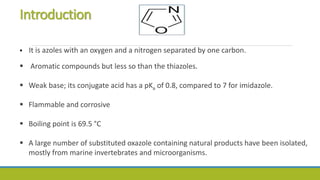
 It is azoles with an oxygen and a nitrogen separated by one carbon.
 Aromatic compounds but less so than the thiazoles.
 Weak base; its conjugate acid has a pKa of 0.8, compared to 7 for imidazole.
 Flammable and corrosive
 Boiling point is 69.5 °C
 A large number of substituted oxazole containing natural products have been isolated,
mostly from marine invertebrates and microorganisms.
Synthesis
 Robinson–Gabriel synthesis by dehydration of 2-acylaminoketones
 Fischer oxazole synthesis from cyanohydrins and aldehydes
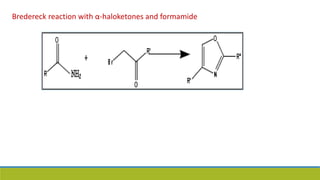
 Bredereck reaction with α-haloketones and formamide
 Van Leusen reaction with aldehydes and TosMIC
Robinson–Gabriel synthesis
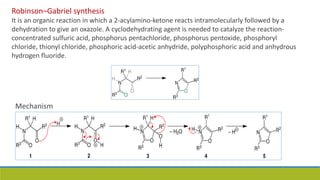
It is an organic reaction in which a 2-acylamino-ketone reacts intramolecularly followed by a
dehydration to give an oxazole. A cyclodehydrating agent is needed to catalyze the reaction-
concentrated sulfuric acid, phosphorus pentachloride, phosphorus pentoxide, phosphoryl
chloride, thionyl chloride, phosphoric acid-acetic anhydride, polyphosphoric acid and anhydrous
hydrogen fluoride.
Mechanism
Fischer oxazole synthesis
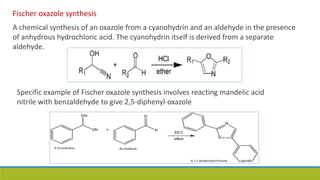
A chemical synthesis of an oxazole from a cyanohydrin and an aldehyde in the presence
of anhydrous hydrochloric acid. The cyanohydrin itself is derived from a separate
aldehyde.
Specific example of Fischer oxazole synthesis involves reacting mandelic acid
nitrile with benzaldehyde to give 2,5-diphenyl-oxazole
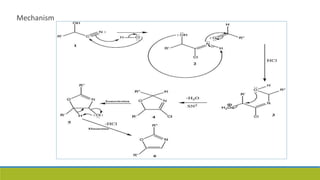
Bredereck reaction with α-haloketones and formamide
Mechanism
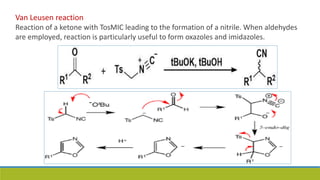
Van Leusen reaction
Reaction of a ketone with TosMIC leading to the formation of a nitrile. When aldehydes
are employed, reaction is particularly useful to form oxazoles and imidazoles.
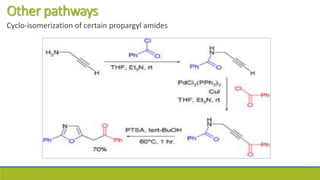
Other pathways
Cyclo-isomerization of certain propargyl amides
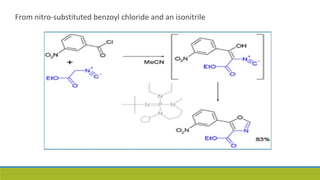
From nitro-substituted benzoyl chloride and an isonitrile
Biosynthesis
Cyclization and oxidation of serine or threonine non-ribosomal peptides
Where X = H, CH3 for serine and threonine respectively, B = base
(1) Enzymatic cyclization (2) Elimination (3) [O] = enzymatic oxidation
Reactions
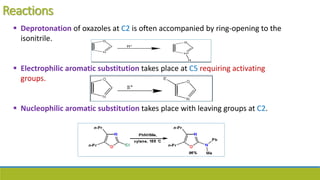
 Deprotonation of oxazoles at C2 is often accompanied by ring-opening to the
isonitrile.
 Electrophilic aromatic substitution takes place at C5 requiring activating
groups.
 Nucleophilic aromatic substitution takes place with leaving groups at C2.
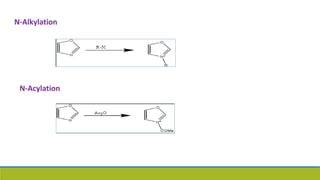
N-Alkylation
N-Acylation
 Diels–Alder reactions with oxazole dienes can be followed by loss of oxygen to
form pyridines.
 Cornforth rearrangement of 4-acyloxazoles is a thermal rearrangement
reaction with the organic acyl residue and the C5 substituent changing
positions.
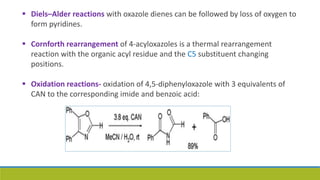
 Oxidation reactions- oxidation of 4,5-diphenyloxazole with 3 equivalents of
CAN to the corresponding imide and benzoic acid:
Uses
 Adrenergic Antagonists
 Fungicides
 Anthelmintic Agents
 Antihypertensive Agents
 Antiulcer Agents
• Pesticides
• Agrochemical Fungicides
• Insecticides
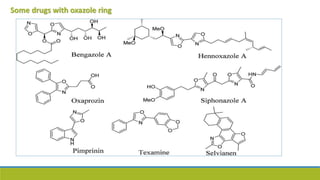
Some drugs with oxazole ring
References & Recommended Readings
1. Organic Chemistry, I. L. Finar
2. Text book of Organic Chemistry, A. Bahl and B.Bahl
3. Heterocyclic Chemistry, T. L. Gilchrist
4. Heterocyclic Chemistry, J. S. Clark
http://www.chem.gla.ac.uk/staff/stephenc/UndergraduateTeaching.html
5. The Pharma Innovation Journal 2017, 6(1): 109-117

Oxazole

  • 1.
  • 2.
    Introduction  It isazoles with an oxygen and a nitrogen separated by one carbon.  Aromatic compounds but less so than the thiazoles.  Weak base; its conjugate acid has a pKa of 0.8, compared to 7 for imidazole.  Flammable and corrosive  Boiling point is 69.5 °C  A large number of substituted oxazole containing natural products have been isolated, mostly from marine invertebrates and microorganisms.
  • 3.
    Synthesis  Robinson–Gabriel synthesisby dehydration of 2-acylaminoketones  Fischer oxazole synthesis from cyanohydrins and aldehydes  Bredereck reaction with α-haloketones and formamide  Van Leusen reaction with aldehydes and TosMIC
  • 4.
    Robinson–Gabriel synthesis It isan organic reaction in which a 2-acylamino-ketone reacts intramolecularly followed by a dehydration to give an oxazole. A cyclodehydrating agent is needed to catalyze the reaction- concentrated sulfuric acid, phosphorus pentachloride, phosphorus pentoxide, phosphoryl chloride, thionyl chloride, phosphoric acid-acetic anhydride, polyphosphoric acid and anhydrous hydrogen fluoride. Mechanism
  • 5.
    Fischer oxazole synthesis Achemical synthesis of an oxazole from a cyanohydrin and an aldehyde in the presence of anhydrous hydrochloric acid. The cyanohydrin itself is derived from a separate aldehyde. Specific example of Fischer oxazole synthesis involves reacting mandelic acid nitrile with benzaldehyde to give 2,5-diphenyl-oxazole
  • 6.
    Bredereck reaction withα-haloketones and formamide
  • 7.
  • 8.
    Van Leusen reaction Reactionof a ketone with TosMIC leading to the formation of a nitrile. When aldehydes are employed, reaction is particularly useful to form oxazoles and imidazoles.
  • 9.
    Other pathways Cyclo-isomerization ofcertain propargyl amides
  • 10.
    From nitro-substituted benzoylchloride and an isonitrile
  • 11.
    Biosynthesis Cyclization and oxidationof serine or threonine non-ribosomal peptides Where X = H, CH3 for serine and threonine respectively, B = base (1) Enzymatic cyclization (2) Elimination (3) [O] = enzymatic oxidation
  • 12.
    Reactions  Deprotonation ofoxazoles at C2 is often accompanied by ring-opening to the isonitrile.  Electrophilic aromatic substitution takes place at C5 requiring activating groups.  Nucleophilic aromatic substitution takes place with leaving groups at C2.
  • 13.
  • 14.
     Diels–Alder reactionswith oxazole dienes can be followed by loss of oxygen to form pyridines.  Cornforth rearrangement of 4-acyloxazoles is a thermal rearrangement reaction with the organic acyl residue and the C5 substituent changing positions.  Oxidation reactions- oxidation of 4,5-diphenyloxazole with 3 equivalents of CAN to the corresponding imide and benzoic acid:
  • 15.
    Uses  Adrenergic Antagonists Fungicides  Anthelmintic Agents  Antihypertensive Agents  Antiulcer Agents • Pesticides • Agrochemical Fungicides • Insecticides
  • 16.
    Some drugs withoxazole ring
  • 17.
    References & RecommendedReadings 1. Organic Chemistry, I. L. Finar 2. Text book of Organic Chemistry, A. Bahl and B.Bahl 3. Heterocyclic Chemistry, T. L. Gilchrist 4. Heterocyclic Chemistry, J. S. Clark http://www.chem.gla.ac.uk/staff/stephenc/UndergraduateTeaching.html 5. The Pharma Innovation Journal 2017, 6(1): 109-117