Web Security Overview
Noah G. Jaehnert
Director of Information Security
OurHealth, LLC
Agenda
• Who are you/Who am I?
• What is OurHealth?
• What is security/What is Information Security?
• Why is security difficult?
• What happens if we don't do security right?
• What can developers do to enhance security?
• Questions?
• If I only leave you with three things...
Who am I?
• Noah G. Jaehnert - Director of Information Security at OurHealth
• Email: njaehnert@ourhealth.org,Twitter: @njaehner
• LinkedIn: https://www.linkedin.com/in/noahjaehnert
• Previous experience:
• Security Architecture Program Manager/Enterprise Security Strategist –
• Senior Information Security Consultant –
• Enterprise Architect –
• Technical Engineer –
Who am I?
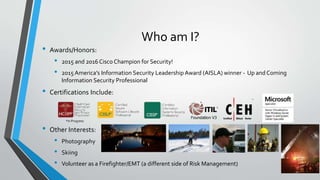
• Awards/Honors:
• 2015 and 2016 Cisco Champion for Security!
• 2015 America’s Information Security Leadership Award (AISLA) winner - Up and Coming
Information Security Professional
• Certifications Include:
• Other Interests:
• Photography
• Skiing
• Volunteer as a Firefighter/EMT (a different side of Risk Management)
*In Progress
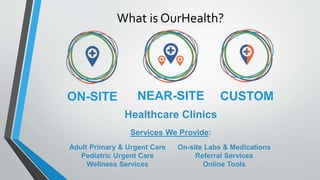
What is OurHealth?
CUSTOMNEAR-SITEON-SITE
Healthcare Clinics
Services We Provide:
Adult Primary & Urgent Care
Pediatric Urgent Care
Wellness Services
On-site Labs & Medications
Referral Services
Online Tools
What is OurHealth’s Mission?People
Passion
Excellence
What is security?
• Security is the degree of resistance to, or protection from, harm.
• It applies to any vulnerable and valuable asset, such as a person, dwelling,
community, item, nation, or organization.
• As noted by the Institute for Security and Open Methodologies (ISECOM) in
their Open Source SecurityTesting Methodology Manual (SSTMM),
security provides:
• A form of protection where a separation is created between the assets and the
threat
• These separations are generically called "controls," and sometimes include
changes to the asset or the threat
Components of Security
• The Certified Information Systems Security Professional (CISSP)
certification requires knowledge of the following domains/areas:
• Access Control
• Application Development Security
• Business Continuity and Disaster Recovery Planning
• Cryptography
• Information Security Governance and Risk Management
• Legal regulations, investigations, and compliance
• Operations Security
• Physical and Environmental Security
• SecurityArchitecture and Design
• Telecommunications and Network Security
What Is Information Security?
• The protection of information and its critical elements, including the
systems and hardware that use, store, and transmit that information
• Tools, such as policy, awareness, training, education, and technology
are necessary to support the overall protection of information and
systems
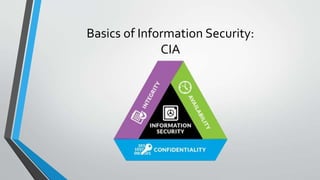
• The C.I.A. triangle was created as a standard to provide guidance on
protecting information and systems
Basics of Information Security:
CIA
Basics of Information Security:
CIA
Basics of Information Security:
CIA
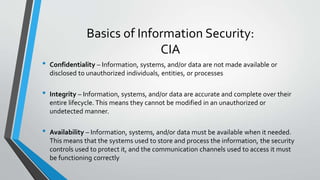
• Confidentiality – Information, systems, and/or data are not made available or
disclosed to unauthorized individuals, entities, or processes
• Integrity – Information, systems, and/or data are accurate and complete over their
entire lifecycle. This means they cannot be modified in an unauthorized or
undetected manner.
• Availability – Information, systems, and/or data must be available when it needed.
This means that the systems used to store and process the information, the security
controls used to protect it, and the communication channels used to access it must
be functioning correctly
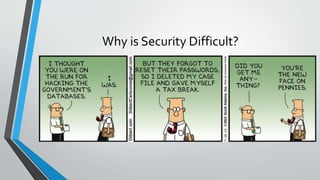
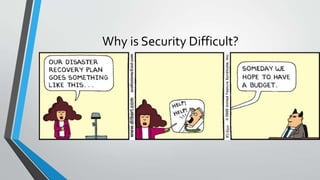
Why is Security Difficult?
• OurHealth
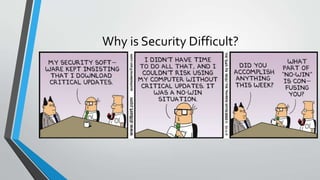
Why is Security Difficult?
• OurHealth
Why is Security Difficult?
• OurHealth
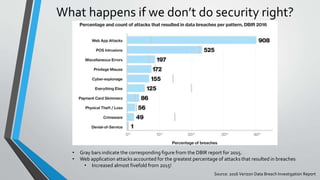
What happens if we don’t do security right?
Source: 2016 Verizon Data Breach Investigation Report
• Gray bars indicate the corresponding figure from the DBIR report for 2015.
• Web application attacks accounted for the greatest percentage of attacks that resulted in breaches
• Increased almost fivefold from 2015!
What can developers do to enhance security?
• Build it into what you do!
• A plethora of resources for developers on building secure applications are
available from the OpenWeb Application Security Project (OWASP).OWASP is:
• The Open Web Application Security Project (OWASP) is a 501(c)(3) worldwide not-for-
profit charitable organization focused on improving the security of software.
• OWASP’s mission is to make software security visible, so that individuals and
organizations are able to make informed decisions.
• OWASP is in a unique position to provide impartial, practical information about AppSec
to individuals, corporations, universities, government agencies and other organizations
worldwide. Operating as a community of like-minded professionals, OWASP issues
software tools and knowledge-based documentation on application security.
What can developers do to enhance security?
• There is an IndianapolisOWASP Chapter that meets quarterly.
• I HIGHLY encourage you attend, because:
• There are great presentations on relevant security topics
• It is an awesome networking opportunity
• Dinner (and sometimes drinks) provided free by a sponsor
• Next meeting: TBD Q4 2016.
• Visit the Indy OWASP Meetup page for details:
http://www.meetup.com/indyowasp/
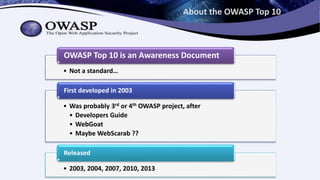
About the OWASP Top 10
• Not a standard…
OWASP Top 10 is an Awareness Document
• Was probably 3rd or 4th OWASP project, after
• Developers Guide
• WebGoat
• Maybe WebScarab ??
First developed in 2003
• 2003, 2004, 2007, 2010, 2013
Released
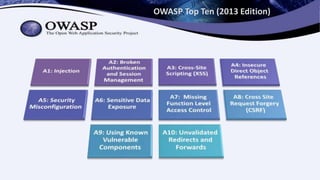
OWASP Top Ten (2013 Edition)
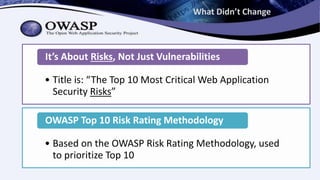
What Didn’t Change
• Title is: “The Top 10 Most Critical Web Application
Security Risks”
It’s About Risks, Not Just Vulnerabilities
• Based on the OWASP Risk Rating Methodology, used
to prioritize Top 10
OWASP Top 10 Risk Rating Methodology
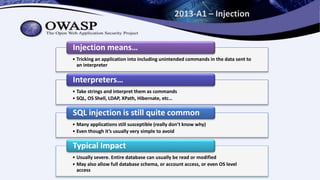
2013-A1 – Injection
• Tricking an application into including unintended commands in the data sent to
an interpreter
Injection means…
• Take strings and interpret them as commands
• SQL, OS Shell, LDAP, XPath, Hibernate, etc…
Interpreters…
• Many applications still susceptible (really don’t know why)
• Even though it’s usually very simple to avoid
SQL injection is still quite common
• Usually severe. Entire database can usually be read or modified
• May also allow full database schema, or account access, or even OS level
access
Typical Impact
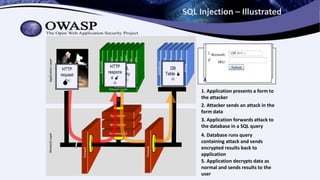
SQL Injection – Illustrated
Firewall
Hardened OS
Web Server
App Server
Firewall
Databases
LegacySystems
WebServices
Directories
HumanResrcs
Billing
Custom Code
APPLICATION
ATTACK
NetworkLayerApplicationLayer
Accounts
Finance
Administration
Transactions
Communication
KnowledgeMgmt
E-Commerce
Bus.Functions
HTTP
request

SQL
query

DB
Table 

HTTP
respons
e 

"SELECT * FROM
accounts WHERE
acct=‘’ OR 1=1--’"
1. Application presents a form to
the attacker
2. Attacker sends an attack in the
form data
3. Application forwards attack to
the database in a SQL query
Account Summary
Acct:5424-6066-2134-4334
Acct:4128-7574-3921-0192
Acct:5424-9383-2039-4029
Acct:4128-0004-1234-0293
4. Database runs query
containing attack and sends
encrypted results back to
application
5. Application decrypts data as
normal and sends results to the
user
Account:
SKU:
Account:
SKU:
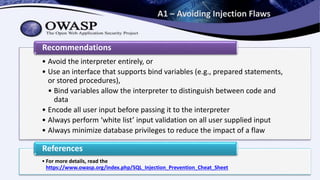
A1 – Avoiding Injection Flaws
• Avoid the interpreter entirely, or
• Use an interface that supports bind variables (e.g., prepared statements,
or stored procedures),
• Bind variables allow the interpreter to distinguish between code and
data
• Encode all user input before passing it to the interpreter
• Always perform ‘white list’ input validation on all user supplied input
• Always minimize database privileges to reduce the impact of a flaw
Recommendations
• For more details, read the
https://www.owasp.org/index.php/SQL_Injection_Prevention_Cheat_Sheet
References
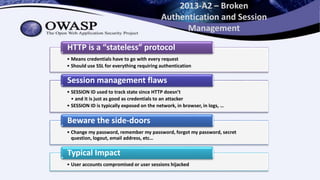
2013-A2 – Broken
Authentication and Session
Management
• Means credentials have to go with every request
• Should use SSL for everything requiring authentication
HTTP is a “stateless” protocol
• SESSION ID used to track state since HTTP doesn’t
• and it is just as good as credentials to an attacker
• SESSION ID is typically exposed on the network, in browser, in logs, …
Session management flaws
• Change my password, remember my password, forgot my password, secret
question, logout, email address, etc…
Beware the side-doors
• User accounts compromised or user sessions hijacked
Typical Impact
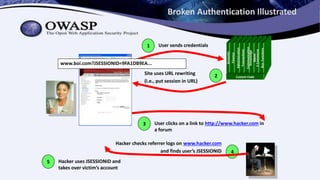
Broken Authentication Illustrated
Custom Code
Accounts
Finance
Administration
Transactions
Communication
Knowledge
Mgmt
E-Commerce
Bus.Functions
1 User sends credentials
2Site uses URL rewriting
(i.e., put session in URL)
3 User clicks on a link to http://www.hacker.com in
a forum
www.boi.com?JSESSIONID=9FA1DB9EA...
4
Hacker checks referrer logs on www.hacker.com
and finds user’s JSESSIONID
5 Hacker uses JSESSIONID and
takes over victim’s account
A2 – Avoiding Broken
Authentication and Session
Management
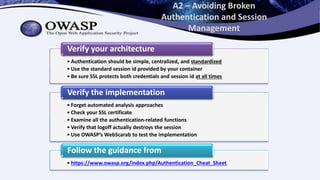
• Authentication should be simple, centralized, and standardized
• Use the standard session id provided by your container
• Be sure SSL protects both credentials and session id at all times
Verify your architecture
• Forget automated analysis approaches
• Check your SSL certificate
• Examine all the authentication-related functions
• Verify that logoff actually destroys the session
• Use OWASP’s WebScarab to test the implementation
Verify the implementation
• https://www.owasp.org/index.php/Authentication_Cheat_Sheet
Follow the guidance from
Summary: How do you address these
problems?
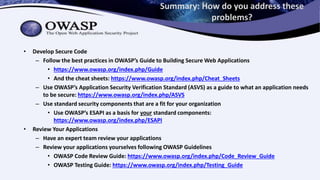
• Develop Secure Code
– Follow the best practices in OWASP’s Guide to Building Secure Web Applications
• https://www.owasp.org/index.php/Guide
• And the cheat sheets: https://www.owasp.org/index.php/Cheat_Sheets
– Use OWASP’s Application Security Verification Standard (ASVS) as a guide to what an application needs
to be secure: https://www.owasp.org/index.php/ASVS
– Use standard security components that are a fit for your organization
• Use OWASP’s ESAPI as a basis for your standard components:
https://www.owasp.org/index.php/ESAPI
• Review Your Applications
– Have an expert team review your applications
– Review your applications yourselves following OWASP Guidelines
• OWASP Code Review Guide: https://www.owasp.org/index.php/Code_Review_Guide
• OWASP Testing Guide: https://www.owasp.org/index.php/Testing_Guide
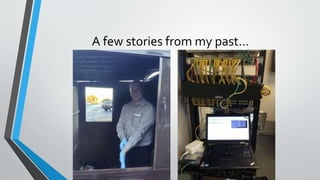
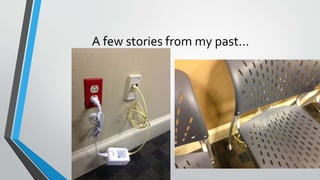
A few stories from my past…
Questions?
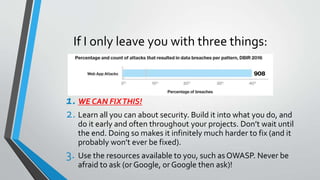
If I only leave you with three things:
1. WE CAN FIXTHIS!
2. Learn all you can about security. Build it into what you do, and
do it early and often throughout your projects. Don’t wait until
the end. Doing so makes it infinitely much harder to fix (and it
probably won’t ever be fixed).
3. Use the resources available to you, such asOWASP. Never be
afraid to ask (or Google, or Google then ask)!
Sources/Resources
• 2016Verizon Data Breach Investigation Report: http://www.verizonenterprise.com/verizon-
insights-lab/dbir/2016/
• Open Web Application Security Project (OWASP): https://www.owasp.org
• OWASP Cheat Sheets: https://www.owasp.org/index.php/OWASP_Cheat_Sheet_Series
• OWASP TopTen Project:
https://www.owasp.org/index.php/Category:OWASP_Top_Ten_Project
• OWASP TopTen 2013 (latest edition): https://storage.googleapis.com/google-code-archive-
downloads/v2/code.google.com/owasptop10/OWASP%20Top%2010%20-%202013.pdf
• OWASP TopTen Slides (used in this presentation): https://storage.googleapis.com/google-
code-archive-downloads/v2/code.google.com/owasptop10/OWASP_Top-10_2013%20-
%20Presentation.pptx
My contact information:
• If I can ever be a resource to you, please do not hesitate to reach out!
• Email: njaehnert@ourhealth.org
• Twitter: @njaehner
• LinkedIn: https://www.linkedin.com/in/noahjaehnert

Web Security Overview

  • 1.
    Web Security Overview NoahG. Jaehnert Director of Information Security OurHealth, LLC
  • 2.
    Agenda • Who areyou/Who am I? • What is OurHealth? • What is security/What is Information Security? • Why is security difficult? • What happens if we don't do security right? • What can developers do to enhance security? • Questions? • If I only leave you with three things...
  • 3.
    Who am I? •Noah G. Jaehnert - Director of Information Security at OurHealth • Email: njaehnert@ourhealth.org,Twitter: @njaehner • LinkedIn: https://www.linkedin.com/in/noahjaehnert • Previous experience: • Security Architecture Program Manager/Enterprise Security Strategist – • Senior Information Security Consultant – • Enterprise Architect – • Technical Engineer –
  • 4.
    Who am I? •Awards/Honors: • 2015 and 2016 Cisco Champion for Security! • 2015 America’s Information Security Leadership Award (AISLA) winner - Up and Coming Information Security Professional • Certifications Include: • Other Interests: • Photography • Skiing • Volunteer as a Firefighter/EMT (a different side of Risk Management) *In Progress
  • 5.
    What is OurHealth? CUSTOMNEAR-SITEON-SITE HealthcareClinics Services We Provide: Adult Primary & Urgent Care Pediatric Urgent Care Wellness Services On-site Labs & Medications Referral Services Online Tools
  • 6.
    What is OurHealth’sMission?People Passion Excellence
  • 7.
    What is security? •Security is the degree of resistance to, or protection from, harm. • It applies to any vulnerable and valuable asset, such as a person, dwelling, community, item, nation, or organization. • As noted by the Institute for Security and Open Methodologies (ISECOM) in their Open Source SecurityTesting Methodology Manual (SSTMM), security provides: • A form of protection where a separation is created between the assets and the threat • These separations are generically called "controls," and sometimes include changes to the asset or the threat
  • 8.
    Components of Security •The Certified Information Systems Security Professional (CISSP) certification requires knowledge of the following domains/areas: • Access Control • Application Development Security • Business Continuity and Disaster Recovery Planning • Cryptography • Information Security Governance and Risk Management • Legal regulations, investigations, and compliance • Operations Security • Physical and Environmental Security • SecurityArchitecture and Design • Telecommunications and Network Security
  • 9.
    What Is InformationSecurity? • The protection of information and its critical elements, including the systems and hardware that use, store, and transmit that information • Tools, such as policy, awareness, training, education, and technology are necessary to support the overall protection of information and systems • The C.I.A. triangle was created as a standard to provide guidance on protecting information and systems
  • 10.
    Basics of InformationSecurity: CIA
  • 11.
    Basics of InformationSecurity: CIA
  • 12.
    Basics of InformationSecurity: CIA • Confidentiality – Information, systems, and/or data are not made available or disclosed to unauthorized individuals, entities, or processes • Integrity – Information, systems, and/or data are accurate and complete over their entire lifecycle. This means they cannot be modified in an unauthorized or undetected manner. • Availability – Information, systems, and/or data must be available when it needed. This means that the systems used to store and process the information, the security controls used to protect it, and the communication channels used to access it must be functioning correctly
  • 13.
    Why is SecurityDifficult? • OurHealth
  • 14.
    Why is SecurityDifficult? • OurHealth
  • 15.
    Why is SecurityDifficult? • OurHealth
  • 16.
    What happens ifwe don’t do security right? Source: 2016 Verizon Data Breach Investigation Report • Gray bars indicate the corresponding figure from the DBIR report for 2015. • Web application attacks accounted for the greatest percentage of attacks that resulted in breaches • Increased almost fivefold from 2015!
  • 17.
    What can developersdo to enhance security? • Build it into what you do! • A plethora of resources for developers on building secure applications are available from the OpenWeb Application Security Project (OWASP).OWASP is: • The Open Web Application Security Project (OWASP) is a 501(c)(3) worldwide not-for- profit charitable organization focused on improving the security of software. • OWASP’s mission is to make software security visible, so that individuals and organizations are able to make informed decisions. • OWASP is in a unique position to provide impartial, practical information about AppSec to individuals, corporations, universities, government agencies and other organizations worldwide. Operating as a community of like-minded professionals, OWASP issues software tools and knowledge-based documentation on application security.
  • 18.
    What can developersdo to enhance security? • There is an IndianapolisOWASP Chapter that meets quarterly. • I HIGHLY encourage you attend, because: • There are great presentations on relevant security topics • It is an awesome networking opportunity • Dinner (and sometimes drinks) provided free by a sponsor • Next meeting: TBD Q4 2016. • Visit the Indy OWASP Meetup page for details: http://www.meetup.com/indyowasp/
  • 19.
    About the OWASPTop 10 • Not a standard… OWASP Top 10 is an Awareness Document • Was probably 3rd or 4th OWASP project, after • Developers Guide • WebGoat • Maybe WebScarab ?? First developed in 2003 • 2003, 2004, 2007, 2010, 2013 Released
  • 20.
    OWASP Top Ten(2013 Edition)
  • 21.
    What Didn’t Change •Title is: “The Top 10 Most Critical Web Application Security Risks” It’s About Risks, Not Just Vulnerabilities • Based on the OWASP Risk Rating Methodology, used to prioritize Top 10 OWASP Top 10 Risk Rating Methodology
  • 22.
    2013-A1 – Injection •Tricking an application into including unintended commands in the data sent to an interpreter Injection means… • Take strings and interpret them as commands • SQL, OS Shell, LDAP, XPath, Hibernate, etc… Interpreters… • Many applications still susceptible (really don’t know why) • Even though it’s usually very simple to avoid SQL injection is still quite common • Usually severe. Entire database can usually be read or modified • May also allow full database schema, or account access, or even OS level access Typical Impact
  • 23.
    SQL Injection –Illustrated Firewall Hardened OS Web Server App Server Firewall Databases LegacySystems WebServices Directories HumanResrcs Billing Custom Code APPLICATION ATTACK NetworkLayerApplicationLayer Accounts Finance Administration Transactions Communication KnowledgeMgmt E-Commerce Bus.Functions HTTP request  SQL query  DB Table   HTTP respons e   "SELECT * FROM accounts WHERE acct=‘’ OR 1=1--’" 1. Application presents a form to the attacker 2. Attacker sends an attack in the form data 3. Application forwards attack to the database in a SQL query Account Summary Acct:5424-6066-2134-4334 Acct:4128-7574-3921-0192 Acct:5424-9383-2039-4029 Acct:4128-0004-1234-0293 4. Database runs query containing attack and sends encrypted results back to application 5. Application decrypts data as normal and sends results to the user Account: SKU: Account: SKU:
  • 24.
    A1 – AvoidingInjection Flaws • Avoid the interpreter entirely, or • Use an interface that supports bind variables (e.g., prepared statements, or stored procedures), • Bind variables allow the interpreter to distinguish between code and data • Encode all user input before passing it to the interpreter • Always perform ‘white list’ input validation on all user supplied input • Always minimize database privileges to reduce the impact of a flaw Recommendations • For more details, read the https://www.owasp.org/index.php/SQL_Injection_Prevention_Cheat_Sheet References
  • 25.
    2013-A2 – Broken Authenticationand Session Management • Means credentials have to go with every request • Should use SSL for everything requiring authentication HTTP is a “stateless” protocol • SESSION ID used to track state since HTTP doesn’t • and it is just as good as credentials to an attacker • SESSION ID is typically exposed on the network, in browser, in logs, … Session management flaws • Change my password, remember my password, forgot my password, secret question, logout, email address, etc… Beware the side-doors • User accounts compromised or user sessions hijacked Typical Impact
  • 26.
    Broken Authentication Illustrated CustomCode Accounts Finance Administration Transactions Communication Knowledge Mgmt E-Commerce Bus.Functions 1 User sends credentials 2Site uses URL rewriting (i.e., put session in URL) 3 User clicks on a link to http://www.hacker.com in a forum www.boi.com?JSESSIONID=9FA1DB9EA... 4 Hacker checks referrer logs on www.hacker.com and finds user’s JSESSIONID 5 Hacker uses JSESSIONID and takes over victim’s account
  • 27.
    A2 – AvoidingBroken Authentication and Session Management • Authentication should be simple, centralized, and standardized • Use the standard session id provided by your container • Be sure SSL protects both credentials and session id at all times Verify your architecture • Forget automated analysis approaches • Check your SSL certificate • Examine all the authentication-related functions • Verify that logoff actually destroys the session • Use OWASP’s WebScarab to test the implementation Verify the implementation • https://www.owasp.org/index.php/Authentication_Cheat_Sheet Follow the guidance from
  • 28.
    Summary: How doyou address these problems? • Develop Secure Code – Follow the best practices in OWASP’s Guide to Building Secure Web Applications • https://www.owasp.org/index.php/Guide • And the cheat sheets: https://www.owasp.org/index.php/Cheat_Sheets – Use OWASP’s Application Security Verification Standard (ASVS) as a guide to what an application needs to be secure: https://www.owasp.org/index.php/ASVS – Use standard security components that are a fit for your organization • Use OWASP’s ESAPI as a basis for your standard components: https://www.owasp.org/index.php/ESAPI • Review Your Applications – Have an expert team review your applications – Review your applications yourselves following OWASP Guidelines • OWASP Code Review Guide: https://www.owasp.org/index.php/Code_Review_Guide • OWASP Testing Guide: https://www.owasp.org/index.php/Testing_Guide
  • 29.
    A few storiesfrom my past…
  • 30.
    A few storiesfrom my past…
  • 31.
  • 32.
    If I onlyleave you with three things: 1. WE CAN FIXTHIS! 2. Learn all you can about security. Build it into what you do, and do it early and often throughout your projects. Don’t wait until the end. Doing so makes it infinitely much harder to fix (and it probably won’t ever be fixed). 3. Use the resources available to you, such asOWASP. Never be afraid to ask (or Google, or Google then ask)!
  • 33.
    Sources/Resources • 2016Verizon DataBreach Investigation Report: http://www.verizonenterprise.com/verizon- insights-lab/dbir/2016/ • Open Web Application Security Project (OWASP): https://www.owasp.org • OWASP Cheat Sheets: https://www.owasp.org/index.php/OWASP_Cheat_Sheet_Series • OWASP TopTen Project: https://www.owasp.org/index.php/Category:OWASP_Top_Ten_Project • OWASP TopTen 2013 (latest edition): https://storage.googleapis.com/google-code-archive- downloads/v2/code.google.com/owasptop10/OWASP%20Top%2010%20-%202013.pdf • OWASP TopTen Slides (used in this presentation): https://storage.googleapis.com/google- code-archive-downloads/v2/code.google.com/owasptop10/OWASP_Top-10_2013%20- %20Presentation.pptx
  • 34.
    My contact information: •If I can ever be a resource to you, please do not hesitate to reach out! • Email: njaehnert@ourhealth.org • Twitter: @njaehner • LinkedIn: https://www.linkedin.com/in/noahjaehnert