Parvez Misarwala
BE, MBA, PMP
Introduction to Scrum and Scrum
Team
• Defining Scrum
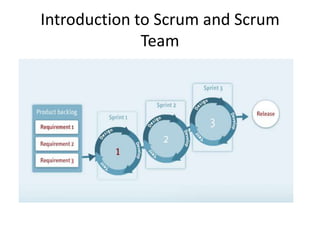
– Scrum is based on the following core agile values
• Iterative and incremental development
• Frequent delivery
• Involvement of customer
• Self organizing cross functional team
– It is based on empirical rather than prescriptive
process control
Introduction to Scrum and Scrum
Team
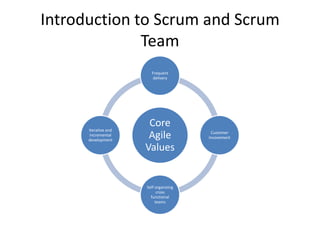
Core
Agile
Values
Frequent
delivery
Customer
Invovement
Self organizing
cross
functional
teams
Iterative and
incremental
development
Introduction to Scrum and Scrum
Team
Introduction to Scrum and Scrum
Team
• Defining Scrum
Introduction to Scrum and Scrum
Team
• Scrum roles
1. Product owner
• Creates product backlog
• Works closely with the development team to ensure
everyone in the team understands requirements
• Qualities of product owner
– Clear vision
– Capacity to gather requirements
– Good Communication Skills
– Problem solving skills
– Decision making ability
Introduction to Scrum and Scrum
Team
2. Scrum master
• Can be one master for multiple development teams
• Proven track record in implementing scrum
• Assertive leader, excellent communicator
• Conflict resolution
• Good presentation skills
– Development methodology
• Usually 5-9 individuals
• Self organizing
• Cross functional –
engineering, programming, design, marketing, sales and
network support
Communicating with stakeholders on a
scrum project
• Communicating with Stakeholders
– Scrum favors face to face communication over
voice video or text
• Happens real time
• Helps build trust
• Encourages flow of information
– Burndown charts
– Task boards
Communicating with stakeholders on a
scrum project
• Types of meetings in scrum
– Sprint planning meeting
– Daily standup meeting
– Scrum of Scrums
– Sprint review meeting
– Sprint retrospective
Scrum Phases
– The pre-game phase
– The Game Phase
– The Post Game phase
The pre game phase
– The pre-game phase
• Replaces initiating and planning phases in a traditional
development approach
• It involves activities that has to be completed before
the project activity begins
• Pre-game phase may last from days to weeks
depending upon the nature of the project and initial
amount of work required to prepare and plan for it
• Overall goal is to get buy in or approval from customer
or customer representative.
The pre game phase
Two main components
1. Planning
– Establishing project Goal – Product owner
» Vision of the project
» ROI
– Establishing product requirement – Product owner
– Product backlog – Product owner
» Product owner with the help of customers identify most important features to be
developed. Based on the market demand and value for customer
– Product owner identifies release date, overall budget and risk control measures, team members
and tools needed to develop the product
– Guidelines in creating product backlog
– Order customer requirements
– Add technical requirements
– Provide the most detail for top items
– Ensure user stories are specific
2. Creating a high level design
– Dev team creates high level design which describes product structure and behavior
– Analysis on impact of new product on existing system or architecture
– Sprint 0
» Review the backlog
» Identify and assign deliverables
The game Phase
– The game phase
• Also called sprint or development phase
• Sprint planning
– Product owner prioritizes product backlog for sprint planning.
Items with highest value needs to be selected first.
– Development team formulates the sprint goal, develops sprint
backlog and estimate tasks
The post game Phase
– The post game phase
• Developing user documentation
• Integration testing
• Product testing
The Sprint
– Occurs in game phase
– Sprint length for 30 days by books. But can vary from 10-30
days
– Each sprint is a workable piece of functionality
– Sprint planning
• Before the start of sprint the product owner and development
team meet to plan the sprint
• Reviewing changes in requirements and updating sprint plans
accordingly.
• Team determines which stories to move from product backlog to
sprint backlog
• It further divides stories into tasks ensuring each tasks requires
ideally less than 2 days or a maximum of 16 developer hours.
• Sprint planning meetings should not exceed a maximum of 4 hrs.
The Sprint
– Daily standup meetings
• Shouldn’t exceed 15 mins
• Allowed to flag potential problems but major issues to be raised after the
meeting
• Ideally be conducted at the start of the working day.
• Team members updates on
– Task completed since last meeting
– Tasks to be completed by next meeting
– Any obstacles
– These meetings
» Ensures collaboration
» Enable quick decision making
» Prevent time being wasted
• If project includes multiple scrum meetings, scrum of scrum meetings are
organized to coordinate between teams
– Unit tests and Sprint overviews
– Sprint retrospectives and closure
The Sprint
– Unit tests and Sprint reviews
• Developers conduct unit testing of work as they complete
• Sprint reviews
– Development team provides a demo to product owner and
customer for review
– Based on the feedback , product owner may make changes to the
product backlog
– For efficiency
» Limit the preparation time of review meeting to 30 mins
» Reiterate sprint goal at the start of review meeting
» Keep product backlog visible
» Allow anyone present to task questions
» Add new input to the product backlog
» Be flexible about the meetings duration
– Maximum of 4 hrs
The Sprint
– Sprint retrospectives and closure
• After sprint review meeting, scrum master conducts
sprint retrospective with development team
• Also reviews tasks that werent completed during sprint
due to unexpected obstacles or difficulties
• Meeting limit maximum of 3 hrs, for sprint of 30 days
Tracking Sprint progress
– Burndown charts
• Tracks cumulative number of hours of work remaining in the sprint
against the number of days left for the sprint
– Progress Charts
• Task boards
• Scrum boards
• Use various metrics to measure performnce of each individual team
members
– Velocity
– Standards violation
– Business value delivered
– Defects per iteration
– Number of stories
– Level of automation
– Number of tests
– Using tracking metrics

Overview on scrum development process

  • 1.
  • 2.
    Introduction to Scrumand Scrum Team • Defining Scrum – Scrum is based on the following core agile values • Iterative and incremental development • Frequent delivery • Involvement of customer • Self organizing cross functional team – It is based on empirical rather than prescriptive process control
  • 3.
    Introduction to Scrumand Scrum Team Core Agile Values Frequent delivery Customer Invovement Self organizing cross functional teams Iterative and incremental development
  • 4.
    Introduction to Scrumand Scrum Team
  • 5.
    Introduction to Scrumand Scrum Team • Defining Scrum
  • 6.
    Introduction to Scrumand Scrum Team • Scrum roles 1. Product owner • Creates product backlog • Works closely with the development team to ensure everyone in the team understands requirements • Qualities of product owner – Clear vision – Capacity to gather requirements – Good Communication Skills – Problem solving skills – Decision making ability
  • 7.
    Introduction to Scrumand Scrum Team 2. Scrum master • Can be one master for multiple development teams • Proven track record in implementing scrum • Assertive leader, excellent communicator • Conflict resolution • Good presentation skills – Development methodology • Usually 5-9 individuals • Self organizing • Cross functional – engineering, programming, design, marketing, sales and network support
  • 8.
    Communicating with stakeholderson a scrum project • Communicating with Stakeholders – Scrum favors face to face communication over voice video or text • Happens real time • Helps build trust • Encourages flow of information – Burndown charts – Task boards
  • 9.
    Communicating with stakeholderson a scrum project • Types of meetings in scrum – Sprint planning meeting – Daily standup meeting – Scrum of Scrums – Sprint review meeting – Sprint retrospective
  • 10.
    Scrum Phases – Thepre-game phase – The Game Phase – The Post Game phase
  • 11.
    The pre gamephase – The pre-game phase • Replaces initiating and planning phases in a traditional development approach • It involves activities that has to be completed before the project activity begins • Pre-game phase may last from days to weeks depending upon the nature of the project and initial amount of work required to prepare and plan for it • Overall goal is to get buy in or approval from customer or customer representative.
  • 12.
    The pre gamephase Two main components 1. Planning – Establishing project Goal – Product owner » Vision of the project » ROI – Establishing product requirement – Product owner – Product backlog – Product owner » Product owner with the help of customers identify most important features to be developed. Based on the market demand and value for customer – Product owner identifies release date, overall budget and risk control measures, team members and tools needed to develop the product – Guidelines in creating product backlog – Order customer requirements – Add technical requirements – Provide the most detail for top items – Ensure user stories are specific 2. Creating a high level design – Dev team creates high level design which describes product structure and behavior – Analysis on impact of new product on existing system or architecture – Sprint 0 » Review the backlog » Identify and assign deliverables
  • 13.
    The game Phase –The game phase • Also called sprint or development phase • Sprint planning – Product owner prioritizes product backlog for sprint planning. Items with highest value needs to be selected first. – Development team formulates the sprint goal, develops sprint backlog and estimate tasks
  • 14.
    The post gamePhase – The post game phase • Developing user documentation • Integration testing • Product testing
  • 15.
    The Sprint – Occursin game phase – Sprint length for 30 days by books. But can vary from 10-30 days – Each sprint is a workable piece of functionality – Sprint planning • Before the start of sprint the product owner and development team meet to plan the sprint • Reviewing changes in requirements and updating sprint plans accordingly. • Team determines which stories to move from product backlog to sprint backlog • It further divides stories into tasks ensuring each tasks requires ideally less than 2 days or a maximum of 16 developer hours. • Sprint planning meetings should not exceed a maximum of 4 hrs.
  • 16.
    The Sprint – Dailystandup meetings • Shouldn’t exceed 15 mins • Allowed to flag potential problems but major issues to be raised after the meeting • Ideally be conducted at the start of the working day. • Team members updates on – Task completed since last meeting – Tasks to be completed by next meeting – Any obstacles – These meetings » Ensures collaboration » Enable quick decision making » Prevent time being wasted • If project includes multiple scrum meetings, scrum of scrum meetings are organized to coordinate between teams – Unit tests and Sprint overviews – Sprint retrospectives and closure
  • 17.
    The Sprint – Unittests and Sprint reviews • Developers conduct unit testing of work as they complete • Sprint reviews – Development team provides a demo to product owner and customer for review – Based on the feedback , product owner may make changes to the product backlog – For efficiency » Limit the preparation time of review meeting to 30 mins » Reiterate sprint goal at the start of review meeting » Keep product backlog visible » Allow anyone present to task questions » Add new input to the product backlog » Be flexible about the meetings duration – Maximum of 4 hrs
  • 18.
    The Sprint – Sprintretrospectives and closure • After sprint review meeting, scrum master conducts sprint retrospective with development team • Also reviews tasks that werent completed during sprint due to unexpected obstacles or difficulties • Meeting limit maximum of 3 hrs, for sprint of 30 days
  • 19.
    Tracking Sprint progress –Burndown charts • Tracks cumulative number of hours of work remaining in the sprint against the number of days left for the sprint – Progress Charts • Task boards • Scrum boards • Use various metrics to measure performnce of each individual team members – Velocity – Standards violation – Business value delivered – Defects per iteration – Number of stories – Level of automation – Number of tests – Using tracking metrics