An Introduction to Scrum <your name here> <date>
<you> <date> Presented by An Introduction to Scrum
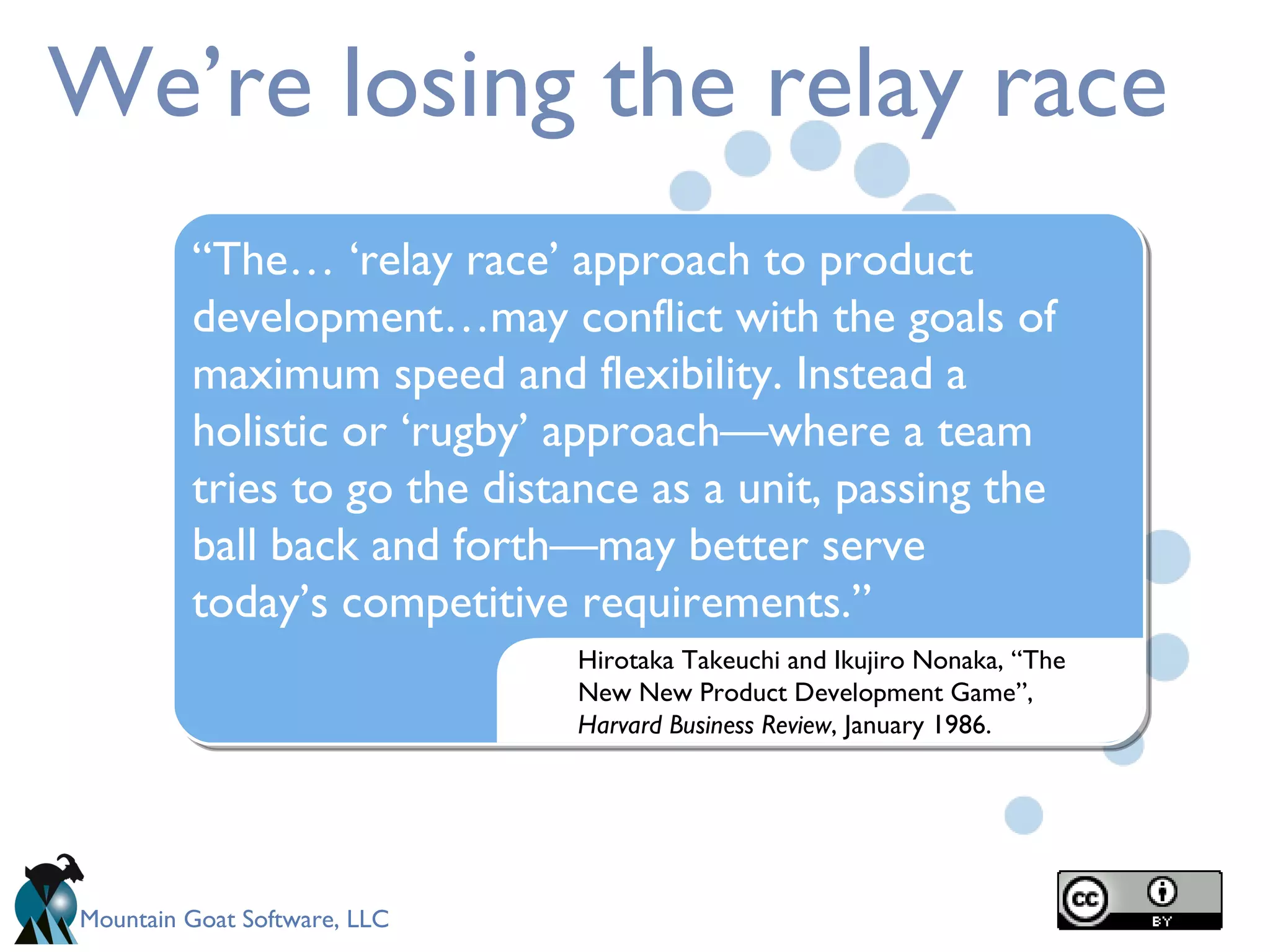
We’re losing the relay race Hirotaka Takeuchi and Ikujiro Nonaka, “The New New Product Development Game”,  Harvard Business Review ,   January 1986. “ The… ‘relay race’ approach to product development…may conflict with the goals of maximum speed and flexibility. Instead a holistic or ‘rugby’ approach—where a team tries to go the distance as a unit, passing the ball back and forth—may better serve today’s competitive requirements.”
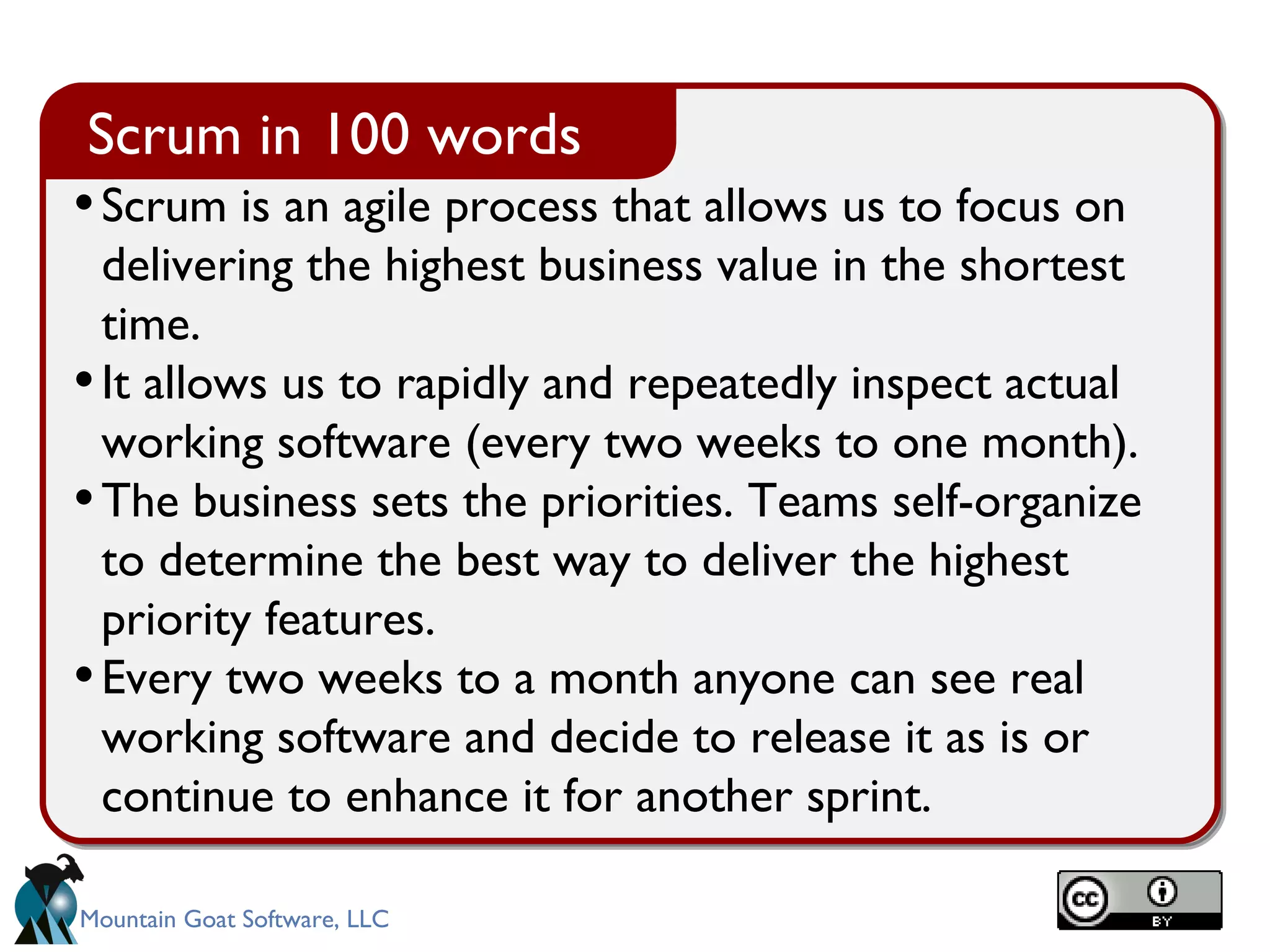
Scrum is an agile process that allows us to focus on delivering the highest business value in the shortest time.  It allows us to rapidly and repeatedly inspect actual working software (every two weeks to one month). The business sets the priorities. Teams self-organize to determine the best way to deliver the highest priority features.  Every two weeks to a month anyone can see real working software and decide to release it as is or continue to enhance it for another sprint. Scrum in 100 words
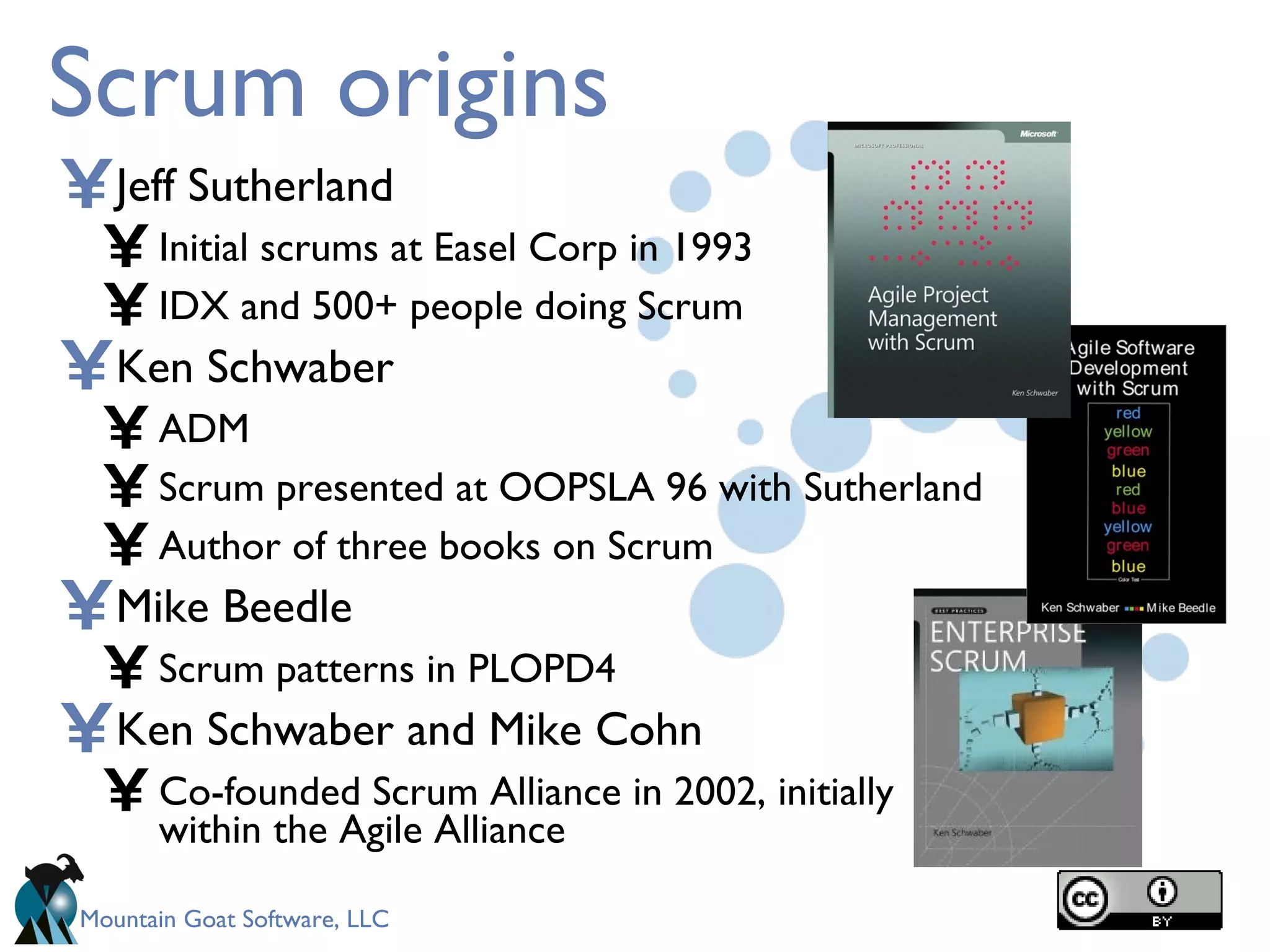
Scrum origins Jeff Sutherland Initial scrums at Easel Corp in 1993 IDX and 500+ people doing Scrum Ken Schwaber ADM Scrum presented at OOPSLA 96 with Sutherland Author of three books on Scrum Mike Beedle Scrum patterns in PLOPD4 Ken Schwaber and Mike Cohn Co-founded Scrum Alliance in 2002, initially within the Agile Alliance
Scrum has been used by: Microsoft Yahoo Google Electronic Arts High Moon Studios Lockheed Martin Philips Siemens Nokia Capital One BBC Intuit Intuit Nielsen Media First American Real Estate BMC Software Ipswitch John Deere Lexis Nexis Sabre Salesforce.com Time Warner Turner Broadcasting Oce
Scrum has been used for: Commercial software In-house development Contract development Fixed-price projects Financial applications ISO 9001-certified applications Embedded systems 24x7 systems with 99.999% uptime requirements the Joint Strike Fighter Video game development FDA-approved, life-critical systems Satellite-control software Websites Handheld software Mobile phones Network switching applications ISV applications Some of the largest applications in use
Characteristics Self-organizing teams Product progresses in a series of month-long “sprints” Requirements are captured as items in a list of “product backlog” No specific engineering practices prescribed Uses generative rules to create an agile environment for delivering projects One of the “agile processes”
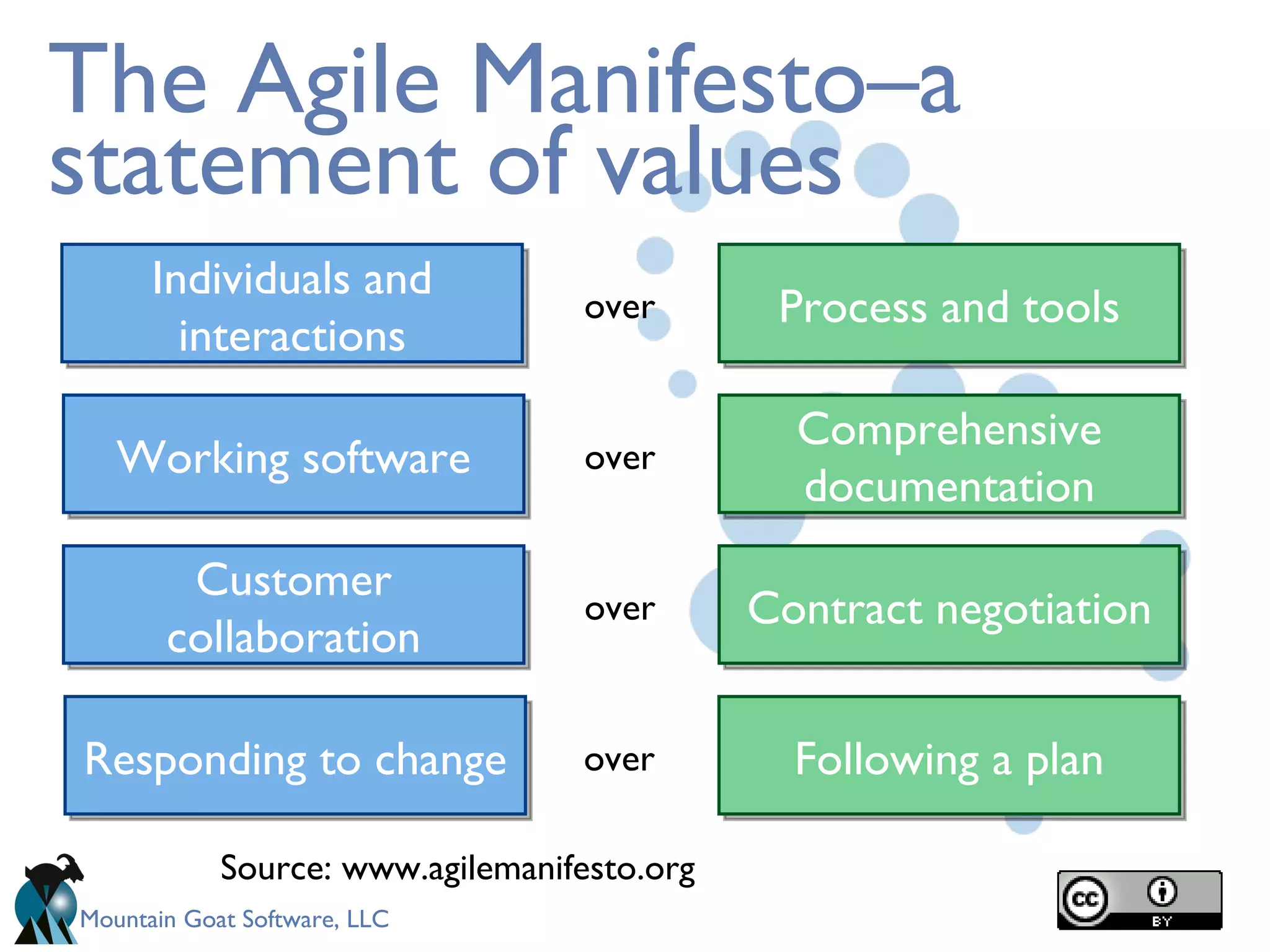
The Agile Manifesto–a statement of values Source: www.agilemanifesto.org Process and tools Individuals and interactions over Following a plan Responding to change over Comprehensive documentation Working software over Contract negotiation Customer collaboration over
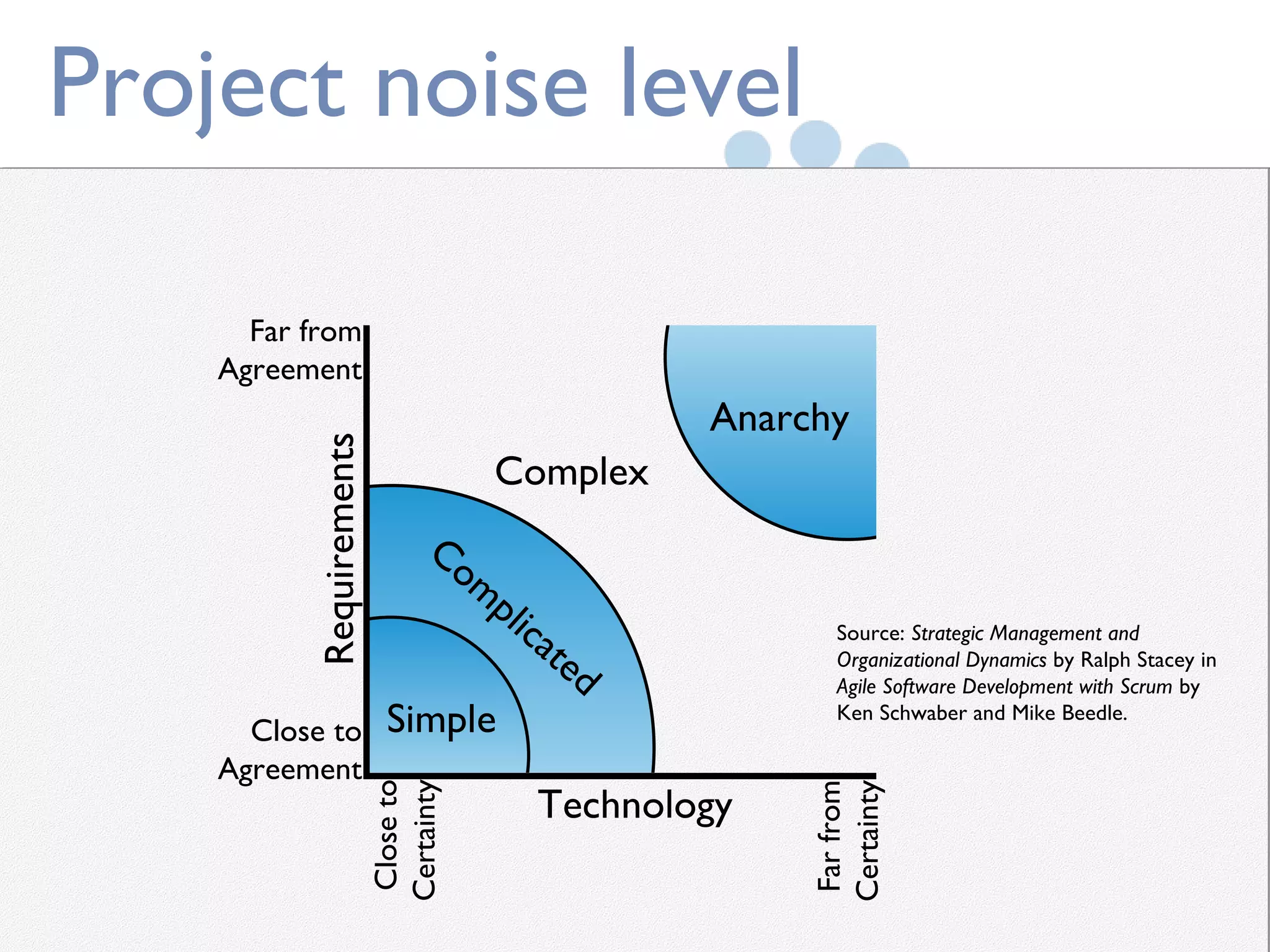
Project noise level Simple Complex Anarchy Complicated Technology Requirements Far from Agreement Close to Agreement Close to Certainty Far from Certainty Source:  Strategic Management and Organizational Dynamics  by Ralph Stacey in  Agile Software Development with Scrum  by Ken Schwaber and Mike Beedle.
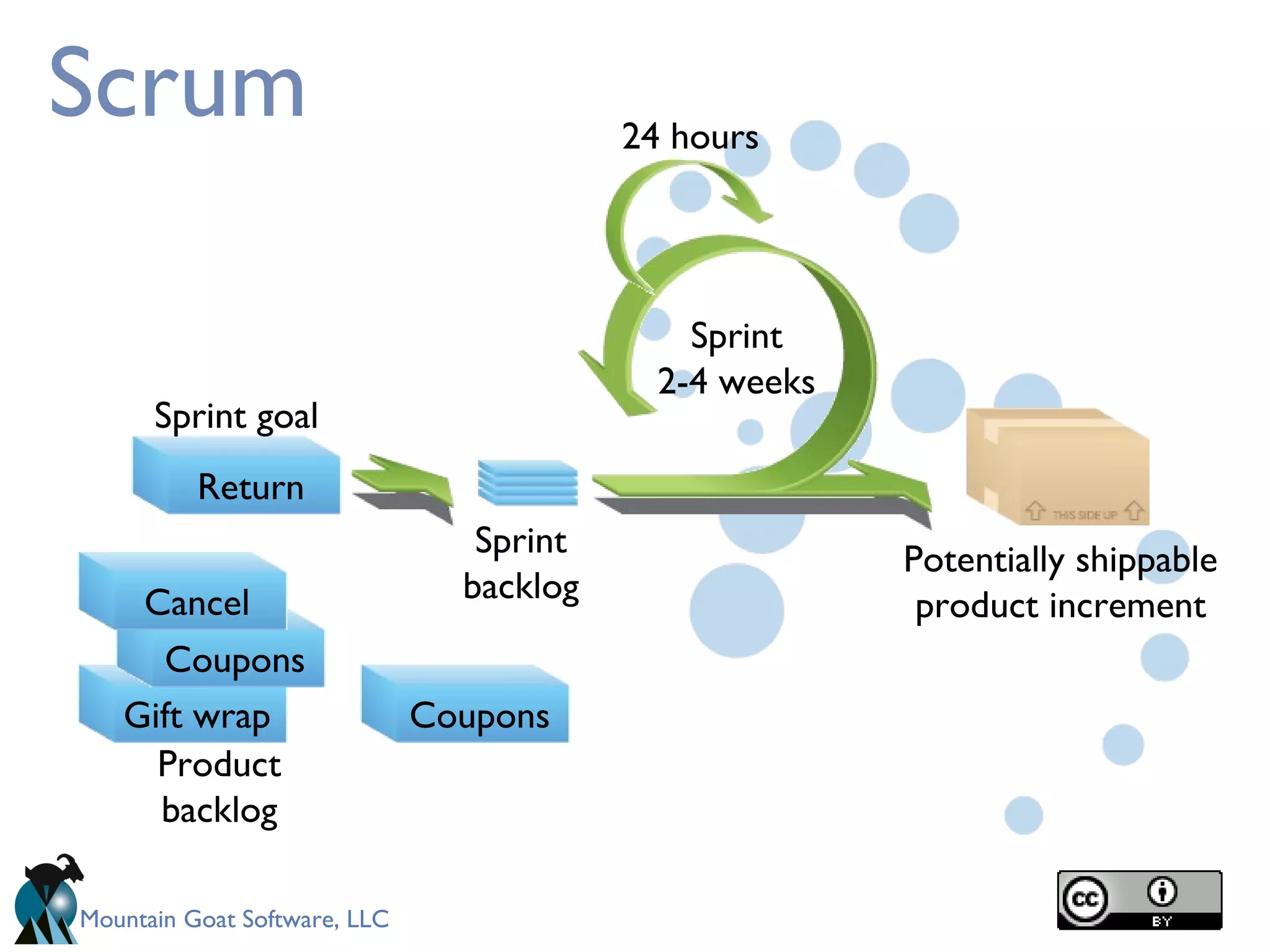
Scrum Product backlog Cancel Gift wrap Return Sprint 2-4 weeks Return Sprint goal Sprint backlog Potentially shippable product increment Coupons Gift wrap Coupons Cancel 24 hours
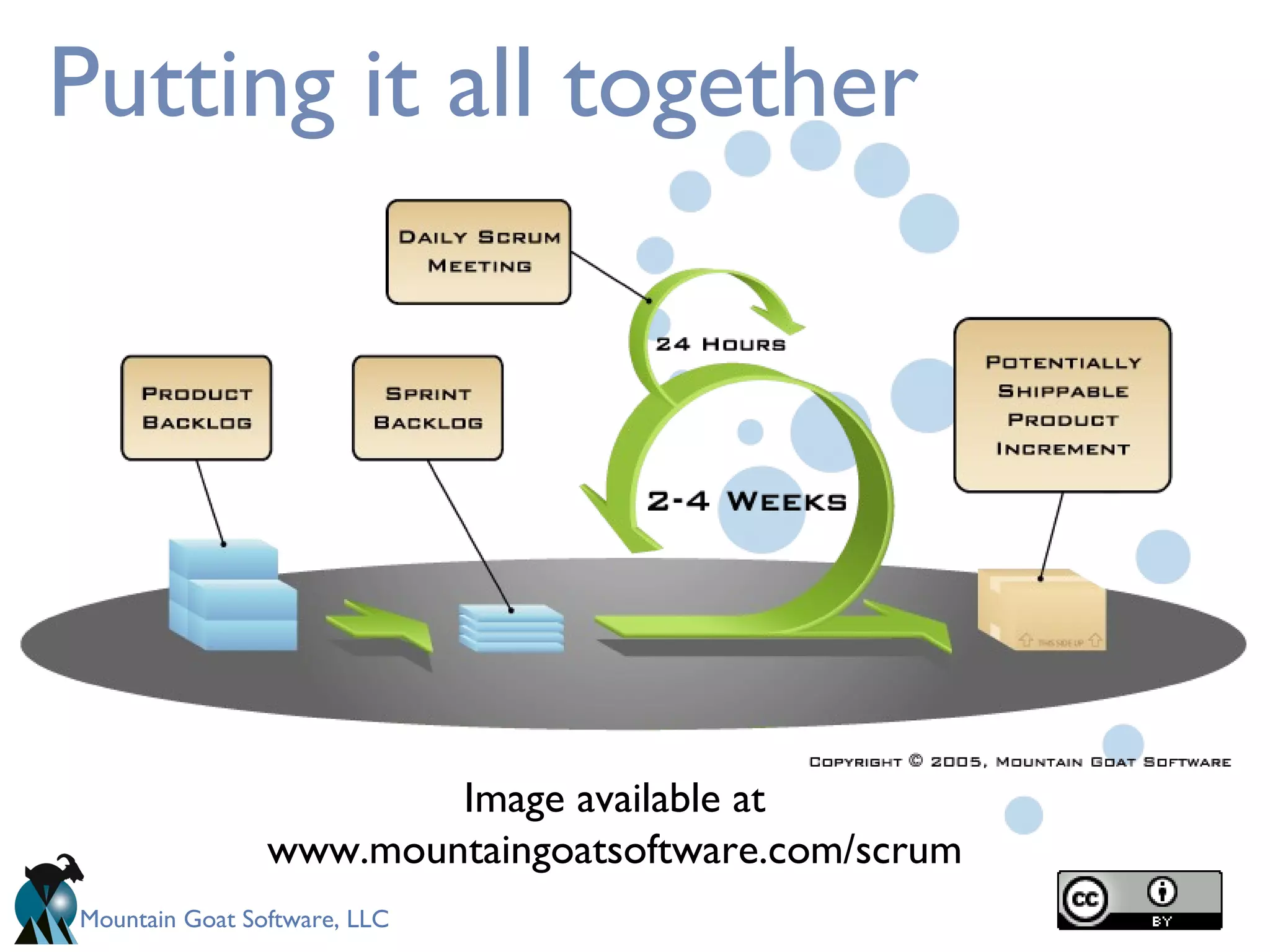
Putting it all together Image available at www.mountaingoatsoftware.com/scrum
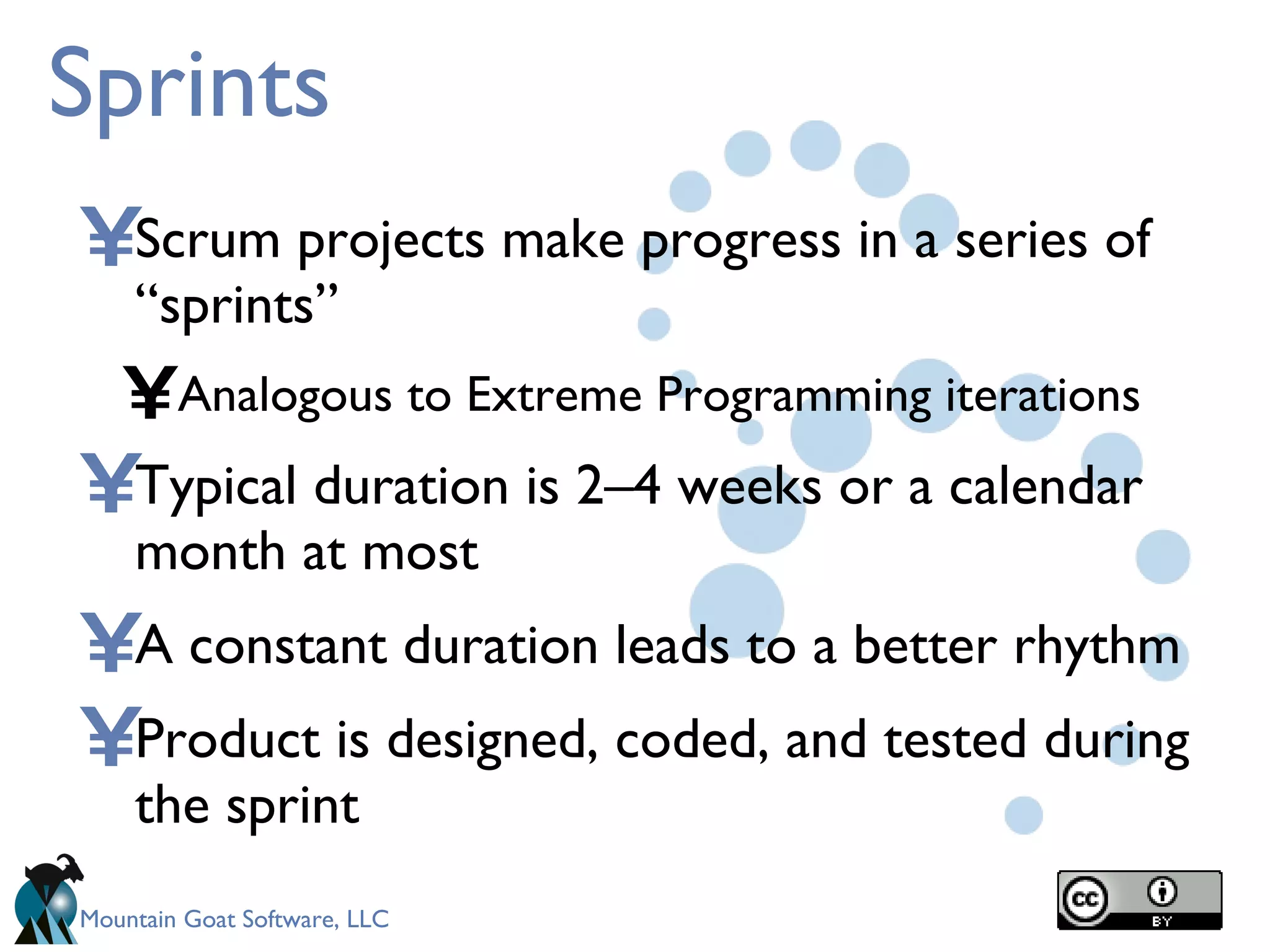
Sprints Scrum projects make progress in a series of “sprints” Analogous to Extreme Programming iterations Typical duration is 2–4 weeks or a calendar month at most A constant duration leads to a better rhythm Product is designed, coded, and tested during the sprint
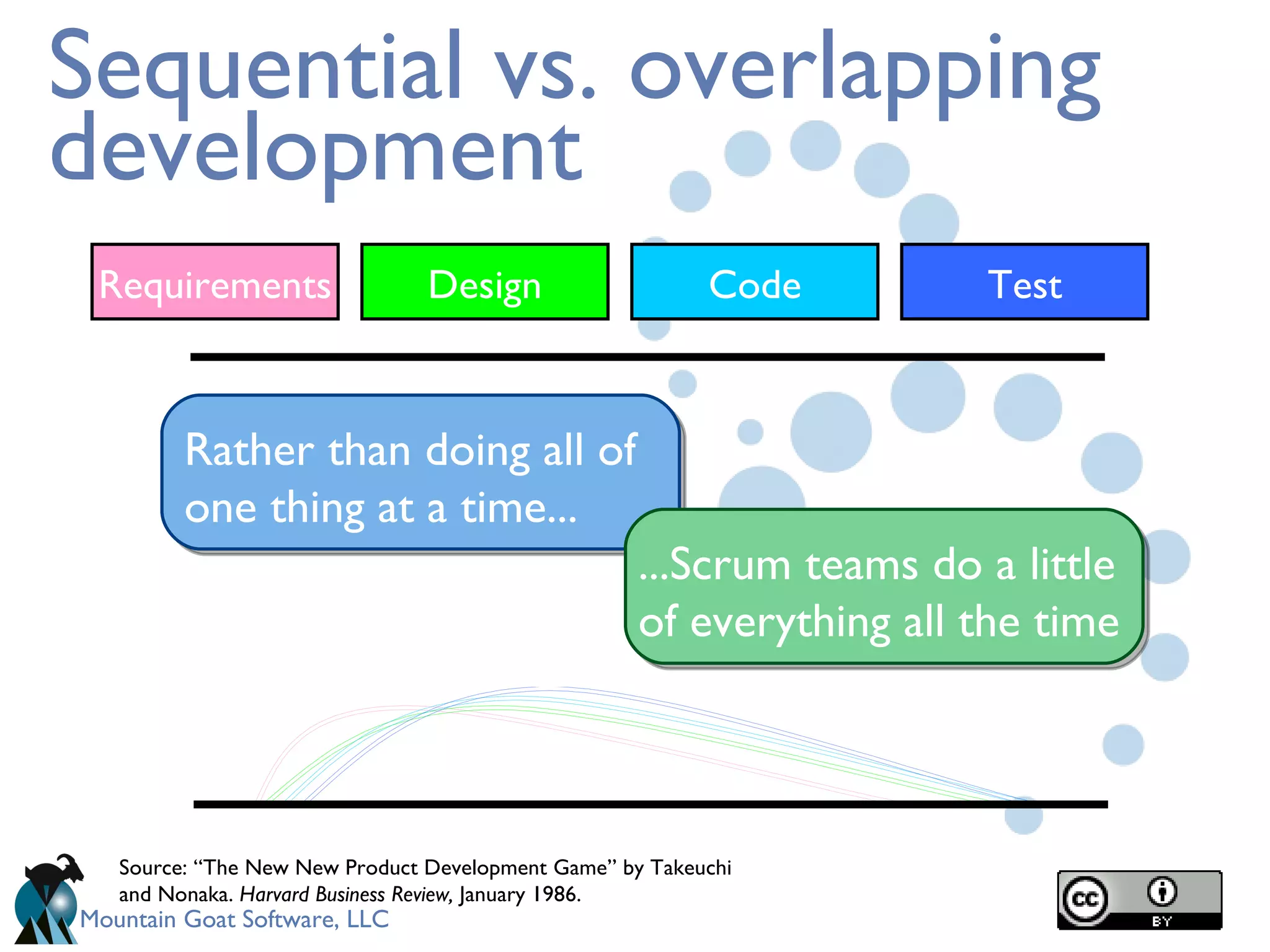
Sequential vs. overlapping development Source: “The New New Product Development Game” by Takeuchi and Nonaka.  Harvard Business Review,  January 1986. Rather than doing all of one thing at a time... ...Scrum teams do a little of everything all the time Requirements Design Code Test
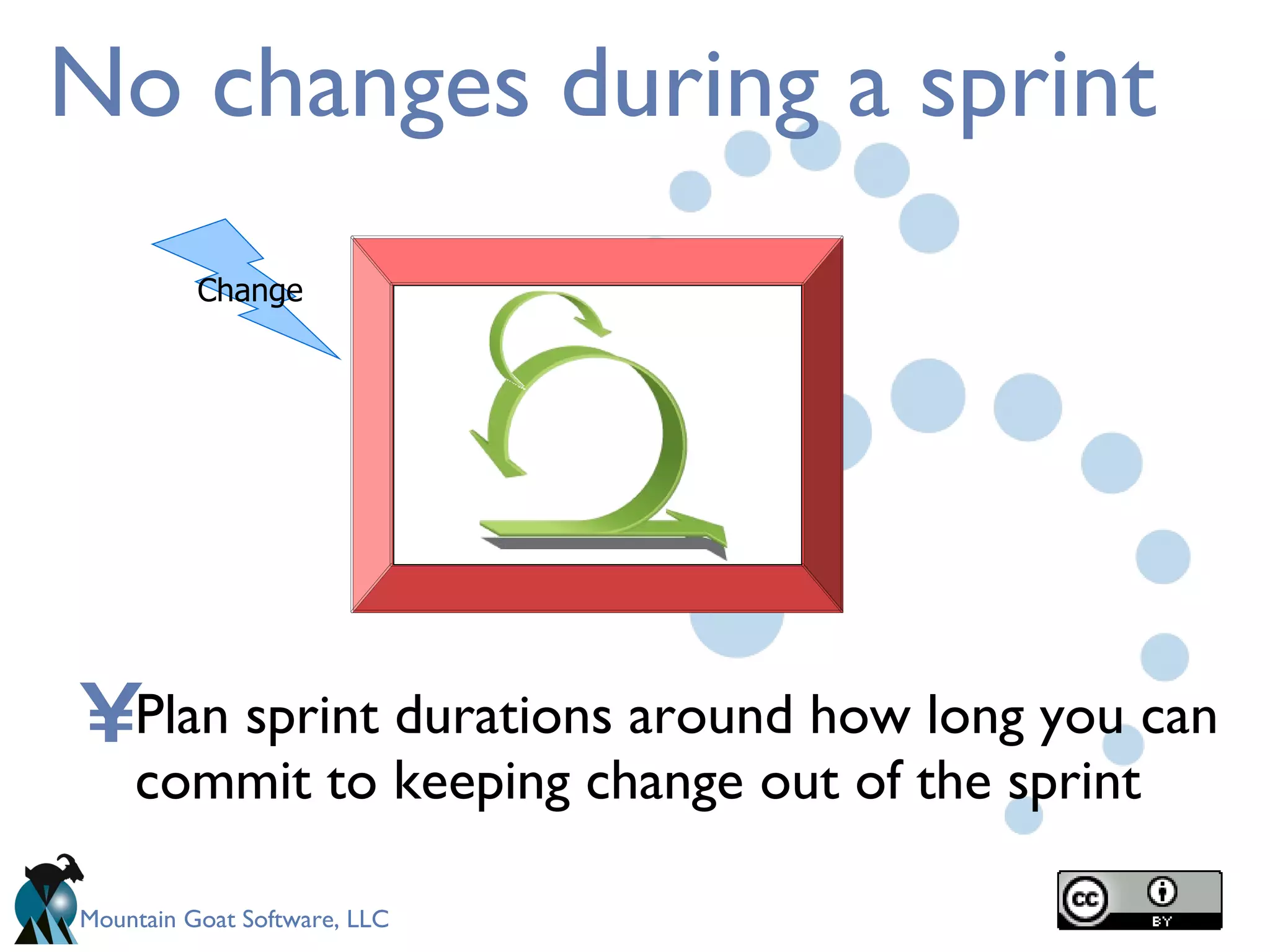
No changes during a sprint Plan sprint durations around how long you can commit to keeping change out of the sprint Change
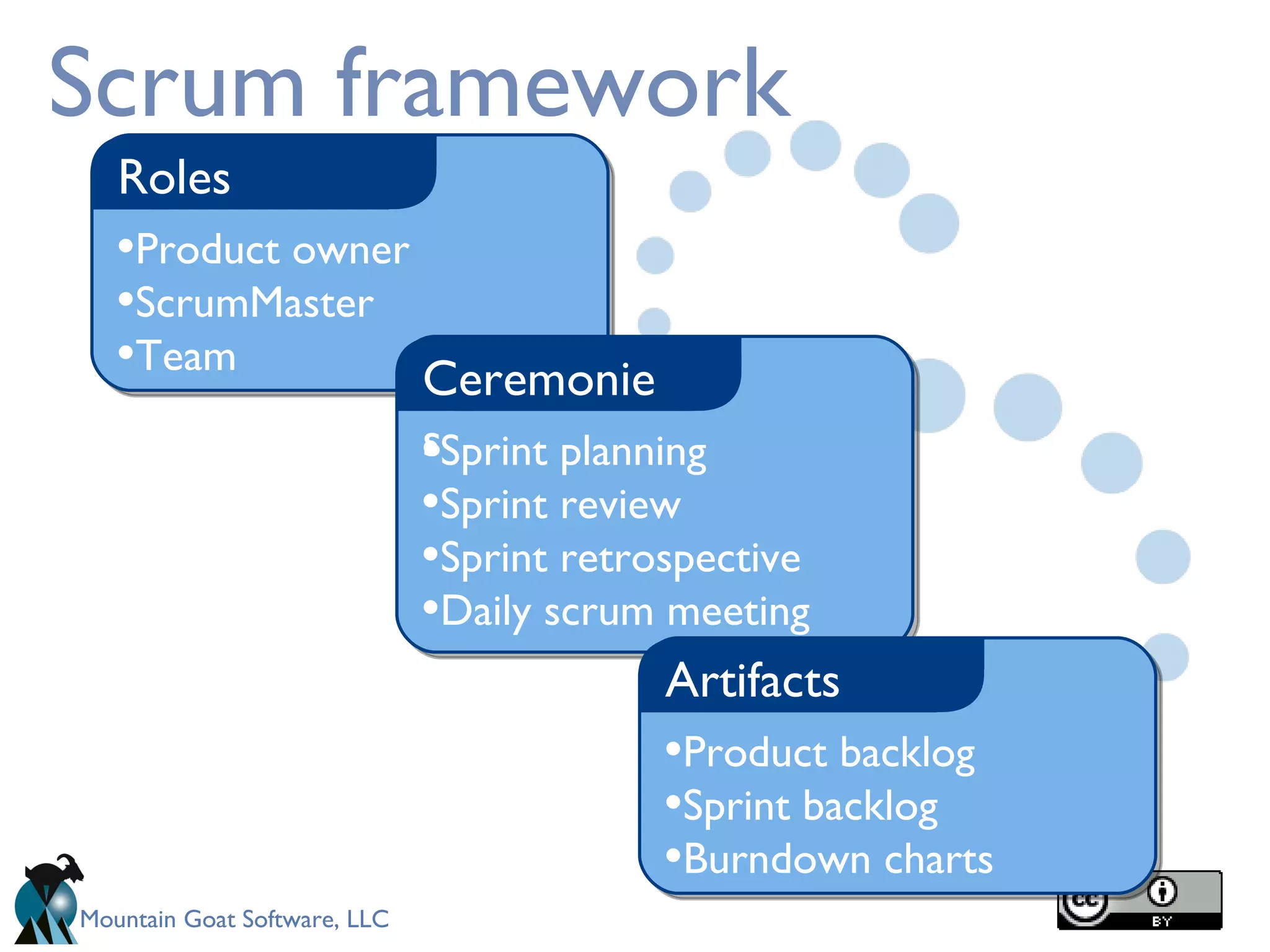
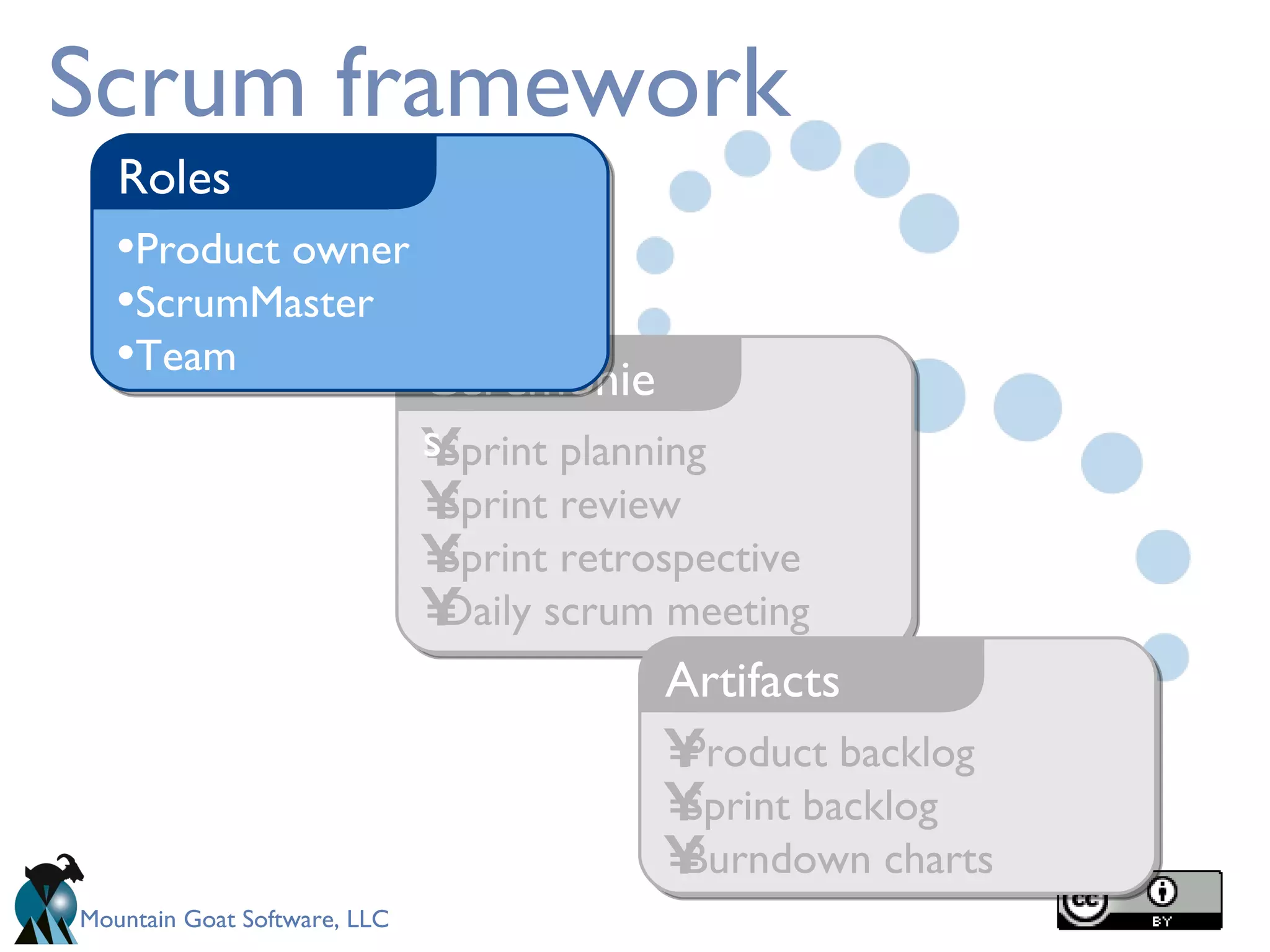
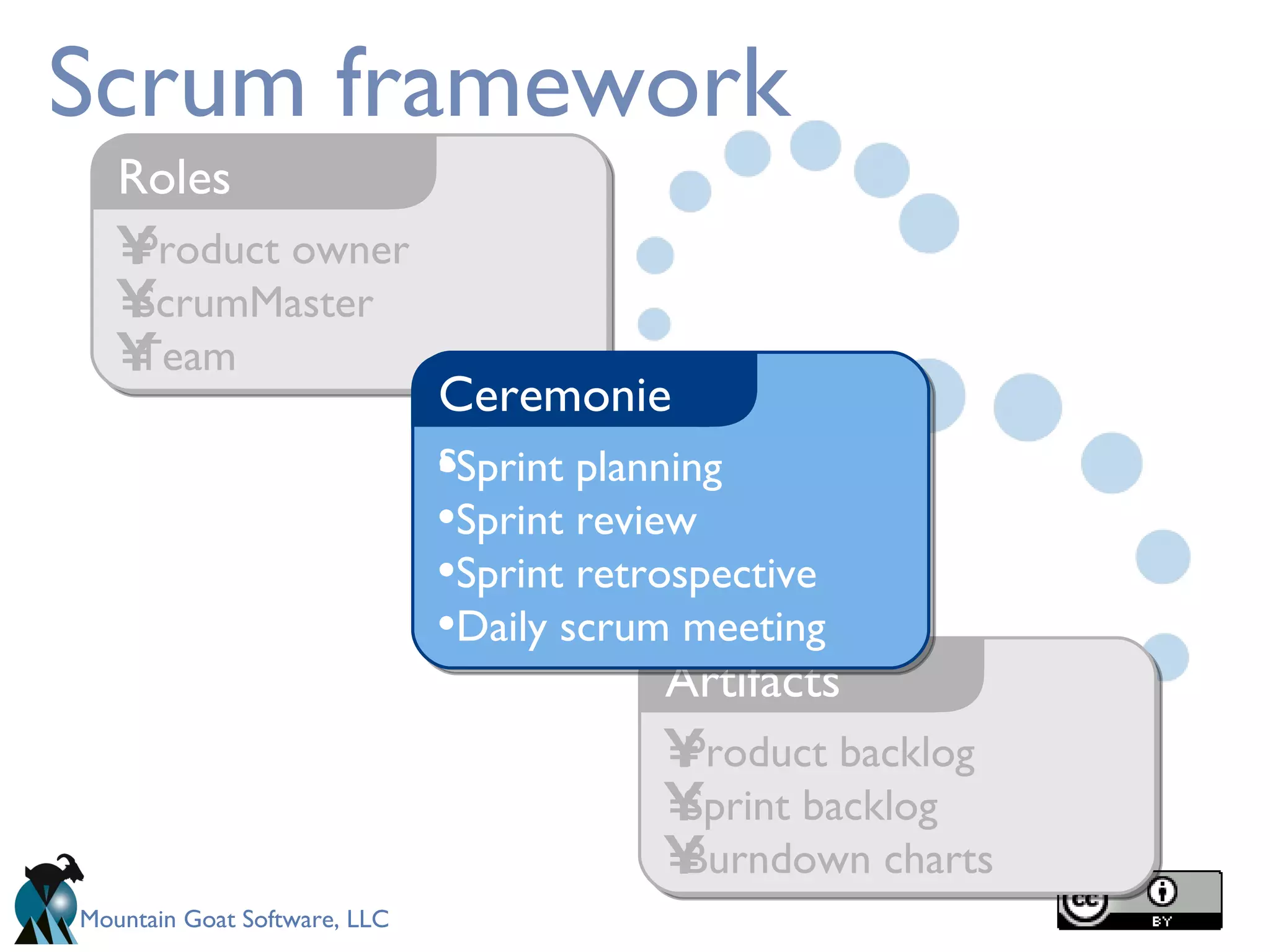
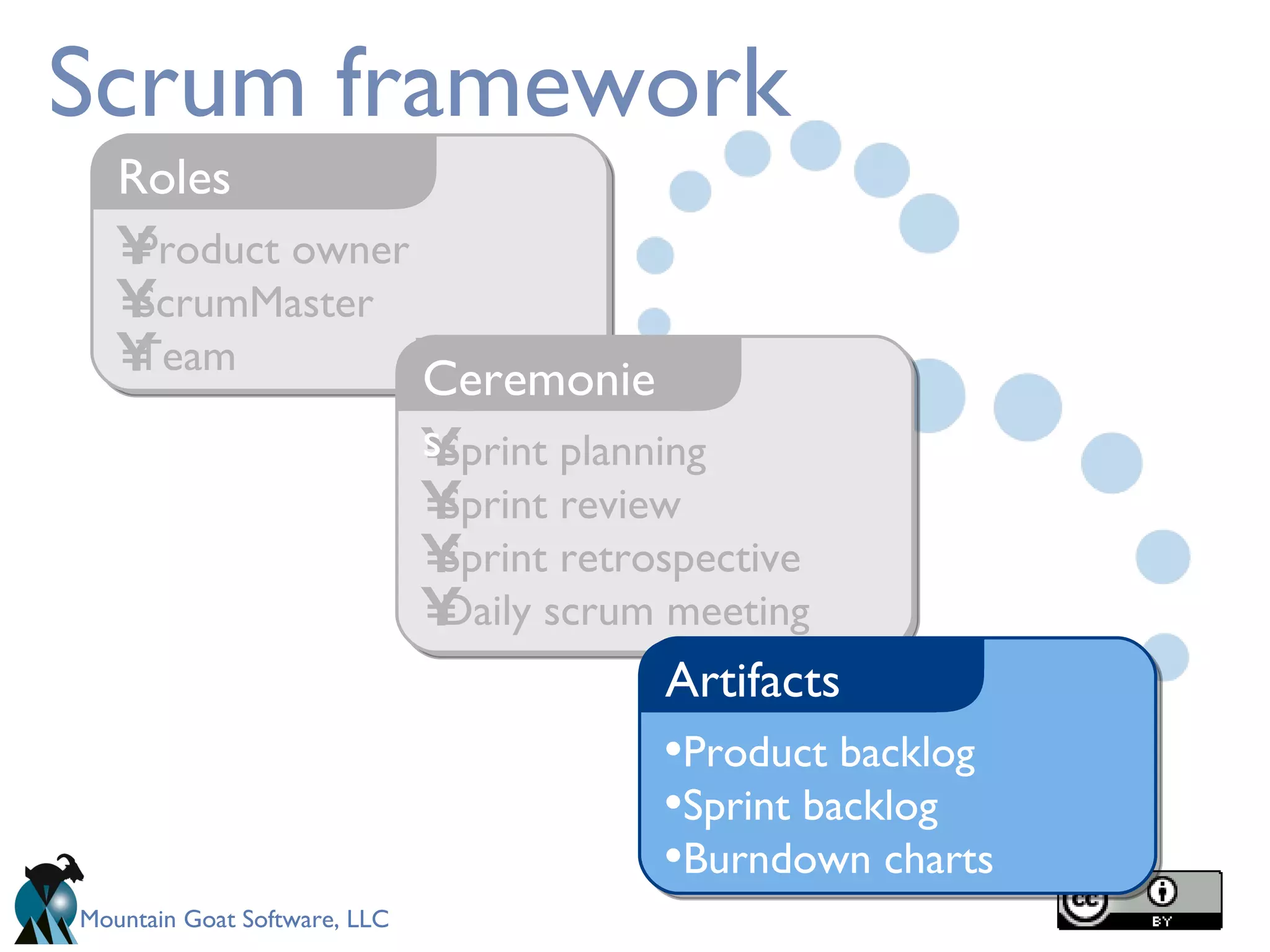
Scrum framework Product owner ScrumMaster Team Roles Sprint planning Sprint review Sprint retrospective Daily scrum meeting Ceremonies Product backlog Sprint backlog Burndown charts Artifacts
Scrum framework Product backlog Sprint backlog Burndown charts Artifacts Sprint planning Sprint review Sprint retrospective Daily scrum meeting Ceremonies Product owner ScrumMaster Team Roles
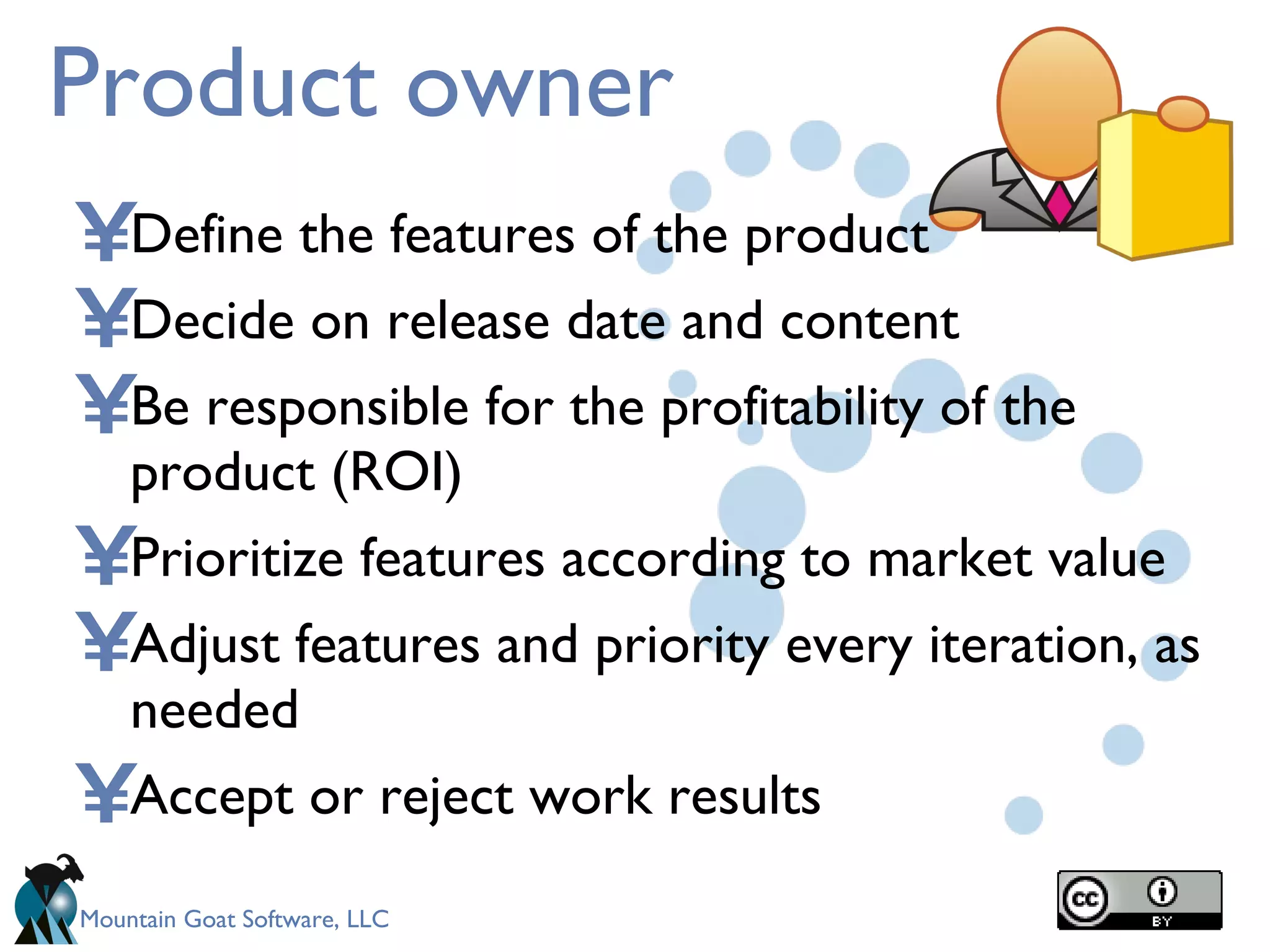
Product owner Define the features of the product Decide on release date and content Be responsible for the profitability of the product (ROI) Prioritize features according to market value  Adjust features and priority every iteration, as needed   Accept or reject work results
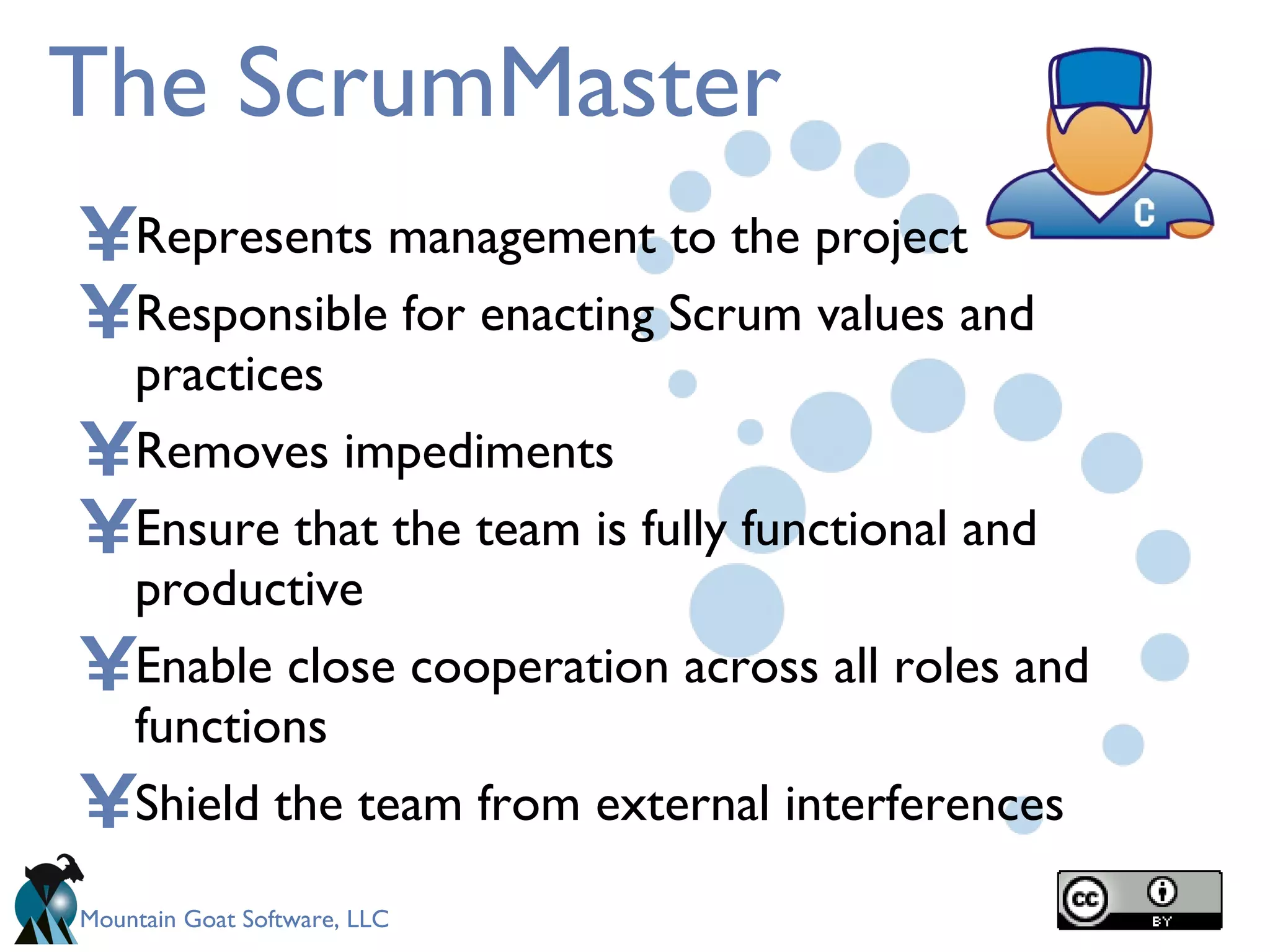
The ScrumMaster Represents management to the project Responsible for enacting Scrum values and practices Removes impediments  Ensure that the team is fully functional and productive Enable close cooperation across all roles and functions Shield the team from external interferences
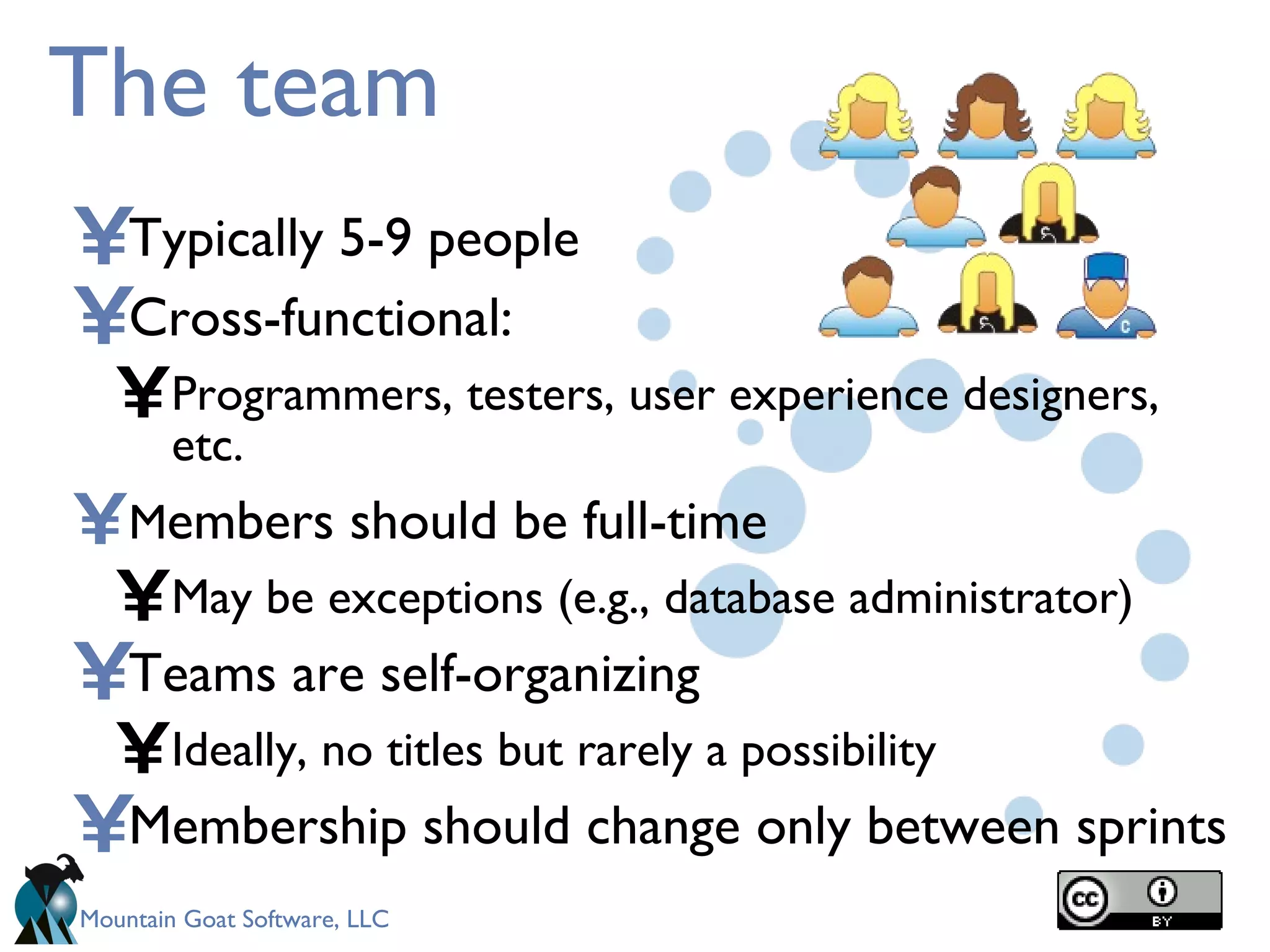
The team Typically 5-9 people Cross-functional: Programmers, testers, user experience designers, etc. M embers should be full-time May be exceptions (e.g., database administrator) Teams are self-organizing Ideally, no titles but rarely a possibility Membership should change only between sprints
Scrum framework Product owner ScrumMaster Team Roles Product backlog Sprint backlog Burndown charts Artifacts Sprint planning Sprint review Sprint retrospective Daily scrum meeting Ceremonies
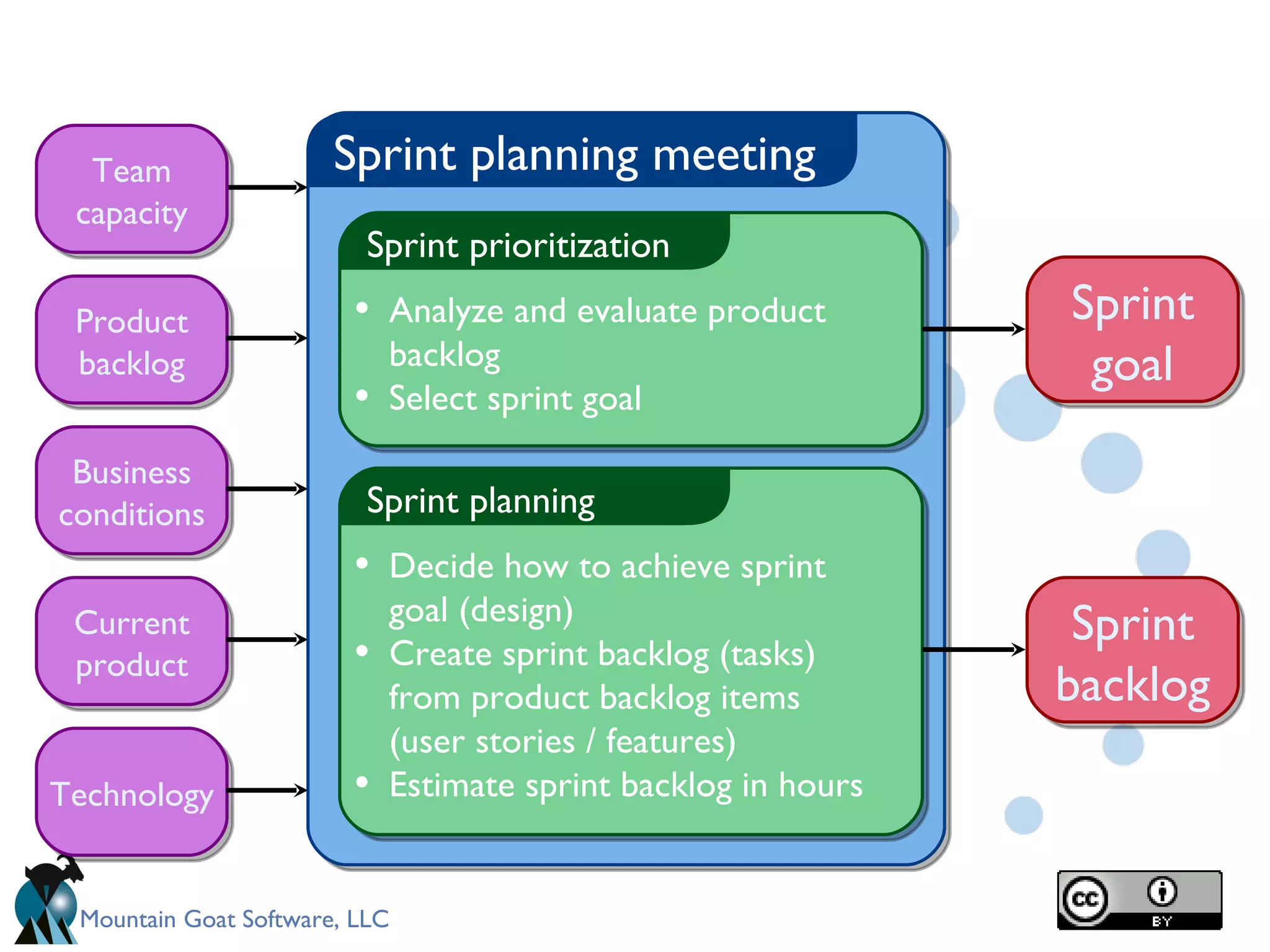
Sprint planning meeting Business conditions Team capacity Product backlog Technology Current product Sprint prioritization Analyze and evaluate product backlog Select sprint goal Sprint planning Decide how to achieve sprint goal (design) Create sprint backlog (tasks) from product backlog items (user stories / features) Estimate sprint backlog in hours Sprint goal Sprint backlog
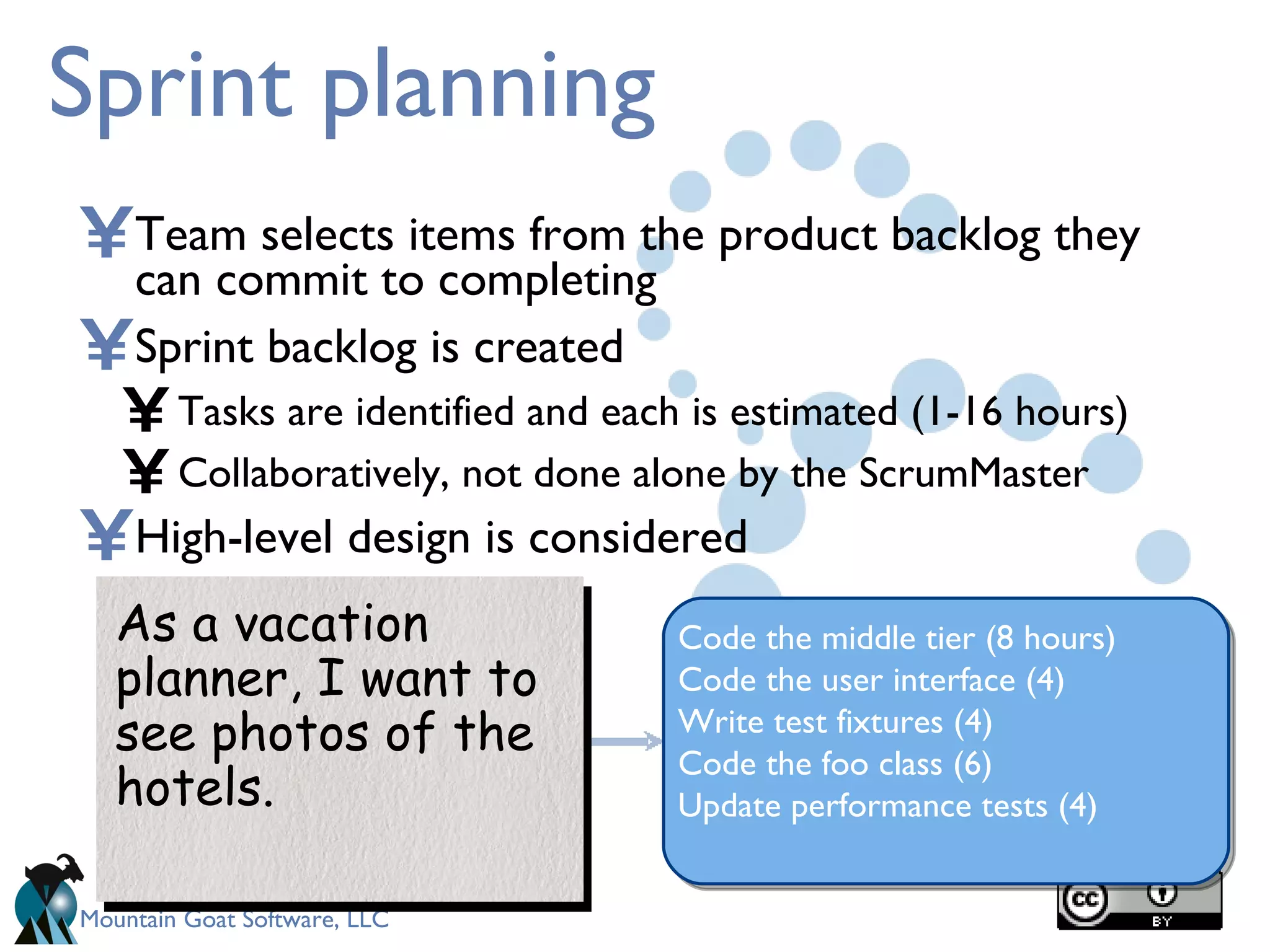
Sprint planning Team selects items from the product backlog they can commit to completing Sprint backlog is created Tasks are identified and each is estimated (1-16 hours) Collaboratively, not done alone by the ScrumMaster High-level design is considered As a vacation planner, I want to see photos of the hotels. Code the middle tier (8 hours) Code the user interface (4) Write test fixtures (4) Code the foo class (6) Update performance tests (4)
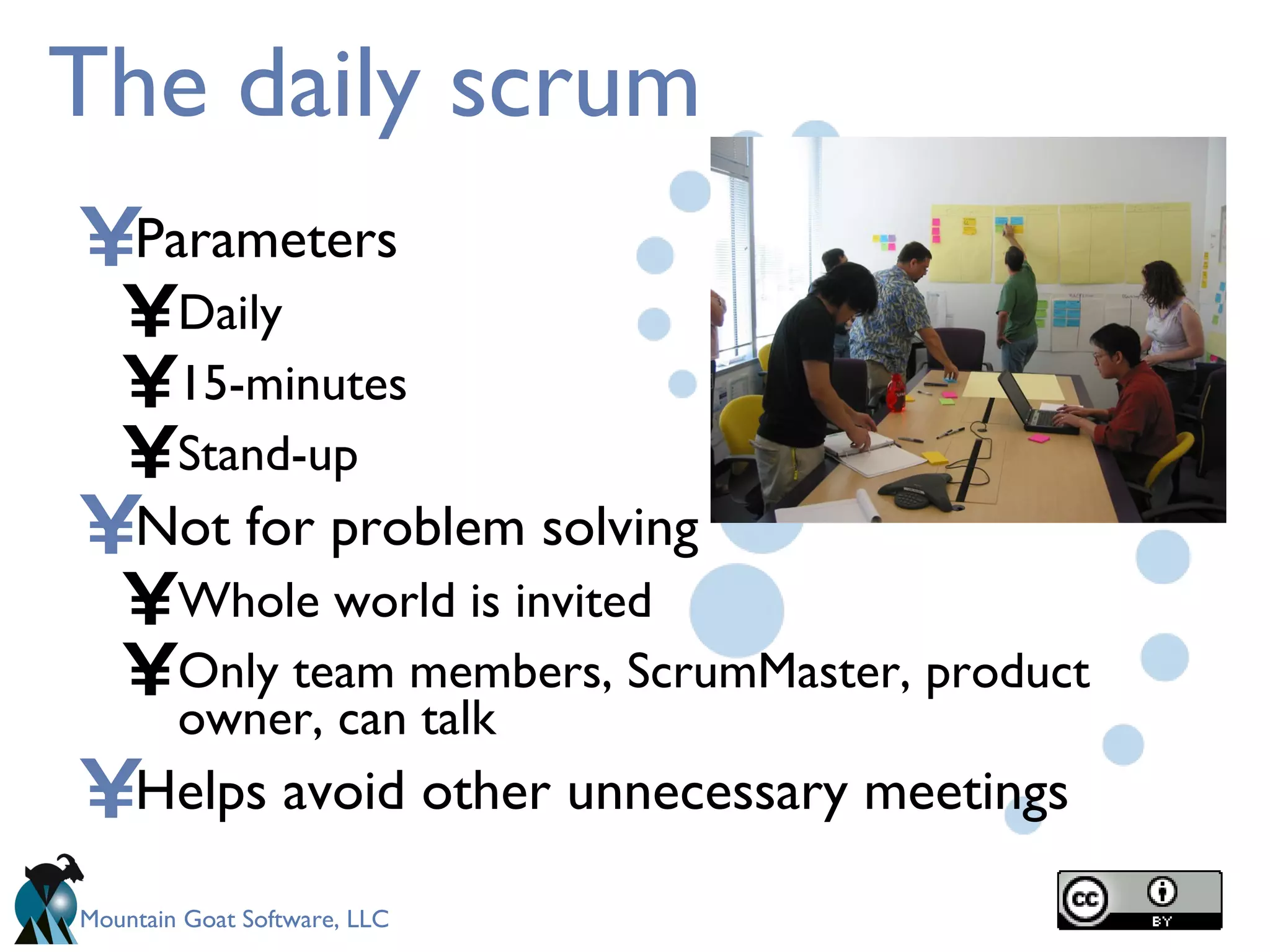
The daily scrum Parameters Daily 15-minutes Stand-up Not for problem solving Whole world is invited Only team members, ScrumMaster, product owner, can talk Helps avoid other unnecessary meetings
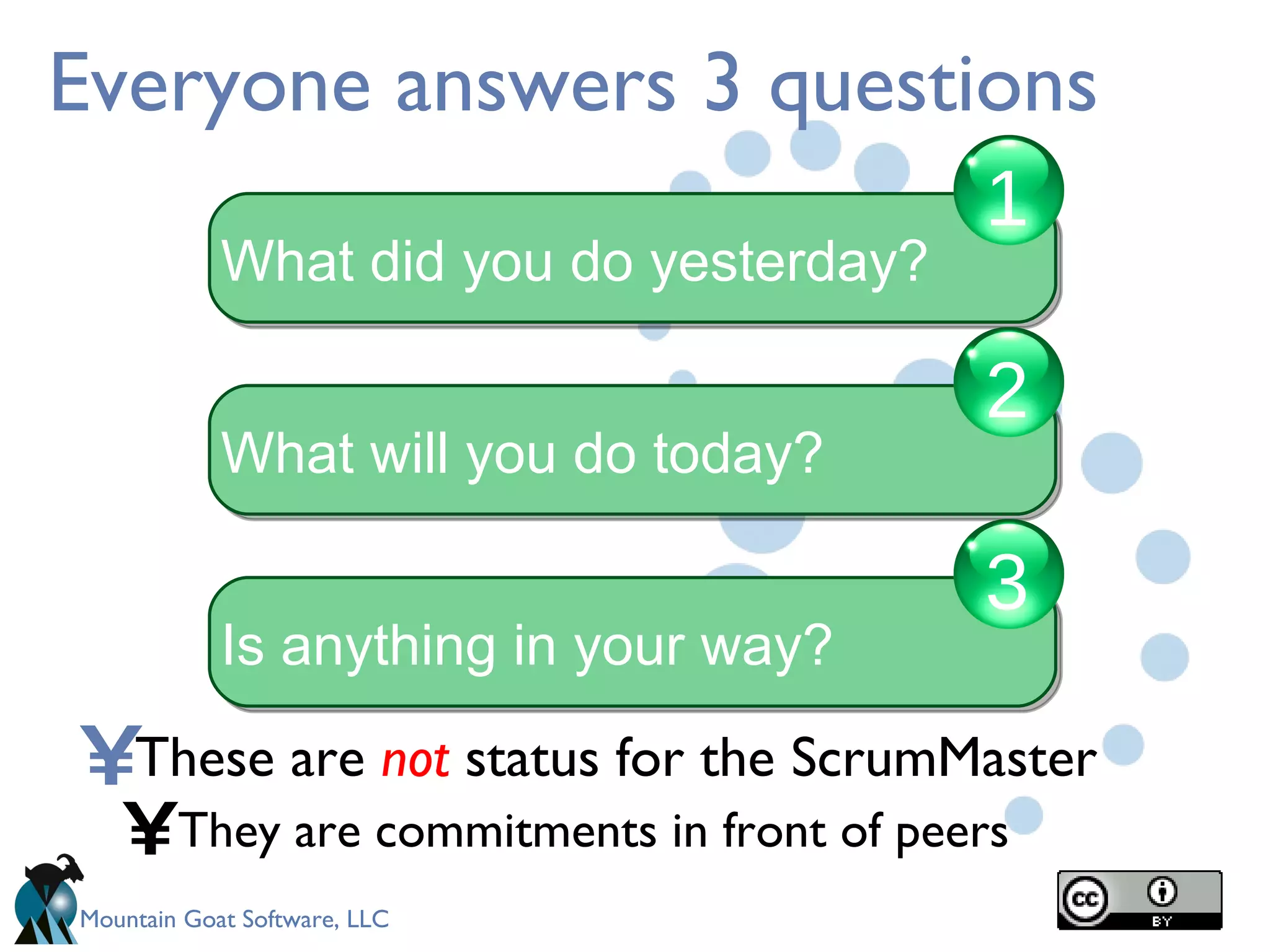
Everyone answers 3 questions These are  not  status for the ScrumMaster They are commitments in front of peers What did you do yesterday? 1 What will you do today? 2 Is anything in your way? 3
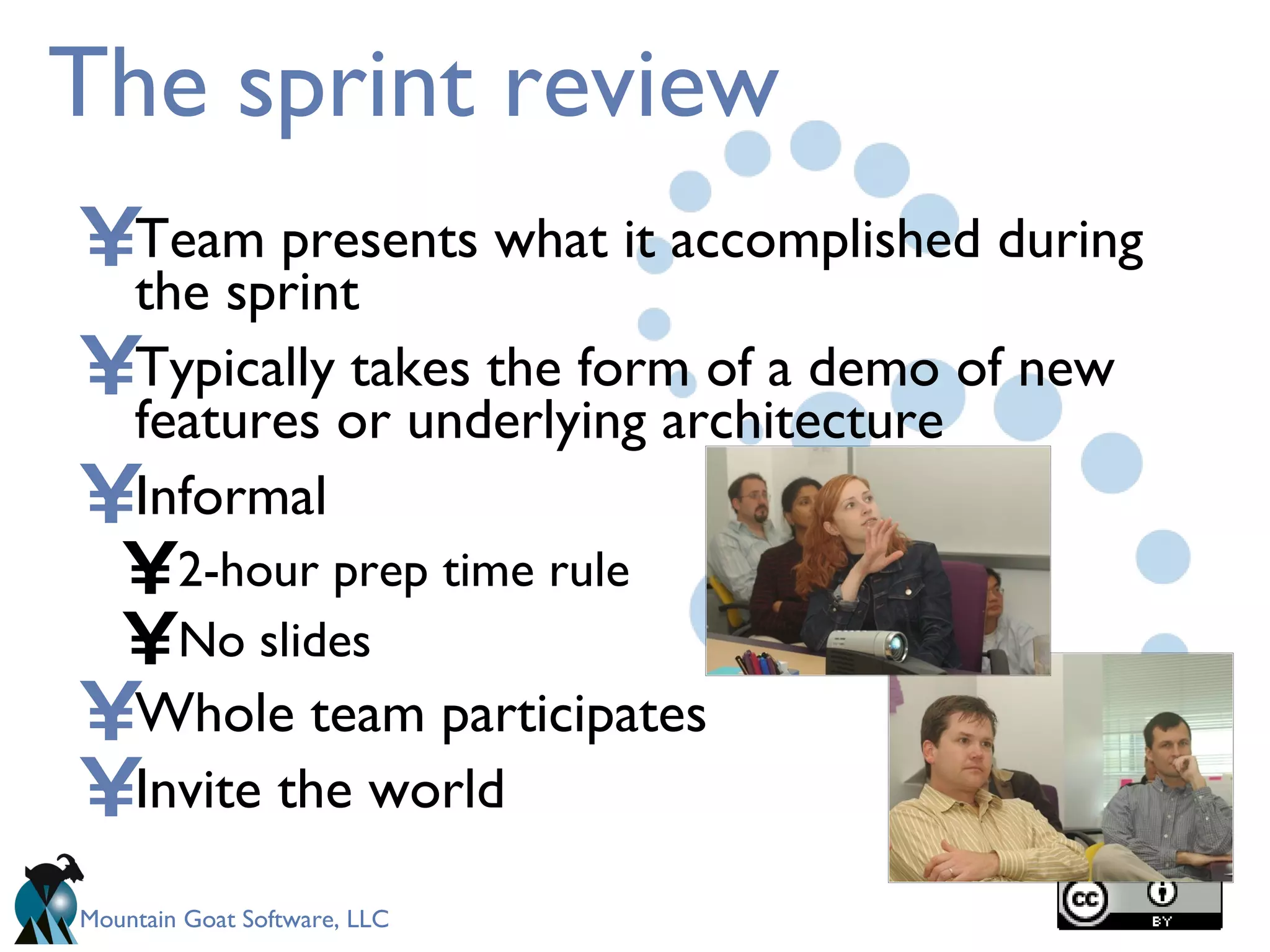
The sprint review Team presents what it accomplished during the sprint Typically takes the form of a demo of new features or underlying architecture Informal 2-hour prep time rule No slides Whole team participates Invite the world
Sprint retrospective Periodically take a look at what is and is not working Typically 15–30 minutes Done after every sprint Whole team participates ScrumMaster Product owner Team Possibly customers and others
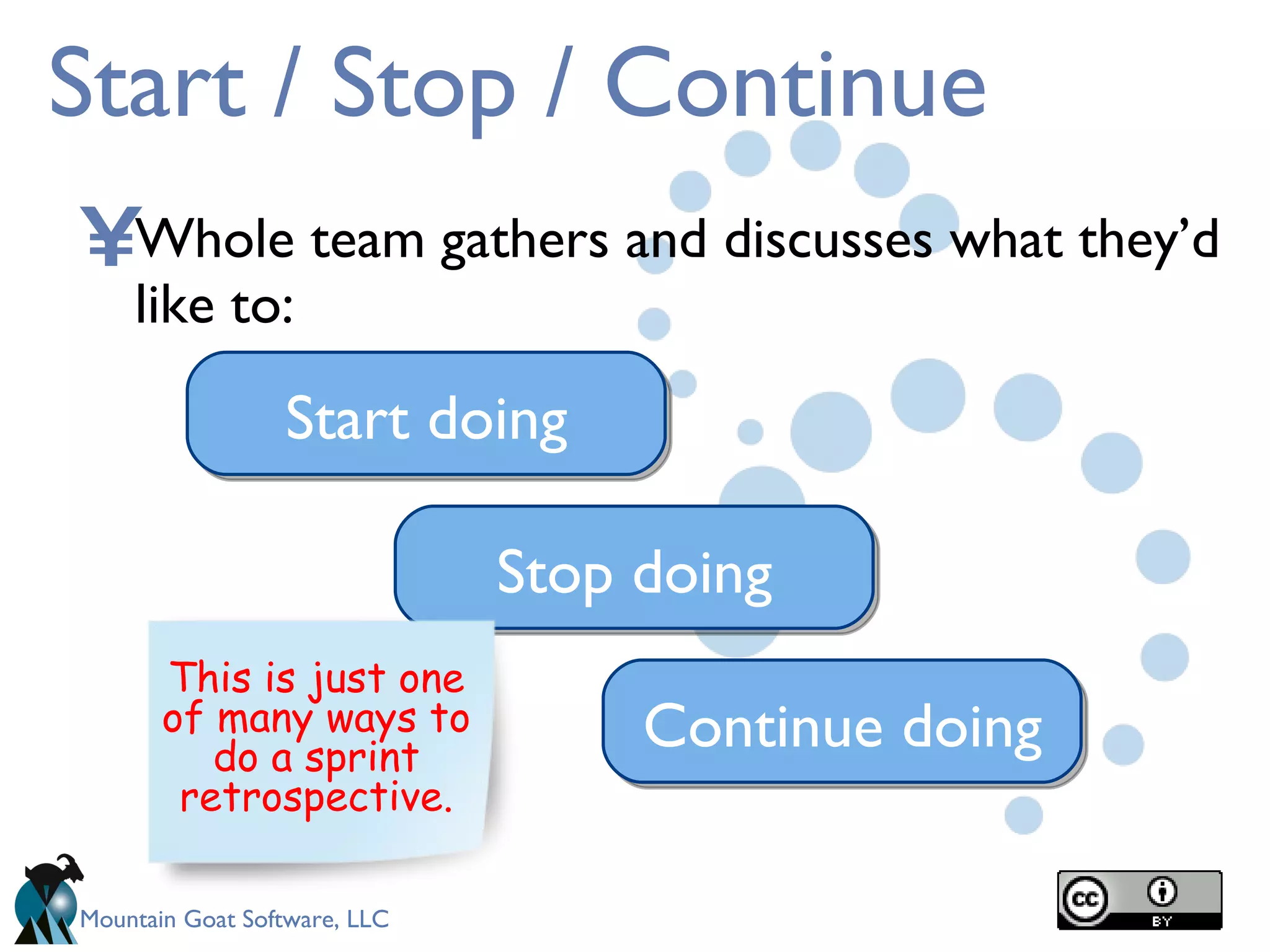
Start / Stop / Continue Whole team gathers and discusses what they’d like to: Start doing Stop doing Continue doing This is just one of many ways to do a sprint retrospective.
Scrum framework Product owner ScrumMaster Team Roles Sprint planning Sprint review Sprint retrospective Daily scrum meeting Ceremonies Product backlog Sprint backlog Burndown charts Artifacts
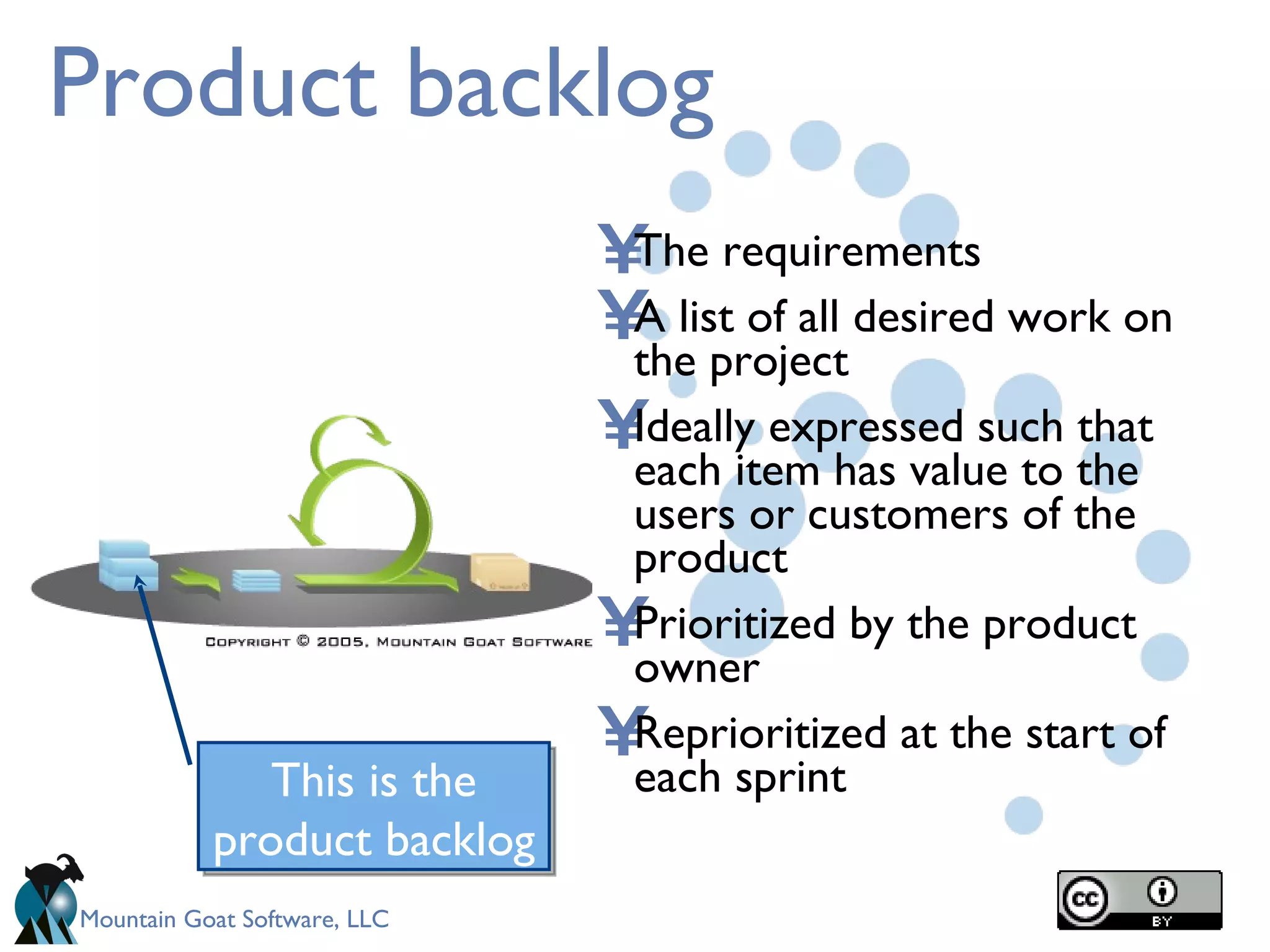
Product backlog The requirements A list of all desired work on the project Ideally expressed such that each item has value to the users or customers of the product  Prioritized by the product owner Reprioritized at the start of each sprint This is the product backlog
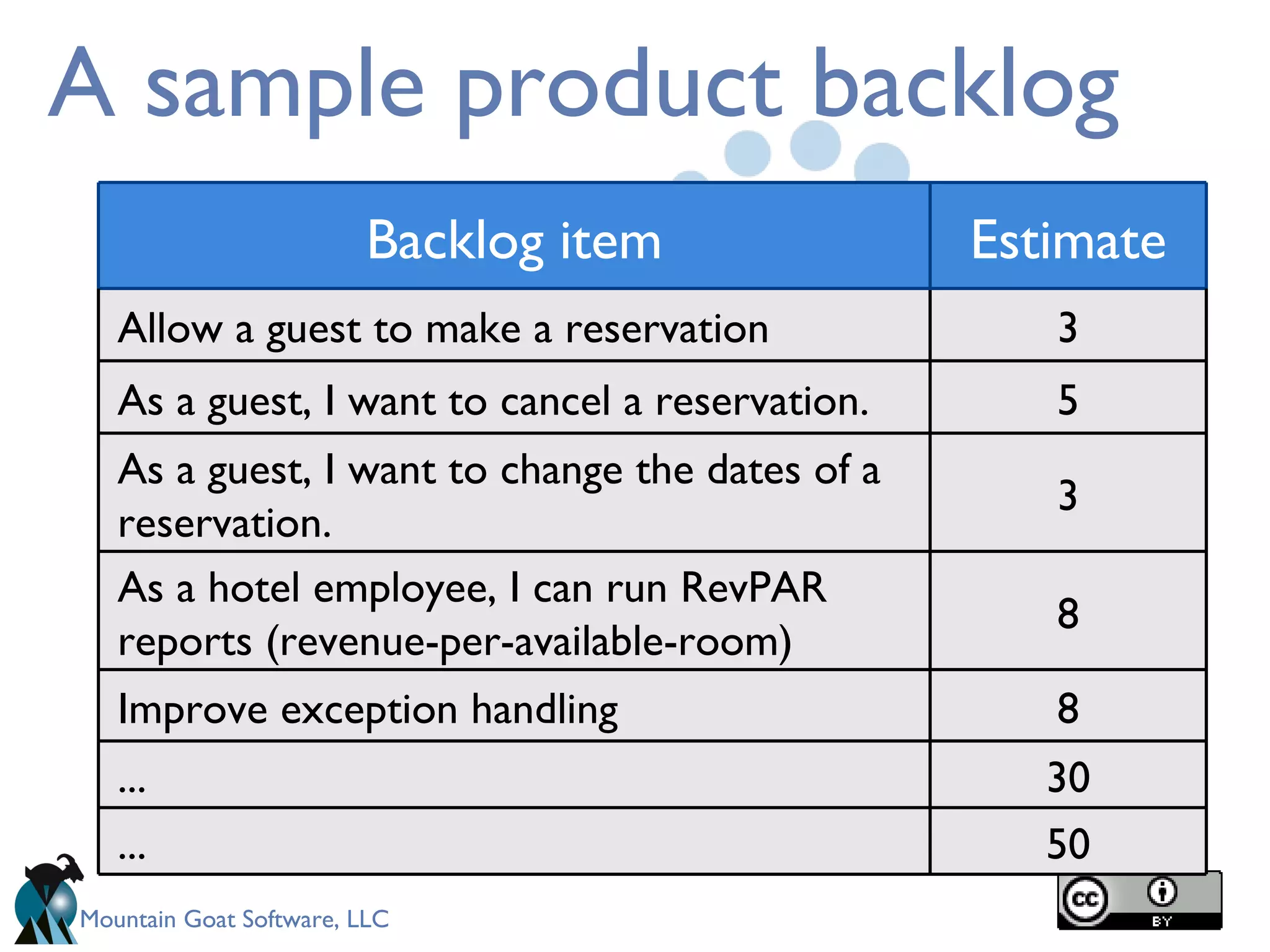
A sample product backlog Backlog item Estimate Allow a guest to make a reservation 3 As a guest, I want to cancel a reservation. 5 As a guest, I want to change the dates of a reservation. 3 As a hotel employee, I can run RevPAR reports (revenue-per-available-room) 8 Improve exception handling 8 ... 30 ... 50
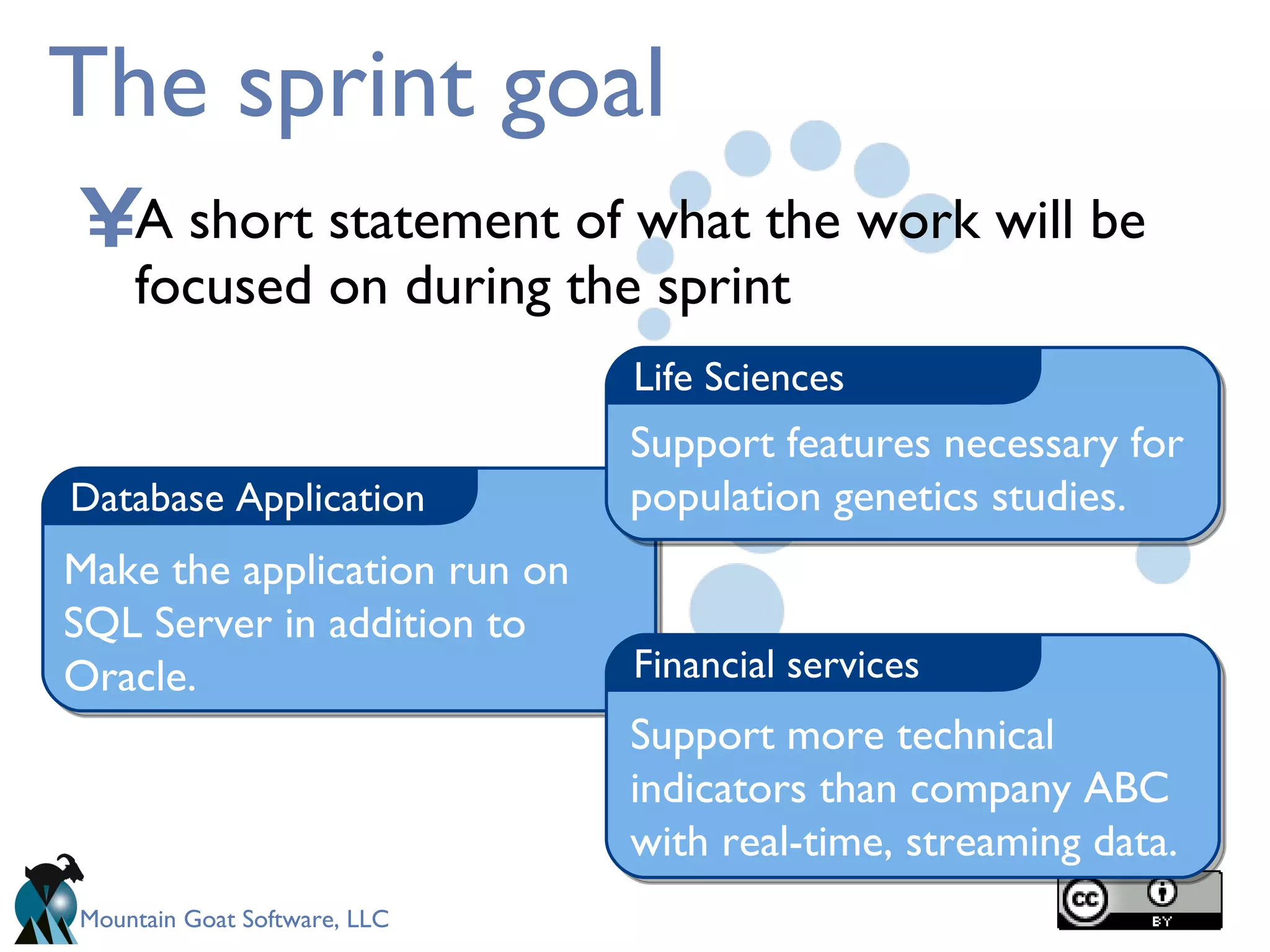
The sprint goal A short statement of what the work will be focused on during the sprint Database Application Financial services Life Sciences Support features necessary for population genetics studies. Support more technical indicators than company ABC with real-time, streaming data. Make the application run on SQL Server in addition to Oracle.
Managing the sprint backlog Individuals sign up for work of their own choosing Work is never assigned Estimated work remaining is updated daily Any team member can add, delete or change the sprint backlog Work for the sprint emerges If work is unclear, define a sprint backlog item with a larger amount of time and break it down later Update work remaining as more becomes known
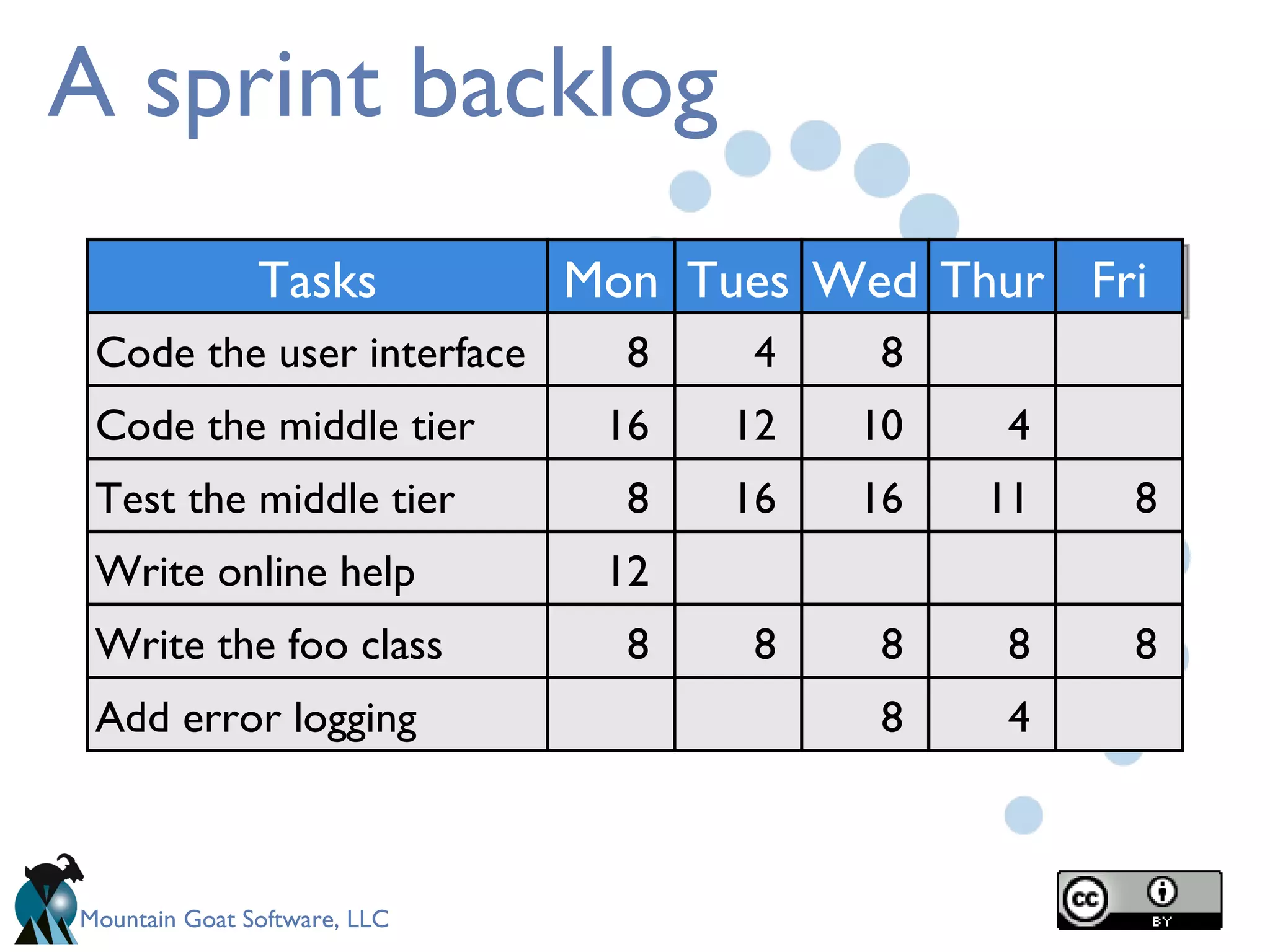
A sprint backlog Tasks Code the user interface Code the middle tier Test the middle tier Write online help Write the foo class Mon Tues Wed Thur Fri 8 16 8 12 8 4 12 16 8 4 11 8 4 8 8 Add error logging 8 10 16 8 8
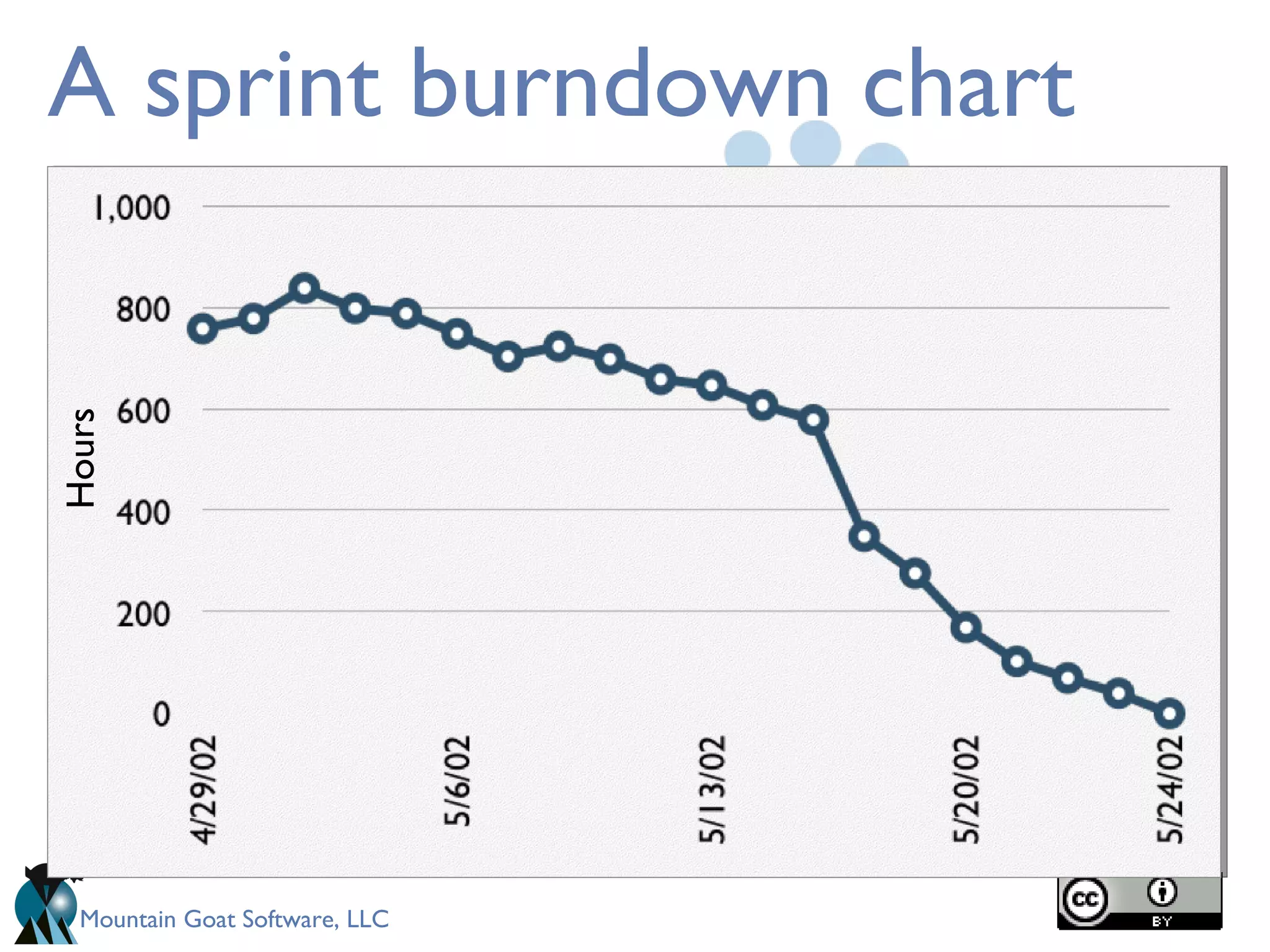
A sprint burndown chart Hours
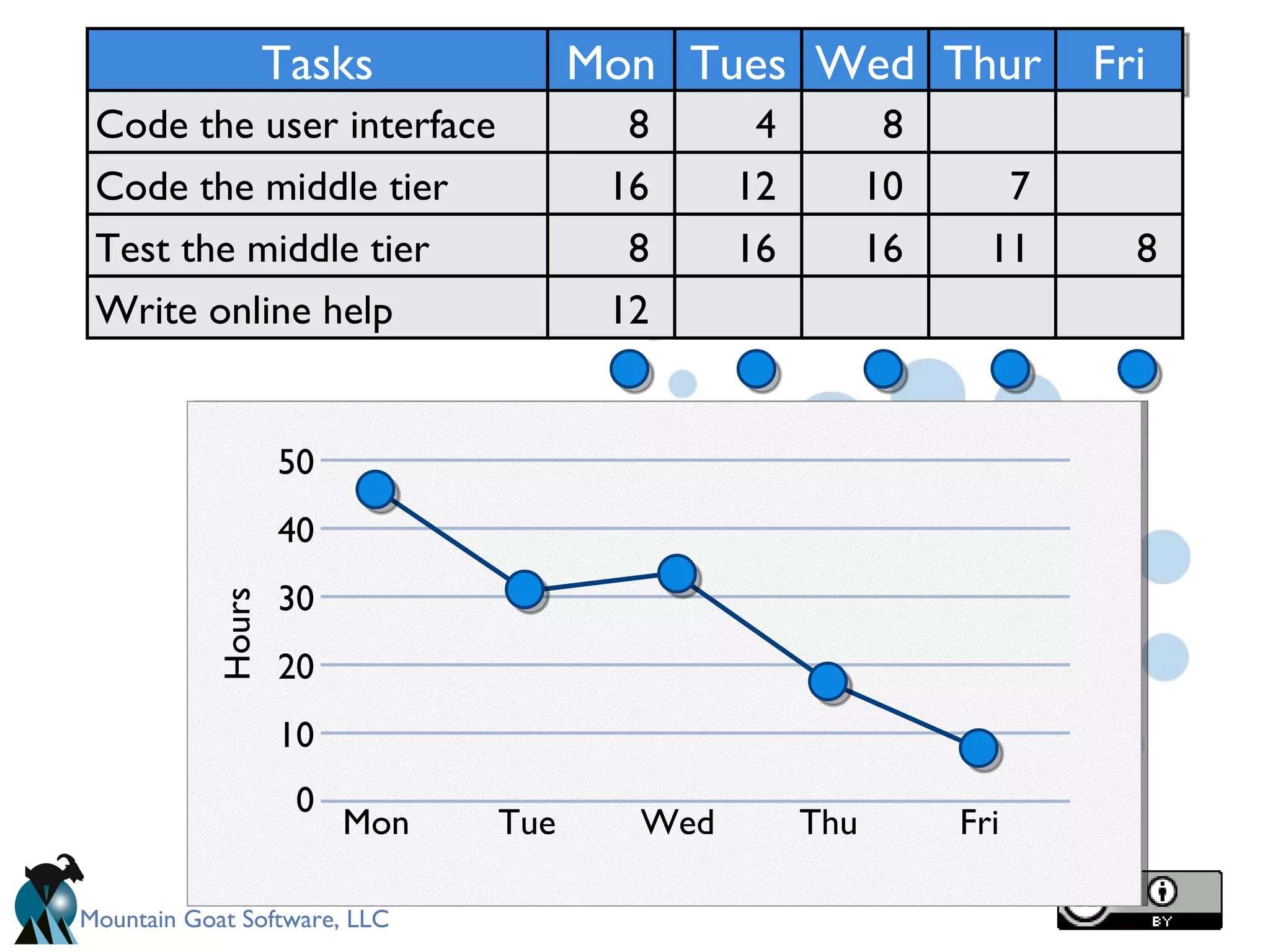
Hours 40 30 20 10 0 Mon Tue Wed Thu Fri Tasks Code the user interface Code the middle tier Test the middle tier Write online help Mon 8 16 8 12 Tues Wed Thur Fri 50 4 12 16 7 11 8 10 16 8
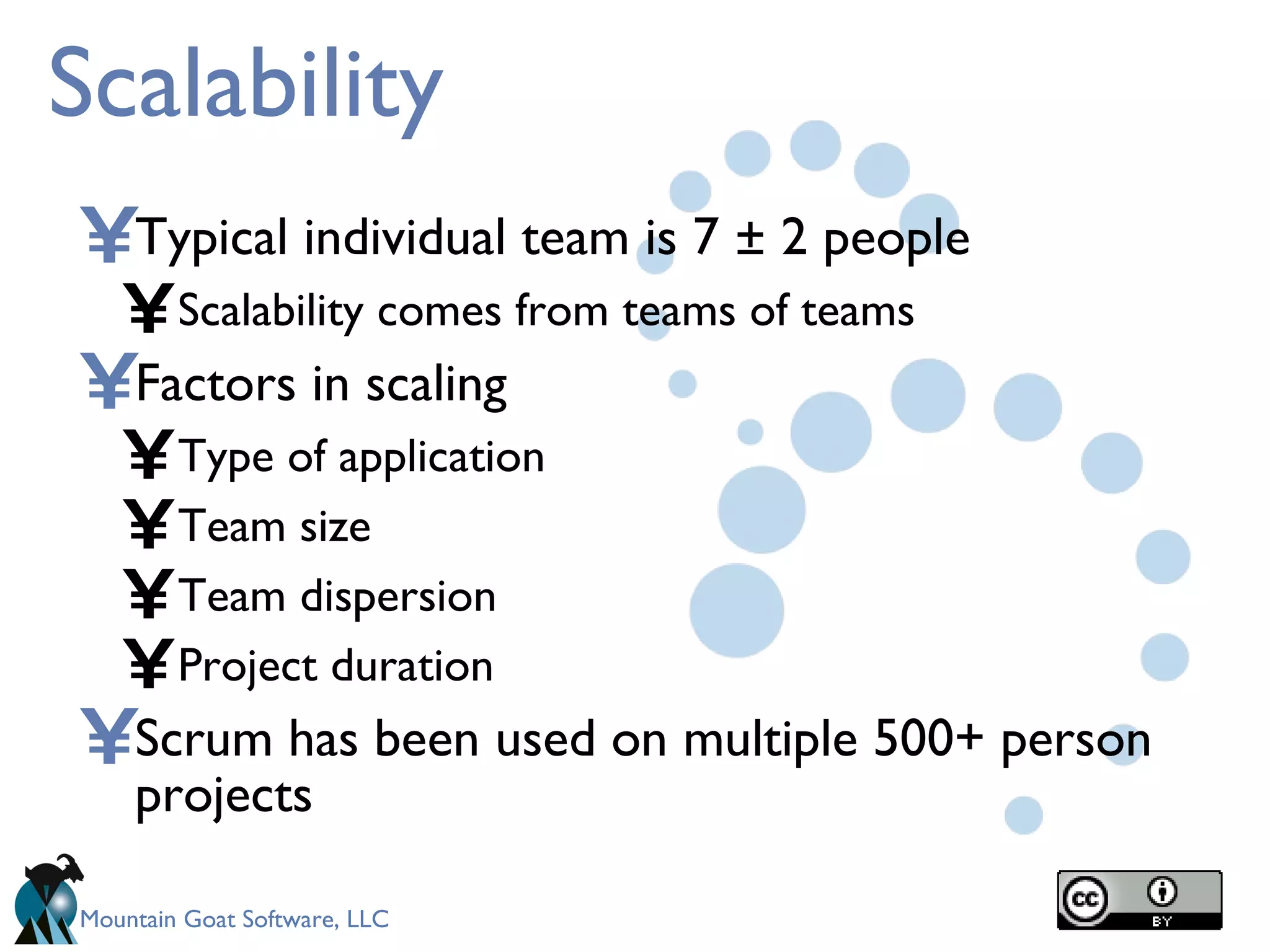
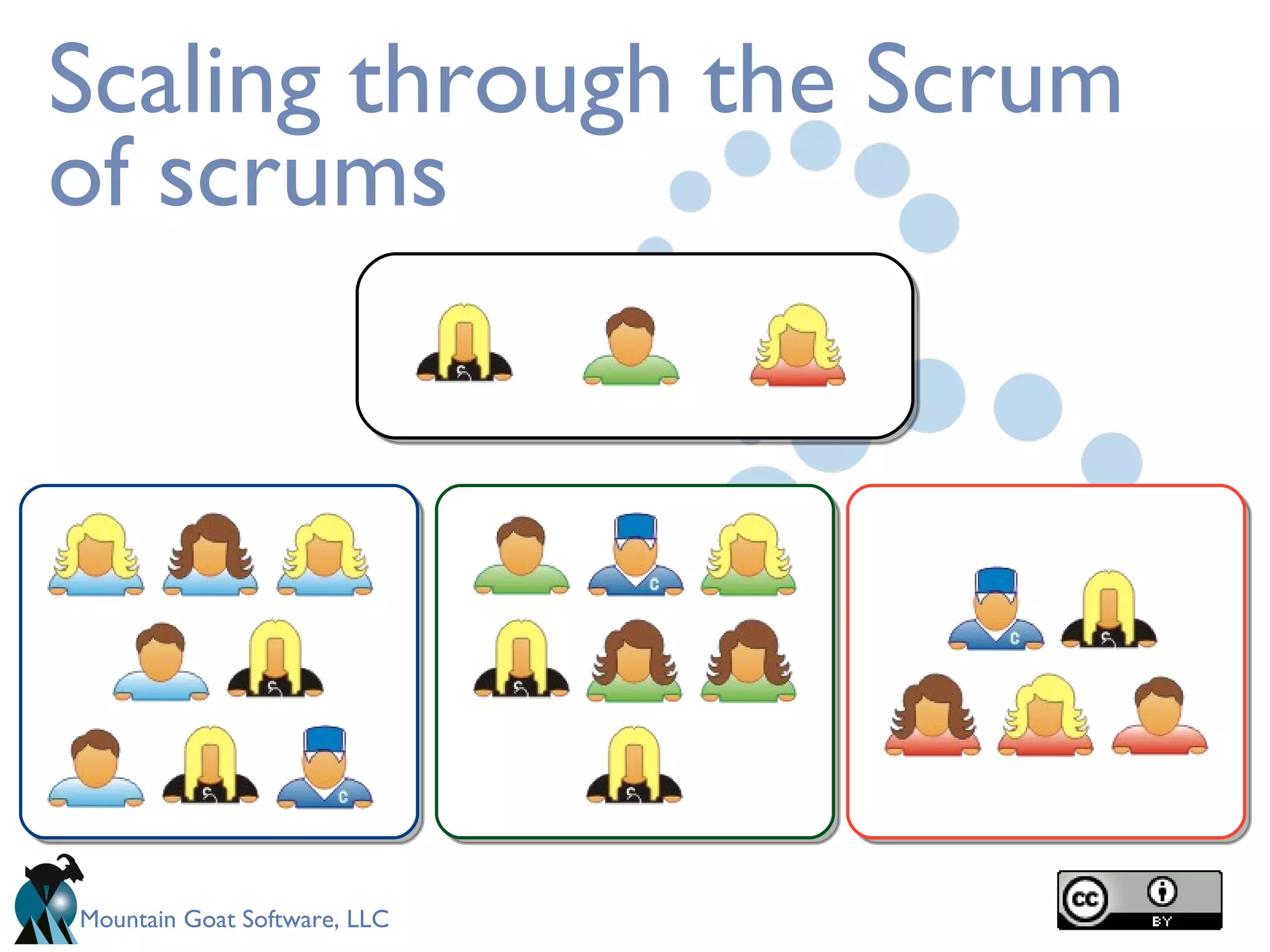
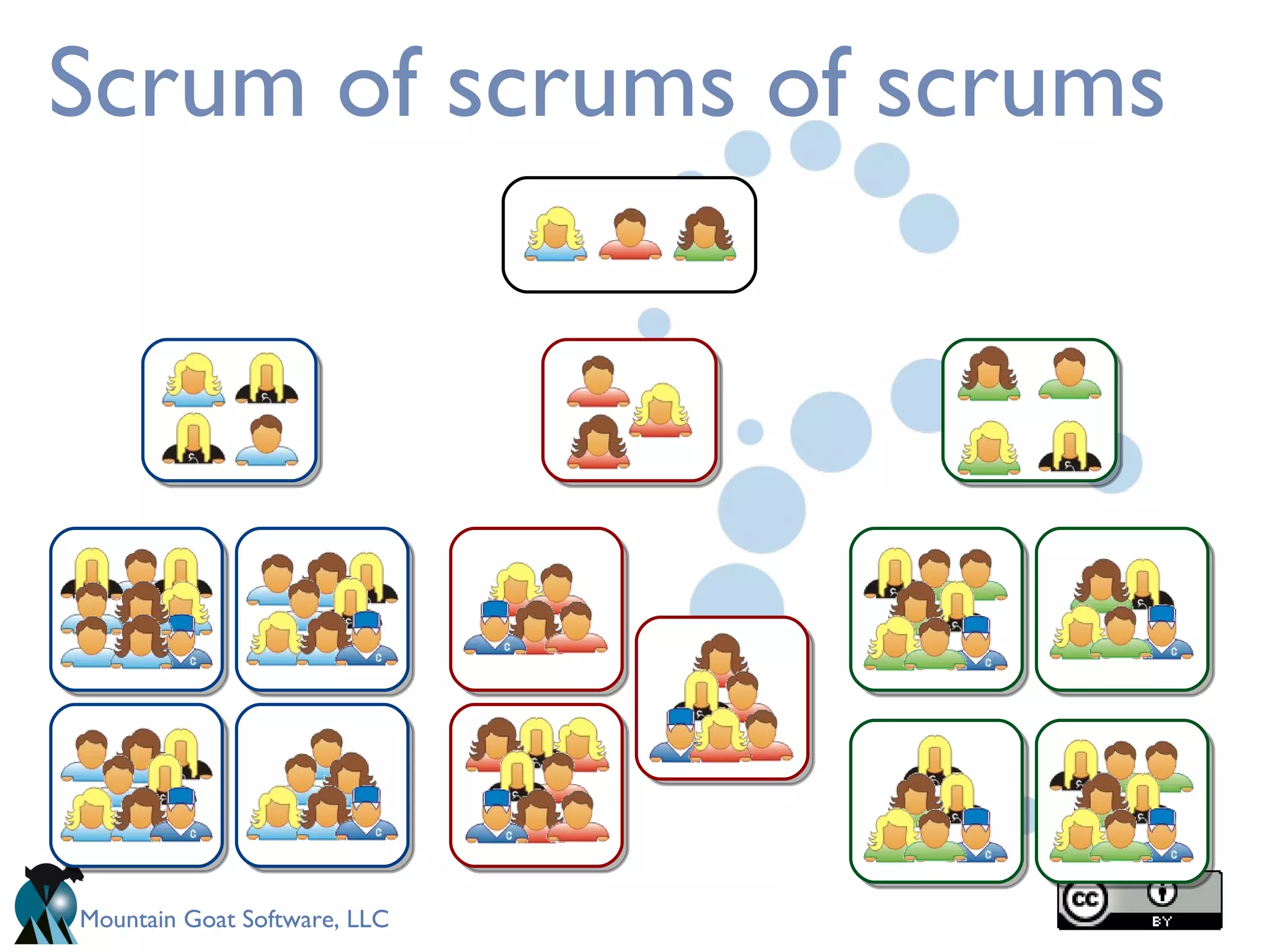
Scalability Typical individual team is 7 ± 2 people Scalability comes from teams of teams Factors in scaling Type of application Team size Team dispersion Project duration Scrum has been used on multiple 500+ person projects
Scaling through the Scrum of scrums
Scrum of scrums of scrums
Where to go next www.mountaingoatsoftware.com/scrum www.scrumalliance.org www.controlchaos.com [email_address]
A Scrum reading list Agile and Iterative Development: A Manager’s Guide  by Craig Larman Agile Estimating and Planning  by Mike Cohn Agile Project Management   with Scrum  by Ken Schwaber Agile Retrospectives  by Esther Derby and Diana Larsen Agile Software Development Ecosystems  by Jim Highsmith Agile Software Development with Scrum  by Ken Schwaber and  Mike Beedle Scrum and The Enterprise  by Ken Schwaber User Stories Applied for Agile Software Development  by Mike Cohn Lots of weekly articles at www.scrumalliance.org
Copyright notice You are free: to Share―to copy, distribute and and transmit the work to Remix―to adapt the work Under the following conditions Attribution. You must attribute the work in the manner specified by the author or licensor (but not in any way that suggests that they endorse you or your use of the work). Nothing in this license impairs or restricts the author’s moral rights. For more information see   http://creativecommons.org/licenses/by/3.0/
Contact information Presentation by: Mike Cohn [email_address] www.mountaingoatsoftware.com (720) 890-6110 (office) You can remove this (or any slide) but you must credit the source somewhere in your presentation. Use the logo and company name (as at bottom left, for example) or include a slide somewhere saying that portions (or all) of your presentation are from this source. Thanks.

Intro To Scrum

  • 1.
    An Introduction toScrum <your name here> <date>
  • 2.
    <you> <date> Presentedby An Introduction to Scrum
  • 3.
    We’re losing therelay race Hirotaka Takeuchi and Ikujiro Nonaka, “The New New Product Development Game”, Harvard Business Review , January 1986. “ The… ‘relay race’ approach to product development…may conflict with the goals of maximum speed and flexibility. Instead a holistic or ‘rugby’ approach—where a team tries to go the distance as a unit, passing the ball back and forth—may better serve today’s competitive requirements.”
  • 4.
    Scrum is anagile process that allows us to focus on delivering the highest business value in the shortest time. It allows us to rapidly and repeatedly inspect actual working software (every two weeks to one month). The business sets the priorities. Teams self-organize to determine the best way to deliver the highest priority features. Every two weeks to a month anyone can see real working software and decide to release it as is or continue to enhance it for another sprint. Scrum in 100 words
  • 5.
    Scrum origins JeffSutherland Initial scrums at Easel Corp in 1993 IDX and 500+ people doing Scrum Ken Schwaber ADM Scrum presented at OOPSLA 96 with Sutherland Author of three books on Scrum Mike Beedle Scrum patterns in PLOPD4 Ken Schwaber and Mike Cohn Co-founded Scrum Alliance in 2002, initially within the Agile Alliance
  • 6.
    Scrum has beenused by: Microsoft Yahoo Google Electronic Arts High Moon Studios Lockheed Martin Philips Siemens Nokia Capital One BBC Intuit Intuit Nielsen Media First American Real Estate BMC Software Ipswitch John Deere Lexis Nexis Sabre Salesforce.com Time Warner Turner Broadcasting Oce
  • 7.
    Scrum has beenused for: Commercial software In-house development Contract development Fixed-price projects Financial applications ISO 9001-certified applications Embedded systems 24x7 systems with 99.999% uptime requirements the Joint Strike Fighter Video game development FDA-approved, life-critical systems Satellite-control software Websites Handheld software Mobile phones Network switching applications ISV applications Some of the largest applications in use
  • 8.
    Characteristics Self-organizing teamsProduct progresses in a series of month-long “sprints” Requirements are captured as items in a list of “product backlog” No specific engineering practices prescribed Uses generative rules to create an agile environment for delivering projects One of the “agile processes”
  • 9.
    The Agile Manifesto–astatement of values Source: www.agilemanifesto.org Process and tools Individuals and interactions over Following a plan Responding to change over Comprehensive documentation Working software over Contract negotiation Customer collaboration over
  • 10.
    Project noise levelSimple Complex Anarchy Complicated Technology Requirements Far from Agreement Close to Agreement Close to Certainty Far from Certainty Source: Strategic Management and Organizational Dynamics by Ralph Stacey in Agile Software Development with Scrum by Ken Schwaber and Mike Beedle.
  • 11.
    Scrum Product backlogCancel Gift wrap Return Sprint 2-4 weeks Return Sprint goal Sprint backlog Potentially shippable product increment Coupons Gift wrap Coupons Cancel 24 hours
  • 12.
    Putting it alltogether Image available at www.mountaingoatsoftware.com/scrum
  • 13.
    Sprints Scrum projectsmake progress in a series of “sprints” Analogous to Extreme Programming iterations Typical duration is 2–4 weeks or a calendar month at most A constant duration leads to a better rhythm Product is designed, coded, and tested during the sprint
  • 14.
    Sequential vs. overlappingdevelopment Source: “The New New Product Development Game” by Takeuchi and Nonaka. Harvard Business Review, January 1986. Rather than doing all of one thing at a time... ...Scrum teams do a little of everything all the time Requirements Design Code Test
  • 15.
    No changes duringa sprint Plan sprint durations around how long you can commit to keeping change out of the sprint Change
  • 16.
    Scrum framework Productowner ScrumMaster Team Roles Sprint planning Sprint review Sprint retrospective Daily scrum meeting Ceremonies Product backlog Sprint backlog Burndown charts Artifacts
  • 17.
    Scrum framework Productbacklog Sprint backlog Burndown charts Artifacts Sprint planning Sprint review Sprint retrospective Daily scrum meeting Ceremonies Product owner ScrumMaster Team Roles
  • 18.
    Product owner Definethe features of the product Decide on release date and content Be responsible for the profitability of the product (ROI) Prioritize features according to market value Adjust features and priority every iteration, as needed  Accept or reject work results
  • 19.
    The ScrumMaster Representsmanagement to the project Responsible for enacting Scrum values and practices Removes impediments Ensure that the team is fully functional and productive Enable close cooperation across all roles and functions Shield the team from external interferences
  • 20.
    The team Typically5-9 people Cross-functional: Programmers, testers, user experience designers, etc. M embers should be full-time May be exceptions (e.g., database administrator) Teams are self-organizing Ideally, no titles but rarely a possibility Membership should change only between sprints
  • 21.
    Scrum framework Productowner ScrumMaster Team Roles Product backlog Sprint backlog Burndown charts Artifacts Sprint planning Sprint review Sprint retrospective Daily scrum meeting Ceremonies
  • 22.
    Sprint planning meetingBusiness conditions Team capacity Product backlog Technology Current product Sprint prioritization Analyze and evaluate product backlog Select sprint goal Sprint planning Decide how to achieve sprint goal (design) Create sprint backlog (tasks) from product backlog items (user stories / features) Estimate sprint backlog in hours Sprint goal Sprint backlog
  • 23.
    Sprint planning Teamselects items from the product backlog they can commit to completing Sprint backlog is created Tasks are identified and each is estimated (1-16 hours) Collaboratively, not done alone by the ScrumMaster High-level design is considered As a vacation planner, I want to see photos of the hotels. Code the middle tier (8 hours) Code the user interface (4) Write test fixtures (4) Code the foo class (6) Update performance tests (4)
  • 24.
    The daily scrumParameters Daily 15-minutes Stand-up Not for problem solving Whole world is invited Only team members, ScrumMaster, product owner, can talk Helps avoid other unnecessary meetings
  • 25.
    Everyone answers 3questions These are not status for the ScrumMaster They are commitments in front of peers What did you do yesterday? 1 What will you do today? 2 Is anything in your way? 3
  • 26.
    The sprint reviewTeam presents what it accomplished during the sprint Typically takes the form of a demo of new features or underlying architecture Informal 2-hour prep time rule No slides Whole team participates Invite the world
  • 27.
    Sprint retrospective Periodicallytake a look at what is and is not working Typically 15–30 minutes Done after every sprint Whole team participates ScrumMaster Product owner Team Possibly customers and others
  • 28.
    Start / Stop/ Continue Whole team gathers and discusses what they’d like to: Start doing Stop doing Continue doing This is just one of many ways to do a sprint retrospective.
  • 29.
    Scrum framework Productowner ScrumMaster Team Roles Sprint planning Sprint review Sprint retrospective Daily scrum meeting Ceremonies Product backlog Sprint backlog Burndown charts Artifacts
  • 30.
    Product backlog Therequirements A list of all desired work on the project Ideally expressed such that each item has value to the users or customers of the product Prioritized by the product owner Reprioritized at the start of each sprint This is the product backlog
  • 31.
    A sample productbacklog Backlog item Estimate Allow a guest to make a reservation 3 As a guest, I want to cancel a reservation. 5 As a guest, I want to change the dates of a reservation. 3 As a hotel employee, I can run RevPAR reports (revenue-per-available-room) 8 Improve exception handling 8 ... 30 ... 50
  • 32.
    The sprint goalA short statement of what the work will be focused on during the sprint Database Application Financial services Life Sciences Support features necessary for population genetics studies. Support more technical indicators than company ABC with real-time, streaming data. Make the application run on SQL Server in addition to Oracle.
  • 33.
    Managing the sprintbacklog Individuals sign up for work of their own choosing Work is never assigned Estimated work remaining is updated daily Any team member can add, delete or change the sprint backlog Work for the sprint emerges If work is unclear, define a sprint backlog item with a larger amount of time and break it down later Update work remaining as more becomes known
  • 34.
    A sprint backlogTasks Code the user interface Code the middle tier Test the middle tier Write online help Write the foo class Mon Tues Wed Thur Fri 8 16 8 12 8 4 12 16 8 4 11 8 4 8 8 Add error logging 8 10 16 8 8
  • 35.
    A sprint burndownchart Hours
  • 36.
    Hours 40 3020 10 0 Mon Tue Wed Thu Fri Tasks Code the user interface Code the middle tier Test the middle tier Write online help Mon 8 16 8 12 Tues Wed Thur Fri 50 4 12 16 7 11 8 10 16 8
  • 37.
    Scalability Typical individualteam is 7 ± 2 people Scalability comes from teams of teams Factors in scaling Type of application Team size Team dispersion Project duration Scrum has been used on multiple 500+ person projects
  • 38.
    Scaling through theScrum of scrums
  • 39.
    Scrum of scrumsof scrums
  • 40.
    Where to gonext www.mountaingoatsoftware.com/scrum www.scrumalliance.org www.controlchaos.com [email_address]
  • 41.
    A Scrum readinglist Agile and Iterative Development: A Manager’s Guide by Craig Larman Agile Estimating and Planning by Mike Cohn Agile Project Management with Scrum by Ken Schwaber Agile Retrospectives by Esther Derby and Diana Larsen Agile Software Development Ecosystems by Jim Highsmith Agile Software Development with Scrum by Ken Schwaber and Mike Beedle Scrum and The Enterprise by Ken Schwaber User Stories Applied for Agile Software Development by Mike Cohn Lots of weekly articles at www.scrumalliance.org
  • 42.
    Copyright notice Youare free: to Share―to copy, distribute and and transmit the work to Remix―to adapt the work Under the following conditions Attribution. You must attribute the work in the manner specified by the author or licensor (but not in any way that suggests that they endorse you or your use of the work). Nothing in this license impairs or restricts the author’s moral rights. For more information see http://creativecommons.org/licenses/by/3.0/
  • 43.
    Contact information Presentationby: Mike Cohn [email_address] www.mountaingoatsoftware.com (720) 890-6110 (office) You can remove this (or any slide) but you must credit the source somewhere in your presentation. Use the logo and company name (as at bottom left, for example) or include a slide somewhere saying that portions (or all) of your presentation are from this source. Thanks.

Editor's Notes

  • #4 would be nice to include a quote from Wicked Problems here