
1
Practicing Agile through Scrum
Naveen Kumar Singh, PMP, PMI-ACP, CSM
VP – Program, PMI North India Chapter
• Scrum is an agile process that allows us to focus on delivering the
highest business value in the shortest time.
• It allows us to rapidly and repeatedly inspect actual working
software.
• The business sets the priorities. Teams self-organize to determine
the best way to deliver the highest priority features.
• Every two weeks to a month anyone can see real working software
and decide to release it as is or continue to enhance it for another
sprint.
Scrum in 100 words
Characteristics
• Self-organizing teams
• Product progresses in a series of month-long “sprints”
• Requirements are captured as items in a list of “product
backlog”
• No specific engineering practices prescribed
• One of the “agile processes”
Scrum
Cancel
Gift wrap
Return
Sprint
30 Days
Return
Sprint goal
Sprint backlog Potentially shippable
product increment
Product
backlog
CouponsGift wrap
Coupons
Cancel
24 hours
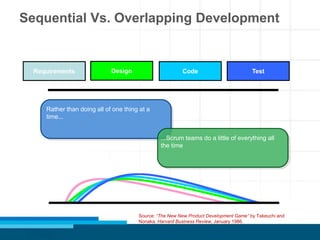
Source: “The New New Product Development Game” by Takeuchi and
Nonaka. Harvard Business Review, January 1986.
Rather than doing all of one thing at a
time...
...Scrum teams do a little of everything all
the time
Requirements Design Code Test
Sequential Vs. Overlapping Development
Scrum Framework
•Scrum Master
•Product Owner
•Team
Roles
•Sprint planning
•Daily scrum meeting
•Sprint review
•Sprint retrospective
Ceremonies
•Product backlog
•Sprint backlog
•Increment
Artifacts
Sprint - The Exploration Cycles
Sprints
• Scrum projects make progress in a
series of “sprints”
• Analogous to Extreme Programming
iterations
• Typical duration is a calendar month
at most
• Product is designed, coded, and
tested during the sprint
Sprint
30 Days
Characteristic of Sprint
Sprint
Timeboxed
Short Duration
Consistent
duration
Goal shouldn’t
be altered
once started
Selecting Sprint Length
• Length of the release
• Amount of uncertainty
• How easy is to get feedbacks
• Stability of priorities
• The overhead of iterating
• Give a feeling of urgency
Short Duration
Short
Duration
Ease of
Planning
Fast
feedback
Expose
Issues
Improved
return on
Investment
Rejuvenating
Frequent
Check point
Consistent Duration
Consistent Duration
Predictable
rhythm
Reduces
coordination
overhead.
Allows
synchronizati
on
Simplifies
planning
activities.
Scrum Roles
Scrum Roles
Product Owner
Development
Team
Scrum Master
Scrum Master
I never teach my pupils; I only attempt to provide the conditions
in which they can learn. —Albert Einstein
Scrum Master
• Observes the team and
ensures adherence to
scrum rules
• Responsible for enacting
Scrum values and
practices
• Introduces Scrum Roles
to the team
• Coach & Manage Team
Members
Scrum Master
• Create productivity team
• Acts as a team moderator.
• The Facilitation of daily Scrum
• Remove hurdles or any other
external interference
• Improve the engineering
practices and tools.
Scrum Master
• Remove the barriers between
development and the Product
Owner.
• Teach the Product Owner how
to maximize ROI.
• Shield the team from external
interferences
• Keep information about the
team’s progress up-to-date and
visible to all parties.
Dos Don’ts
Guides and facilitates Direct or drive
Keeps everyone focused on
delivering business value
Stick to deadlines and approaches
that no longer work
Has a keen interest in the team’s
overall Performance
Become attached to specific
outcomes from the team
Coaches the team for high
performance
Get involved in task-level direction
Promotes the skills and growth of
every team member
Become the only voice of the team
Scrum Master Behaviours
Product Owner
Product Owner
• Mouthpiece of stakeholders
and customers. Facilitate the
scrum financing.
• Ensures profit returns from
the product development and
its launch in the market
(ROI).
Product Owner
• Visualizes the conception,
management, outcome, and
launch of the product.
• Decide on release date and
content
• Prioritize features according
to market value
Product Owner
• Controls the right use of
backlog.
• Has right to accept or reject
the outcome of the project.
• Adjust features and priority
every iteration, as needed
• Accept or reject work results
Product Owner is CRACK
• Committed to the work and engaged
in it fully
• Responsible for the outcome
• Authorized by the person paying the
bills to make decisions about the
product under development and to
know which decisions can be made
solo and which require consultation
with others
• Collaborative as a normal mode of
interacting with people
• Knowledgeable about the business
purposes of the endeavor and the
business domain itself
Development Team
Development Team
• Responsible for product
quality, estimation, and
delivery.
• Responsible for converting
product backlog into
shippable product
• Responsible for managing
their day to day tasks
Development Team
• Makes Rules for living
together
• Identifies missing items in
Product Backlog
• Prepares Sprint Backlog
• Prepares definition of Done
Development Team
• It is right sized i.e. 3 to 9
• It is self dependent which
means it is self managed and
self organized.
• It is also multifunctional.
• Interlaces with customers,
end users, PO, and even
PMOs (project management
organizations)
Scrum Ceremonies
Sprint Planning
Sprint Planning
• The Team and the Product Owner collaborate to help the
Team determine how much Product Backlog it can turn into
functionality during the upcoming Sprint.
• The Team create plans (Sprint Backlog) by identifying tasks
for converting selected Product Backlog into functionality
Sprint planning meeting
Sprint prioritization
• Analyze and evaluate product
backlog
• Select sprint goal
Sprint planning
• Decide how to achieve sprint goal
(design)
• Create sprint backlog (tasks) from
product backlog items (user stories /
features)
• Estimate sprint backlog in hours
Sprint
goal
Sprint
backlog
Business
conditions
Team
capacity
Product
backlog
Technology
Current
product
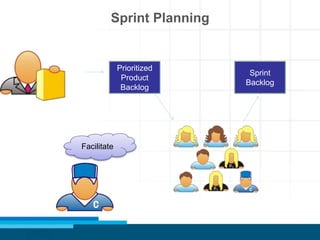
Sprint Planning
Prioritized
Product
Backlog
Sprint
Backlog
Facilitate
Sprint Planning
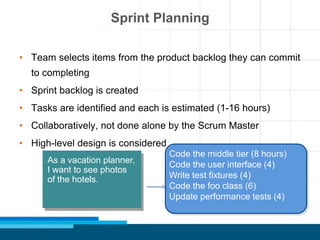
• Team selects items from the product backlog they can commit
to completing
• Sprint backlog is created
• Tasks are identified and each is estimated (1-16 hours)
• Collaboratively, not done alone by the Scrum Master
• High-level design is considered
As a vacation planner,
I want to see photos
of the hotels.
Code the middle tier (8 hours)
Code the user interface (4)
Write test fixtures (4)
Code the foo class (6)
Update performance tests (4)
The Daily Scrum
Meeting
Why Daily Scrum?
• Fine-grain coordination
• Daily commitment
• Raising impediments
• Peer pressure
• Access Progress towards sprint goal
• Replanning
The Daily Scrum
• Parameters
• Daily
• 15-minutes
• Stand-up
• Not for problem solving
• Only team members, Scrum Master,
Product Owner, can talk
• Helps avoid other unnecessary
meetings
• Team is responsible of conducting
this meeting
Daily Scrum
Facilitate
Observe
What did you do yesterday?
1
What will you do today?
2
Is anything in your way? 3
 These are not status for
the Scrum Master
• They are
commitments in front
of peers
Sprint Review
The Sprint Review
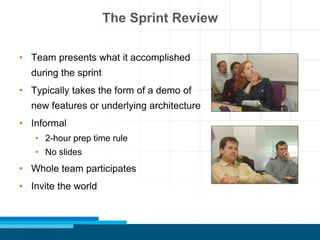
• Team presents what it accomplished
during the sprint
• Typically takes the form of a demo of
new features or underlying architecture
• Informal
• 2-hour prep time rule
• No slides
• Whole team participates
• Invite the world
Sprint Review
Facilitate
Feedback
on Product
Feedback
on Product
Demo
Sprint
Retrospective
Sprint Retrospective
• Periodically take a look at what is and is not working
• Done after every sprint
• Participants
• Scrum Master
• Team
• Product owner (Optional)
Sprint Retrospective Meeting
A meeting time-boxed for 3 hours and
facilitated by the Scrum Master at which the
Team discusses the just-concluded Sprint
and determines what could be changed that
might make the next Sprint more enjoyable or
productive.
Start / Stop / Continue
Facilitate
Observe Start doing
Stop doing
Continue doing
This is just one
of many ways to
do a sprint
retrospective
Scrum Artifacts
Product
Backlog
Sprint
Backlog Increment
Product Backlog
Product Backlog
• The requirements
• A list of all desired work (Product Backlog Item) on the project
• Ideally expressed such that each item has value to the users
or customers of the product
• Prioritized by the product owner
• Reprioritized at the start of each sprint
Good Product Backlog
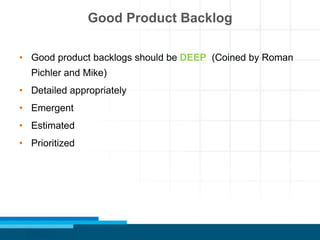
• Good product backlogs should be DEEP (Coined by Roman
Pichler and Mike)
• Detailed appropriately
• Emergent
• Estimated
• Prioritized
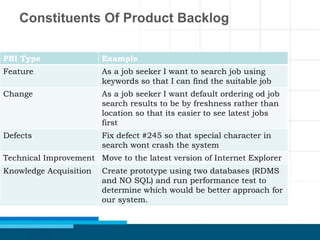
Constituents Of Product Backlog
PBI Type Example
Feature As a job seeker I want to search job using
keywords so that I can find the suitable job
Change As a job seeker I want default ordering od job
search results to be by freshness rather than
location so that its easier to see latest jobs
first
Defects Fix defect #245 so that special character in
search wont crash the system
Technical Improvement Move to the latest version of Internet Explorer
Knowledge Acquisition Create prototype using two databases (RDMS
and NO SQL) and run performance test to
determine which would be better approach for
our system.
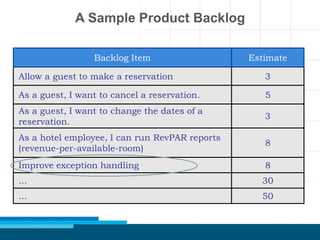
A Sample Product Backlog
Backlog Item Estimate
Allow a guest to make a reservation 3
As a guest, I want to cancel a reservation. 5
As a guest, I want to change the dates of a
reservation.
3
As a hotel employee, I can run RevPAR reports
(revenue-per-available-room)
8
Improve exception handling 8
... 30
... 50
Sprint Backlog
Sprint Backlog
• The Sprint Backlog defines the work the Team will perform to
turn Selected Product Backlog items into a “Done” Increment.
• The list emerges during the Sprint.
• Each ongoing task identifies those responsible for doing the
work
• Each Tasks has information about estimated amount of work
remaining on the task on any given day during the Sprint.
The Sprint Goal
• A short statement of what the work will be focused on
during the sprint
Database Application
Financial services
Life Sciences
Support features necessary for
population genetics studies.
Support more technical
indicators than company ABC
with real-time, streaming data.
Make the application run on
SQL Server in addition to
Oracle.
Sprint Backlog
Sprint Backlog
Sprint
Planning
During the
Day
Daily
Scrum
Maintain
Increment
The Increment
• The Increment is the sum of all the Product Backlog items
completed during a Sprint and all previous Sprints.
• At the end of a Sprint, the new Increment must be “Done,”
• It must be in useable condition (Potentially shippable product)
Increment
Develop
Increment
Demo
Increment
Definition of Done
• Everyone must understand what done means
• This varies significantly per Scrum Team, members must have a
shared understanding of what it means for work to be complete, to
ensure transparency
• This guides Development Team in knowing how many Product
Backlog items it can select during a Sprint Planning Meeting.
• The purpose of each Sprint is to deliver Increments of potentially
releasable functionality that adhere to Definition of “Done.”
• Definition of Done may change during the project
Stay Connected
Naveen Kumar Singh
naveenhome@gmail.com
References - http://www.mountaingoatsoftware.com/
www.izenbridge.com

Practicing Agile through Scrum

  • 1.
    1 Practicing Agile throughScrum Naveen Kumar Singh, PMP, PMI-ACP, CSM VP – Program, PMI North India Chapter
  • 2.
    • Scrum isan agile process that allows us to focus on delivering the highest business value in the shortest time. • It allows us to rapidly and repeatedly inspect actual working software. • The business sets the priorities. Teams self-organize to determine the best way to deliver the highest priority features. • Every two weeks to a month anyone can see real working software and decide to release it as is or continue to enhance it for another sprint. Scrum in 100 words
  • 3.
    Characteristics • Self-organizing teams •Product progresses in a series of month-long “sprints” • Requirements are captured as items in a list of “product backlog” • No specific engineering practices prescribed • One of the “agile processes”
  • 4.
    Scrum Cancel Gift wrap Return Sprint 30 Days Return Sprintgoal Sprint backlog Potentially shippable product increment Product backlog CouponsGift wrap Coupons Cancel 24 hours
  • 5.
    Source: “The NewNew Product Development Game” by Takeuchi and Nonaka. Harvard Business Review, January 1986. Rather than doing all of one thing at a time... ...Scrum teams do a little of everything all the time Requirements Design Code Test Sequential Vs. Overlapping Development
  • 6.
    Scrum Framework •Scrum Master •ProductOwner •Team Roles •Sprint planning •Daily scrum meeting •Sprint review •Sprint retrospective Ceremonies •Product backlog •Sprint backlog •Increment Artifacts
  • 7.
    Sprint - TheExploration Cycles
  • 8.
    Sprints • Scrum projectsmake progress in a series of “sprints” • Analogous to Extreme Programming iterations • Typical duration is a calendar month at most • Product is designed, coded, and tested during the sprint Sprint 30 Days
  • 9.
    Characteristic of Sprint Sprint Timeboxed ShortDuration Consistent duration Goal shouldn’t be altered once started
  • 10.
    Selecting Sprint Length •Length of the release • Amount of uncertainty • How easy is to get feedbacks • Stability of priorities • The overhead of iterating • Give a feeling of urgency
  • 11.
  • 12.
  • 13.
  • 14.
  • 15.
    Scrum Master I neverteach my pupils; I only attempt to provide the conditions in which they can learn. —Albert Einstein
  • 16.
    Scrum Master • Observesthe team and ensures adherence to scrum rules • Responsible for enacting Scrum values and practices • Introduces Scrum Roles to the team • Coach & Manage Team Members
  • 17.
    Scrum Master • Createproductivity team • Acts as a team moderator. • The Facilitation of daily Scrum • Remove hurdles or any other external interference • Improve the engineering practices and tools.
  • 18.
    Scrum Master • Removethe barriers between development and the Product Owner. • Teach the Product Owner how to maximize ROI. • Shield the team from external interferences • Keep information about the team’s progress up-to-date and visible to all parties.
  • 19.
    Dos Don’ts Guides andfacilitates Direct or drive Keeps everyone focused on delivering business value Stick to deadlines and approaches that no longer work Has a keen interest in the team’s overall Performance Become attached to specific outcomes from the team Coaches the team for high performance Get involved in task-level direction Promotes the skills and growth of every team member Become the only voice of the team Scrum Master Behaviours
  • 20.
  • 21.
    Product Owner • Mouthpieceof stakeholders and customers. Facilitate the scrum financing. • Ensures profit returns from the product development and its launch in the market (ROI).
  • 22.
    Product Owner • Visualizesthe conception, management, outcome, and launch of the product. • Decide on release date and content • Prioritize features according to market value
  • 23.
    Product Owner • Controlsthe right use of backlog. • Has right to accept or reject the outcome of the project. • Adjust features and priority every iteration, as needed • Accept or reject work results
  • 24.
    Product Owner isCRACK • Committed to the work and engaged in it fully • Responsible for the outcome • Authorized by the person paying the bills to make decisions about the product under development and to know which decisions can be made solo and which require consultation with others • Collaborative as a normal mode of interacting with people • Knowledgeable about the business purposes of the endeavor and the business domain itself
  • 25.
  • 26.
    Development Team • Responsiblefor product quality, estimation, and delivery. • Responsible for converting product backlog into shippable product • Responsible for managing their day to day tasks
  • 27.
    Development Team • MakesRules for living together • Identifies missing items in Product Backlog • Prepares Sprint Backlog • Prepares definition of Done
  • 28.
    Development Team • Itis right sized i.e. 3 to 9 • It is self dependent which means it is self managed and self organized. • It is also multifunctional. • Interlaces with customers, end users, PO, and even PMOs (project management organizations)
  • 29.
  • 30.
  • 31.
    Sprint Planning • TheTeam and the Product Owner collaborate to help the Team determine how much Product Backlog it can turn into functionality during the upcoming Sprint. • The Team create plans (Sprint Backlog) by identifying tasks for converting selected Product Backlog into functionality
  • 32.
    Sprint planning meeting Sprintprioritization • Analyze and evaluate product backlog • Select sprint goal Sprint planning • Decide how to achieve sprint goal (design) • Create sprint backlog (tasks) from product backlog items (user stories / features) • Estimate sprint backlog in hours Sprint goal Sprint backlog Business conditions Team capacity Product backlog Technology Current product
  • 33.
  • 34.
    Sprint Planning • Teamselects items from the product backlog they can commit to completing • Sprint backlog is created • Tasks are identified and each is estimated (1-16 hours) • Collaboratively, not done alone by the Scrum Master • High-level design is considered As a vacation planner, I want to see photos of the hotels. Code the middle tier (8 hours) Code the user interface (4) Write test fixtures (4) Code the foo class (6) Update performance tests (4)
  • 35.
  • 36.
    Why Daily Scrum? •Fine-grain coordination • Daily commitment • Raising impediments • Peer pressure • Access Progress towards sprint goal • Replanning
  • 37.
    The Daily Scrum •Parameters • Daily • 15-minutes • Stand-up • Not for problem solving • Only team members, Scrum Master, Product Owner, can talk • Helps avoid other unnecessary meetings • Team is responsible of conducting this meeting
  • 38.
    Daily Scrum Facilitate Observe What didyou do yesterday? 1 What will you do today? 2 Is anything in your way? 3  These are not status for the Scrum Master • They are commitments in front of peers
  • 39.
  • 40.
    The Sprint Review •Team presents what it accomplished during the sprint • Typically takes the form of a demo of new features or underlying architecture • Informal • 2-hour prep time rule • No slides • Whole team participates • Invite the world
  • 41.
  • 42.
  • 43.
    Sprint Retrospective • Periodicallytake a look at what is and is not working • Done after every sprint • Participants • Scrum Master • Team • Product owner (Optional)
  • 44.
    Sprint Retrospective Meeting Ameeting time-boxed for 3 hours and facilitated by the Scrum Master at which the Team discusses the just-concluded Sprint and determines what could be changed that might make the next Sprint more enjoyable or productive.
  • 45.
    Start / Stop/ Continue Facilitate Observe Start doing Stop doing Continue doing This is just one of many ways to do a sprint retrospective
  • 46.
  • 47.
  • 48.
  • 49.
    Product Backlog • Therequirements • A list of all desired work (Product Backlog Item) on the project • Ideally expressed such that each item has value to the users or customers of the product • Prioritized by the product owner • Reprioritized at the start of each sprint
  • 50.
    Good Product Backlog •Good product backlogs should be DEEP (Coined by Roman Pichler and Mike) • Detailed appropriately • Emergent • Estimated • Prioritized
  • 51.
    Constituents Of ProductBacklog PBI Type Example Feature As a job seeker I want to search job using keywords so that I can find the suitable job Change As a job seeker I want default ordering od job search results to be by freshness rather than location so that its easier to see latest jobs first Defects Fix defect #245 so that special character in search wont crash the system Technical Improvement Move to the latest version of Internet Explorer Knowledge Acquisition Create prototype using two databases (RDMS and NO SQL) and run performance test to determine which would be better approach for our system.
  • 52.
    A Sample ProductBacklog Backlog Item Estimate Allow a guest to make a reservation 3 As a guest, I want to cancel a reservation. 5 As a guest, I want to change the dates of a reservation. 3 As a hotel employee, I can run RevPAR reports (revenue-per-available-room) 8 Improve exception handling 8 ... 30 ... 50
  • 53.
  • 54.
    Sprint Backlog • TheSprint Backlog defines the work the Team will perform to turn Selected Product Backlog items into a “Done” Increment. • The list emerges during the Sprint. • Each ongoing task identifies those responsible for doing the work • Each Tasks has information about estimated amount of work remaining on the task on any given day during the Sprint.
  • 55.
    The Sprint Goal •A short statement of what the work will be focused on during the sprint Database Application Financial services Life Sciences Support features necessary for population genetics studies. Support more technical indicators than company ABC with real-time, streaming data. Make the application run on SQL Server in addition to Oracle.
  • 56.
  • 57.
  • 58.
    The Increment • TheIncrement is the sum of all the Product Backlog items completed during a Sprint and all previous Sprints. • At the end of a Sprint, the new Increment must be “Done,” • It must be in useable condition (Potentially shippable product)
  • 59.
  • 60.
    Definition of Done •Everyone must understand what done means • This varies significantly per Scrum Team, members must have a shared understanding of what it means for work to be complete, to ensure transparency • This guides Development Team in knowing how many Product Backlog items it can select during a Sprint Planning Meeting. • The purpose of each Sprint is to deliver Increments of potentially releasable functionality that adhere to Definition of “Done.” • Definition of Done may change during the project
  • 61.
    Stay Connected Naveen KumarSingh naveenhome@gmail.com References - http://www.mountaingoatsoftware.com/ www.izenbridge.com