SCRUM usage
Zoltan Iszlai, Project Manager
Contents
 SCRUM intro and goals
 Actors
 The process
 The product backlog
 User stories (WBS -> stories)
 Sprints and sprint planning
 Daily standup and the retrospective meeting
 Demo meeting (product increment)
SCRUM intro and goals
Page 2 of 10
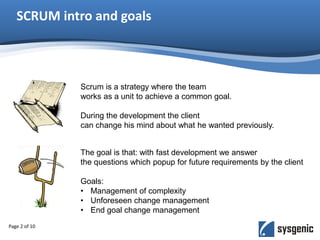
Scrum is a strategy where the team
works as a unit to achieve a common goal.
During the development the client
can change his mind about what he wanted previously.
The goal is that: with fast development we answer
the questions which popup for future requirements by the client
Goals:
• Management of complexity
• Unforeseen change management
• End goal change management
Actors
Page 3 of 10
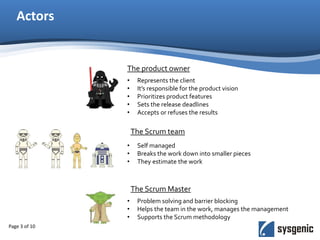
• Represents the client
• It’s responsible for the product vision
• Prioritizes product features
• Sets the release deadlines
• Accepts or refuses the results
The product owner
• Self managed
• Breaks the work down into smaller pieces
• They estimate the work
The Scrum team
The Scrum Master
• Problem solving and barrier blocking
• Helps the team in the work, manages the management
• Supports the Scrum methodology
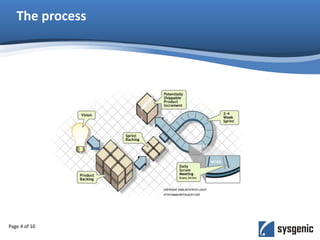
The process
Page 4 of 10
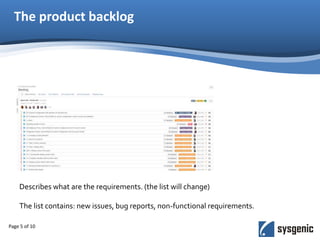
The product backlog
Page 5 of 10
Describes what are the requirements. (the list will change)
The list contains: new issues, bug reports, non-functional requirements.
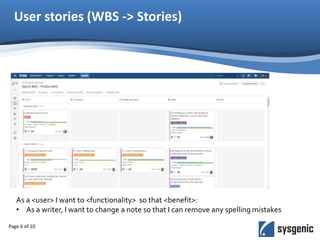
User stories (WBS -> Stories)
Page 6 of 10
As a <user> I want to <functionality> so that <benefit>:
• As a writer, I want to change a note so that I can remove any spelling mistakes
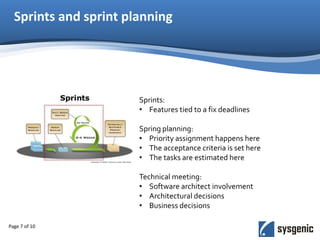
Sprints and sprint planning
Page 7 of 10
Sprints:
• Features tied to a fix deadlines
Spring planning:
• Priority assignment happens here
• The acceptance criteria is set here
• The tasks are estimated here
Technical meeting:
• Software architect involvement
• Architectural decisions
• Business decisions
Daily standup and the retrospective meeting
Page 8 of 10
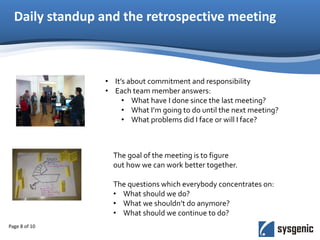
• It’s about commitment and responsibility
• Each team member answers:
• What have I done since the last meeting?
• What I’m going to do until the next meeting?
• What problems did I face or will I face?
The goal of the meeting is to figure
out how we can work better together.
The questions which everybody concentrates on:
• What should we do?
• What we shouldn’t do anymore?
• What should we continue to do?
Demo meeting (product increment)
Page 9 of 10
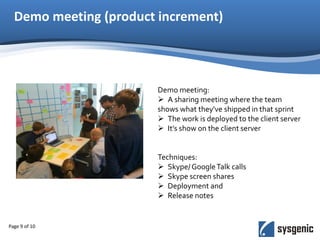
Demo meeting:
 A sharing meeting where the team
shows what they've shipped in that sprint
 The work is deployed to the client server
 It’s show on the client server
Techniques:
 Skype/ GoogleTalk calls
 Skype screen shares
 Deployment and
 Release notes
Thank you.
Questions?

Using Scrum Internship Course

  • 1.
  • 2.
    Contents  SCRUM introand goals  Actors  The process  The product backlog  User stories (WBS -> stories)  Sprints and sprint planning  Daily standup and the retrospective meeting  Demo meeting (product increment)
  • 3.
    SCRUM intro andgoals Page 2 of 10 Scrum is a strategy where the team works as a unit to achieve a common goal. During the development the client can change his mind about what he wanted previously. The goal is that: with fast development we answer the questions which popup for future requirements by the client Goals: • Management of complexity • Unforeseen change management • End goal change management
  • 4.
    Actors Page 3 of10 • Represents the client • It’s responsible for the product vision • Prioritizes product features • Sets the release deadlines • Accepts or refuses the results The product owner • Self managed • Breaks the work down into smaller pieces • They estimate the work The Scrum team The Scrum Master • Problem solving and barrier blocking • Helps the team in the work, manages the management • Supports the Scrum methodology
  • 5.
  • 6.
    The product backlog Page5 of 10 Describes what are the requirements. (the list will change) The list contains: new issues, bug reports, non-functional requirements.
  • 7.
    User stories (WBS-> Stories) Page 6 of 10 As a <user> I want to <functionality> so that <benefit>: • As a writer, I want to change a note so that I can remove any spelling mistakes
  • 8.
    Sprints and sprintplanning Page 7 of 10 Sprints: • Features tied to a fix deadlines Spring planning: • Priority assignment happens here • The acceptance criteria is set here • The tasks are estimated here Technical meeting: • Software architect involvement • Architectural decisions • Business decisions
  • 9.
    Daily standup andthe retrospective meeting Page 8 of 10 • It’s about commitment and responsibility • Each team member answers: • What have I done since the last meeting? • What I’m going to do until the next meeting? • What problems did I face or will I face? The goal of the meeting is to figure out how we can work better together. The questions which everybody concentrates on: • What should we do? • What we shouldn’t do anymore? • What should we continue to do?
  • 10.
    Demo meeting (productincrement) Page 9 of 10 Demo meeting:  A sharing meeting where the team shows what they've shipped in that sprint  The work is deployed to the client server  It’s show on the client server Techniques:  Skype/ GoogleTalk calls  Skype screen shares  Deployment and  Release notes
  • 11.