
Overview of Models, Frames of
Reference andApproaches
Theories
 Healthcare professionals use theory to guide their practice.
 Theories are predictions of what will occur under certain
circumstances.
 When people hear the word ‘‘theory,’’ they tend to think of
something that is complex, esoteric, difficult to understand, and
completely impractical.
 For e.g.- Sensory Integration Theory, Theory of Occupational
Adaptation, Theory of Occupational Reconstructions
Model
 Model provides structure and assists occupational therapists to
produce proper, profession-specific, scientifically-based
intervention.
 For e.g.
 Biomechanical Model
 Rehabilitation Model
 Model of Human Occupation (MOHO)
Frames of
Reference
 A frame of reference uses pieces of one or more theories and makes
them practical and useful.
 On the basis of one or more theories, a frame of reference is an
accepted structure for organizing theoretical material and translating
information into practice.
 The scaffolding of a frame of reference organizes theoretical
material needed for problem identification and solution in
occupational therapy service delivery.
 For Eg- Biomechanical FOR, Sensory Integration FOR,
Rehabilitation FOR
Application of
Theory and
Frame of
Reference
 Before learning about the usefulness of frames of reference, it is
critical to have a basic understanding of theory.
 The purpose of a theory is to inform the theorist’s intentions and the
use of theory refers to how professionals actually put the theory into
practice.
 Sometimes theory is not complex: people develop simple theories
all the time.
Function–
dysfunction
continua
 Function–dysfunction continua, clearly identifies those areas of
function with which the frame of reference is concerned.
 After reading a theoretical base, a person should be able to identify
the specific areas of performance important to an individual's skills
and abilities.
 Each function–dysfunction continuum covers one area of
performance important to the particular frame of reference.
Approaches
 Occupational therapy treatment approaches are based on the
occupational therapy frames of reference or frameworks.
 The frameworks guide therapists in the evaluation and treatment of
a patient.
 The occupational therapy planning and focus revolve around the
performance area, performance components, and performance
contexts.
 For e.g. – Neurodeveplomental Approach, Roods Approach etc.
Client-
centeredCare
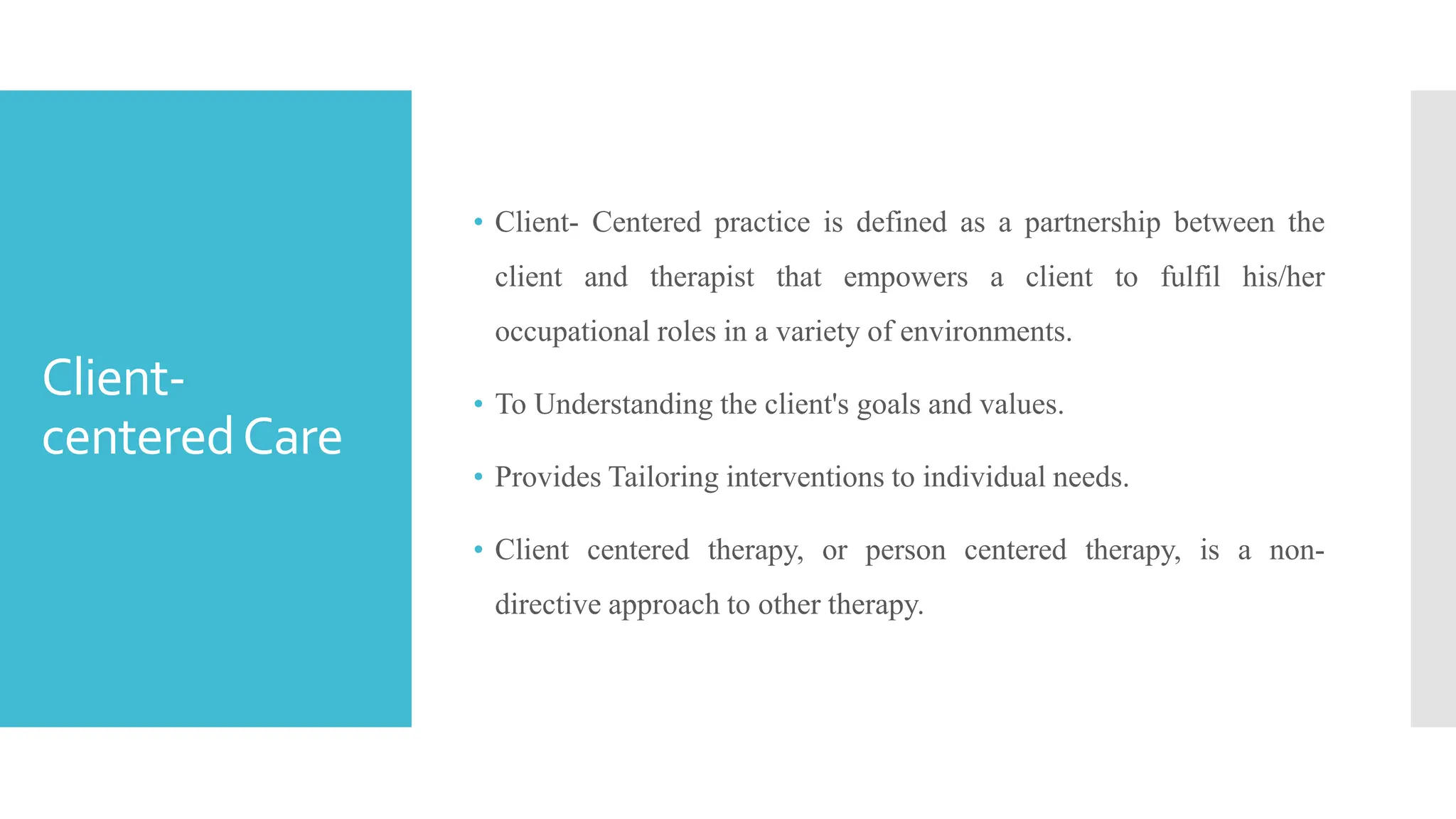
• Client- Centered practice is defined as a partnership between the
client and therapist that empowers a client to fulfil his/her
occupational roles in a variety of environments.
• To Understanding the client's goals and values.
• Provides Tailoring interventions to individual needs.
• Client centered therapy, or person centered therapy, is a non-
directive approach to other therapy.
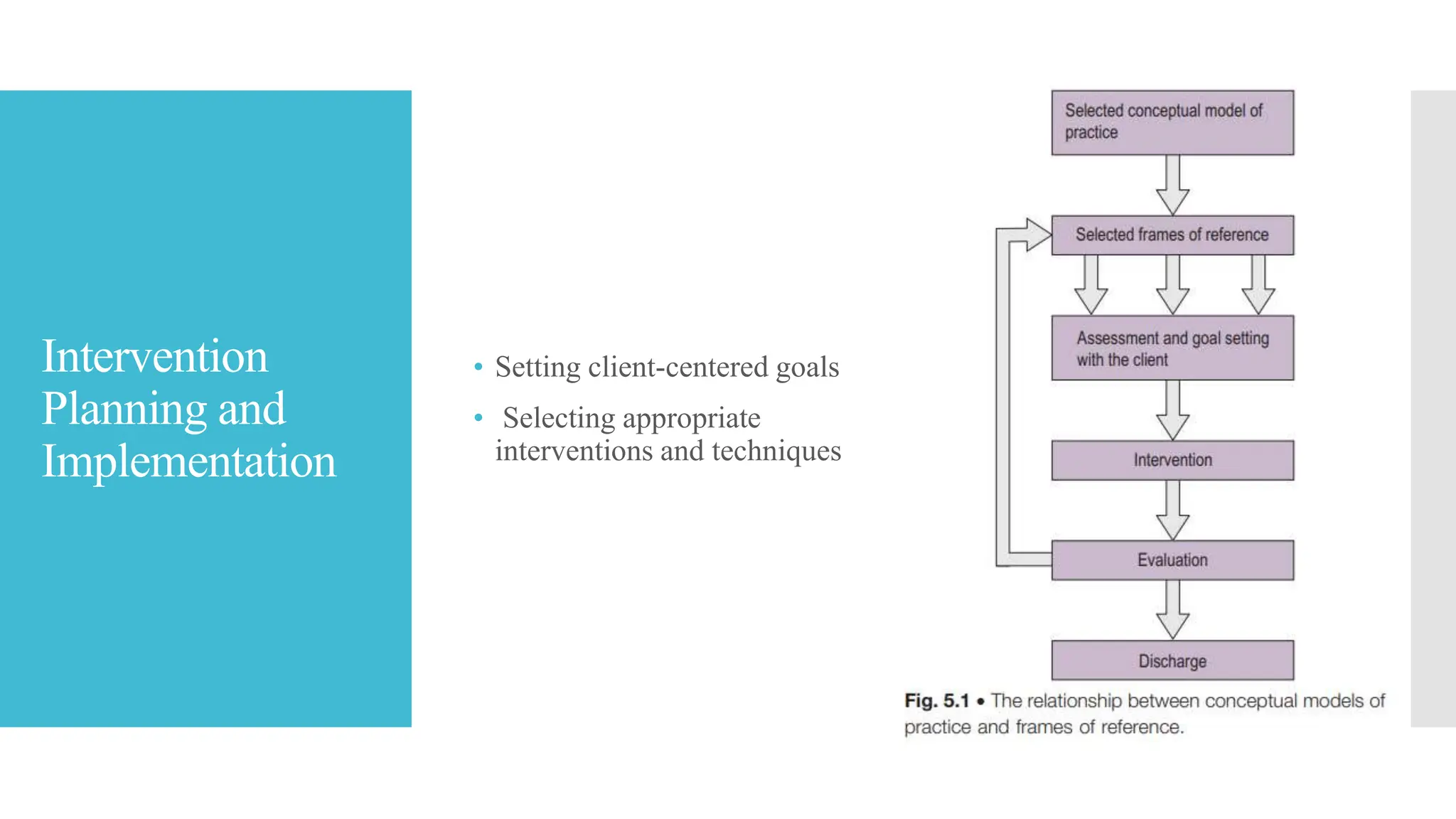
Intervention
Planning and
Implementation
• Setting client-centered goals
• Selecting appropriate
interventions and techniques
The Future of
Occupational
Therapy
• Trends and innovations in OccupationalTherapy
• The evolving role of technology In OT Practice.
ThankYou

Overview of Models, Frames of Reference and Approaches.pptx

  • 1.
    Overview of Models,Frames of Reference andApproaches
  • 2.
    Theories  Healthcare professionalsuse theory to guide their practice.  Theories are predictions of what will occur under certain circumstances.  When people hear the word ‘‘theory,’’ they tend to think of something that is complex, esoteric, difficult to understand, and completely impractical.  For e.g.- Sensory Integration Theory, Theory of Occupational Adaptation, Theory of Occupational Reconstructions
  • 3.
    Model  Model providesstructure and assists occupational therapists to produce proper, profession-specific, scientifically-based intervention.  For e.g.  Biomechanical Model  Rehabilitation Model  Model of Human Occupation (MOHO)
  • 4.
    Frames of Reference  Aframe of reference uses pieces of one or more theories and makes them practical and useful.  On the basis of one or more theories, a frame of reference is an accepted structure for organizing theoretical material and translating information into practice.  The scaffolding of a frame of reference organizes theoretical material needed for problem identification and solution in occupational therapy service delivery.  For Eg- Biomechanical FOR, Sensory Integration FOR, Rehabilitation FOR
  • 5.
    Application of Theory and Frameof Reference  Before learning about the usefulness of frames of reference, it is critical to have a basic understanding of theory.  The purpose of a theory is to inform the theorist’s intentions and the use of theory refers to how professionals actually put the theory into practice.  Sometimes theory is not complex: people develop simple theories all the time.
  • 6.
    Function– dysfunction continua  Function–dysfunction continua,clearly identifies those areas of function with which the frame of reference is concerned.  After reading a theoretical base, a person should be able to identify the specific areas of performance important to an individual's skills and abilities.  Each function–dysfunction continuum covers one area of performance important to the particular frame of reference.
  • 7.
    Approaches  Occupational therapytreatment approaches are based on the occupational therapy frames of reference or frameworks.  The frameworks guide therapists in the evaluation and treatment of a patient.  The occupational therapy planning and focus revolve around the performance area, performance components, and performance contexts.  For e.g. – Neurodeveplomental Approach, Roods Approach etc.
  • 9.
    Client- centeredCare • Client- Centeredpractice is defined as a partnership between the client and therapist that empowers a client to fulfil his/her occupational roles in a variety of environments. • To Understanding the client's goals and values. • Provides Tailoring interventions to individual needs. • Client centered therapy, or person centered therapy, is a non- directive approach to other therapy.
  • 10.
    Intervention Planning and Implementation • Settingclient-centered goals • Selecting appropriate interventions and techniques
  • 11.
    The Future of Occupational Therapy •Trends and innovations in OccupationalTherapy • The evolving role of technology In OT Practice.
  • 12.