• Traditional food production and
distribution practices are unable
to feed the world’s 6.3+ billion
people
• Will resources in the sea be able
to provide enough food to
alleviate future problems of
malnutrition and starvation ?
Most valuable living marine resources:
• Demersal fish
• Pelagic fish
• Crustaceans
• Mollusks
• Marine mammals
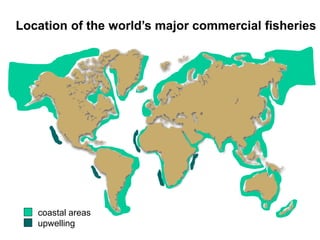
Location of the world’s major commercial fisheries
upwelling
coastal areas
Commercial fishing:
• 500 species regularly caught
• Employs 200 million people worldwide
• In 2002 the world fishing fleet numbered
about four million vessels.
In 2005:
• 100 million tons taken
• $70 billion
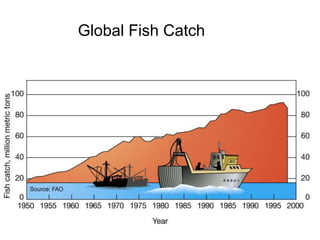
Global Fish Catch
World Commercial Catch of Marine
Fishes, Crustaceans, and Mollusks
(1995) cod
Species Group Millions of Metric Tons, Live Wt.
Herrings, sardines, anchovies 22.0
Jacks, mullets, sauries 11.2
Mollusks 11.0
Cods, hake, haddock 10.6
Redfish, basses, conger eels 7.0
Crustaceans 4.8
Tunas, bonitos, billfish 4.7
Mackerel, snooks, cutlass fishes 4.7
Flounders, halibut, soles 0.9
Miscellaneous marine fishes 17.7
Total (excluding marine mammals) 94.6
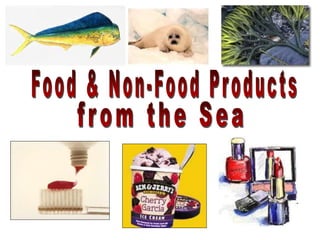
Food from the Sea
• Seaweeds
• Invertebrates (e.g., oysters, clams, crabs,
lobster, squid, etc.)
• Fish (herring, mackerel, haddock, cod,
tuna, mahi-mahi, etc.)
Fisheries management
• Fisheries management
seeks to maintain a long-
term fishery by:
– Assessing ecosystem
health
– Determining fish stocks
– Analyzing fishing
practices
– Enforcing catch limits
• Fisheries management
does not regulate the
number of fishing
vessels
Fisheries Mismanagement
Fisheries mismanagement
• Overfishing
• Commercial extinction
• Bycatch (27 million metric tons annually)
• Targeting smaller species on the low end of the
food chain
Bycatch by Gear Type for 2002/2003
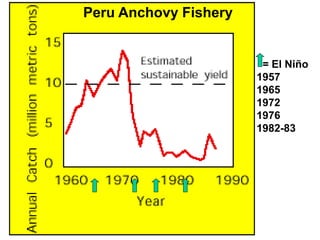
Peru Anchovy Fishery
• Upwelling zone off Peru
• Fishery began 1950
• Greatest fish catches for any single species
• Fish exported for domestic animal feed
• Fishery collapsed due to El Niño and overfishing
= El Niño
1957
1965
1972
1976
1982-83
Peru Anchovy Fishery
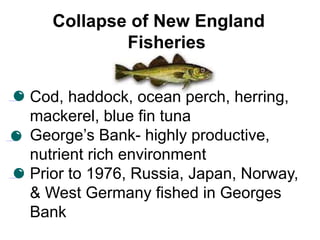
Collapse of New England
Fisheries
• Cod, haddock, ocean perch, herring,
mackerel, blue fin tuna
• George’s Bank- highly productive,
nutrient rich environment
• Prior to 1976, Russia, Japan, Norway,
& West Germany fished in Georges
Bank
Collapse of New England
Fisheries
Magnuson Act passed & prevented
foreigners from fishing in U.S. waters
Fishery technology intensified and
resulted in overfishing
Harvests were beyond the max.
sustainable yield
Georges Bank closes after collapse
Some fish stocks begin to rebound
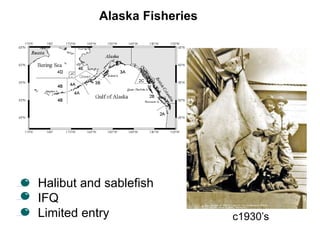
Alaska Fisheries
• Halibut and sablefish
• IFQ
• Limited entry c1930’s
Shark Overfishing
• Slow growth
• Low reproductive rate
• Late sexual maturity
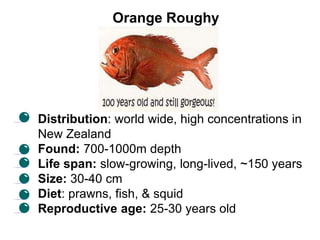
Orange Roughy
• Distribution: world wide, high concentrations in
New Zealand
• Found: 700-1000m depth
• Life span: slow-growing, long-lived, ~150 years
• Size: 30-40 cm
• Diet: prawns, fish, & squid
• Reproductive age: 25-30 years old
Fishing Techniques
Fishing Methods
• Harpoon - whales, swordfish, bluefin tuna
• Pole and line - mahi-mahi and used for tuna
extensively in the 50‘s
• Longline - swordfish, tuna (pelagic); cod,
halibut (bottom)
• Trolling - salmon, albacore, mahi-mahi
• Drift (gill) netting - various pelagic fish
• Trawl - anchovies (pelagic); cod, halibut
(bottom)
• Purse seine - sardines, herring, mackerel
• Traps and Pots - Crabs, lobster, rock fish
Drift Net
net size:
20 m x 65 km
Longlining
Gill net
Bottom-dwelling fish
Purse seine
Trawl
midwater
bottom
http://www.youtube.com/watch?v=bUHcD_jTgVA
Before trawl
After trawl
Trawl from space
Gulf of Mexico, near Louisiana coast. Individual vessels can be seen as bright
spots at end of sediment trails. Other bright spots are fixed oil and gas production
platforms. One sediment trail can be traced for 27 km. Assuming a standard
trawling speed of 2.5 knots, sediment from this trawl is visibly persistent for nearly
6 hours. Water depth <20m. Large, indistinct bright blue patches at lower left and
upper right are cloud/haze. (Credit: Landsat)
Exclusive Economic Zone (EEZ)
1. 200 nautical miles
2. under direct control of the country that owns the
nearest land
Allow nations to claim jurisdiction over their territorial
seas (contiguous sea beds and their waters that
extend off shore by 12 nautical miles)
Regulates continental shelf resources:
• Fishing
• Mineral exploration
• Scientific research
Exclusive Economic Zone of the United States
Fisheries Problems & Solutions
A. Maximum sustainable yield: maximum amount of
fish that can be harvested without depleting
future stocks
B. World‘s maximum sustainable yield estimated at
100 to 135 million metric tons
C. Present harvests are at about 100 million metric
tons
D. For fisheries where numbers available,
estimated that 45% are currently over-fished
E. A number of fisheries have already collapsed
(Anchovy fishery off Peru, Cod fishery in the N.
Atlantic)
Fisheries Problems & Solutions
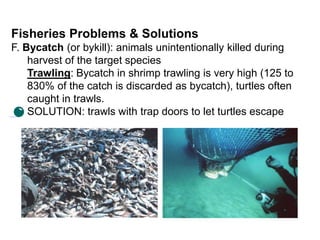
F. Bycatch (or bykill): animals unintentionally killed during
harvest of the target species
Trawling: Bycatch in shrimp trawling is very high (125 to
830% of the catch is discarded as bycatch), turtles often
caught in trawls.
SOLUTION: trawls with trap doors to let turtles escape
Dolphins caught in tuna net
Purse seine: Tuna known to hang out under pods of
dolphins, nets set around pods of dolphins would result
in many drowning.
SOLUTIONS: Nets not set around dolphin pods and/or
employ — “backing down”, a technique that lowers
upper edge of net letting dolphins escape
Fisheries Problems & Solutions
Driftnets: indiscriminate entangling of many sorts of
marine animals
SOLUTION: banned in oceanic fisheries (but some
countries still using them)
Fisheries Problems & Solutions
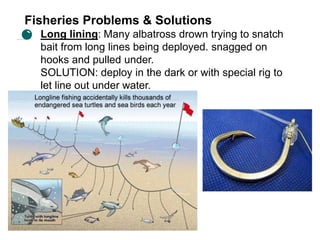
Long lining: Many albatross drown trying to snatch
bait from long lines being deployed. snagged on
hooks and pulled under.
SOLUTION: deploy in the dark or with special rig to
let line out under water.
Global swordfish catch
http://www.pifsc.noaa.gov/wpa
cfin/hi/dar/Pages/hi_fish_2.php
0
50
100
150
200
250
300
350
400
450
1817 1861 1900 1961
N. Atlantic
Swordfish
Ave.
wt.
in
lbs
year
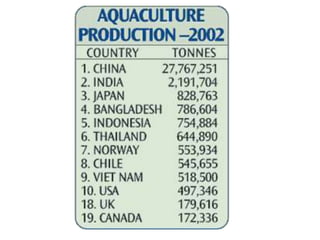
Mariculture or Aquaculture
(marine agriculture)- farming
finfish, shellfish and algae under
favorable conditions
Big Island, Kona, Tilapia
One of every four
fish eaten today was
raised in either a fw
or sw fish farm.
84% of the 6 million to 7
million tons of seafood
consumed each year in the
U.S. is imported . About ½
comes from aquaculture.
H. Jones, Time, 2011.
Aquaculture also produces:
• Bait fish
• Ornamental or aquarium fish
• Aquatic animals used to
augment natural populations
• Algae for chemical extraction
• Pearl oysters
Criteria for selecting species for
farming:
- inexpensive to grow
- grows quickly
- high sales price
- resistant to disease and parasites
tilapia barramundi catfish
Problems associated with Mariculture:
• Won’t make a dent in the shortfall in food
supply
• Fish food- fish meal
• Pollution
• Escapees
• Loss of natural habitat
• Loss of genetic diversity
• High stress overcrowding pens
• High concentration of
pathogens/parasites
Overcrowded Pens
Salmon with lice
Parasites & Disease
Pollution Under a salmon farm cage
Fish Vaccination
Integrated Aquaculture
Aquaponics
Hawaii open ocean aquaculture
Mio, big eye tuna, yellow tail
$34.7 million in 2008
Artificial Reefs
Improve the local marine bio-density
1. attract schools of fish
2. providing habitats for the colonization
of commercially valuable species
3. improve the local inshore marine
harvest
May wash up
on beaches
tires ship wrecks construction rubble
Threat to Marine Life
• Commercial fishing operations
• Pollution
• Habitat Degradation
• Trampling and beach combing
• Climate Change
Threat to Marine Life
• Commercial fishing operations
– Overfishing
– Discards
– Bycatch
– Ghost fishing
– Use of deleterious fishing gears
Threat to Marine Life
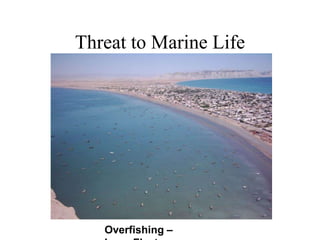
Overfishing –
Threat to Marine Life
Overfishing –
Threat to Marine Life
Discards
Threat to Marine Life
Bycatch
Cod End of Trawl Net
Threat to Marine Life
Use of small mesh
Threat to Marine Life
Deleterious fishing
Threat to Marine Life
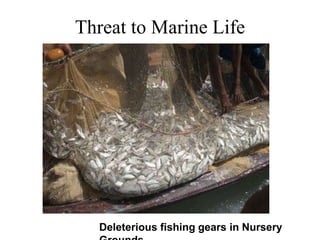
Deleterious fishing gears in Nursery
Threat to Marine Life
Deleterious fishing gears in Nursery
Threat to Marine Life
High bycatch
Threat to Marine Life
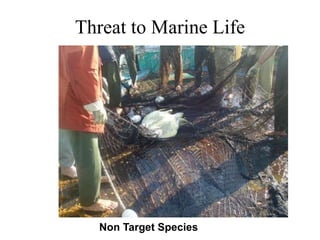
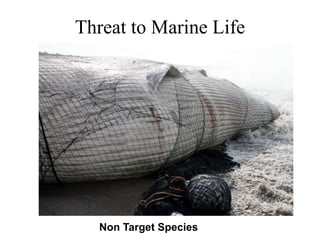
Non Target Species
Threat to Marine Life
Non Target Species
Threat to Marine Life
• Pollution
– Sewage Pollution
• Domestic sewage
• Industrial sewage
– Oil Pollution
– Solid waste disposal
– Thermal Pollution
– Light Pollution
Threat to Marine Life
Sewage Pollution
Threat to Marine Life
Sewage Pollution
Threat to Marine Life
Sewage Pollution
Threat to Marine Life
Oil Pollution
Threat to Marine Life
Oil Pollution
Threat to Marine Life
Solid Waste Disposal
Threat to Marine Life
Thermal Pollution
Threat to Marine Life
Light Pollution: Gwader by
night
Threat to Marine Life
• Habitat Degradation
– Mangrove denudation
– Land reclamation
– Port Development
Threat to Marine Life
Mangrove denudation
Threat to Marine Life
Land reclamation
Threat to Marine Life
Port Development-Sonmiani (Damb)
Threat to Marine Life
• Trampling and beach combing
– Trampling
– Stone turning
– Disturbance to animals
– Beach Combing
Threat to Marine Life
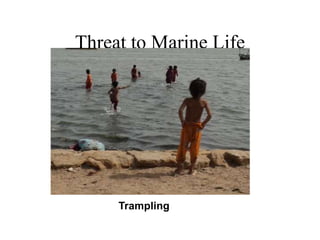
Trampling
Threat to Marine Life
Disturbance to Marine Animals
Threat to Marine Life
• Climate Change
– Seawater intrusion
– Frequent cyclone
– Unpredictability of weather
– Sea Level Rise
Threat to Marine Life
Frequent Cyclone – 2A Cyclone
1999
Threat to Marine Life
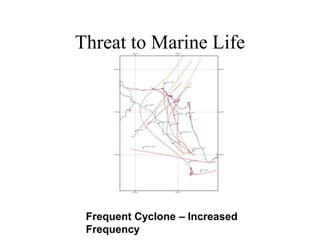
Frequent Cyclone – Increased
Frequency
Threat to Marine Life
Seawater Intrusion: Indus
Creeks
Threat to Marine Life
Frequent Cyclone- Phet Damage
at Jiwani
Threat to Marine Life
Sea level Rise-Damb 2006
Threat to Marine Life
Sea level Rise-Damb- 2012
THANKS

overfishing.ppt

  • 2.
    • Traditional foodproduction and distribution practices are unable to feed the world’s 6.3+ billion people • Will resources in the sea be able to provide enough food to alleviate future problems of malnutrition and starvation ?
  • 3.
    Most valuable livingmarine resources: • Demersal fish • Pelagic fish • Crustaceans • Mollusks • Marine mammals
  • 4.
    Location of theworld’s major commercial fisheries upwelling coastal areas
  • 5.
    Commercial fishing: • 500species regularly caught • Employs 200 million people worldwide • In 2002 the world fishing fleet numbered about four million vessels. In 2005: • 100 million tons taken • $70 billion
  • 6.
  • 8.
    World Commercial Catchof Marine Fishes, Crustaceans, and Mollusks (1995) cod Species Group Millions of Metric Tons, Live Wt. Herrings, sardines, anchovies 22.0 Jacks, mullets, sauries 11.2 Mollusks 11.0 Cods, hake, haddock 10.6 Redfish, basses, conger eels 7.0 Crustaceans 4.8 Tunas, bonitos, billfish 4.7 Mackerel, snooks, cutlass fishes 4.7 Flounders, halibut, soles 0.9 Miscellaneous marine fishes 17.7 Total (excluding marine mammals) 94.6
  • 10.
    Food from theSea • Seaweeds • Invertebrates (e.g., oysters, clams, crabs, lobster, squid, etc.) • Fish (herring, mackerel, haddock, cod, tuna, mahi-mahi, etc.)
  • 11.
    Fisheries management • Fisheriesmanagement seeks to maintain a long- term fishery by: – Assessing ecosystem health – Determining fish stocks – Analyzing fishing practices – Enforcing catch limits • Fisheries management does not regulate the number of fishing vessels
  • 12.
  • 13.
    Fisheries mismanagement • Overfishing •Commercial extinction • Bycatch (27 million metric tons annually) • Targeting smaller species on the low end of the food chain
  • 14.
    Bycatch by GearType for 2002/2003
  • 15.
  • 16.
    Peru Anchovy Fishery •Upwelling zone off Peru • Fishery began 1950 • Greatest fish catches for any single species • Fish exported for domestic animal feed • Fishery collapsed due to El Niño and overfishing
  • 17.
  • 18.
    Collapse of NewEngland Fisheries • Cod, haddock, ocean perch, herring, mackerel, blue fin tuna • George’s Bank- highly productive, nutrient rich environment • Prior to 1976, Russia, Japan, Norway, & West Germany fished in Georges Bank
  • 19.
    Collapse of NewEngland Fisheries Magnuson Act passed & prevented foreigners from fishing in U.S. waters Fishery technology intensified and resulted in overfishing Harvests were beyond the max. sustainable yield Georges Bank closes after collapse Some fish stocks begin to rebound
  • 20.
    Alaska Fisheries • Halibutand sablefish • IFQ • Limited entry c1930’s
  • 21.
    Shark Overfishing • Slowgrowth • Low reproductive rate • Late sexual maturity
  • 22.
    Orange Roughy • Distribution:world wide, high concentrations in New Zealand • Found: 700-1000m depth • Life span: slow-growing, long-lived, ~150 years • Size: 30-40 cm • Diet: prawns, fish, & squid • Reproductive age: 25-30 years old
  • 24.
  • 25.
    Fishing Methods • Harpoon- whales, swordfish, bluefin tuna • Pole and line - mahi-mahi and used for tuna extensively in the 50‘s • Longline - swordfish, tuna (pelagic); cod, halibut (bottom) • Trolling - salmon, albacore, mahi-mahi • Drift (gill) netting - various pelagic fish • Trawl - anchovies (pelagic); cod, halibut (bottom) • Purse seine - sardines, herring, mackerel • Traps and Pots - Crabs, lobster, rock fish
  • 26.
  • 27.
  • 28.
  • 29.
  • 30.
  • 31.
  • 32.
    Trawl from space Gulfof Mexico, near Louisiana coast. Individual vessels can be seen as bright spots at end of sediment trails. Other bright spots are fixed oil and gas production platforms. One sediment trail can be traced for 27 km. Assuming a standard trawling speed of 2.5 knots, sediment from this trawl is visibly persistent for nearly 6 hours. Water depth <20m. Large, indistinct bright blue patches at lower left and upper right are cloud/haze. (Credit: Landsat)
  • 33.
    Exclusive Economic Zone(EEZ) 1. 200 nautical miles 2. under direct control of the country that owns the nearest land Allow nations to claim jurisdiction over their territorial seas (contiguous sea beds and their waters that extend off shore by 12 nautical miles) Regulates continental shelf resources: • Fishing • Mineral exploration • Scientific research
  • 34.
    Exclusive Economic Zoneof the United States
  • 37.
    Fisheries Problems &Solutions A. Maximum sustainable yield: maximum amount of fish that can be harvested without depleting future stocks B. World‘s maximum sustainable yield estimated at 100 to 135 million metric tons C. Present harvests are at about 100 million metric tons D. For fisheries where numbers available, estimated that 45% are currently over-fished E. A number of fisheries have already collapsed (Anchovy fishery off Peru, Cod fishery in the N. Atlantic)
  • 38.
    Fisheries Problems &Solutions F. Bycatch (or bykill): animals unintentionally killed during harvest of the target species Trawling: Bycatch in shrimp trawling is very high (125 to 830% of the catch is discarded as bycatch), turtles often caught in trawls. SOLUTION: trawls with trap doors to let turtles escape
  • 39.
    Dolphins caught intuna net Purse seine: Tuna known to hang out under pods of dolphins, nets set around pods of dolphins would result in many drowning. SOLUTIONS: Nets not set around dolphin pods and/or employ — “backing down”, a technique that lowers upper edge of net letting dolphins escape
  • 40.
    Fisheries Problems &Solutions Driftnets: indiscriminate entangling of many sorts of marine animals SOLUTION: banned in oceanic fisheries (but some countries still using them)
  • 41.
    Fisheries Problems &Solutions Long lining: Many albatross drown trying to snatch bait from long lines being deployed. snagged on hooks and pulled under. SOLUTION: deploy in the dark or with special rig to let line out under water.
  • 42.
  • 44.
    Mariculture or Aquaculture (marineagriculture)- farming finfish, shellfish and algae under favorable conditions Big Island, Kona, Tilapia
  • 45.
    One of everyfour fish eaten today was raised in either a fw or sw fish farm.
  • 46.
    84% of the6 million to 7 million tons of seafood consumed each year in the U.S. is imported . About ½ comes from aquaculture. H. Jones, Time, 2011.
  • 49.
    Aquaculture also produces: •Bait fish • Ornamental or aquarium fish • Aquatic animals used to augment natural populations • Algae for chemical extraction • Pearl oysters
  • 50.
    Criteria for selectingspecies for farming: - inexpensive to grow - grows quickly - high sales price - resistant to disease and parasites tilapia barramundi catfish
  • 51.
    Problems associated withMariculture: • Won’t make a dent in the shortfall in food supply • Fish food- fish meal • Pollution • Escapees • Loss of natural habitat • Loss of genetic diversity • High stress overcrowding pens • High concentration of pathogens/parasites
  • 52.
  • 53.
  • 54.
    Pollution Under asalmon farm cage
  • 55.
  • 56.
  • 57.
    Hawaii open oceanaquaculture Mio, big eye tuna, yellow tail $34.7 million in 2008
  • 58.
    Artificial Reefs Improve thelocal marine bio-density 1. attract schools of fish 2. providing habitats for the colonization of commercially valuable species 3. improve the local inshore marine harvest May wash up on beaches tires ship wrecks construction rubble
  • 59.
    Threat to MarineLife • Commercial fishing operations • Pollution • Habitat Degradation • Trampling and beach combing • Climate Change
  • 60.
    Threat to MarineLife • Commercial fishing operations – Overfishing – Discards – Bycatch – Ghost fishing – Use of deleterious fishing gears
  • 61.
    Threat to MarineLife Overfishing –
  • 62.
    Threat to MarineLife Overfishing –
  • 63.
    Threat to MarineLife Discards
  • 64.
    Threat to MarineLife Bycatch
  • 65.
    Cod End ofTrawl Net Threat to Marine Life Use of small mesh
  • 66.
    Threat to MarineLife Deleterious fishing
  • 67.
    Threat to MarineLife Deleterious fishing gears in Nursery
  • 68.
    Threat to MarineLife Deleterious fishing gears in Nursery
  • 69.
    Threat to MarineLife High bycatch
  • 70.
    Threat to MarineLife Non Target Species
  • 71.
    Threat to MarineLife Non Target Species
  • 72.
    Threat to MarineLife • Pollution – Sewage Pollution • Domestic sewage • Industrial sewage – Oil Pollution – Solid waste disposal – Thermal Pollution – Light Pollution
  • 73.
    Threat to MarineLife Sewage Pollution
  • 74.
    Threat to MarineLife Sewage Pollution
  • 75.
    Threat to MarineLife Sewage Pollution
  • 76.
    Threat to MarineLife Oil Pollution
  • 77.
    Threat to MarineLife Oil Pollution
  • 78.
    Threat to MarineLife Solid Waste Disposal
  • 79.
    Threat to MarineLife Thermal Pollution
  • 80.
    Threat to MarineLife Light Pollution: Gwader by night
  • 81.
    Threat to MarineLife • Habitat Degradation – Mangrove denudation – Land reclamation – Port Development
  • 82.
    Threat to MarineLife Mangrove denudation
  • 83.
    Threat to MarineLife Land reclamation
  • 84.
    Threat to MarineLife Port Development-Sonmiani (Damb)
  • 85.
    Threat to MarineLife • Trampling and beach combing – Trampling – Stone turning – Disturbance to animals – Beach Combing
  • 86.
    Threat to MarineLife Trampling
  • 87.
    Threat to MarineLife Disturbance to Marine Animals
  • 88.
    Threat to MarineLife • Climate Change – Seawater intrusion – Frequent cyclone – Unpredictability of weather – Sea Level Rise
  • 89.
    Threat to MarineLife Frequent Cyclone – 2A Cyclone 1999
  • 90.
    Threat to MarineLife Frequent Cyclone – Increased Frequency
  • 91.
    Threat to MarineLife Seawater Intrusion: Indus Creeks
  • 92.
    Threat to MarineLife Frequent Cyclone- Phet Damage at Jiwani
  • 93.
    Threat to MarineLife Sea level Rise-Damb 2006
  • 94.
    Threat to MarineLife Sea level Rise-Damb- 2012
  • 97.