Future Trends in
Aquaculture Engineering
Vikas Kumar Ujjania
M.F.Sc. 2nd Year
Dept. Of Aquaculture
College of Fisheries, MPUAT
Udaipur-313001
Introduction
 During the past few years there has been
considerable growth in the global
aquaculture industry. Many factors have
made this growth possible. One is
development within the field of aquaculture
engineering.
 Aquaculture engineering covers a very large
area of knowledge and involves many
general engineering specialisms.
 The development of new aquaculture
species would not have been possible
Definition
 Aquaculture engineering is a
multidisciplinary field of engineering and
that aims to solve technical problems
associated with farming of aquatic flora
and fauna.
Aims & Scope
 To utilize technical engineering
knowledge and principles in aquaculture
and biological production systems.
 Engineering and design of aquaculture
facilities
 Engineering-based research studies
 Construction experience and techniques
 In-service experience, commissioning,
operation
 Materials selection and their uses
Application of modern
technology in Aquaculture
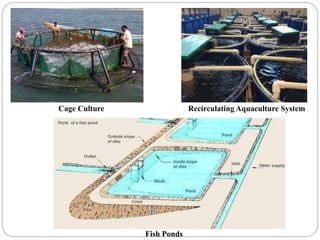
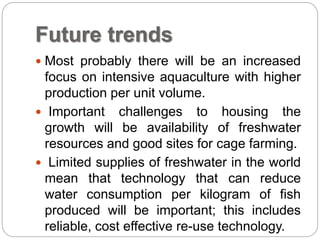
 Common aquaculture systems requiring
optimization and engineering include sea
cages, ponds, and recirculating systems.
 The design and management of these
systems is based on their production goals
and the economics of the farming operation.
 To identify effective solutions the discipline is
combined with both fish physiology and
business economics.
 Aquaculture technology is varied with design
and development requiring knowledge of
mechanical, biological and environmental
systems along with material
engineering and instrumentation.
 Furthermore, engineering techniques often
involve solutions borrowed from wastewater
treatment, fisheries, and traditional
agriculture.
 Aquaculture engineering has played a role in
the expansion of the aquaculture industry,
which now accounts for half of all seafood
products consumed in the world.
Cage Culture Recirculating Aquaculture System
Fish Ponds
Future trends
 Most probably there will be an increased
focus on intensive aquaculture with higher
production per unit volume.
 Important challenges to housing the
growth will be availability of freshwater
resources and good sites for cage farming.
 Limited supplies of freshwater in the world
mean that technology that can reduce
water consumption per kilogram of fish
produced will be important; this includes
reliable, cost effective re-use technology.
Cont…
 By employing re-use technology it will also be
possible to maintain a continuous supply of
high quality water independently of the quality
of the incoming water.
 To have more accurate control over water
quality will also be of major importance when
establishing aquaculture with new species,
especially during the fry production stage.
 The trend to use more and more weather
exposed sites for cage farms will continue.
Development of cages that can not only
withstand adverse weather conditions but
also be operated easily in bad weather, and
Cont…
 Rapid developments in electronics and
monitoring will gradually become
incorporated into the aquaculture
industry.
 Intensive aquaculture will develop into a
process industry where the control room
will be the center of operations and
processes will be monitored by
electronic instruments; robots will
probably be used to replace some of
today’s manual functions.
Cont…
 Nanotechnology will be included, for
instance by using more and smaller
sensors for more purposes.
 Individual tagging of the fish will most
probably also be a future possibility,
which makes control of the welfare of
the single individual possible; this can
also be important regarding control of
escaped fish.
Monitoring, control and
surveillance
 In brief it could be said that monitoring, control
and surveillance (MCS) is all about
compliance to fishery management measures.
This is of course a rather simplistic approach,
but when the elements are analyzed we see
that they all lead towards this goal: monitoring
gathers information on the fishery that is used
to assist in developing and assessing
appropriate management measures, while
surveillance uses this information to ensure
that these controls are complied with.
 If a more precise meaning for MCS is required
reference should be made to a definition
developed by an FAO Expert Consultation in
1981 (FAO, 1981):
 Monitoring - the continuous requirement for the
measurement of fishing effort characteristics and
resource yields;
 Control - the regulatory conditions under which
the exploitation of the resource may be
conducted; and
 Surveillance - the degree and types of
observations required to maintain compliance
with the regulatory controls imposed on fishing
activities.
Radiotelementary
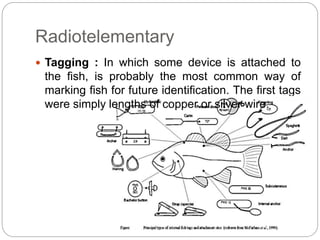
 Tagging : In which some device is attached to
the fish, is probably the most common way of
marking fish for future identification. The first tags
were simply lengths of copper or silver wire.
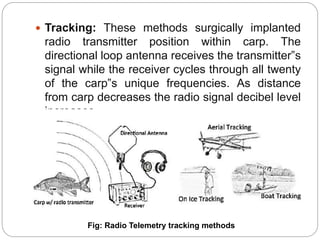
 Tracking: These methods surgically implanted
radio transmitter position within carp. The
directional loop antenna receives the transmitter‟s
signal while the receiver cycles through all twenty
of the carp‟s unique frequencies. As distance
from carp decreases the radio signal decibel level
increases.
Fig: Radio Telemetry tracking methods
References
 Lekang, O.I., Fjæra, S.O. (1997) Teknologi for
akvakultur. Landbruksforlaget (in Norwegian).
 Lekang, O.I., Fjæra, S.O. (2002) Teknisk utstyr til
fiskeoppdrett. Gan forlag (in Norwegian).
 http://www.brainkart.com/article/Future-trends--
increased-importance-of-aquaculture-
engineering_14974/#:~:text=Most%20probably%
20there%20will%20be,good%20sites%20for%20
cage%20farming.
 http://www.fao.org/3/y3427e/y3427e0a.htm
 https://www.researchgate.net/figure/Radio-
Telemetry-tracking-methods-and-surgically-
implanted-radio-transmitter-
THANK YOU…

Future trends in aquaculture engineering

  • 1.
    Future Trends in AquacultureEngineering Vikas Kumar Ujjania M.F.Sc. 2nd Year Dept. Of Aquaculture College of Fisheries, MPUAT Udaipur-313001
  • 2.
    Introduction  During thepast few years there has been considerable growth in the global aquaculture industry. Many factors have made this growth possible. One is development within the field of aquaculture engineering.  Aquaculture engineering covers a very large area of knowledge and involves many general engineering specialisms.  The development of new aquaculture species would not have been possible
  • 3.
    Definition  Aquaculture engineeringis a multidisciplinary field of engineering and that aims to solve technical problems associated with farming of aquatic flora and fauna.
  • 4.
    Aims & Scope To utilize technical engineering knowledge and principles in aquaculture and biological production systems.  Engineering and design of aquaculture facilities  Engineering-based research studies  Construction experience and techniques  In-service experience, commissioning, operation  Materials selection and their uses
  • 5.
    Application of modern technologyin Aquaculture  Common aquaculture systems requiring optimization and engineering include sea cages, ponds, and recirculating systems.  The design and management of these systems is based on their production goals and the economics of the farming operation.  To identify effective solutions the discipline is combined with both fish physiology and business economics.
  • 6.
     Aquaculture technologyis varied with design and development requiring knowledge of mechanical, biological and environmental systems along with material engineering and instrumentation.  Furthermore, engineering techniques often involve solutions borrowed from wastewater treatment, fisheries, and traditional agriculture.  Aquaculture engineering has played a role in the expansion of the aquaculture industry, which now accounts for half of all seafood products consumed in the world.
  • 7.
    Cage Culture RecirculatingAquaculture System Fish Ponds
  • 8.
    Future trends  Mostprobably there will be an increased focus on intensive aquaculture with higher production per unit volume.  Important challenges to housing the growth will be availability of freshwater resources and good sites for cage farming.  Limited supplies of freshwater in the world mean that technology that can reduce water consumption per kilogram of fish produced will be important; this includes reliable, cost effective re-use technology.
  • 9.
    Cont…  By employingre-use technology it will also be possible to maintain a continuous supply of high quality water independently of the quality of the incoming water.  To have more accurate control over water quality will also be of major importance when establishing aquaculture with new species, especially during the fry production stage.  The trend to use more and more weather exposed sites for cage farms will continue. Development of cages that can not only withstand adverse weather conditions but also be operated easily in bad weather, and
  • 10.
    Cont…  Rapid developmentsin electronics and monitoring will gradually become incorporated into the aquaculture industry.  Intensive aquaculture will develop into a process industry where the control room will be the center of operations and processes will be monitored by electronic instruments; robots will probably be used to replace some of today’s manual functions.
  • 11.
    Cont…  Nanotechnology willbe included, for instance by using more and smaller sensors for more purposes.  Individual tagging of the fish will most probably also be a future possibility, which makes control of the welfare of the single individual possible; this can also be important regarding control of escaped fish.
  • 12.
    Monitoring, control and surveillance In brief it could be said that monitoring, control and surveillance (MCS) is all about compliance to fishery management measures. This is of course a rather simplistic approach, but when the elements are analyzed we see that they all lead towards this goal: monitoring gathers information on the fishery that is used to assist in developing and assessing appropriate management measures, while surveillance uses this information to ensure that these controls are complied with.
  • 13.
     If amore precise meaning for MCS is required reference should be made to a definition developed by an FAO Expert Consultation in 1981 (FAO, 1981):  Monitoring - the continuous requirement for the measurement of fishing effort characteristics and resource yields;  Control - the regulatory conditions under which the exploitation of the resource may be conducted; and  Surveillance - the degree and types of observations required to maintain compliance with the regulatory controls imposed on fishing activities.
  • 14.
    Radiotelementary  Tagging :In which some device is attached to the fish, is probably the most common way of marking fish for future identification. The first tags were simply lengths of copper or silver wire.
  • 15.
     Tracking: Thesemethods surgically implanted radio transmitter position within carp. The directional loop antenna receives the transmitter‟s signal while the receiver cycles through all twenty of the carp‟s unique frequencies. As distance from carp decreases the radio signal decibel level increases. Fig: Radio Telemetry tracking methods
  • 16.
    References  Lekang, O.I.,Fjæra, S.O. (1997) Teknologi for akvakultur. Landbruksforlaget (in Norwegian).  Lekang, O.I., Fjæra, S.O. (2002) Teknisk utstyr til fiskeoppdrett. Gan forlag (in Norwegian).  http://www.brainkart.com/article/Future-trends-- increased-importance-of-aquaculture- engineering_14974/#:~:text=Most%20probably% 20there%20will%20be,good%20sites%20for%20 cage%20farming.  http://www.fao.org/3/y3427e/y3427e0a.htm  https://www.researchgate.net/figure/Radio- Telemetry-tracking-methods-and-surgically- implanted-radio-transmitter-
  • 17.