Overfishing By Sofia Marcheva Ivaylo Nikolov
Overfishing (13) Catching too much fish for the system to support Overfishing is a non-sustainable use of the oceans 3 types: Growth – harvesting fish before it reaches a reasonable size to produce the max. yield Recruit – not enough adults to reproduce Ecosystem – when overfishing changes the ecosystem (decrease in predatory species    increase in small fishes)
Level of Global Fish Catch (15) 2006 – 144 million tonnes (capture fisheries + aquaculture) 110 millions – for human consumption China and Peru – largest fish catch More than ½ of monitored fish stocks – fully exploited About ¼ are overexploited or slowly recovering Maximum potential of world’s capture fisheries is reached    measures need to be taken Scientists are concerned about the sustainability of fish catches and remind that actions need to be taken ASAP
Fishing down the food chain Hunting fishes down the trophic levels   in the food web (11) Decline in Mean trophic level (14) Transition from high trophic level, big-sized fish to small low trophic level species that live shorter (14) Results at first in increase in fish catch, but then it declines (14) Fishermen tend to catch larger fishes, but then they become less and there is a shift to smaller fishes (11) Shows unsustainability (11)
Bycatch Fish caught unintentionally while hunting other species(3) Sometimes bycatch is kept or sold(4) Ex. Catching bluefish while fishing striped bass( костур) Throwing back the bycatch is called discard.(4) Discarding can lead to change of current population of a specie(4)
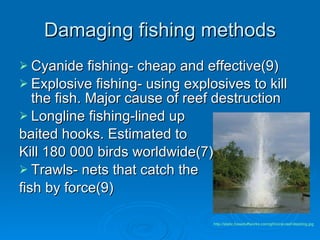
Damaging fishing methods Cyanide fishing- cheap and effective(9) Explosive fishing- using explosives to kill the fish. Major cause of reef destruction Longline fishing-lined up  baited hooks. Estimated to Kill 180 000 birds worldwide(7) Trawls- nets that catch the fish by force(9) http://static.howstuffworks.com/gif/coral-reef-blasting.jpg
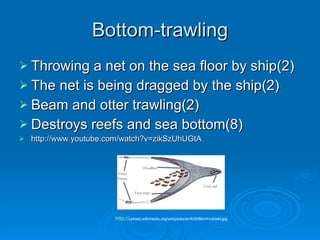
Bottom-trawling Throwing a net on the sea floor by ship(2) The net is being dragged by the ship(2) Beam and otter trawling(2) Destroys reefs and sea bottom(8) http://www.youtube.com/watch?v=zikSzUhUGtA http:// upload.wikimedia.org/wikipedia/en/6/6f/Benthictrawl.jpg
No-take zones Preserved areas where species are protected(8) Some no-take zones are police secured and difficult to enter(8) They create environment for restoring ecosystems and increase of population(8)
Aquaculture (Impact on Wild Species) (1) Aquafarming  (cultivating most needed species and keeping them under controlled conditions) vs.  commercial fishing  (harvesting of wild species) Negative impact on wild species Ex. Salmon – affects wild salmon and forage fish Great demand for salmon    even greater for forage fish to feed them    problem for wild salmon
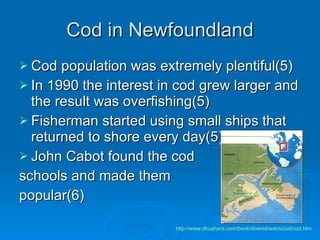
Cod in Newfoundland Cod population was extremely plentiful(5) In 1990 the interest in cod grew larger and the result was overfishing(5) Fisherman started using small ships that returned to shore every day(5) John Cabot found the cod  schools and made them  popular(6) http://www.dhushara.com/book/diversit/extra/cod/cod.htm
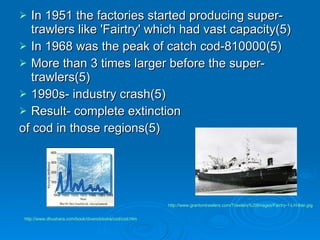
In 1951 the factories started producing super-trawlers like  'Fairtry'  which had vast capacity(5) In 1968 was the peak of catch cod-810000(5) More than 3 times larger before the super-trawlers(5) 1990s -  industry   crash(5) Result- complete extinction of cod in those regions(5) http://www.grantontrawlers.com/Trawlers%20Images/Fairtry-1-LH-8an.jpg   http://www.dhushara.com/book/diversit/extra/cod/cod.htm
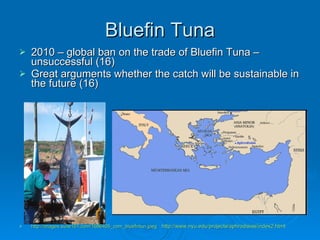
Bluefin Tuna Large migratory fish – Atlantic + Mediterranean (17) 4m, 250kg, >70km/h (17) Faces extinction (17) Actual amount of tuna caught – uncertain (16) 2008, 2009 – UN decreased the tuna season claiming that quotas have been early reached (16) Japan – 90% of bluefin tuna caught in the Mediterranean (16)
Bluefin Tuna 2010 – global ban on the trade of Bluefin Tuna – unsuccessful (16) Great arguments whether the catch will be sustainable in the future (16) http://images.suite101.com/1686405_com_bluefintun.jpeg   http://www.nyu.edu/projects/aphrodisias/index2.html
Works Cited &quot;Aquaculture.&quot;  Wikipedia . Web. 15 June 2010. <http://en.wikipedia.org/wiki/Aquaculture#Impacts_on_wild_fish>. &quot;Bottom Trawling.&quot; Wikipedia, the Free Encyclopedia. 8 June 2010. Web. 15 June 2010. <http://en.wikipedia.org/wiki/Bottom_trawling>. &quot;Bycatch.&quot; Wikipedia, the Free Encyclopedia. 6 June 2010. Web. 15 June 2010. <http://en.wikipedia.org/wiki/Bycatch> Castro, Kathleen. &quot;Bycatch.&quot; Rhode Island Sea Grant. Web. 15 June 2010. <http://seagrant.gso.uri.edu/factsheets/Bycatch.html>. Century, The 19th. &quot;Cod Fishing in Newfoundland.&quot; Wikipedia, the Free Encyclopedia. 20 Apr. 2010. Web. 15 June 2010.<http://en.wikipedia.org/wiki/Cod_fishing_in_Newfoundland>. &quot;Cod Gone.&quot; Dhushara. Web. 15 June 2010. <http://www.dhushara.com/book/diversit/extra/cod/cod.htm>. &quot;Coral Degradation through Destructive Fishing Practices.&quot; Encyclopedia of Earth. 24 Aug. 2008. Web. 15 June 2010.<http://www.eoearth.org/article/Coral_degradation_through_destructive_fishing_practices#Explosive_Fishing> &quot;Coral Reefs Doomed, Study Says; Centuries of Overfishing Killing Ecosystems.&quot; Common Dreams | News & Views. 2003. Web. 15 June 2010.<http://www.commondreams.org/headlines03/0816-06.htm>. Destructive Fishing.&quot; CopperWiki. 8 Mar. 2010. Web. 15 June 2010. <http://www.copperwiki.org/index.php/Destructive_fishing> &quot;FISHING DOWN THE FOOD CHAIN.&quot; Site Has Moved. Web. 15 June 2010. <http://archive.greenpeace.org/comms/fish/part3.html>. &quot;Fishing down the Food Web.&quot;  Wikipedia . Web. 15 June 2010. <http://en.wikipedia.org/wiki/Fishing_down_the_food_web>. &quot;Overfishing - A Global Environmental Problem, Threat and Disaster.&quot; Overfishing - A Global Environmental Problem, Threat and Disaster. Web. 15 June 2010.  http://overfishing.org/pages/why_is_overfishing_a_problem.php &quot;Overfishing.&quot;  Wikipedia . Web. 15 June 2010. <http://en.wikipedia.org/wiki/Overfishing>. Pauly, Daniel. &quot;Fishing Down Marine Food Webs.&quot;  Science/AAAS . 6 Feb. 1998. Web. 15 June 2010. <http://sciencemag.org/cgi/content/short/279/5352/860>. &quot;Scientific Facts on Fisheries Latest Data.&quot;  GreenFacts . Web. 15 June 2010. <http://www.greenfacts.org/en/fisheries/index.htm>. Somerfield, Mark. &quot;Bluefin Tuna Fishing in the Mediterranean.&quot;  European Affairs . 21 Mar. 2010. Web. 15 June 2010. <http://eeuropeanrussianaffairs.suite101.com/article.cfm/bluefin-tuna-fishing-in-the-mediterranean>. &quot;WWF - Bluefin Tuna in Crisis.&quot;  WWF . Web. 15 June 2010. <http://wwf.panda.org/what_we_do/footprint/smart_fishing/sustainable_fisheries/bluefin_tuna/>.

Overfishing2

  • 1.
    Overfishing By SofiaMarcheva Ivaylo Nikolov
  • 2.
    Overfishing (13) Catchingtoo much fish for the system to support Overfishing is a non-sustainable use of the oceans 3 types: Growth – harvesting fish before it reaches a reasonable size to produce the max. yield Recruit – not enough adults to reproduce Ecosystem – when overfishing changes the ecosystem (decrease in predatory species  increase in small fishes)
  • 3.
    Level of GlobalFish Catch (15) 2006 – 144 million tonnes (capture fisheries + aquaculture) 110 millions – for human consumption China and Peru – largest fish catch More than ½ of monitored fish stocks – fully exploited About ¼ are overexploited or slowly recovering Maximum potential of world’s capture fisheries is reached  measures need to be taken Scientists are concerned about the sustainability of fish catches and remind that actions need to be taken ASAP
  • 4.
    Fishing down thefood chain Hunting fishes down the trophic levels in the food web (11) Decline in Mean trophic level (14) Transition from high trophic level, big-sized fish to small low trophic level species that live shorter (14) Results at first in increase in fish catch, but then it declines (14) Fishermen tend to catch larger fishes, but then they become less and there is a shift to smaller fishes (11) Shows unsustainability (11)
  • 5.
    Bycatch Fish caughtunintentionally while hunting other species(3) Sometimes bycatch is kept or sold(4) Ex. Catching bluefish while fishing striped bass( костур) Throwing back the bycatch is called discard.(4) Discarding can lead to change of current population of a specie(4)
  • 6.
    Damaging fishing methodsCyanide fishing- cheap and effective(9) Explosive fishing- using explosives to kill the fish. Major cause of reef destruction Longline fishing-lined up baited hooks. Estimated to Kill 180 000 birds worldwide(7) Trawls- nets that catch the fish by force(9) http://static.howstuffworks.com/gif/coral-reef-blasting.jpg
  • 7.
    Bottom-trawling Throwing anet on the sea floor by ship(2) The net is being dragged by the ship(2) Beam and otter trawling(2) Destroys reefs and sea bottom(8) http://www.youtube.com/watch?v=zikSzUhUGtA http:// upload.wikimedia.org/wikipedia/en/6/6f/Benthictrawl.jpg
  • 8.
    No-take zones Preservedareas where species are protected(8) Some no-take zones are police secured and difficult to enter(8) They create environment for restoring ecosystems and increase of population(8)
  • 9.
    Aquaculture (Impact onWild Species) (1) Aquafarming (cultivating most needed species and keeping them under controlled conditions) vs. commercial fishing (harvesting of wild species) Negative impact on wild species Ex. Salmon – affects wild salmon and forage fish Great demand for salmon  even greater for forage fish to feed them  problem for wild salmon
  • 10.
    Cod in NewfoundlandCod population was extremely plentiful(5) In 1990 the interest in cod grew larger and the result was overfishing(5) Fisherman started using small ships that returned to shore every day(5) John Cabot found the cod schools and made them popular(6) http://www.dhushara.com/book/diversit/extra/cod/cod.htm
  • 11.
    In 1951 thefactories started producing super-trawlers like 'Fairtry' which had vast capacity(5) In 1968 was the peak of catch cod-810000(5) More than 3 times larger before the super-trawlers(5) 1990s - industry crash(5) Result- complete extinction of cod in those regions(5) http://www.grantontrawlers.com/Trawlers%20Images/Fairtry-1-LH-8an.jpg http://www.dhushara.com/book/diversit/extra/cod/cod.htm
  • 12.
    Bluefin Tuna Largemigratory fish – Atlantic + Mediterranean (17) 4m, 250kg, >70km/h (17) Faces extinction (17) Actual amount of tuna caught – uncertain (16) 2008, 2009 – UN decreased the tuna season claiming that quotas have been early reached (16) Japan – 90% of bluefin tuna caught in the Mediterranean (16)
  • 13.
    Bluefin Tuna 2010– global ban on the trade of Bluefin Tuna – unsuccessful (16) Great arguments whether the catch will be sustainable in the future (16) http://images.suite101.com/1686405_com_bluefintun.jpeg http://www.nyu.edu/projects/aphrodisias/index2.html
  • 14.
    Works Cited &quot;Aquaculture.&quot; Wikipedia . Web. 15 June 2010. <http://en.wikipedia.org/wiki/Aquaculture#Impacts_on_wild_fish>. &quot;Bottom Trawling.&quot; Wikipedia, the Free Encyclopedia. 8 June 2010. Web. 15 June 2010. <http://en.wikipedia.org/wiki/Bottom_trawling>. &quot;Bycatch.&quot; Wikipedia, the Free Encyclopedia. 6 June 2010. Web. 15 June 2010. <http://en.wikipedia.org/wiki/Bycatch> Castro, Kathleen. &quot;Bycatch.&quot; Rhode Island Sea Grant. Web. 15 June 2010. <http://seagrant.gso.uri.edu/factsheets/Bycatch.html>. Century, The 19th. &quot;Cod Fishing in Newfoundland.&quot; Wikipedia, the Free Encyclopedia. 20 Apr. 2010. Web. 15 June 2010.<http://en.wikipedia.org/wiki/Cod_fishing_in_Newfoundland>. &quot;Cod Gone.&quot; Dhushara. Web. 15 June 2010. <http://www.dhushara.com/book/diversit/extra/cod/cod.htm>. &quot;Coral Degradation through Destructive Fishing Practices.&quot; Encyclopedia of Earth. 24 Aug. 2008. Web. 15 June 2010.<http://www.eoearth.org/article/Coral_degradation_through_destructive_fishing_practices#Explosive_Fishing> &quot;Coral Reefs Doomed, Study Says; Centuries of Overfishing Killing Ecosystems.&quot; Common Dreams | News & Views. 2003. Web. 15 June 2010.<http://www.commondreams.org/headlines03/0816-06.htm>. Destructive Fishing.&quot; CopperWiki. 8 Mar. 2010. Web. 15 June 2010. <http://www.copperwiki.org/index.php/Destructive_fishing> &quot;FISHING DOWN THE FOOD CHAIN.&quot; Site Has Moved. Web. 15 June 2010. <http://archive.greenpeace.org/comms/fish/part3.html>. &quot;Fishing down the Food Web.&quot; Wikipedia . Web. 15 June 2010. <http://en.wikipedia.org/wiki/Fishing_down_the_food_web>. &quot;Overfishing - A Global Environmental Problem, Threat and Disaster.&quot; Overfishing - A Global Environmental Problem, Threat and Disaster. Web. 15 June 2010. http://overfishing.org/pages/why_is_overfishing_a_problem.php &quot;Overfishing.&quot; Wikipedia . Web. 15 June 2010. <http://en.wikipedia.org/wiki/Overfishing>. Pauly, Daniel. &quot;Fishing Down Marine Food Webs.&quot; Science/AAAS . 6 Feb. 1998. Web. 15 June 2010. <http://sciencemag.org/cgi/content/short/279/5352/860>. &quot;Scientific Facts on Fisheries Latest Data.&quot; GreenFacts . Web. 15 June 2010. <http://www.greenfacts.org/en/fisheries/index.htm>. Somerfield, Mark. &quot;Bluefin Tuna Fishing in the Mediterranean.&quot; European Affairs . 21 Mar. 2010. Web. 15 June 2010. <http://eeuropeanrussianaffairs.suite101.com/article.cfm/bluefin-tuna-fishing-in-the-mediterranean>. &quot;WWF - Bluefin Tuna in Crisis.&quot; WWF . Web. 15 June 2010. <http://wwf.panda.org/what_we_do/footprint/smart_fishing/sustainable_fisheries/bluefin_tuna/>.