Depleting
Fish Biodiversity along the
Indian Coast
Introduction
• Fishing is central to the livelihood and food
security of many people in the developing
world.
• Accelerated loss of coastal and marine
biodiversity components over the last few
decades has been of great concern.
• The identification of depleted fish stocks in
the light of loss of biodiversity has been
engaging the attention of marine fishery
scientists all over the world.
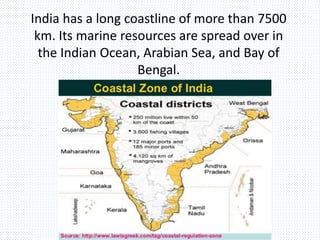
India has a long coastline of more than 7500
km. Its marine resources are spread over in
the Indian Ocean, Arabian Sea, and Bay of
Bengal.
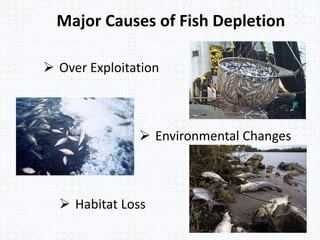
Major Causes of Fish Depletion
 Over Exploitation
 Environmental Changes
 Habitat Loss
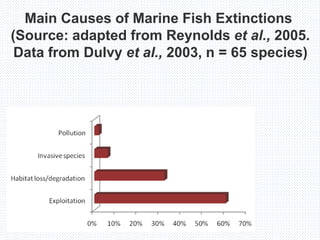
Main Causes of Marine Fish Extinctions
(Source: adapted from Reynolds et al., 2005.
Data from Dulvy et al., 2003, n = 65 species)
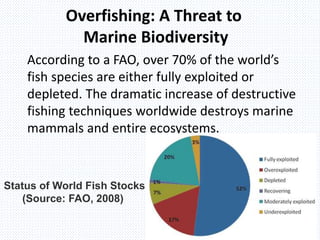
Overfishing: A Threat to
Marine Biodiversity
According to a FAO, over 70% of the world’s
fish species are either fully exploited or
depleted. The dramatic increase of destructive
fishing techniques worldwide destroys marine
mammals and entire ecosystems.
Status of World Fish Stocks
(Source: FAO, 2008)
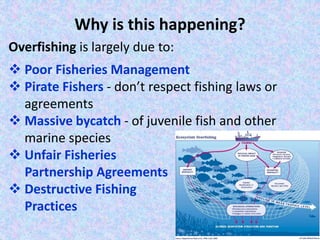
Overfishing is largely due to:
 Poor Fisheries Management
 Pirate Fishers - don’t respect fishing laws or
agreements
 Massive bycatch - of juvenile fish and other
marine species
 Unfair Fisheries
Partnership Agreements
 Destructive Fishing
Practices
Why is this happening?
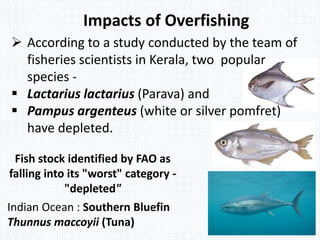
 According to a study conducted by the team of
fisheries scientists in Kerala, two popular
species -
 Lactarius lactarius (Parava) and
 Pampus argenteus (white or silver pomfret)
have depleted.
Impacts of Overfishing
Fish stock identified by FAO as
falling into its "worst" category -
"depleted"
Indian Ocean : Southern Bluefin
Thunnus maccoyii (Tuna)
Biodiversity Conservation Technologies
in Fisheries
 Enforcement of bycatch reduction technologies
 Promotion of low impact and fuel efficient
fishing systems
 Use of smart trawling techniques
 Regulation on total fishing effort at sustainable
levels
 Maintenance of Marine Protected Areas
will facilitate protection and restoration of
biodiversity
• The ecological impact of high volume of fishing is
evident from its effects on bio-diversity. The
impacts of declining fish catches are being
painfully felt by many coastal fishing
communities around the world.
• Environment activists have to demand that the
government have to revise its fishery policy,
including that of issuing permits to foreign
vessels.
• Fishery regulations and implementation of
conservation measures should be implemented.
Conclusion
Presented by
S.Priya M.Sc., M.Phil.,
Ph.D., Research Scholar,
Department of Zoology,
Queen Mary’s College
Depleting Fish biodiversity

Depleting Fish biodiversity

  • 1.
  • 2.
    Introduction • Fishing iscentral to the livelihood and food security of many people in the developing world. • Accelerated loss of coastal and marine biodiversity components over the last few decades has been of great concern. • The identification of depleted fish stocks in the light of loss of biodiversity has been engaging the attention of marine fishery scientists all over the world.
  • 3.
    India has along coastline of more than 7500 km. Its marine resources are spread over in the Indian Ocean, Arabian Sea, and Bay of Bengal.
  • 4.
    Major Causes ofFish Depletion  Over Exploitation  Environmental Changes  Habitat Loss
  • 5.
    Main Causes ofMarine Fish Extinctions (Source: adapted from Reynolds et al., 2005. Data from Dulvy et al., 2003, n = 65 species)
  • 6.
    Overfishing: A Threatto Marine Biodiversity According to a FAO, over 70% of the world’s fish species are either fully exploited or depleted. The dramatic increase of destructive fishing techniques worldwide destroys marine mammals and entire ecosystems. Status of World Fish Stocks (Source: FAO, 2008)
  • 7.
    Overfishing is largelydue to:  Poor Fisheries Management  Pirate Fishers - don’t respect fishing laws or agreements  Massive bycatch - of juvenile fish and other marine species  Unfair Fisheries Partnership Agreements  Destructive Fishing Practices Why is this happening?
  • 8.
     According toa study conducted by the team of fisheries scientists in Kerala, two popular species -  Lactarius lactarius (Parava) and  Pampus argenteus (white or silver pomfret) have depleted. Impacts of Overfishing Fish stock identified by FAO as falling into its "worst" category - "depleted" Indian Ocean : Southern Bluefin Thunnus maccoyii (Tuna)
  • 9.
    Biodiversity Conservation Technologies inFisheries  Enforcement of bycatch reduction technologies  Promotion of low impact and fuel efficient fishing systems  Use of smart trawling techniques  Regulation on total fishing effort at sustainable levels  Maintenance of Marine Protected Areas will facilitate protection and restoration of biodiversity
  • 10.
    • The ecologicalimpact of high volume of fishing is evident from its effects on bio-diversity. The impacts of declining fish catches are being painfully felt by many coastal fishing communities around the world. • Environment activists have to demand that the government have to revise its fishery policy, including that of issuing permits to foreign vessels. • Fishery regulations and implementation of conservation measures should be implemented. Conclusion
  • 11.
    Presented by S.Priya M.Sc.,M.Phil., Ph.D., Research Scholar, Department of Zoology, Queen Mary’s College