Random
Ovarian
Stimulation
and Follicular
Waves
Dr Mohamed Atef Behery
Assistant Professor of Obstetrics and
Gynecology
Senior Consultant of Reproductive Medicine ,ART
Unit -Al-Azhar University-Cairo-Egypt
Peer Reviewer of Archives of Gynecology
and Obstetrics Journal
Peer Reviewer of Obstetrics and Gynecology
Journal ,Australia
Introduction
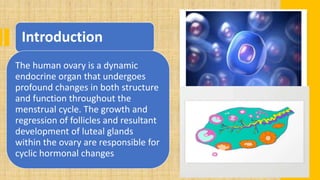
The human ovary is a dynamic
endocrine organ that undergoes
profound changes in both structure
and function throughout the
menstrual cycle. The growth and
regression of follicles and resultant
development of luteal glands
within the ovary are responsible for
cyclic hormonal changes
Follicular Waves
Nowadays there is an evidence to validate the idea that multiple
waves of antral folliculogenesis occur throughout the human
menstrual cycle, similarly to those previously reported in several
other mammalian species. (Adam et al 2012, Ginther et al 2004)

The concept of follicular waves has challenged traditional models
of ovarian physiology and led to the optimization of ovarian
stimulation protocols for women undergoing assisted
reproduction. (Sighinolf et al, 2018 and Vaiarell et al, 2017).
THEORIES OF ANTRAL OVARIAN FOLLICULAR DEVELOPMENT
DURING THE MENSTRUAL CYCLE
1) Continuous Recruitment Theory
From the continuous pool of recruited antral follicles, a single
dominant follicle developed in the early follicular phase, resulting in
ovulation at mid-cycle. The dominant follicle was thought to be
selected because it was at an optimal stage of maturity to be able to
respond to rising FSH following luteal regression. (Mc Natty et al
1981, Baird et al., 1987, Westergaard et al., 1986)
2) Cyclic Recruitment Theory
In women and nonhuman primates, estradiol
and inhibin A from the corpus luteum (CL)
were thought to suppress FSH and resultant
growth of antral follicles >4 mm in size
throughout the luteal phase (Smith et
al.,1990)
3) Follicular Wave Theory
In contrast to notions of continuous recruitment, or a single
episode of cyclic recruitment, cohorts of antral follicles, referred to
as waves, have been shown to emerge multiple times during the
menstrual cycle
Subsequent studies used transabdominal (Queenan et al. 1980)and
transvaginal ultrasonography (Baerwald et al. 2003) to further
support the notion that multiple waves of antral follicles developed
throughout the menstrual cycle in healthy women.
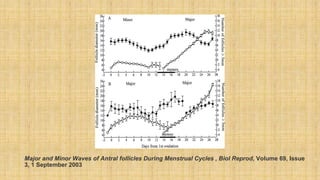
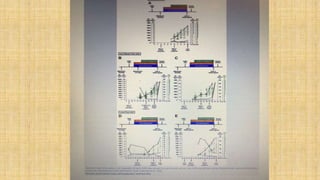
Major and Minor Waves of Antral follicles During Menstrual Cycles , Biol Reprod, Volume 69, Issue
3, 1 September 2003
Definition of follicular wave
A follicular wave is defined as the synchronous growth of a group
of antral follicles 2–5 mm in size that occurs at regular intervals
during the menstrual/estrous cycle; follicles in each wave are
similar, but not identical, in diameter (Pierson et al.1987)
Thus, the term ‘‘wave’’ is synonymous with ‘‘secondary
recruitment.’’ Either two or three waves of antral follicle
development have been reported in 100% of reproductive-age
women evaluated with the use of transvaginal ultrasonography
An interovulatory interval (IOI)
An IOI is the period from one ovulation
to the subsequent ovulation, which
conceptually represents a menstrual
cycle (intermenstrual interval) shifted
forward or backwards by 2 weeks.
Sixty-eight percent of women developed two waves
throughout an IOI and 32% developed three waves.
(Baerwald et al 2020)
In women with two follicular waves, waves emerged,
on average, on days 1 and 14 (day 0 = ovulation no. 1).
In women with three follicular waves, waves emerged,
on average, on days 0, 12, and 18 (Baerwald et al 2020)
The length of the IOI was longer in women with
three versus two waves (29 vs. 27 days)
In all women, the final major wave of the IOI was
ovulatory, whereas preceding major waves were
anovulatory. Minor waves were defined as those in
which a dominant follicle did not develop; all minor
waves were anovulatory
Three ovulations occurred within 45 days. Ovulation was
confirmed on all three occasions by a rise in serum LH,
followed by ultrasonographic detection of a CL in association
with a rise in serum P.(Baerwald et al 2020)
The hormonal regulation of antral follicular waves throughout the
menstrual cycle is not fully understood. Preliminary data suggest that
the emergence of each follicular wave throughout the IOI is preceded
by a rise in serum FSH (Baerwald et al 2003),
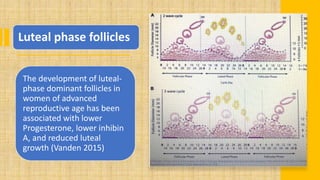
Luteal phase follicles
The development of luteal-
phase dominant follicles in
women of advanced
reproductive age has been
associated with lower
Progesterone, lower inhibin
A, and reduced luteal
growth (Vanden 2015)
Random-Start Ovarian Stimulation
According to many studies ‘‘random start stimulation’’ has
arisen, in which ovarian stimulation can be initiated at any
time of the cycle. (Von Wolff et al.,2016, Ubaldi et al.,2016,
Cimadomo et al 2018)
Endometrial development is not synchronized with ovarian
function in random-stimulation starts. Therefore, these
protocols require oocyte retrieval, oocyte/embryo
cryopreservation, and subsequent thawed embryo transfer
Random ovarian stimulation
Mid to Late Follicular-Phase Starts. Initiation
of ovarian stimulation in the mid to late
follicular phase has been defined as starting
therapy >7 days after menses in the presence
of a dominant follicle >13 mm in size and/or P
is <2 ng/ml .(Baerwald et al 2020)
Regime 0f Induction in Random Stimulation
1-Protocols combining exogenous FSH with aromatase inhibitors
(tamoxifen, anastrazole, or letrozole) have been studied ( Baruffi
et al.,2007).
Letrozole is the recommended aromatase inhibitor for onco-
fertility patients because it reduces serum E2 concentrations
without compromising clinical outcomes (Pereira et al 2018,
Farquhar et al 2017))
Regime 0f Induction in Random Stimulation
GnRH-ant protocols have been used with random-
start stimulation in a variety of different ways.
GnRH-ant is started concomitant to initiating hMG or
rFSH and continued until trigger (Pereira et al 2017)
Regime of Induction in Random Stimulation
Antagonists have also been administered on day 10 and continued until E2
<60 pg/dL (Checa et al.,2015)).
Flexible GnRH-ant protocols also have been used, in which a GnRH-ant is
administered only after a dominant follicle =13 mm in size is detected.
A luteal phase follicular wave then emerged, and GnRH-ant was initiated to
prevent a subsequent endogenous spontaneous LH surge (Cakmak et al
2013)
Luteal-Phase Starts
Luteal-phase starts have been
defined as those initiated at least 14
days after menses, in which P is > 3–7
ng/mL and/or a CL is visualized
ultrasonographically (Kim et al 2015)
Stimulation Regimen in Luteal-Phase
rFSH and a GnRHant have been administered in parallel, beginning
at any stage of the luteal phase (Muteshi et al.,2018).
GnRH-ant is administered 5 days after initiating ovarian stimulation
in the luteal phase and continuing to trigger.
GnRH-ant could be initiated for 3 days during the luteal phase
followed by FSH on the 4th day; both medications were continued
until the time of trigger.(Sonmezer et al2013, Muteshi et al 2018)
Stimulation Regimen in Luteal-Phase
It has been proposed that endogenous P from the CL during
the luteal phase suppresses a premature endogenous LH surge;
therefore, exogenous P may not be required during LPS.
Regardless of the exogenous FSH regimen used, hCG or GnRH-
agonist is used to trigger final oocyte maturation once one or
more follicles reach >17–18 mm.
Oocytes are aspirated, vitrified or fertilized in vitro, and a
thawed embryo transfer cycle planned.
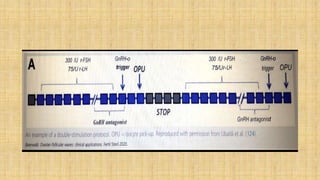
Double Ovarian Stimulation(DuoStim protocol)
Double ovarian stimulation protocols have been developed in which
conventional stimulation in the early follicular phase is followed by a
second stimulation within the same cycle.
Has specific clinical applications for women with a poor response to conventional
stimulation (Kuang et al., 2014) and in women before chemotherapy to increase
the total number of oocytes available for cryopreservation (Tsampras et al 2017)
Women can undergo a second stimulation in the
luteal phase rather than waiting for a new cycle to
reinitiate therapy.
Double Ovarian Stimulation(DuoStim)
The transition from Follicular Phase Stimulation(FPS) to Luteal Phase
Stimulation(LPS) occurs 2–5 days after the first oocyte retrieval.
Stimulation is reinitiated using the same protocol as with FPS, regardless
of the number of antral follicles present (Vaiarelli et al.,2018).
Fixed and flexible GnRH-ant protocols have been used for LPS (Checa et
al,.2015). Alternatively, no GnRH-ant has been used in LPS
Zahng 2015, Reprod Biol Endocrinol. 2015; 13: 76.
Notes
ibuprofen was administered at the time of trigger in place of
a GnRH-a or GnRH-ant to inhibit premature follicle rupture
for both FPS and LPS (Kuang et al 2014, Xu B, Li 2013,Madani
et al 2019 ).
If no oocytes are available following FPS, LPS is initiated on
day 18–20 of the cycle and oocyte retrieval is followed by
oocyte cryopreservation or fertilization (Jin et al 2018,
Cimadomo et al., 2018).
Clinical Outcomes of Random-Start Stimulation
1-Stimulation was associated with an increased duration of stimulation(
von Wolff et al 2016), increased cumulative FSH dose ( Cakmak et al
2013,Buendgen et al.,2013, . Kim and kim 2015, . Kuang et al.,2014), and
increased oocyte retrieval rate (Li et al.,2016, . Bedosch et al.,2010,Wang et
al.,2016) compared with conventional early FPS.
However, in most studies, no differences in
outcomes were reported between random-start
versus conventional stimulation.
Clinical Outcomes of Random-Start Stimulation
2-No differences in fertilization or clinical pregnancy rates have
been reported between conventional versus random start
stimulation.
3-Preliminary data to date have shown no differences in neonatal
outcomes or incidence of congenital malformations between LPS
versus conventional stimulation starts, however, data obtained to
date are limited(Baerwald et al 2020)
Conclusions
1-Waves of ovarian follicular development have
been identified and characterized in every
mammalian species in which serial measurements
of follicle development and hormone production
have been simultaneously obtained.
Conclusions
2-It is anticipated that women diagnosed with cancer or a poor ovarian
response (related to age or other factors) will have a greater chance of
successful assisted reproduction with the use of these strategies.
3-DuoStim appears to provide a safe and patient-oriented means of
increasing the number of oocytes obtained without compromising
pregnancy outcomes.
4-Random-start stimulation has now become standard practice for
women requiring fertility preservation before chemotherapy.
Conclusions
5-DuoStim has also been shown to increase the total
number of oocytes available for cryopreservation in
these women without delaying cancer therapy.
6-The primary benefits of random-start and DuoStim
protocols include a patient-oriented approach to
care, timely and efficient treatment, and a resultant
lower drop-out rate.
Conclusions
7-To date, similar clinical pregnancy
rates and similar or increased live
birth rates have been reported with
the use of random-start versus
conventional stimulation.
Limitations
1-limitations to random start and DuoStim
protocols include the need to return to care
for frozen embryo transfer, the potential for
increased doses of gonadotropins, higher
costs per cycle, and access to clinics with
vitrification capabilities.
Limitations
2-Clinical pregnancy rates do not appear to differ in women
undergoing DuoStim versus conventional ovarian stimulation.
However, research to evaluate live birth rates and long-term
outcomes in children born after these novel protocols are lacking
3-Continued prospective randomized trials are required to confirm
whether the use of DuoStim protocols increases the probability of
delivering a healthy baby.
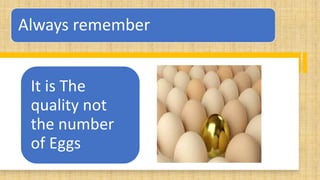
Always remember
It is The
quality not
the number
of Eggs
Thank you

Ovarian waves and random ovarian stimulation

  • 1.
    Random Ovarian Stimulation and Follicular Waves Dr MohamedAtef Behery Assistant Professor of Obstetrics and Gynecology Senior Consultant of Reproductive Medicine ,ART Unit -Al-Azhar University-Cairo-Egypt Peer Reviewer of Archives of Gynecology and Obstetrics Journal Peer Reviewer of Obstetrics and Gynecology Journal ,Australia
  • 2.
    Introduction The human ovaryis a dynamic endocrine organ that undergoes profound changes in both structure and function throughout the menstrual cycle. The growth and regression of follicles and resultant development of luteal glands within the ovary are responsible for cyclic hormonal changes
  • 3.
    Follicular Waves Nowadays thereis an evidence to validate the idea that multiple waves of antral folliculogenesis occur throughout the human menstrual cycle, similarly to those previously reported in several other mammalian species. (Adam et al 2012, Ginther et al 2004) The concept of follicular waves has challenged traditional models of ovarian physiology and led to the optimization of ovarian stimulation protocols for women undergoing assisted reproduction. (Sighinolf et al, 2018 and Vaiarell et al, 2017).
  • 4.
    THEORIES OF ANTRALOVARIAN FOLLICULAR DEVELOPMENT DURING THE MENSTRUAL CYCLE 1) Continuous Recruitment Theory From the continuous pool of recruited antral follicles, a single dominant follicle developed in the early follicular phase, resulting in ovulation at mid-cycle. The dominant follicle was thought to be selected because it was at an optimal stage of maturity to be able to respond to rising FSH following luteal regression. (Mc Natty et al 1981, Baird et al., 1987, Westergaard et al., 1986)
  • 5.
    2) Cyclic RecruitmentTheory In women and nonhuman primates, estradiol and inhibin A from the corpus luteum (CL) were thought to suppress FSH and resultant growth of antral follicles >4 mm in size throughout the luteal phase (Smith et al.,1990)
  • 6.
    3) Follicular WaveTheory In contrast to notions of continuous recruitment, or a single episode of cyclic recruitment, cohorts of antral follicles, referred to as waves, have been shown to emerge multiple times during the menstrual cycle Subsequent studies used transabdominal (Queenan et al. 1980)and transvaginal ultrasonography (Baerwald et al. 2003) to further support the notion that multiple waves of antral follicles developed throughout the menstrual cycle in healthy women.
  • 7.
    Major and MinorWaves of Antral follicles During Menstrual Cycles , Biol Reprod, Volume 69, Issue 3, 1 September 2003
  • 8.
    Definition of follicularwave A follicular wave is defined as the synchronous growth of a group of antral follicles 2–5 mm in size that occurs at regular intervals during the menstrual/estrous cycle; follicles in each wave are similar, but not identical, in diameter (Pierson et al.1987) Thus, the term ‘‘wave’’ is synonymous with ‘‘secondary recruitment.’’ Either two or three waves of antral follicle development have been reported in 100% of reproductive-age women evaluated with the use of transvaginal ultrasonography
  • 9.
    An interovulatory interval(IOI) An IOI is the period from one ovulation to the subsequent ovulation, which conceptually represents a menstrual cycle (intermenstrual interval) shifted forward or backwards by 2 weeks.
  • 10.
    Sixty-eight percent ofwomen developed two waves throughout an IOI and 32% developed three waves. (Baerwald et al 2020) In women with two follicular waves, waves emerged, on average, on days 1 and 14 (day 0 = ovulation no. 1). In women with three follicular waves, waves emerged, on average, on days 0, 12, and 18 (Baerwald et al 2020)
  • 11.
    The length ofthe IOI was longer in women with three versus two waves (29 vs. 27 days) In all women, the final major wave of the IOI was ovulatory, whereas preceding major waves were anovulatory. Minor waves were defined as those in which a dominant follicle did not develop; all minor waves were anovulatory
  • 12.
    Three ovulations occurredwithin 45 days. Ovulation was confirmed on all three occasions by a rise in serum LH, followed by ultrasonographic detection of a CL in association with a rise in serum P.(Baerwald et al 2020) The hormonal regulation of antral follicular waves throughout the menstrual cycle is not fully understood. Preliminary data suggest that the emergence of each follicular wave throughout the IOI is preceded by a rise in serum FSH (Baerwald et al 2003),
  • 13.
    Luteal phase follicles Thedevelopment of luteal- phase dominant follicles in women of advanced reproductive age has been associated with lower Progesterone, lower inhibin A, and reduced luteal growth (Vanden 2015)
  • 14.
    Random-Start Ovarian Stimulation Accordingto many studies ‘‘random start stimulation’’ has arisen, in which ovarian stimulation can be initiated at any time of the cycle. (Von Wolff et al.,2016, Ubaldi et al.,2016, Cimadomo et al 2018) Endometrial development is not synchronized with ovarian function in random-stimulation starts. Therefore, these protocols require oocyte retrieval, oocyte/embryo cryopreservation, and subsequent thawed embryo transfer
  • 16.
    Random ovarian stimulation Midto Late Follicular-Phase Starts. Initiation of ovarian stimulation in the mid to late follicular phase has been defined as starting therapy >7 days after menses in the presence of a dominant follicle >13 mm in size and/or P is <2 ng/ml .(Baerwald et al 2020)
  • 17.
    Regime 0f Inductionin Random Stimulation 1-Protocols combining exogenous FSH with aromatase inhibitors (tamoxifen, anastrazole, or letrozole) have been studied ( Baruffi et al.,2007). Letrozole is the recommended aromatase inhibitor for onco- fertility patients because it reduces serum E2 concentrations without compromising clinical outcomes (Pereira et al 2018, Farquhar et al 2017))
  • 18.
    Regime 0f Inductionin Random Stimulation GnRH-ant protocols have been used with random- start stimulation in a variety of different ways. GnRH-ant is started concomitant to initiating hMG or rFSH and continued until trigger (Pereira et al 2017)
  • 19.
    Regime of Inductionin Random Stimulation Antagonists have also been administered on day 10 and continued until E2 <60 pg/dL (Checa et al.,2015)). Flexible GnRH-ant protocols also have been used, in which a GnRH-ant is administered only after a dominant follicle =13 mm in size is detected. A luteal phase follicular wave then emerged, and GnRH-ant was initiated to prevent a subsequent endogenous spontaneous LH surge (Cakmak et al 2013)
  • 20.
    Luteal-Phase Starts Luteal-phase startshave been defined as those initiated at least 14 days after menses, in which P is > 3–7 ng/mL and/or a CL is visualized ultrasonographically (Kim et al 2015)
  • 21.
    Stimulation Regimen inLuteal-Phase rFSH and a GnRHant have been administered in parallel, beginning at any stage of the luteal phase (Muteshi et al.,2018). GnRH-ant is administered 5 days after initiating ovarian stimulation in the luteal phase and continuing to trigger. GnRH-ant could be initiated for 3 days during the luteal phase followed by FSH on the 4th day; both medications were continued until the time of trigger.(Sonmezer et al2013, Muteshi et al 2018)
  • 22.
    Stimulation Regimen inLuteal-Phase It has been proposed that endogenous P from the CL during the luteal phase suppresses a premature endogenous LH surge; therefore, exogenous P may not be required during LPS. Regardless of the exogenous FSH regimen used, hCG or GnRH- agonist is used to trigger final oocyte maturation once one or more follicles reach >17–18 mm. Oocytes are aspirated, vitrified or fertilized in vitro, and a thawed embryo transfer cycle planned.
  • 23.
    Double Ovarian Stimulation(DuoStimprotocol) Double ovarian stimulation protocols have been developed in which conventional stimulation in the early follicular phase is followed by a second stimulation within the same cycle. Has specific clinical applications for women with a poor response to conventional stimulation (Kuang et al., 2014) and in women before chemotherapy to increase the total number of oocytes available for cryopreservation (Tsampras et al 2017) Women can undergo a second stimulation in the luteal phase rather than waiting for a new cycle to reinitiate therapy.
  • 25.
    Double Ovarian Stimulation(DuoStim) Thetransition from Follicular Phase Stimulation(FPS) to Luteal Phase Stimulation(LPS) occurs 2–5 days after the first oocyte retrieval. Stimulation is reinitiated using the same protocol as with FPS, regardless of the number of antral follicles present (Vaiarelli et al.,2018). Fixed and flexible GnRH-ant protocols have been used for LPS (Checa et al,.2015). Alternatively, no GnRH-ant has been used in LPS
  • 26.
    Zahng 2015, ReprodBiol Endocrinol. 2015; 13: 76.
  • 27.
    Notes ibuprofen was administeredat the time of trigger in place of a GnRH-a or GnRH-ant to inhibit premature follicle rupture for both FPS and LPS (Kuang et al 2014, Xu B, Li 2013,Madani et al 2019 ). If no oocytes are available following FPS, LPS is initiated on day 18–20 of the cycle and oocyte retrieval is followed by oocyte cryopreservation or fertilization (Jin et al 2018, Cimadomo et al., 2018).
  • 28.
    Clinical Outcomes ofRandom-Start Stimulation 1-Stimulation was associated with an increased duration of stimulation( von Wolff et al 2016), increased cumulative FSH dose ( Cakmak et al 2013,Buendgen et al.,2013, . Kim and kim 2015, . Kuang et al.,2014), and increased oocyte retrieval rate (Li et al.,2016, . Bedosch et al.,2010,Wang et al.,2016) compared with conventional early FPS. However, in most studies, no differences in outcomes were reported between random-start versus conventional stimulation.
  • 29.
    Clinical Outcomes ofRandom-Start Stimulation 2-No differences in fertilization or clinical pregnancy rates have been reported between conventional versus random start stimulation. 3-Preliminary data to date have shown no differences in neonatal outcomes or incidence of congenital malformations between LPS versus conventional stimulation starts, however, data obtained to date are limited(Baerwald et al 2020)
  • 30.
    Conclusions 1-Waves of ovarianfollicular development have been identified and characterized in every mammalian species in which serial measurements of follicle development and hormone production have been simultaneously obtained.
  • 31.
    Conclusions 2-It is anticipatedthat women diagnosed with cancer or a poor ovarian response (related to age or other factors) will have a greater chance of successful assisted reproduction with the use of these strategies. 3-DuoStim appears to provide a safe and patient-oriented means of increasing the number of oocytes obtained without compromising pregnancy outcomes. 4-Random-start stimulation has now become standard practice for women requiring fertility preservation before chemotherapy.
  • 32.
    Conclusions 5-DuoStim has alsobeen shown to increase the total number of oocytes available for cryopreservation in these women without delaying cancer therapy. 6-The primary benefits of random-start and DuoStim protocols include a patient-oriented approach to care, timely and efficient treatment, and a resultant lower drop-out rate.
  • 33.
    Conclusions 7-To date, similarclinical pregnancy rates and similar or increased live birth rates have been reported with the use of random-start versus conventional stimulation.
  • 34.
    Limitations 1-limitations to randomstart and DuoStim protocols include the need to return to care for frozen embryo transfer, the potential for increased doses of gonadotropins, higher costs per cycle, and access to clinics with vitrification capabilities.
  • 35.
    Limitations 2-Clinical pregnancy ratesdo not appear to differ in women undergoing DuoStim versus conventional ovarian stimulation. However, research to evaluate live birth rates and long-term outcomes in children born after these novel protocols are lacking 3-Continued prospective randomized trials are required to confirm whether the use of DuoStim protocols increases the probability of delivering a healthy baby.
  • 36.
    Always remember It isThe quality not the number of Eggs
  • 37.