LUTEAL PHASE IMPORTANCE IN CONCEPTION
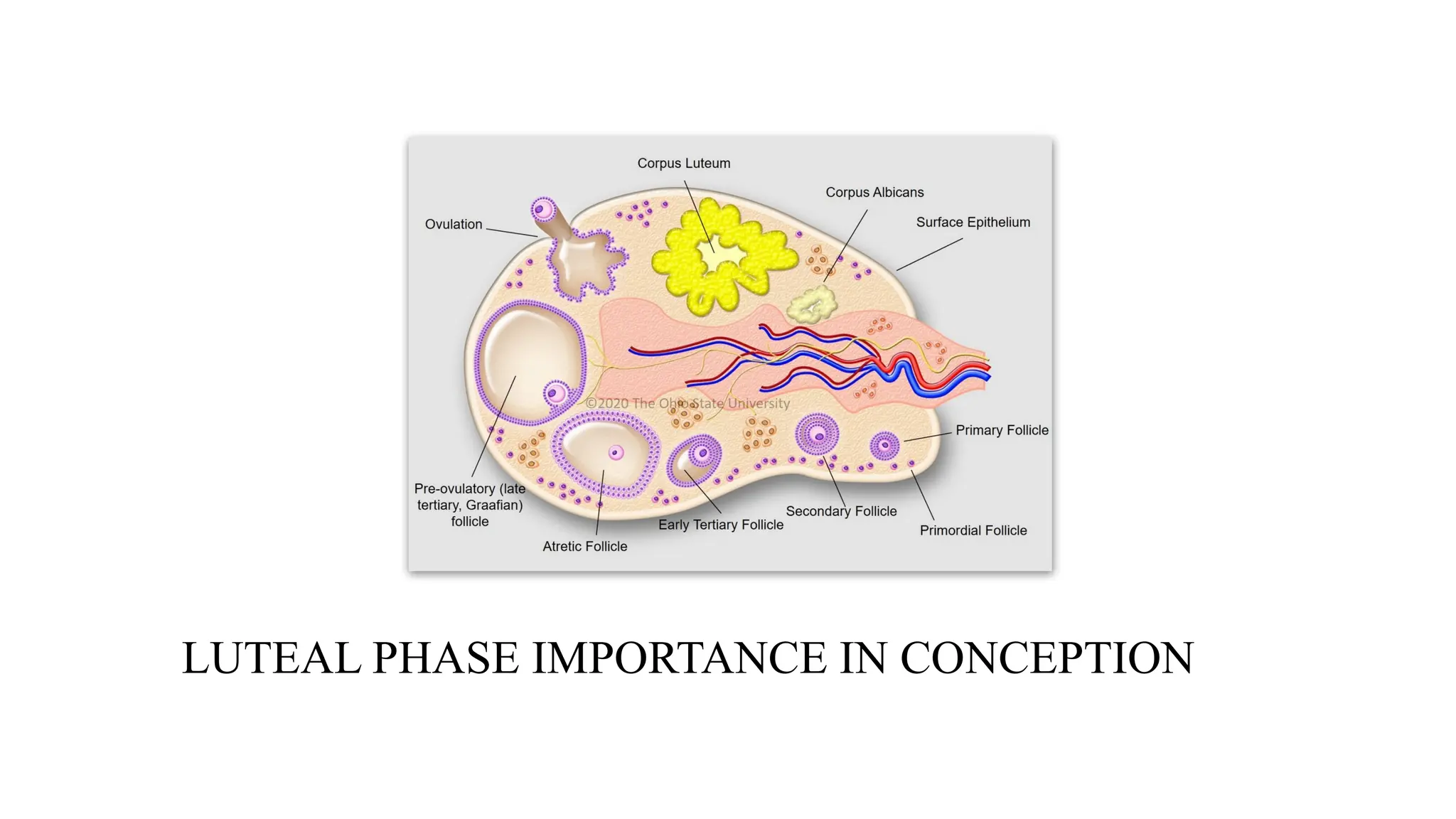
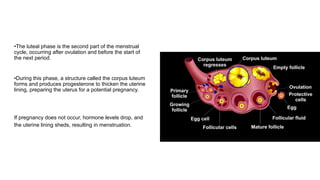
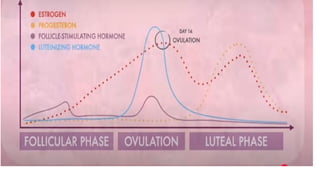
•The luteal phase is the second part of the menstrual
cycle, occurring after ovulation and before the start of
the next period.
•During this phase, a structure called the corpus luteum
forms and produces progesterone to thicken the uterine
lining, preparing the uterus for a potential pregnancy.
If pregnancy does not occur, hormone levels drop, and
the uterine lining sheds, resulting in menstruation.
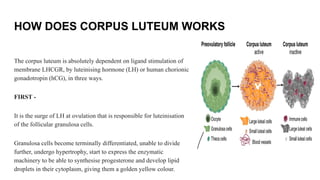
HOW DOES CORPUS LUTEUM WORKS
The corpus luteum is absolutely dependent on ligand stimulation of
membrane LHCGR, by luteinising hormone (LH) or human chorionic
gonadotropin (hCG), in three ways.
FIRST -
It is the surge of LH at ovulation that is responsible for luteinisation
of the follicular granulosa cells.
Granulosa cells become terminally differentiated, unable to divide
further, undergo hypertrophy, start to express the enzymatic
machinery to be able to synthesise progesterone and develop lipid
droplets in their cytoplasm, giving them a golden yellow colour.
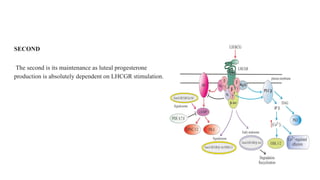
SECOND
The second is its maintenance as luteal progesterone
production is absolutely dependent on LHCGR stimulation.
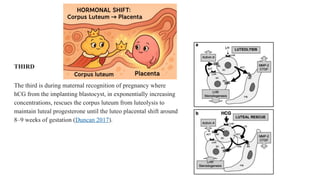
THIRD
The third is during maternal recognition of pregnancy where
hCG from the implanting blastocyst, in exponentially increasing
concentrations, rescues the corpus luteum from luteolysis to
maintain luteal progesterone until the luteo placental shift around
8–9 weeks of gestation (Duncan 2017).
SHORT LUTEAL PHASE
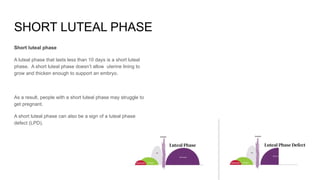
Short luteal phase
A luteal phase that lasts less than 10 days is a short luteal
phase. A short luteal phase doesn’t allow uterine lining to
grow and thicken enough to support an embryo.
As a result, people with a short luteal phase may struggle to
get pregnant.
A short luteal phase can also be a sign of a luteal phase
defect (LPD).
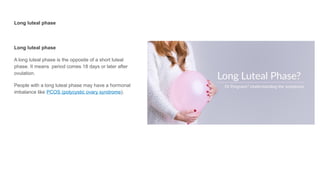
Long luteal phase
Long luteal phase
A long luteal phase is the opposite of a short luteal
phase. It means period comes 18 days or later after
ovulation.
People with a long luteal phase may have a hormonal
imbalance like PCOS (polycystic ovary syndrome).
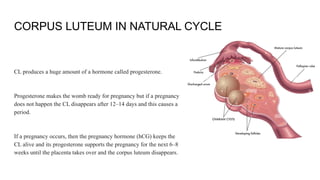
CORPUS LUTEUM IN NATURAL CYCLE
CL produces a huge amount of a hormone called progesterone.
Progesterone makes the womb ready for pregnancy but if a pregnancy
does not happen the CL disappears after 12–14 days and this causes a
period.
If a pregnancy occurs, then the pregnancy hormone (hCG) keeps the
CL alive and its progesterone supports the pregnancy for the next 6–8
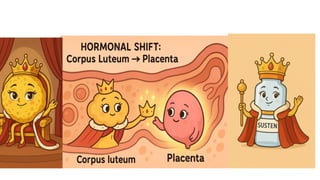
weeks until the placenta takes over and the corpus luteum disappears.
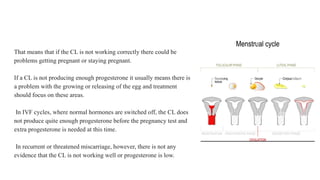
That means that if the CL is not working correctly there could be
problems getting pregnant or staying pregnant.
If a CL is not producing enough progesterone it usually means there is
a problem with the growing or releasing of the egg and treatment
should focus on these areas.
In IVF cycles, where normal hormones are switched off, the CL does
not produce quite enough progesterone before the pregnancy test and
extra progesterone is needed at this time.
In recurrent or threatened miscarriage, however, there is not any
evidence that the CL is not working well or progesterone is low.
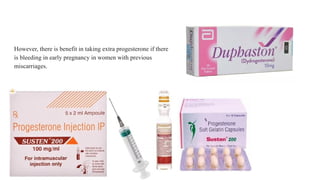
However, there is benefit in taking extra progesterone if there
is bleeding in early pregnancy in women with previous
miscarriages.
IVF AND LPD
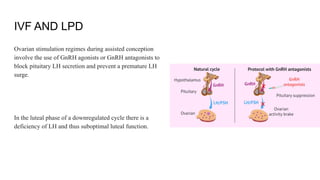
Ovarian stimulation regimes during assisted conception
involve the use of GnRH agonists or GnRH antagonists to
block pituitary LH secretion and prevent a premature LH
surge.
In the luteal phase of a downregulated cycle there is a
deficiency of LH and thus suboptimal luteal function.
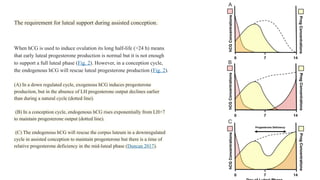
The requirement for luteal support during assisted conception.
When hCG is used to induce ovulation its long half-life (>24 h) means
that early luteal progesterone production is normal but it is not enough
to support a full luteal phase (Fig. 2). However, in a conception cycle,
the endogenous hCG will rescue luteal progesterone production (Fig. 2).
(A) In a down regulated cycle, exogenous hCG induces progesterone
production, but in the absence of LH progesterone output declines earlier
than during a natural cycle (dotted line).
(B) In a conception cycle, endogenous hCG rises exponentially from LH+7
to maintain progesterone output (dotted line).
(C) The endogenous hCG will rescue the corpus luteum in a downregulated
cycle in assisted conception to maintain progesterone but there is a time of
relative progesterone deficiency in the mid-luteal phase (Duncan 2017).
FRESH EMBRYO TRANSFER
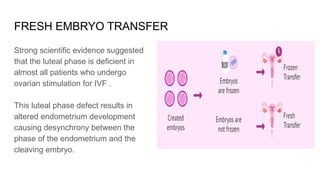
Strong scientific evidence suggested
that the luteal phase is deficient in
almost all patients who undergo
ovarian stimulation for IVF .
This luteal phase defect results in
altered endometrium development
causing desynchrony between the
phase of the endometrium and the
cleaving embryo.
As suggested by the European Society of
Human Reproduction and Embryology (ESHRE)
guidelines,
With regard to the timing of LPS, progesterone
supplementation should be started in the interval
between the evening of the day of oocyte
retrieval and day 3 post oocyte retrieval (19–23)
while starting progesterone before oocyte
retrieval should be discouraged (24)
Hence susten is to be started on day 0 of the cycle that day of oocyte pick up
Better to check p4 before trigger to ensure that Lh surge has not occurred before
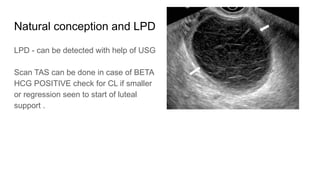
Natural conception and LPD
LPD - can be detected with help of USG
Scan TAS can be done in case of BETA
HCG POSITIVE check for CL if smaller
or regression seen to start of luteal
support .
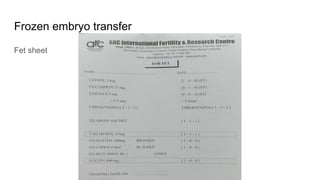
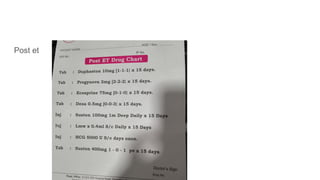
Frozen embryo transfer
Fet sheet
Post et
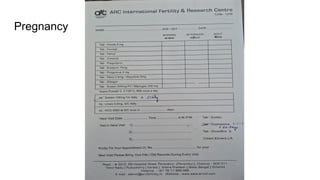
Pregnancy
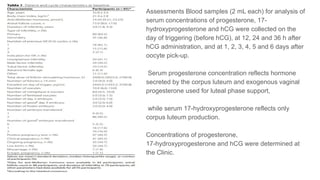
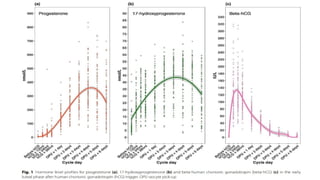
Assessments Blood samples (2 mL each) for analysis of
serum concentrations of progesterone, 17-
hydroxyprogesterone and hCG were collected on the
day of triggering (before hCG), at 12, 24 and 36 h after
hCG administration, and at 1, 2, 3, 4, 5 and 6 days after
oocyte pick-up.
Serum progesterone concentration reflects hormone
secreted by the corpus luteum and exogenous vaginal
progesterone used for luteal phase support,
while serum 17-hydroxyprogesterone reflects only
corpus luteum production.
Concentrations of progesterone,
17-hydroxyprogesterone and hCG were determined at
the Clinic.
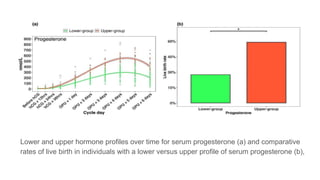
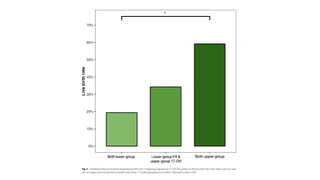
Lower and upper hormone profiles over time for serum progesterone (a) and comparative
rates of live birth in individuals with a lower versus upper profile of serum progesterone (b),
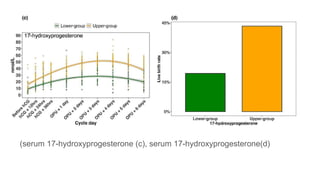
(serum 17-hydroxyprogesterone (c), serum 17-hydroxyprogesterone(d)
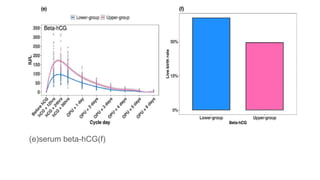
(e)serum beta-hCG(f)
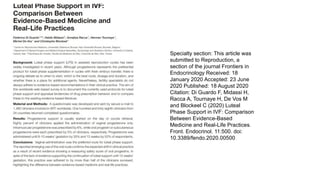
Specialty section: This article was
submitted to Reproduction, a
section of the journal Frontiers in
Endocrinology Received: 18
January 2020 Accepted: 23 June
2020 Published: 18 August 2020
Citation: Di Guardo F, Midassi H,
Racca A, Tournaye H, De Vos M
and Blockeel C (2020) Luteal
Phase Support in IVF: Comparison
Between Evidence-Based
Medicine and Real-Life Practices.
Front. Endocrinol. 11:500. doi:
10.3389/fendo.2020.00500
LUTEAL PHASE IMPORTANCE IN CONCEPTION.pptx

LUTEAL PHASE IMPORTANCE IN CONCEPTION.pptx

  • 1.
  • 3.
    •The luteal phaseis the second part of the menstrual cycle, occurring after ovulation and before the start of the next period. •During this phase, a structure called the corpus luteum forms and produces progesterone to thicken the uterine lining, preparing the uterus for a potential pregnancy. If pregnancy does not occur, hormone levels drop, and the uterine lining sheds, resulting in menstruation.
  • 6.
    HOW DOES CORPUSLUTEUM WORKS The corpus luteum is absolutely dependent on ligand stimulation of membrane LHCGR, by luteinising hormone (LH) or human chorionic gonadotropin (hCG), in three ways. FIRST - It is the surge of LH at ovulation that is responsible for luteinisation of the follicular granulosa cells. Granulosa cells become terminally differentiated, unable to divide further, undergo hypertrophy, start to express the enzymatic machinery to be able to synthesise progesterone and develop lipid droplets in their cytoplasm, giving them a golden yellow colour.
  • 7.
    SECOND The second isits maintenance as luteal progesterone production is absolutely dependent on LHCGR stimulation.
  • 8.
    THIRD The third isduring maternal recognition of pregnancy where hCG from the implanting blastocyst, in exponentially increasing concentrations, rescues the corpus luteum from luteolysis to maintain luteal progesterone until the luteo placental shift around 8–9 weeks of gestation (Duncan 2017).
  • 9.
    SHORT LUTEAL PHASE Shortluteal phase A luteal phase that lasts less than 10 days is a short luteal phase. A short luteal phase doesn’t allow uterine lining to grow and thicken enough to support an embryo. As a result, people with a short luteal phase may struggle to get pregnant. A short luteal phase can also be a sign of a luteal phase defect (LPD).
  • 10.
    Long luteal phase Longluteal phase A long luteal phase is the opposite of a short luteal phase. It means period comes 18 days or later after ovulation. People with a long luteal phase may have a hormonal imbalance like PCOS (polycystic ovary syndrome).
  • 11.
    CORPUS LUTEUM INNATURAL CYCLE CL produces a huge amount of a hormone called progesterone. Progesterone makes the womb ready for pregnancy but if a pregnancy does not happen the CL disappears after 12–14 days and this causes a period. If a pregnancy occurs, then the pregnancy hormone (hCG) keeps the CL alive and its progesterone supports the pregnancy for the next 6–8 weeks until the placenta takes over and the corpus luteum disappears.
  • 12.
    That means thatif the CL is not working correctly there could be problems getting pregnant or staying pregnant. If a CL is not producing enough progesterone it usually means there is a problem with the growing or releasing of the egg and treatment should focus on these areas. In IVF cycles, where normal hormones are switched off, the CL does not produce quite enough progesterone before the pregnancy test and extra progesterone is needed at this time. In recurrent or threatened miscarriage, however, there is not any evidence that the CL is not working well or progesterone is low.
  • 13.
    However, there isbenefit in taking extra progesterone if there is bleeding in early pregnancy in women with previous miscarriages.
  • 15.
    IVF AND LPD Ovarianstimulation regimes during assisted conception involve the use of GnRH agonists or GnRH antagonists to block pituitary LH secretion and prevent a premature LH surge. In the luteal phase of a downregulated cycle there is a deficiency of LH and thus suboptimal luteal function.
  • 16.
    The requirement forluteal support during assisted conception. When hCG is used to induce ovulation its long half-life (>24 h) means that early luteal progesterone production is normal but it is not enough to support a full luteal phase (Fig. 2). However, in a conception cycle, the endogenous hCG will rescue luteal progesterone production (Fig. 2). (A) In a down regulated cycle, exogenous hCG induces progesterone production, but in the absence of LH progesterone output declines earlier than during a natural cycle (dotted line). (B) In a conception cycle, endogenous hCG rises exponentially from LH+7 to maintain progesterone output (dotted line). (C) The endogenous hCG will rescue the corpus luteum in a downregulated cycle in assisted conception to maintain progesterone but there is a time of relative progesterone deficiency in the mid-luteal phase (Duncan 2017).
  • 17.
    FRESH EMBRYO TRANSFER Strongscientific evidence suggested that the luteal phase is deficient in almost all patients who undergo ovarian stimulation for IVF . This luteal phase defect results in altered endometrium development causing desynchrony between the phase of the endometrium and the cleaving embryo.
  • 18.
    As suggested bythe European Society of Human Reproduction and Embryology (ESHRE) guidelines, With regard to the timing of LPS, progesterone supplementation should be started in the interval between the evening of the day of oocyte retrieval and day 3 post oocyte retrieval (19–23) while starting progesterone before oocyte retrieval should be discouraged (24)
  • 19.
    Hence susten isto be started on day 0 of the cycle that day of oocyte pick up Better to check p4 before trigger to ensure that Lh surge has not occurred before
  • 20.
    Natural conception andLPD LPD - can be detected with help of USG Scan TAS can be done in case of BETA HCG POSITIVE check for CL if smaller or regression seen to start of luteal support .
  • 21.
  • 22.
  • 23.
  • 25.
    Assessments Blood samples(2 mL each) for analysis of serum concentrations of progesterone, 17- hydroxyprogesterone and hCG were collected on the day of triggering (before hCG), at 12, 24 and 36 h after hCG administration, and at 1, 2, 3, 4, 5 and 6 days after oocyte pick-up. Serum progesterone concentration reflects hormone secreted by the corpus luteum and exogenous vaginal progesterone used for luteal phase support, while serum 17-hydroxyprogesterone reflects only corpus luteum production. Concentrations of progesterone, 17-hydroxyprogesterone and hCG were determined at the Clinic.
  • 27.
    Lower and upperhormone profiles over time for serum progesterone (a) and comparative rates of live birth in individuals with a lower versus upper profile of serum progesterone (b),
  • 28.
    (serum 17-hydroxyprogesterone (c),serum 17-hydroxyprogesterone(d)
  • 29.
  • 31.
    Specialty section: Thisarticle was submitted to Reproduction, a section of the journal Frontiers in Endocrinology Received: 18 January 2020 Accepted: 23 June 2020 Published: 18 August 2020 Citation: Di Guardo F, Midassi H, Racca A, Tournaye H, De Vos M and Blockeel C (2020) Luteal Phase Support in IVF: Comparison Between Evidence-Based Medicine and Real-Life Practices. Front. Endocrinol. 11:500. doi: 10.3389/fendo.2020.00500