


1
๏‚žPatient selection and work-up
๏‚žOvarian stimulation
๏‚žMonitoring of follicular growth and
endometrial development
๏‚žTiming of insemination
๏‚žNumber of inseminations
๏‚žSemen preparation
๏‚žInsemination procedure
๏‚žLuteal support
๏‚žAge < 40 years
๏‚žPatient capable of spontaneous or induced
ovulation
๏‚žAtleast one patent fallopian tube with good
tubo- ovarian relationship
๏‚žSperm count of more than 10 million/ml
pre-wash or a post-wash count of >3-5
million motile sperms with percentage
motility of more than 40%
๏‚žEasy access to the uterine cavity via a
negotiable cervical canal
Controlled ovarian stimulation along with
intrauterine insemination โ€“effective form of
treatment - select group of couples.
๏‚žMale factor
๏‚žFemale factor
๏‚ž Subnormal semen parameters
oligozoospermia, asthenozoospermia,
teratozoospermia, hypospermia, highly viscous
semen
๏‚ž Retrograde ejaculation.
๏‚ž Ejaculatory failure-
๏‚ž Anatomical
๏‚ž Neurological
๏‚ž Psychological
๏‚ž Drug induced
๏‚žUnexplained infertility
๏‚žCervical factor, Antisperm antibodies
๏‚žOvulatory dysfunction (ovulating but no
pregnancy and associated with male
factor-ESHRE/ASRM)
๏‚žMinimal to mild endometriosis
๏‚žVaginismus
๏‚žAllergy to seminal plasma
๏‚ž Absentee husband
๏‚žAnti โ€“ neoplastic treatment
๏‚žVasectomy
๏‚žPoor semen parameters
๏‚žDrug therapy
๏‚žSevere abnormal semen parameters.
๏‚žAzoospermia.
๏‚žHereditary disease in male.
๏‚žRepeated failure at IVF/ICSI.
๏‚žTubal pathology
๏‚žGenital tract infection
๏‚žSevere male factor infertility
๏‚žSevere endometriosis
๏‚žGenetic abnormality in husband
๏‚žUnexplained genital tract bleeding
๏‚žOlder women more than 40 years
๏‚žMultiple failures at IUI
๏‚žOral drugs
๏‚žOral drugs with gonadotropins
๏‚žGonadotropins alone
๏‚žGonadotropins with Gnrh analogs
๏‚žGonadotropins with Gnrh antagonists
๏‚žAnovulatory women โ€“monofolliculogenisis.
๏‚žOvulatory womenโ€“ super ovulation to
increase the chance of pregnancy as more
eggs will be available for the sperms to
fertilize.
๏‚žMaximizes conception- ideally expressed
as singleton live birth at term.
๏‚žMinimizes multiple pregnancy and OHSS.
๏‚žAvoiding risks of preterm delivery, perinatal
morbidity and mortality to the neonate and
risks to the mother from OHSS
๏‚žBasic protocol
๏‚žDAY 3-5
๏‚žUltrasound- AFC , ENDO , CYST
๏‚žDose 50mg
๏‚žSexual relation every other day from day
10 onwards
๏‚žIf menses occurred within usual frame
work of 26-32 days- ovulation is assumed
to occurred.
๏‚žIf no ovulation then increase 50 mg tab
each succeeding cycle
๏‚ž Effectiveness and safety of OI are increased.
๏‚ž Starting day determined by day 2 -E2 and P4.
๏‚ž Initial dose according to body weight.
๏‚ž Monitoring by USG and E2 levels.
๏‚ž Day and Time of IUI or timed intercourse-
regulated by triggering ovulation with HCG .
๏‚ž PCOS -Ovulation in 60-80% and conception
rate of 50%-60% for upto 6 cycles
(ESHRE/ASRM GUIDELINE on PCOS-2008)
๏‚ž Overall cycle fecundability is 15%-22% in those
ovulating with CC in first 3 cycles .
(Eijkeman---Human Rep 2003)
๏‚ž Unexplained infertility-CC alone-5%, CC+IUI-
10%
(Deaton etal-fert ster 1990)
๏‚žExtended course.
๏‚žCC+ Glucocorticoids.
๏‚žPreliminary suppressive therapy.
๏‚žCC+ Insulin sensitizer .
๏‚žLetrazole / Tamoxifen.
๏‚žGonadotropin therapy .
๏‚žLOD .
๏‚ž Extended course---50% who are resistant may
respond to 7-10 day course .FDA approves only
750mg of CC per treatment cycle.
(Isac etal-Fert stert 1997).
๏‚ž CC+ Glucocorticoids
Continuous/follicular phase
Prednisolone-5mg or dexa-0.5-2mg/day -
normal or raised DHEAS level- increased
ovulation(75-80%) and pregnancy rates(40-
40.5%)
(RCT-Parsanezhad etal-fert stert 2002, human
reprod 2006 .)
๏‚ž Preliminary suppressive therapy -in
women with excess LH and androgen
levels-continuous OC pills for 2
months(70% ovulation rates and 50%
pregnancy rates)
(Branigan etal RCT Fert stert 2003)
๏‚ž Gnrh alone or in combination with OC
pill can also be used.
(Genazzaniโ€”J Asst rep gen 2000)
๏‚ž No evidence of difference in live birth
rate comparing Metformin plus CC with
CC alone(meta analysis 2007 ).
๏‚ž Highly effective in achieving ovulation
induction in CC resistant cases (fertil
steril 2006 )
๏‚ž Metformin with gonadotropin did not
improve ovulation or pregnancy rates
but did reduce risk of OHSS. (RCT hum
reprod 2006 )
๏‚ž Metformin treatment for 12 weeks before and
during IVF or ICSI in non-obese women with
PCOS significantly increases pregnancy and
LBRs compared with placebo. However, there
was no effect on the outcome of ART per se.
(randomized,multi-centre study 2011 )
๏‚ž Metformin is still of benefit in improving clinical
pregnancy and ovulation rates although no
clear evidence exists that metformin improves
live birth rates (LBRs) whether it is used alone,
in combination with clomiphene or compared
with clomiphene. Cochrane analysis (Tang et
al., 2010)
๏‚ž May have a role in OI after CC failure or as
first line.
๏‚ž Similar in efficacy to CC in terms of ovulatory
rates.
(Nikolaos etal-systematic review reprod
biomed online-oct-2009)
๏‚ž ESHRE/ASRM consensus-
Off label option, currently not licensed for use
in infertility . Further studies are needed
regarding safety before wide spread use .
๏‚ž The long letrozole protocol (10 days)
can produce more mature follicles and
subsequently more pregnancies than
the short letrozole therapy (5 days).
(Fertil Steril_ 2009 )
๏‚ž use of higher doses of letrozole offers
no advantage in terms of pregnancy
rates over the lower (2.5 mg)
dose(2007 Reproductive BioMedicine)
๏‚ž Aromatase inhibitors are as effective as
or superior to CC in ovulation induction
and in superovulation. Unlike CC, they
do not carry an antiestrogenic effect on
the endometrium. Given the
advantages of aromatase inhibitors,
they can be used to replace CC as
ovulation-inducing drugs. (Fertil Steril_
2006.)
๏‚ž The step-up letrozole protocol was
associated with multifollicular ovarian
development similar to CC. Higher
clinical pregnancy rate/treatment cycle
compared with CC was also observed
with the letrozole step-up treatment
(27.3% vs. 11.8%).
๏‚ž Pregnancy rates treated with CC and
LET were identical . (RCT FERTIL STER
2007 )
๏‚ž Concurrent protocol
๏‚ž Overlap protocol
๏‚ž Sequential protocol
๏‚ž Cycle fecundability better than CC alone
(Dickey et al-Human rep 1993)
๏‚ž Monitoring similar to gonadotropin cycle
๏‚ž Lower incidence of multiple pregnancy
(Ron et al Human rep 1989)
๏‚ž GROUP I
๏‚ž CC RESISTANT(15-25%)
๏‚ž 50% of PCOS women who have undergone LOD
need CC or gonadotropin
๏‚ž If no ovulation after 6 months use CC for
stimulation (ESHRE/ASRM in PCOS-2008).
๏‚ž CLASS IV - if intolerant to dopamine agonists.
๏‚žConventional step up
๏‚žLow dose protocol
Step up
Step down
๏‚žSequential protocol
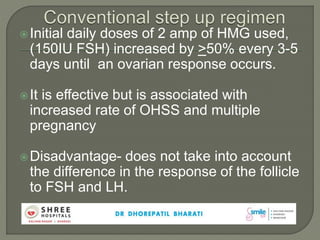
๏‚žInitial daily doses of 2 amp of HMG used,
(150IU FSH) increased by >50% every 3-5
days until an ovarian response occurs.
๏‚žIt is effective but is associated with
increased rate of OHSS and multiple
pregnancy
๏‚žDisadvantage- does not take into account
the difference in the response of the follicle
to FSH and LH.
Low dose regimens
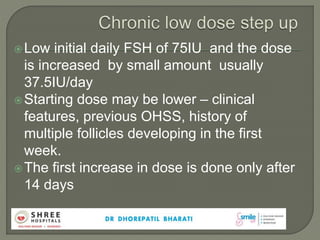
๏‚žLow initial daily FSH of 75IU and the dose
is increased by small amount usually
37.5IU/day
๏‚žStarting dose may be lower โ€“ clinical
features, previous OHSS, history of
multiple follicles developing in the first
week.
๏‚žThe first increase in dose is done only after
14 days
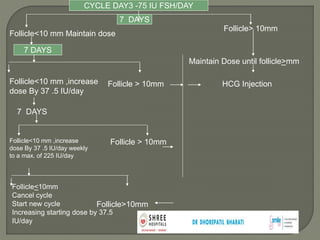
CYCLE DAY3 -75 IU FSH/DAY
7 DAYS
7 DAYS
Follicle<10 mm Maintain dose
Follicle<10 mm ,increase
dose By 37 .5 IU/day
Follicle > 10mm
Follicle> 10mm
Maintain Dose until follicle>mm
HCG Injection
7 DAYS
Follicle<10 mm ,increase
dose By 37 .5 IU/day weekly
to a max. of 225 IU/day
Follicle > 10mm
Follicle<10mm
Cancel cycle
Start new cycle
Increasing starting dose by 37.5
IU/day
Follicle>10mm
๏‚ž Gonadotropins have a very narrow therapeutic
range.
๏‚ž These regimens allow FSH to rise slowly to just
above the threshold level and at the same time
avoiding the explosive ovarian response.-
Threshold concept(BROWN etal)
๏‚ž Initiation of follicular growth requires only 10-
30% of increase in the dose of exogenous FSH
๏‚žLow complications of OHSS and multiple
pregnancy and fair pregnancy rates.
๏‚žPregnancy rate of 10% per initiated cycle
with a mean rate of 0.3% of higher order
multiple pregnancy.
(Ragni etal-6670 IUI cycles-Fert ster
2006)
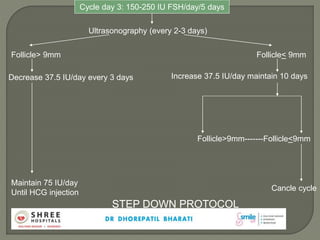
Cycle day 3: 150-250 IU FSH/day/5 days
Ultrasonography (every 2-3 days)
Follicle> 9mm Follicle< 9mm
Decrease 37.5 IU/day every 3 days Increase 37.5 IU/day maintain 10 days
Maintain 75 IU/day
Until HCG injection
Follicle>9mm-------Follicle<9mm
Cancle cycle
STEP DOWN PROTOCOL
๏‚žConcept-approximate physiologic
circumstances mimicking natural intercycle
FSH elevation and the subsequent
decreasing dependence of the DF on FSH.
๏‚žDuration rather than the magnitude of FSH
increase affects follicle development
๏‚žMonitoring is more intense .
๏‚žDifficult to judge the correct dose reduction
in daily clinical practice.
๏‚žProtocol is effective but the rate of OHSS
is more compared to step up regimen.
๏‚ž Low dose step up regimens are superior to step down
regimens in terms of mono folliculogenisis, ovulation
rates and ovarian hyperstimulation in PCOS
(Christian Maitre โ€“RCT stepup Vs stepdown in PCOS-
Huma rep-2003)
๏‚ž Step up regimen-duration of therapy and the amount of
gonadotropins required are more compared to step down
regimens
๏‚ž Even in step up regimens results are better if the starting
dose is low and the increments are also smaller doses
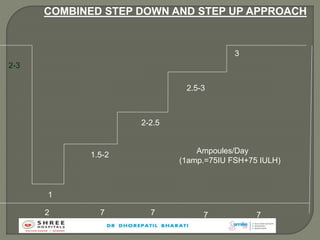
Combines an initial step up followed by a
step down regimen after follicular selection
(leading follicle >14mm ).
2-3
1
1.5-2
2-2.5
2.5-3
3
Ampoules/Day
(1amp.=75IU FSH+75 IULH)
COMBINED STEP DOWN AND STEP UP APPROACH
2 7 7 7 7
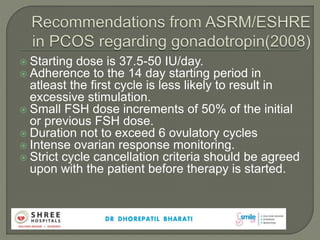
๏‚ž Starting dose is 37.5-50 IU/day.
๏‚ž Adherence to the 14 day starting period in
atleast the first cycle is less likely to result in
excessive stimulation.
๏‚ž Small FSH dose increments of 50% of the initial
or previous FSH dose.
๏‚ž Duration not to exceed 6 ovulatory cycles
๏‚ž Intense ovarian response monitoring.
๏‚ž Strict cycle cancellation criteria should be agreed
upon with the patient before therapy is started.
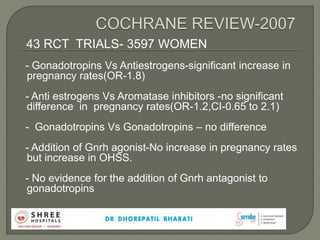
43 RCT TRIALS- 3597 WOMEN
- Gonadotropins Vs Antiestrogens-significant increase in
pregnancy rates(OR-1.8)
- Anti estrogens Vs Aromatase inhibitors -no significant
difference in pregnancy rates(OR-1.2,CI-0.65 to 2.1)
- Gonadotropins Vs Gonadotropins โ€“ no difference
- Addition of Gnrh agonist-No increase in pregnancy rates
but increase in OHSS.
- No evidence for the addition of Gnrh antagonist to
gonadotropins
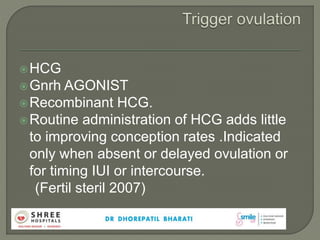
๏‚žHCG
๏‚žGnrh AGONIST
๏‚žRecombinant HCG.
๏‚žRoutine administration of HCG adds little
to improving conception rates .Indicated
only when absent or delayed ovulation or
for timing IUI or intercourse.
(Fertil steril 2007)
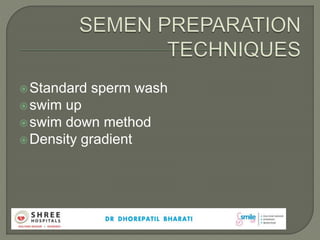
๏‚žStandard sperm wash
๏‚žswim up
๏‚žswim down method
๏‚žDensity gradient
๏‚ž Single IUI.
๏‚ž 36 hrs after HCG .
๏‚ž After follicle rupture .
๏‚ž Within 24 hrs of LH surge.
๏‚ž Double IUI.
๏‚ž At 24 and 48hrs after HCG adminst.
๏‚ž Day 6 and day 8 of last pill .
๏‚ž NO statistical difference in pregnancy rates in
different timing regimens.
(Esra et al โ€“Fert ster 2009)
๏‚ž RATIONALE-increase opportunity for longer
fertilisation period (22-47hrs).
๏‚ž No clear benefit in terms of LBR.
(TafunBagis etal-Human rep ,may 2010)
๏‚ž Systematic review of 3RCT-No difference.
(NICE guideline-fertility-2004)
๏‚ž No clear benefit in terms of pregnancy rates.
(meta analysis-Nikalaos-Fert stert Aug.2009.)
๏‚žPre- ovulatory USG.
Fresh unwashed semen- 6-8 hrs before
ovulation.
Washed semen โ€“No sooner than 4 hrs
after ovulation.
Cryopreserved semen โ€“ As close to
ovulation.
๏‚žLH testing kit.
Within 24 hrs of color change .
๏‚žIntra vaginal insemination
๏‚žIntra cervical insemination
๏‚žIntra uterine insemination
๏‚žIntra uterine tuboperitoneal insemination
๏‚žDirect intra peritoneal insemination
๏‚žFallopian tube perfusion .
๏‚žThe patient is positioned .
๏‚žCervix exposed with cuscos bivavle
speculum, excessive vaginal secretions
are wiped away and the cervical os is
cleansed with the standard buffer solution
using a cotton swab.
๏‚žIUI cannula is flushed with 1-2 ml of
flushing media to wash away any toxic
factors present.
๏‚ž Specimen ( 0.4- 0.5ml) drawn into the
catheter and syringe.
๏‚ž The catheter is gently introduced into the
cervix to pass beyond cervical os until the
catheter enters the uterus.
๏‚ž The catheter is advanced to a depth of at
least 4cm but no more than 6cm to avoid
trauma to the endometrium
๏‚ž When the catheter is in place and before
ejecting the specimen , the opened forceps is
positioned on either side of the cervix and the
opposing ends gently squeezed together with
just enough pressure to prevent fluid
escaping .
โ€ข The specimen is slowly ejected from the
syringe.
โ€ข The air remaining in the syringe is
expressed as the catheter is withdrawn, to
form an air block in the cervix.
โ€ข Pressure on the forceps should be
maintained until the cramping subsides,
usually within one minute
๏‚ž2 ml of buffered solution is drawn up into
the syringe before drawing up the
specimen suspended in 0.4- 0.5ml wash
media
๏‚žThe specimen and buffered solution are
injected slowly
๏‚žThe specimen propelled by the 2ml of
media, will fill the endometrial cavity and
partially fill the fallopian tubes.
๏‚žFSP involves injecting 4.0 or 6.0 ml of a
washed specimen under pressure while
sealing the cervix to prevent reflux.
๏‚žIncreasing the insemination volume to 10
ml ensures peritoneal delivery of sperm
๏‚žFSP resulted in significantly higher
pregnancy rates than IUI. ( cochrane
database 2004 ).
15 min of bed rest after IUI has shown to
improve ongoing pregnancy and LBR
(RCT-Custers etal BMJ2009).
๏‚ž 08 -14% per cycle for all causes of infertility.
๏‚ž Semen parameters- count , motility and
morphology
(Van etalโ€”fert&ster 2001)
(lee etal โ€“int.j.andr,2002)
๏‚žAge
๏‚žSemen source and quality
๏‚žNo of follicles
๏‚žReason for treatment
๏‚žPrevious treatment cycles
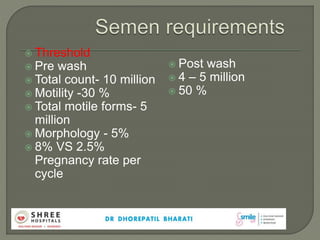
๏‚ž Threshold
๏‚ž Pre wash
๏‚ž Total count- 10 million
๏‚ž Motility -30 %
๏‚ž Total motile forms- 5
million
๏‚ž Morphology - 5%
๏‚ž 8% VS 2.5%
Pregnancy rate per
cycle
๏‚ž Post wash
๏‚ž 4 โ€“ 5 million
๏‚ž 50 %
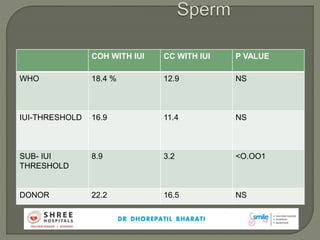
COH WITH IUI CC WITH IUI P VALUE
WHO 18.4 % 12.9 NS
IUI-THRESHOLD 16.9 11.4 NS
SUB- IUI
THRESHOLD
8.9 3.2 <O.OO1
DONOR 22.2 16.5 NS
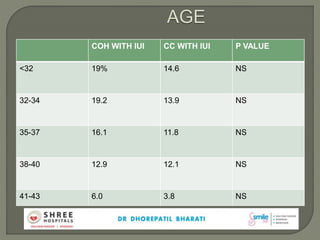
COH WITH IUI CC WITH IUI P VALUE
<32 19% 14.6 NS
32-34 19.2 13.9 NS
35-37 16.1 11.8 NS
38-40 12.9 12.1 NS
41-43 6.0 3.8 NS
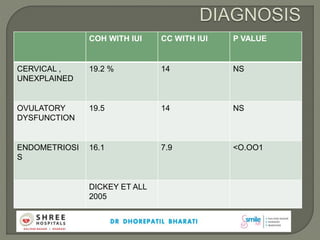
COH WITH IUI CC WITH IUI P VALUE
CERVICAL ,
UNEXPLAINED
19.2 % 14 NS
OVULATORY
DYSFUNCTION
19.5 14 NS
ENDOMETRIOSI
S
16.1 7.9 <O.OO1
DICKEY ET ALL
2005
COH WITH IUI CC WITH IUI P VALUE
1 11.3 % 9.8 NS
2 13.2 14.3 NS
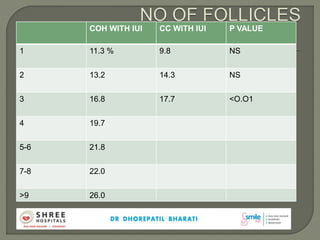
3 16.8 17.7 <O.O1
4 19.7
5-6 21.8
7-8 22.0
>9 26.0
COH WITH IUI CC WITH IUI P VALUE
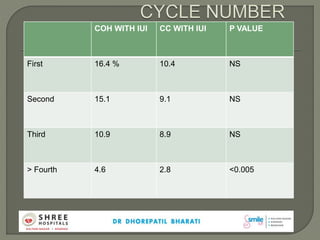
First 16.4 % 10.4 NS
Second 15.1 9.1 NS
Third 10.9 8.9 NS
> Fourth 4.6 2.8 <0.005
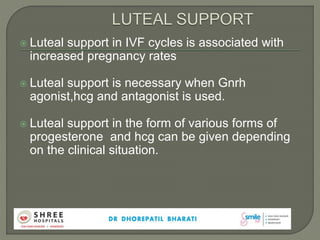
๏‚ž Luteal support in IVF cycles is associated with
increased pregnancy rates
๏‚ž Luteal support is necessary when Gnrh
agonist,hcg and antagonist is used.
๏‚ž Luteal support in the form of various forms of
progesterone and hcg can be given depending
on the clinical situation.
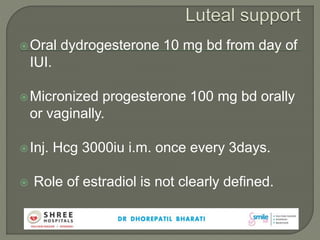
๏‚žOral dydrogesterone 10 mg bd from day of
IUI.
๏‚žMicronized progesterone 100 mg bd orally
or vaginally.
๏‚žInj. Hcg 3000iu i.m. once every 3days.
๏‚ž Role of estradiol is not clearly defined.
๏‚žFailure of treatment
๏‚žPelvic infection: 0.01-0.2%
๏‚žUterine contractions and anaphylaxis
๏‚žOHSS < 1%
๏‚žMultiple pregnancy
๏‚žEctopic pregnancy
๏‚žMiscarriages
๏‚žPain and vaso vagal attack
๏‚ž THANK YOU
68

Controlled Ovarian Hyperstimulation With IUI

  • 1.
  • 3.
    ๏‚žPatient selection andwork-up ๏‚žOvarian stimulation ๏‚žMonitoring of follicular growth and endometrial development ๏‚žTiming of insemination ๏‚žNumber of inseminations ๏‚žSemen preparation ๏‚žInsemination procedure ๏‚žLuteal support
  • 4.
    ๏‚žAge < 40years ๏‚žPatient capable of spontaneous or induced ovulation ๏‚žAtleast one patent fallopian tube with good tubo- ovarian relationship ๏‚žSperm count of more than 10 million/ml pre-wash or a post-wash count of >3-5 million motile sperms with percentage motility of more than 40% ๏‚žEasy access to the uterine cavity via a negotiable cervical canal
  • 5.
    Controlled ovarian stimulationalong with intrauterine insemination โ€“effective form of treatment - select group of couples.
  • 6.
  • 7.
    ๏‚ž Subnormal semenparameters oligozoospermia, asthenozoospermia, teratozoospermia, hypospermia, highly viscous semen ๏‚ž Retrograde ejaculation. ๏‚ž Ejaculatory failure- ๏‚ž Anatomical ๏‚ž Neurological ๏‚ž Psychological ๏‚ž Drug induced
  • 8.
    ๏‚žUnexplained infertility ๏‚žCervical factor,Antisperm antibodies ๏‚žOvulatory dysfunction (ovulating but no pregnancy and associated with male factor-ESHRE/ASRM) ๏‚žMinimal to mild endometriosis ๏‚žVaginismus ๏‚žAllergy to seminal plasma
  • 9.
    ๏‚ž Absentee husband ๏‚žAntiโ€“ neoplastic treatment ๏‚žVasectomy ๏‚žPoor semen parameters ๏‚žDrug therapy
  • 10.
    ๏‚žSevere abnormal semenparameters. ๏‚žAzoospermia. ๏‚žHereditary disease in male. ๏‚žRepeated failure at IVF/ICSI.
  • 11.
    ๏‚žTubal pathology ๏‚žGenital tractinfection ๏‚žSevere male factor infertility ๏‚žSevere endometriosis ๏‚žGenetic abnormality in husband ๏‚žUnexplained genital tract bleeding ๏‚žOlder women more than 40 years ๏‚žMultiple failures at IUI
  • 12.
    ๏‚žOral drugs ๏‚žOral drugswith gonadotropins ๏‚žGonadotropins alone ๏‚žGonadotropins with Gnrh analogs ๏‚žGonadotropins with Gnrh antagonists
  • 13.
    ๏‚žAnovulatory women โ€“monofolliculogenisis. ๏‚žOvulatorywomenโ€“ super ovulation to increase the chance of pregnancy as more eggs will be available for the sperms to fertilize.
  • 14.
    ๏‚žMaximizes conception- ideallyexpressed as singleton live birth at term. ๏‚žMinimizes multiple pregnancy and OHSS. ๏‚žAvoiding risks of preterm delivery, perinatal morbidity and mortality to the neonate and risks to the mother from OHSS
  • 15.
    ๏‚žBasic protocol ๏‚žDAY 3-5 ๏‚žUltrasound-AFC , ENDO , CYST ๏‚žDose 50mg ๏‚žSexual relation every other day from day 10 onwards ๏‚žIf menses occurred within usual frame work of 26-32 days- ovulation is assumed to occurred. ๏‚žIf no ovulation then increase 50 mg tab each succeeding cycle
  • 16.
    ๏‚ž Effectiveness andsafety of OI are increased. ๏‚ž Starting day determined by day 2 -E2 and P4. ๏‚ž Initial dose according to body weight. ๏‚ž Monitoring by USG and E2 levels. ๏‚ž Day and Time of IUI or timed intercourse- regulated by triggering ovulation with HCG .
  • 17.
    ๏‚ž PCOS -Ovulationin 60-80% and conception rate of 50%-60% for upto 6 cycles (ESHRE/ASRM GUIDELINE on PCOS-2008) ๏‚ž Overall cycle fecundability is 15%-22% in those ovulating with CC in first 3 cycles . (Eijkeman---Human Rep 2003) ๏‚ž Unexplained infertility-CC alone-5%, CC+IUI- 10% (Deaton etal-fert ster 1990)
  • 18.
    ๏‚žExtended course. ๏‚žCC+ Glucocorticoids. ๏‚žPreliminarysuppressive therapy. ๏‚žCC+ Insulin sensitizer . ๏‚žLetrazole / Tamoxifen. ๏‚žGonadotropin therapy . ๏‚žLOD .
  • 19.
    ๏‚ž Extended course---50%who are resistant may respond to 7-10 day course .FDA approves only 750mg of CC per treatment cycle. (Isac etal-Fert stert 1997). ๏‚ž CC+ Glucocorticoids Continuous/follicular phase Prednisolone-5mg or dexa-0.5-2mg/day - normal or raised DHEAS level- increased ovulation(75-80%) and pregnancy rates(40- 40.5%) (RCT-Parsanezhad etal-fert stert 2002, human reprod 2006 .)
  • 20.
    ๏‚ž Preliminary suppressivetherapy -in women with excess LH and androgen levels-continuous OC pills for 2 months(70% ovulation rates and 50% pregnancy rates) (Branigan etal RCT Fert stert 2003) ๏‚ž Gnrh alone or in combination with OC pill can also be used. (Genazzaniโ€”J Asst rep gen 2000)
  • 21.
    ๏‚ž No evidenceof difference in live birth rate comparing Metformin plus CC with CC alone(meta analysis 2007 ). ๏‚ž Highly effective in achieving ovulation induction in CC resistant cases (fertil steril 2006 ) ๏‚ž Metformin with gonadotropin did not improve ovulation or pregnancy rates but did reduce risk of OHSS. (RCT hum reprod 2006 )
  • 22.
    ๏‚ž Metformin treatmentfor 12 weeks before and during IVF or ICSI in non-obese women with PCOS significantly increases pregnancy and LBRs compared with placebo. However, there was no effect on the outcome of ART per se. (randomized,multi-centre study 2011 ) ๏‚ž Metformin is still of benefit in improving clinical pregnancy and ovulation rates although no clear evidence exists that metformin improves live birth rates (LBRs) whether it is used alone, in combination with clomiphene or compared with clomiphene. Cochrane analysis (Tang et al., 2010)
  • 23.
    ๏‚ž May havea role in OI after CC failure or as first line. ๏‚ž Similar in efficacy to CC in terms of ovulatory rates. (Nikolaos etal-systematic review reprod biomed online-oct-2009) ๏‚ž ESHRE/ASRM consensus- Off label option, currently not licensed for use in infertility . Further studies are needed regarding safety before wide spread use .
  • 24.
    ๏‚ž The longletrozole protocol (10 days) can produce more mature follicles and subsequently more pregnancies than the short letrozole therapy (5 days). (Fertil Steril_ 2009 ) ๏‚ž use of higher doses of letrozole offers no advantage in terms of pregnancy rates over the lower (2.5 mg) dose(2007 Reproductive BioMedicine)
  • 25.
    ๏‚ž Aromatase inhibitorsare as effective as or superior to CC in ovulation induction and in superovulation. Unlike CC, they do not carry an antiestrogenic effect on the endometrium. Given the advantages of aromatase inhibitors, they can be used to replace CC as ovulation-inducing drugs. (Fertil Steril_ 2006.)
  • 26.
    ๏‚ž The step-upletrozole protocol was associated with multifollicular ovarian development similar to CC. Higher clinical pregnancy rate/treatment cycle compared with CC was also observed with the letrozole step-up treatment (27.3% vs. 11.8%). ๏‚ž Pregnancy rates treated with CC and LET were identical . (RCT FERTIL STER 2007 )
  • 27.
    ๏‚ž Concurrent protocol ๏‚žOverlap protocol ๏‚ž Sequential protocol ๏‚ž Cycle fecundability better than CC alone (Dickey et al-Human rep 1993) ๏‚ž Monitoring similar to gonadotropin cycle ๏‚ž Lower incidence of multiple pregnancy (Ron et al Human rep 1989)
  • 28.
    ๏‚ž GROUP I ๏‚žCC RESISTANT(15-25%) ๏‚ž 50% of PCOS women who have undergone LOD need CC or gonadotropin ๏‚ž If no ovulation after 6 months use CC for stimulation (ESHRE/ASRM in PCOS-2008). ๏‚ž CLASS IV - if intolerant to dopamine agonists.
  • 29.
    ๏‚žConventional step up ๏‚žLowdose protocol Step up Step down ๏‚žSequential protocol
  • 30.
    ๏‚žInitial daily dosesof 2 amp of HMG used, (150IU FSH) increased by >50% every 3-5 days until an ovarian response occurs. ๏‚žIt is effective but is associated with increased rate of OHSS and multiple pregnancy ๏‚žDisadvantage- does not take into account the difference in the response of the follicle to FSH and LH.
  • 31.
  • 32.
    ๏‚žLow initial dailyFSH of 75IU and the dose is increased by small amount usually 37.5IU/day ๏‚žStarting dose may be lower โ€“ clinical features, previous OHSS, history of multiple follicles developing in the first week. ๏‚žThe first increase in dose is done only after 14 days
  • 33.
    CYCLE DAY3 -75IU FSH/DAY 7 DAYS 7 DAYS Follicle<10 mm Maintain dose Follicle<10 mm ,increase dose By 37 .5 IU/day Follicle > 10mm Follicle> 10mm Maintain Dose until follicle>mm HCG Injection 7 DAYS Follicle<10 mm ,increase dose By 37 .5 IU/day weekly to a max. of 225 IU/day Follicle > 10mm Follicle<10mm Cancel cycle Start new cycle Increasing starting dose by 37.5 IU/day Follicle>10mm
  • 34.
    ๏‚ž Gonadotropins havea very narrow therapeutic range. ๏‚ž These regimens allow FSH to rise slowly to just above the threshold level and at the same time avoiding the explosive ovarian response.- Threshold concept(BROWN etal) ๏‚ž Initiation of follicular growth requires only 10- 30% of increase in the dose of exogenous FSH
  • 35.
    ๏‚žLow complications ofOHSS and multiple pregnancy and fair pregnancy rates. ๏‚žPregnancy rate of 10% per initiated cycle with a mean rate of 0.3% of higher order multiple pregnancy. (Ragni etal-6670 IUI cycles-Fert ster 2006)
  • 36.
    Cycle day 3:150-250 IU FSH/day/5 days Ultrasonography (every 2-3 days) Follicle> 9mm Follicle< 9mm Decrease 37.5 IU/day every 3 days Increase 37.5 IU/day maintain 10 days Maintain 75 IU/day Until HCG injection Follicle>9mm-------Follicle<9mm Cancle cycle STEP DOWN PROTOCOL
  • 37.
    ๏‚žConcept-approximate physiologic circumstances mimickingnatural intercycle FSH elevation and the subsequent decreasing dependence of the DF on FSH. ๏‚žDuration rather than the magnitude of FSH increase affects follicle development
  • 38.
    ๏‚žMonitoring is moreintense . ๏‚žDifficult to judge the correct dose reduction in daily clinical practice. ๏‚žProtocol is effective but the rate of OHSS is more compared to step up regimen.
  • 39.
    ๏‚ž Low dosestep up regimens are superior to step down regimens in terms of mono folliculogenisis, ovulation rates and ovarian hyperstimulation in PCOS (Christian Maitre โ€“RCT stepup Vs stepdown in PCOS- Huma rep-2003) ๏‚ž Step up regimen-duration of therapy and the amount of gonadotropins required are more compared to step down regimens ๏‚ž Even in step up regimens results are better if the starting dose is low and the increments are also smaller doses
  • 40.
    Combines an initialstep up followed by a step down regimen after follicular selection (leading follicle >14mm ).
  • 41.
  • 42.
    ๏‚ž Starting doseis 37.5-50 IU/day. ๏‚ž Adherence to the 14 day starting period in atleast the first cycle is less likely to result in excessive stimulation. ๏‚ž Small FSH dose increments of 50% of the initial or previous FSH dose. ๏‚ž Duration not to exceed 6 ovulatory cycles ๏‚ž Intense ovarian response monitoring. ๏‚ž Strict cycle cancellation criteria should be agreed upon with the patient before therapy is started.
  • 43.
    43 RCT TRIALS-3597 WOMEN - Gonadotropins Vs Antiestrogens-significant increase in pregnancy rates(OR-1.8) - Anti estrogens Vs Aromatase inhibitors -no significant difference in pregnancy rates(OR-1.2,CI-0.65 to 2.1) - Gonadotropins Vs Gonadotropins โ€“ no difference - Addition of Gnrh agonist-No increase in pregnancy rates but increase in OHSS. - No evidence for the addition of Gnrh antagonist to gonadotropins
  • 44.
    ๏‚žHCG ๏‚žGnrh AGONIST ๏‚žRecombinant HCG. ๏‚žRoutineadministration of HCG adds little to improving conception rates .Indicated only when absent or delayed ovulation or for timing IUI or intercourse. (Fertil steril 2007)
  • 45.
    ๏‚žStandard sperm wash ๏‚žswimup ๏‚žswim down method ๏‚žDensity gradient
  • 46.
    ๏‚ž Single IUI. ๏‚ž36 hrs after HCG . ๏‚ž After follicle rupture . ๏‚ž Within 24 hrs of LH surge. ๏‚ž Double IUI. ๏‚ž At 24 and 48hrs after HCG adminst. ๏‚ž Day 6 and day 8 of last pill . ๏‚ž NO statistical difference in pregnancy rates in different timing regimens. (Esra et al โ€“Fert ster 2009)
  • 47.
    ๏‚ž RATIONALE-increase opportunityfor longer fertilisation period (22-47hrs). ๏‚ž No clear benefit in terms of LBR. (TafunBagis etal-Human rep ,may 2010) ๏‚ž Systematic review of 3RCT-No difference. (NICE guideline-fertility-2004) ๏‚ž No clear benefit in terms of pregnancy rates. (meta analysis-Nikalaos-Fert stert Aug.2009.)
  • 48.
    ๏‚žPre- ovulatory USG. Freshunwashed semen- 6-8 hrs before ovulation. Washed semen โ€“No sooner than 4 hrs after ovulation. Cryopreserved semen โ€“ As close to ovulation. ๏‚žLH testing kit. Within 24 hrs of color change .
  • 49.
    ๏‚žIntra vaginal insemination ๏‚žIntracervical insemination ๏‚žIntra uterine insemination ๏‚žIntra uterine tuboperitoneal insemination ๏‚žDirect intra peritoneal insemination ๏‚žFallopian tube perfusion .
  • 50.
    ๏‚žThe patient ispositioned . ๏‚žCervix exposed with cuscos bivavle speculum, excessive vaginal secretions are wiped away and the cervical os is cleansed with the standard buffer solution using a cotton swab. ๏‚žIUI cannula is flushed with 1-2 ml of flushing media to wash away any toxic factors present.
  • 51.
    ๏‚ž Specimen (0.4- 0.5ml) drawn into the catheter and syringe. ๏‚ž The catheter is gently introduced into the cervix to pass beyond cervical os until the catheter enters the uterus. ๏‚ž The catheter is advanced to a depth of at least 4cm but no more than 6cm to avoid trauma to the endometrium ๏‚ž When the catheter is in place and before ejecting the specimen , the opened forceps is positioned on either side of the cervix and the opposing ends gently squeezed together with just enough pressure to prevent fluid escaping .
  • 52.
    โ€ข The specimenis slowly ejected from the syringe. โ€ข The air remaining in the syringe is expressed as the catheter is withdrawn, to form an air block in the cervix. โ€ข Pressure on the forceps should be maintained until the cramping subsides, usually within one minute
  • 53.
    ๏‚ž2 ml ofbuffered solution is drawn up into the syringe before drawing up the specimen suspended in 0.4- 0.5ml wash media ๏‚žThe specimen and buffered solution are injected slowly ๏‚žThe specimen propelled by the 2ml of media, will fill the endometrial cavity and partially fill the fallopian tubes.
  • 54.
    ๏‚žFSP involves injecting4.0 or 6.0 ml of a washed specimen under pressure while sealing the cervix to prevent reflux. ๏‚žIncreasing the insemination volume to 10 ml ensures peritoneal delivery of sperm ๏‚žFSP resulted in significantly higher pregnancy rates than IUI. ( cochrane database 2004 ).
  • 55.
    15 min ofbed rest after IUI has shown to improve ongoing pregnancy and LBR (RCT-Custers etal BMJ2009).
  • 56.
    ๏‚ž 08 -14%per cycle for all causes of infertility. ๏‚ž Semen parameters- count , motility and morphology (Van etalโ€”fert&ster 2001) (lee etal โ€“int.j.andr,2002)
  • 57.
    ๏‚žAge ๏‚žSemen source andquality ๏‚žNo of follicles ๏‚žReason for treatment ๏‚žPrevious treatment cycles
  • 58.
    ๏‚ž Threshold ๏‚ž Prewash ๏‚ž Total count- 10 million ๏‚ž Motility -30 % ๏‚ž Total motile forms- 5 million ๏‚ž Morphology - 5% ๏‚ž 8% VS 2.5% Pregnancy rate per cycle ๏‚ž Post wash ๏‚ž 4 โ€“ 5 million ๏‚ž 50 %
  • 59.
    COH WITH IUICC WITH IUI P VALUE WHO 18.4 % 12.9 NS IUI-THRESHOLD 16.9 11.4 NS SUB- IUI THRESHOLD 8.9 3.2 <O.OO1 DONOR 22.2 16.5 NS
  • 60.
    COH WITH IUICC WITH IUI P VALUE <32 19% 14.6 NS 32-34 19.2 13.9 NS 35-37 16.1 11.8 NS 38-40 12.9 12.1 NS 41-43 6.0 3.8 NS
  • 61.
    COH WITH IUICC WITH IUI P VALUE CERVICAL , UNEXPLAINED 19.2 % 14 NS OVULATORY DYSFUNCTION 19.5 14 NS ENDOMETRIOSI S 16.1 7.9 <O.OO1 DICKEY ET ALL 2005
  • 62.
    COH WITH IUICC WITH IUI P VALUE 1 11.3 % 9.8 NS 2 13.2 14.3 NS 3 16.8 17.7 <O.O1 4 19.7 5-6 21.8 7-8 22.0 >9 26.0
  • 63.
    COH WITH IUICC WITH IUI P VALUE First 16.4 % 10.4 NS Second 15.1 9.1 NS Third 10.9 8.9 NS > Fourth 4.6 2.8 <0.005
  • 64.
    ๏‚ž Luteal supportin IVF cycles is associated with increased pregnancy rates ๏‚ž Luteal support is necessary when Gnrh agonist,hcg and antagonist is used. ๏‚ž Luteal support in the form of various forms of progesterone and hcg can be given depending on the clinical situation.
  • 65.
    ๏‚žOral dydrogesterone 10mg bd from day of IUI. ๏‚žMicronized progesterone 100 mg bd orally or vaginally. ๏‚žInj. Hcg 3000iu i.m. once every 3days. ๏‚ž Role of estradiol is not clearly defined.
  • 66.
    ๏‚žFailure of treatment ๏‚žPelvicinfection: 0.01-0.2% ๏‚žUterine contractions and anaphylaxis ๏‚žOHSS < 1% ๏‚žMultiple pregnancy ๏‚žEctopic pregnancy ๏‚žMiscarriages ๏‚žPain and vaso vagal attack
  • 67.
  • 68.