Outpass Generation with Raspberry Pi Using Arbian
Operating System
ABSTRACT
A kiosk is usually designed to perform any specific operations
like money withdrawal, ticket booking. Kiosks are mostly
designed using closed source hardwares and thus they are very
costly. Using open source platforms like Arduino and Raspberry
pi, the manufacturing cost of kiosks can be comparatively
reduced. Thus this Outpass system generates outpass with the help
of the web kiosk that run an embedded Linux operating system
(Arbian). The existing systems are E-Outpass system, E-gate, E-
gatepass for IT Park. These devices are used for product tracking,
maintaining the entry and exit of IT employees and other
organizations. These systems are kiosk machines which cannot
run like normal desktop machines. ARM based fan less processors
has revolutionized the mobile computing platform and it is fast. In
the same way, this outpass system will also invokes a kiosk
operating system which is created from the ARM based Linux
kernel and named as Arbian Operating system.
Categories and Subject Descriptors
B.0 [Hardware], D.4.0 [Operating Systems]: Operating System
Architecture Design – OS tweaking, Debian based ARM ported
architecture, Working Model of Outpass, Communication of
hardware
General Terms
QEMU, Tweaking, Tool chains, Linux From Scratch, Bill of
materials, Terminals, Putty, Message Passing
Keywords
Arbian, OutPass, Tool chain, Raspberry pi, Arduino.
1. INTRODUCTION
This outpass system is created with the help of open-source
embedded hardwares and networking as its backbone. Embedded
hardwares are used to design devices to perform specific tasks
alone. Open source embedded hardwares are those whose design
schema, circuit diagram, Bill of Materials are available to recreate
it. The ideology of open source hardware is initiated by Bruce
Perens in the year 1997. Later many companies came forward to
release documentations and device-drivers for their open source
hardwares. Both free and open source software (FOSS) as well as
open source hardware is created by this open source culture
movement and applies a like concept to a variety of components.
But the open source embedded hardwares used in this project are
not only used to perform specific tasks, it acts as a Single Board
Computer (SBC). Any external hardware modules like Bluetooth,
wireless sensors, USB hubs can be installed easily.
Networking, as the world always states, it is used for the
interconnection of devices. This can be either wired or wireless.
For portability wireless is used like 3G dongles, Wi-Fi dongles.
For wired connectivity, Ethernet shields and RJ (Reserved Jack)-
45 cables are used. This network acts as a backbone for the entire
communication of the project.
2. RELATED WORKS
Newton Software Private Ltd. Et al., invented E-GATEPASS
FOR IT PARK [1] which can be added as an essential feature for
IT Park. It is added to the security of the park and also maintain
data of visitor. This data is stored date wise and can be accessed at
a later date. In IT parks, the facility of adding multiple companies
with their respective departments is maintained. This E-
GATEPASS controls the entry as well as the exit hence at any
given point of time we can have a record of no. of visitors in the
premises. Company wise reports can be arrived at Admin login.
This added security device the e-gatepass is a must have for all
corporates to maintain the standards for security in this uncertain
world.
Moty Grossman Et al., introduced C-PASS E-GATE [2], a pass
system which is used to generate the pass and store information
about the person using face recognition technique .This system is
mostly used in borders when a person needs to cross the border of
the country their face is recognized according to that their
passport id which is stored in the database is matched and then he
is allowed to cross the border.
Er Kumar Aneesh Et al., found E-OUT PASS SYSTEM [3] which
is used to check out the In and out of the products. The product
Saravanan D Dhivakar K Vignesh T
Assistant Professor U.G. Student U.G. Student
Dept of CSE Dept of CSE Dept of CSE
SMVEC SMVEC SMVEC
svsaravana1@gmail.com diwa.dhiva@gmail.com vigneshmoto13@gmail.com
Visvashwarr V Premkumar K Amudhavel J
U.G.Student Associate Professor Assistant Professor
Dept of CSE Dept of CSE Dept of CSE
SMVEC
visvashwarr93@gmail.com
SMVEC
premkvpt@gmail.com
SMVEC
amudhavel.in@gmail.com
detail and the cost of the product is stored in database and
according to that dispatch of the products can be identified It
keeps monitoring the materials which are coming inside or going
outside of the company. For that we need to maintain a database.
Fields like specification of the material, item number, Date of
dispatch, Expected date of the return and actual date of return.
These databases are maintained on daily basis and at the end of
the months reports are generated. Apart from that Addition of new
firm entry and edit of the new firm entry can be also done.
3. PROBLEM STATEMENT
In order to reduce the man-work and the time elapsed by using the
traditional out pass system, this system has been devised. This
system is developed in the sense it handles he request in the queue
and forwards them to the authorizing devices and finally the pass
is generated as the printout using the thermal printer which is
attached to the device. This kiosk uses the minimal level of Linux
based embedded operating system which is arm ported, as
embedded hardware uses the ARM [Advanced Risc Machine]
processor.
4. IMPLEMENTATION
This system is developed with the following
In this project, we made use of open source technologies as
follows:
 Operating System- Linux Mint
 Hardware- Raspberry pi as a server & Arduino as a
slave
 Language Used- Python and MySQL
 Raspberry Pi is an open source hardware and it is a user
terminal
 Arduino is also an open source hardware and it is used
for authorizing the requests
4.1.1 TOOLS
The Tools Used are Listed Below
 QEMU (Emulator)
 Python IDE 2.7.2
 Putty (Remote connection)
 VNC server (Virtual Network Computing)
The QEMU is an Emulator which is used to encode the Programs
and test the constraints before loading it to the entire system.
Python IDE is used to develop the front end of the web
framework using the Django module
Putty is the open source terminal which is used to assign the IP
address for the embedded hardware terminals which are used in
this system
VNC [virtual network computing] server is a graphical desktop
sharing which is used to access the Raspberry pi from the host
machine.
4.1.2 TECHNOLOGIES
 MySQL (Structured Query Language)
 Python
 Linux Based Operating System
 Arbian Operating System
MYSQL is an open source database which is used to store
the details about the individual.
Python is used as the interface between the front end and
the databases
Linux Based Operating System -the host machine uses the
debian operating system
Arbian is the Linux based embedded operating system which is
ARM ported Debian based kernel.
4.1.3 COMPILING A NEW DEBIAN BASED
LINUX OPERATING SYSTEM
Every Linux based operating system is created with the Linux
kernel
The operating system at its start-up includes the following
 Software boot loader
 eMMC mounting
 GRUB (GRand Unified Boot loader)
 ARM ported kernel
 Board Supporting Packages
4.1.4 TOOL CHAINS USED IN ALL SORTS
OF LINUX BASED OPERATING SYSTEM
Generally a Linux From Scratch (LFS) includes 45 packages.
The operating system that is designed will include the following
tool chains
 GCC compiler
 Bin
 Text editors
 Shell scripting editors
 File handling
 CPU monitoring
4.1.5 STEPS INVOLVED IN DEVELOPING
A DEBIAN BASED ARM PORTED
OPERATING SYSTEM
The scenario goes like the following; we take minimum four
devices for communication. In addition two more devices can be
used for rare cases.
 Get the sources
 Add missing dependencies
 Build the kernel (takes lot of time)
 Cross-compiling
 Install tool chains
 Get source packages
 Build sources
 Install packages
 Mount volumes
 Install modules
 Flash the image to the SD card
 Load in to the pi board
4.1.6 FROM WHERE THE NEW LINUX
OPERATING SYSTEMS EMERGE?
 The Linux Foundation (TLF) - Non-Government
Organisation (NGO)
 Yocto project
 not an embedded Linux distribution
 project that provides templates, tools and
methods -- custom Linux-based systems
 Linaro - many complex projects that map across various
teams and groups.
 ARMv8, Digital Home, Mobile & Android,
Networking, Server, and Test & Validation.
 In this project, the Linaro Project is used to build the
operating system.
4.1.7 ARCHITECTURE OF ARBIAN
OPERATING SYSTEM
Figure.1. Architecture Diagram (OS)
5. WORKING MODEL
The scenario goes like the following; we take minimum four
devices for communication. In addition two more devices can be
used for rare cases.
The three devices are as follows
 User terminal
 Preliminary Terminal
 Intermediate terminal
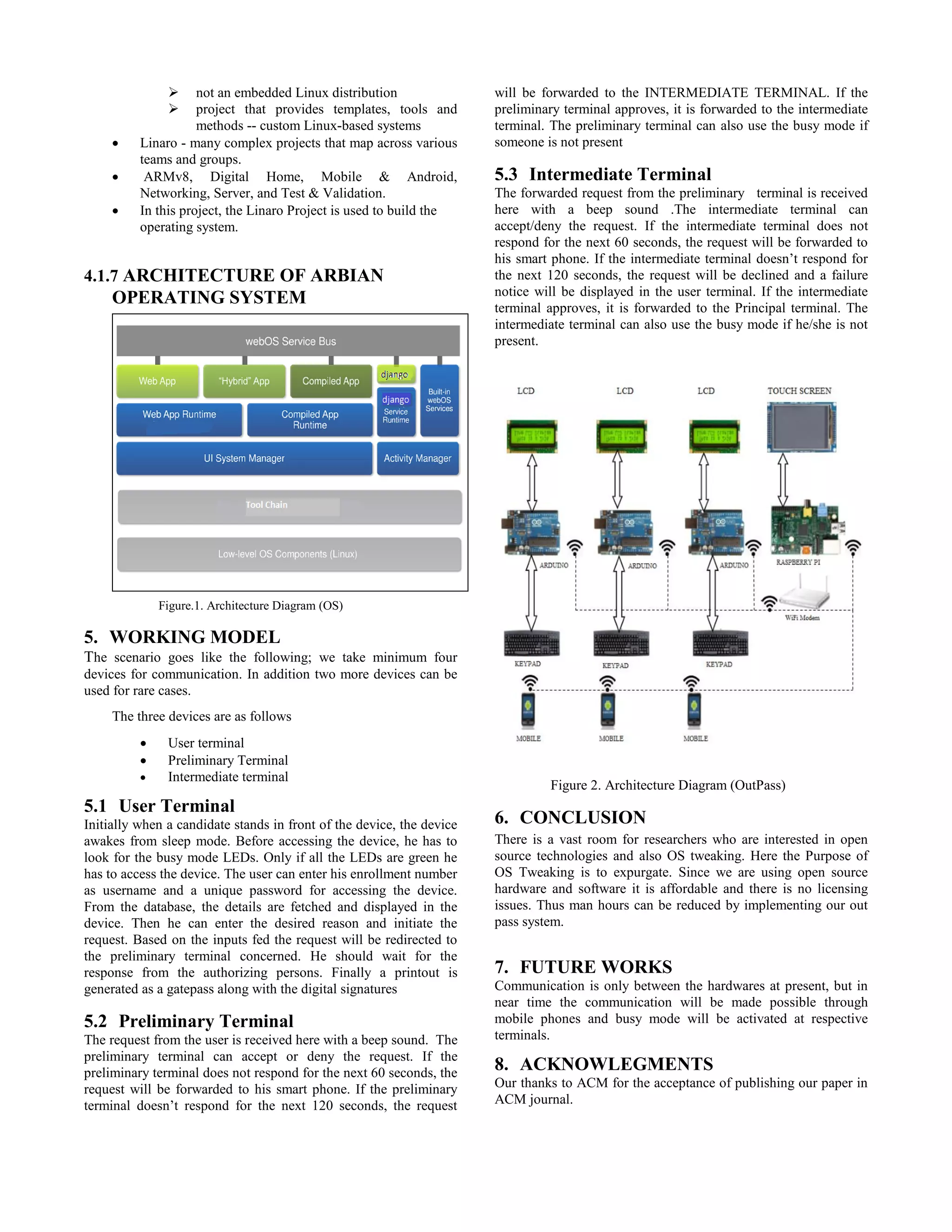
5.1 User Terminal
Initially when a candidate stands in front of the device, the device
awakes from sleep mode. Before accessing the device, he has to
look for the busy mode LEDs. Only if all the LEDs are green he
has to access the device. The user can enter his enrollment number
as username and a unique password for accessing the device.
From the database, the details are fetched and displayed in the
device. Then he can enter the desired reason and initiate the
request. Based on the inputs fed the request will be redirected to
the preliminary terminal concerned. He should wait for the
response from the authorizing persons. Finally a printout is
generated as a gatepass along with the digital signatures
5.2 Preliminary Terminal
The request from the user is received here with a beep sound. The
preliminary terminal can accept or deny the request. If the
preliminary terminal does not respond for the next 60 seconds, the
request will be forwarded to his smart phone. If the preliminary
terminal doesn’t respond for the next 120 seconds, the request
will be forwarded to the INTERMEDIATE TERMINAL. If the
preliminary terminal approves, it is forwarded to the intermediate
terminal. The preliminary terminal can also use the busy mode if
someone is not present
5.3 Intermediate Terminal
The forwarded request from the preliminary terminal is received
here with a beep sound .The intermediate terminal can
accept/deny the request. If the intermediate terminal does not
respond for the next 60 seconds, the request will be forwarded to
his smart phone. If the intermediate terminal doesn’t respond for
the next 120 seconds, the request will be declined and a failure
notice will be displayed in the user terminal. If the intermediate
terminal approves, it is forwarded to the Principal terminal. The
intermediate terminal can also use the busy mode if he/she is not
present.
Figure 2. Architecture Diagram (OutPass)
6. CONCLUSION
There is a vast room for researchers who are interested in open
source technologies and also OS tweaking. Here the Purpose of
OS Tweaking is to expurgate. Since we are using open source
hardware and software it is affordable and there is no licensing
issues. Thus man hours can be reduced by implementing our out
pass system.
7. FUTURE WORKS
Communication is only between the hardwares at present, but in
near time the communication will be made possible through
mobile phones and busy mode will be activated at respective
terminals.
8. ACKNOWLEGMENTS
Our thanks to ACM for the acceptance of publishing our paper in
ACM journal.
9. REFERENCES
[1] Christian Hernandez, Raciel Poot, Lizzi Narvaez, Erika
Llanes and Victor in 2010. “Design And Implementation Of
a System for Wireless Control Of Robot” , IJCSI
International Journal Of Computer Science Issues
[2] Ren Zhengang, Gao Yingbo, 2009. “Design of Electronic
Toll Collection System in Expressway Based on RFID”,
International Conference on Environmental Science and
Information Application Technology.
[3] Shoaib Rehman Soomro, Mohammad Arslan Javed, Fahad
Ahmed Memon, 2012 International Conference on, 22-23
Oct. 2012. “VEHICLE NUMBER RECOGNITION
SYSTEM FOR AUTOMATIC TOLL TAX COLLECTION,
Robotics and Artificial Intelligence (ICRAI)”, p.g-125 – 129.
[4] Ahmad Zubair, Sourav Mahmood Sagar, Pran Kanai Saha,
and Shaikh Anowarul Fattah, 6th International Conference
on Electrical and Computer Engineering ICECE 2010, 18-20
December 2010, Dhaka, Bangladesh. “A Design for Low
Cost Electronic Toll Collection System with Secured Data
Communication”,
[5] Gopinath Shanmuga Sundaram, Bhanuprasad Patibandala,
Harish Santhanam, Sindhura Gaddam, Vamsi Krishna Alla,
Gautham Ravi Prakash, Shiva Chaitanya Vishwakarma
Chandracha, Sindhu Boppana and James M. Conrad, “Open-
PEOPLE project:.
[6] T Li, LK John, in “Proceedings of the International
Conference on Measurement and Modeling of Computer
Systems”, Run-time modelingA Acquaviva, L Benini, B
Ricco, “Energy characterization of embedded real-time”.
Proceedings of the 2002 IEEE International Conference on
Computer Design: VLSI
[7] K Baynes, C Collins, E Fiterman, B Ganesh, P Kohout, C
Smit, T Zhang, BL Jacob, (2003) “The performance and
energy consumption of embedded real-time operating
systems”. IEEE Trans. Comput. 52, pp. 1454–1469
[8] B Guo, D Wang, Y Shen, Z Li, (2008) “A Hopfield neural
network approach for power optimization of real-time
operating systems”. Neur. Comput. Appl. 17, 11–17
[9] X Zhao, Y Guo, H Wang, X Chen, in Proceedings of the
2008 International Conference on Embedded Software and
Systems Symposia, “Fine-grained energy estimation
optimization of embedded operating systems”, Chengdu,
Sichuan, China, pp. 90–95
[10] N Fournel, A Fraboulet, P Feautrier, (2007). in IEEE
International Symposium on a World ofWireless, Mobile and
Multimedia Networks, “eSimu: a fast and accurate energy
consumption simulator for real embedded system”, Espoo,
Finland, pp. 1–6
[11] Y Fei, S Ravi, A Raghunathan, N Jha, “Energy-optimizing
source code transformations for operating system-driven
embedded software.” ACM Trans. Embed. Comput. Syst.
(TECS). 7, 1–26 (2007)
[12] S Dhouib, E Senn, J Diguet, J Laurent, in Proceedings of the
2009 12th International Symposium on Integrated Circuits,
ISIC’09, “Modelling and estimating the energy consumption
of embedded applications and operating systems”, Singapore,
pp. 457–461
[13] OMAP35x Evaluation Module (EVM) (2011),”
http://focus.ti.com/docs/toolsw/folders/print/tmdsevm3530.ht
ml”
[14] F Liu, F Guo, Y Solihin, S Kim, 2008 A Ekerm, in
Proceedings of the 17th international conference on Parallel
architectures and compilation techniques, “Characterizing
and modeling the behavior of context switch misses”,
Toronto, Ontario, Canada, pp. 91–101
[15] D Tsafrir, in ACMWorkshop on Experimental Computer
Science (ExpCS), (2009)“The context-switch overhead
inflicted by hardware interrupts
[16] B Ouni, C Belleudy, S Bilavarn, E Senn, in (2008)
“Conference on Design and Architectures for Signal and
Image Processing, DASIP”. Chengdu, Sichuan, China, pp.
90–95
[17] J Park, D Shin, N Chang, M Pedram, (2010) in Proceedings
of the 16th ACM/IEEE international symposium on Low
power electronics and design “A Hopfield neural network
approach for power optimization of real-time operating
systems”.

outpass system

  • 1.
    Outpass Generation withRaspberry Pi Using Arbian Operating System ABSTRACT A kiosk is usually designed to perform any specific operations like money withdrawal, ticket booking. Kiosks are mostly designed using closed source hardwares and thus they are very costly. Using open source platforms like Arduino and Raspberry pi, the manufacturing cost of kiosks can be comparatively reduced. Thus this Outpass system generates outpass with the help of the web kiosk that run an embedded Linux operating system (Arbian). The existing systems are E-Outpass system, E-gate, E- gatepass for IT Park. These devices are used for product tracking, maintaining the entry and exit of IT employees and other organizations. These systems are kiosk machines which cannot run like normal desktop machines. ARM based fan less processors has revolutionized the mobile computing platform and it is fast. In the same way, this outpass system will also invokes a kiosk operating system which is created from the ARM based Linux kernel and named as Arbian Operating system. Categories and Subject Descriptors B.0 [Hardware], D.4.0 [Operating Systems]: Operating System Architecture Design – OS tweaking, Debian based ARM ported architecture, Working Model of Outpass, Communication of hardware General Terms QEMU, Tweaking, Tool chains, Linux From Scratch, Bill of materials, Terminals, Putty, Message Passing Keywords Arbian, OutPass, Tool chain, Raspberry pi, Arduino. 1. INTRODUCTION This outpass system is created with the help of open-source embedded hardwares and networking as its backbone. Embedded hardwares are used to design devices to perform specific tasks alone. Open source embedded hardwares are those whose design schema, circuit diagram, Bill of Materials are available to recreate it. The ideology of open source hardware is initiated by Bruce Perens in the year 1997. Later many companies came forward to release documentations and device-drivers for their open source hardwares. Both free and open source software (FOSS) as well as open source hardware is created by this open source culture movement and applies a like concept to a variety of components. But the open source embedded hardwares used in this project are not only used to perform specific tasks, it acts as a Single Board Computer (SBC). Any external hardware modules like Bluetooth, wireless sensors, USB hubs can be installed easily. Networking, as the world always states, it is used for the interconnection of devices. This can be either wired or wireless. For portability wireless is used like 3G dongles, Wi-Fi dongles. For wired connectivity, Ethernet shields and RJ (Reserved Jack)- 45 cables are used. This network acts as a backbone for the entire communication of the project. 2. RELATED WORKS Newton Software Private Ltd. Et al., invented E-GATEPASS FOR IT PARK [1] which can be added as an essential feature for IT Park. It is added to the security of the park and also maintain data of visitor. This data is stored date wise and can be accessed at a later date. In IT parks, the facility of adding multiple companies with their respective departments is maintained. This E- GATEPASS controls the entry as well as the exit hence at any given point of time we can have a record of no. of visitors in the premises. Company wise reports can be arrived at Admin login. This added security device the e-gatepass is a must have for all corporates to maintain the standards for security in this uncertain world. Moty Grossman Et al., introduced C-PASS E-GATE [2], a pass system which is used to generate the pass and store information about the person using face recognition technique .This system is mostly used in borders when a person needs to cross the border of the country their face is recognized according to that their passport id which is stored in the database is matched and then he is allowed to cross the border. Er Kumar Aneesh Et al., found E-OUT PASS SYSTEM [3] which is used to check out the In and out of the products. The product Saravanan D Dhivakar K Vignesh T Assistant Professor U.G. Student U.G. Student Dept of CSE Dept of CSE Dept of CSE SMVEC SMVEC SMVEC svsaravana1@gmail.com diwa.dhiva@gmail.com vigneshmoto13@gmail.com Visvashwarr V Premkumar K Amudhavel J U.G.Student Associate Professor Assistant Professor Dept of CSE Dept of CSE Dept of CSE SMVEC visvashwarr93@gmail.com SMVEC premkvpt@gmail.com SMVEC amudhavel.in@gmail.com
  • 2.
    detail and thecost of the product is stored in database and according to that dispatch of the products can be identified It keeps monitoring the materials which are coming inside or going outside of the company. For that we need to maintain a database. Fields like specification of the material, item number, Date of dispatch, Expected date of the return and actual date of return. These databases are maintained on daily basis and at the end of the months reports are generated. Apart from that Addition of new firm entry and edit of the new firm entry can be also done. 3. PROBLEM STATEMENT In order to reduce the man-work and the time elapsed by using the traditional out pass system, this system has been devised. This system is developed in the sense it handles he request in the queue and forwards them to the authorizing devices and finally the pass is generated as the printout using the thermal printer which is attached to the device. This kiosk uses the minimal level of Linux based embedded operating system which is arm ported, as embedded hardware uses the ARM [Advanced Risc Machine] processor. 4. IMPLEMENTATION This system is developed with the following In this project, we made use of open source technologies as follows:  Operating System- Linux Mint  Hardware- Raspberry pi as a server & Arduino as a slave  Language Used- Python and MySQL  Raspberry Pi is an open source hardware and it is a user terminal  Arduino is also an open source hardware and it is used for authorizing the requests 4.1.1 TOOLS The Tools Used are Listed Below  QEMU (Emulator)  Python IDE 2.7.2  Putty (Remote connection)  VNC server (Virtual Network Computing) The QEMU is an Emulator which is used to encode the Programs and test the constraints before loading it to the entire system. Python IDE is used to develop the front end of the web framework using the Django module Putty is the open source terminal which is used to assign the IP address for the embedded hardware terminals which are used in this system VNC [virtual network computing] server is a graphical desktop sharing which is used to access the Raspberry pi from the host machine. 4.1.2 TECHNOLOGIES  MySQL (Structured Query Language)  Python  Linux Based Operating System  Arbian Operating System MYSQL is an open source database which is used to store the details about the individual. Python is used as the interface between the front end and the databases Linux Based Operating System -the host machine uses the debian operating system Arbian is the Linux based embedded operating system which is ARM ported Debian based kernel. 4.1.3 COMPILING A NEW DEBIAN BASED LINUX OPERATING SYSTEM Every Linux based operating system is created with the Linux kernel The operating system at its start-up includes the following  Software boot loader  eMMC mounting  GRUB (GRand Unified Boot loader)  ARM ported kernel  Board Supporting Packages 4.1.4 TOOL CHAINS USED IN ALL SORTS OF LINUX BASED OPERATING SYSTEM Generally a Linux From Scratch (LFS) includes 45 packages. The operating system that is designed will include the following tool chains  GCC compiler  Bin  Text editors  Shell scripting editors  File handling  CPU monitoring 4.1.5 STEPS INVOLVED IN DEVELOPING A DEBIAN BASED ARM PORTED OPERATING SYSTEM The scenario goes like the following; we take minimum four devices for communication. In addition two more devices can be used for rare cases.  Get the sources  Add missing dependencies  Build the kernel (takes lot of time)  Cross-compiling  Install tool chains  Get source packages  Build sources  Install packages  Mount volumes  Install modules  Flash the image to the SD card  Load in to the pi board 4.1.6 FROM WHERE THE NEW LINUX OPERATING SYSTEMS EMERGE?  The Linux Foundation (TLF) - Non-Government Organisation (NGO)  Yocto project
  • 3.
     not anembedded Linux distribution  project that provides templates, tools and methods -- custom Linux-based systems  Linaro - many complex projects that map across various teams and groups.  ARMv8, Digital Home, Mobile & Android, Networking, Server, and Test & Validation.  In this project, the Linaro Project is used to build the operating system. 4.1.7 ARCHITECTURE OF ARBIAN OPERATING SYSTEM Figure.1. Architecture Diagram (OS) 5. WORKING MODEL The scenario goes like the following; we take minimum four devices for communication. In addition two more devices can be used for rare cases. The three devices are as follows  User terminal  Preliminary Terminal  Intermediate terminal 5.1 User Terminal Initially when a candidate stands in front of the device, the device awakes from sleep mode. Before accessing the device, he has to look for the busy mode LEDs. Only if all the LEDs are green he has to access the device. The user can enter his enrollment number as username and a unique password for accessing the device. From the database, the details are fetched and displayed in the device. Then he can enter the desired reason and initiate the request. Based on the inputs fed the request will be redirected to the preliminary terminal concerned. He should wait for the response from the authorizing persons. Finally a printout is generated as a gatepass along with the digital signatures 5.2 Preliminary Terminal The request from the user is received here with a beep sound. The preliminary terminal can accept or deny the request. If the preliminary terminal does not respond for the next 60 seconds, the request will be forwarded to his smart phone. If the preliminary terminal doesn’t respond for the next 120 seconds, the request will be forwarded to the INTERMEDIATE TERMINAL. If the preliminary terminal approves, it is forwarded to the intermediate terminal. The preliminary terminal can also use the busy mode if someone is not present 5.3 Intermediate Terminal The forwarded request from the preliminary terminal is received here with a beep sound .The intermediate terminal can accept/deny the request. If the intermediate terminal does not respond for the next 60 seconds, the request will be forwarded to his smart phone. If the intermediate terminal doesn’t respond for the next 120 seconds, the request will be declined and a failure notice will be displayed in the user terminal. If the intermediate terminal approves, it is forwarded to the Principal terminal. The intermediate terminal can also use the busy mode if he/she is not present. Figure 2. Architecture Diagram (OutPass) 6. CONCLUSION There is a vast room for researchers who are interested in open source technologies and also OS tweaking. Here the Purpose of OS Tweaking is to expurgate. Since we are using open source hardware and software it is affordable and there is no licensing issues. Thus man hours can be reduced by implementing our out pass system. 7. FUTURE WORKS Communication is only between the hardwares at present, but in near time the communication will be made possible through mobile phones and busy mode will be activated at respective terminals. 8. ACKNOWLEGMENTS Our thanks to ACM for the acceptance of publishing our paper in ACM journal.
  • 4.
    9. REFERENCES [1] ChristianHernandez, Raciel Poot, Lizzi Narvaez, Erika Llanes and Victor in 2010. “Design And Implementation Of a System for Wireless Control Of Robot” , IJCSI International Journal Of Computer Science Issues [2] Ren Zhengang, Gao Yingbo, 2009. “Design of Electronic Toll Collection System in Expressway Based on RFID”, International Conference on Environmental Science and Information Application Technology. [3] Shoaib Rehman Soomro, Mohammad Arslan Javed, Fahad Ahmed Memon, 2012 International Conference on, 22-23 Oct. 2012. “VEHICLE NUMBER RECOGNITION SYSTEM FOR AUTOMATIC TOLL TAX COLLECTION, Robotics and Artificial Intelligence (ICRAI)”, p.g-125 – 129. [4] Ahmad Zubair, Sourav Mahmood Sagar, Pran Kanai Saha, and Shaikh Anowarul Fattah, 6th International Conference on Electrical and Computer Engineering ICECE 2010, 18-20 December 2010, Dhaka, Bangladesh. “A Design for Low Cost Electronic Toll Collection System with Secured Data Communication”, [5] Gopinath Shanmuga Sundaram, Bhanuprasad Patibandala, Harish Santhanam, Sindhura Gaddam, Vamsi Krishna Alla, Gautham Ravi Prakash, Shiva Chaitanya Vishwakarma Chandracha, Sindhu Boppana and James M. Conrad, “Open- PEOPLE project:. [6] T Li, LK John, in “Proceedings of the International Conference on Measurement and Modeling of Computer Systems”, Run-time modelingA Acquaviva, L Benini, B Ricco, “Energy characterization of embedded real-time”. Proceedings of the 2002 IEEE International Conference on Computer Design: VLSI [7] K Baynes, C Collins, E Fiterman, B Ganesh, P Kohout, C Smit, T Zhang, BL Jacob, (2003) “The performance and energy consumption of embedded real-time operating systems”. IEEE Trans. Comput. 52, pp. 1454–1469 [8] B Guo, D Wang, Y Shen, Z Li, (2008) “A Hopfield neural network approach for power optimization of real-time operating systems”. Neur. Comput. Appl. 17, 11–17 [9] X Zhao, Y Guo, H Wang, X Chen, in Proceedings of the 2008 International Conference on Embedded Software and Systems Symposia, “Fine-grained energy estimation optimization of embedded operating systems”, Chengdu, Sichuan, China, pp. 90–95 [10] N Fournel, A Fraboulet, P Feautrier, (2007). in IEEE International Symposium on a World ofWireless, Mobile and Multimedia Networks, “eSimu: a fast and accurate energy consumption simulator for real embedded system”, Espoo, Finland, pp. 1–6 [11] Y Fei, S Ravi, A Raghunathan, N Jha, “Energy-optimizing source code transformations for operating system-driven embedded software.” ACM Trans. Embed. Comput. Syst. (TECS). 7, 1–26 (2007) [12] S Dhouib, E Senn, J Diguet, J Laurent, in Proceedings of the 2009 12th International Symposium on Integrated Circuits, ISIC’09, “Modelling and estimating the energy consumption of embedded applications and operating systems”, Singapore, pp. 457–461 [13] OMAP35x Evaluation Module (EVM) (2011),” http://focus.ti.com/docs/toolsw/folders/print/tmdsevm3530.ht ml” [14] F Liu, F Guo, Y Solihin, S Kim, 2008 A Ekerm, in Proceedings of the 17th international conference on Parallel architectures and compilation techniques, “Characterizing and modeling the behavior of context switch misses”, Toronto, Ontario, Canada, pp. 91–101 [15] D Tsafrir, in ACMWorkshop on Experimental Computer Science (ExpCS), (2009)“The context-switch overhead inflicted by hardware interrupts [16] B Ouni, C Belleudy, S Bilavarn, E Senn, in (2008) “Conference on Design and Architectures for Signal and Image Processing, DASIP”. Chengdu, Sichuan, China, pp. 90–95 [17] J Park, D Shin, N Chang, M Pedram, (2010) in Proceedings of the 16th ACM/IEEE international symposium on Low power electronics and design “A Hopfield neural network approach for power optimization of real-time operating systems”.