OUTLINING
•An outline shows the
framework of a text
through division and
subdivision of ideas.
Basic Principles and Rules in
Outlining
1. Principle of Division
Every part of an outline that has
subtopics should have at least two
parts or subsections
Sample 1:
• I. Types of Mass Media
• A. Print
• B. Broadcast
• 1. Radio
• 2. Television
• C. Digital Media
• 1. Internet
• 2. Computers
• 3. Mobile Phones
• II. Significance of Mass Media
• A. Information Dissemination
• B. Opinion Formation
• C. Social Cohesion (Socialization)
• D. Entertainment Fare
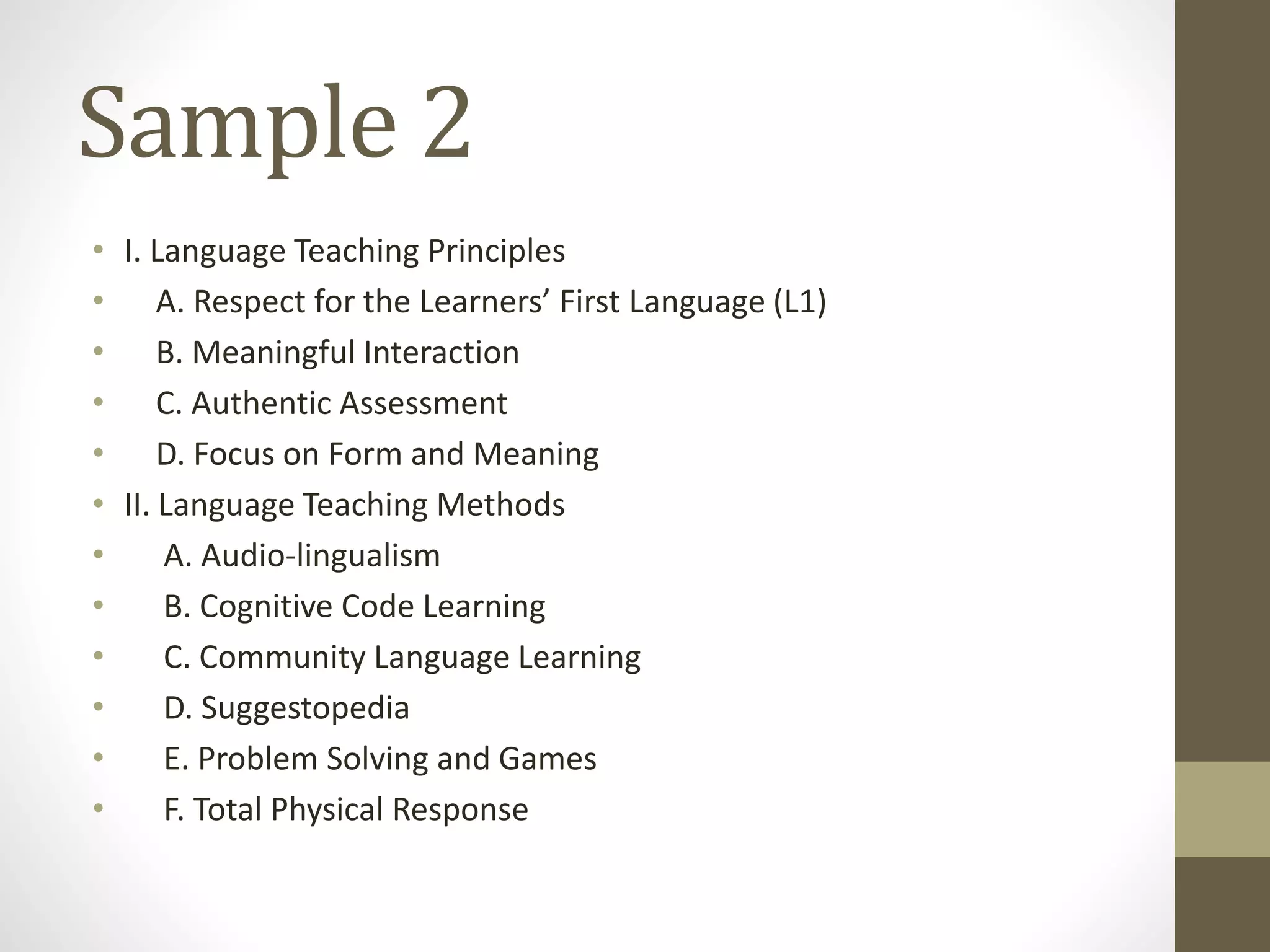
Sample 2
• I. Language Teaching Principles
• A. Respect for the Learners’ First Language (L1)
• B. Meaningful Interaction
• C. Authentic Assessment
• D. Focus on Form and Meaning
• II. Language Teaching Methods
• A. Audio-lingualism
• B. Cognitive Code Learning
• C. Community Language Learning
• D. Suggestopedia
• E. Problem Solving and Games
• F. Total Physical Response
2. Principle of Classification
•-similar ideas should go together
•-this implies that there should be
no overlapping of topics and
subtopics in an outline
Example
• I. Nature of Texting
• A. Texting as a “ hybrid construct”
• B. As suspension of grammar and
punctuation rules
• II. Usage of texting in the Philippines
3. Principle of Coordination
•Ideas of equal rank and value are
coordinate, therefore, they belong
to the same level of the outline.
•Coordinate headings must be
expressed in parallel construction.
• Example 1:
• I. Mass media are important in modern life.
• II. Forms of mass media
• Example 2:
• I. Importance of mass media in modern life
• II. Forms of mass media
Example
• Wrong:
• I. Mass media are important in modern life. (sentence)
• II. Forms of mass media (phrase)
• Right:
• I. Importance of mass media in modern life (phrase)
• II. Forms of mass media (phrase)
4. Principle of Subordination
•There are big ideas and small
ideas; small ideas should fall
under the appropriate big ideas.
Example
•I. Definition of mass media
•II. Types of mass media
• A. Broadcast media
• B. Print media
Things to remember
• 1. If you’re outlining an article, you cannot
add to the ideas of the original
• 2. Copied headings should be enclosed in
quotes, otherwise you commit plagiarism.
You should also give the bibliographical
details (author, date of publication, title,
publisher,etc.) of the source material at
the end of the outline
Types of outline
1. Sentence outline
•Heading of each level is one
sentence
Example
•I. There are two types of sports fan.
• A. The first type is the spectator.
• B. The second type is the analyst.
•II. Sports fan express their
involvement in the game in several
ways.
2. Topic outline
•- Heading of each level is a phrase
Example
•I. Two types of sports fan
• A. The spectator
• B. The analyst
•II. Ways sports fans express their
involvement in the game.
OUTLINE FORMAT
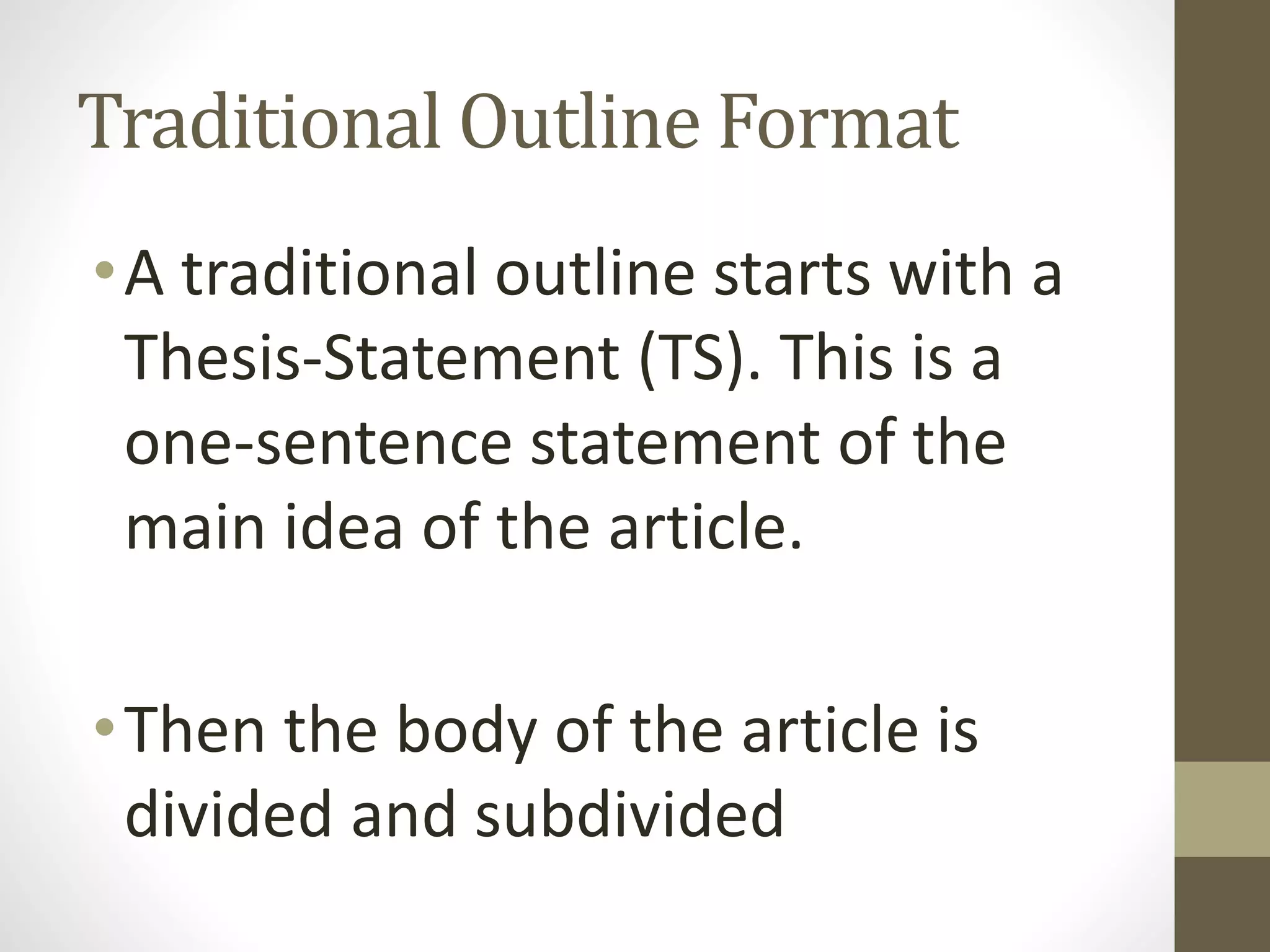
Traditional Outline Format
•A traditional outline starts with a
Thesis-Statement (TS). This is a
one-sentence statement of the
main idea of the article.
•Then the body of the article is
divided and subdivided
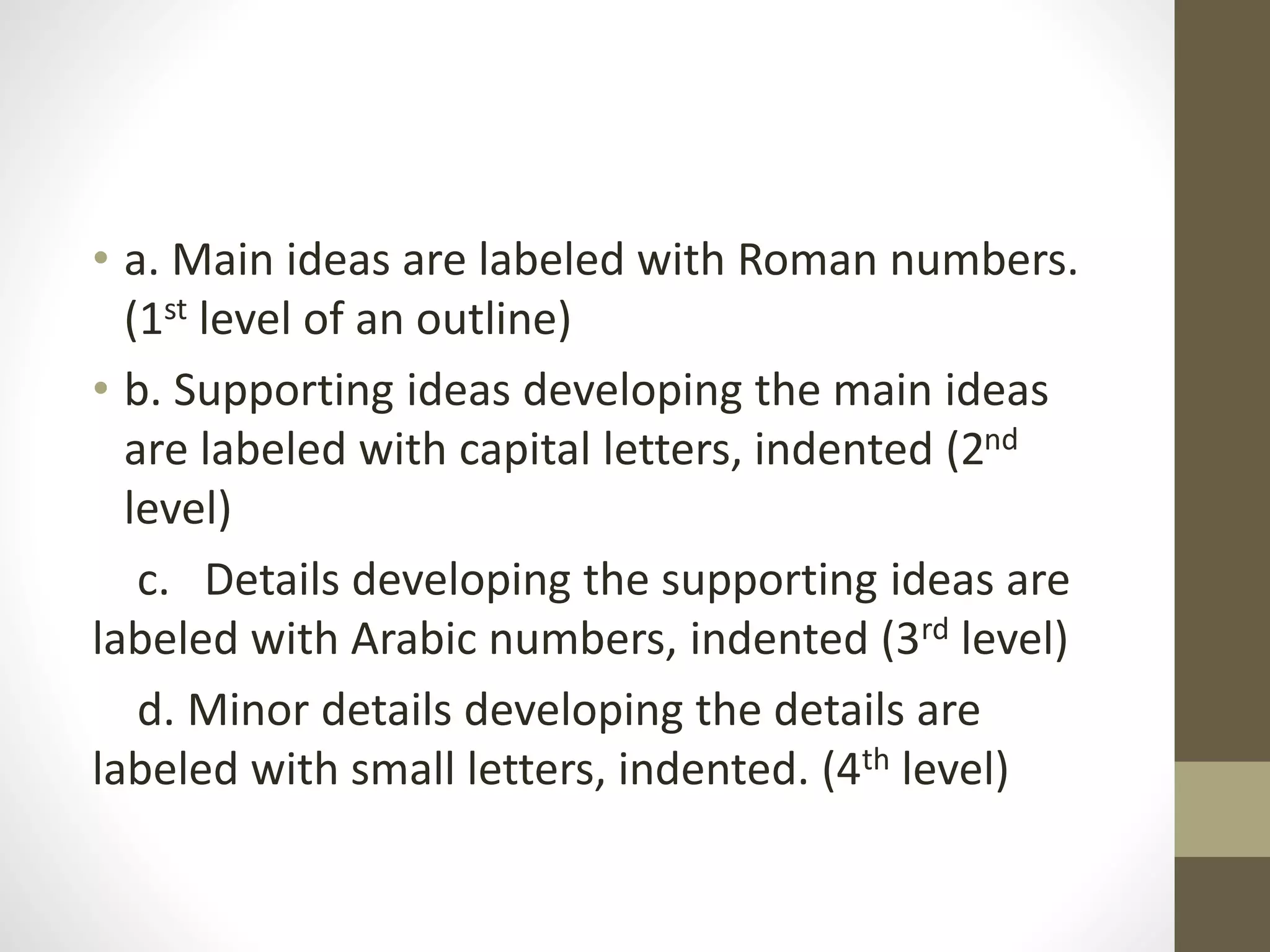
• a. Main ideas are labeled with Roman numbers.
(1st level of an outline)
• b. Supporting ideas developing the main ideas
are labeled with capital letters, indented (2nd
level)
c. Details developing the supporting ideas are
labeled with Arabic numbers, indented (3rd level)
d. Minor details developing the details are
labeled with small letters, indented. (4th level)
Nontraditional Outline Format
•A one-sentence summary of the
idea used in the introduction and
another for the conclusion may be
added to the outline.
•
• Thesis Statement: ___________________
• 1.0 Introduction
• 2.0 Main idea
• 2.1 Supporting idea
• 2.2 Supporting idea
• 2.2.1 Detail developing
• 2.2.2 Another detail developing
• 3.0 Main idea
• 3.1 Supporting idea
• 3.2 Supporting idea
• 4.0 Conclusion

OUTLINING.pptx

  • 1.
  • 2.
    •An outline showsthe framework of a text through division and subdivision of ideas.
  • 3.
    Basic Principles andRules in Outlining
  • 4.
    1. Principle ofDivision Every part of an outline that has subtopics should have at least two parts or subsections
  • 5.
    Sample 1: • I.Types of Mass Media • A. Print • B. Broadcast • 1. Radio • 2. Television • C. Digital Media • 1. Internet • 2. Computers • 3. Mobile Phones • II. Significance of Mass Media • A. Information Dissemination • B. Opinion Formation • C. Social Cohesion (Socialization) • D. Entertainment Fare
  • 6.
    Sample 2 • I.Language Teaching Principles • A. Respect for the Learners’ First Language (L1) • B. Meaningful Interaction • C. Authentic Assessment • D. Focus on Form and Meaning • II. Language Teaching Methods • A. Audio-lingualism • B. Cognitive Code Learning • C. Community Language Learning • D. Suggestopedia • E. Problem Solving and Games • F. Total Physical Response
  • 7.
    2. Principle ofClassification •-similar ideas should go together •-this implies that there should be no overlapping of topics and subtopics in an outline
  • 8.
    Example • I. Natureof Texting • A. Texting as a “ hybrid construct” • B. As suspension of grammar and punctuation rules • II. Usage of texting in the Philippines
  • 9.
    3. Principle ofCoordination •Ideas of equal rank and value are coordinate, therefore, they belong to the same level of the outline. •Coordinate headings must be expressed in parallel construction.
  • 10.
    • Example 1: •I. Mass media are important in modern life. • II. Forms of mass media • Example 2: • I. Importance of mass media in modern life • II. Forms of mass media
  • 11.
    Example • Wrong: • I.Mass media are important in modern life. (sentence) • II. Forms of mass media (phrase) • Right: • I. Importance of mass media in modern life (phrase) • II. Forms of mass media (phrase)
  • 12.
    4. Principle ofSubordination •There are big ideas and small ideas; small ideas should fall under the appropriate big ideas.
  • 13.
    Example •I. Definition ofmass media •II. Types of mass media • A. Broadcast media • B. Print media
  • 14.
    Things to remember •1. If you’re outlining an article, you cannot add to the ideas of the original • 2. Copied headings should be enclosed in quotes, otherwise you commit plagiarism. You should also give the bibliographical details (author, date of publication, title, publisher,etc.) of the source material at the end of the outline
  • 15.
  • 16.
    1. Sentence outline •Headingof each level is one sentence
  • 17.
    Example •I. There aretwo types of sports fan. • A. The first type is the spectator. • B. The second type is the analyst. •II. Sports fan express their involvement in the game in several ways.
  • 18.
    2. Topic outline •-Heading of each level is a phrase
  • 19.
    Example •I. Two typesof sports fan • A. The spectator • B. The analyst •II. Ways sports fans express their involvement in the game.
  • 20.
  • 21.
    Traditional Outline Format •Atraditional outline starts with a Thesis-Statement (TS). This is a one-sentence statement of the main idea of the article. •Then the body of the article is divided and subdivided
  • 22.
    • a. Mainideas are labeled with Roman numbers. (1st level of an outline) • b. Supporting ideas developing the main ideas are labeled with capital letters, indented (2nd level) c. Details developing the supporting ideas are labeled with Arabic numbers, indented (3rd level) d. Minor details developing the details are labeled with small letters, indented. (4th level)
  • 23.
    Nontraditional Outline Format •Aone-sentence summary of the idea used in the introduction and another for the conclusion may be added to the outline. •
  • 24.
    • Thesis Statement:___________________ • 1.0 Introduction • 2.0 Main idea • 2.1 Supporting idea • 2.2 Supporting idea • 2.2.1 Detail developing • 2.2.2 Another detail developing • 3.0 Main idea • 3.1 Supporting idea • 3.2 Supporting idea • 4.0 Conclusion