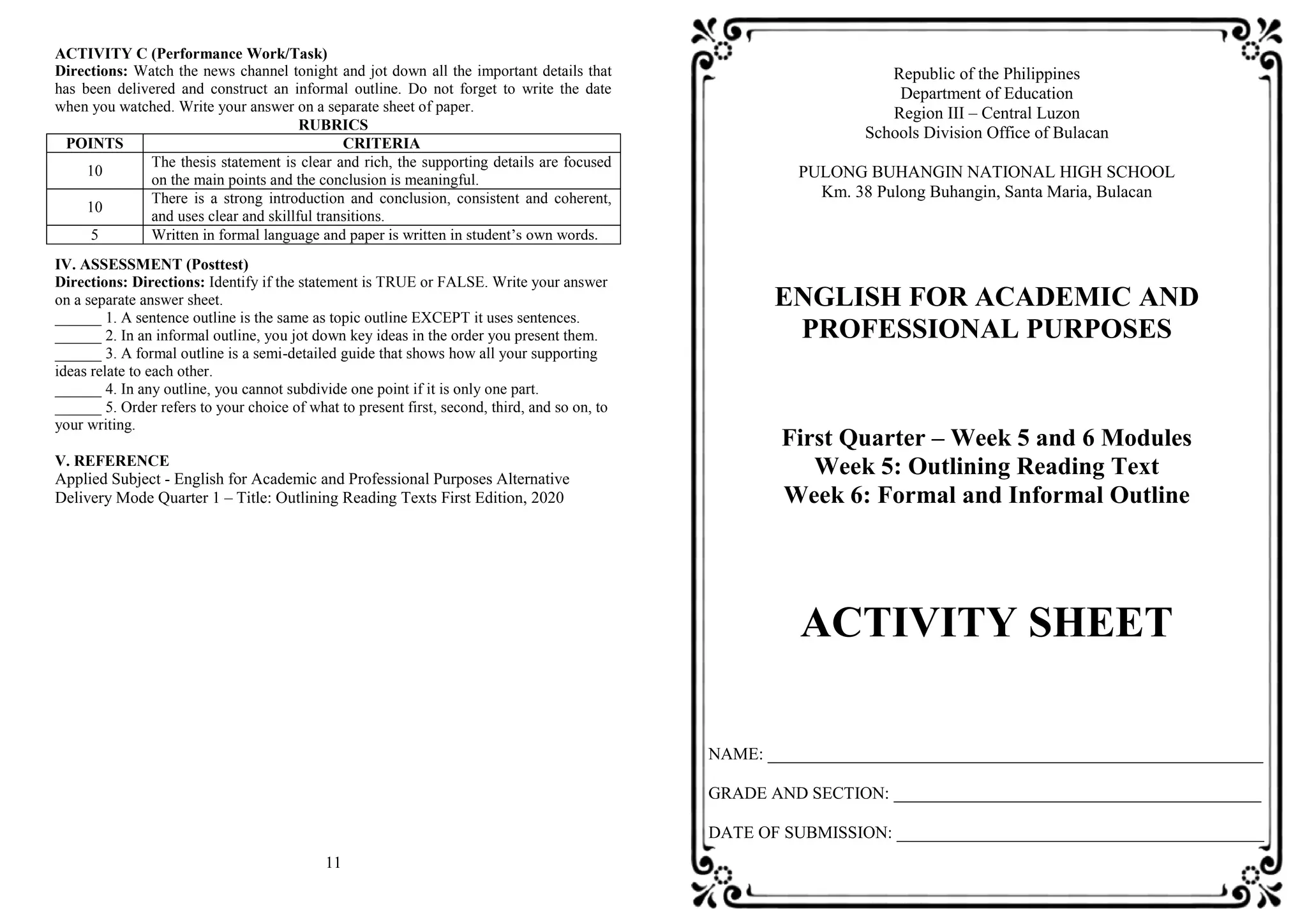
ACTIVITY C (Performance Work/Task)
Directions: Watch the news channel tonight and jot down all the important details that
has been delivered and construct an informal outline. Do not forget to write the date
when you watched. Write your answer on a separate sheet of paper.
RUBRICS
POINTS CRITERIA
10
The thesis statement is clear and rich, the supporting details are focused
on the main points and the conclusion is meaningful.
10
There is a strong introduction and conclusion, consistent and coherent,
and uses clear and skillful transitions.
5 Written in formal language and paper is written in student’s own words.
IV. ASSESSMENT (Posttest)
Directions: Directions: Identify if the statement is TRUE or FALSE. Write your answer
on a separate answer sheet.
______ 1. A sentence outline is the same as topic outline EXCEPT it uses sentences.
______ 2. In an informal outline, you jot down key ideas in the order you present them.
______ 3. A formal outline is a semi-detailed guide that shows how all your supporting
ideas relate to each other.
______ 4. In any outline, you cannot subdivide one point if it is only one part.
______ 5. Order refers to your choice of what to present first, second, third, and so on, to
your writing.
V. REFERENCE
Applied Subject - English for Academic and Professional Purposes Alternative
Delivery Mode Quarter 1 – Title: Outlining Reading Texts First Edition, 2020
11
Republic of the Philippines
Department of Education
Region III – Central Luzon
Schools Division Office of Bulacan
PULONG BUHANGIN NATIONAL HIGH SCHOOL
Km. 38 Pulong Buhangin, Santa Maria, Bulacan
ENGLISH FOR ACADEMIC AND
PROFESSIONAL PURPOSES
First Quarter – Week 5 and 6 Modules
Week 5: Outlining Reading Text
Week 6: Formal and Informal Outline
ACTIVITY SHEET
NAME: __________________________________________________________
GRADE AND SECTION: ___________________________________________
DATE OF SUBMISSION: ___________________________________________
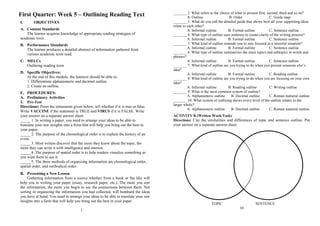
First Quarter: Week 5 – Outlining Reading Text
I. OBJECTIVES
A. Content Standards
The learner acquires knowledge of appropriate reading strategies of
academic texts
B. Performance Standards
The learner produces a detailed abstract of information gathered from
various academic texts read.
C. MELCs
Outlining reading texts
D. Specific Objectives:
At the end of this module, the learners should be able to:
1. Differentiate alphanumeric and decimal outline
2. Create an outline.
E. PROCEDURES:
A. Preliminary Activities
1. Pre-Test
Directions: From the statements given below, tell whether if it is true or false.
Write VACCINE if the statement is TRUE and VIRUS if it is FALSE. Write
your answer on a separate answer sheet.
_____ 1. In writing a paper, you need to arrange your ideas to be able to
translate your raw insights into a form that will help you bring out the best in
your paper.
_____ 2. The purpose of the chronological order is to explain the history of an
event.
_____ 3. Most writers discover that the more they know about the topic, the
more they can write it with intelligence and interest.
_____ 4. The purpose of spatial order is to help readers visualize something as
you want them to see it.
_____ 5. The three methods of organizing information are chronological order,
spatial order, and methodical order.
B. Presenting a New Lesson
Gathering information from a source whether from a book or the like will
help you in writing your paper (essay, research paper, etc.). The more you sort
the information, the more you begin to see the connections between them. Not
sorting or organizing the information you had collected, will bombard the ideas
you have at hand. You need to arrange your ideas to be able to translate your raw
insights into a form that will help you bring out the best in your paper.
1
_______ 2. What refers to the choice of what to present first, second, third and so on?
A. Outline B. Order C. Guide map
_______ 3. What do you call the detailed guide that shows how all your supporting ideas
relate to each other?
A. Informal outline B. Formal outline C. Sentence outline
_______ 4. What type of outline uses sentence to create clarity of the writing process?
A. Informal outline B. Formal outline C. Sentence outline
_______ 5. What kind of outline reminds you to stay focused in a stressful situation?
A. Informal outline B. Formal outline C. Sentence outline
_______ 6. What type of outline summarizes the main topics and subtopics in words and
phrases?
A. Informal outline B. Formal outline C. Sentence outline
_______ 7. What kind of outline are you trying to do when you present someone else’s
idea?
A. Informal outline B. Formal outline C. Reading outline
_______ 8. What kind of outline are you trying to do when you are focusing on your own
idea?
A. Informal outline B. Reading outline C. Writing outline
_______ 9. What is the most common system of outline?
A. Alphanumeric outline B. Decimal outline C. Roman numeral outline
_______ 10. What system of outlining shows every level of the outline relates to the
larger whole?
A. Alphanumeric outline B. Decimal outline C. Roman numeral outline
ACTIVITY B (Written Work/Task)
Directions: Cite the similarities and differences of topic and sentence outline. Put
your answer on a separate answer sheet.
TOPIC SENTENCE
10
In the previous example, both the topic and sentence outline follow the standard
five-paragraph essay arrangement, but longer essays will require more paragraphs and
thus more Roman numerals. If you think that a paragraph might become too long or
stringy, add an additional paragraph to your outline, renumbering the main points
appropriately.
Now, let us see the sample sentence outline of the same topic from the same
source and author.
I. Introduction
Thesis statement: Everyone wants the newest and the best digital technology,
but the choices are many, and the specifications are often confusing.
II. E-book readers are changing the way people read.
A. E-book readers make books easy to access and to carry.
1. Books can be downloaded electronically.
2. Device can store hundreds of books in memory.
B. The market expands as a variety of companies enter it.
1. Booksellers sell their own e-book readers.
2. Electronics and computer companies also sell e-book readers.
C. Current e-book readers have significant limitations.
1. The devices are owned by different brands and may not be
compatible.
2. Few programs have been made to fit the other way Americans read:
by borrowing books from libraries.
III. Digital cameras have almost totally replaced film cameras.
A. The first major choice is the type of digital camera.
1. Compact digital cameras are light but have fewer megapixels.
2. Single lens reflex cameras, or SLRs, may be large and heavy but can
be used for many functions.
3. Some cameras combined the best features of compacts and SLRs.
B. Choosing the camera type involves the confusing “megapixel wars”.
C. The zoom lens battle also determined the camera you will buy.
IV. Nothing is more confusing to me than choosing among televisions.
A. In the resolution wars, what are the benefits of 1080P and 768P?
B. In the screen-size wars, what do plasma screens and LCD screens offer?
C. Does every home really need a media center?
V. Conclusion
The solution for many people should be to avoid buying on impulse. Consumers
should think about what they really need, not what is advertised.
C. Independent Activities
ACTIVITY A (Written Work/Task)
Directions: Choose the letter of the correct answer. Write your answer on a separate
answer sheet.
_______1. What do you call a written plan that serves as a skeleton for the paragraphs
you write?
A. Outline B. Order C. Guide map
9
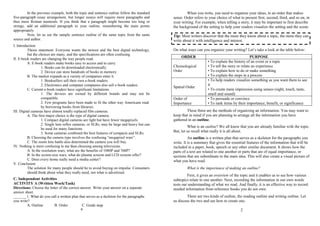
When you write, you need to organize your ideas, in an order that makes
sense. Order refers to your choice of what to present first, second, third, and so on, in
your writing. For example, when telling a story, it may be important to first describe
the background of the setting to help your readers visualize the setting and the scene.
Tip: Most writers discover that the more they know about a topic, the more they can
write about it with intelligence and interest.
On what ways can you organize your writing? Let’s take a look at the table below:
ORDER PURPOSE
Chronological
Order
• To explain the history of an event or a topic
• To tell the story or relate an experience
• To explain how to do or make something
• To explain the steps in a process
Spatial Order
• To help readers visualize something as you want them to see
it
• To create main impression using senses (sight, touch, taste,
smell and sound)
Order of
Importance
• To persuade or convince
• To rank items by their importance, benefit, or significance
These three are the methods of organizing an information. You may want to
keep that in mind if you are planning to arrange all the information you have
gathered in an outline.
What is an outline? We all know that you are already familiar with the topic.
But, let us recall what really it is all about.
An outline is a written plan that serves as a skeleton for the paragraphs you
write. It is a summary that gives the essential features of the information that will be
included in a paper, book, speech or any other similar document. It shows how the
parts of a text are related to one another or parts that are of equal importance, or
sections that are subordinate to the main idea. This will also create a visual picture of
what you have read.
What is the importance of making an outline?
First, it gives an overview of the topic and it enables us to see how various
subtopics relate to one another. Next, recording the information in our own words
tests our understanding of what we read. And finally, it is an effective way to record
needed information from reference books you do not own.
There are two kinds of outline, the reading outline and writing outline. Let
us discuss the two and see how to create one.
2
READING OUTLINE - is used to get the main ideas of a text that is already
written.
Steps in Creating a Reading Outline
1. Read the entire text first. Skim the text afterward.
2. Locate the main idea or thesis statement of the whole essay or text.
3. Look for key phrases in each paragraph.
4. Locate the topic sentence of each paragraph.
5. Look at the topic sentences and group those with related ideas together.
6. The contents of the reading are arranged according to levels.
7. Evaluate the supporting details provided.
8. Go back to the text to check whether you have followed its sequence closely and
that you have not missed any important information.
WRITING OUTLINE - is a skeletal overview of your draft, which contains your
fundamental points and the different ideas that support them.
Steps in Creating Own Outline
1. Determine what your purpose is for writing the thesis, who your reading audience
is, and point of view and tone you would like to assume in delivering your message.
2. Begin your outline with a thesis statement.
3. Review your notes.
4. Group together similar ideas and thoughts.
5. Examine all your main topics, subtopics, supporting points and particular details
to see if it all developed your thesis, and are logically sequenced. Also, check if all
levels in the outline have parallel wordings and grammatical structure.
The main difference between the two is the source of ideas. When you
outline someone else’s work, you are trying to present their ideas and structure.
When outlining your own paper, you will need to focus on your own ideas and the
best way to organize them.
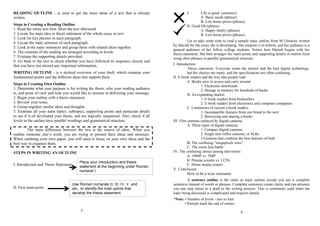
STEPS IN WRITING AN OUTLINE
I. Introduction and Thesis Statement
II. First main point
3
I. Life is good. (sentence)
A. Basic needs (phrase)
B. Low home prices (phrase)
II. Good life (phrase)
A. Happy family (phrase)
B. Low home prices (phrase)
Let us take some time to read a sample topic outline from M Libraries written
by Mariah for the essay she is developing. Her purpose is to inform, and her audience is a
general audience of her fellow college students. Notice how Mariah begins with her
thesis statement. She then arranges her main points and supporting details in outline form
using short phrases in parallel grammatical structure.
I. Introduction
Thesis statement: Everyone wants the newest and the best digital technology,
but the choices are many, and the specifications are often confusing.
II. E-book readers and the way that people read
A. Books easy to access and carry around
1. Electronic downloads
2. Storage in memory for hundreds of books
B. An expanding market
1. E-book readers from booksellers
2. E-book readers from electronics and computer companies
C. Limitations of current e-book readers
1. Incompatible features from one brand to the next
2. Borrowing and sharing e-books
III. Film cameras replaced by digital cameras
A. Three types of digital cameras
1. Compact digital cameras
2. Single lens reflex cameras, or SLRs
3.Cameras that combine the best features of both
B. The confusing “megapixels wars”
C. The zoom lens battle
IV. The confusing choice among televisions
A. 1080P vs. 768P
B. Plasma screens vs. LCDs
C. Home media centers
V. Conclusion
How to be a wise consumer
A sentence outline is the same as topic outline except you use a complete
sentences instead of words or phrases. Complete sentences create clarity and can advance
you one step closer to a draft in the writing process. This is commonly used when the
topic being discussed is complicated and requires details.
*Note: • Number of levels - two to four
• Periods mark the end of entries
8
Place your introduction and thesis
statement at the beginning under Roman
numeral I.
Use Roman numerals II, III, IV, V, and
etc., to identify the main points that
develop the thesis statement.
First Quarter: Week 6 – Formal
and Informal Outline
I. OBJECTIVES
A. Content Standards
The learner acquires knowledge of appropriate reading strategies of
academic texts
B. Performance Standards
The learner produces a detailed abstract of information gathered from
various academic texts read.
C. MELCs
Outlining reading texts
D. Specific Objectives:
At the end of this module, the learners should be able to:
1. Differentiate topic outline and sentence outline
2. Create an outline.
E. PROCEDURES:
A. Preliminary Activities
1. Pre-Test
Directions: Identify if the statement is TRUE or FALSE. Write your answer on a
separate answer sheet.
______ 1. A sentence outline is the same as topic outline EXCEPT it uses sentences.
______ 2. In an informal outline, you jot down key ideas in the order you present them.
______ 3. A formal outline is a semi-detailed guide that shows how all your supporting
ideas relate to each other.
______ 4. In any outline, you cannot subdivide one point if it is only one part.
______ 5. Order refers to your choice of what to present first, second, third, and so on, to
your writing.
B. Presenting a New Lesson
For an essay question on a test or a brief oral presentation in class, all you need
to prepare is a short, informal outline in which you jot down key ideas in the order you
present them. This kind of outline reminds you to stay focused in a stressful situation and
include all the good ideas that help you explain or prove your point.
For a longer paper like a story in a book or a research paper, a formal outline is
advisable. A formal outline is a detailed guide that shows how all your supporting ideas
relate to each other. It helps you distinguish between ideas that are of equal importance
and ones that are of lesser importance.
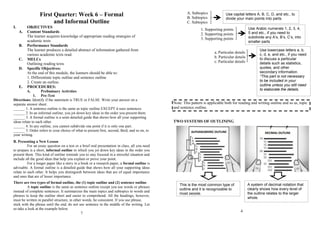
There are two types of formal outline, the (1) topic outline and (2) sentence outline.
A topic outline is the same as sentence outline except you use words or phrases
instead of complete sentences. It summarizes the main topics and subtopics in words and
phrases to keep the outline short and easier to comprehend. All the headings, however,
must be written in parallel structure, in other words, be consistent. If you use phrase,
stick with the phrase until the end, do not use sentence in the middle of the writing. Let
us take a look at the example below.
7
A. Subtopics
B. Subtopics
C. Subtopics
1. Supporting points
2. Supporting points
3. Supporting points
a. Particular details
b. Particular details
c. Particular details
Note: This pattern is applicable both for reading and writing outline and so as, topic
and sentence outline.
TWO SYSTEMS OF OUTLINING
4
Use capital letters A, B, C, D, and etc., to
divide your main points into parts.
Use Arabic numerals 1, 2, 3, 4,
5 and etc., if you need to
subdivide any A’s, B’s, C’s, into
smaller parts
Use lowercase letters a, b,
c, d, e, and etc., if you need
to discuss a particular
details such as statistics,
quotes, and other
secondary information.
*This part is not necessary
to be included in your
outline unless you still need
to elaborate the details.
This is the most common type of
outline and it is recognizable to
most people.
A system of decimal notation that
clearly shows how every level of
the outline relates to the larger
whole.
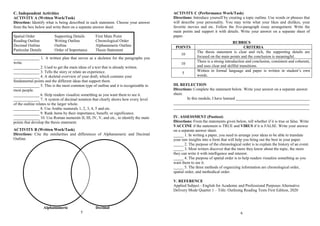
C. Independent Activities
ACTIVITY A (Written Work/Task)
Direction: Identify what is being described in each statement. Choose your answer
from the box below and write them on a separate answer sheet.
Spatial Order Supporting Details First Main Point
Reading Outline Writing Outline Chronological Order
Decimal Outline Outline Alphanumeric Outline
Particular Details Order of Importance Thesis Statement
_____________ 1. A written plan that serves as a skeleton for the paragraphs you
write.
_____________ 2. Used to get the main ideas of a text that is already written.
_____________ 3. Tells the story or relate an experience.
_____________ 4. A skeletal overview of your draft, which contains your
fundamental points and the different ideas that support them.
_____________ 5. This is the most common type of outline and it is recognizable to
most people.
_____________ 6. Help readers visualize something as you want them to see it.
_____________ 7. A system of decimal notation that clearly shows how every level
of the outline relates to the larger whole.
_____________ 8. Use Arabic numerals 1, 2, 3, 4, 5 and etc.
_____________ 9. Rank items by their importance, benefit, or significance.
_____________ 10. Use Roman numerals II, III, IV, V, and etc., to identify the main
points that develop the thesis statement.
ACTIVITY B (Written Work/Task)
Directions: Cite the similarities and differences of Alphanumeric and Decimal
Outline.
Alphanumeric Decimal
5
ACTIVITY C (Performance Work/Task)
Directions: Introduce yourself by creating a topic outline. Use words or phrases that
will describe your personality. You may write what your likes and dislikes, your
favorite movies and etc. Follow the five-paragraph essay arrangement. Write the
main points and support it with details. Write your answer on a separate sheet of
paper.
RUBRICS
POINTS CRITERIA
10
The thesis statement is clear and rich, the supporting details are
focused on the main points and the conclusion is meaningful.
10
There is a strong introduction and conclusion, consistent and coherent,
and uses clear and skillful transitions.
5
Written in formal language and paper is written in student’s own
words.
III. REFLECTION
Directions: Complete the statement below. Write your answer on a separate answer
sheet.
In this module, I have learned _____________________________________
____________________________________________________________________
____________________________________________________________________
IV. ASSESSMENT (Posttest)
Directions: From the statements given below, tell whether if it is true or false. Write
VACCINE if the statement is TRUE and VIRUS if it is FALSE. Write your answer
on a separate answer sheet.
_____ 1. In writing a paper, you need to arrange your ideas to be able to translate
your raw insights into a form that will help you bring out the best in your paper.
_____ 2. The purpose of the chronological order is to explain the history of an event.
_____ 3. Most writers discover that the more they know about the topic, the more
they can write it with intelligence and interest.
_____ 4. The purpose of spatial order is to help readers visualize something as you
want them to see it.
_____ 5. The three methods of organizing information are chronological order,
spatial order, and methodical order.
V. REFERENCE
Applied Subject - English for Academic and Professional Purposes Alternative
Delivery Mode Quarter 1 – Title: Outlining Reading Texts First Edition, 2020
6

EAPP-Q1-week-5-6-LAS.docx

  • 1.
    ACTIVITY C (PerformanceWork/Task) Directions: Watch the news channel tonight and jot down all the important details that has been delivered and construct an informal outline. Do not forget to write the date when you watched. Write your answer on a separate sheet of paper. RUBRICS POINTS CRITERIA 10 The thesis statement is clear and rich, the supporting details are focused on the main points and the conclusion is meaningful. 10 There is a strong introduction and conclusion, consistent and coherent, and uses clear and skillful transitions. 5 Written in formal language and paper is written in student’s own words. IV. ASSESSMENT (Posttest) Directions: Directions: Identify if the statement is TRUE or FALSE. Write your answer on a separate answer sheet. ______ 1. A sentence outline is the same as topic outline EXCEPT it uses sentences. ______ 2. In an informal outline, you jot down key ideas in the order you present them. ______ 3. A formal outline is a semi-detailed guide that shows how all your supporting ideas relate to each other. ______ 4. In any outline, you cannot subdivide one point if it is only one part. ______ 5. Order refers to your choice of what to present first, second, third, and so on, to your writing. V. REFERENCE Applied Subject - English for Academic and Professional Purposes Alternative Delivery Mode Quarter 1 – Title: Outlining Reading Texts First Edition, 2020 11 Republic of the Philippines Department of Education Region III – Central Luzon Schools Division Office of Bulacan PULONG BUHANGIN NATIONAL HIGH SCHOOL Km. 38 Pulong Buhangin, Santa Maria, Bulacan ENGLISH FOR ACADEMIC AND PROFESSIONAL PURPOSES First Quarter – Week 5 and 6 Modules Week 5: Outlining Reading Text Week 6: Formal and Informal Outline ACTIVITY SHEET NAME: __________________________________________________________ GRADE AND SECTION: ___________________________________________ DATE OF SUBMISSION: ___________________________________________
  • 2.
    First Quarter: Week5 – Outlining Reading Text I. OBJECTIVES A. Content Standards The learner acquires knowledge of appropriate reading strategies of academic texts B. Performance Standards The learner produces a detailed abstract of information gathered from various academic texts read. C. MELCs Outlining reading texts D. Specific Objectives: At the end of this module, the learners should be able to: 1. Differentiate alphanumeric and decimal outline 2. Create an outline. E. PROCEDURES: A. Preliminary Activities 1. Pre-Test Directions: From the statements given below, tell whether if it is true or false. Write VACCINE if the statement is TRUE and VIRUS if it is FALSE. Write your answer on a separate answer sheet. _____ 1. In writing a paper, you need to arrange your ideas to be able to translate your raw insights into a form that will help you bring out the best in your paper. _____ 2. The purpose of the chronological order is to explain the history of an event. _____ 3. Most writers discover that the more they know about the topic, the more they can write it with intelligence and interest. _____ 4. The purpose of spatial order is to help readers visualize something as you want them to see it. _____ 5. The three methods of organizing information are chronological order, spatial order, and methodical order. B. Presenting a New Lesson Gathering information from a source whether from a book or the like will help you in writing your paper (essay, research paper, etc.). The more you sort the information, the more you begin to see the connections between them. Not sorting or organizing the information you had collected, will bombard the ideas you have at hand. You need to arrange your ideas to be able to translate your raw insights into a form that will help you bring out the best in your paper. 1 _______ 2. What refers to the choice of what to present first, second, third and so on? A. Outline B. Order C. Guide map _______ 3. What do you call the detailed guide that shows how all your supporting ideas relate to each other? A. Informal outline B. Formal outline C. Sentence outline _______ 4. What type of outline uses sentence to create clarity of the writing process? A. Informal outline B. Formal outline C. Sentence outline _______ 5. What kind of outline reminds you to stay focused in a stressful situation? A. Informal outline B. Formal outline C. Sentence outline _______ 6. What type of outline summarizes the main topics and subtopics in words and phrases? A. Informal outline B. Formal outline C. Sentence outline _______ 7. What kind of outline are you trying to do when you present someone else’s idea? A. Informal outline B. Formal outline C. Reading outline _______ 8. What kind of outline are you trying to do when you are focusing on your own idea? A. Informal outline B. Reading outline C. Writing outline _______ 9. What is the most common system of outline? A. Alphanumeric outline B. Decimal outline C. Roman numeral outline _______ 10. What system of outlining shows every level of the outline relates to the larger whole? A. Alphanumeric outline B. Decimal outline C. Roman numeral outline ACTIVITY B (Written Work/Task) Directions: Cite the similarities and differences of topic and sentence outline. Put your answer on a separate answer sheet. TOPIC SENTENCE 10
  • 3.
    In the previousexample, both the topic and sentence outline follow the standard five-paragraph essay arrangement, but longer essays will require more paragraphs and thus more Roman numerals. If you think that a paragraph might become too long or stringy, add an additional paragraph to your outline, renumbering the main points appropriately. Now, let us see the sample sentence outline of the same topic from the same source and author. I. Introduction Thesis statement: Everyone wants the newest and the best digital technology, but the choices are many, and the specifications are often confusing. II. E-book readers are changing the way people read. A. E-book readers make books easy to access and to carry. 1. Books can be downloaded electronically. 2. Device can store hundreds of books in memory. B. The market expands as a variety of companies enter it. 1. Booksellers sell their own e-book readers. 2. Electronics and computer companies also sell e-book readers. C. Current e-book readers have significant limitations. 1. The devices are owned by different brands and may not be compatible. 2. Few programs have been made to fit the other way Americans read: by borrowing books from libraries. III. Digital cameras have almost totally replaced film cameras. A. The first major choice is the type of digital camera. 1. Compact digital cameras are light but have fewer megapixels. 2. Single lens reflex cameras, or SLRs, may be large and heavy but can be used for many functions. 3. Some cameras combined the best features of compacts and SLRs. B. Choosing the camera type involves the confusing “megapixel wars”. C. The zoom lens battle also determined the camera you will buy. IV. Nothing is more confusing to me than choosing among televisions. A. In the resolution wars, what are the benefits of 1080P and 768P? B. In the screen-size wars, what do plasma screens and LCD screens offer? C. Does every home really need a media center? V. Conclusion The solution for many people should be to avoid buying on impulse. Consumers should think about what they really need, not what is advertised. C. Independent Activities ACTIVITY A (Written Work/Task) Directions: Choose the letter of the correct answer. Write your answer on a separate answer sheet. _______1. What do you call a written plan that serves as a skeleton for the paragraphs you write? A. Outline B. Order C. Guide map 9 When you write, you need to organize your ideas, in an order that makes sense. Order refers to your choice of what to present first, second, third, and so on, in your writing. For example, when telling a story, it may be important to first describe the background of the setting to help your readers visualize the setting and the scene. Tip: Most writers discover that the more they know about a topic, the more they can write about it with intelligence and interest. On what ways can you organize your writing? Let’s take a look at the table below: ORDER PURPOSE Chronological Order • To explain the history of an event or a topic • To tell the story or relate an experience • To explain how to do or make something • To explain the steps in a process Spatial Order • To help readers visualize something as you want them to see it • To create main impression using senses (sight, touch, taste, smell and sound) Order of Importance • To persuade or convince • To rank items by their importance, benefit, or significance These three are the methods of organizing an information. You may want to keep that in mind if you are planning to arrange all the information you have gathered in an outline. What is an outline? We all know that you are already familiar with the topic. But, let us recall what really it is all about. An outline is a written plan that serves as a skeleton for the paragraphs you write. It is a summary that gives the essential features of the information that will be included in a paper, book, speech or any other similar document. It shows how the parts of a text are related to one another or parts that are of equal importance, or sections that are subordinate to the main idea. This will also create a visual picture of what you have read. What is the importance of making an outline? First, it gives an overview of the topic and it enables us to see how various subtopics relate to one another. Next, recording the information in our own words tests our understanding of what we read. And finally, it is an effective way to record needed information from reference books you do not own. There are two kinds of outline, the reading outline and writing outline. Let us discuss the two and see how to create one. 2
  • 4.
    READING OUTLINE -is used to get the main ideas of a text that is already written. Steps in Creating a Reading Outline 1. Read the entire text first. Skim the text afterward. 2. Locate the main idea or thesis statement of the whole essay or text. 3. Look for key phrases in each paragraph. 4. Locate the topic sentence of each paragraph. 5. Look at the topic sentences and group those with related ideas together. 6. The contents of the reading are arranged according to levels. 7. Evaluate the supporting details provided. 8. Go back to the text to check whether you have followed its sequence closely and that you have not missed any important information. WRITING OUTLINE - is a skeletal overview of your draft, which contains your fundamental points and the different ideas that support them. Steps in Creating Own Outline 1. Determine what your purpose is for writing the thesis, who your reading audience is, and point of view and tone you would like to assume in delivering your message. 2. Begin your outline with a thesis statement. 3. Review your notes. 4. Group together similar ideas and thoughts. 5. Examine all your main topics, subtopics, supporting points and particular details to see if it all developed your thesis, and are logically sequenced. Also, check if all levels in the outline have parallel wordings and grammatical structure. The main difference between the two is the source of ideas. When you outline someone else’s work, you are trying to present their ideas and structure. When outlining your own paper, you will need to focus on your own ideas and the best way to organize them. STEPS IN WRITING AN OUTLINE I. Introduction and Thesis Statement II. First main point 3 I. Life is good. (sentence) A. Basic needs (phrase) B. Low home prices (phrase) II. Good life (phrase) A. Happy family (phrase) B. Low home prices (phrase) Let us take some time to read a sample topic outline from M Libraries written by Mariah for the essay she is developing. Her purpose is to inform, and her audience is a general audience of her fellow college students. Notice how Mariah begins with her thesis statement. She then arranges her main points and supporting details in outline form using short phrases in parallel grammatical structure. I. Introduction Thesis statement: Everyone wants the newest and the best digital technology, but the choices are many, and the specifications are often confusing. II. E-book readers and the way that people read A. Books easy to access and carry around 1. Electronic downloads 2. Storage in memory for hundreds of books B. An expanding market 1. E-book readers from booksellers 2. E-book readers from electronics and computer companies C. Limitations of current e-book readers 1. Incompatible features from one brand to the next 2. Borrowing and sharing e-books III. Film cameras replaced by digital cameras A. Three types of digital cameras 1. Compact digital cameras 2. Single lens reflex cameras, or SLRs 3.Cameras that combine the best features of both B. The confusing “megapixels wars” C. The zoom lens battle IV. The confusing choice among televisions A. 1080P vs. 768P B. Plasma screens vs. LCDs C. Home media centers V. Conclusion How to be a wise consumer A sentence outline is the same as topic outline except you use a complete sentences instead of words or phrases. Complete sentences create clarity and can advance you one step closer to a draft in the writing process. This is commonly used when the topic being discussed is complicated and requires details. *Note: • Number of levels - two to four • Periods mark the end of entries 8 Place your introduction and thesis statement at the beginning under Roman numeral I. Use Roman numerals II, III, IV, V, and etc., to identify the main points that develop the thesis statement.
  • 5.
    First Quarter: Week6 – Formal and Informal Outline I. OBJECTIVES A. Content Standards The learner acquires knowledge of appropriate reading strategies of academic texts B. Performance Standards The learner produces a detailed abstract of information gathered from various academic texts read. C. MELCs Outlining reading texts D. Specific Objectives: At the end of this module, the learners should be able to: 1. Differentiate topic outline and sentence outline 2. Create an outline. E. PROCEDURES: A. Preliminary Activities 1. Pre-Test Directions: Identify if the statement is TRUE or FALSE. Write your answer on a separate answer sheet. ______ 1. A sentence outline is the same as topic outline EXCEPT it uses sentences. ______ 2. In an informal outline, you jot down key ideas in the order you present them. ______ 3. A formal outline is a semi-detailed guide that shows how all your supporting ideas relate to each other. ______ 4. In any outline, you cannot subdivide one point if it is only one part. ______ 5. Order refers to your choice of what to present first, second, third, and so on, to your writing. B. Presenting a New Lesson For an essay question on a test or a brief oral presentation in class, all you need to prepare is a short, informal outline in which you jot down key ideas in the order you present them. This kind of outline reminds you to stay focused in a stressful situation and include all the good ideas that help you explain or prove your point. For a longer paper like a story in a book or a research paper, a formal outline is advisable. A formal outline is a detailed guide that shows how all your supporting ideas relate to each other. It helps you distinguish between ideas that are of equal importance and ones that are of lesser importance. There are two types of formal outline, the (1) topic outline and (2) sentence outline. A topic outline is the same as sentence outline except you use words or phrases instead of complete sentences. It summarizes the main topics and subtopics in words and phrases to keep the outline short and easier to comprehend. All the headings, however, must be written in parallel structure, in other words, be consistent. If you use phrase, stick with the phrase until the end, do not use sentence in the middle of the writing. Let us take a look at the example below. 7 A. Subtopics B. Subtopics C. Subtopics 1. Supporting points 2. Supporting points 3. Supporting points a. Particular details b. Particular details c. Particular details Note: This pattern is applicable both for reading and writing outline and so as, topic and sentence outline. TWO SYSTEMS OF OUTLINING 4 Use capital letters A, B, C, D, and etc., to divide your main points into parts. Use Arabic numerals 1, 2, 3, 4, 5 and etc., if you need to subdivide any A’s, B’s, C’s, into smaller parts Use lowercase letters a, b, c, d, e, and etc., if you need to discuss a particular details such as statistics, quotes, and other secondary information. *This part is not necessary to be included in your outline unless you still need to elaborate the details. This is the most common type of outline and it is recognizable to most people. A system of decimal notation that clearly shows how every level of the outline relates to the larger whole.
  • 6.
    C. Independent Activities ACTIVITYA (Written Work/Task) Direction: Identify what is being described in each statement. Choose your answer from the box below and write them on a separate answer sheet. Spatial Order Supporting Details First Main Point Reading Outline Writing Outline Chronological Order Decimal Outline Outline Alphanumeric Outline Particular Details Order of Importance Thesis Statement _____________ 1. A written plan that serves as a skeleton for the paragraphs you write. _____________ 2. Used to get the main ideas of a text that is already written. _____________ 3. Tells the story or relate an experience. _____________ 4. A skeletal overview of your draft, which contains your fundamental points and the different ideas that support them. _____________ 5. This is the most common type of outline and it is recognizable to most people. _____________ 6. Help readers visualize something as you want them to see it. _____________ 7. A system of decimal notation that clearly shows how every level of the outline relates to the larger whole. _____________ 8. Use Arabic numerals 1, 2, 3, 4, 5 and etc. _____________ 9. Rank items by their importance, benefit, or significance. _____________ 10. Use Roman numerals II, III, IV, V, and etc., to identify the main points that develop the thesis statement. ACTIVITY B (Written Work/Task) Directions: Cite the similarities and differences of Alphanumeric and Decimal Outline. Alphanumeric Decimal 5 ACTIVITY C (Performance Work/Task) Directions: Introduce yourself by creating a topic outline. Use words or phrases that will describe your personality. You may write what your likes and dislikes, your favorite movies and etc. Follow the five-paragraph essay arrangement. Write the main points and support it with details. Write your answer on a separate sheet of paper. RUBRICS POINTS CRITERIA 10 The thesis statement is clear and rich, the supporting details are focused on the main points and the conclusion is meaningful. 10 There is a strong introduction and conclusion, consistent and coherent, and uses clear and skillful transitions. 5 Written in formal language and paper is written in student’s own words. III. REFLECTION Directions: Complete the statement below. Write your answer on a separate answer sheet. In this module, I have learned _____________________________________ ____________________________________________________________________ ____________________________________________________________________ IV. ASSESSMENT (Posttest) Directions: From the statements given below, tell whether if it is true or false. Write VACCINE if the statement is TRUE and VIRUS if it is FALSE. Write your answer on a separate answer sheet. _____ 1. In writing a paper, you need to arrange your ideas to be able to translate your raw insights into a form that will help you bring out the best in your paper. _____ 2. The purpose of the chronological order is to explain the history of an event. _____ 3. Most writers discover that the more they know about the topic, the more they can write it with intelligence and interest. _____ 4. The purpose of spatial order is to help readers visualize something as you want them to see it. _____ 5. The three methods of organizing information are chronological order, spatial order, and methodical order. V. REFERENCE Applied Subject - English for Academic and Professional Purposes Alternative Delivery Mode Quarter 1 – Title: Outlining Reading Texts First Edition, 2020 6