Strategies to Enhance
Research Visibility, Impact &
Citations
aleebrahim@um.edu.my
@Aleebrahim
www.researcherid.com/rid/C-2414-2009
http://scholar.google.com/citations
Nader Ale Ebrahim, PhD
Visiting Research Fellow
Centre for Research Services
Institute of Management and Research Services
University of Malaya, Kuala Lumpur, Malaysia
6th October 2017
Nader Ale Ebrahim, PhD
=====================================
Centre for Research Services
Research Management & Innovation Complex
University of Malaya, Kuala Lumpur, Malaysia
www.researcherid.com/rid/C-2414-2009
http://scholar.google.com/citations
All of my presentations are available online at:
https://figshare.com/authors/Nader_Ale_Ebrahim/100797
Link to this presentation: https://doi.org/10.6084/m9.figshare.5472847.v1 (New version)
Read more:
1. Ale Ebrahim, N., Salehi, H., Embi, M. A., Habibi Tanha, F., Gholizadeh, H., Motahar, S. M., & Ordi, A. (2013). Effective
Strategies for Increasing Citation Frequency. International Education Studies, 6(11), 93-99. doi: 10.5539/ies.v6n11p93
2. Ale Ebrahim, Nader. "Optimize Your Article for Search Engine." University of Malaya Research Bulletin 2.1 (2014): 38-39.
INTRODUCTORY WORKSHOP ON:
Strategies to Enhance Research
Visibility, Impact & Citations
Abstract
Abstract: Do you know “Over 43% of ISI papers have never
ever received any citations?” (nature.com/top100, 2014).
Publishing a high quality paper in scientific journals is only
halfway towards receiving citation in the future. The rest of
the journey is dependent on disseminating the publications
via proper utilization of the “Research Tools”. Proper tools
allow the researchers to increase the research impact and
citations for their publications. This workshop will provide
various techniques on how you can increase the visibility
and hence the impact of your research work.
Keywords: H-index, Improve citations, Research tools, Bibliometrics,
Research visibility, Research impact
©2017-2018 Nader Ale Ebrahim 3
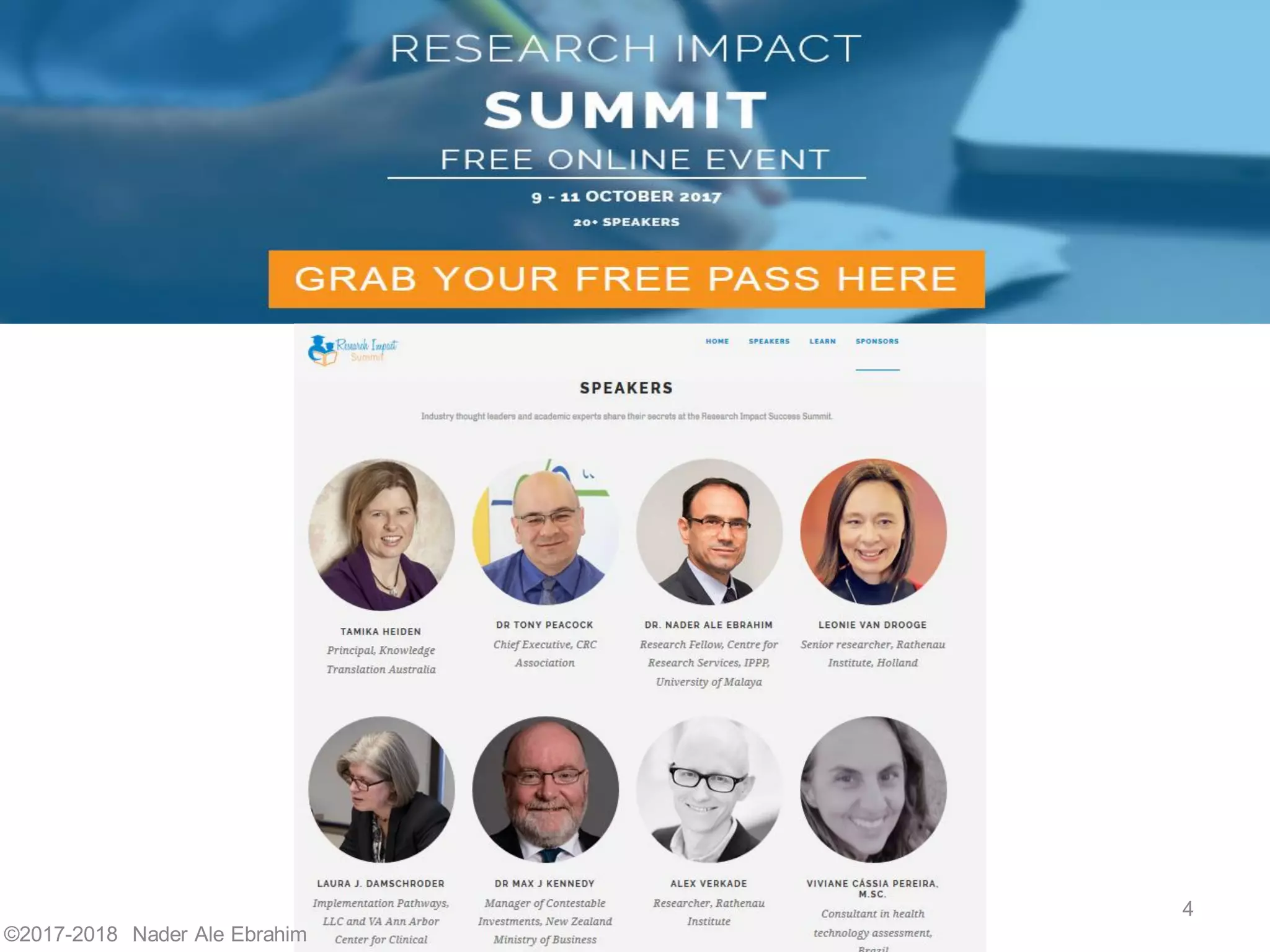
©2017-2018 Nader Ale Ebrahim 4
©2017-2018 Nader Ale Ebrahim
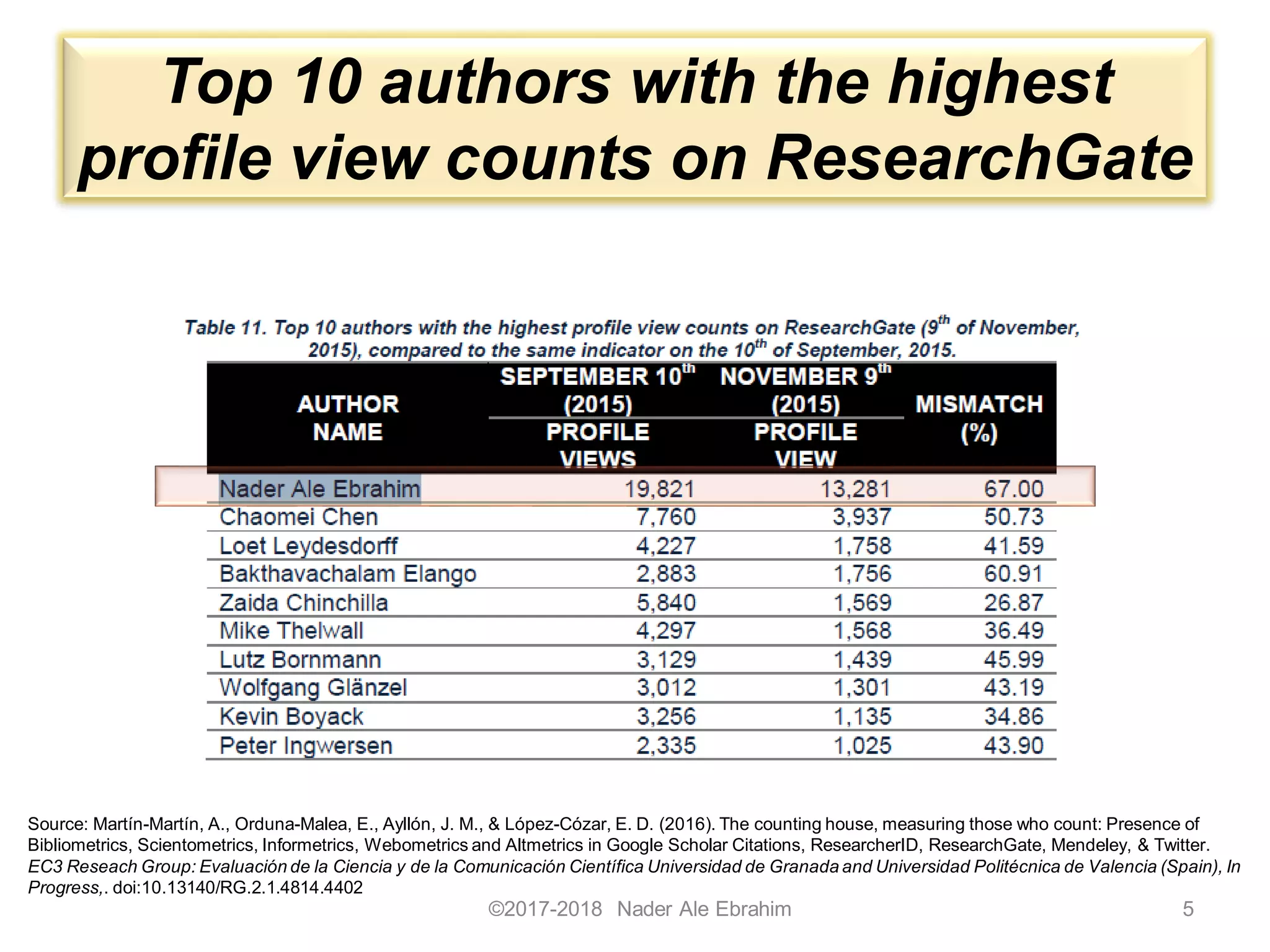
Top 10 authors with the highest
profile view counts on ResearchGate
©2017-2018 Nader Ale Ebrahim 5
Source: Martín-Martín, A., Orduna-Malea, E., Ayllón, J. M., & López-Cózar, E. D. (2016). The counting house, measuring those who count: Presence of
Bibliometrics, Scientometrics, Informetrics, Webometrics and Altmetrics in Google Scholar Citations, ResearcherID, ResearchGate, Mendeley, & Twitter.
EC3 Reseach Group: Evaluación de la Ciencia y de la Comunicación Científica Universidad de Granada and Universidad Politécnica de Valencia (Spain), In
Progress,. doi:10.13140/RG.2.1.4814.4402
Effective Strategies for Increasing Citation Frequency
Journal Reputation and Impact: publishing a paper in a journal based on disciplinary reputatation or with a high
impact factor is the most well known way of getting your paper cited. But there are many other things a scholar can do
to promote his or her work and make it easy for others to find.
Utilize Open Access Tools: Open Access journals tend to be cited more than non open access. Deposit your paper in
a repository such as Scholars Archive here on campus or a disciplinary repository. Share your detailed research data in
a repository.
Standarize Identifying Info: try to use the same name throughout your career as well as the name of your affiliated
insitution. Using common "official" names will allow for consistency and easy retrieval of your work by author or
affiliation.
Bring Colleagues on Board: team-authored articles are cited more frequently, as does publishing with international
authors. Working cross-or inter-disciplinarily helps as well.
Beef Up That Paper: use more references, publish a longer paper. Also papers which are published elsewhere after
having been rejected are cited more frequently.
Beyond Peer-Reviewed Original Research: Write a review paper. Present a working paper. Write and disseminate
web-based tutorials on your topic.
Search Optimization: use keywords in the abstract and assign them to the manuscript. Use descriptive titles that
utilize the obvious terms searchers would use to look for your topic, avoiding questions in the title. Select a journal that
is indexed in the key library databases for your field.
Market Yourself: create a key phrase that describes your research career and use it. Update your professional web
page and publication lists frequently. Link to your latest and greatest article in your professional email signature file.
Utliize Social Media: Use author profiles such as ResearcherID and ORCID. Contribute to Wikipedia, start a blog
and/or podcast, join academic social media sites.
From: Ebrahim, N.A., et al. (2013). Effective strategies for increasing citation frequency. International Education
Studies, 6(11), 93-99. doi:10.5539/ies.v6n11p93
©2017-2018 Nader Ale Ebrahim 6
Research Tools Mind Map
©2017-2018 Nader Ale Ebrahim 7
dit: Atena Ale
©2017-2018 Nader Ale Ebrahim
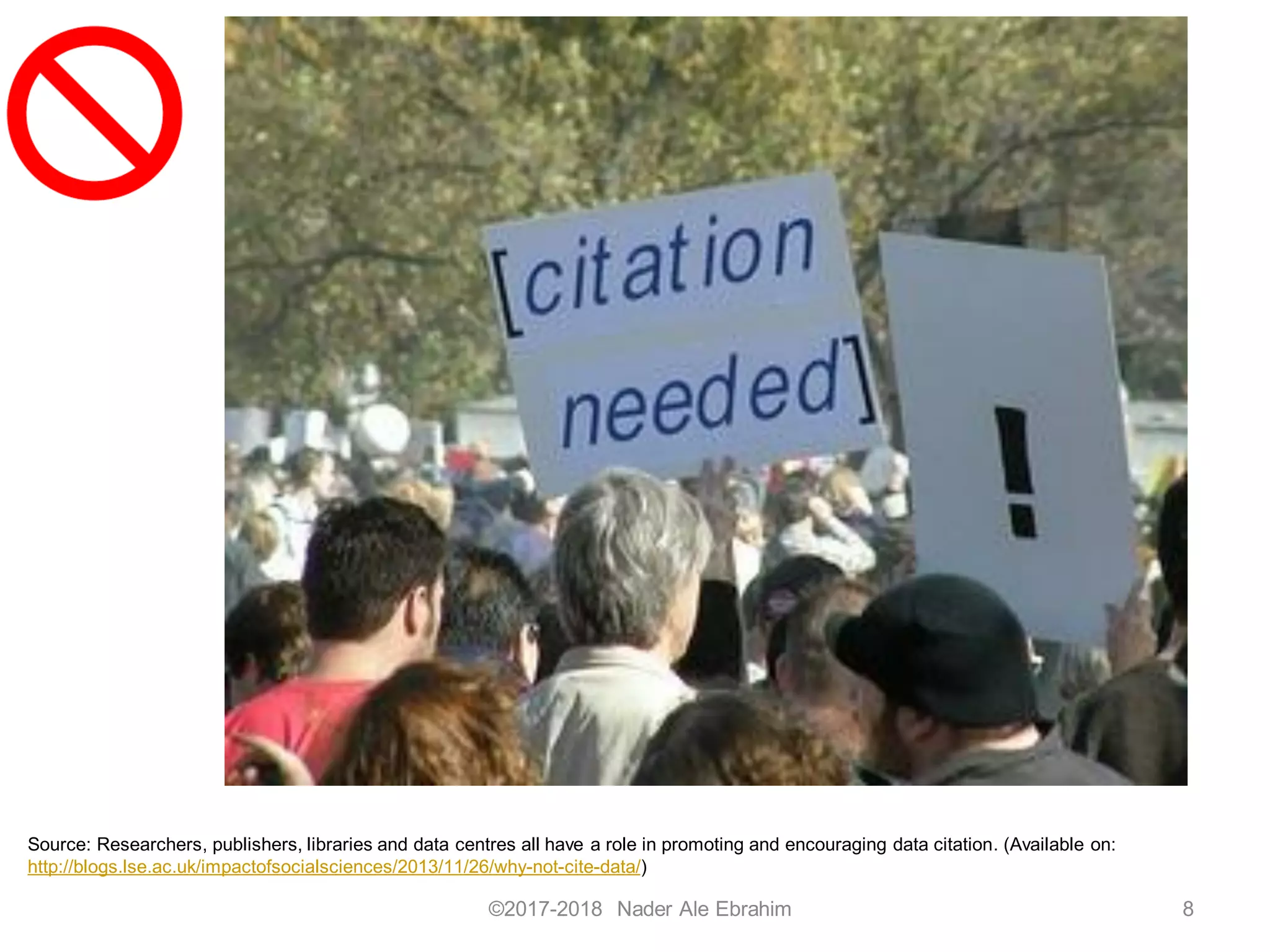
Source: Researchers, publishers, libraries and data centres all have a role in promoting and encouraging data citation. (Available on:
http://blogs.lse.ac.uk/impactofsocialsciences/2013/11/26/why-not-cite-data/)
8
©2017-2018 Nader Ale Ebrahim
Source: http://wiki.lib.sun.ac.za/index.php/SUNScholar/Research_Article_Metrics
9
Brazilian citation scheme outed
Thomson Reuters suspends journals from its rankings for ‘citation
stacking’
©2017-2018 Nader Ale Ebrahim
Source: Richard Van Noorden , Nature News, 27 August 2013
10
Citation manipulation: Journal retracts paper because
author boosted references to a journal he edits
©2017-2018 Nader Ale Ebrahim
Source: http://retractionwatch.com/2014/02/03/citation-manipulation-journal-retracts-paper-because-author-boosted-references-to-a-journal-he-edits/
11
Path analysis of the relationship between visibility and citation: the
mediating roles of save, discussion, and recommendation metrics
©2017-2018 Nader Ale Ebrahim 12
Source: Ebrahimy, S., Mehrad, J., Setareh, F., & Hosseinchari, M. (2016). Path analysis of the relationship between visibility and citation: the mediating
roles of save, discussion, and recommendation metrics. Scientometrics 1-14. doi:10.1007/s11192-016-2130-z
©2017-2018 Nader Ale Ebrahim
©2017-2018 Nader Ale Ebrahim 14
©2017-2018 Nader Ale Ebrahim 15
Malaysia’s No. of Documents 1996 – 2016
Published in 2017
©2017-2018 Nader Ale Ebrahim 16
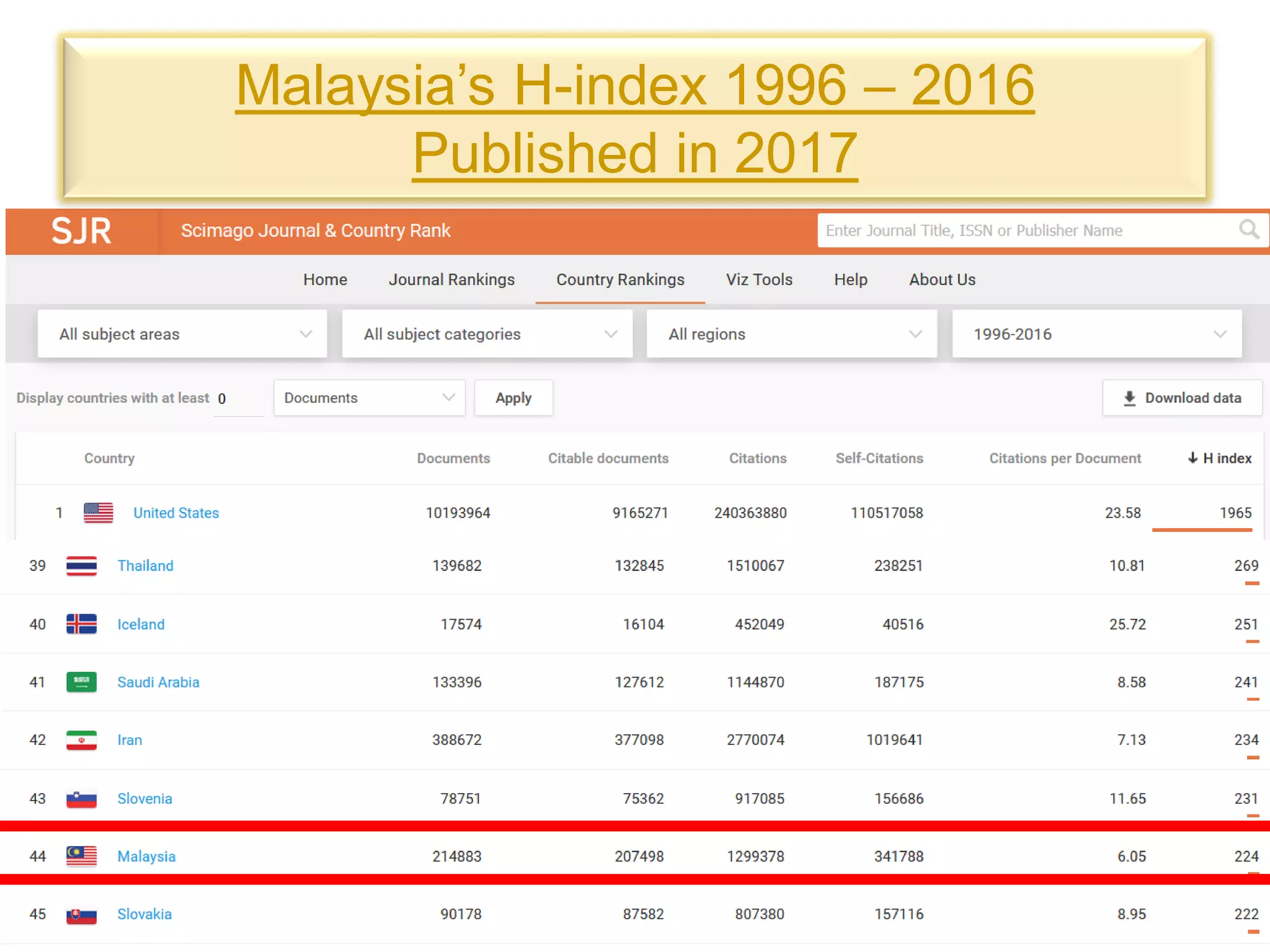
Malaysia’s H-index 1996 – 2016
Published in 2017
©2017-2018 Nader Ale Ebrahim 17
©2017-2018 Nader Ale Ebrahim 18
Source: http://roarmap.eprints.org/view/country/002.html (This list was generated on Wed May 17 02:08:35 2017 BST
Africa (23)
3%
Americas (209)
24%
Asia (58)
7%
Europe (531)
61%
Oceania (40)
5%
OPEN ACCESS POLICIES WORLDWIDE
Worldwide Repositories by Country
©2017-2018 Nader Ale Ebrahim 19
Source: http://www.opendoar.org/
©2017-2018 Nader Ale Ebrahim 20
Example
©2017-2018 Nader Ale Ebrahim
Ale Ebrahim, N., Salehi, H., Embi, M. A., Habibi Tanha, F., Gholizadeh, H., & Motahar, S. M. (2014). Visibility and Citation Impact.
International Education Studies, 7(4), 120-125. doi: 10.5539/ies.v7n4p120 , . Available at SSRN: http://ssrn.com/abstract=2419315
21
Example
©2017-2018 Nader Ale Ebrahim
Ale Ebrahim, N., Salehi, H., Embi, M. A., Habibi Tanha, F., Gholizadeh, H., & Motahar, S. M. (2014). Visibility and Citation Impact.
International Education Studies, 7(4), 120-125. doi: 10.5539/ies.v7n4p120 , . Available at SSRN: http://ssrn.com/abstract=2419315
22
Measuring Your Impact
• Google Scholar
• Scopus
• Web of Science
• Publish or Perish
• Microsoft Academic Search
• PlumX
• Altmetric
• …….
©2017-2018 Nader Ale Ebrahim 23
Measure your own Altmetric
score
©2017-2018 Nader Ale Ebrahim 24
©2017-2018 Nader Ale Ebrahim 25
How to increase the visibility of your research?
1. Get unique author
identifier ORCID to
distinguish yourself and your
work from that of all other
researchers.
2. Share outputsof
your research
3. Create and keep up
to date online profile
(or a web CV)
4. Engage in social
networking
communities
5. Blog
Adopted from: http://pitt.libguides.com/researchvisibility
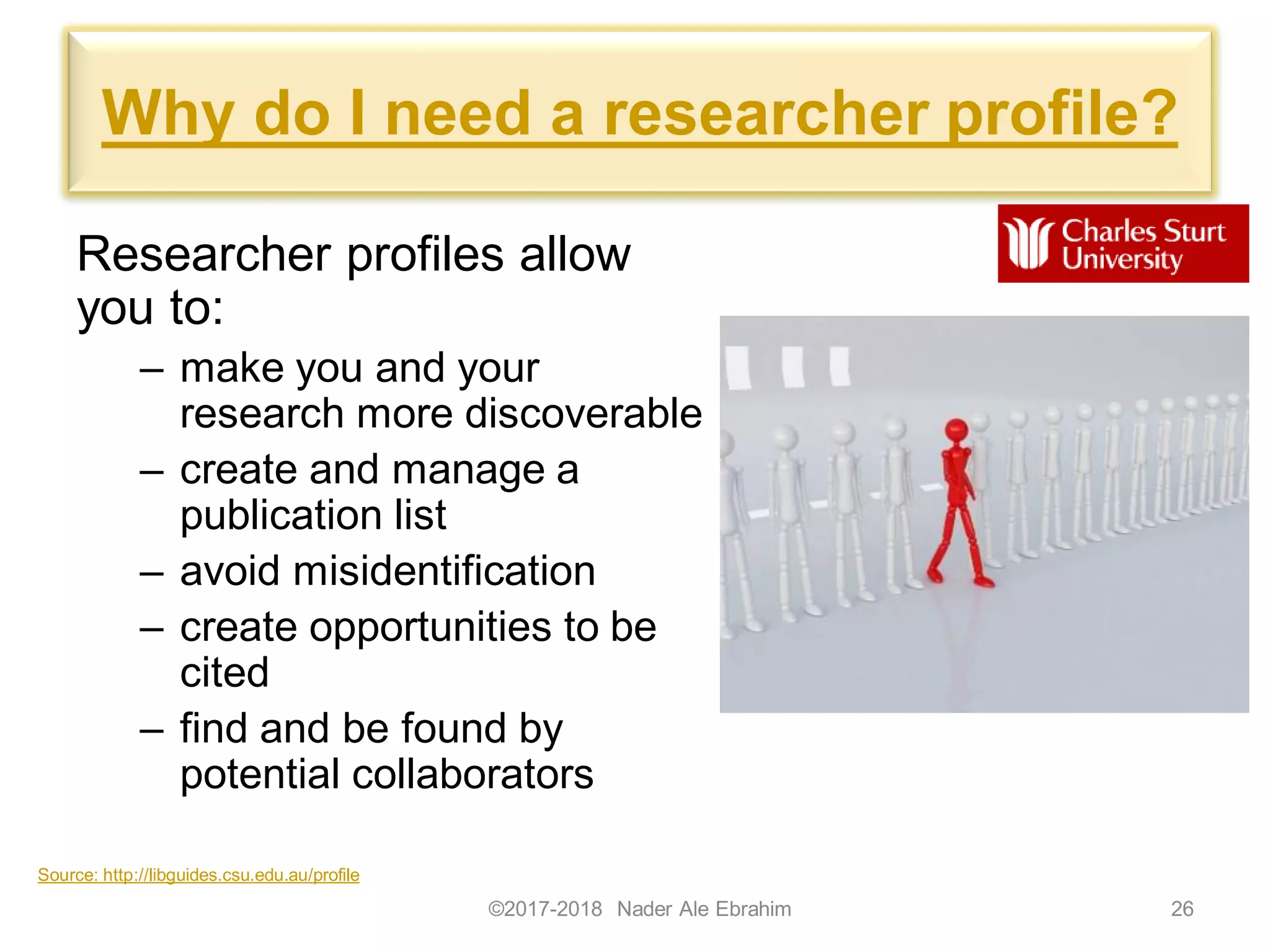
Why do I need a researcher profile?
Researcher profiles allow
you to:
– make you and your
research more discoverable
– create and manage a
publication list
– avoid misidentification
– create opportunities to be
cited
– find and be found by
potential collaborators
©2017-2018 Nader Ale Ebrahim 26
Source: http://libguides.csu.edu.au/profile
©2017-2018 Nader Ale Ebrahim 27
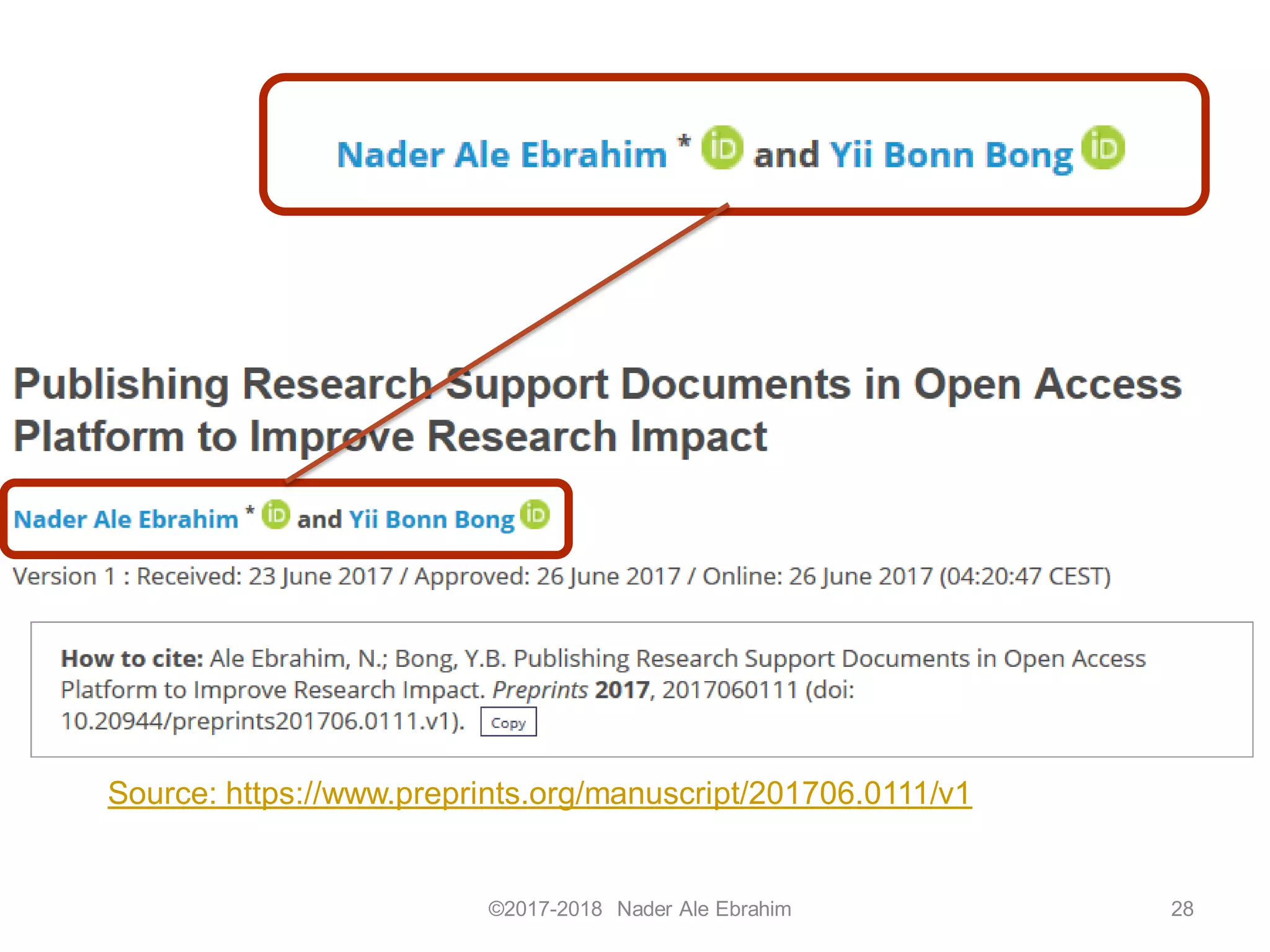
Source: https://www.preprints.org/manuscript/201706.0111/v1
©2017-2018 Nader Ale Ebrahim 28
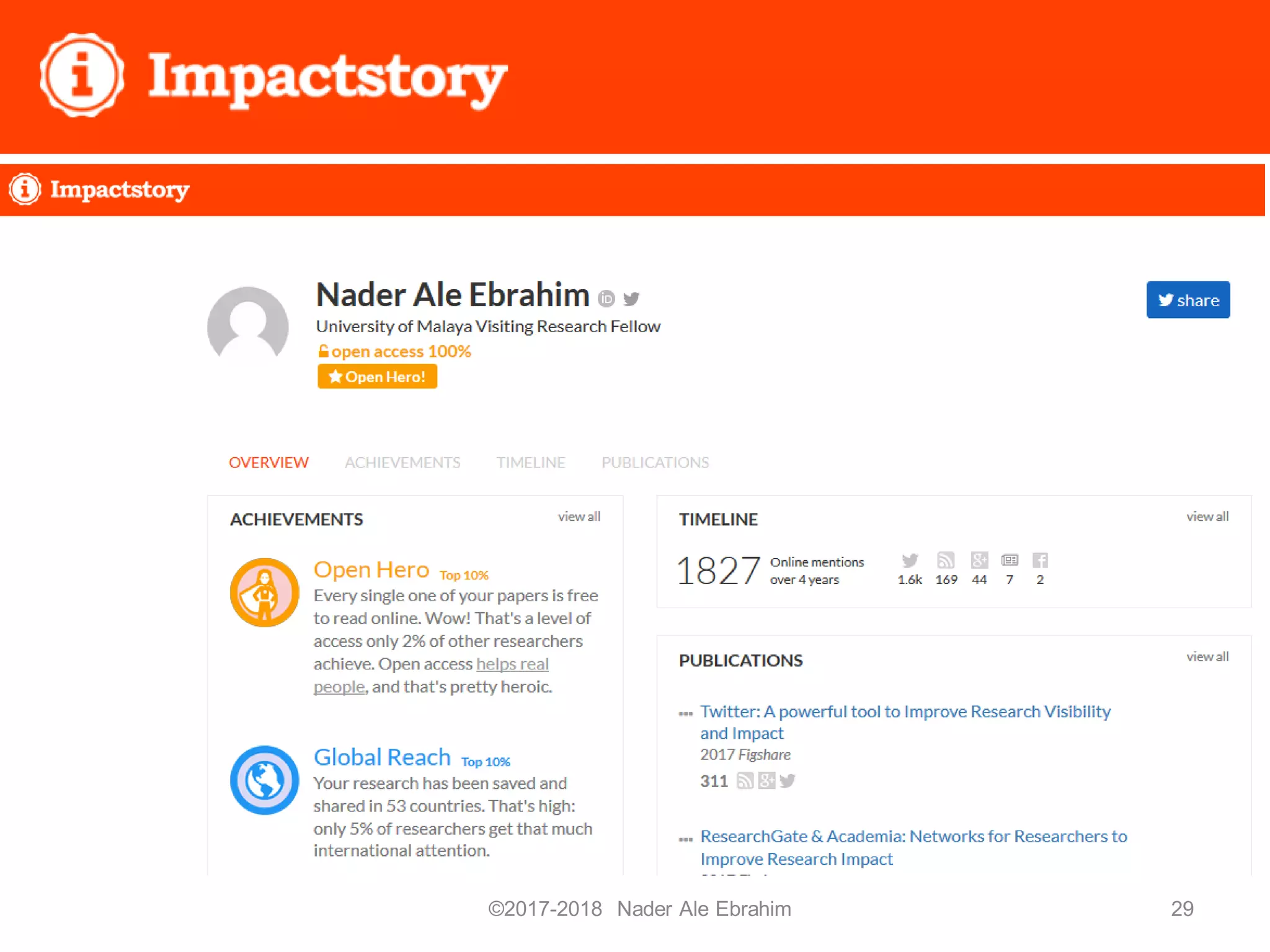
Source: https://www.preprints.org/manuscript/201706.0111/v1
©2017-2018 Nader Ale Ebrahim 29
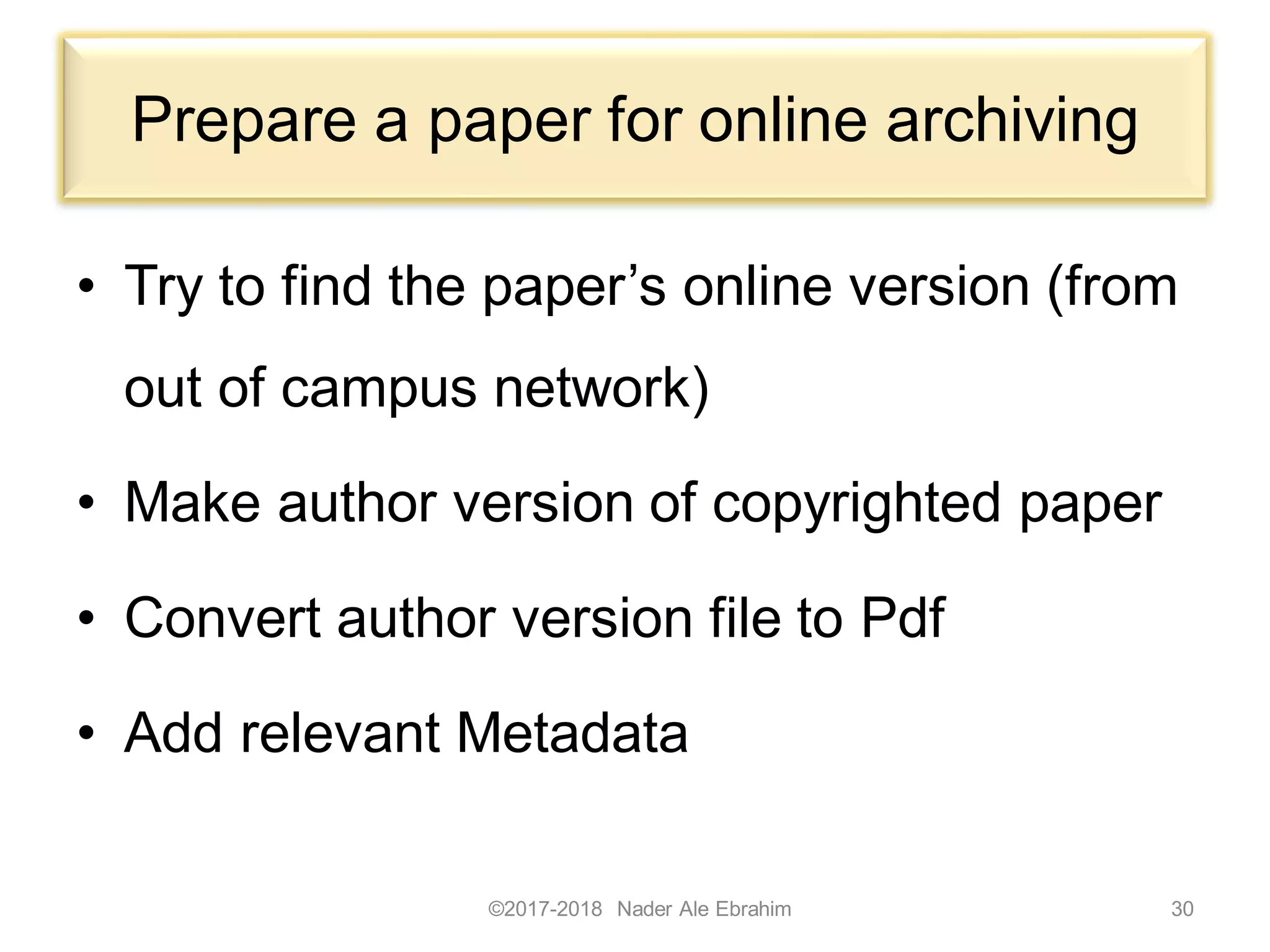
Prepare a paper for online archiving
• Try to find the paper’s online version (from
out of campus network)
• Make author version of copyrighted paper
• Convert author version file to Pdf
• Add relevant Metadata
©2017-2018 Nader Ale Ebrahim 30
©2017-2018 Nader Ale Ebrahim 31
©2017-2018 Nader Ale Ebrahim 32
The Effects of Participative Leadership Practices on Job
Satisfaction for Highly Skilled Virtual Teams
©2017-2018 Nader Ale Ebrahim 33
Source: Sinani, F. (2016). The Effects of Participative Leadership Practices on Job Satisfaction for Highly Skilled Virtual Teams. (Doctor of Philosophy),
Walden University. Retrieved from http://scholarworks.waldenu.edu/cgi/viewcontent.cgi?article=3485&context=dissertations
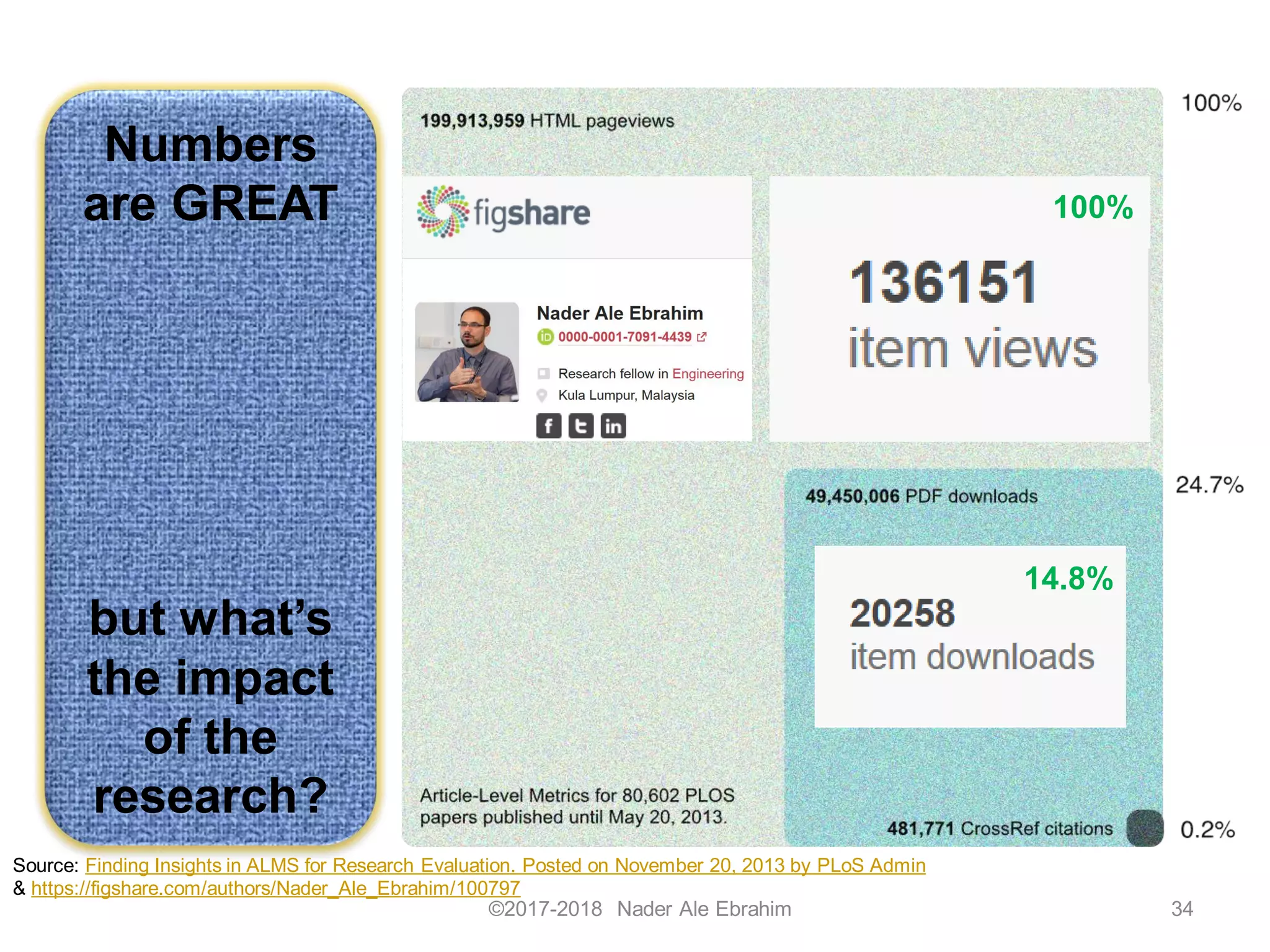
Numbers
are GREAT
but what’s
the impact
of the
research?
©2017-2018 Nader Ale Ebrahim 34
Source: Finding Insights in ALMS for Research Evaluation. Posted on November 20, 2013 by PLoS Admin
& https://figshare.com/authors/Nader_Ale_Ebrahim/100797
100%
14.8%
Numbers
are GREAT
but what’s
the impact
of the
research?
©2017-2018 Nader Ale Ebrahim 35
Source: Finding Insights in ALMS for Research Evaluation. Posted on November 20, 2013 by PLoS Admin
& https://ssrn.com/abstract=1501443
21.7%
100%
How can academia kick its addiction
to the impact factor?
©2017-2018 Nader Ale Ebrahim 36
Source http://blog.scienceopen.com/2016/04/how- can-academia-kick-its-addiction-to-the-impact-factor/
Credit: Hilda Bastian
©2017-2018 Nader Ale Ebrahim 37
?
Source: https://www.altmetric.com/about-our-data/the-donut-and-score/
How is the Altmetric score
calculated?
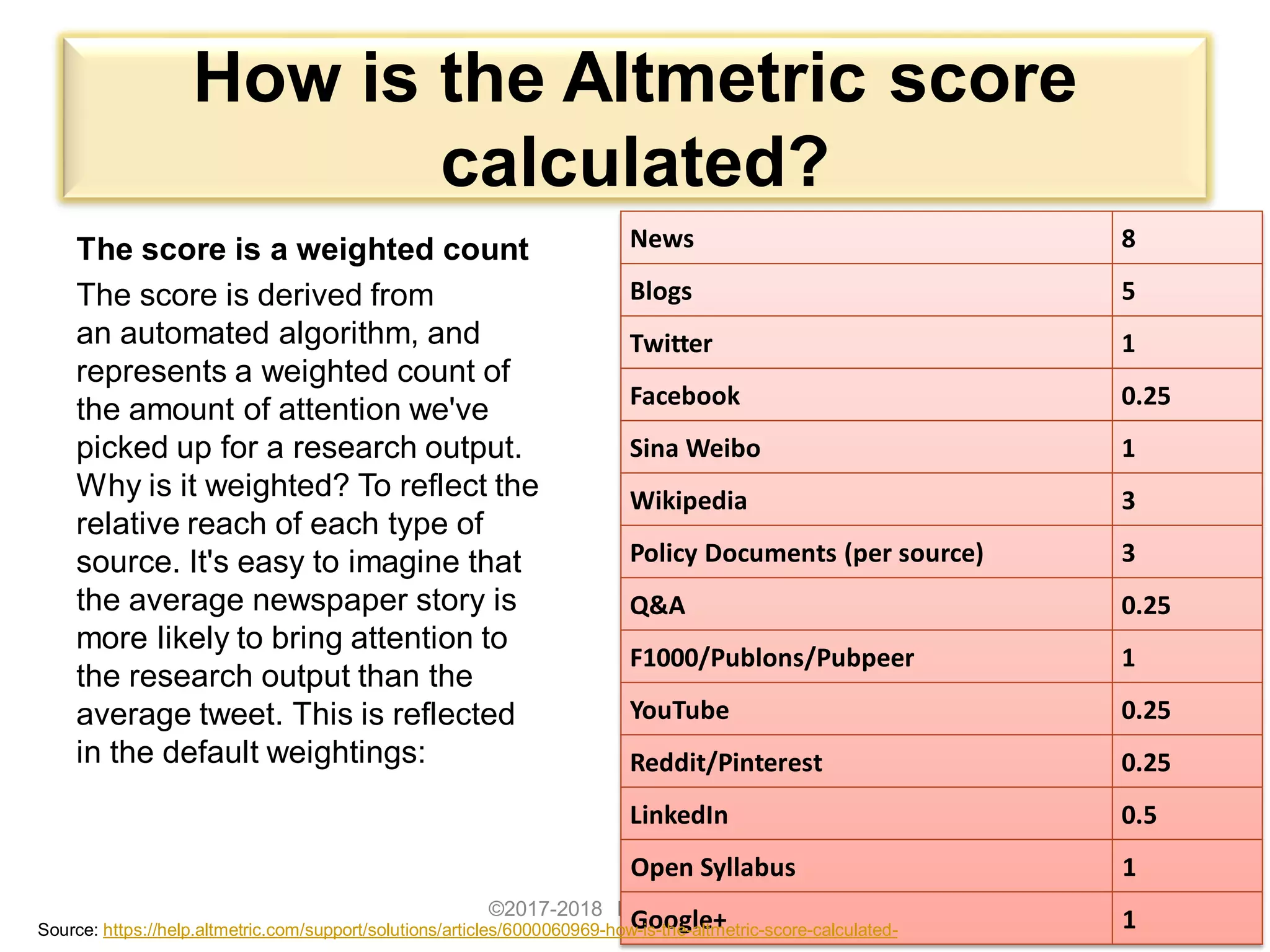
The score is a weighted count
The score is derived from
an automated algorithm, and
represents a weighted count of
the amount of attention we've
picked up for a research output.
Why is it weighted? To reflect the
relative reach of each type of
source. It's easy to imagine that
the average newspaper story is
more likely to bring attention to
the research output than the
average tweet. This is reflected
in the default weightings:
©2017-2018 Nader Ale Ebrahim 38
News 8
Blogs 5
Twitter 1
Facebook 0.25
Sina Weibo 1
Wikipedia 3
Policy Documents (per source) 3
Q&A 0.25
F1000/Publons/Pubpeer 1
YouTube 0.25
Reddit/Pinterest 0.25
LinkedIn 0.5
Open Syllabus 1
Google+ 1Source: https://help.altmetric.com/support/solutions/articles/6000060969-how-is-the-altmetric-score-calculated-
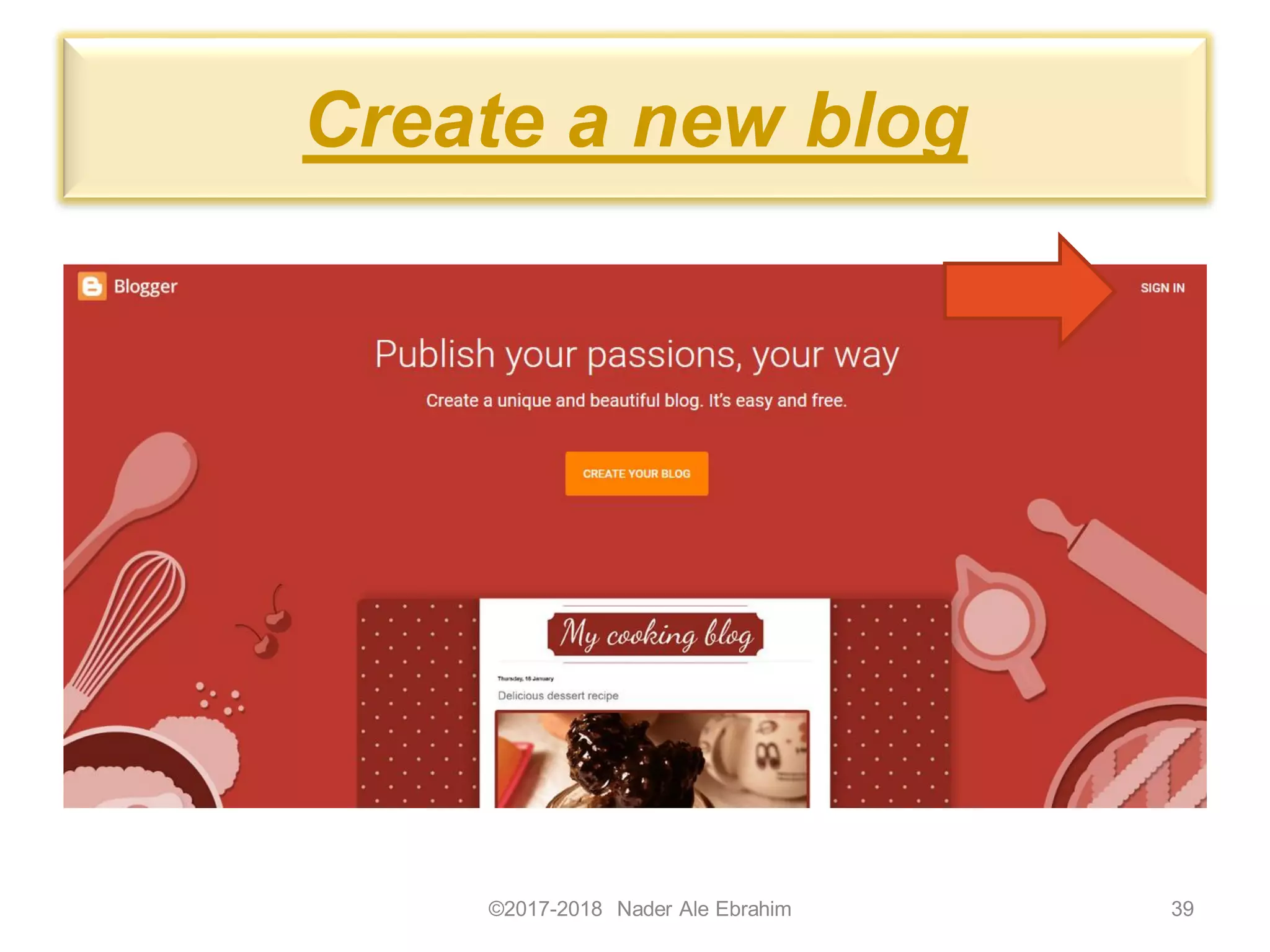
Create a new blog
©2017-2018 Nader Ale Ebrahim 39
Find your community on Twitter
• Sign up - Creating a Twitter account is
dead simple: logon to Twitter.com and sign
up for an account.
• Personalize your account - First, add a
photo to your “avatar”. Next, add a short
bio.
• Find people to follow - Find users who
share your interests and to “follow” them to
start receiving their updates.
©2017-2018 Nader Ale Ebrahim
Source: http://blog.impactstory.org/category/impact-challenge/page/3/
40
The Kardashian index: a measure of
discrepant social media profile for scientists
F=43.3C0.32(1)
Where F is the number of twitter followers and C is the
number of citations.
As a typical number of followers can now be calculated
using this formula, Hall (2014) proposed that the
Kardashian Index
(K-index) can be calculated as follows:
K−index=F(a)/F(c)
Where F(a) is the actual number of twitter followers of
researcher X and F(c) is the number researcher X should
have given their citations. Hence a high K-index is a
warning to the community that researcher X may have
built their public profile on shaky foundations, while a very
low K-index suggests that a scientist is being undervalued.
Here, Hall (2014) proposed that those people whose K-
index is greater than 5 can be considered ‘Science
Kardashians’ ©2017-2018 Nader Ale Ebrahim 41
Neil Hall, Prof
Source: N. Hall, “The Kardashian index: a measure of discrepant social media profile for scientists,” Genome Biology, vol. 15, no. 7, pp. 1-3, 2014/07/30,
2014.
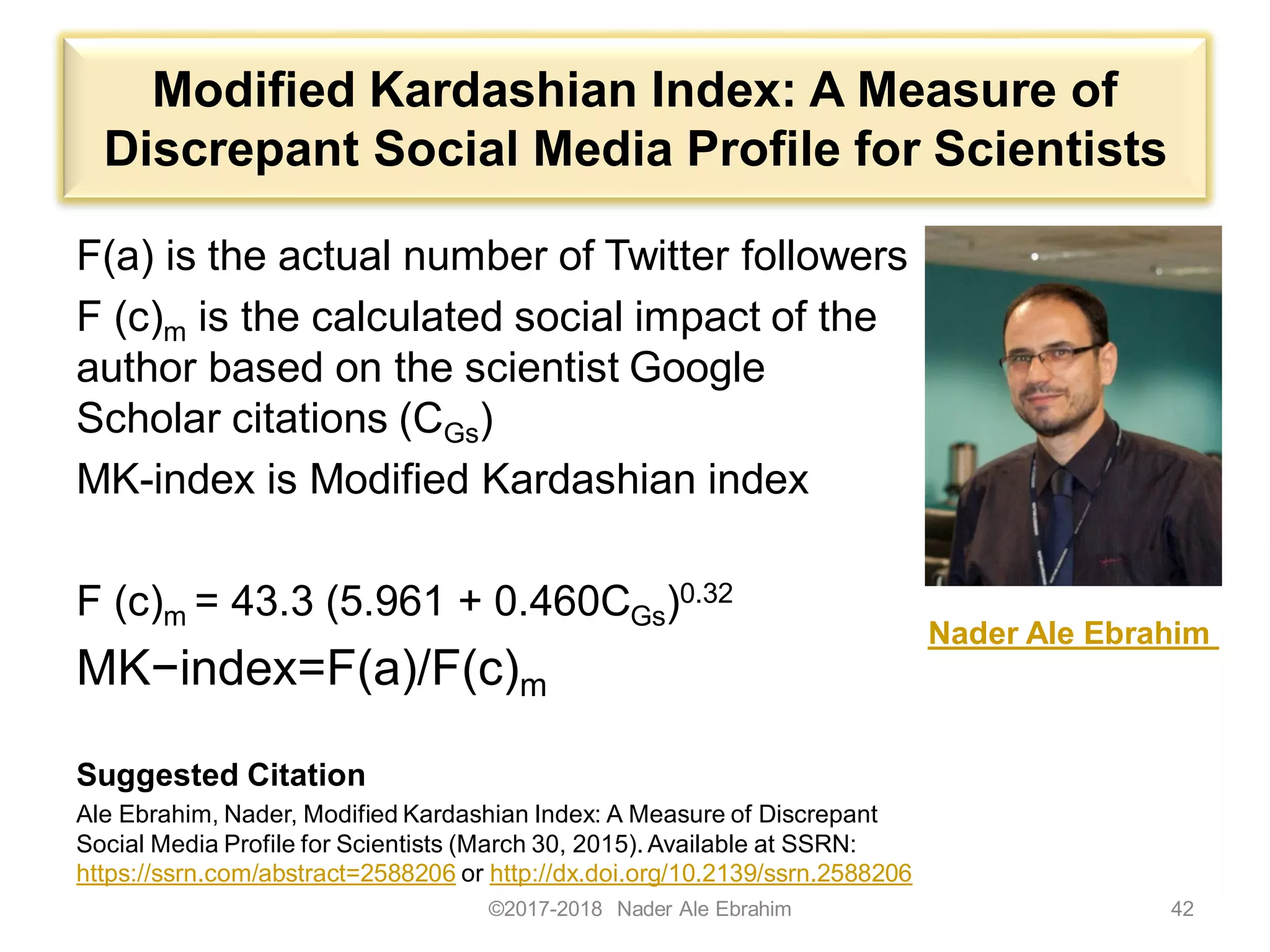
Modified Kardashian Index: A Measure of
Discrepant Social Media Profile for Scientists
F(a) is the actual number of Twitter followers
F (c)m is the calculated social impact of the
author based on the scientist Google
Scholar citations (CGs)
MK-index is Modified Kardashian index
F (c)m = 43.3 (5.961 + 0.460CGs)0.32
MK−index=F(a)/F(c)m
Suggested Citation
Ale Ebrahim, Nader, Modified Kardashian Index: A Measure of Discrepant
Social Media Profile for Scientists (March 30, 2015). Available at SSRN:
https://ssrn.com/abstract=2588206 or http://dx.doi.org/10.2139/ssrn.2588206
©2017-2018 Nader Ale Ebrahim 42
Nader Ale Ebrahim
©2017-2018 Nader Ale Ebrahim
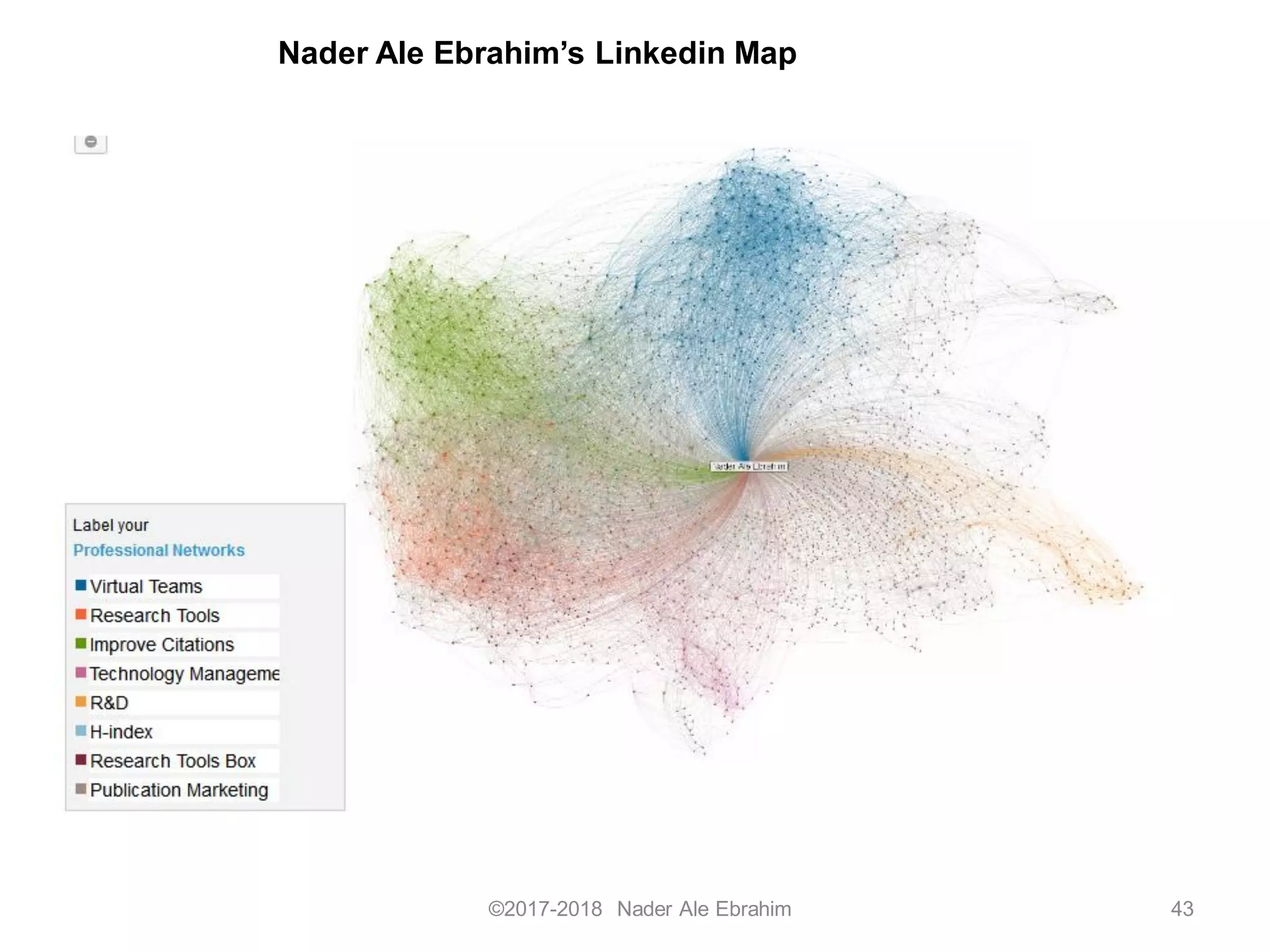
Nader Ale Ebrahim’s Linkedin Map
43
Make your profile a positive tool in promoting the
circulation of your published content:
©2017-2018 Nader Ale Ebrahim
Source: https://hub.wiley.com/community/exchanges/discover/blog/2014/05/01/how-to-promote-your-work-through-linkedin?referrer=exchanges
Tell your entire story
Frame your profile
Make it powerful and concise
Be public
Highlight your work
Showcase your honors and awards
Add images, videos, presentations, and documents
44
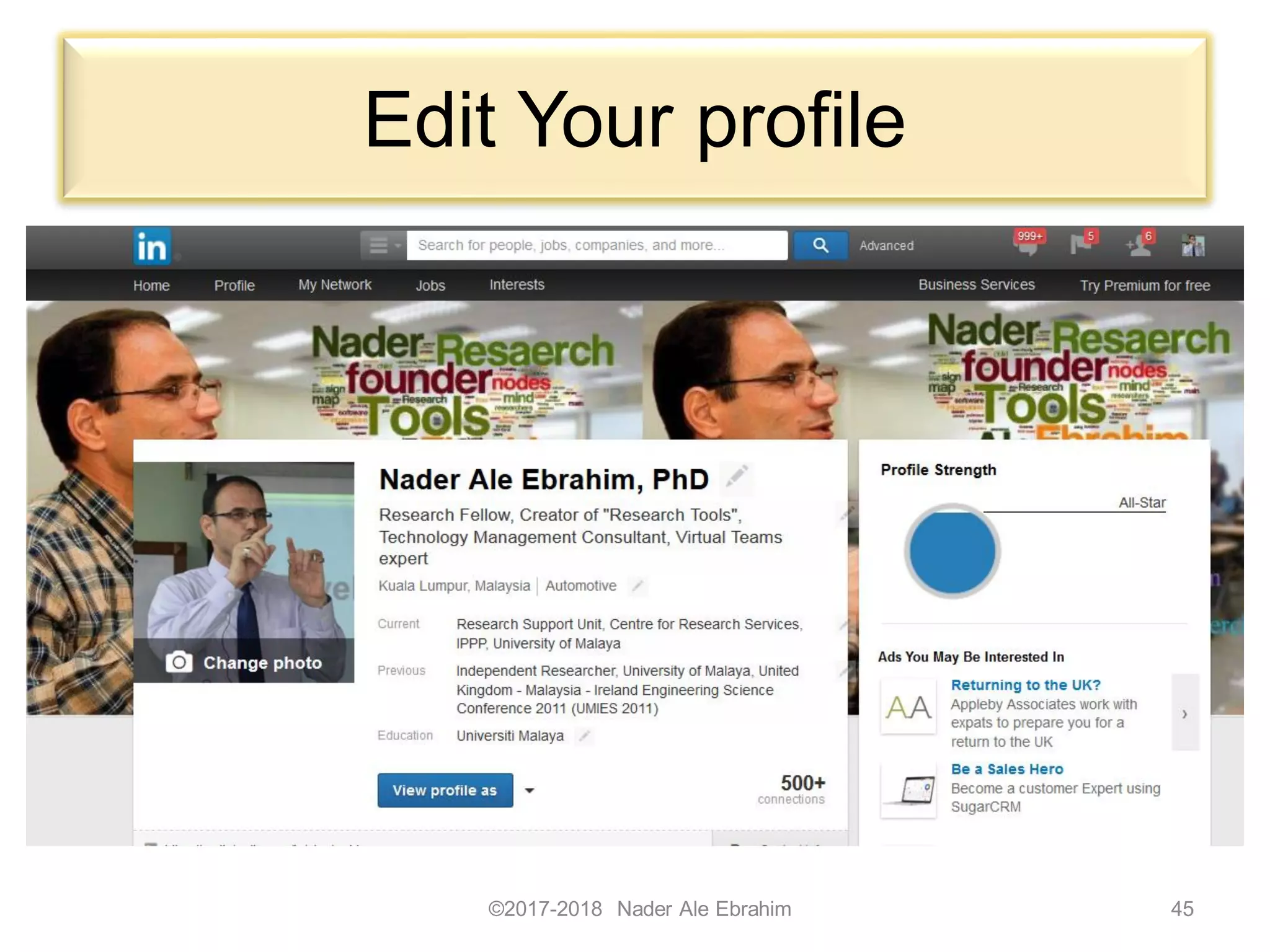
Edit Your profile
©2017-2018 Nader Ale Ebrahim 45
RESEARCHER DATA SHARING
INSIGHTS
©2017-2018 Nader Ale Ebrahim 46
Source: http://www.acscinf.org/PDF/Giffi-%20Researcher%20Data%20Insights%20--%20Infographic%20FINAL%20REVISED.pdf
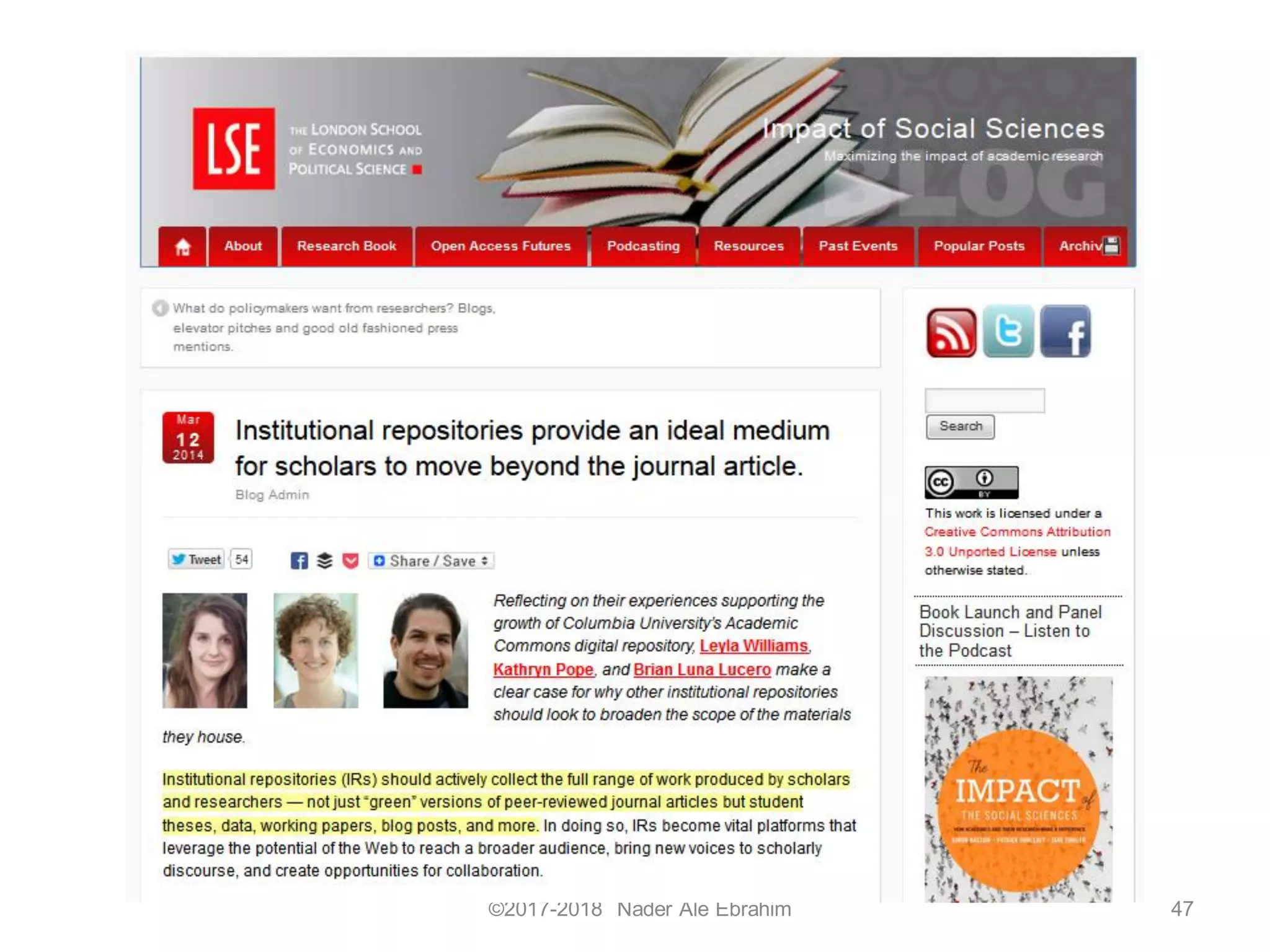
©2017-2018 Nader Ale Ebrahim 47
Citation Tracking Tools
©2017-2018 Nader Ale Ebrahim 48
Tracking via Citation Alerts
Source: http://guides.library.kumc.edu/c.php?g=451739&p=3084603
Use the citation alerts function in databases to be notified when someone cites your work. This allows you to follow who is citing you and
when you have been cited. Alerts can be created for authors or specific articles and can be sent via email or RSS feed on a specified frequency
(daily, weekly, monthly).
Web of Science Citation Alerts
You can create an alert for an author or a specific article:
Save a search query on your name as author and create an alert
Create an alert for a specific article you authored
Link to help for creating alerts or view the Web of Science tutorial.
Google & Google Scholar Alerts
Set up a Google Scholar Profile and create an alert to be emailed whenever any of your articles are cited
Set up a Google Alert based on a search of your name or research area for email notification
PubMed Commons Comments
PubMed Commons enables authors to share opinions and information about scientific publications indexed in PubMed. As an author of an
indexed publication, you can create an alert to be notified when someone posts a comment to one of your articles. Create a search for yourself
as the author and articles that have comments, as in the example below:
Example: Olivero M [author] AND has_user_comments [filter]
Then create an alert for this search. View the brief PubMed Tutorial for details on creating an alert.
See the PubMed Commons Guide for more examples of searching for comments in PubMed Commons.
Track Altmetrics
Use the free Altmetric bookmarklet to track other forms of metrics (non-citations) for you published journal articles. Drag the Bookmarklet to
your browser's bookmarks bar and use this for any journal article to learn of any social media activity for the selected article.
Find who cited the article
©2017-2018 Nader Ale Ebrahim 50
KNOWN CITATIONS
Prof. Luis M. Camarinha-Matos
©2017-2018 Nader Ale Ebrahim
Source: http://www.uninova.pt/cam/cv/CVcamCit.PDF
51
Increasing Visibility and Enhancing
Impact of Research
©2017-2018 Nader Ale Ebrahim 52
Source: Bong, Yiibonn and Ale Ebrahim, Nader, Increasing Visibility and Enhancing Impact of Research (April 24, 2017). Asia
Research News 2017. Available at SSRN: https://ssrn.com/abstract=2959952
Preparing for Publication – Writing
• Use a unique name consistently throughout academic
careers;
• Use a standardized institutional affiliation and address;
• Repeat key phrases in the abstract while writing
naturally;
• Assign keyword terms to the manuscript;
• Use more references;
• Write a longer paper;
• Write a review paper;
• Present a working paper;
©2016-2017 Nader Ale Ebrahim
Read more: Ale Ebrahim, N., Salehi, H., Embi, M. A., Habibi Tanha, F., Gholizadeh, H., Motahar, S. M., & Ordi, A. (2013).
Effective Strategies for Increasing Citation Frequency. International Education Studies, 6(11), 93-99. doi:
10.5539/ies.v6n11p93
Preparing for Publication – Collaboration
& Journal Selection
• Publish with international authors;
• Publish papers with a Nobel laureates;
• Publish your article in one of the journals
everyone in your discipline reads
• Open Access (OA) has a positive impact on
growth of citations;
• Publish your work in a journal with the highest
number of indexing
©2016-2017 Nader Ale Ebrahim
Read more: Ale Ebrahim, N., Salehi, H., Embi, M. A., Habibi Tanha, F., Gholizadeh, H., Motahar, S. M., & Ordi, A. (2013).
Effective Strategies for Increasing Citation Frequency. International Education Studies, 6(11), 93-99. doi:
10.5539/ies.v6n11p93
©2017-2018 Nader Ale Ebrahim 55
Make sure you have a
SEO-friendly
manuscript, then
submit.
dit: Atena Ale Ebrahim
Papers are accepted based on novelty,
importance and scientific merit. But once
published, a well-crafted title and
abstract can help your work be found.
Source: http://blogs.nature.com/naturejobs/2015/07/10/publishing-high-impact-papers-natures-way
©2017-2018 Nader Ale Ebrahim 56
©2017-2018 Nader Ale EbrahimAle Ebrahim, Nader, Optimize Your Article for Search Engine (December 23, 2014). University of Malaya Research Bulletin, Vol. 2,
No. 1, 23, December 2014. Available at SSRN: http://ssrn.com/abstract=2588209
57
Tips
• Write a good and short title for your article. If you can use one or more keywords
in the title while accurately describing the content of your article, then do it. Keep in
mind the audience of your article and any academic keywords specific to your field to
inform which keywords may be best to use.
• In addition to the keywords tool from Google, check out Google Insights and
Google Trends. With the latter two, you can see the popularity of keywords over a
period of time and by geographic location, which may or may not be relevant for you
and to your article. Until now, Google offers the most tools for SEO.
• Don’t go overboard with using numerous top keywords in every location of
your article. You want to tastefully optimize your article without compromising the
relevance and quality of your writing and research.
• Using the most popular keyword tool may not always be best for you and your
article. After all, it is the most popular for a reason, partly because it is frequently
used in documents by others. You can test this by doing your own search of the
keyword and seeing how many search results are found. If it is an exorbitant amount
of articles, you may want to choose another keyword that is also very relevant to your
research topic.
©2017-2018 Nader Ale Ebrahim 58
Source: https://www.elsevier.com/connect/get-found-optimize-your-research-articles-for-search-engines
Top Tips to make Your Article
Discoverable
1. Find the Keywords and search phrase to optimize your document
– Think about the most important words that are relevant to the article.
– Consider looking up specific keywords on Google Trends or the Google Adwords Keywords
tool to find out which search terms are popular.
– Try out your keywords in Google Scholar, etc. and if too many results are returned, it may be
better to consider a keyword with less competition.
2. Make sure you have a SEO-friendly title for your article
– The title needs to be descriptive and must contain a key phrase related to your topic.
– Put your keywords within the first 65 characters of the title. Google Scholar considers the
length of a title. In a search for the phrase ‘SEO for Authors: A How-to Guide’ would be
ranked higher than one titled ‘Search Engine Optimization (SEO) for Authors: Ranking
Information and Publishing Tips’. Although in general titles should be fairly short, we
suggest choosing a longer title if there are many relevant keywords.
3. Write your abstract using keywords, phrases and synonyms
– Include the keywords and phrases in your abstract that a researcher might search on to find
your article. Provide additional relevant keywords and synonyms for those keywords as they
relate to your article keeping in mind those keywords are also used by the abstracting and
indexing services as a method to tag the research content.
©2017-2018 Nader Ale Ebrahim 59
Source: http://guides.library.ucla.edu/seo
Top Tips to make Your Article
Discoverable
4. Stay consistent
– Refer to authors names and initials in a consistent manner throughout the paper and in the same way
they’ve been referred to in the past online publications. If names are used inconsistently, search engines
may not be able to id articles or citations correctly; as a consequence, citations may be assigned incorrectly,
and articles will not be as highly ranked as they should be. For instance, Jöran, Joeran, and Joran are all
correct spellings of the same name (given different transcription rules), but Google Scholar sees them as
three different names. Obtain an ORCID and use it when submitting works to publishers to aid
dissambiguation.
5. Use headings
– Headings for the various sections of your article tip off search engines to the structure and content of your
article. Incorporate your keywords and phrases in these headings wherever it’s appropriate.
6. Cite your own, or your co-authors, previous publications
– Academic search engines, and especially Google Scholar, assign significant weight to citation
counts. Citations influence whether articles are indexed at all, and they also influence the ranking of
articles. When referencing your own published work, it is important to include a link where that work can be
downloaded . This helps readers to find your article and helps academic search engines to index the
referenced articles’ full text.
7. Text in figures and tables should be machine readable
– Vector graphics containing font based text should be used instead of rasterized images so it can be indexed
by academic search engines. Graphics stored as JPEG, BMP, GIF, TIFF, or PNG files are not vector
graphics.
– When documents are converted to PDF, all metadata should be correct (especially author and title). Some
search engines use PDF metadata to identify the file or to display information about the article on the search
engine results page.
©2017-2018 Nader Ale Ebrahim 60
Source: http://guides.library.ucla.edu/seo
Example of Well-Optimized Abstrac
©2017-2018 Nader Ale Ebrahim 61
Source: http://media.wiley.com/assets/7158/18/SEO_For_Authors.pdf
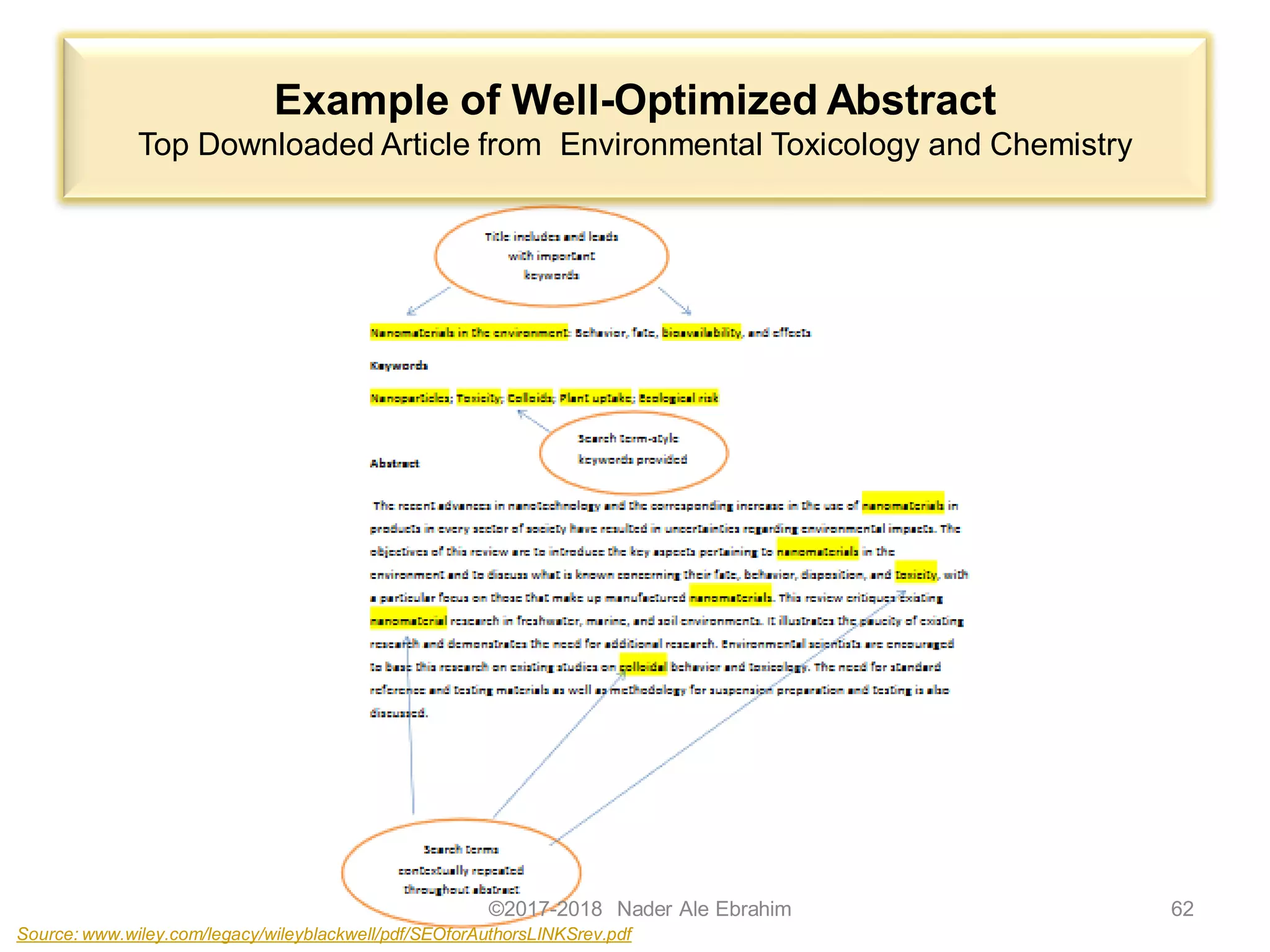
Example of Well-Optimized Abstract
Top Downloaded Article from Environmental Toxicology and Chemistry
©2017-2018 Nader Ale Ebrahim 62
Source: www.wiley.com/legacy/wileyblackwell/pdf/SEOforAuthorsLINKSrev.pdf
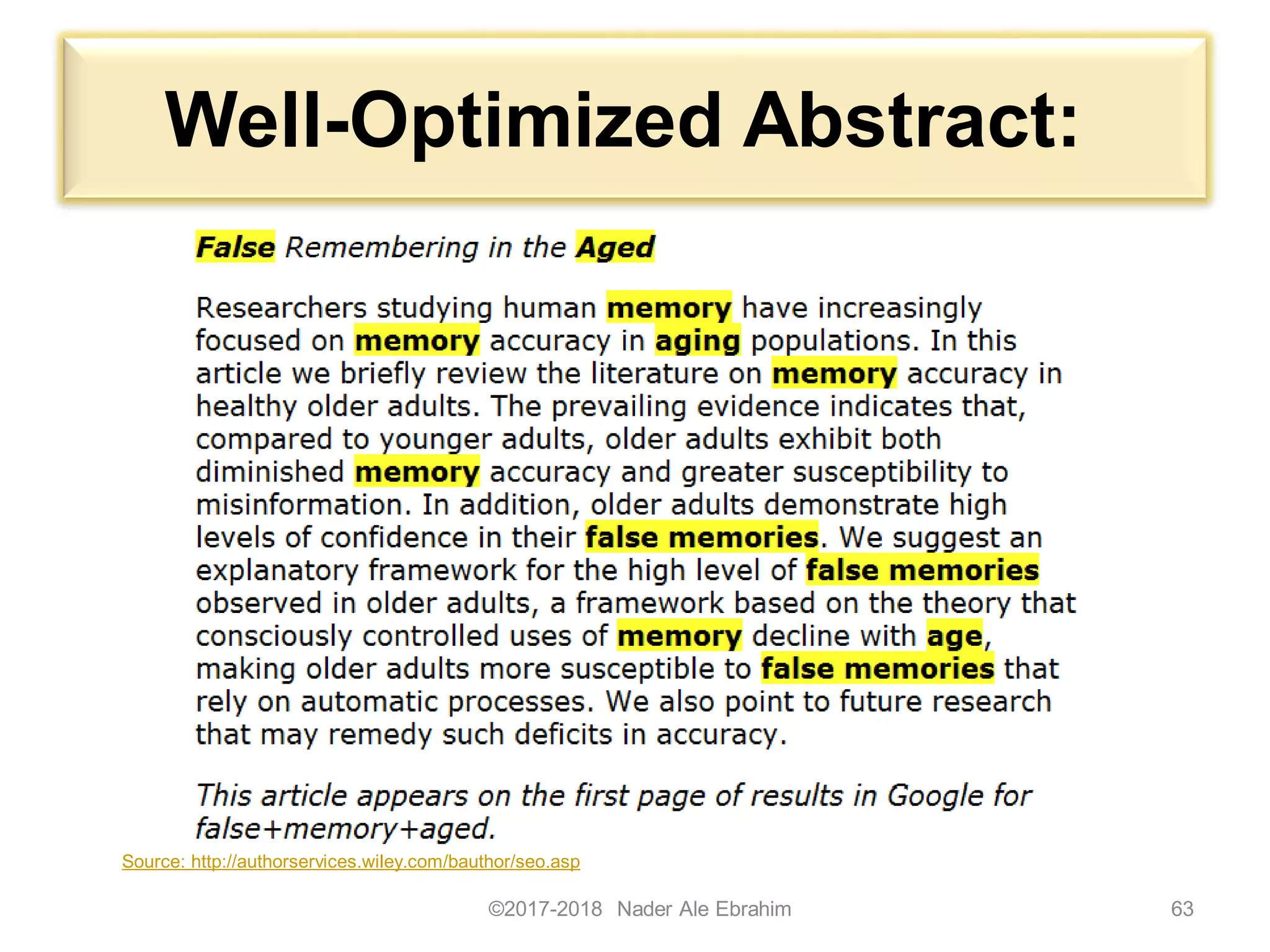
Well-Optimized Abstract:
©2017-2018 Nader Ale Ebrahim 63
Source: http://authorservices.wiley.com/bauthor/seo.asp
Poorly Optimized Abstract:
©2017-2018 Nader Ale Ebrahim 64
Source: http://authorservices.wiley.com/bauthor/seo.asp
Compare Keywords
“Senior Population” with “Aged”
©2017-2018 Nader Ale Ebrahim 65
Compare Keywords
“Senior Population” with “Aged”
©2017-2018 Nader Ale Ebrahim 66
Metadata
The metadata of an article refers to a number of
things. Metadata can refer to the keywords used,
as well as to the type of file your document is, such
as whether it is a PDF or Word file, the title,
subjects and authors of the article, the date of the
article, the name of the publisher and more. The
metadata of your article also factors in the indexing
and ranking of your article, so you should ensure
this information is complete.
See more at:: http://elsevierconnect.com/get-found-optimize-your-research-articles-for-search-engines/
©2017-2018 Nader Ale Ebrahim 67
Dissemination 1/2
• Self-archive articles
• Keep your professional web pages and
published lists up to date
• Make your research easy to find,
especially for online searchers
• Deposit paper in Open Access repository
• Contribute to Wikipedia
• Start blogging
©2016-2017 Nader Ale Ebrahim
Read more: Ale Ebrahim, N., Salehi, H., Embi, M. A., Habibi Tanha, F., Gholizadeh, H., Motahar, S. M., & Ordi, A. (2013).
Effective Strategies for Increasing Citation Frequency. International Education Studies, 6(11), 93-99. doi:
10.5539/ies.v6n11p93
Dissemination 2/2
• Join academic social networking sites
• link your latest published article to your
email signature
• Create a podcast describing the research
project and submit the podcast to YouTube
or Vimeo
• Make an online CV.
©2016-2017 Nader Ale Ebrahim
Read more: Ale Ebrahim, N., Salehi, H., Embi, M. A., Habibi Tanha, F., Gholizadeh, H., Motahar, S. M., & Ordi, A. (2013).
Effective Strategies for Increasing Citation Frequency. International Education Studies, 6(11), 93-99. doi:
10.5539/ies.v6n11p93
My recent publications
©2017-2018 Nader Ale Ebrahim 70
Questions?
©2017-2018 Nader Ale Ebrahim 71
E-mail: aleebrahim@um.edu.my
Twitter: @aleebrahim
www.researcherid.com/rid/C-2414-2009
http://scholar.google.com/citations
Nader Ale Ebrahim, PhD
=====================================
Centre for Research Services
Institute of Management and Research Services
University of Malaya, Kuala Lumpur, Malaysia
www.researcherid.com/rid/C-2414-2009
http://scholar.google.com/citations
CENTRE FOR RESEARCH SERVICES
RESEARCH MANAGEMENT & INNOVATION COMPLEX (IPPP)
UNIVERSITY OF MALAYA
References
1. Martín-Martín, A., Orduna-Malea, E., Ayllón, J. M., & López-Cózar, E. D. (2016). The counting house, measuring those who count: Presence of Bibliometrics,
Scientometrics, Informetrics, Webometrics and Altmetrics in Google Scholar Citations, ResearcherID, ResearchGate, Mendeley, & Twitter. EC3 Reseach Group:
Evaluación de la Ciencia y de la Comunicación Científica Universidad de Granada and Universidad Politécnica de Valencia (Spain), In Progress,.
doi:10.13140/RG.2.1.4814.4402
2. Ebrahim, N.A., et al. (2013). Effective strategies for increasing citation frequency. International Education Studies, 6(11), 93-99. doi:10.5539/ies.v6n11p93
3. Richard Van Noorden , Nature News, 27 August 2013
4. Ebrahimy, S., Mehrad, J., Setareh, F., & Hosseinchari, M. (2016). Path analysis of the relationship between visibility and citation: the mediating roles of save, discussion,
and recommendation metrics. Scientometrics 1-14. doi:10.1007/s11192-016-2130-z
5. Ale Ebrahim, N., Salehi, H., Embi, M. A., Habibi Tanha, F., Gholizadeh, H., & Motahar, S. M. (2014). Visibility and Citation Impact. International Education Studies, 7(4),
120-125. doi: 10.5539/ies.v7n4p120 , . Available at SSRN: http://ssrn.com/abstract=2419315
6. Sinani, F. (2016). The Effects of Participative Leadership Practices on Job Satisfaction for Highly Skilled Virtual Teams. (Doctor of Philosophy), Walden University.
Retrieved from http://scholarworks.waldenu.edu/cgi/viewcontent.cgi?article=3485&context=dissertations
7. Finding Insights in ALMS for Research Evaluation. Posted on November 20, 2013 by PLoS Admin
& https://ssrn.com/abstract=1501443
8. N. Hall, “The Kardashian index: a measure of discrepant social media profile for scientists,” Genome Biology, vol. 15, no. 7, pp. 1-3, 2014/07/30, 2014.
9. Ale Ebrahim, Nader, Modified Kardashian Index: A Measure of Discrepant Social Media Profile for Scientists (March 30, 2015). Available at SSRN:
https://ssrn.com/abstract=2588206 or http://dx.doi.org/10.2139/ssrn.2588206
10. Bong, Yiibonn and Ale Ebrahim, Nader, Increasing Visibility and Enhancing Impact of Research (April 24, 2017). Asia Research News 2017. Available at SSRN:
https://ssrn.com/abstract=2959952
11. Ale Ebrahim, Nader, Optimize Your Article for Search Engine (December 23, 2014). University of Malaya Research Bulletin, Vol. 2, No. 1, 23, December 2014. Available at
SSRN: http://ssrn.com/abstract=2588209
My recent publication:
1. N. Ale Ebrahim, and Y. B. Bong, “A Bibliometric Study of Open Innovation, 2012-2017,” International Journal of Innovation (IJI), vol. 5, no. 3, September, 2017. http://dx.doi.org/10.5585/iji.v5i3.184
2. Abedini, A., Rahman, R., Naeini, H. S., & Ale Ebrahim, N. (2017). The100 Most Cited Papers in “Industrial Design”: A Bibliometric Analysis. Exacta – Engenharia de Produção, 15(3), doi:10.5585/ExactaEP.v15n3.7659
3. S. Shamshirband, A. Kalantari, A. Kamsin, H. S. Kamaruddin, N. Ale Ebrahim, A. Gani, and A. Ebrahimi, “A Bibliometric Approach to Tracking Big Data Research Trends,” Journal of Big Data, vol. 4, no. 30, 29 September, 2017.
https://doi.org/10.1186/s40537-017-0088-1
4. Jamali, S. M., Nurulazam Md Zain, A., Samsudin, M. A., & Ale Ebrahim, N. (2017). Self-Efficacy,Scientific Reasoning, and Learning Achievement in the STEM PjBL Literature. Paper presented at the International Postgraduate
Conference on Research in Education (IPCoRE 2017), School of Educational Studies, Universiti Sains Malaysia (USM), Penang, Malaysia
5. Samsudin, M. A., Nurulazam Md Zain, A., Jamali, S. M., & Ale Ebrahim, N. (2017). Physics Achievement in STEM PjBL: A Gender Study. Paper presented at the International Postgraduate Conference on Research in Education
(IPCoRE 2017), School of Educational Studies, Universiti Sains Malaysia (USM), Penang, Malaysia.
6. Muhammad, M., Ahmed, A., Lola, G. K., Mikail Usman, U., & Ale Ebrahim, N. (2017). The Rise of “Trade Liberalization”: Bibliometric Analysis of Trade Liberalization Study. Mediterranean Journal of Social Sciences, 8(2), 97-104.
http://ssrn.com/abstract=2928551
My recent presentations:
1. Ale Ebrahim, Nader (2017): Improve Research Visibility and Impact by Academic SEO. https://doi.org/10.6084/m9.figshare.5463349.v2
2. Ale Ebrahim, Nader (2017): Online Reference Management Tools for Improving Research Visibility and Impact.https://doi.org/10.6084/m9.figshare.5440165.v1
3. Ale Ebrahim, Nader (2017): Create Online Researcher’s Profile to Increase Visibility. https://doi.org/10.6084/m9.figshare.5417731.v1
4. Ale Ebrahim, Nader (2017): New indicators for measuring research impact. https://doi.org/10.6084/m9.figshare.5398072.v1
5. Ale Ebrahim, Nader (2017): How to Writea Bibliometric Paper. https://doi.org/10.6084/m9.figshare.5374615.v1
6. Ale Ebrahim, Nader (2017): A Journal Selection Procedure for Receiving the Highest Citation and Impact. https://doi.org/10.6084/m9.figshare.5330950.v1
©2017-2018 Nader Ale Ebrahim 72

Strategies to Enhance Research Visibility, Impact & Citations

  • 1.
    Strategies to Enhance ResearchVisibility, Impact & Citations aleebrahim@um.edu.my @Aleebrahim www.researcherid.com/rid/C-2414-2009 http://scholar.google.com/citations Nader Ale Ebrahim, PhD Visiting Research Fellow Centre for Research Services Institute of Management and Research Services University of Malaya, Kuala Lumpur, Malaysia 6th October 2017
  • 2.
    Nader Ale Ebrahim,PhD ===================================== Centre for Research Services Research Management & Innovation Complex University of Malaya, Kuala Lumpur, Malaysia www.researcherid.com/rid/C-2414-2009 http://scholar.google.com/citations All of my presentations are available online at: https://figshare.com/authors/Nader_Ale_Ebrahim/100797 Link to this presentation: https://doi.org/10.6084/m9.figshare.5472847.v1 (New version) Read more: 1. Ale Ebrahim, N., Salehi, H., Embi, M. A., Habibi Tanha, F., Gholizadeh, H., Motahar, S. M., & Ordi, A. (2013). Effective Strategies for Increasing Citation Frequency. International Education Studies, 6(11), 93-99. doi: 10.5539/ies.v6n11p93 2. Ale Ebrahim, Nader. "Optimize Your Article for Search Engine." University of Malaya Research Bulletin 2.1 (2014): 38-39. INTRODUCTORY WORKSHOP ON: Strategies to Enhance Research Visibility, Impact & Citations
  • 3.
    Abstract Abstract: Do youknow “Over 43% of ISI papers have never ever received any citations?” (nature.com/top100, 2014). Publishing a high quality paper in scientific journals is only halfway towards receiving citation in the future. The rest of the journey is dependent on disseminating the publications via proper utilization of the “Research Tools”. Proper tools allow the researchers to increase the research impact and citations for their publications. This workshop will provide various techniques on how you can increase the visibility and hence the impact of your research work. Keywords: H-index, Improve citations, Research tools, Bibliometrics, Research visibility, Research impact ©2017-2018 Nader Ale Ebrahim 3
  • 4.
    ©2017-2018 Nader AleEbrahim 4 ©2017-2018 Nader Ale Ebrahim
  • 5.
    Top 10 authorswith the highest profile view counts on ResearchGate ©2017-2018 Nader Ale Ebrahim 5 Source: Martín-Martín, A., Orduna-Malea, E., Ayllón, J. M., & López-Cózar, E. D. (2016). The counting house, measuring those who count: Presence of Bibliometrics, Scientometrics, Informetrics, Webometrics and Altmetrics in Google Scholar Citations, ResearcherID, ResearchGate, Mendeley, & Twitter. EC3 Reseach Group: Evaluación de la Ciencia y de la Comunicación Científica Universidad de Granada and Universidad Politécnica de Valencia (Spain), In Progress,. doi:10.13140/RG.2.1.4814.4402
  • 6.
    Effective Strategies forIncreasing Citation Frequency Journal Reputation and Impact: publishing a paper in a journal based on disciplinary reputatation or with a high impact factor is the most well known way of getting your paper cited. But there are many other things a scholar can do to promote his or her work and make it easy for others to find. Utilize Open Access Tools: Open Access journals tend to be cited more than non open access. Deposit your paper in a repository such as Scholars Archive here on campus or a disciplinary repository. Share your detailed research data in a repository. Standarize Identifying Info: try to use the same name throughout your career as well as the name of your affiliated insitution. Using common "official" names will allow for consistency and easy retrieval of your work by author or affiliation. Bring Colleagues on Board: team-authored articles are cited more frequently, as does publishing with international authors. Working cross-or inter-disciplinarily helps as well. Beef Up That Paper: use more references, publish a longer paper. Also papers which are published elsewhere after having been rejected are cited more frequently. Beyond Peer-Reviewed Original Research: Write a review paper. Present a working paper. Write and disseminate web-based tutorials on your topic. Search Optimization: use keywords in the abstract and assign them to the manuscript. Use descriptive titles that utilize the obvious terms searchers would use to look for your topic, avoiding questions in the title. Select a journal that is indexed in the key library databases for your field. Market Yourself: create a key phrase that describes your research career and use it. Update your professional web page and publication lists frequently. Link to your latest and greatest article in your professional email signature file. Utliize Social Media: Use author profiles such as ResearcherID and ORCID. Contribute to Wikipedia, start a blog and/or podcast, join academic social media sites. From: Ebrahim, N.A., et al. (2013). Effective strategies for increasing citation frequency. International Education Studies, 6(11), 93-99. doi:10.5539/ies.v6n11p93 ©2017-2018 Nader Ale Ebrahim 6
  • 7.
    Research Tools MindMap ©2017-2018 Nader Ale Ebrahim 7 dit: Atena Ale
  • 8.
    ©2017-2018 Nader AleEbrahim Source: Researchers, publishers, libraries and data centres all have a role in promoting and encouraging data citation. (Available on: http://blogs.lse.ac.uk/impactofsocialsciences/2013/11/26/why-not-cite-data/) 8
  • 9.
    ©2017-2018 Nader AleEbrahim Source: http://wiki.lib.sun.ac.za/index.php/SUNScholar/Research_Article_Metrics 9
  • 10.
    Brazilian citation schemeouted Thomson Reuters suspends journals from its rankings for ‘citation stacking’ ©2017-2018 Nader Ale Ebrahim Source: Richard Van Noorden , Nature News, 27 August 2013 10
  • 11.
    Citation manipulation: Journalretracts paper because author boosted references to a journal he edits ©2017-2018 Nader Ale Ebrahim Source: http://retractionwatch.com/2014/02/03/citation-manipulation-journal-retracts-paper-because-author-boosted-references-to-a-journal-he-edits/ 11
  • 12.
    Path analysis ofthe relationship between visibility and citation: the mediating roles of save, discussion, and recommendation metrics ©2017-2018 Nader Ale Ebrahim 12 Source: Ebrahimy, S., Mehrad, J., Setareh, F., & Hosseinchari, M. (2016). Path analysis of the relationship between visibility and citation: the mediating roles of save, discussion, and recommendation metrics. Scientometrics 1-14. doi:10.1007/s11192-016-2130-z
  • 13.
  • 14.
  • 15.
  • 16.
    Malaysia’s No. ofDocuments 1996 – 2016 Published in 2017 ©2017-2018 Nader Ale Ebrahim 16
  • 17.
    Malaysia’s H-index 1996– 2016 Published in 2017 ©2017-2018 Nader Ale Ebrahim 17
  • 18.
    ©2017-2018 Nader AleEbrahim 18 Source: http://roarmap.eprints.org/view/country/002.html (This list was generated on Wed May 17 02:08:35 2017 BST Africa (23) 3% Americas (209) 24% Asia (58) 7% Europe (531) 61% Oceania (40) 5% OPEN ACCESS POLICIES WORLDWIDE
  • 19.
    Worldwide Repositories byCountry ©2017-2018 Nader Ale Ebrahim 19 Source: http://www.opendoar.org/
  • 20.
  • 21.
    Example ©2017-2018 Nader AleEbrahim Ale Ebrahim, N., Salehi, H., Embi, M. A., Habibi Tanha, F., Gholizadeh, H., & Motahar, S. M. (2014). Visibility and Citation Impact. International Education Studies, 7(4), 120-125. doi: 10.5539/ies.v7n4p120 , . Available at SSRN: http://ssrn.com/abstract=2419315 21
  • 22.
    Example ©2017-2018 Nader AleEbrahim Ale Ebrahim, N., Salehi, H., Embi, M. A., Habibi Tanha, F., Gholizadeh, H., & Motahar, S. M. (2014). Visibility and Citation Impact. International Education Studies, 7(4), 120-125. doi: 10.5539/ies.v7n4p120 , . Available at SSRN: http://ssrn.com/abstract=2419315 22
  • 23.
    Measuring Your Impact •Google Scholar • Scopus • Web of Science • Publish or Perish • Microsoft Academic Search • PlumX • Altmetric • ……. ©2017-2018 Nader Ale Ebrahim 23
  • 24.
    Measure your ownAltmetric score ©2017-2018 Nader Ale Ebrahim 24
  • 25.
    ©2017-2018 Nader AleEbrahim 25 How to increase the visibility of your research? 1. Get unique author identifier ORCID to distinguish yourself and your work from that of all other researchers. 2. Share outputsof your research 3. Create and keep up to date online profile (or a web CV) 4. Engage in social networking communities 5. Blog Adopted from: http://pitt.libguides.com/researchvisibility
  • 26.
    Why do Ineed a researcher profile? Researcher profiles allow you to: – make you and your research more discoverable – create and manage a publication list – avoid misidentification – create opportunities to be cited – find and be found by potential collaborators ©2017-2018 Nader Ale Ebrahim 26 Source: http://libguides.csu.edu.au/profile
  • 27.
    ©2017-2018 Nader AleEbrahim 27 Source: https://www.preprints.org/manuscript/201706.0111/v1
  • 28.
    ©2017-2018 Nader AleEbrahim 28 Source: https://www.preprints.org/manuscript/201706.0111/v1
  • 29.
  • 30.
    Prepare a paperfor online archiving • Try to find the paper’s online version (from out of campus network) • Make author version of copyrighted paper • Convert author version file to Pdf • Add relevant Metadata ©2017-2018 Nader Ale Ebrahim 30
  • 31.
  • 32.
  • 33.
    The Effects ofParticipative Leadership Practices on Job Satisfaction for Highly Skilled Virtual Teams ©2017-2018 Nader Ale Ebrahim 33 Source: Sinani, F. (2016). The Effects of Participative Leadership Practices on Job Satisfaction for Highly Skilled Virtual Teams. (Doctor of Philosophy), Walden University. Retrieved from http://scholarworks.waldenu.edu/cgi/viewcontent.cgi?article=3485&context=dissertations
  • 34.
    Numbers are GREAT but what’s theimpact of the research? ©2017-2018 Nader Ale Ebrahim 34 Source: Finding Insights in ALMS for Research Evaluation. Posted on November 20, 2013 by PLoS Admin & https://figshare.com/authors/Nader_Ale_Ebrahim/100797 100% 14.8%
  • 35.
    Numbers are GREAT but what’s theimpact of the research? ©2017-2018 Nader Ale Ebrahim 35 Source: Finding Insights in ALMS for Research Evaluation. Posted on November 20, 2013 by PLoS Admin & https://ssrn.com/abstract=1501443 21.7% 100%
  • 36.
    How can academiakick its addiction to the impact factor? ©2017-2018 Nader Ale Ebrahim 36 Source http://blog.scienceopen.com/2016/04/how- can-academia-kick-its-addiction-to-the-impact-factor/ Credit: Hilda Bastian
  • 37.
    ©2017-2018 Nader AleEbrahim 37 ? Source: https://www.altmetric.com/about-our-data/the-donut-and-score/
  • 38.
    How is theAltmetric score calculated? The score is a weighted count The score is derived from an automated algorithm, and represents a weighted count of the amount of attention we've picked up for a research output. Why is it weighted? To reflect the relative reach of each type of source. It's easy to imagine that the average newspaper story is more likely to bring attention to the research output than the average tweet. This is reflected in the default weightings: ©2017-2018 Nader Ale Ebrahim 38 News 8 Blogs 5 Twitter 1 Facebook 0.25 Sina Weibo 1 Wikipedia 3 Policy Documents (per source) 3 Q&A 0.25 F1000/Publons/Pubpeer 1 YouTube 0.25 Reddit/Pinterest 0.25 LinkedIn 0.5 Open Syllabus 1 Google+ 1Source: https://help.altmetric.com/support/solutions/articles/6000060969-how-is-the-altmetric-score-calculated-
  • 39.
    Create a newblog ©2017-2018 Nader Ale Ebrahim 39
  • 40.
    Find your communityon Twitter • Sign up - Creating a Twitter account is dead simple: logon to Twitter.com and sign up for an account. • Personalize your account - First, add a photo to your “avatar”. Next, add a short bio. • Find people to follow - Find users who share your interests and to “follow” them to start receiving their updates. ©2017-2018 Nader Ale Ebrahim Source: http://blog.impactstory.org/category/impact-challenge/page/3/ 40
  • 41.
    The Kardashian index:a measure of discrepant social media profile for scientists F=43.3C0.32(1) Where F is the number of twitter followers and C is the number of citations. As a typical number of followers can now be calculated using this formula, Hall (2014) proposed that the Kardashian Index (K-index) can be calculated as follows: K−index=F(a)/F(c) Where F(a) is the actual number of twitter followers of researcher X and F(c) is the number researcher X should have given their citations. Hence a high K-index is a warning to the community that researcher X may have built their public profile on shaky foundations, while a very low K-index suggests that a scientist is being undervalued. Here, Hall (2014) proposed that those people whose K- index is greater than 5 can be considered ‘Science Kardashians’ ©2017-2018 Nader Ale Ebrahim 41 Neil Hall, Prof Source: N. Hall, “The Kardashian index: a measure of discrepant social media profile for scientists,” Genome Biology, vol. 15, no. 7, pp. 1-3, 2014/07/30, 2014.
  • 42.
    Modified Kardashian Index:A Measure of Discrepant Social Media Profile for Scientists F(a) is the actual number of Twitter followers F (c)m is the calculated social impact of the author based on the scientist Google Scholar citations (CGs) MK-index is Modified Kardashian index F (c)m = 43.3 (5.961 + 0.460CGs)0.32 MK−index=F(a)/F(c)m Suggested Citation Ale Ebrahim, Nader, Modified Kardashian Index: A Measure of Discrepant Social Media Profile for Scientists (March 30, 2015). Available at SSRN: https://ssrn.com/abstract=2588206 or http://dx.doi.org/10.2139/ssrn.2588206 ©2017-2018 Nader Ale Ebrahim 42 Nader Ale Ebrahim
  • 43.
    ©2017-2018 Nader AleEbrahim Nader Ale Ebrahim’s Linkedin Map 43
  • 44.
    Make your profilea positive tool in promoting the circulation of your published content: ©2017-2018 Nader Ale Ebrahim Source: https://hub.wiley.com/community/exchanges/discover/blog/2014/05/01/how-to-promote-your-work-through-linkedin?referrer=exchanges Tell your entire story Frame your profile Make it powerful and concise Be public Highlight your work Showcase your honors and awards Add images, videos, presentations, and documents 44
  • 45.
    Edit Your profile ©2017-2018Nader Ale Ebrahim 45
  • 46.
    RESEARCHER DATA SHARING INSIGHTS ©2017-2018Nader Ale Ebrahim 46 Source: http://www.acscinf.org/PDF/Giffi-%20Researcher%20Data%20Insights%20--%20Infographic%20FINAL%20REVISED.pdf
  • 47.
  • 48.
  • 49.
    Tracking via CitationAlerts Source: http://guides.library.kumc.edu/c.php?g=451739&p=3084603 Use the citation alerts function in databases to be notified when someone cites your work. This allows you to follow who is citing you and when you have been cited. Alerts can be created for authors or specific articles and can be sent via email or RSS feed on a specified frequency (daily, weekly, monthly). Web of Science Citation Alerts You can create an alert for an author or a specific article: Save a search query on your name as author and create an alert Create an alert for a specific article you authored Link to help for creating alerts or view the Web of Science tutorial. Google & Google Scholar Alerts Set up a Google Scholar Profile and create an alert to be emailed whenever any of your articles are cited Set up a Google Alert based on a search of your name or research area for email notification PubMed Commons Comments PubMed Commons enables authors to share opinions and information about scientific publications indexed in PubMed. As an author of an indexed publication, you can create an alert to be notified when someone posts a comment to one of your articles. Create a search for yourself as the author and articles that have comments, as in the example below: Example: Olivero M [author] AND has_user_comments [filter] Then create an alert for this search. View the brief PubMed Tutorial for details on creating an alert. See the PubMed Commons Guide for more examples of searching for comments in PubMed Commons. Track Altmetrics Use the free Altmetric bookmarklet to track other forms of metrics (non-citations) for you published journal articles. Drag the Bookmarklet to your browser's bookmarks bar and use this for any journal article to learn of any social media activity for the selected article.
  • 50.
    Find who citedthe article ©2017-2018 Nader Ale Ebrahim 50
  • 51.
    KNOWN CITATIONS Prof. LuisM. Camarinha-Matos ©2017-2018 Nader Ale Ebrahim Source: http://www.uninova.pt/cam/cv/CVcamCit.PDF 51
  • 52.
    Increasing Visibility andEnhancing Impact of Research ©2017-2018 Nader Ale Ebrahim 52 Source: Bong, Yiibonn and Ale Ebrahim, Nader, Increasing Visibility and Enhancing Impact of Research (April 24, 2017). Asia Research News 2017. Available at SSRN: https://ssrn.com/abstract=2959952
  • 53.
    Preparing for Publication– Writing • Use a unique name consistently throughout academic careers; • Use a standardized institutional affiliation and address; • Repeat key phrases in the abstract while writing naturally; • Assign keyword terms to the manuscript; • Use more references; • Write a longer paper; • Write a review paper; • Present a working paper; ©2016-2017 Nader Ale Ebrahim Read more: Ale Ebrahim, N., Salehi, H., Embi, M. A., Habibi Tanha, F., Gholizadeh, H., Motahar, S. M., & Ordi, A. (2013). Effective Strategies for Increasing Citation Frequency. International Education Studies, 6(11), 93-99. doi: 10.5539/ies.v6n11p93
  • 54.
    Preparing for Publication– Collaboration & Journal Selection • Publish with international authors; • Publish papers with a Nobel laureates; • Publish your article in one of the journals everyone in your discipline reads • Open Access (OA) has a positive impact on growth of citations; • Publish your work in a journal with the highest number of indexing ©2016-2017 Nader Ale Ebrahim Read more: Ale Ebrahim, N., Salehi, H., Embi, M. A., Habibi Tanha, F., Gholizadeh, H., Motahar, S. M., & Ordi, A. (2013). Effective Strategies for Increasing Citation Frequency. International Education Studies, 6(11), 93-99. doi: 10.5539/ies.v6n11p93
  • 55.
    ©2017-2018 Nader AleEbrahim 55 Make sure you have a SEO-friendly manuscript, then submit. dit: Atena Ale Ebrahim
  • 56.
    Papers are acceptedbased on novelty, importance and scientific merit. But once published, a well-crafted title and abstract can help your work be found. Source: http://blogs.nature.com/naturejobs/2015/07/10/publishing-high-impact-papers-natures-way ©2017-2018 Nader Ale Ebrahim 56
  • 57.
    ©2017-2018 Nader AleEbrahimAle Ebrahim, Nader, Optimize Your Article for Search Engine (December 23, 2014). University of Malaya Research Bulletin, Vol. 2, No. 1, 23, December 2014. Available at SSRN: http://ssrn.com/abstract=2588209 57
  • 58.
    Tips • Write agood and short title for your article. If you can use one or more keywords in the title while accurately describing the content of your article, then do it. Keep in mind the audience of your article and any academic keywords specific to your field to inform which keywords may be best to use. • In addition to the keywords tool from Google, check out Google Insights and Google Trends. With the latter two, you can see the popularity of keywords over a period of time and by geographic location, which may or may not be relevant for you and to your article. Until now, Google offers the most tools for SEO. • Don’t go overboard with using numerous top keywords in every location of your article. You want to tastefully optimize your article without compromising the relevance and quality of your writing and research. • Using the most popular keyword tool may not always be best for you and your article. After all, it is the most popular for a reason, partly because it is frequently used in documents by others. You can test this by doing your own search of the keyword and seeing how many search results are found. If it is an exorbitant amount of articles, you may want to choose another keyword that is also very relevant to your research topic. ©2017-2018 Nader Ale Ebrahim 58 Source: https://www.elsevier.com/connect/get-found-optimize-your-research-articles-for-search-engines
  • 59.
    Top Tips tomake Your Article Discoverable 1. Find the Keywords and search phrase to optimize your document – Think about the most important words that are relevant to the article. – Consider looking up specific keywords on Google Trends or the Google Adwords Keywords tool to find out which search terms are popular. – Try out your keywords in Google Scholar, etc. and if too many results are returned, it may be better to consider a keyword with less competition. 2. Make sure you have a SEO-friendly title for your article – The title needs to be descriptive and must contain a key phrase related to your topic. – Put your keywords within the first 65 characters of the title. Google Scholar considers the length of a title. In a search for the phrase ‘SEO for Authors: A How-to Guide’ would be ranked higher than one titled ‘Search Engine Optimization (SEO) for Authors: Ranking Information and Publishing Tips’. Although in general titles should be fairly short, we suggest choosing a longer title if there are many relevant keywords. 3. Write your abstract using keywords, phrases and synonyms – Include the keywords and phrases in your abstract that a researcher might search on to find your article. Provide additional relevant keywords and synonyms for those keywords as they relate to your article keeping in mind those keywords are also used by the abstracting and indexing services as a method to tag the research content. ©2017-2018 Nader Ale Ebrahim 59 Source: http://guides.library.ucla.edu/seo
  • 60.
    Top Tips tomake Your Article Discoverable 4. Stay consistent – Refer to authors names and initials in a consistent manner throughout the paper and in the same way they’ve been referred to in the past online publications. If names are used inconsistently, search engines may not be able to id articles or citations correctly; as a consequence, citations may be assigned incorrectly, and articles will not be as highly ranked as they should be. For instance, Jöran, Joeran, and Joran are all correct spellings of the same name (given different transcription rules), but Google Scholar sees them as three different names. Obtain an ORCID and use it when submitting works to publishers to aid dissambiguation. 5. Use headings – Headings for the various sections of your article tip off search engines to the structure and content of your article. Incorporate your keywords and phrases in these headings wherever it’s appropriate. 6. Cite your own, or your co-authors, previous publications – Academic search engines, and especially Google Scholar, assign significant weight to citation counts. Citations influence whether articles are indexed at all, and they also influence the ranking of articles. When referencing your own published work, it is important to include a link where that work can be downloaded . This helps readers to find your article and helps academic search engines to index the referenced articles’ full text. 7. Text in figures and tables should be machine readable – Vector graphics containing font based text should be used instead of rasterized images so it can be indexed by academic search engines. Graphics stored as JPEG, BMP, GIF, TIFF, or PNG files are not vector graphics. – When documents are converted to PDF, all metadata should be correct (especially author and title). Some search engines use PDF metadata to identify the file or to display information about the article on the search engine results page. ©2017-2018 Nader Ale Ebrahim 60 Source: http://guides.library.ucla.edu/seo
  • 61.
    Example of Well-OptimizedAbstrac ©2017-2018 Nader Ale Ebrahim 61 Source: http://media.wiley.com/assets/7158/18/SEO_For_Authors.pdf
  • 62.
    Example of Well-OptimizedAbstract Top Downloaded Article from Environmental Toxicology and Chemistry ©2017-2018 Nader Ale Ebrahim 62 Source: www.wiley.com/legacy/wileyblackwell/pdf/SEOforAuthorsLINKSrev.pdf
  • 63.
    Well-Optimized Abstract: ©2017-2018 NaderAle Ebrahim 63 Source: http://authorservices.wiley.com/bauthor/seo.asp
  • 64.
    Poorly Optimized Abstract: ©2017-2018Nader Ale Ebrahim 64 Source: http://authorservices.wiley.com/bauthor/seo.asp
  • 65.
    Compare Keywords “Senior Population”with “Aged” ©2017-2018 Nader Ale Ebrahim 65
  • 66.
    Compare Keywords “Senior Population”with “Aged” ©2017-2018 Nader Ale Ebrahim 66
  • 67.
    Metadata The metadata ofan article refers to a number of things. Metadata can refer to the keywords used, as well as to the type of file your document is, such as whether it is a PDF or Word file, the title, subjects and authors of the article, the date of the article, the name of the publisher and more. The metadata of your article also factors in the indexing and ranking of your article, so you should ensure this information is complete. See more at:: http://elsevierconnect.com/get-found-optimize-your-research-articles-for-search-engines/ ©2017-2018 Nader Ale Ebrahim 67
  • 68.
    Dissemination 1/2 • Self-archivearticles • Keep your professional web pages and published lists up to date • Make your research easy to find, especially for online searchers • Deposit paper in Open Access repository • Contribute to Wikipedia • Start blogging ©2016-2017 Nader Ale Ebrahim Read more: Ale Ebrahim, N., Salehi, H., Embi, M. A., Habibi Tanha, F., Gholizadeh, H., Motahar, S. M., & Ordi, A. (2013). Effective Strategies for Increasing Citation Frequency. International Education Studies, 6(11), 93-99. doi: 10.5539/ies.v6n11p93
  • 69.
    Dissemination 2/2 • Joinacademic social networking sites • link your latest published article to your email signature • Create a podcast describing the research project and submit the podcast to YouTube or Vimeo • Make an online CV. ©2016-2017 Nader Ale Ebrahim Read more: Ale Ebrahim, N., Salehi, H., Embi, M. A., Habibi Tanha, F., Gholizadeh, H., Motahar, S. M., & Ordi, A. (2013). Effective Strategies for Increasing Citation Frequency. International Education Studies, 6(11), 93-99. doi: 10.5539/ies.v6n11p93
  • 70.
  • 71.
    Questions? ©2017-2018 Nader AleEbrahim 71 E-mail: aleebrahim@um.edu.my Twitter: @aleebrahim www.researcherid.com/rid/C-2414-2009 http://scholar.google.com/citations Nader Ale Ebrahim, PhD ===================================== Centre for Research Services Institute of Management and Research Services University of Malaya, Kuala Lumpur, Malaysia www.researcherid.com/rid/C-2414-2009 http://scholar.google.com/citations CENTRE FOR RESEARCH SERVICES RESEARCH MANAGEMENT & INNOVATION COMPLEX (IPPP) UNIVERSITY OF MALAYA
  • 72.
    References 1. Martín-Martín, A.,Orduna-Malea, E., Ayllón, J. M., & López-Cózar, E. D. (2016). The counting house, measuring those who count: Presence of Bibliometrics, Scientometrics, Informetrics, Webometrics and Altmetrics in Google Scholar Citations, ResearcherID, ResearchGate, Mendeley, & Twitter. EC3 Reseach Group: Evaluación de la Ciencia y de la Comunicación Científica Universidad de Granada and Universidad Politécnica de Valencia (Spain), In Progress,. doi:10.13140/RG.2.1.4814.4402 2. Ebrahim, N.A., et al. (2013). Effective strategies for increasing citation frequency. International Education Studies, 6(11), 93-99. doi:10.5539/ies.v6n11p93 3. Richard Van Noorden , Nature News, 27 August 2013 4. Ebrahimy, S., Mehrad, J., Setareh, F., & Hosseinchari, M. (2016). Path analysis of the relationship between visibility and citation: the mediating roles of save, discussion, and recommendation metrics. Scientometrics 1-14. doi:10.1007/s11192-016-2130-z 5. Ale Ebrahim, N., Salehi, H., Embi, M. A., Habibi Tanha, F., Gholizadeh, H., & Motahar, S. M. (2014). Visibility and Citation Impact. International Education Studies, 7(4), 120-125. doi: 10.5539/ies.v7n4p120 , . Available at SSRN: http://ssrn.com/abstract=2419315 6. Sinani, F. (2016). The Effects of Participative Leadership Practices on Job Satisfaction for Highly Skilled Virtual Teams. (Doctor of Philosophy), Walden University. Retrieved from http://scholarworks.waldenu.edu/cgi/viewcontent.cgi?article=3485&context=dissertations 7. Finding Insights in ALMS for Research Evaluation. Posted on November 20, 2013 by PLoS Admin & https://ssrn.com/abstract=1501443 8. N. Hall, “The Kardashian index: a measure of discrepant social media profile for scientists,” Genome Biology, vol. 15, no. 7, pp. 1-3, 2014/07/30, 2014. 9. Ale Ebrahim, Nader, Modified Kardashian Index: A Measure of Discrepant Social Media Profile for Scientists (March 30, 2015). Available at SSRN: https://ssrn.com/abstract=2588206 or http://dx.doi.org/10.2139/ssrn.2588206 10. Bong, Yiibonn and Ale Ebrahim, Nader, Increasing Visibility and Enhancing Impact of Research (April 24, 2017). Asia Research News 2017. Available at SSRN: https://ssrn.com/abstract=2959952 11. Ale Ebrahim, Nader, Optimize Your Article for Search Engine (December 23, 2014). University of Malaya Research Bulletin, Vol. 2, No. 1, 23, December 2014. Available at SSRN: http://ssrn.com/abstract=2588209 My recent publication: 1. N. Ale Ebrahim, and Y. B. Bong, “A Bibliometric Study of Open Innovation, 2012-2017,” International Journal of Innovation (IJI), vol. 5, no. 3, September, 2017. http://dx.doi.org/10.5585/iji.v5i3.184 2. Abedini, A., Rahman, R., Naeini, H. S., & Ale Ebrahim, N. (2017). The100 Most Cited Papers in “Industrial Design”: A Bibliometric Analysis. Exacta – Engenharia de Produção, 15(3), doi:10.5585/ExactaEP.v15n3.7659 3. S. Shamshirband, A. Kalantari, A. Kamsin, H. S. Kamaruddin, N. Ale Ebrahim, A. Gani, and A. Ebrahimi, “A Bibliometric Approach to Tracking Big Data Research Trends,” Journal of Big Data, vol. 4, no. 30, 29 September, 2017. https://doi.org/10.1186/s40537-017-0088-1 4. Jamali, S. M., Nurulazam Md Zain, A., Samsudin, M. A., & Ale Ebrahim, N. (2017). Self-Efficacy,Scientific Reasoning, and Learning Achievement in the STEM PjBL Literature. Paper presented at the International Postgraduate Conference on Research in Education (IPCoRE 2017), School of Educational Studies, Universiti Sains Malaysia (USM), Penang, Malaysia 5. Samsudin, M. A., Nurulazam Md Zain, A., Jamali, S. M., & Ale Ebrahim, N. (2017). Physics Achievement in STEM PjBL: A Gender Study. Paper presented at the International Postgraduate Conference on Research in Education (IPCoRE 2017), School of Educational Studies, Universiti Sains Malaysia (USM), Penang, Malaysia. 6. Muhammad, M., Ahmed, A., Lola, G. K., Mikail Usman, U., & Ale Ebrahim, N. (2017). The Rise of “Trade Liberalization”: Bibliometric Analysis of Trade Liberalization Study. Mediterranean Journal of Social Sciences, 8(2), 97-104. http://ssrn.com/abstract=2928551 My recent presentations: 1. Ale Ebrahim, Nader (2017): Improve Research Visibility and Impact by Academic SEO. https://doi.org/10.6084/m9.figshare.5463349.v2 2. Ale Ebrahim, Nader (2017): Online Reference Management Tools for Improving Research Visibility and Impact.https://doi.org/10.6084/m9.figshare.5440165.v1 3. Ale Ebrahim, Nader (2017): Create Online Researcher’s Profile to Increase Visibility. https://doi.org/10.6084/m9.figshare.5417731.v1 4. Ale Ebrahim, Nader (2017): New indicators for measuring research impact. https://doi.org/10.6084/m9.figshare.5398072.v1 5. Ale Ebrahim, Nader (2017): How to Writea Bibliometric Paper. https://doi.org/10.6084/m9.figshare.5374615.v1 6. Ale Ebrahim, Nader (2017): A Journal Selection Procedure for Receiving the Highest Citation and Impact. https://doi.org/10.6084/m9.figshare.5330950.v1 ©2017-2018 Nader Ale Ebrahim 72