The Scholarly Publishing Ecosystem
Christin Wixson, Scholarly Communication Librarian
Plymouth State University, January 31, 2018
Journal Services
• establish and maintain policies (editors)
• solicit and select articles (editors)
• organize peer review (editors)
• identify misconduct (editors & reviewers)
• copy editing? (staff)
• layout (staff)
• maintain website (staff)
• long term preservation (staff)
• journal promotion (editors & staff)
• print edition? (staff)
• advertising? (staff)
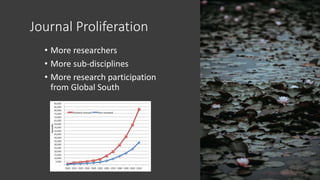
Journal Proliferation
• More researchers
• More sub-disciplines
• More research participation
from Global South
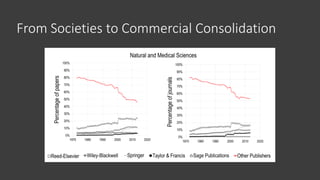
From Societies to Commercial Consolidation
Do for-profit journals cost more than
non-profit journals?
Yes.
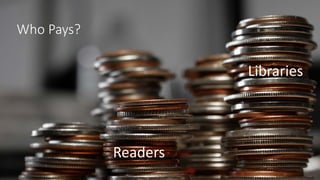
Who Pays?
Readers
Libraries
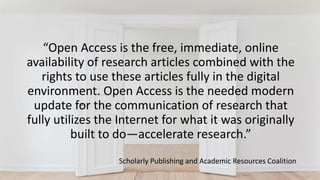
“Open Access is the free, immediate, online
availability of research articles combined with the
rights to use these articles fully in the digital
environment. Open Access is the needed modern
update for the communication of research that
fully utilizes the Internet for what it was originally
built to do—accelerate research.”
Scholarly Publishing and Academic Resources Coalition
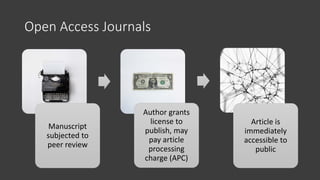
Open Access Journals
Manuscript
subjected to
peer review
Author grants
license to
publish, may
pay article
processing
charge (APC)
Article is
immediately
accessible to
public
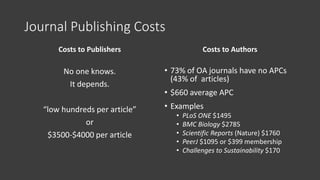
Journal Publishing Costs
Costs to Publishers
No one knows.
It depends.
“low hundreds per article”
or
$3500-$4000 per article
Costs to Authors
• 73% of OA journals have no APCs
(43% of articles)
• $660 average APC
• Examples
• PLoS ONE $1495
• BMC Biology $2785
• Scientific Reports (Nature) $1760
• PeerJ $1095 or $399 membership
• Challenges to Sustainability $170
Public Service Announcement
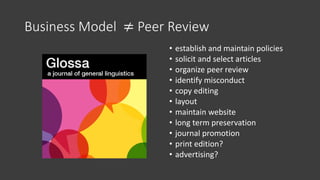
Business Model ≠ Peer Review
• establish and maintain policies
• solicit and select articles
• organize peer review
• identify misconduct
• copy editing
• layout
• maintain website
• long term preservation
• journal promotion
• print edition?
• advertising?
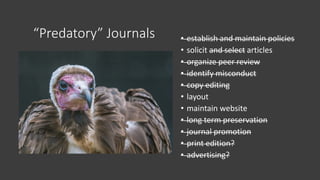
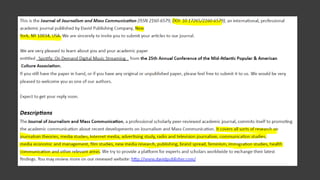
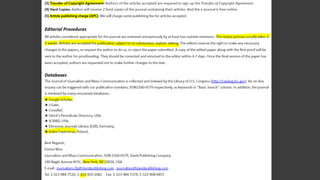
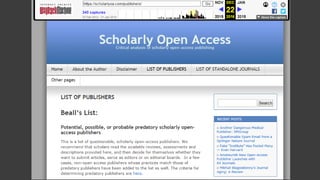
“Predatory” Journals • establish and maintain policies
• solicit and select articles
• organize peer review
• identify misconduct
• copy editing
• layout
• maintain website
• long term preservation
• journal promotion
• print edition?
• advertising?
Pseudo-Journals
Illegitimate
Publishing Entities
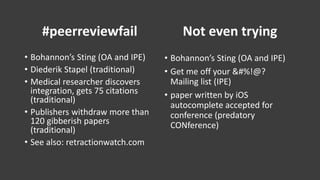
#peerreviewfail
• Bohannon’s Sting (OA and IPE)
• Diederik Stapel (traditional)
• Medical researcher discovers
integration, gets 75 citations
(traditional)
• Publishers withdraw more than
120 gibberish papers
(traditional)
• See also: retractionwatch.com
Not even trying
• Bohannon’s Sting (OA and IPE)
• Get me off your &#%!@?
Mailing list (IPE)
• paper written by iOS
autocomplete accepted for
conference (predatory
CONference)
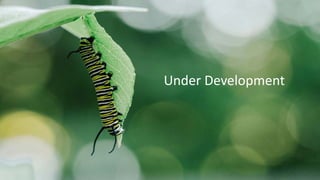
Under Development
Field Guide to Journal Publishing
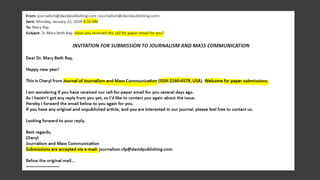
Solicitations
• Appropriate and well-targeted
• Does not specify a particular work
• Poor grammar & spelling
• Asks for submission fees rather than publication fees
• Advertises rapid turn around times
• Repeated spamming
• Guarantee manuscript acceptance
Contact Information
• Includes telephone, email, and mailing address
• Name of journal is unique, not intended to mislead
• Name of journal is similar to well-known journal
• Unprofessional email domains (gmail or yahoo)
• Do not receive responses to email or phone within a couple days
• Mismatch between editor locations and address
• Mismatch between journal name and address
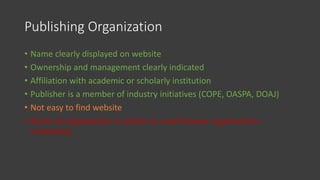
Publishing Organization
• Name clearly displayed on website
• Ownership and management clearly indicated
• Affiliation with academic or scholarly institution
• Publisher is a member of industry initiatives (COPE, OASPA, DOAJ)
• Not easy to find website
• Name of organization is similar to a well known organization –
misleading
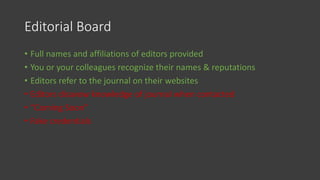
Editorial Board
• Full names and affiliations of editors provided
• You or your colleagues recognize their names & reputations
• Editors refer to the journal on their websites
• Editors disavow knowledge of journal when contacted
• “Coming Soon”
• Fake credentials
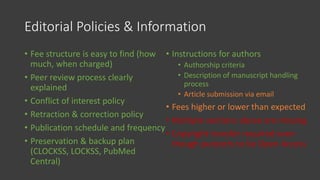
Editorial Policies & Information
• Fee structure is easy to find (how
much, when charged)
• Peer review process clearly
explained
• Conflict of interest policy
• Retraction & correction policy
• Publication schedule and frequency
• Preservation & backup plan
(CLOCKSS, LOCKSS, PubMed
Central)
• Instructions for authors
• Authorship criteria
• Description of manuscript handling
process
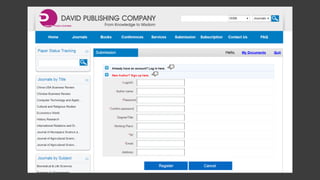
• Article submission via email
• Fees higher or lower than expected
• Multiple sections above are missing
• Copyright transfer required even
though purports to be Open Access
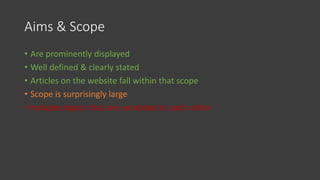
Aims & Scope
• Are prominently displayed
• Well defined & clearly stated
• Articles on the website fall within that scope
• Scope is surprisingly large
• Includes topics that are unrelated to each other
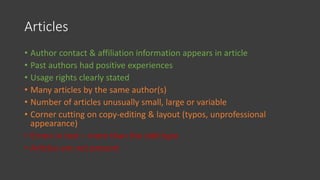
Articles
• Author contact & affiliation information appears in article
• Past authors had positive experiences
• Usage rights clearly stated
• Many articles by the same author(s)
• Number of articles unusually small, large or variable
• Corner cutting on copy-editing & layout (typos, unprofessional
appearance)
• Errors in text – more than the odd typo
• Articles are not present
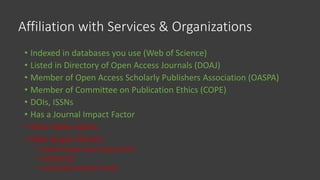
Affiliation with Services & Organizations
• Indexed in databases you use (Web of Science)
• Listed in Directory of Open Access Journals (DOAJ)
• Member of Open Access Scholarly Publishers Association (OASPA)
• Member of Committee on Publication Ethics (COPE)
• DOIs, ISSNs
• Has a Journal Impact Factor
• False index claims
• Fake impact factors
• Index Copernicus Value (ICV)
• CiteFactor
• Universal Impact Factor
Journal Impact Metrics
• Journal Impact Factor/Journal Citation Reports
• SCImago Journal Rank
• Eigenfactor Score
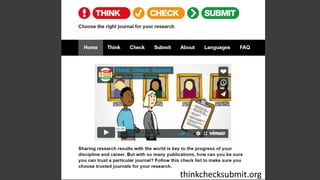
thinkchecksubmit.org
References
Slide 1: The Scholarly Publishing Ecosystem
Image by Free-Photos on Pixabay, https://pixabay.com/photo-690976/ used under CC0
Slide 2: Journal Services
Image by John Flannery on Flickr, https://flic.kr/p/5ERMAE used under CC BY-SA 2.0
Slide 3: Journal Proliferation
Image by Annie Spratt on Unsplash, https://unsplash.com/photos/Wu1XZGZ41ng
Graph from https://www.library.pitt.edu/subscriptions, data from http://ulrichsweb.serialssolutions.com
Slide 4: From Societies to Commercial Concentration
Lariviere, V., Haustein, S., & Mongeon, P. (2015). The Oligopoly of Academic Publishers in the Digital Era. PLoS ONE.
http://journals.plos.org/plosone/article?id=10.1371/journal.pone.0127502
Slide 5: Do for-profit journals cost more than non-profit journals?
Image by Amaury Laporte on Flickr, https://flic.kr/p/MtqaSa used under CC BY-NC 2.0
Van Noorden, R. (2013). Open access: The true cost of science publishing. Nature. https://www.nature.com/news/open-access-the-true-cost-of-science-publishing-1.12676
Slide 6: Who Pays?
Image by Mat on Flickr, https://flic.kr/p/58roiC used under CC BY-ND 2.0
Slide 7
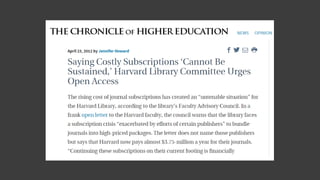
Howard, J. (2012). Saying costly subscriptions ‘cannot be sustained,’ Harvard library committee urges open access. Chronicle of Higher Education.
https://www.chronicle.com/blogs/ticker/saying-costly-subscriptions-cannot-be-sustained-harvard-library-committee-urges-open-access/42589
Slide 8: Open Access
Image by Philipp Berndt on Unsplash, https://unsplash.com/photos/5i0GnoTTjSE
SPARC (n.d.) Open Access. https://sparcopen.org/open-access/
Slide 9: Open Access Journals
Image 1 by Florian Klauer on Unsplash, https://unsplash.com/photos/mk7D-4UCfmg
Image 2 by NeONBRAND on Unsplash, https://unsplash.com/photos/8fDhgAN5zG0
Image 3 by Jason Leung on Unsplash, https://unsplash.com/photos/ShoP4ESuIsY
Slide 10: Journal Publishing Costs
Crotty, D. (2015). Is it true that most open access journals do not charge APC? Sort of. It depends. Scholarly Kitchen. https://scholarlykitchen.sspnet.org/2015/08/26/do-most-oa-
journals-not-charge-an-apc-sort-of-it-depends/)
Van Noorden, R. (2013). Open access: The true cost of science publishing. Nature. https://www.nature.com/news/open-access-the-true-cost-of-science-publishing-1.12676
Slide 11: Public Service Announcement
Image by Jens Lelie on Unsplash, https://unsplash.com/photos/u0vgcIOQG08
Slide 12: Business Model ≠ Peer Review
Jaschik, S. (2015). Language of protest. Inside Higher Ed. https://www.insidehighered.com/news/2015/11/02/editors-and-editorial-board-quit-top-linguistics-journal-protest-
subscription-fees
Slide 13: #peerreviewfail
Bohannon, J. (2013). Who’s afraid of peer review? Science. http://science.sciencemag.org/content/342/6154/60.full
Liberman, M. (2013). The open access hoax and other failures of peer review. http://languagelog.ldc.upenn.edu/nll/?p=7584
Medical researcher discovers integration, gets 75 citations (2007). https://fliptomato.wordpress.com/2007/03/19/medical-researcher-discovers-integration-gets-75-citations/
Van Noorden, R. (2014). Publishers withdraw more than 120 gibberish papers. Nature. https://www.nature.com/news/publishers-withdraw-more-than-120-gibberish-papers-1.14763
Safi, M. (2014). Journal accepts bogus paper requesting removal from mailing list. The Guardian. https://www.theguardian.com/australia-news/2014/nov/25/journal-accepts-paper-
requesting-removal-from-mailing-list
Slide 14: “Predatory” Journals
Image by Patrick Brinksma on Unsplash, https://unsplash.com/photos/P0-AJ-R6OUM
Slide 15
Image by Dieter Michael Rauch on Unsplash, https://unsplash.com/photos/iYrFqXSwxNU
Slide 16
Image by David Midgley on Flickr, https://flic.kr/p/4jqWey used under CC BY-NC-ND 2.0
Slide 17
Image by Aaron Burden on Unsplash, https://unsplash.com/photos/URXoswgLc44
Slide 18: Field Guide to Journal Publishing
Image by Daniel von Appen on Unsplash, https://unsplash.com/photos/IAMNlBMq8B8
Slide 26: Affiliation with Other Services & Organizations
Directory of Open Access Journals (DOAJ) https://doaj.org
Open Access Scholarly Publishers Association (OASPA) https://oaspa.org
Committee on Publication Ethics (COPE) https://publicationethics.org
Jalalian, M. (2015). The story of fake impact factor companies and how we detected them. Electron Physician. https://www.ncbi.nlm.nih.gov/pmc/articles/PMC4477767/
Slide 27: Journal Impact Metrics
Image by NASA on Unsplash, https://unsplash.com/photos/Q1p7bh3SHj8
Wixson, C. (2017). Scholarly Communication: Impact Metrics. http://library.plymouth.edu/scholcomm/impactmetrics
Callaway, E. (2016). Beat it, impact factor! Publishing elite turn against controversial metric. Nature. https://www.nature.com/news/beat-it-impact-factor-publishing-elite-turns-
against-controversial-metric-1.20224
Slide 31
http://davidpublisher.com/index.php/Home/Sub/index.html
Slide 32
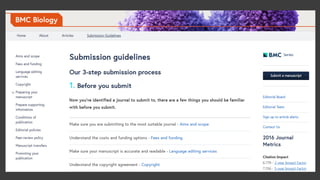
https://bmcbiol.biomedcentral.com/submission-guidelines
Slide 33
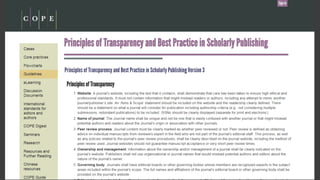
COPE/DOAJ/OASPA/WAME (2018). Principles of transparency and best practice in scholarly publishing version 3. https://publicationethics.org/resources/guidelines-new/principles-
transparency-and-best-practice-scholarly-publishing
Slide 34
Beall’s List: Potential, possible, or probable predatory scholarly open-access publishers. http://web.archive.org/web/20161222020349/https://scholarlyoa.com/publishers/
Crawford, W. (2016). “Trust me”: The other problem with 87% of Beall’s Lists. https://walt.lishost.org/2016/01/trust-me-the-other-problem-with-87-of-bealls-lists/
Slide 35
Think. Check. Submit. http://thinkchecksubmit.org
Slide 39: Questions
Image by Evan Dennis on Unsplash, https://unsplash.com/photos/i--IN3cvEjg
Questions?

Scholarly Publishing Ecosystem

  • 1.
    The Scholarly PublishingEcosystem Christin Wixson, Scholarly Communication Librarian Plymouth State University, January 31, 2018
  • 2.
    Journal Services • establishand maintain policies (editors) • solicit and select articles (editors) • organize peer review (editors) • identify misconduct (editors & reviewers) • copy editing? (staff) • layout (staff) • maintain website (staff) • long term preservation (staff) • journal promotion (editors & staff) • print edition? (staff) • advertising? (staff)
  • 3.
    Journal Proliferation • Moreresearchers • More sub-disciplines • More research participation from Global South
  • 4.
    From Societies toCommercial Consolidation
  • 5.
    Do for-profit journalscost more than non-profit journals? Yes.
  • 6.
  • 8.
    “Open Access isthe free, immediate, online availability of research articles combined with the rights to use these articles fully in the digital environment. Open Access is the needed modern update for the communication of research that fully utilizes the Internet for what it was originally built to do—accelerate research.” Scholarly Publishing and Academic Resources Coalition
  • 9.
    Open Access Journals Manuscript subjectedto peer review Author grants license to publish, may pay article processing charge (APC) Article is immediately accessible to public
  • 10.
    Journal Publishing Costs Coststo Publishers No one knows. It depends. “low hundreds per article” or $3500-$4000 per article Costs to Authors • 73% of OA journals have no APCs (43% of articles) • $660 average APC • Examples • PLoS ONE $1495 • BMC Biology $2785 • Scientific Reports (Nature) $1760 • PeerJ $1095 or $399 membership • Challenges to Sustainability $170
  • 11.
  • 12.
    Business Model ≠Peer Review • establish and maintain policies • solicit and select articles • organize peer review • identify misconduct • copy editing • layout • maintain website • long term preservation • journal promotion • print edition? • advertising?
  • 13.
    “Predatory” Journals •establish and maintain policies • solicit and select articles • organize peer review • identify misconduct • copy editing • layout • maintain website • long term preservation • journal promotion • print edition? • advertising?
  • 14.
  • 15.
    #peerreviewfail • Bohannon’s Sting(OA and IPE) • Diederik Stapel (traditional) • Medical researcher discovers integration, gets 75 citations (traditional) • Publishers withdraw more than 120 gibberish papers (traditional) • See also: retractionwatch.com Not even trying • Bohannon’s Sting (OA and IPE) • Get me off your &#%!@? Mailing list (IPE) • paper written by iOS autocomplete accepted for conference (predatory CONference)
  • 17.
  • 18.
    Field Guide toJournal Publishing
  • 19.
    Solicitations • Appropriate andwell-targeted • Does not specify a particular work • Poor grammar & spelling • Asks for submission fees rather than publication fees • Advertises rapid turn around times • Repeated spamming • Guarantee manuscript acceptance
  • 20.
    Contact Information • Includestelephone, email, and mailing address • Name of journal is unique, not intended to mislead • Name of journal is similar to well-known journal • Unprofessional email domains (gmail or yahoo) • Do not receive responses to email or phone within a couple days • Mismatch between editor locations and address • Mismatch between journal name and address
  • 21.
    Publishing Organization • Nameclearly displayed on website • Ownership and management clearly indicated • Affiliation with academic or scholarly institution • Publisher is a member of industry initiatives (COPE, OASPA, DOAJ) • Not easy to find website • Name of organization is similar to a well known organization – misleading
  • 22.
    Editorial Board • Fullnames and affiliations of editors provided • You or your colleagues recognize their names & reputations • Editors refer to the journal on their websites • Editors disavow knowledge of journal when contacted • “Coming Soon” • Fake credentials
  • 23.
    Editorial Policies &Information • Fee structure is easy to find (how much, when charged) • Peer review process clearly explained • Conflict of interest policy • Retraction & correction policy • Publication schedule and frequency • Preservation & backup plan (CLOCKSS, LOCKSS, PubMed Central) • Instructions for authors • Authorship criteria • Description of manuscript handling process • Article submission via email • Fees higher or lower than expected • Multiple sections above are missing • Copyright transfer required even though purports to be Open Access
  • 24.
    Aims & Scope •Are prominently displayed • Well defined & clearly stated • Articles on the website fall within that scope • Scope is surprisingly large • Includes topics that are unrelated to each other
  • 25.
    Articles • Author contact& affiliation information appears in article • Past authors had positive experiences • Usage rights clearly stated • Many articles by the same author(s) • Number of articles unusually small, large or variable • Corner cutting on copy-editing & layout (typos, unprofessional appearance) • Errors in text – more than the odd typo • Articles are not present
  • 26.
    Affiliation with Services& Organizations • Indexed in databases you use (Web of Science) • Listed in Directory of Open Access Journals (DOAJ) • Member of Open Access Scholarly Publishers Association (OASPA) • Member of Committee on Publication Ethics (COPE) • DOIs, ISSNs • Has a Journal Impact Factor • False index claims • Fake impact factors • Index Copernicus Value (ICV) • CiteFactor • Universal Impact Factor
  • 27.
    Journal Impact Metrics •Journal Impact Factor/Journal Citation Reports • SCImago Journal Rank • Eigenfactor Score
  • 35.
  • 36.
    References Slide 1: TheScholarly Publishing Ecosystem Image by Free-Photos on Pixabay, https://pixabay.com/photo-690976/ used under CC0 Slide 2: Journal Services Image by John Flannery on Flickr, https://flic.kr/p/5ERMAE used under CC BY-SA 2.0 Slide 3: Journal Proliferation Image by Annie Spratt on Unsplash, https://unsplash.com/photos/Wu1XZGZ41ng Graph from https://www.library.pitt.edu/subscriptions, data from http://ulrichsweb.serialssolutions.com Slide 4: From Societies to Commercial Concentration Lariviere, V., Haustein, S., & Mongeon, P. (2015). The Oligopoly of Academic Publishers in the Digital Era. PLoS ONE. http://journals.plos.org/plosone/article?id=10.1371/journal.pone.0127502 Slide 5: Do for-profit journals cost more than non-profit journals? Image by Amaury Laporte on Flickr, https://flic.kr/p/MtqaSa used under CC BY-NC 2.0 Van Noorden, R. (2013). Open access: The true cost of science publishing. Nature. https://www.nature.com/news/open-access-the-true-cost-of-science-publishing-1.12676 Slide 6: Who Pays? Image by Mat on Flickr, https://flic.kr/p/58roiC used under CC BY-ND 2.0 Slide 7 Howard, J. (2012). Saying costly subscriptions ‘cannot be sustained,’ Harvard library committee urges open access. Chronicle of Higher Education. https://www.chronicle.com/blogs/ticker/saying-costly-subscriptions-cannot-be-sustained-harvard-library-committee-urges-open-access/42589
  • 37.
    Slide 8: OpenAccess Image by Philipp Berndt on Unsplash, https://unsplash.com/photos/5i0GnoTTjSE SPARC (n.d.) Open Access. https://sparcopen.org/open-access/ Slide 9: Open Access Journals Image 1 by Florian Klauer on Unsplash, https://unsplash.com/photos/mk7D-4UCfmg Image 2 by NeONBRAND on Unsplash, https://unsplash.com/photos/8fDhgAN5zG0 Image 3 by Jason Leung on Unsplash, https://unsplash.com/photos/ShoP4ESuIsY Slide 10: Journal Publishing Costs Crotty, D. (2015). Is it true that most open access journals do not charge APC? Sort of. It depends. Scholarly Kitchen. https://scholarlykitchen.sspnet.org/2015/08/26/do-most-oa- journals-not-charge-an-apc-sort-of-it-depends/) Van Noorden, R. (2013). Open access: The true cost of science publishing. Nature. https://www.nature.com/news/open-access-the-true-cost-of-science-publishing-1.12676 Slide 11: Public Service Announcement Image by Jens Lelie on Unsplash, https://unsplash.com/photos/u0vgcIOQG08 Slide 12: Business Model ≠ Peer Review Jaschik, S. (2015). Language of protest. Inside Higher Ed. https://www.insidehighered.com/news/2015/11/02/editors-and-editorial-board-quit-top-linguistics-journal-protest- subscription-fees Slide 13: #peerreviewfail Bohannon, J. (2013). Who’s afraid of peer review? Science. http://science.sciencemag.org/content/342/6154/60.full Liberman, M. (2013). The open access hoax and other failures of peer review. http://languagelog.ldc.upenn.edu/nll/?p=7584 Medical researcher discovers integration, gets 75 citations (2007). https://fliptomato.wordpress.com/2007/03/19/medical-researcher-discovers-integration-gets-75-citations/ Van Noorden, R. (2014). Publishers withdraw more than 120 gibberish papers. Nature. https://www.nature.com/news/publishers-withdraw-more-than-120-gibberish-papers-1.14763 Safi, M. (2014). Journal accepts bogus paper requesting removal from mailing list. The Guardian. https://www.theguardian.com/australia-news/2014/nov/25/journal-accepts-paper- requesting-removal-from-mailing-list Slide 14: “Predatory” Journals Image by Patrick Brinksma on Unsplash, https://unsplash.com/photos/P0-AJ-R6OUM Slide 15 Image by Dieter Michael Rauch on Unsplash, https://unsplash.com/photos/iYrFqXSwxNU
  • 38.
    Slide 16 Image byDavid Midgley on Flickr, https://flic.kr/p/4jqWey used under CC BY-NC-ND 2.0 Slide 17 Image by Aaron Burden on Unsplash, https://unsplash.com/photos/URXoswgLc44 Slide 18: Field Guide to Journal Publishing Image by Daniel von Appen on Unsplash, https://unsplash.com/photos/IAMNlBMq8B8 Slide 26: Affiliation with Other Services & Organizations Directory of Open Access Journals (DOAJ) https://doaj.org Open Access Scholarly Publishers Association (OASPA) https://oaspa.org Committee on Publication Ethics (COPE) https://publicationethics.org Jalalian, M. (2015). The story of fake impact factor companies and how we detected them. Electron Physician. https://www.ncbi.nlm.nih.gov/pmc/articles/PMC4477767/ Slide 27: Journal Impact Metrics Image by NASA on Unsplash, https://unsplash.com/photos/Q1p7bh3SHj8 Wixson, C. (2017). Scholarly Communication: Impact Metrics. http://library.plymouth.edu/scholcomm/impactmetrics Callaway, E. (2016). Beat it, impact factor! Publishing elite turn against controversial metric. Nature. https://www.nature.com/news/beat-it-impact-factor-publishing-elite-turns- against-controversial-metric-1.20224 Slide 31 http://davidpublisher.com/index.php/Home/Sub/index.html Slide 32 https://bmcbiol.biomedcentral.com/submission-guidelines Slide 33 COPE/DOAJ/OASPA/WAME (2018). Principles of transparency and best practice in scholarly publishing version 3. https://publicationethics.org/resources/guidelines-new/principles- transparency-and-best-practice-scholarly-publishing Slide 34 Beall’s List: Potential, possible, or probable predatory scholarly open-access publishers. http://web.archive.org/web/20161222020349/https://scholarlyoa.com/publishers/ Crawford, W. (2016). “Trust me”: The other problem with 87% of Beall’s Lists. https://walt.lishost.org/2016/01/trust-me-the-other-problem-with-87-of-bealls-lists/ Slide 35 Think. Check. Submit. http://thinkchecksubmit.org Slide 39: Questions Image by Evan Dennis on Unsplash, https://unsplash.com/photos/i--IN3cvEjg
  • 39.