Microblogging for
Enhancing the Research
Accessibility
aleebrahim@um.edu.my
@aleebrahim
www.researcherid.com/rid/C-2414-2009
http://scholar.google.com/citations
Nader Ale Ebrahim, PhD
Visiting Research Fellow
Research Support Unit
Centre for Research Services
Research Management & Innovation Complex
University of Malaya, Kuala Lumpur, Malaysia
27th April 2016
3rd SERIES OF INTRODUCTORY WORKSHOP ON:
Strategies to Enhance Research
Visibility, Impact & Citations
Nader Ale Ebrahim, PhD
=====================================
Research Support Unit
Centre for Research Services
Research Management & Innovation Complex
University of Malaya, Kuala Lumpur, Malaysia
www.researcherid.com/rid/C-2414-2009
http://scholar.google.com/citations
All of my presentations are available online at:
https://figshare.com/authors/Nader_Ale_Ebrahim/100797
Link to this presentation: https://dx.doi.org/10.6084/m9.figshare.3202093.v1
Read more:
1. Ale Ebrahim, N., Salehi, H., Embi, M. A., Habibi Tanha, F., Gholizadeh, H., Motahar, S. M., & Ordi, A. (2013). Effective
Strategies for Increasing Citation Frequency. International Education Studies, 6(11), 93-99. doi: 10.5539/ies.v6n11p93
2. Ale Ebrahim, Nader. "Optimize Your Article for Search Engine." University of Malaya Research Bulletin 2.1 (2014): 38-39.
Abstract
Abstract: There are statistically significant associations between
higher citations for articles and the use of various social networking
sites such as Twitter, Facebook, blogs and forums. Twitter is a
microblogging tool and social media site created in 2006 that gives you
a chance to share quick thoughts using not more than 140 characters
in a post. It’s a great way to share your current research, publications
and links to achieve maximum publicity. Twitter assist you to stay
current with the literature and new developments in your field of
interest. Proper tools allow the researchers to increase the research
impact and citations. This presentation will provide various techniques
on how microblogging improving your research impact and visibility.
Keywords: H-index, Improve citations, Research tools, Bibliometrics,
Twitter, Research visibility
©2016-2017 Nader Ale Ebrahim
Effective Strategies for Increasing Citation Frequency
Journal Reputation and Impact: publishing a paper in a journal based on disciplinary reputatation or with a high
impact factor is the most well known way of getting your paper cited. But there are many other things a scholar can do
to promote his or her work and make it easy for others to find.
Utilize Open Access Tools: Open Access journals tend to be cited more than non open access. Deposit your paper in
a repository such as Scholars Archive here on campus or a disciplinary repository. Share your detailed research data in
a repository.
Standarize Identifying Info: try to use the same name throughout your career as well as the name of your affiliated
insitution. Using common "official" names will allow for consistency and easy retrieval of your work by author or
affiliation.
Bring Colleagues on Board: team-authored articles are cited more frequently, as does publishing with international
authors. Working cross-or inter-disciplinarily helps as well.
Beef Up That Paper: use more references, publish a longer paper. Also papers which are published elsewhere after
having been rejected are cited more frequently.
Beyond Peer-Reviewed Original Research: Write a review paper. Present a working paper. Write and disseminate
web-based tutorials on your topic.
Search Optimization: use keywords in the abstract and assign them to the manuscript. Use descriptive titles that
utilize the obvious terms searchers would use to look for your topic, avoiding questions in the title. Select a journal that
is indexed in the key library databases for your field.
Market Yourself: create a key phrase that describes your research career and use it. Update your professional web
page and publication lists frequently. Link to your latest and greatest article in your professional email signature file.
Utliize Social Media: Use author profiles such as ResearcherID and ORCID. Contribute to Wikipedia, start a blog
and/or podcast, join academic social media sites.
From: Ebrahim, N.A., et al. (2013). Effective strategies for increasing citation frequency. International Education
Studies, 6(11), 93-99. doi:10.5539/ies.v6n11p93
©2016-2017 Nader Ale Ebrahim
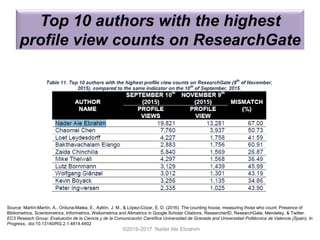
Top 10 authors with the highest
profile view counts on ResearchGate
©2016-2017 Nader Ale Ebrahim
Source: Martín-Martín, A., Orduna-Malea, E., Ayllón, J. M., & López-Cózar, E. D. (2016). The counting house, measuring those who count: Presence of
Bibliometrics, Scientometrics, Informetrics, Webometrics and Altmetrics in Google Scholar Citations, ResearcherID, ResearchGate, Mendeley, & Twitter.
EC3 Reseach Group: Evaluación de la Ciencia y de la Comunicación Científica Universidad de Granada and Universidad Politécnica de Valencia (Spain), In
Progress,. doi:10.13140/RG.2.1.4814.4402
Why citation is important?
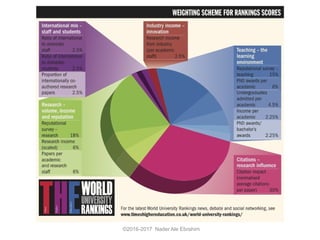
• In the Times Higher Education World University Rankings system Citations — research
influence (worth 3 per cent).
• Citations are widely recognised as a strong indicator of the significance and relevance — that is, the impact — of a
piece of research.
• However, citation data must be used with care as citation rates can vary between subjects and time periods.
• For example, papers in the life sciences tend to be cited more frequently than those published in the social
sciences.
• The rankings this year use normalised citation impact, where the citations to each paper are compared with the
average number of citations received by all papers published in the same field and year. So a paper with a relative
citation impact of 2.0 is cited twice as frequently as the average for similar papers.
• The data were extracted from the Thomson Reuters resource known as Web of Science, the largest and most
comprehensive database of research citations available.
• Its authoritative and multidisciplinary content covers more than 11,600 of the highest-impact journals worldwide.
The benchmarking exercise is carried out on an exact level across 251 subject areas for each year in the period
2004 to 2008.
• For institutions that produce few papers, the relative citation impact may be significantly influenced by one or two
highly cited papers and therefore it does not accurately reflect their typical performance. However, institutions
publishing fewer than 50 papers a year have been excluded from the rankings.
• There are occasions where a groundbreaking academic paper is so influential as to drive the citation counts to
extreme levels — receiving thousands of citations. An institution that contributes to one of these papers will
receive a significant and noticeable boost to its citation impact, and this reflects such institutions' contribution to
globally significant research projects.
• Source: http://www.timeshighereducation.co.uk/world-university-rankings/2010-2011/analysis-methodology.html
©2016-2017 Nader Ale Ebrahim
How do we improve citations?
• Attempt to publish in top journals
• Don’t take the comfortable option of
submitting articles first to middle ranking
journals
• Be prepared to face rejection
• Achieve maximum publicity for your
research
• Ensure that the correct address is used.
©2016-2017 Nader Ale Ebrahim
Source: The Role of Citations in Warwick’s Strategy and Improving Them
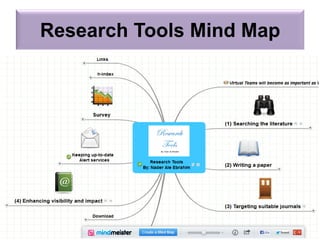
Research Tools Mind Map
©2016-2017 Nader Ale Ebrahim
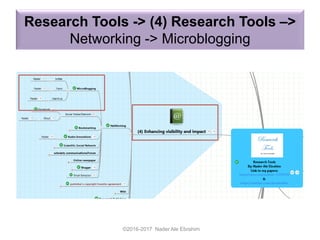
Research Tools -> (4) Research Tools –>
Networking -> Microblogging
©2016-2017 Nader Ale Ebrahim
Source: http://www.nytimes.com/2016/03/13/opinion/sunday/should-all-research-papers-be-free.html?_r=0
Picture credit to: Scott Gelber
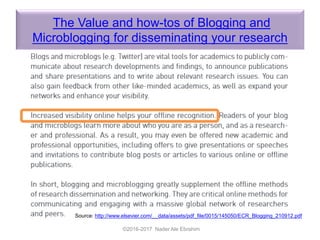
The Value and how-tos of Blogging and
Microblogging for disseminating your research
©2016-2017 Nader Ale Ebrahim
Source: http://www.elsevier.com/__data/assets/pdf_file/0015/145050/ECR_Blogging_210912.pdf
To grow an audience, you need to share
and engage with your readers regularly.
The ideal is to blog once a week.
Tweet on and off throughout the day
about what you are reading, etc.
Many people ‘live-tweet’ conferences,
sending quotes from the current speakers
and up-to-the-minute action, using the
conference ‘hashtag’.
Source: http://wiki.lib.sun.ac.za/images/5/5d/Online_Visibility_Guidelines.pdf
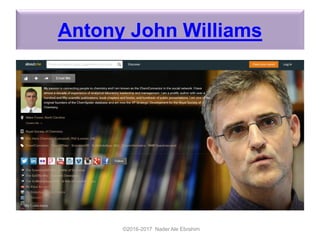
Antony John Williams
©2016-2017 Nader Ale Ebrahim
Promote Your Publication
• Be active on any social networking site
that you might prefer (Twitter, Facebook,
your subject area's community forums etc)
and mention your publication there. Don't
forget to add value to the information, e.g.
post a link to the first chapter etc.
©2016-2017 Nader Ale Ebrahim
Source: http://www.springer.com/authors/book+authors?SGWID=0-154102-12-489999-0
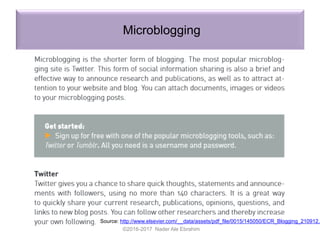
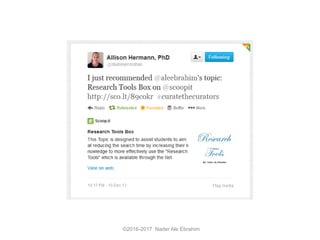
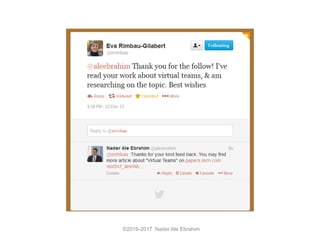
Microblogging
©2016-2017 Nader Ale Ebrahim
Source: http://www.elsevier.com/__data/assets/pdf_file/0015/145050/ECR_Blogging_210912.p
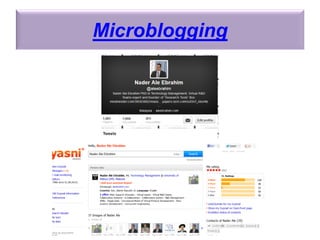
Microblogging
©2016-2017 Nader Ale Ebrahim
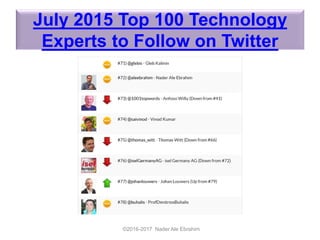
July 2015 Top 100 Technology
Experts to Follow on Twitter
©2016-2017 Nader Ale Ebrahim
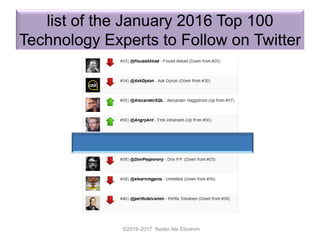
list of the January 2016 Top 100
Technology Experts to Follow on Twitter
©2016-2017 Nader Ale Ebrahim
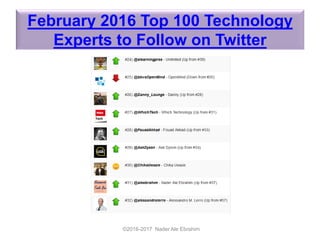
February 2016 Top 100 Technology
Experts to Follow on Twitter
©2016-2017 Nader Ale Ebrahim
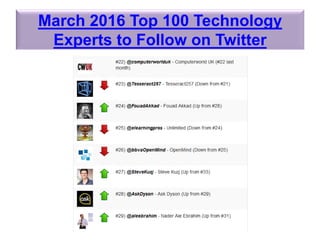
March 2016 Top 100 Technology
Experts to Follow on Twitter
©2016-2017 Nader Ale Ebrahim
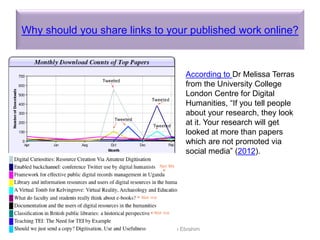
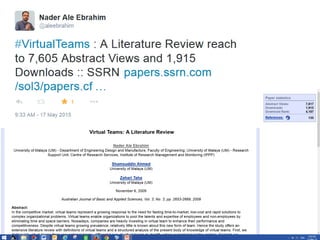
Why should you share links to your published work online?
©2016-2017 Nader Ale Ebrahim
According to Dr Melissa Terras
from the University College
London Centre for Digital
Humanities, “If you tell people
about your research, they look
at it. Your research will get
looked at more than papers
which are not promoted via
social media” (2012).
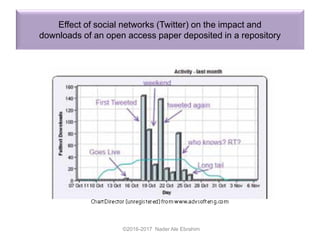
Effect of social networks (Twitter) on the impact and
downloads of an open access paper deposited in a repository
©2016-2017 Nader Ale Ebrahim
Publishing Tips
How to improve the impact of your paper
By Manon Burger Posted on 14 September 2014
Twitter
Twitter gives you a chance to share quick thoughts using no more than
140 characters. Today, one third of all scholars are active on Twitter. It's
a great way to share your current research, publications and links to
new blog posts.
Make an impact:
– Make a profile on www.twitter.com
– Follow other researchers and thereby increase your own following
– Post regular content, e.g. links to hot papers, events and conferences
– Respond promptly to direct messages and comments
– Retweet. By promoting other members of your community you are raising your
own profile at the same time
– Use images. A picture is twice as likely to be retweeted as text
©2016-2017 Nader Ale Ebrahim
Source: http://www.elsevier.com/authors-update/story/publishing-tips/how-to-improve-the-impact-of-your-paper
Find your community on Twitter
Twitter is a microblogging site with 560 million active users,
and more than 1 in 40 researchers are reportedly active on
the site.
Scientists who use Twitter tend to be effusive in their
praise: Twitter helps them stay on top of news in their field,
find new publications, get speaking and publishing
opportunities, communicate their research directly to the
public, and–perhaps most importantly–find a sense of
community. In fact, among researchers who use social
media in a professional context, 83% declared Twitter to be
the most useful tool they use.
©2016-2017 Nader Ale Ebrahim
Source: http://blog.impactstory.org/category/impact-challenge/page/3/
Find your community on Twitter
• Sign up - Creating a Twitter account is
dead simple: logon to Twitter.com and sign
up for an account.
• Personalize your account - First, add a
photo to your “avatar”. Next, add a short
bio.
• Find people to follow - Find users who
share your interests and to “follow” them to
start receiving their updates.
©2016-2017 Nader Ale Ebrahim
Source: http://blog.impactstory.org/category/impact-challenge/page/3/
Basics of composing a tweet
No matter what you tweet about, there are some basic
things you can do to make your tweets more interesting to
others (and thus more likely to be shared via a retweet):
– use hashtags (a word or phrase that follows the “#” sign, like
“#scicomm” or “#tenure”)
– attach a photo to your tweet (when composing a tweet, click the
“Add photo” camera icon and upload a picture from your
computer),
– consider following the 5-3-2 rule: social media experts
recommend that for every 10 updates you post, 5 should be
content from others that are relevant to your followers, 3 should
be professional content, and 2 should be personal updates
©2016-2017 Nader Ale Ebrahim
Source: http://blog.impactstory.org/category/impact-challenge/page/3/
Measuring your success
• Twitter’s new Analytics dashboard can help you measure
the success of your outreach efforts.
• Logon to Twitter Analytics and review your latest tweets
that share links to your blog or your papers.
• The number of impressions are time your tweets
appeared on someone’s timelines. The number of
engagements are the number of times your tweets have
been retweeted, clicked through, or clicked on to learn
more information about what you shared. They help you
measure the amount of exposure you’re receiving and
others’ interest in what you’re tweeting, respectively.
©2016-2017 Nader Ale Ebrahim
Source: http://blog.impactstory.org/category/impact-challenge/page/3/
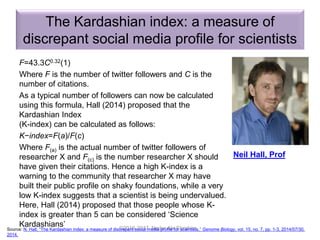
The Kardashian index: a measure of
discrepant social media profile for scientists
F=43.3C0.32(1)
Where F is the number of twitter followers and C is the
number of citations.
As a typical number of followers can now be calculated
using this formula, Hall (2014) proposed that the
Kardashian Index
(K-index) can be calculated as follows:
K−index=F(a)/F(c)
Where F(a) is the actual number of twitter followers of
researcher X and F(c) is the number researcher X should
have given their citations. Hence a high K-index is a
warning to the community that researcher X may have
built their public profile on shaky foundations, while a very
low K-index suggests that a scientist is being undervalued.
Here, Hall (2014) proposed that those people whose K-
index is greater than 5 can be considered ‘Science
Kardashians’ ©2016-2017 Nader Ale Ebrahim
Neil Hall, Prof
Source: N. Hall, “The Kardashian index: a measure of discrepant social media profile for scientists,” Genome Biology, vol. 15, no. 7, pp. 1-3, 2014/07/30,
2014.
©2016-2017 Nader Ale Ebrahim
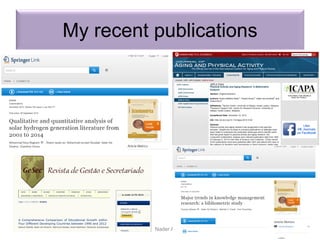
My recent publications
©2016-2017 Nader Ale Ebrahim
Questions?
E-mail: aleebrahim@um.edu.my
Twitter: @aleebrahim
www.researcherid.com/rid/C-2414-2009
http://scholar.google.com/citations
Nader Ale Ebrahim, PhD
=====================================
Research Support Unit
Centre for Research Services
Research Management & Innovation Complex
University of Malaya, Kuala Lumpur, Malaysia
www.researcherid.com/rid/C-2414-2009
http://scholar.google.com/citations
RESEARCH SUPPORT UNIT (RSU)
CENTRE FOR RESEARCH SERVICES
RESEARCH MANAGEMENT & INNOVATION COMPLEX (IPPP)
UNIVERSITY OF MALAYA
©2016-2017 Nader Ale Ebrahim
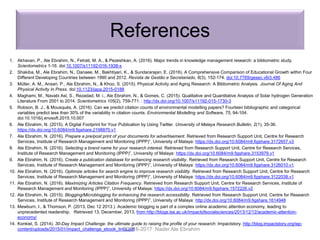
References
1. Akhavan, P., Ale Ebrahim, N., Fetrati, M. A., & Pezeshkan, A. (2016). Major trends in knowledge management research: a bibliometric study.
Scientometrics 1-16. doi:10.1007/s11192-016-1938-x
2. Shakiba, M., Ale Ebrahim, N., Danaee, M., Bakhtiyari, K., & Sundararajan, E. (2016). A Comprehensive Comparison of Educational Growth within Four
Different Developing Countries between 1990 and 2012. Revista de Gestão e Secretariado, 6(3), 152-174. doi:10.7769/gesec.v6i3.486
3. Müller, A. M., Ansari, P., Ale Ebrahim, N., & Khoo, S. (2015). Physical Activity and Aging Research: A Bibliometric Analysis. Journal Of Aging And
Physical Activity In Press. doi:10.1123/japa.2015-0188
4. Maghami, M., Navabi Asl, S., Rezadad, M. i., Ale Ebrahim, N., & Gomes, C. (2015). Qualitative and Quantitative Analysis of Solar hydrogen Generation
Literature From 2001 to 2014. Scientometrics 105(2), 759-771. : http://dx.doi.org/10.1007/s11192-015-1730-3
5. Robson, B. J., & Mousquès, A. (2016). Can we predict citation counts of environmental modelling papers? Fourteen bibliographic and categorical
variables predict less than 30% of the variability in citation counts. Environmental Modelling and Software, 75, 94-104.
doi:10.1016/j.envsoft.2015.10.007
6. Ale Ebrahim, N. (2015). A Digital Footprint for Your Publication by Using Twitter. University of Malaya Research Bulletin, 2(1), 35-36.
https://dx.doi.org/10.6084/m9.figshare.2198875.v1
7. Ale Ebrahim, N. (2016). Prepare a pre/post print of your documents for advertisement. Retrieved from Research Support Unit, Centre for Research
Services, Institute of Research Management and Monitoring (IPPP)”, University of Malaya: https://dx.doi.org/10.6084/m9.figshare.3172657.v3
8. Ale Ebrahim, N. (2016). Selecting a brand name for your research interest. Retrieved from Research Support Unit, Centre for Research Services,
Institute of Research Management and Monitoring (IPPP)”, University of Malaya: https://dx.doi.org/10.6084/m9.figshare.3153979.v1
9. Ale Ebrahim, N. (2016). Create a publication database for enhancing research visibility. Retrieved from Research Support Unit, Centre for Research
Services, Institute of Research Management and Monitoring (IPPP)”, University of Malaya: https://dx.doi.org/10.6084/m9.figshare.3126010.v1
10. Ale Ebrahim, N. (2016). Optimize articles for search engine to improve research visibility. Retrieved from Research Support Unit, Centre for Research
Services, Institute of Research Management and Monitoring (IPPP)”, University of Malaya: https://dx.doi.org/10.6084/m9.figshare.3122038.v1
11. Ale Ebrahim, N. (2016). Maximizing Articles Citation Frequency. Retrieved from Research Support Unit, Centre for Research Services, Institute of
Research Management and Monitoring (IPPP)”, University of Malaya: https://dx.doi.org/10.6084/m9.figshare.1572226.v2
12. Ale Ebrahim, N. (2015). Blogging/Microblogging for enhancing the research accessibility. Retrieved from Research Support Unit, Centre for Research
Services, Institute of Research Management and Monitoring (IPPP)”, University of Malaya: http://dx.doi.org/10.6084/m9.figshare.1614948
13. Mewburn, I., & Thomson, P. (2013, Dec 12 2013 ). Academic blogging is part of a complex online academic attention economy, leading to
unprecedented readership. Retrieved 13, December, 2013, from http://blogs.lse.ac.uk/impactofsocialsciences/2013/12/12/academic-attention-
economy/
14. Konkiel, S. (2014). 30-Day Impact Challenge: the ultimate guide to raising the profile of your research: Impactstory. http://blog.impactstory.org/wp-
content/uploads/2015/01/impact_challenge_ebook_links.pdf©2016-2017 Nader Ale Ebrahim

Microblogging for Enhancing the Research Accessibility

  • 1.
    Microblogging for Enhancing theResearch Accessibility aleebrahim@um.edu.my @aleebrahim www.researcherid.com/rid/C-2414-2009 http://scholar.google.com/citations Nader Ale Ebrahim, PhD Visiting Research Fellow Research Support Unit Centre for Research Services Research Management & Innovation Complex University of Malaya, Kuala Lumpur, Malaysia 27th April 2016
  • 2.
    3rd SERIES OFINTRODUCTORY WORKSHOP ON: Strategies to Enhance Research Visibility, Impact & Citations Nader Ale Ebrahim, PhD ===================================== Research Support Unit Centre for Research Services Research Management & Innovation Complex University of Malaya, Kuala Lumpur, Malaysia www.researcherid.com/rid/C-2414-2009 http://scholar.google.com/citations All of my presentations are available online at: https://figshare.com/authors/Nader_Ale_Ebrahim/100797 Link to this presentation: https://dx.doi.org/10.6084/m9.figshare.3202093.v1 Read more: 1. Ale Ebrahim, N., Salehi, H., Embi, M. A., Habibi Tanha, F., Gholizadeh, H., Motahar, S. M., & Ordi, A. (2013). Effective Strategies for Increasing Citation Frequency. International Education Studies, 6(11), 93-99. doi: 10.5539/ies.v6n11p93 2. Ale Ebrahim, Nader. "Optimize Your Article for Search Engine." University of Malaya Research Bulletin 2.1 (2014): 38-39.
  • 3.
    Abstract Abstract: There arestatistically significant associations between higher citations for articles and the use of various social networking sites such as Twitter, Facebook, blogs and forums. Twitter is a microblogging tool and social media site created in 2006 that gives you a chance to share quick thoughts using not more than 140 characters in a post. It’s a great way to share your current research, publications and links to achieve maximum publicity. Twitter assist you to stay current with the literature and new developments in your field of interest. Proper tools allow the researchers to increase the research impact and citations. This presentation will provide various techniques on how microblogging improving your research impact and visibility. Keywords: H-index, Improve citations, Research tools, Bibliometrics, Twitter, Research visibility ©2016-2017 Nader Ale Ebrahim
  • 4.
    Effective Strategies forIncreasing Citation Frequency Journal Reputation and Impact: publishing a paper in a journal based on disciplinary reputatation or with a high impact factor is the most well known way of getting your paper cited. But there are many other things a scholar can do to promote his or her work and make it easy for others to find. Utilize Open Access Tools: Open Access journals tend to be cited more than non open access. Deposit your paper in a repository such as Scholars Archive here on campus or a disciplinary repository. Share your detailed research data in a repository. Standarize Identifying Info: try to use the same name throughout your career as well as the name of your affiliated insitution. Using common "official" names will allow for consistency and easy retrieval of your work by author or affiliation. Bring Colleagues on Board: team-authored articles are cited more frequently, as does publishing with international authors. Working cross-or inter-disciplinarily helps as well. Beef Up That Paper: use more references, publish a longer paper. Also papers which are published elsewhere after having been rejected are cited more frequently. Beyond Peer-Reviewed Original Research: Write a review paper. Present a working paper. Write and disseminate web-based tutorials on your topic. Search Optimization: use keywords in the abstract and assign them to the manuscript. Use descriptive titles that utilize the obvious terms searchers would use to look for your topic, avoiding questions in the title. Select a journal that is indexed in the key library databases for your field. Market Yourself: create a key phrase that describes your research career and use it. Update your professional web page and publication lists frequently. Link to your latest and greatest article in your professional email signature file. Utliize Social Media: Use author profiles such as ResearcherID and ORCID. Contribute to Wikipedia, start a blog and/or podcast, join academic social media sites. From: Ebrahim, N.A., et al. (2013). Effective strategies for increasing citation frequency. International Education Studies, 6(11), 93-99. doi:10.5539/ies.v6n11p93 ©2016-2017 Nader Ale Ebrahim
  • 5.
    Top 10 authorswith the highest profile view counts on ResearchGate ©2016-2017 Nader Ale Ebrahim Source: Martín-Martín, A., Orduna-Malea, E., Ayllón, J. M., & López-Cózar, E. D. (2016). The counting house, measuring those who count: Presence of Bibliometrics, Scientometrics, Informetrics, Webometrics and Altmetrics in Google Scholar Citations, ResearcherID, ResearchGate, Mendeley, & Twitter. EC3 Reseach Group: Evaluación de la Ciencia y de la Comunicación Científica Universidad de Granada and Universidad Politécnica de Valencia (Spain), In Progress,. doi:10.13140/RG.2.1.4814.4402
  • 6.
    Why citation isimportant? • In the Times Higher Education World University Rankings system Citations — research influence (worth 3 per cent). • Citations are widely recognised as a strong indicator of the significance and relevance — that is, the impact — of a piece of research. • However, citation data must be used with care as citation rates can vary between subjects and time periods. • For example, papers in the life sciences tend to be cited more frequently than those published in the social sciences. • The rankings this year use normalised citation impact, where the citations to each paper are compared with the average number of citations received by all papers published in the same field and year. So a paper with a relative citation impact of 2.0 is cited twice as frequently as the average for similar papers. • The data were extracted from the Thomson Reuters resource known as Web of Science, the largest and most comprehensive database of research citations available. • Its authoritative and multidisciplinary content covers more than 11,600 of the highest-impact journals worldwide. The benchmarking exercise is carried out on an exact level across 251 subject areas for each year in the period 2004 to 2008. • For institutions that produce few papers, the relative citation impact may be significantly influenced by one or two highly cited papers and therefore it does not accurately reflect their typical performance. However, institutions publishing fewer than 50 papers a year have been excluded from the rankings. • There are occasions where a groundbreaking academic paper is so influential as to drive the citation counts to extreme levels — receiving thousands of citations. An institution that contributes to one of these papers will receive a significant and noticeable boost to its citation impact, and this reflects such institutions' contribution to globally significant research projects. • Source: http://www.timeshighereducation.co.uk/world-university-rankings/2010-2011/analysis-methodology.html ©2016-2017 Nader Ale Ebrahim
  • 7.
  • 8.
    How do weimprove citations? • Attempt to publish in top journals • Don’t take the comfortable option of submitting articles first to middle ranking journals • Be prepared to face rejection • Achieve maximum publicity for your research • Ensure that the correct address is used. ©2016-2017 Nader Ale Ebrahim Source: The Role of Citations in Warwick’s Strategy and Improving Them
  • 9.
    Research Tools MindMap ©2016-2017 Nader Ale Ebrahim
  • 10.
    Research Tools ->(4) Research Tools –> Networking -> Microblogging ©2016-2017 Nader Ale Ebrahim
  • 11.
    ©2016-2017 Nader AleEbrahim Source: http://www.nytimes.com/2016/03/13/opinion/sunday/should-all-research-papers-be-free.html?_r=0 Picture credit to: Scott Gelber
  • 12.
    The Value andhow-tos of Blogging and Microblogging for disseminating your research ©2016-2017 Nader Ale Ebrahim Source: http://www.elsevier.com/__data/assets/pdf_file/0015/145050/ECR_Blogging_210912.pdf
  • 13.
    To grow anaudience, you need to share and engage with your readers regularly. The ideal is to blog once a week. Tweet on and off throughout the day about what you are reading, etc. Many people ‘live-tweet’ conferences, sending quotes from the current speakers and up-to-the-minute action, using the conference ‘hashtag’. Source: http://wiki.lib.sun.ac.za/images/5/5d/Online_Visibility_Guidelines.pdf
  • 14.
  • 15.
    Promote Your Publication •Be active on any social networking site that you might prefer (Twitter, Facebook, your subject area's community forums etc) and mention your publication there. Don't forget to add value to the information, e.g. post a link to the first chapter etc. ©2016-2017 Nader Ale Ebrahim Source: http://www.springer.com/authors/book+authors?SGWID=0-154102-12-489999-0
  • 16.
    Microblogging ©2016-2017 Nader AleEbrahim Source: http://www.elsevier.com/__data/assets/pdf_file/0015/145050/ECR_Blogging_210912.p
  • 17.
  • 18.
  • 19.
  • 20.
    July 2015 Top100 Technology Experts to Follow on Twitter ©2016-2017 Nader Ale Ebrahim
  • 21.
    list of theJanuary 2016 Top 100 Technology Experts to Follow on Twitter ©2016-2017 Nader Ale Ebrahim
  • 22.
    February 2016 Top100 Technology Experts to Follow on Twitter ©2016-2017 Nader Ale Ebrahim
  • 23.
    March 2016 Top100 Technology Experts to Follow on Twitter ©2016-2017 Nader Ale Ebrahim
  • 24.
    Why should youshare links to your published work online? ©2016-2017 Nader Ale Ebrahim According to Dr Melissa Terras from the University College London Centre for Digital Humanities, “If you tell people about your research, they look at it. Your research will get looked at more than papers which are not promoted via social media” (2012).
  • 25.
    Effect of socialnetworks (Twitter) on the impact and downloads of an open access paper deposited in a repository ©2016-2017 Nader Ale Ebrahim
  • 26.
  • 27.
    Publishing Tips How toimprove the impact of your paper By Manon Burger Posted on 14 September 2014 Twitter Twitter gives you a chance to share quick thoughts using no more than 140 characters. Today, one third of all scholars are active on Twitter. It's a great way to share your current research, publications and links to new blog posts. Make an impact: – Make a profile on www.twitter.com – Follow other researchers and thereby increase your own following – Post regular content, e.g. links to hot papers, events and conferences – Respond promptly to direct messages and comments – Retweet. By promoting other members of your community you are raising your own profile at the same time – Use images. A picture is twice as likely to be retweeted as text ©2016-2017 Nader Ale Ebrahim Source: http://www.elsevier.com/authors-update/story/publishing-tips/how-to-improve-the-impact-of-your-paper
  • 28.
    Find your communityon Twitter Twitter is a microblogging site with 560 million active users, and more than 1 in 40 researchers are reportedly active on the site. Scientists who use Twitter tend to be effusive in their praise: Twitter helps them stay on top of news in their field, find new publications, get speaking and publishing opportunities, communicate their research directly to the public, and–perhaps most importantly–find a sense of community. In fact, among researchers who use social media in a professional context, 83% declared Twitter to be the most useful tool they use. ©2016-2017 Nader Ale Ebrahim Source: http://blog.impactstory.org/category/impact-challenge/page/3/
  • 29.
    Find your communityon Twitter • Sign up - Creating a Twitter account is dead simple: logon to Twitter.com and sign up for an account. • Personalize your account - First, add a photo to your “avatar”. Next, add a short bio. • Find people to follow - Find users who share your interests and to “follow” them to start receiving their updates. ©2016-2017 Nader Ale Ebrahim Source: http://blog.impactstory.org/category/impact-challenge/page/3/
  • 30.
    Basics of composinga tweet No matter what you tweet about, there are some basic things you can do to make your tweets more interesting to others (and thus more likely to be shared via a retweet): – use hashtags (a word or phrase that follows the “#” sign, like “#scicomm” or “#tenure”) – attach a photo to your tweet (when composing a tweet, click the “Add photo” camera icon and upload a picture from your computer), – consider following the 5-3-2 rule: social media experts recommend that for every 10 updates you post, 5 should be content from others that are relevant to your followers, 3 should be professional content, and 2 should be personal updates ©2016-2017 Nader Ale Ebrahim Source: http://blog.impactstory.org/category/impact-challenge/page/3/
  • 31.
    Measuring your success •Twitter’s new Analytics dashboard can help you measure the success of your outreach efforts. • Logon to Twitter Analytics and review your latest tweets that share links to your blog or your papers. • The number of impressions are time your tweets appeared on someone’s timelines. The number of engagements are the number of times your tweets have been retweeted, clicked through, or clicked on to learn more information about what you shared. They help you measure the amount of exposure you’re receiving and others’ interest in what you’re tweeting, respectively. ©2016-2017 Nader Ale Ebrahim Source: http://blog.impactstory.org/category/impact-challenge/page/3/
  • 32.
    The Kardashian index:a measure of discrepant social media profile for scientists F=43.3C0.32(1) Where F is the number of twitter followers and C is the number of citations. As a typical number of followers can now be calculated using this formula, Hall (2014) proposed that the Kardashian Index (K-index) can be calculated as follows: K−index=F(a)/F(c) Where F(a) is the actual number of twitter followers of researcher X and F(c) is the number researcher X should have given their citations. Hence a high K-index is a warning to the community that researcher X may have built their public profile on shaky foundations, while a very low K-index suggests that a scientist is being undervalued. Here, Hall (2014) proposed that those people whose K- index is greater than 5 can be considered ‘Science Kardashians’ ©2016-2017 Nader Ale Ebrahim Neil Hall, Prof Source: N. Hall, “The Kardashian index: a measure of discrepant social media profile for scientists,” Genome Biology, vol. 15, no. 7, pp. 1-3, 2014/07/30, 2014.
  • 33.
  • 34.
  • 35.
  • 36.
    Questions? E-mail: aleebrahim@um.edu.my Twitter: @aleebrahim www.researcherid.com/rid/C-2414-2009 http://scholar.google.com/citations NaderAle Ebrahim, PhD ===================================== Research Support Unit Centre for Research Services Research Management & Innovation Complex University of Malaya, Kuala Lumpur, Malaysia www.researcherid.com/rid/C-2414-2009 http://scholar.google.com/citations RESEARCH SUPPORT UNIT (RSU) CENTRE FOR RESEARCH SERVICES RESEARCH MANAGEMENT & INNOVATION COMPLEX (IPPP) UNIVERSITY OF MALAYA ©2016-2017 Nader Ale Ebrahim
  • 37.
    References 1. Akhavan, P.,Ale Ebrahim, N., Fetrati, M. A., & Pezeshkan, A. (2016). Major trends in knowledge management research: a bibliometric study. Scientometrics 1-16. doi:10.1007/s11192-016-1938-x 2. Shakiba, M., Ale Ebrahim, N., Danaee, M., Bakhtiyari, K., & Sundararajan, E. (2016). A Comprehensive Comparison of Educational Growth within Four Different Developing Countries between 1990 and 2012. Revista de Gestão e Secretariado, 6(3), 152-174. doi:10.7769/gesec.v6i3.486 3. Müller, A. M., Ansari, P., Ale Ebrahim, N., & Khoo, S. (2015). Physical Activity and Aging Research: A Bibliometric Analysis. Journal Of Aging And Physical Activity In Press. doi:10.1123/japa.2015-0188 4. Maghami, M., Navabi Asl, S., Rezadad, M. i., Ale Ebrahim, N., & Gomes, C. (2015). Qualitative and Quantitative Analysis of Solar hydrogen Generation Literature From 2001 to 2014. Scientometrics 105(2), 759-771. : http://dx.doi.org/10.1007/s11192-015-1730-3 5. Robson, B. J., & Mousquès, A. (2016). Can we predict citation counts of environmental modelling papers? Fourteen bibliographic and categorical variables predict less than 30% of the variability in citation counts. Environmental Modelling and Software, 75, 94-104. doi:10.1016/j.envsoft.2015.10.007 6. Ale Ebrahim, N. (2015). A Digital Footprint for Your Publication by Using Twitter. University of Malaya Research Bulletin, 2(1), 35-36. https://dx.doi.org/10.6084/m9.figshare.2198875.v1 7. Ale Ebrahim, N. (2016). Prepare a pre/post print of your documents for advertisement. Retrieved from Research Support Unit, Centre for Research Services, Institute of Research Management and Monitoring (IPPP)”, University of Malaya: https://dx.doi.org/10.6084/m9.figshare.3172657.v3 8. Ale Ebrahim, N. (2016). Selecting a brand name for your research interest. Retrieved from Research Support Unit, Centre for Research Services, Institute of Research Management and Monitoring (IPPP)”, University of Malaya: https://dx.doi.org/10.6084/m9.figshare.3153979.v1 9. Ale Ebrahim, N. (2016). Create a publication database for enhancing research visibility. Retrieved from Research Support Unit, Centre for Research Services, Institute of Research Management and Monitoring (IPPP)”, University of Malaya: https://dx.doi.org/10.6084/m9.figshare.3126010.v1 10. Ale Ebrahim, N. (2016). Optimize articles for search engine to improve research visibility. Retrieved from Research Support Unit, Centre for Research Services, Institute of Research Management and Monitoring (IPPP)”, University of Malaya: https://dx.doi.org/10.6084/m9.figshare.3122038.v1 11. Ale Ebrahim, N. (2016). Maximizing Articles Citation Frequency. Retrieved from Research Support Unit, Centre for Research Services, Institute of Research Management and Monitoring (IPPP)”, University of Malaya: https://dx.doi.org/10.6084/m9.figshare.1572226.v2 12. Ale Ebrahim, N. (2015). Blogging/Microblogging for enhancing the research accessibility. Retrieved from Research Support Unit, Centre for Research Services, Institute of Research Management and Monitoring (IPPP)”, University of Malaya: http://dx.doi.org/10.6084/m9.figshare.1614948 13. Mewburn, I., & Thomson, P. (2013, Dec 12 2013 ). Academic blogging is part of a complex online academic attention economy, leading to unprecedented readership. Retrieved 13, December, 2013, from http://blogs.lse.ac.uk/impactofsocialsciences/2013/12/12/academic-attention- economy/ 14. Konkiel, S. (2014). 30-Day Impact Challenge: the ultimate guide to raising the profile of your research: Impactstory. http://blog.impactstory.org/wp- content/uploads/2015/01/impact_challenge_ebook_links.pdf©2016-2017 Nader Ale Ebrahim