Languages of the world:
  Language typology and classification
Genetic classification. Language families
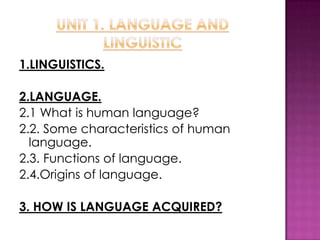
1.LINGUISTICS.

2.LANGUAGE.
2.1 What is human language?
2.2. Some characteristics of human
  language.
2.3. Functions of language.
2.4.Origins of language.

3. HOW IS LANGUAGE ACQUIRED?
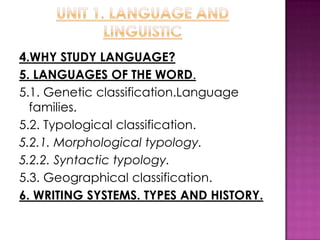
4.WHY STUDY LANGUAGE?
5. LANGUAGES OF THE WORD.
5.1. Genetic classification.Language
  families.
5.2. Typological classification.
5.2.1. Morphological typology.
5.2.2. Syntactic typology.
5.3. Geographical classification.
6. WRITING SYSTEMS. TYPES AND HISTORY.
2.1. WHAT IS HUMAN LANGUAGE ?

A  language is a system used to
  communicate.
 There are similarities and differences
  between human and animal
  communication.
 Language seems to be as old as your
  species.
 Nothing in the animal Kingdom even
  approximates to human language.
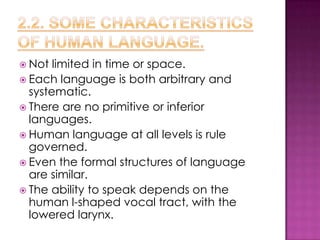
 Not  limited in time or space.
 Each language is both arbitrary and
  systematic.
 There are no primitive or inferior
  languages.
 Human language at all levels is rule
  governed.
 Even the formal structures of language
  are similar.
 The ability to speak depends on the
  human l-shaped vocal tract, with the
  lowered larynx.
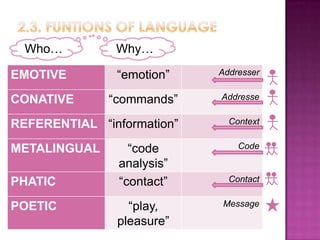
Who…         Why…

EMOTIVE        “emotion”    Addresser


CONATIVE      “commands”    Addresse


REFERENTIAL “information”     Context


METALINGUAL       “code         Code

                analysis”
PHATIC          “contact”     Contact


POETIC           “play,     Message

               pleasure”
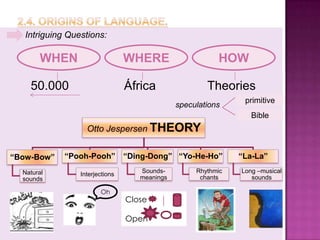
Intriguing Questions:

       WHEN                      WHERE                    HOW

    50.000                       África                Theories
                                                                primitive
                                               speculations
                                                                  Bible
                   Otto Jespersen THEORY


“Bow-Bow”    “Pooh-Pooh” “Ding-Dong” “Yo-He-Ho”                “La-La”
  Natural                           Sounds-         Rhythmic   Long –musical
                 Interjections
  sounds                            meanings         chants       sounds

                        Oh
                                 Close

                                 Open
 Thetheory of blank slates versus the
 innate biological endowment.

 Fora long time it was believed that
 language was simply learnt. The
 presumption was that our minds at
 birth were blank slates on to which the
 rules of our native languages were
 written. Children learn by repetition,
 language is learnt behaviour.
 Thecentral question of linguistics is the
 nature of the innate biological
 endowment (Universal Grammar)
 which enables humans to acquire a
 language so rapidly and efficiently in
 the first year of life.

 “Children seemed to be programmed
 to learn language, just as they seemed
 to be programmed to walk. To a baby
 no language is easier or more difficult
 than any other”
 Children   do not merely repeat what they
 hear.

 Language    teaching has never adopted a
 methodology based strictly on
 Chomsky’swork. However, this idea of
 creativity, has informed many teaching
 techniques.

 http://www.youtube.com/watch?v=xfpZF
 X2hAJQ
 In this view the study of language is
 ultimately the study of the human mind.

 One   reason for studying language is that
 it is tempting to regard language, in the
 traditional phrase, as "a mirror of mind." By
 studying language we may discover
 abstract principles that govern its
 structure and use, principles that are
 universal by biological necessity and not
 mere historical accident, that derive from
 mental characteristics of the species.
Languages of the World
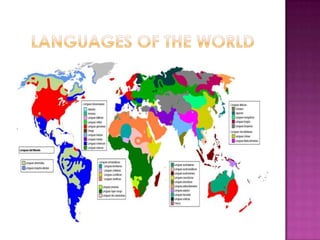
 Isvery difficult say how many languages
  there are in the world .

 And   is very difficult too, say two speech
  varieties are, different languages or
  different dialects of the same language.

 It estimated that there are about 6.000
  languages in the world.
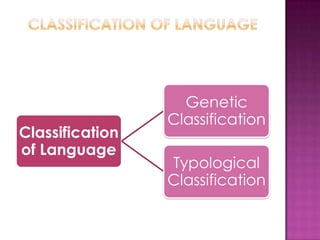
Genetic
                 Classification
Classification
of Language
                 Typological
                 Classification
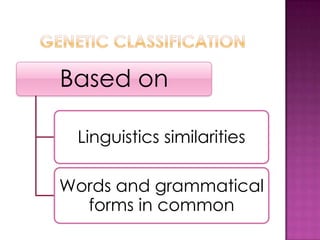
Based on

 Linguistics similarities

Words and grammatical
  forms in common
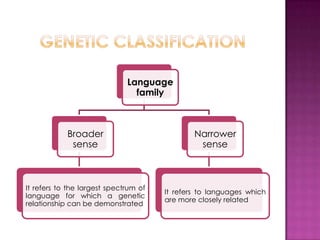
Language
                                family


            Broader                            Narrower
             sense                              sense


It refers to the largest spectrum of
                                       It refers to languages which
language for which a genetic
                                       are more closely related
relationship can be demonstrated
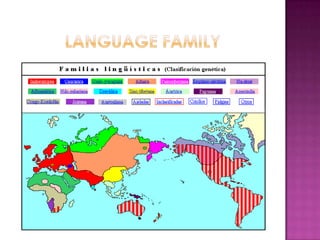
 Language   family is a group of related
 languages that descend from a common
 ancestor     called   proto-language   or
 primordial language.
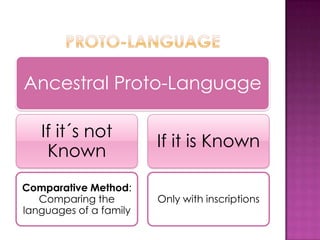
Ancestral Proto-Language

   If it´s not
                        If it is Known
    Known
Comparative Method:
   Comparing the        Only with inscriptions
languages of a family
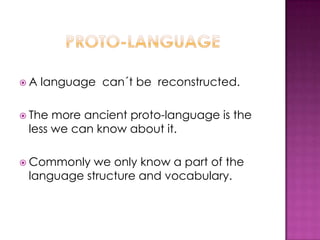
A   language can´t be reconstructed.

 The more ancient proto-language is the
 less we can know about it.

 Commonly  we only know a part of the
 language structure and vocabulary.
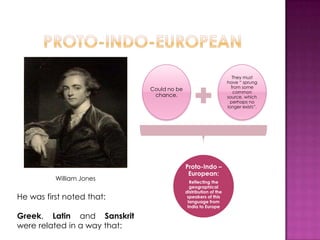
They must
                                                                  have “ sprung
                                                                    from some
                              Could no be                            common
                               chance.                            source, which
                                                                   perhaps no
                                                                  longer exists”.


                                            Proto-Indo –
                                             European:
          William Jones                       Reflecting the
                                              geographical
                                            distribution of the
He was first noted that:                     speakers of this
                                             language from
                                             India to Europe

Greek, Latin and Sanskrit
were related in a way that:
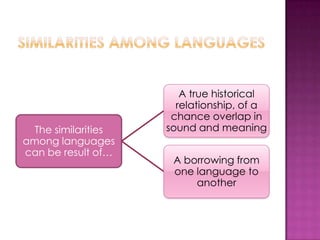
A true historical
                       relationship, of a
                      chance overlap in
  The similarities   sound and meaning
among languages
can be result of…
                      A borrowing from
                      one language to
                          another
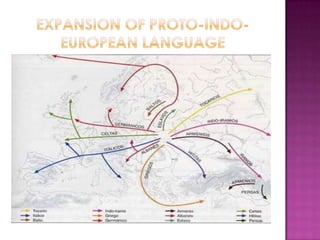
 Proto-Indo-European  had split into twelve
 distinct languages (diagram).

 Not all of Proto-Indo- European languages
 survived.

 Proto-Indo-European  contains words for a
 domesticated       animals   and   crops,
 indicating that these ancient societies
 were agricultural.
 Thisclassification is based on the
 differences or similarities existing in
 languages.

 In
   this case we will analyze the
 morphological typology and the
 syntactic typology:
 The morphology is understood, by a
 wide range of works, as the study of
 the structure of the word, therefore,
 focuses on the elements of a word, the
 relations between them, and the
 properties derived from its articulation
 in a result which is the word.
 a) Isolating languages: the words in these
  languages ​tend to be a single
  morpheme.
 b) Inflecting, synthetic or fusion
  languages: These languages change
  endings and sometimes the internal
  structure of words to show grammatical
  relationships - tense, aspect, case and so
  on
 c)Agglutinative or agglutinating
 languages: These languages add
 suffixes and prefixes (as well as infixes)
 to the stem of a word to add to its
 meaning or to show grammatical
 function.

 d)Polysynthetic or incorporating
 languages: languages which words
 are composed of many morphemes.
 According   to the syntactic typology of
  languages they are divided into different
  types on the basis of the order of the
  grammatical elements (subject (S), object
  (O) and verb (V)) in a sentence. Apart
  from the free word order languages, there
  are six possibilities:
• Subject Verb Object (SVO)
• Subject Object Verb (SOV)
• Verb Subject Object (VSO)
• Verb Object Subject (VOS)
• Object Subject Verb (OSV)
• Object Verb Subject (OVS)
 We  also have to bear in mind that
 following one pattern as a norm
 doesn´t mean we can´t find a different
 one for specific purposes or special
 effects.
 It
   is based on linguistic similarities which
  have arisen from cultural contact
  between linguistic communities.
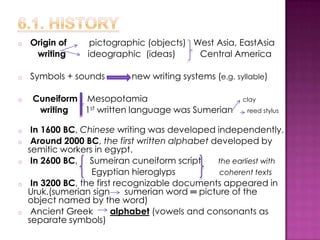
o   Origin of      pictographic (objects) West Asia, EastAsia
     writing      ideographic (ideas)      Central America

o   Symbols + sounds         new writing systems (e.g. syllable)

o    Cuneiform Mesopotamia                               clay
      writing  1st written language was Sumerian          reed stylus


o    In 1600 BC, Chinese writing was developed independently.
o    Around 2000 BC, the first written alphabet developed by
    semitic workers in egypt.
o    In 2600 BC, Sumeiran cuneiform script        the earliest with
                    Egyptian hieroglyps            coherent texts
o    In 3200 BC, the first recognizable documents appeared in
    Uruk.(sumerian sign       sumerian word ═ picture of the
    object named by the word)
o    Ancient Greek        alphabet (vowels and consonants as
    separate symbols)
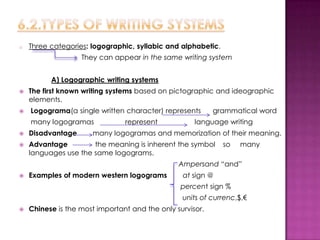
o   Three categories: logographic, syllabic and alphabetic.
                   They can appear in the same writing system


          A) Logographic writing systems
   The first known writing systems based on pictographic and ideographic
    elements.
   Logograma(a single written character) represents       grammatical word
    many logogramas             represent            language writing
   Disadvantage      many logogramas and memorization of their meaning.
   Advantage         the meaning is inherent the symbol      so   many
    languages use the same logograms.
                                                Ampersand “and”
   Examples of modern western logograms         at sign @
                                                 percent sign %
                                                 units of currenc,$,€
   Chinese is the most important and the only survisor.
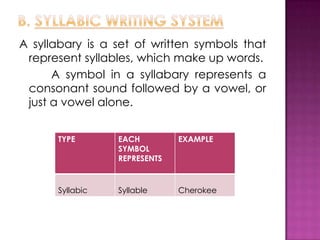
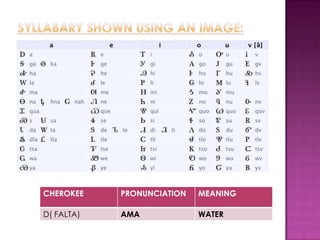
A syllabary is a set of written symbols that
 represent syllables, which make up words.
      A symbol in a syllabary represents a
 consonant sound followed by a vowel, or
 just a vowel alone.


      TYPE       EACH         EXAMPLE
                 SYMBOL
                 REPRESENTS


      Syllabic   Syllable     Cherokee
CHEROKEE    PRONUNCIATION   MEANING

D( FALTA)   AMA             WATER
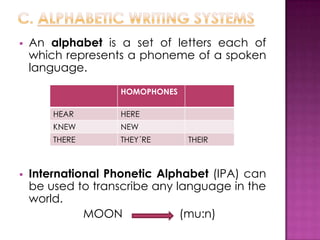
   An alphabet is a set of letters each of
    which represents a phoneme of a spoken
    language.
                   HOMOPHONES

        HEAR       HERE
        KNEW       NEW
        THERE      THEY´RE      THEIR


   International Phonetic Alphabet (IPA) can
    be used to transcribe any language in the
    world.
              MOON             (mu:n)

OTRO1]

  • 1.
    Languages of theworld: Language typology and classification Genetic classification. Language families
  • 2.
    1.LINGUISTICS. 2.LANGUAGE. 2.1 What ishuman language? 2.2. Some characteristics of human language. 2.3. Functions of language. 2.4.Origins of language. 3. HOW IS LANGUAGE ACQUIRED?
  • 3.
    4.WHY STUDY LANGUAGE? 5.LANGUAGES OF THE WORD. 5.1. Genetic classification.Language families. 5.2. Typological classification. 5.2.1. Morphological typology. 5.2.2. Syntactic typology. 5.3. Geographical classification. 6. WRITING SYSTEMS. TYPES AND HISTORY.
  • 4.
    2.1. WHAT ISHUMAN LANGUAGE ? A language is a system used to communicate.  There are similarities and differences between human and animal communication.  Language seems to be as old as your species.  Nothing in the animal Kingdom even approximates to human language.
  • 5.
     Not limited in time or space.  Each language is both arbitrary and systematic.  There are no primitive or inferior languages.  Human language at all levels is rule governed.  Even the formal structures of language are similar.  The ability to speak depends on the human l-shaped vocal tract, with the lowered larynx.
  • 6.
    Who… Why… EMOTIVE “emotion” Addresser CONATIVE “commands” Addresse REFERENTIAL “information” Context METALINGUAL “code Code analysis” PHATIC “contact” Contact POETIC “play, Message pleasure”
  • 7.
    Intriguing Questions: WHEN WHERE HOW 50.000 África Theories primitive speculations Bible Otto Jespersen THEORY “Bow-Bow” “Pooh-Pooh” “Ding-Dong” “Yo-He-Ho” “La-La” Natural Sounds- Rhythmic Long –musical Interjections sounds meanings chants sounds Oh Close Open
  • 8.
     Thetheory ofblank slates versus the innate biological endowment.  Fora long time it was believed that language was simply learnt. The presumption was that our minds at birth were blank slates on to which the rules of our native languages were written. Children learn by repetition, language is learnt behaviour.
  • 9.
     Thecentral questionof linguistics is the nature of the innate biological endowment (Universal Grammar) which enables humans to acquire a language so rapidly and efficiently in the first year of life.  “Children seemed to be programmed to learn language, just as they seemed to be programmed to walk. To a baby no language is easier or more difficult than any other”
  • 10.
     Children do not merely repeat what they hear.  Language teaching has never adopted a methodology based strictly on Chomsky’swork. However, this idea of creativity, has informed many teaching techniques.  http://www.youtube.com/watch?v=xfpZF X2hAJQ
  • 11.
     In thisview the study of language is ultimately the study of the human mind.  One reason for studying language is that it is tempting to regard language, in the traditional phrase, as "a mirror of mind." By studying language we may discover abstract principles that govern its structure and use, principles that are universal by biological necessity and not mere historical accident, that derive from mental characteristics of the species.
  • 12.
  • 13.
     Isvery difficultsay how many languages there are in the world .  And is very difficult too, say two speech varieties are, different languages or different dialects of the same language.  It estimated that there are about 6.000 languages in the world.
  • 15.
    Genetic Classification Classification of Language Typological Classification
  • 16.
    Based on Linguisticssimilarities Words and grammatical forms in common
  • 17.
    Language family Broader Narrower sense sense It refers to the largest spectrum of It refers to languages which language for which a genetic are more closely related relationship can be demonstrated
  • 18.
     Language family is a group of related languages that descend from a common ancestor called proto-language or primordial language.
  • 20.
    Ancestral Proto-Language If it´s not If it is Known Known Comparative Method: Comparing the Only with inscriptions languages of a family
  • 21.
    A language can´t be reconstructed.  The more ancient proto-language is the less we can know about it.  Commonly we only know a part of the language structure and vocabulary.
  • 22.
    They must have “ sprung from some Could no be common chance. source, which perhaps no longer exists”. Proto-Indo – European: William Jones Reflecting the geographical distribution of the He was first noted that: speakers of this language from India to Europe Greek, Latin and Sanskrit were related in a way that:
  • 23.
    A true historical relationship, of a chance overlap in The similarities sound and meaning among languages can be result of… A borrowing from one language to another
  • 25.
     Proto-Indo-European had split into twelve distinct languages (diagram).  Not all of Proto-Indo- European languages survived.  Proto-Indo-European contains words for a domesticated animals and crops, indicating that these ancient societies were agricultural.
  • 26.
     Thisclassification isbased on the differences or similarities existing in languages.  In this case we will analyze the morphological typology and the syntactic typology:
  • 27.
     The morphologyis understood, by a wide range of works, as the study of the structure of the word, therefore, focuses on the elements of a word, the relations between them, and the properties derived from its articulation in a result which is the word.
  • 28.
     a) Isolatinglanguages: the words in these languages ​tend to be a single morpheme.  b) Inflecting, synthetic or fusion languages: These languages change endings and sometimes the internal structure of words to show grammatical relationships - tense, aspect, case and so on
  • 29.
     c)Agglutinative oragglutinating languages: These languages add suffixes and prefixes (as well as infixes) to the stem of a word to add to its meaning or to show grammatical function.  d)Polysynthetic or incorporating languages: languages which words are composed of many morphemes.
  • 30.
     According to the syntactic typology of languages they are divided into different types on the basis of the order of the grammatical elements (subject (S), object (O) and verb (V)) in a sentence. Apart from the free word order languages, there are six possibilities: • Subject Verb Object (SVO) • Subject Object Verb (SOV) • Verb Subject Object (VSO) • Verb Object Subject (VOS) • Object Subject Verb (OSV) • Object Verb Subject (OVS)
  • 31.
     We also have to bear in mind that following one pattern as a norm doesn´t mean we can´t find a different one for specific purposes or special effects.
  • 32.
     It is based on linguistic similarities which have arisen from cultural contact between linguistic communities.
  • 33.
    o Origin of pictographic (objects) West Asia, EastAsia writing ideographic (ideas) Central America o Symbols + sounds new writing systems (e.g. syllable) o Cuneiform Mesopotamia clay writing 1st written language was Sumerian reed stylus o In 1600 BC, Chinese writing was developed independently. o Around 2000 BC, the first written alphabet developed by semitic workers in egypt. o In 2600 BC, Sumeiran cuneiform script the earliest with Egyptian hieroglyps coherent texts o In 3200 BC, the first recognizable documents appeared in Uruk.(sumerian sign sumerian word ═ picture of the object named by the word) o Ancient Greek alphabet (vowels and consonants as separate symbols)
  • 34.
    o Three categories: logographic, syllabic and alphabetic. They can appear in the same writing system A) Logographic writing systems  The first known writing systems based on pictographic and ideographic elements.  Logograma(a single written character) represents grammatical word many logogramas represent language writing  Disadvantage many logogramas and memorization of their meaning.  Advantage the meaning is inherent the symbol so many languages use the same logograms. Ampersand “and”  Examples of modern western logograms at sign @ percent sign % units of currenc,$,€  Chinese is the most important and the only survisor.
  • 35.
    A syllabary isa set of written symbols that represent syllables, which make up words. A symbol in a syllabary represents a consonant sound followed by a vowel, or just a vowel alone. TYPE EACH EXAMPLE SYMBOL REPRESENTS Syllabic Syllable Cherokee
  • 36.
    CHEROKEE PRONUNCIATION MEANING D( FALTA) AMA WATER
  • 37.
    An alphabet is a set of letters each of which represents a phoneme of a spoken language. HOMOPHONES HEAR HERE KNEW NEW THERE THEY´RE THEIR  International Phonetic Alphabet (IPA) can be used to transcribe any language in the world. MOON (mu:n)