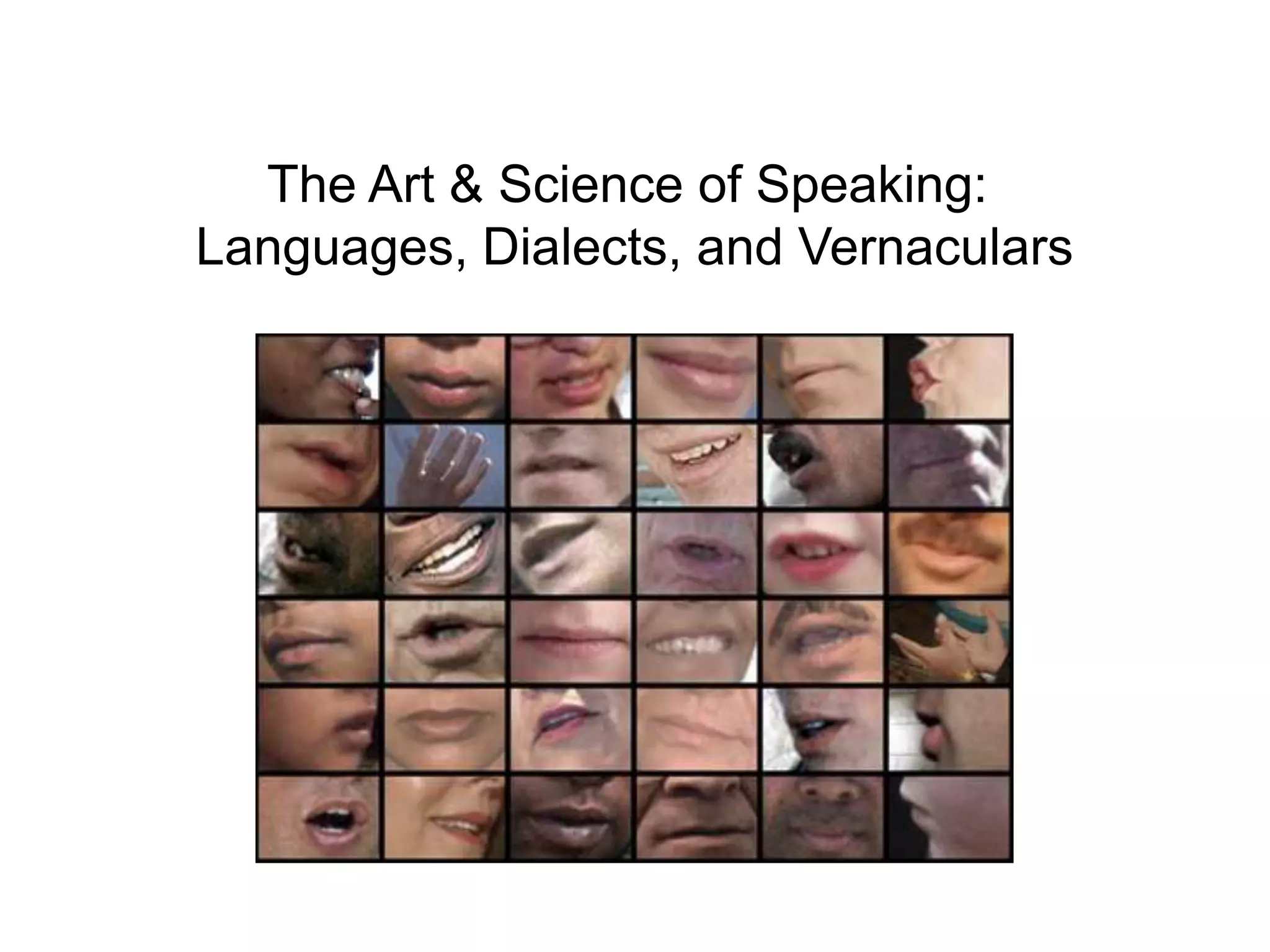
The Art & Science of Speaking:
Languages, Dialects, and Vernaculars
What is language?
a distinctive feature of the human mind
a system we use to convey information
a biological tool that enables humans
           to communicate
a mental construct with rules and
     organizing principles
an elaborated signaling-system
some design features
Language Game 1

Construct a dialogue where each
person is limited to one sentence,
and each sentence must be a
question.
Language Game 2

Construct a dialogue where each person
is limited to one sentence (question-
answer format), and each sentence
must begin with a successive letter.
Language Game 3

Construct a dialogue where one person
creates a line in Gibberish (random
sounds) and the other person translates
that line in English.
Differences between humans and animals?

       1. Vocal tract
       2. Duality of patterning
       3. Displacement
       4. Open-endedness
       5. Stimulus-freedom
       6. Arbitrariness
       7. FOXP2 Gene
Team Quiz
1. Gather in groups of four (find your respective card).
2. As a group, create one closed question and one open question
   on a separate sheet of paper with your names listed.
3. You have 5 minutes.

REVIEW MATERIAL:
Features of language (duality of patterning, displacement, open-endedness,
    stimulus-freedom, arbitrariness , etc.)
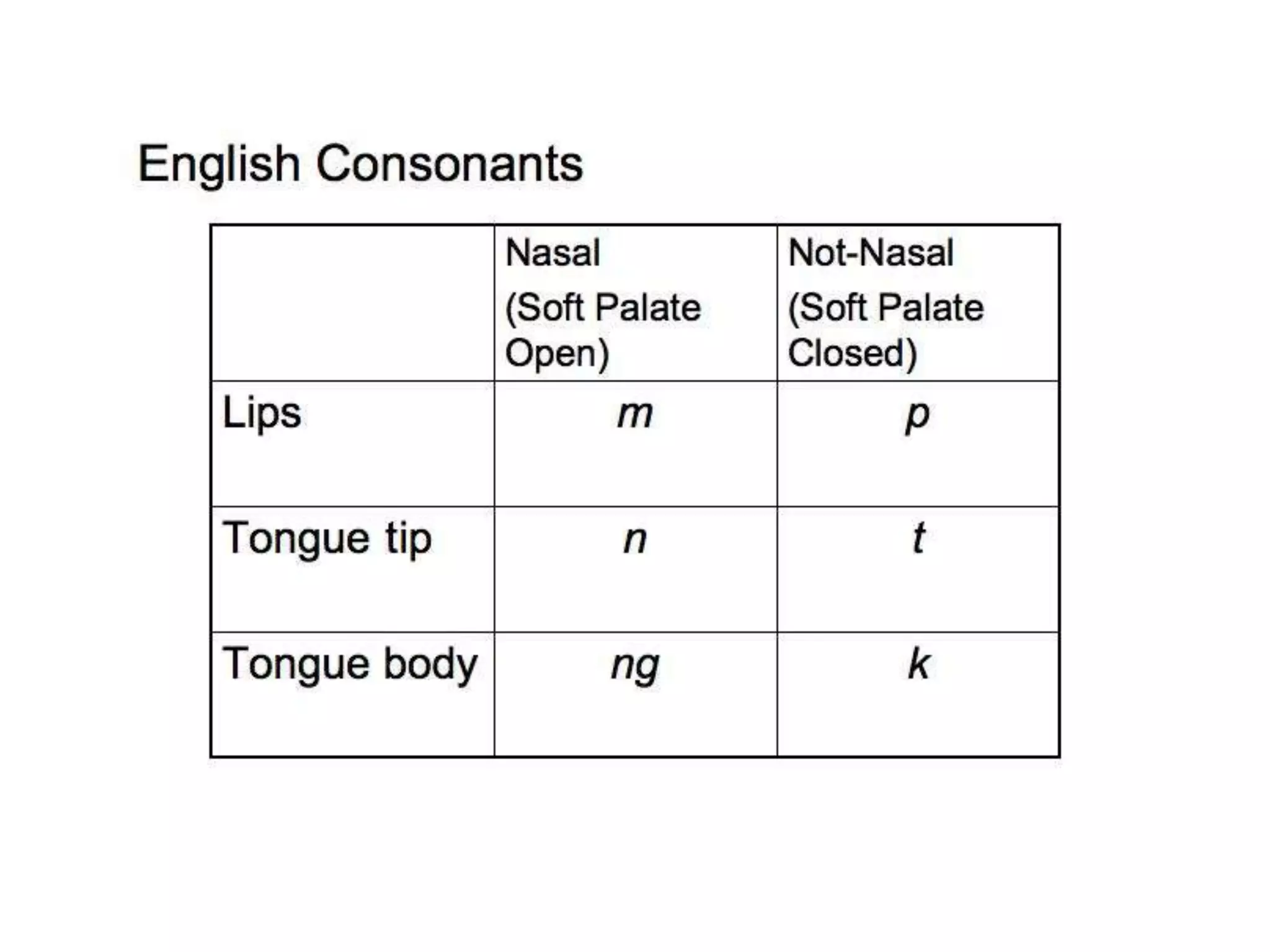
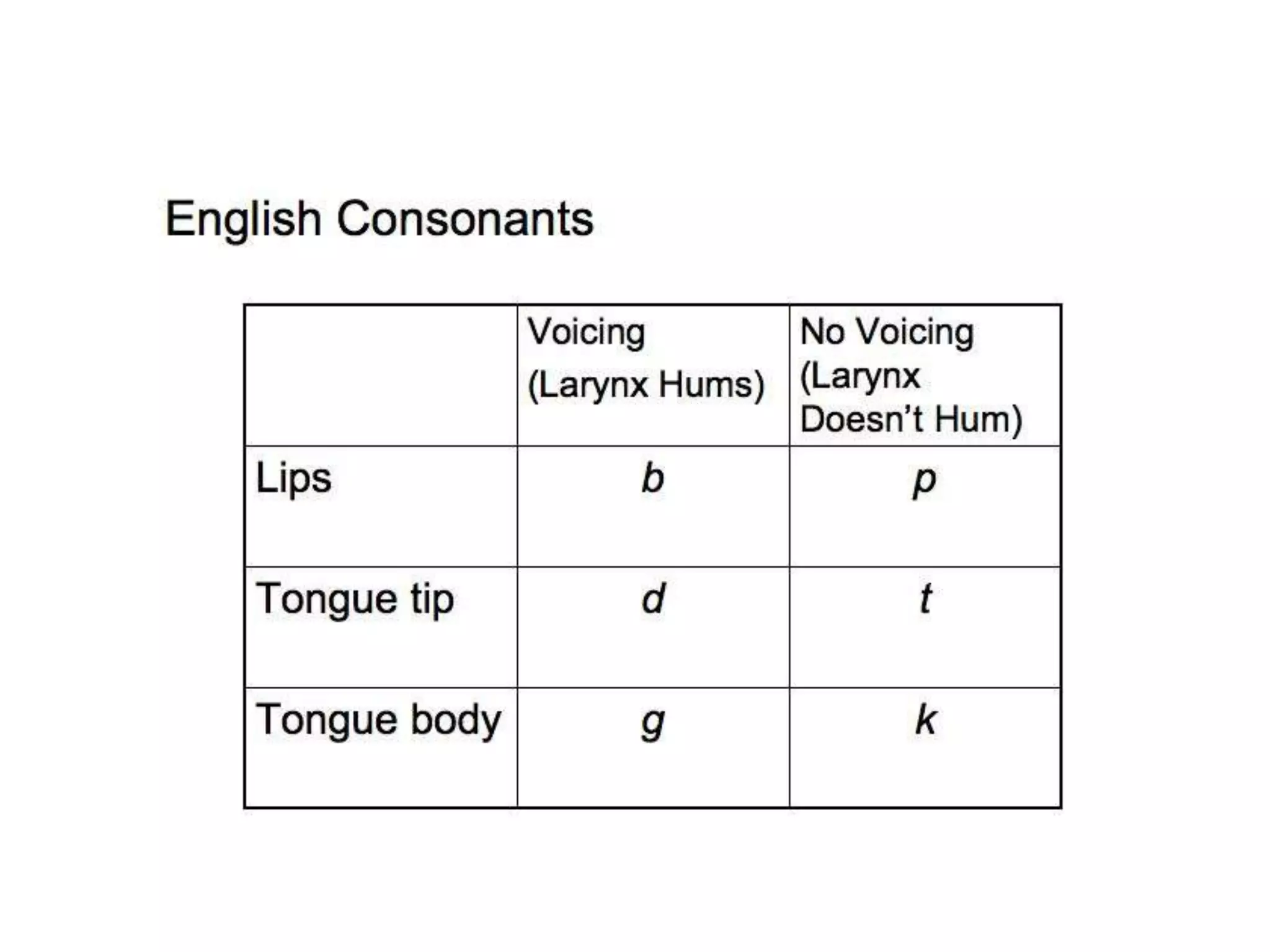
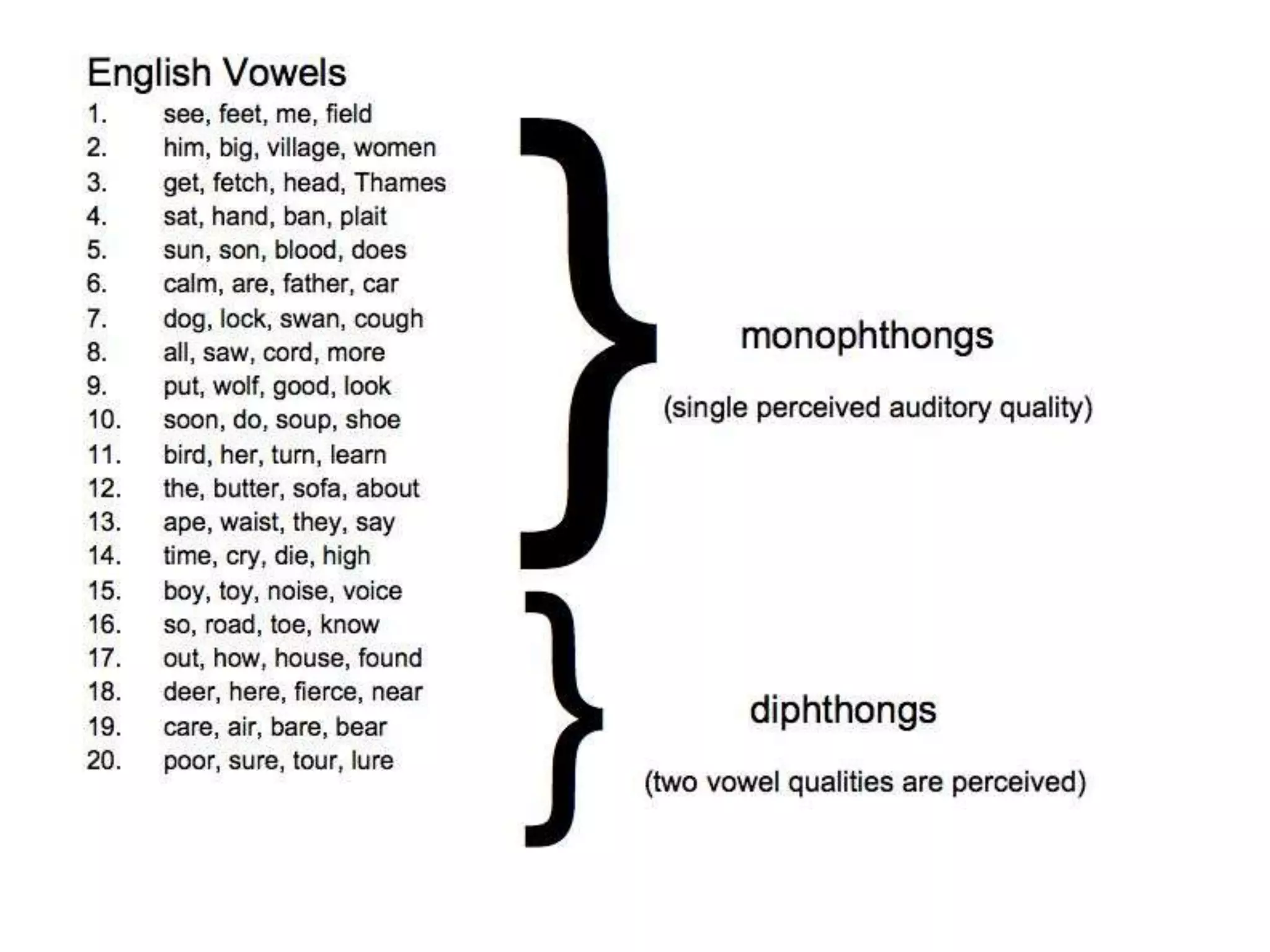
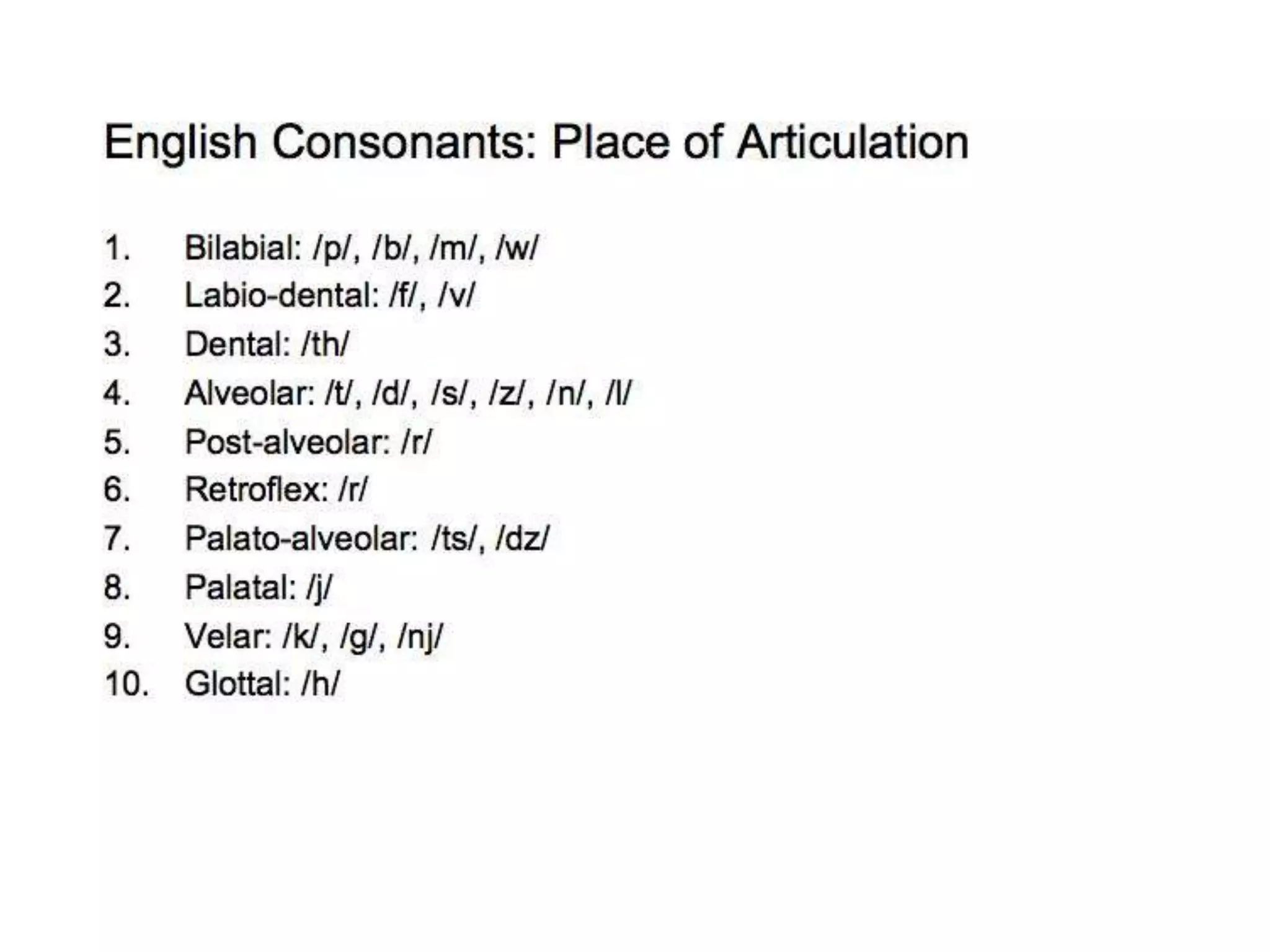
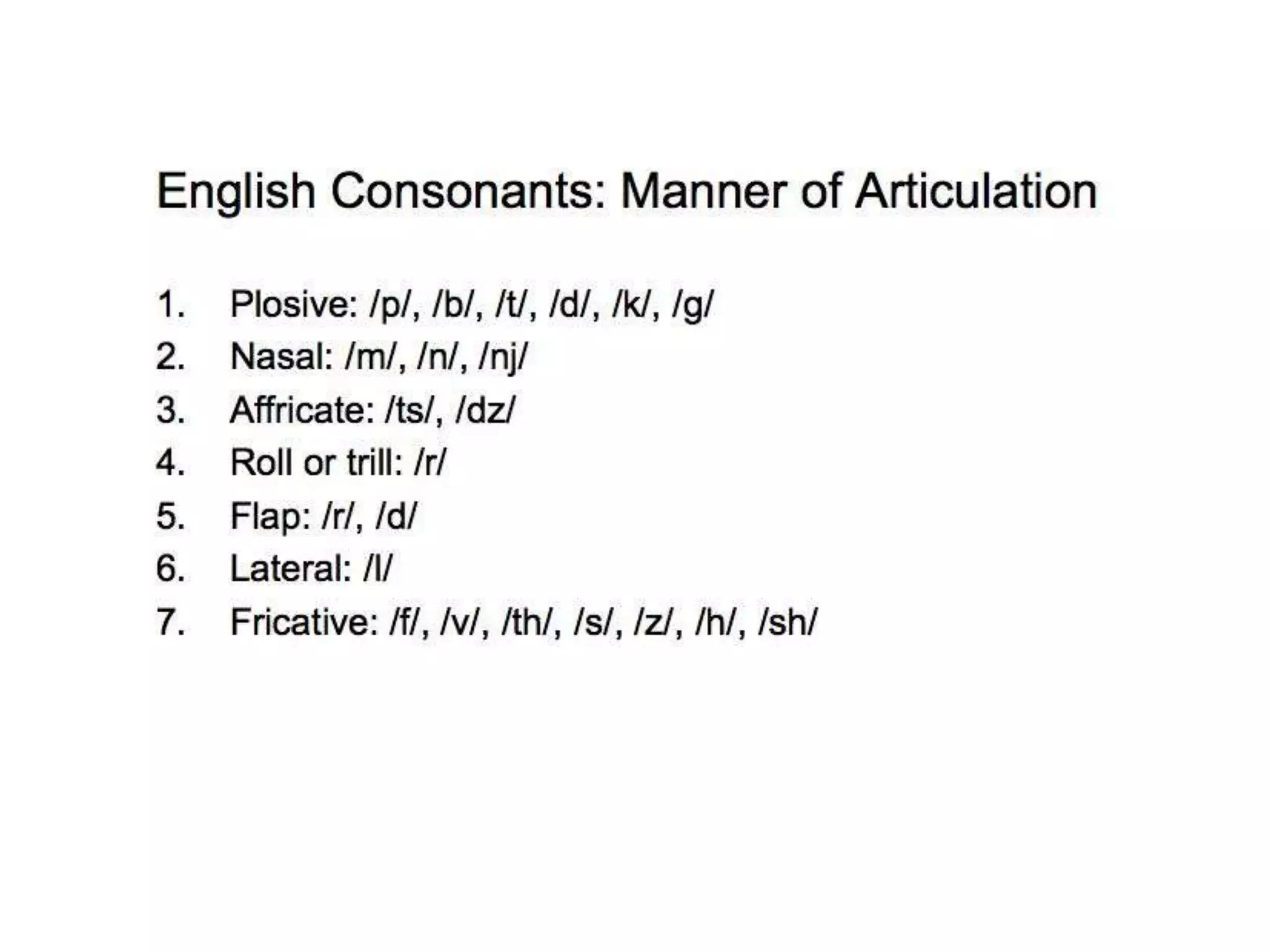
Types of consonants and vowels
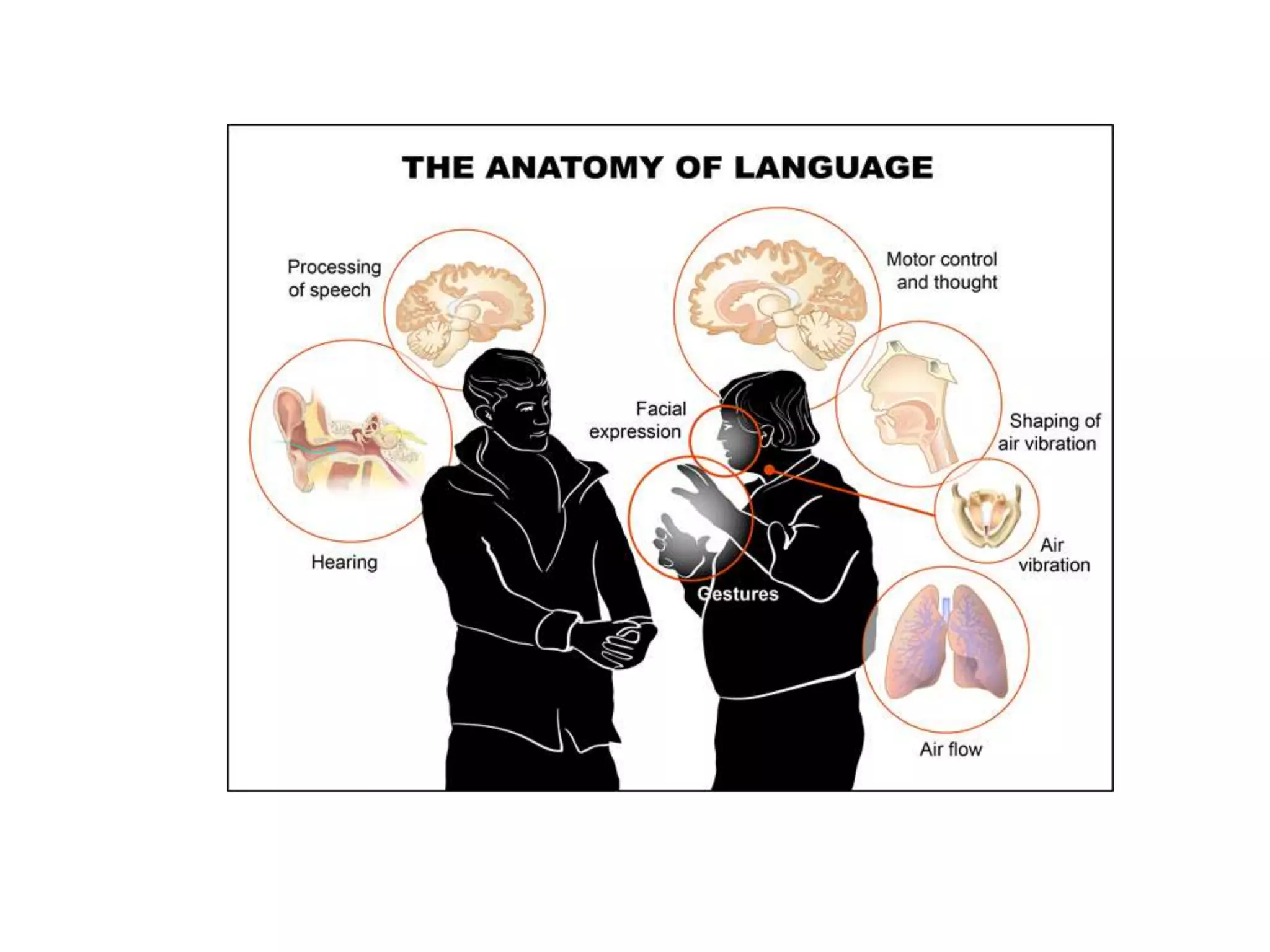
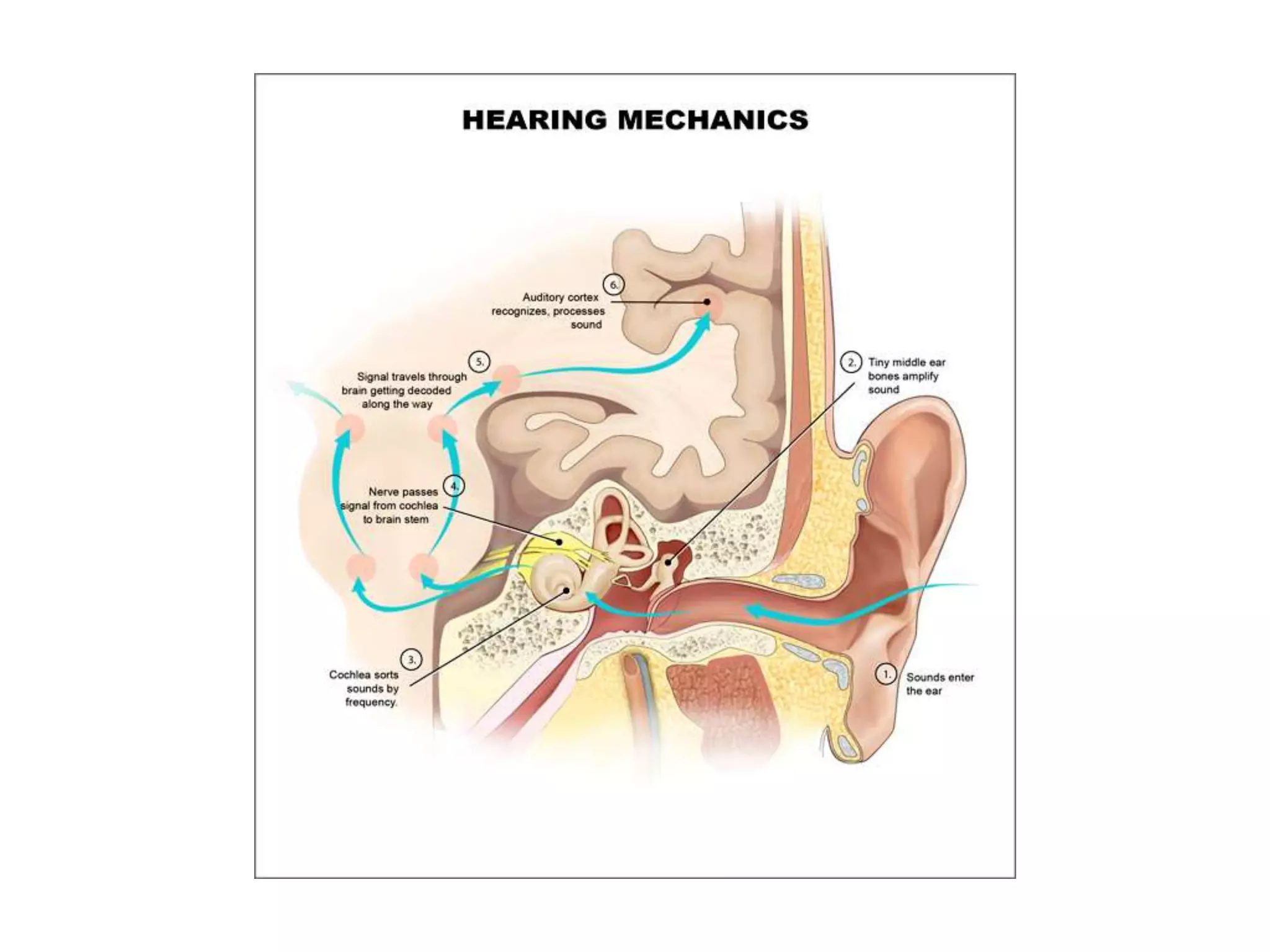
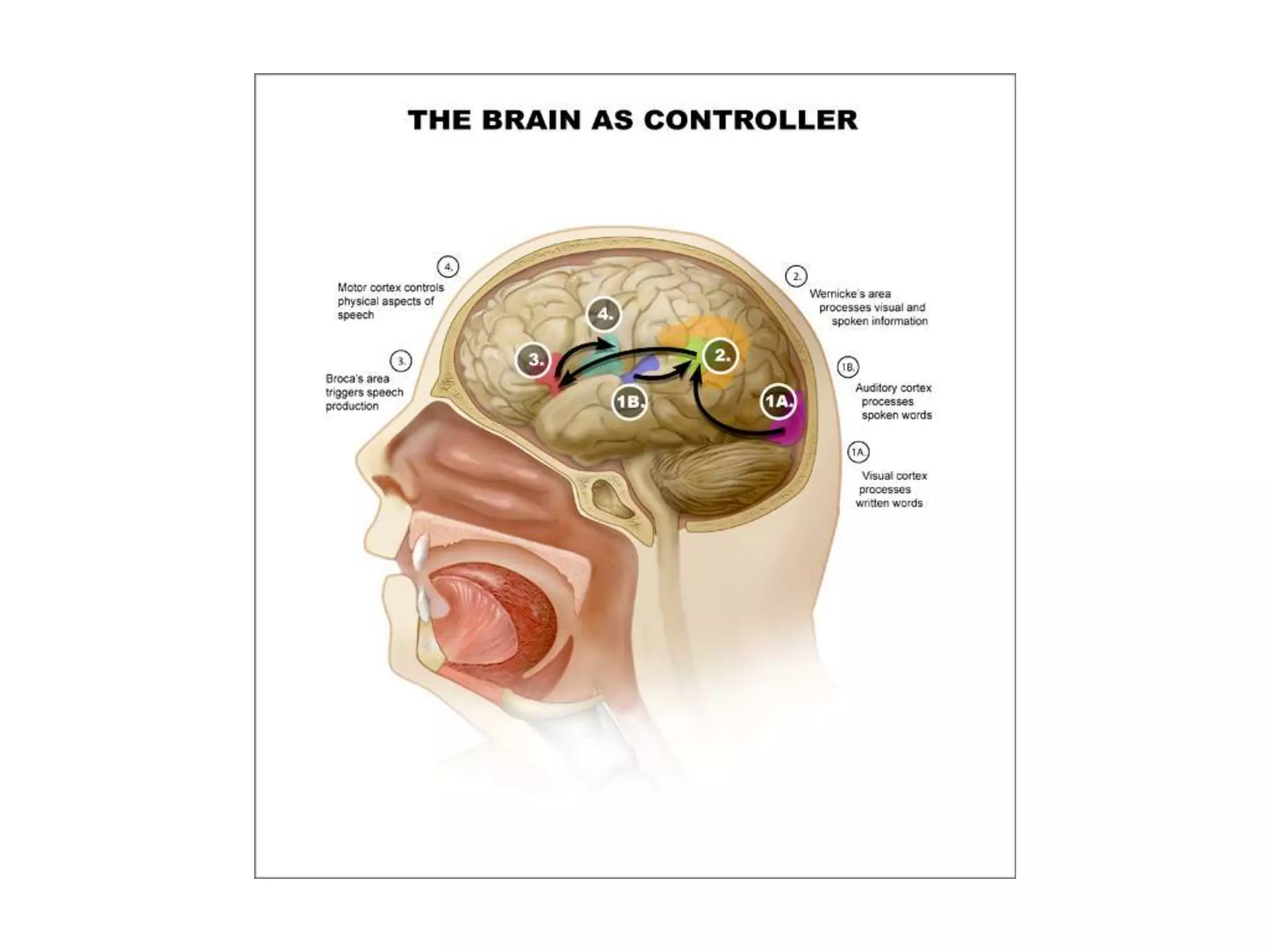
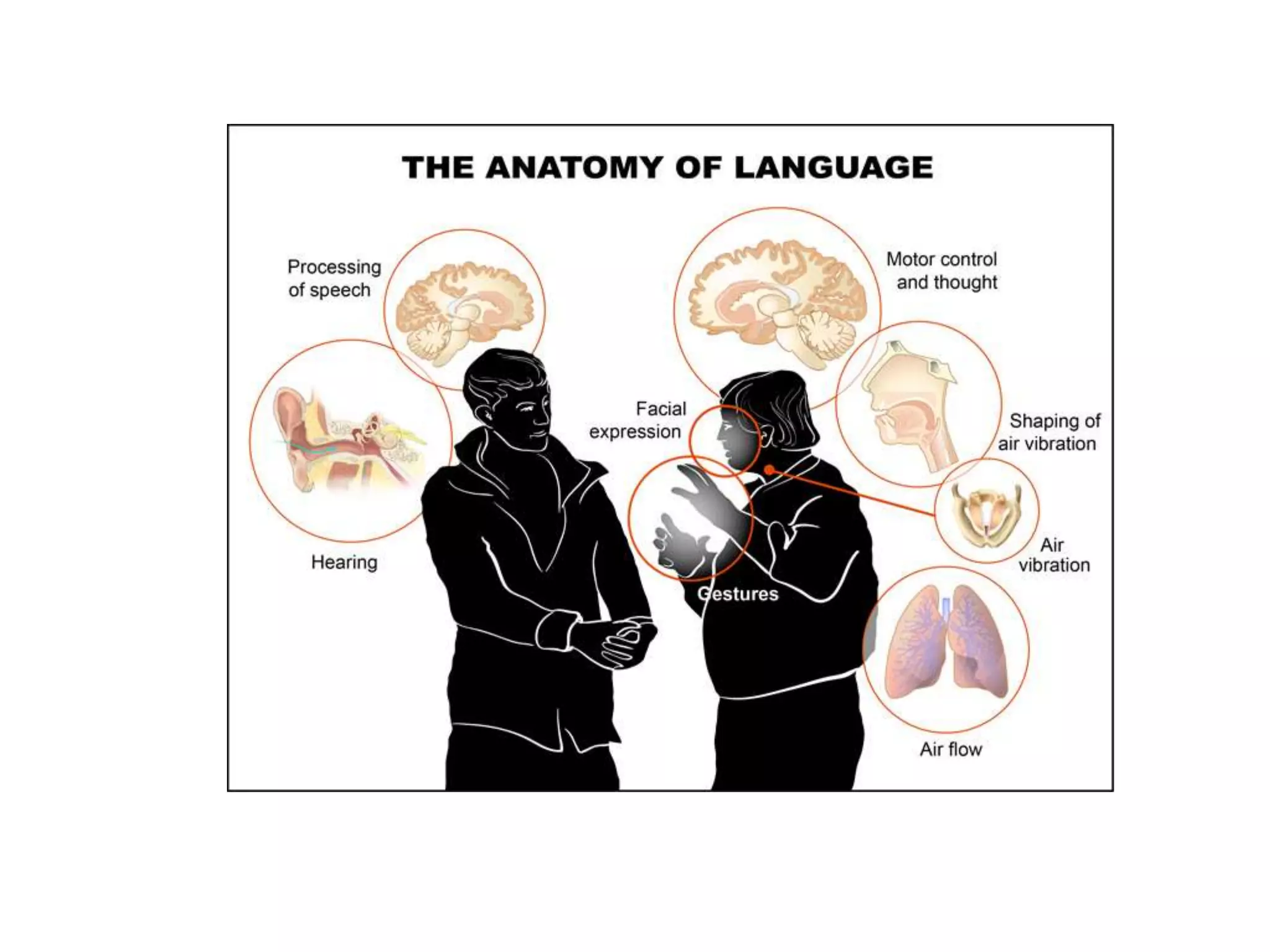
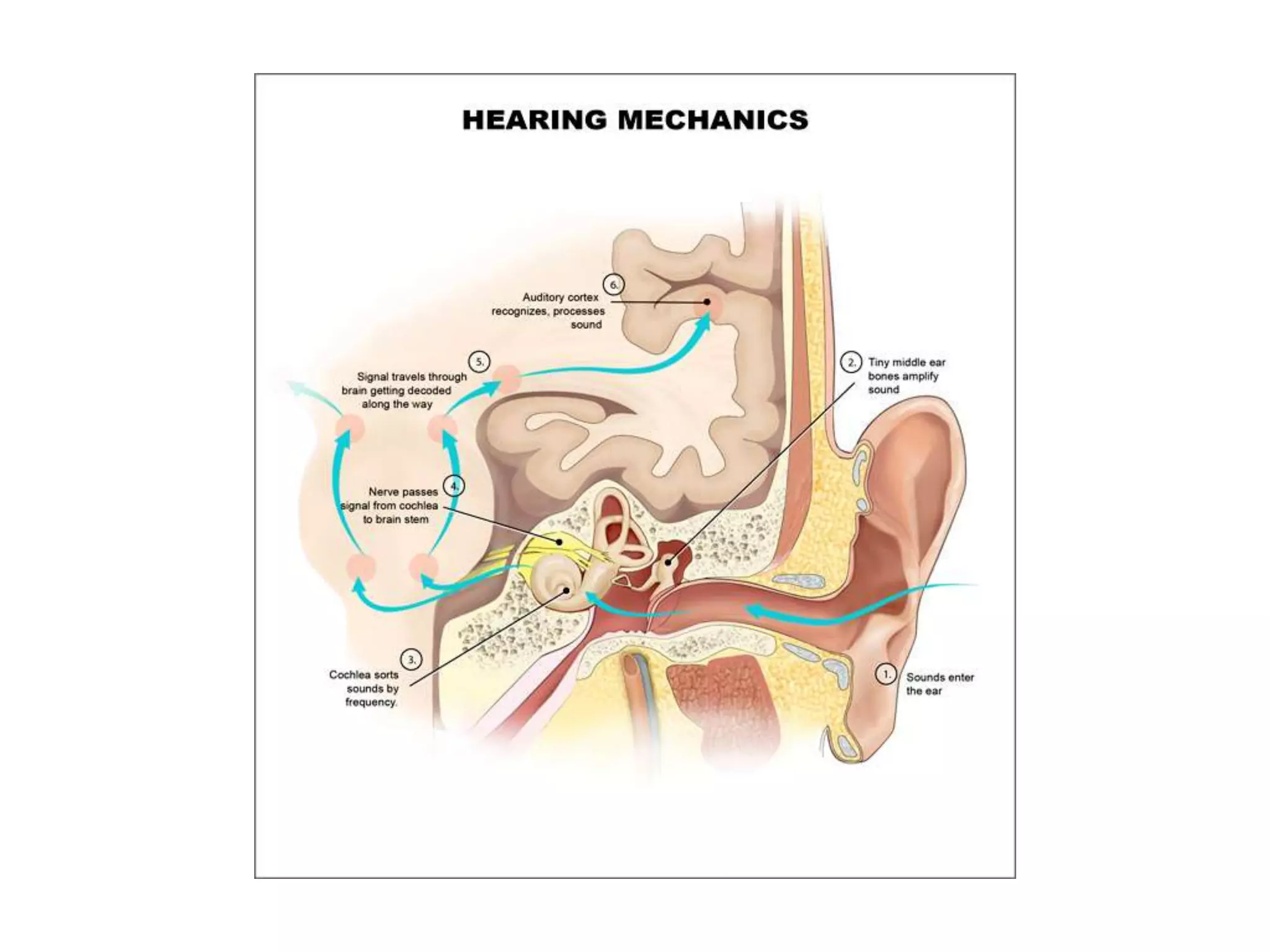
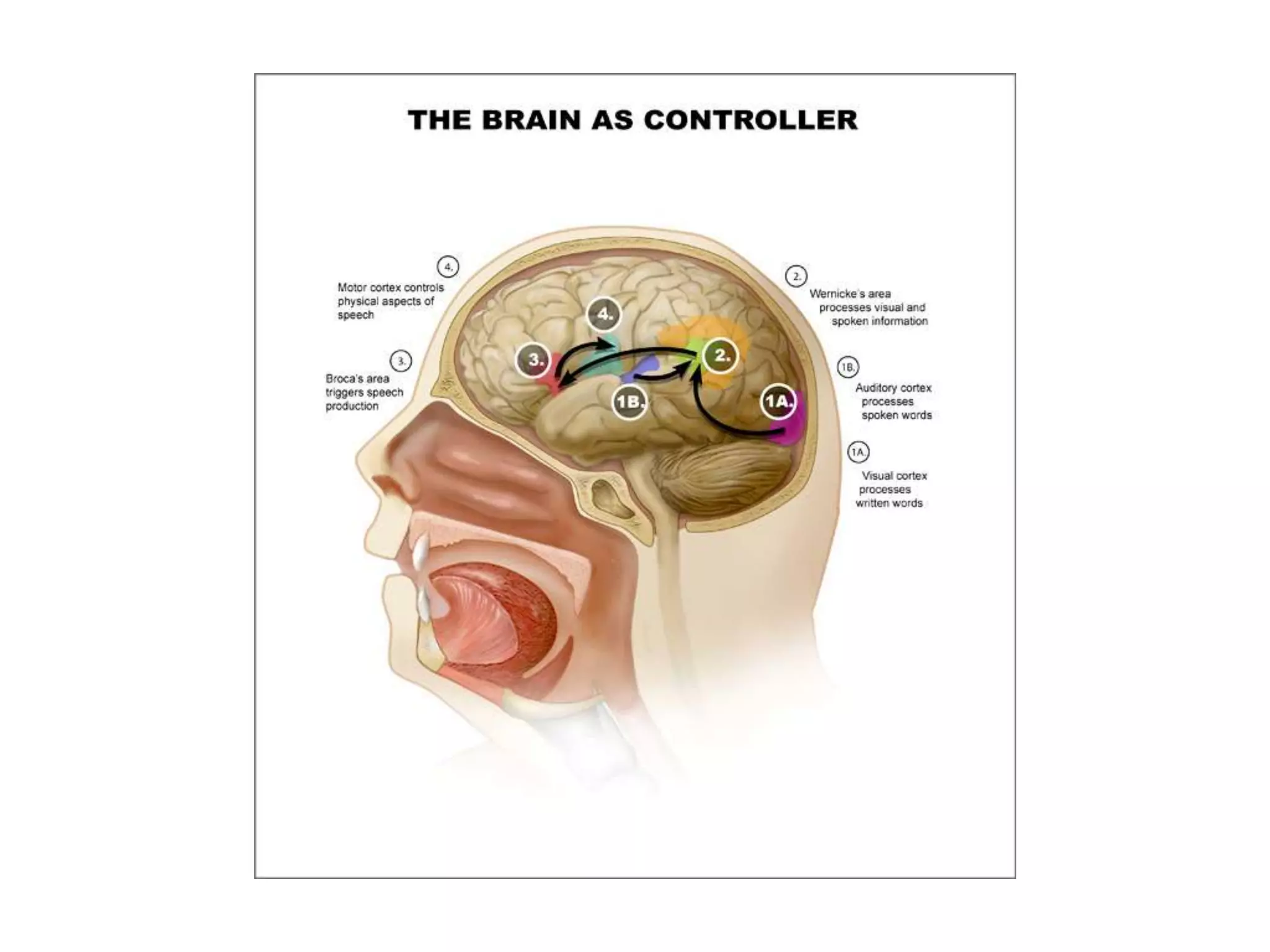
Anatomy of language
Sample film clip
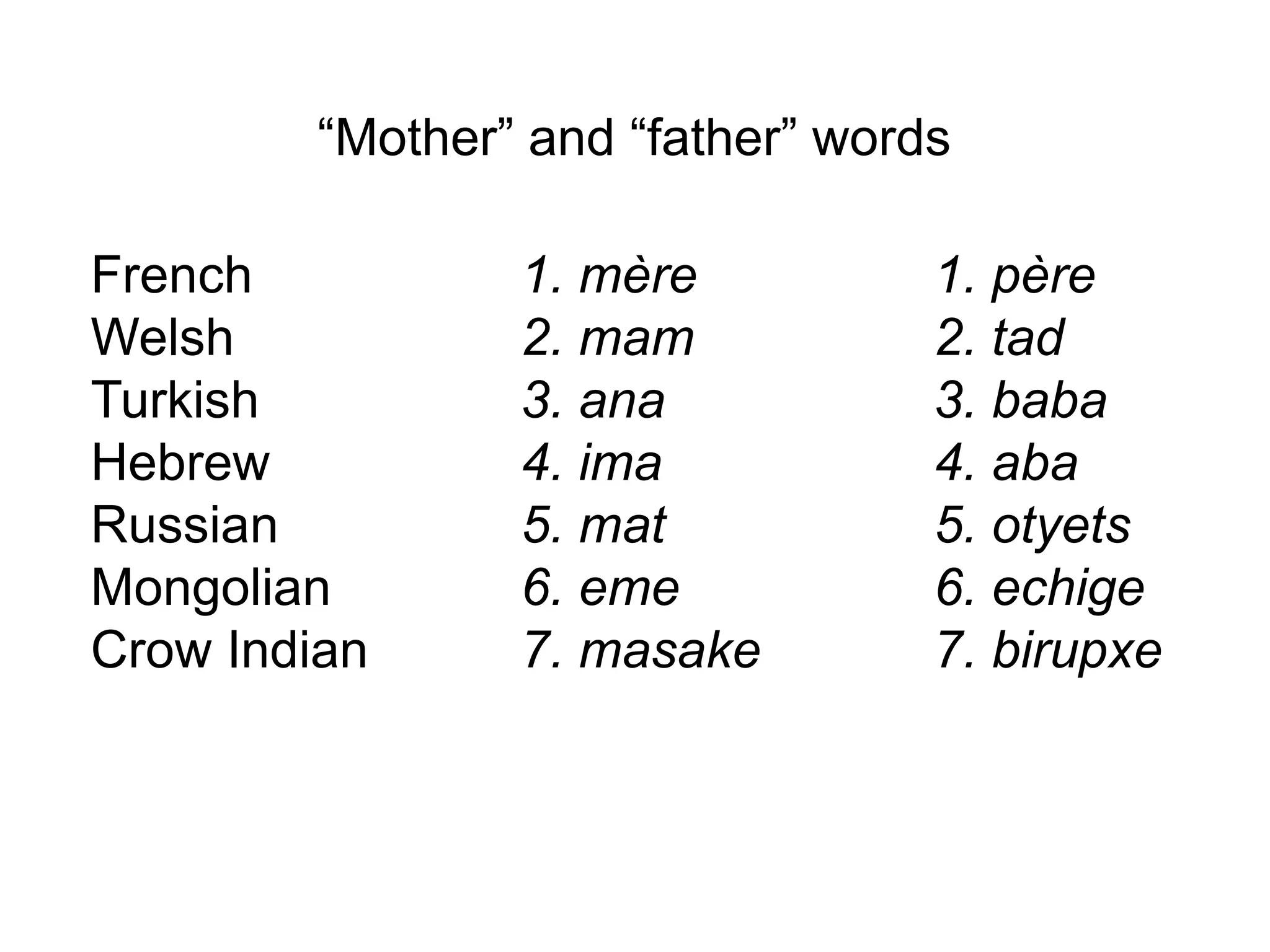
“Mother” and “father” words

French          1. mère           1. père
Welsh           2. mam            2. tad
Turkish         3. ana            3. baba
Hebrew          4. ima            4. aba
Russian         5. mat            5. otyets
Mongolian       6. eme            6. echige
Crow Indian     7. masake         7. birupxe
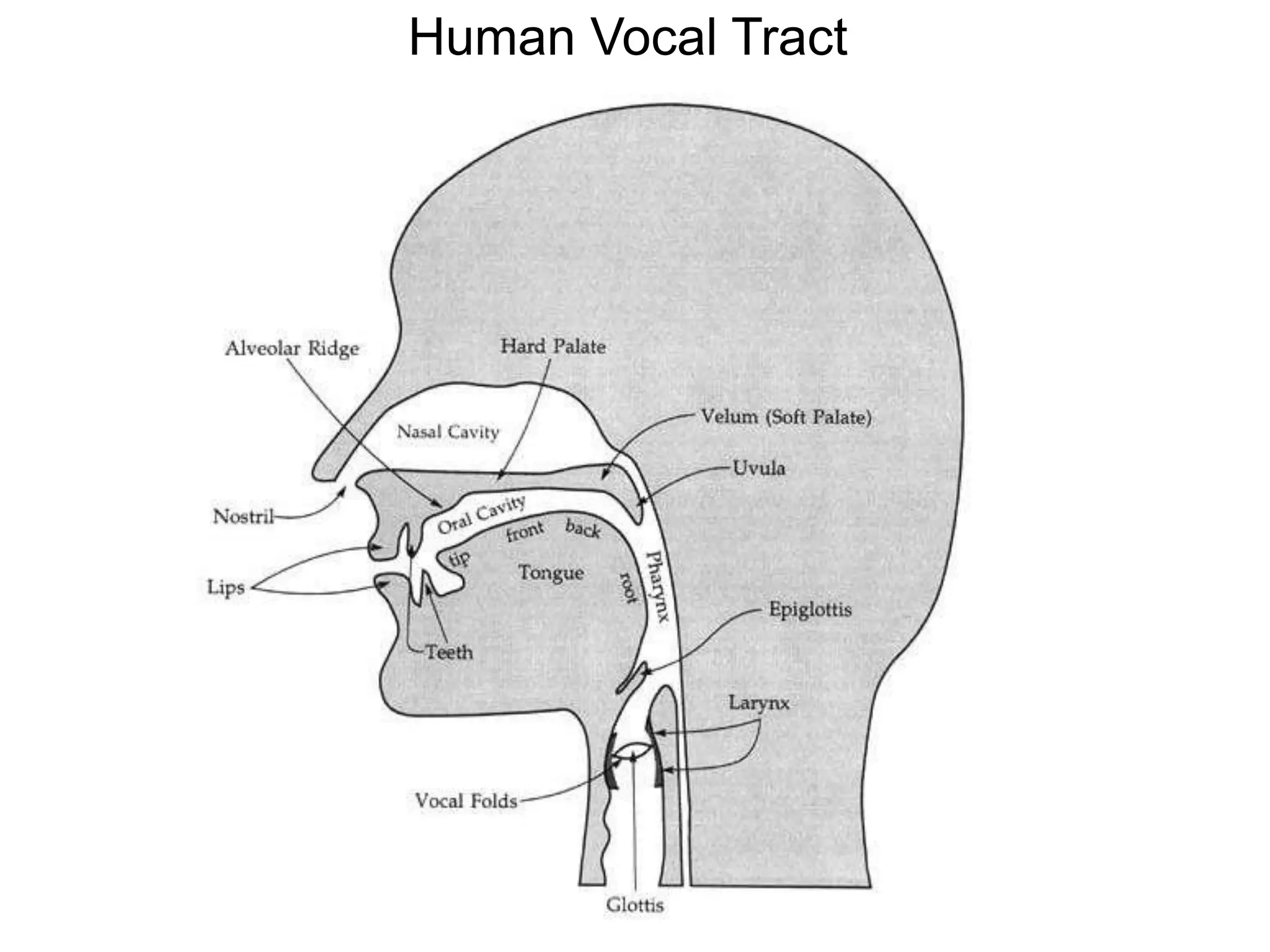
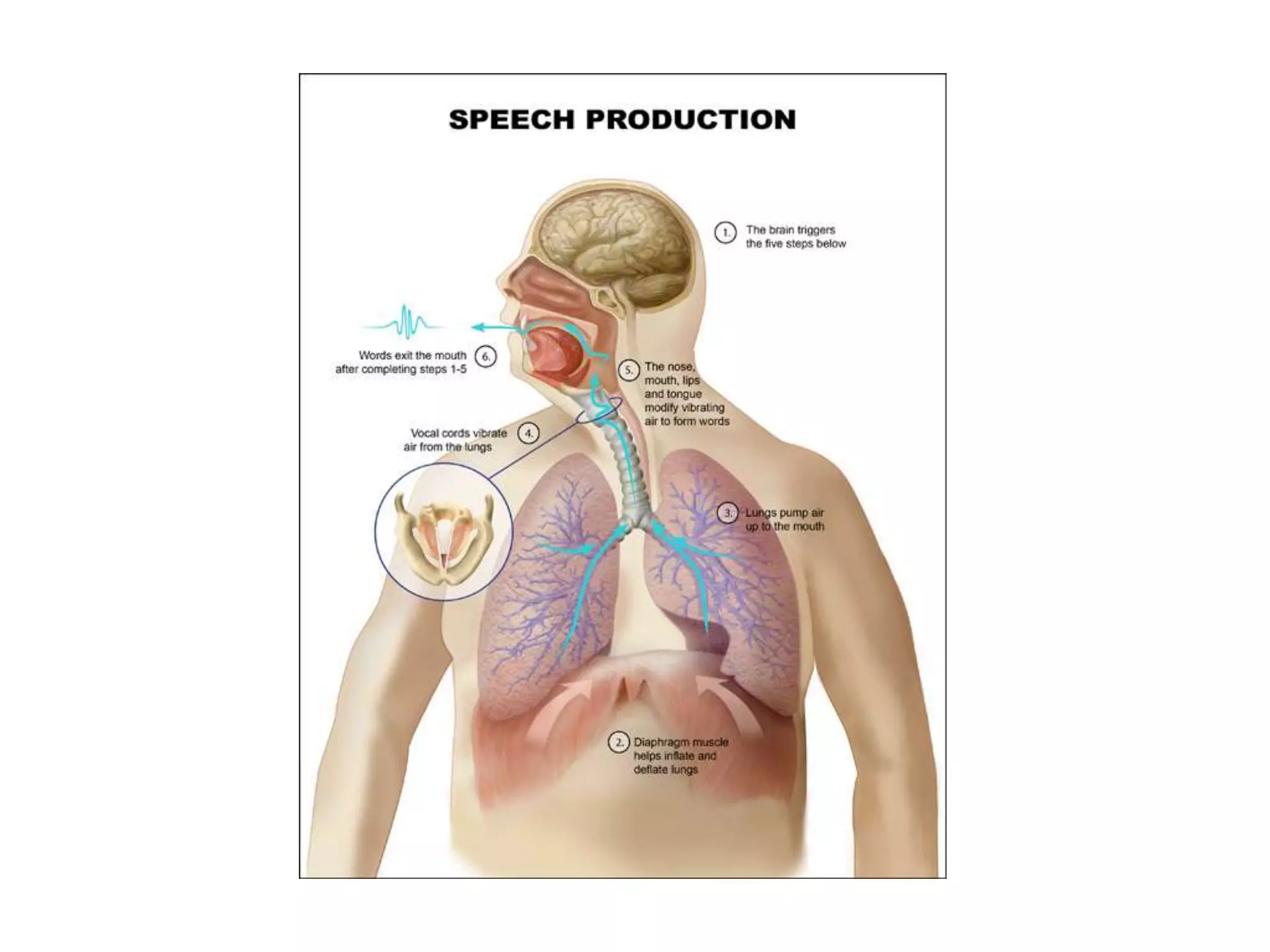
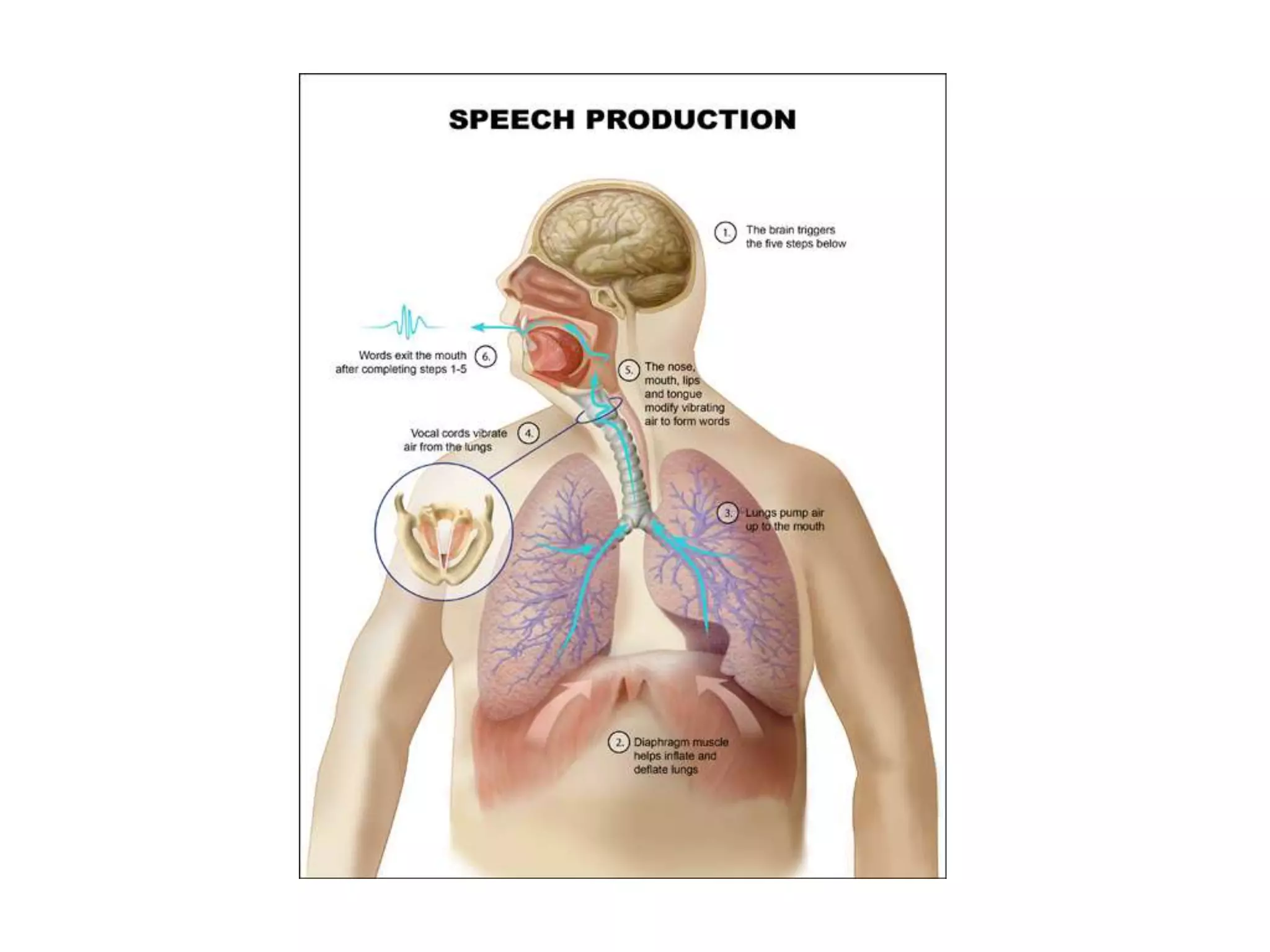
Human Vocal Tract
Human Vocal Tract


An elaborated language requires a highly
sophisticated speech organ that will enable
the speaker to produce the many
differentiated sounds. Only humans are
endowed with a speech organ of this
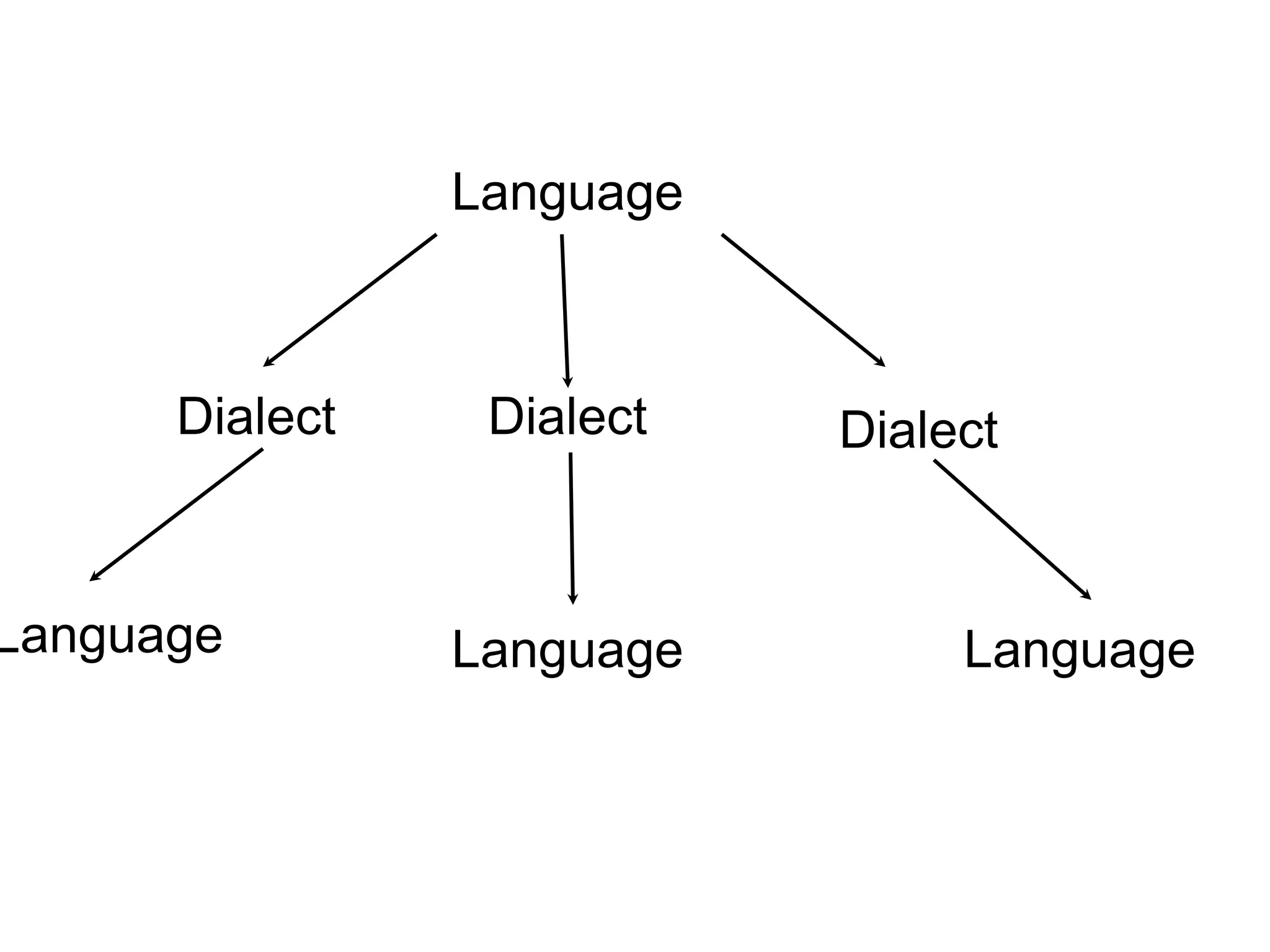
complexity.
Human Vocal Tract


http://www.phonetics.ucla.edu/cour
     se/chapter1/chapter1.html
Duality of patterning
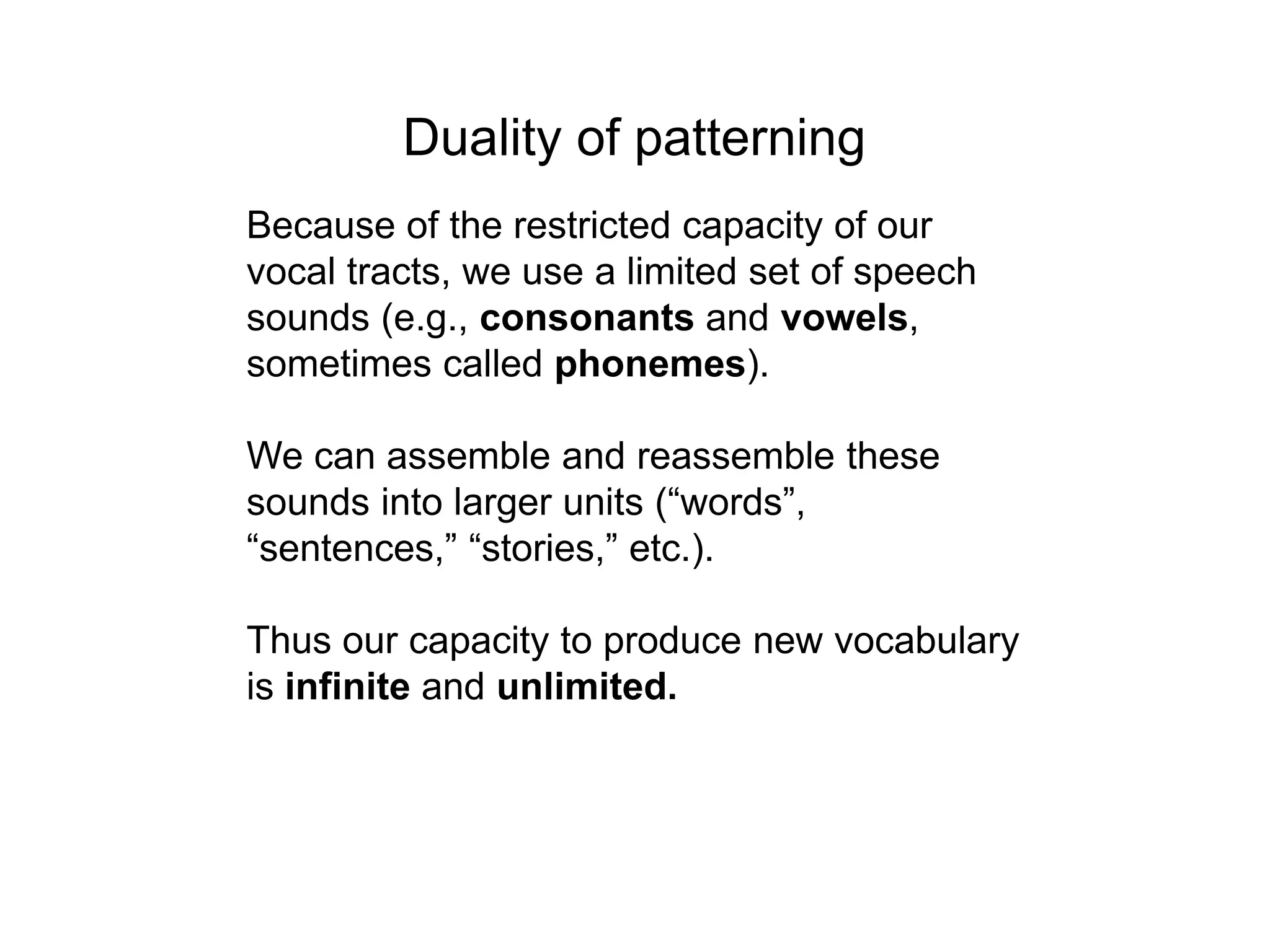
Because of the restricted capacity of our
vocal tracts, we use a limited set of speech
sounds (e.g., consonants and vowels,
sometimes called phonemes).

We can assemble and reassemble these
sounds into larger units (“words”,
“sentences,” “stories,” etc.).

Thus our capacity to produce new vocabulary
is infinite and unlimited.
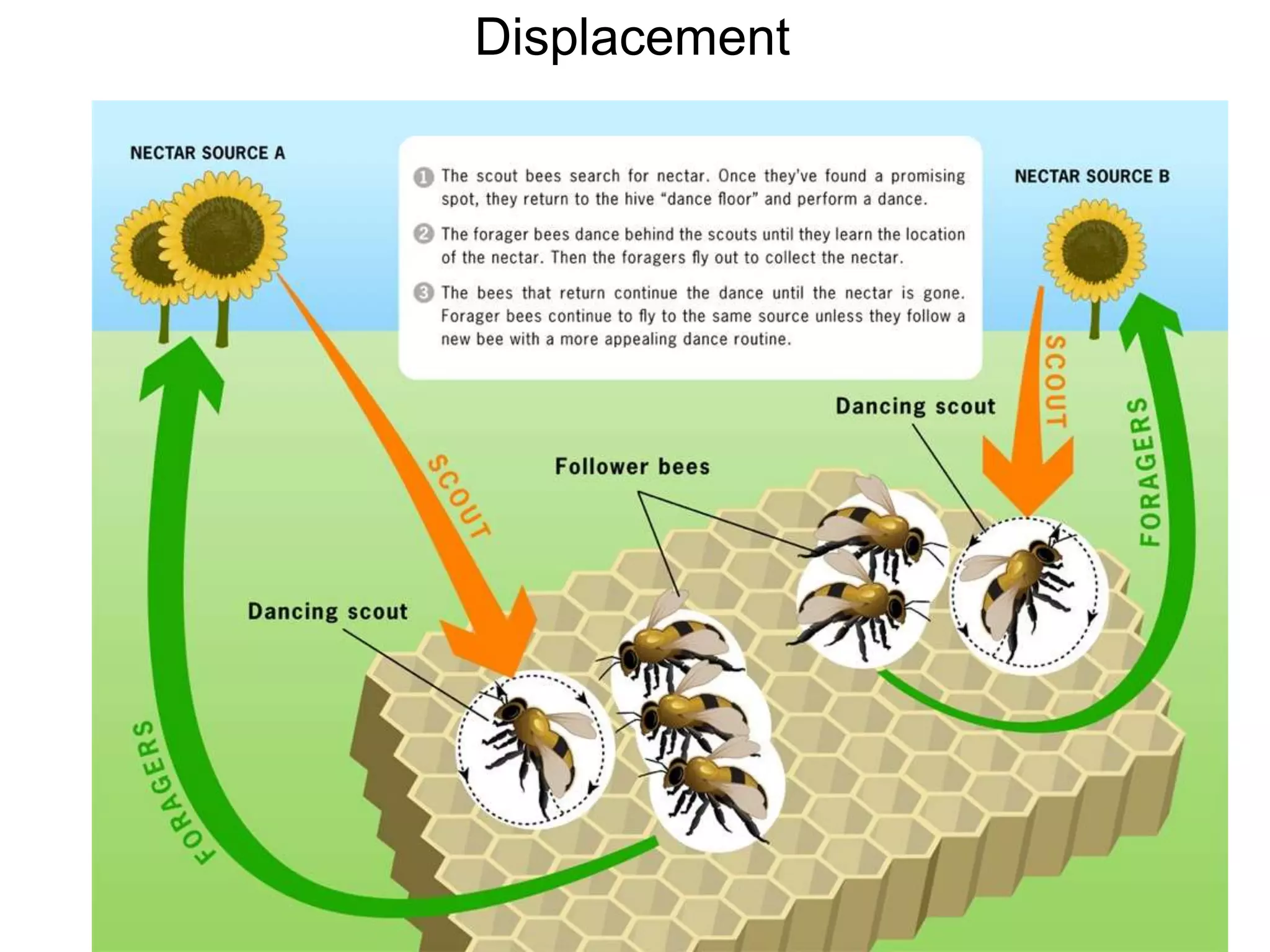
Displacement


In contrast to other animals, humans have
a sense of the past and the future. A
gorilla, for example, cannot tell his fellows
about his parents, his adventures in the
jungle, or his experience of the past.
Displacement


The use of language to talk about things
other than "the here and now", is a
characteristic of humans.
Displacement


.
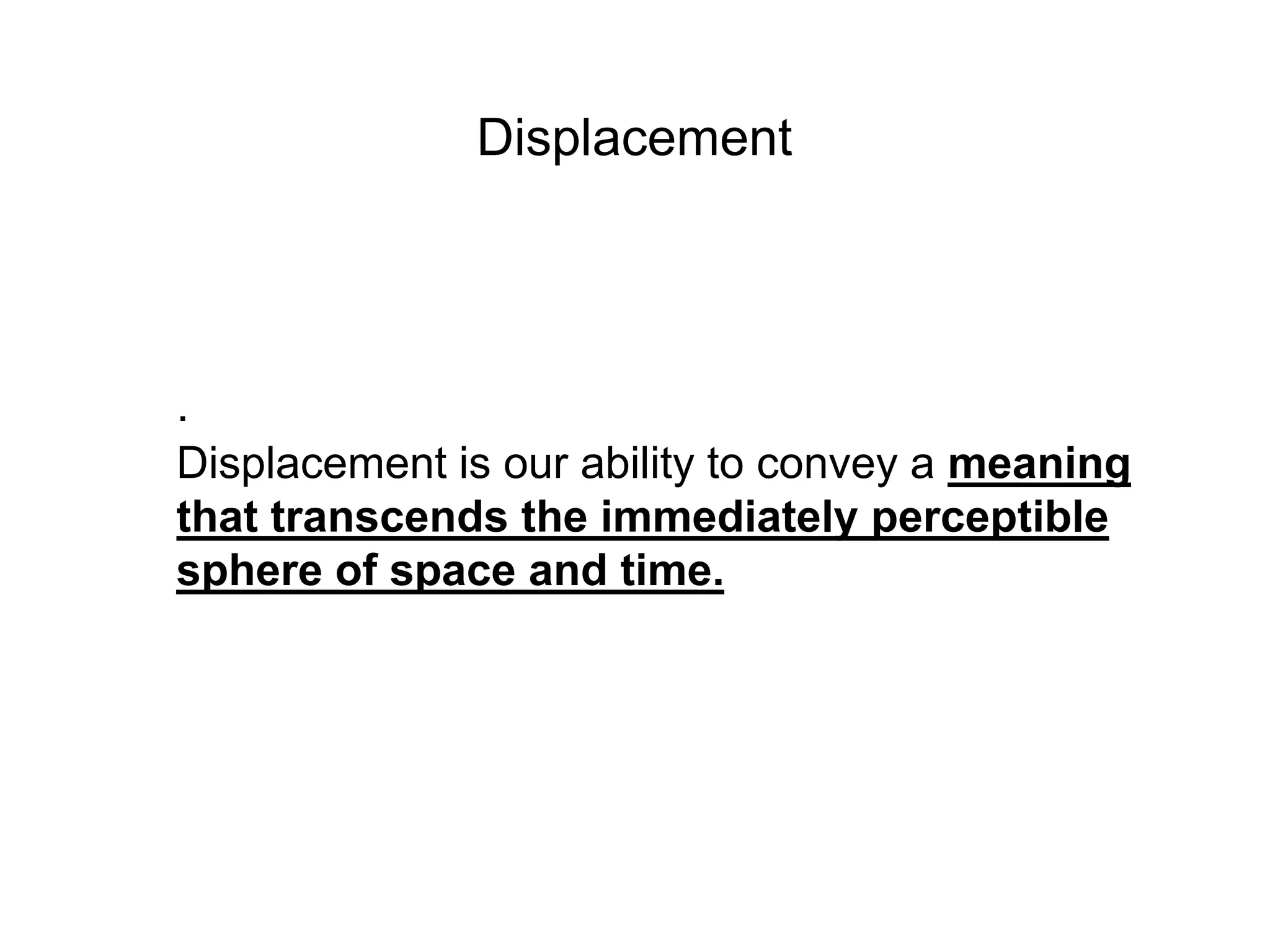
Displacement is our ability to convey a meaning
that transcends the immediately perceptible
sphere of space and time.
Displacement


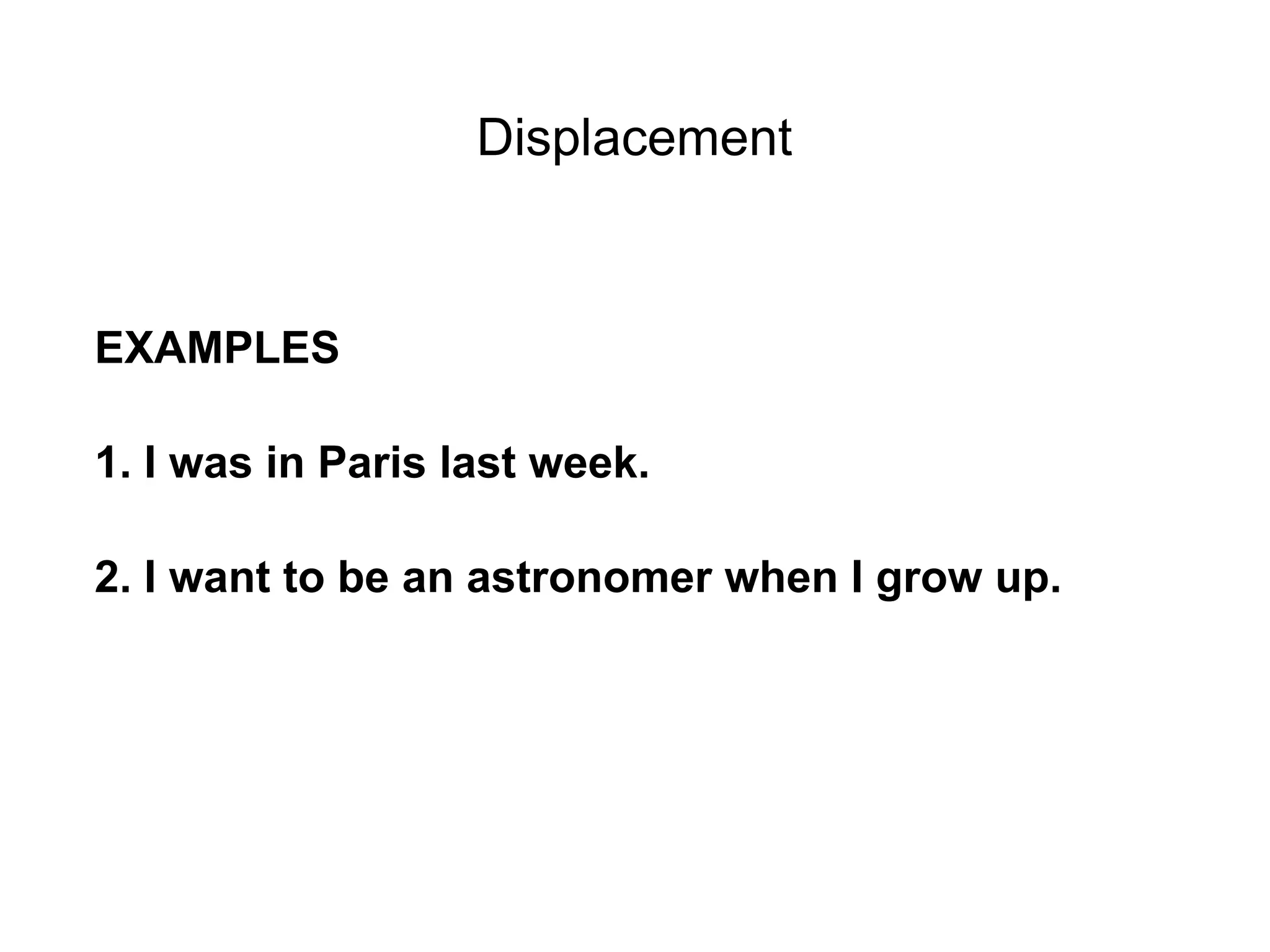
EXAMPLES

1. I was in Paris last week.

2. I want to be an astronomer when I grow up.
Displacement
Displacement


Although some animals seem to possess abilities
approximating those of displacement, they lack
the freedom to apply this to new contexts.
Displacement


The dance of the honey-bee, for
instance, indicates the locations of
rich deposits of food to other bees.
Displacement


The bee frequently repeats the same
patterns in its dance, whereas humans
are able to invent ever new contexts.
Open-endedness


The ability to say things that have
never been said before, including
the possibility to express invented
things or lies, is also a peculiar
feature of human language.
Stimulus-freedom


Humans have the ability to say anything
they like in any context.
Stimulus-freedom


This ability is only restricted in certain
ceremonial contexts such as church
services, etc., where a fixed form is
expected to be followed.
Stimulus-freedom


For example, the honey-bee must
perform its dance, the woodchuck must
cry out in order to warn his fellows when
it beholds an eagle.
Arbitrariness

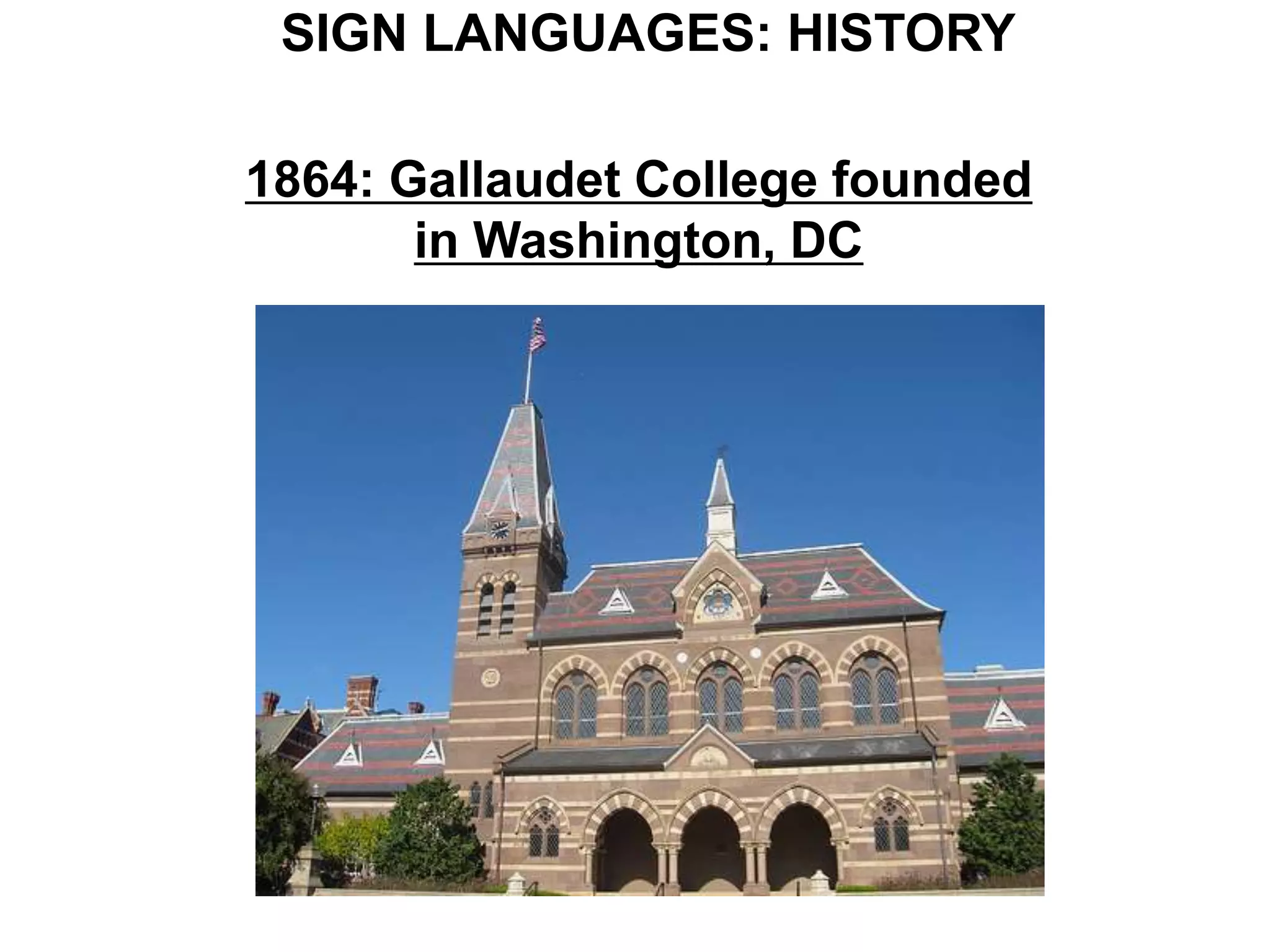
Why is a table called "table” in
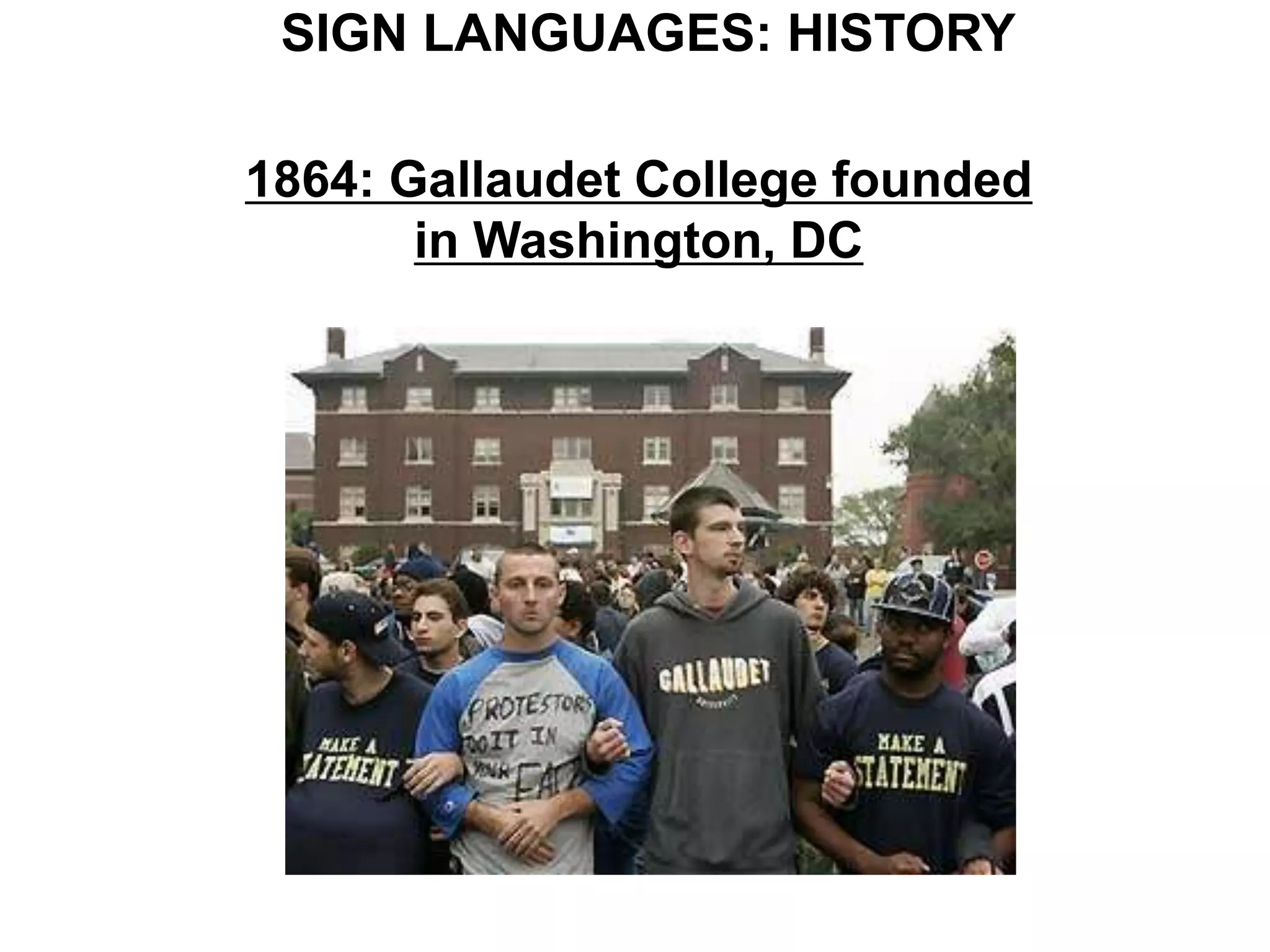
English"? Why is the same object
called “la mesa” in Spanish?

Obviously, the thing never told us its name.
And tables do not make a noise similar to
the word. The same applies to most of the
words of our language.
Arbitrariness


Language is not simply motivated by its
sound structure.

In other words, we cannot tell from the sound
structure which meaning is behind it. Hence,
words and their meanings have no a
prioriconnection (from theoretical deduction).
Arbitrariness


There are, however, exceptions to this rule:

language can beiconic, which means that there
is a direct correlation between form and
meaning.
Arbitrariness


The length of a phrase, for example, could
represent a length of time the phrase refers
to, like in “a long, long time ago.”

Here, the extension serves to visually
represent the semantic emphasis. Iconicity in
language can be found frequently.
Arbitrariness


Another example for nonarbitrariness are
onomatopoeia. These are words that
seem to resemble sounds. There are many
examples for onomatopoetic words, like
splashor bang.
Arbitrariness


Another example for nonarbitrariness are
Some names for animals are also
onomatopoetic, for example, cuckoo. Still,
since animals such as the bird are named
differently in different languages, there can
be no ultimate motivation for the name.
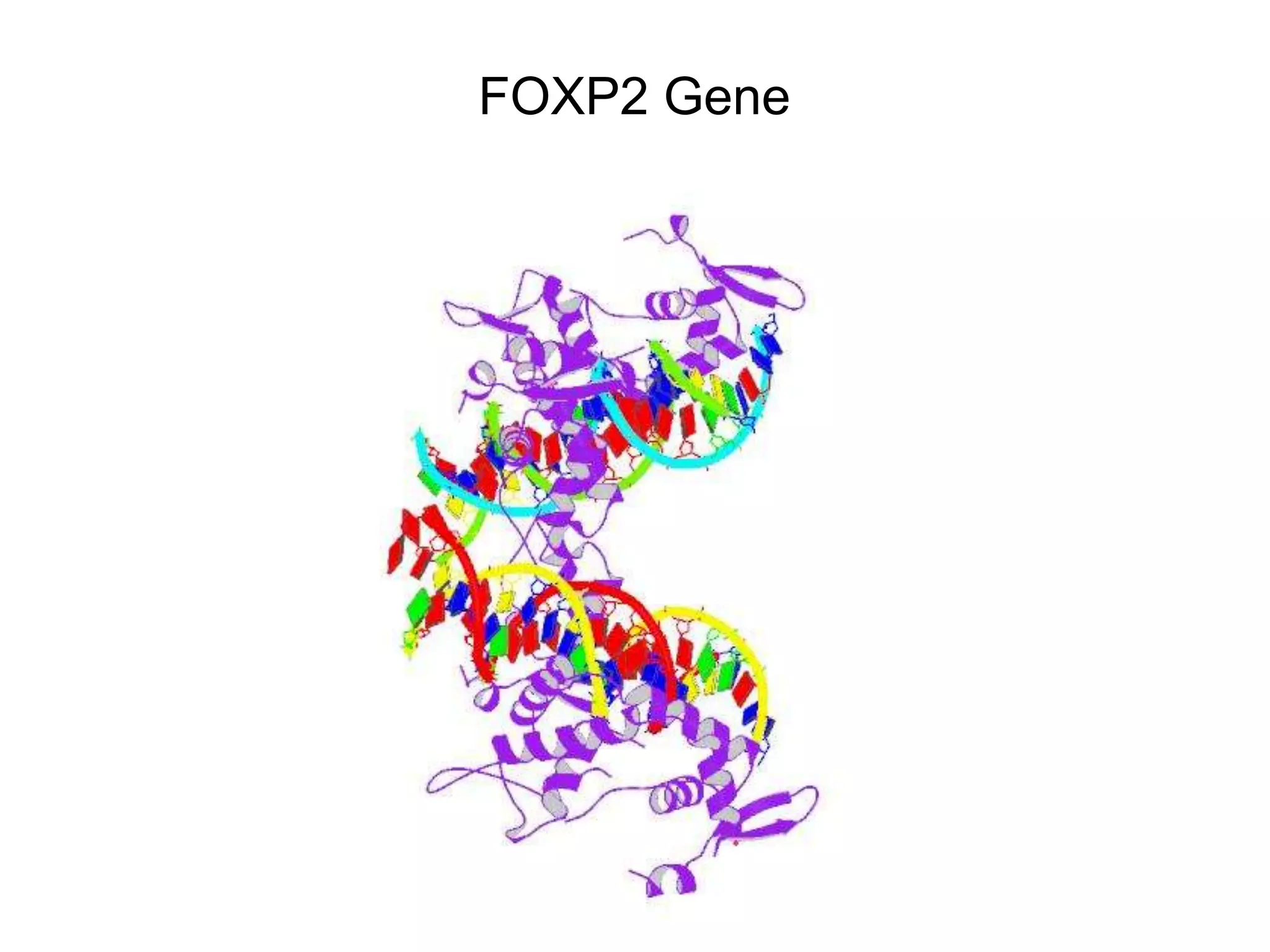
FOXP2 Gene
The Field of Linguistics


   1. Phonetics
   2. Phonology
   3. Syntax
   4. Morphology
   5. Semantics
   6. Pragmatics
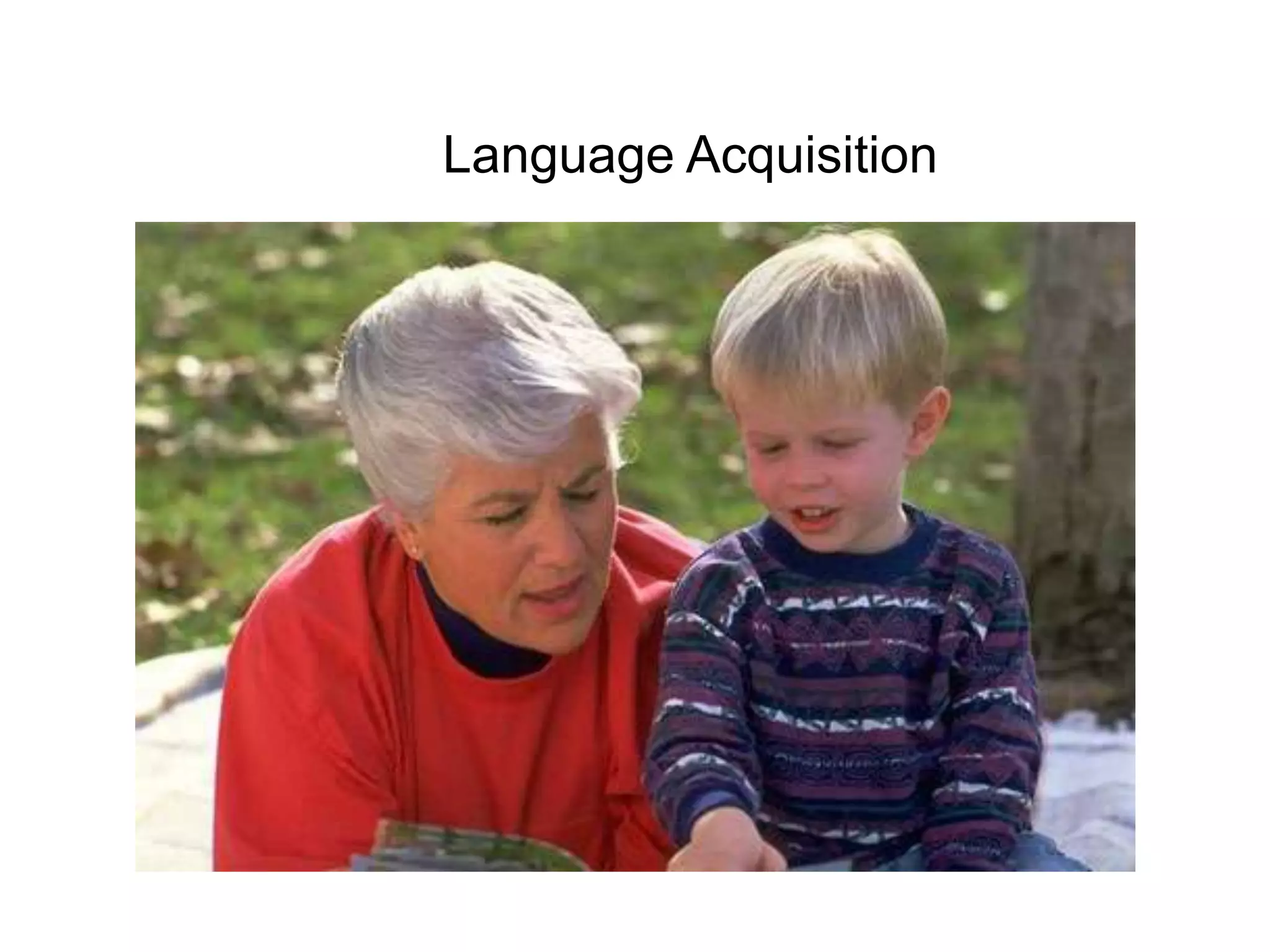
Language Acquisition
Nicaraguan Sign-Language:
A Case of Linguistic Creativity
Language and Dialects

1. What do you think the differences are
   between a language and a dialect?

2. Give examples of each (teach each other
three examples). Write on an index card.
The Study of Language

1. Where did you grow up?

2. How many languages do you speak?

3. Teach each other a word, phrase, or
    sentence in another language or regional
    form.

4. Write on an index card your group
   partner’s responses.
Language


      Dialect    Dialect   Dialect


Language        Language        Language
dialect:

a variation of a particular language
“A language is a dialect with an army.”
standard vs. non-standard
The Language-Dialect Distinction


1. Folklorists and sociolinguists focus on
linguistic diversity internal tospeech
communities.
The Language-Dialect Distinction


2. One such case of linguistic diversity is
dialectal variation.
The Language-Dialect Distinction


3. Most dialects are considered mutually
intelligible varieties of a language that
differ in systematic ways.
The Language-Dialect Distinction


So, if one of you grew up in New
England and another one was born and
raised in Georgia, you’re still able to
understand one another, despite
differences in the language variety each
of you speaks.
The Language-Dialect Distinction


We say you both speak two dialects of
the same language, that is, English.
The Language-Dialect Distinction


               EXAMPLE

Think of the recent evolving of
“Serbian”,“Croatian”, and “Bosnian”
languages in the former Yugoslavia.
The Language-Dialect Distinction


Prior to the disintegration of former
Yugoslavia, people in this part of the
world all spoke something they called
“Serbo-Croatian.”
The Language-Dialect Distinction


Today, they still speak the same thing,
but it’s not called Serbo-Croatian any
more. It’s Serbian, Croatian, or
Bosnian, depending on where you live.
The Language-Dialect Distinction


Folklorists and sociolinguists focus on
linguistic diversity internal tospeech
communities.
The Language-Dialect Distinction


We say you both speak two dialects of
the same language, that is, English.
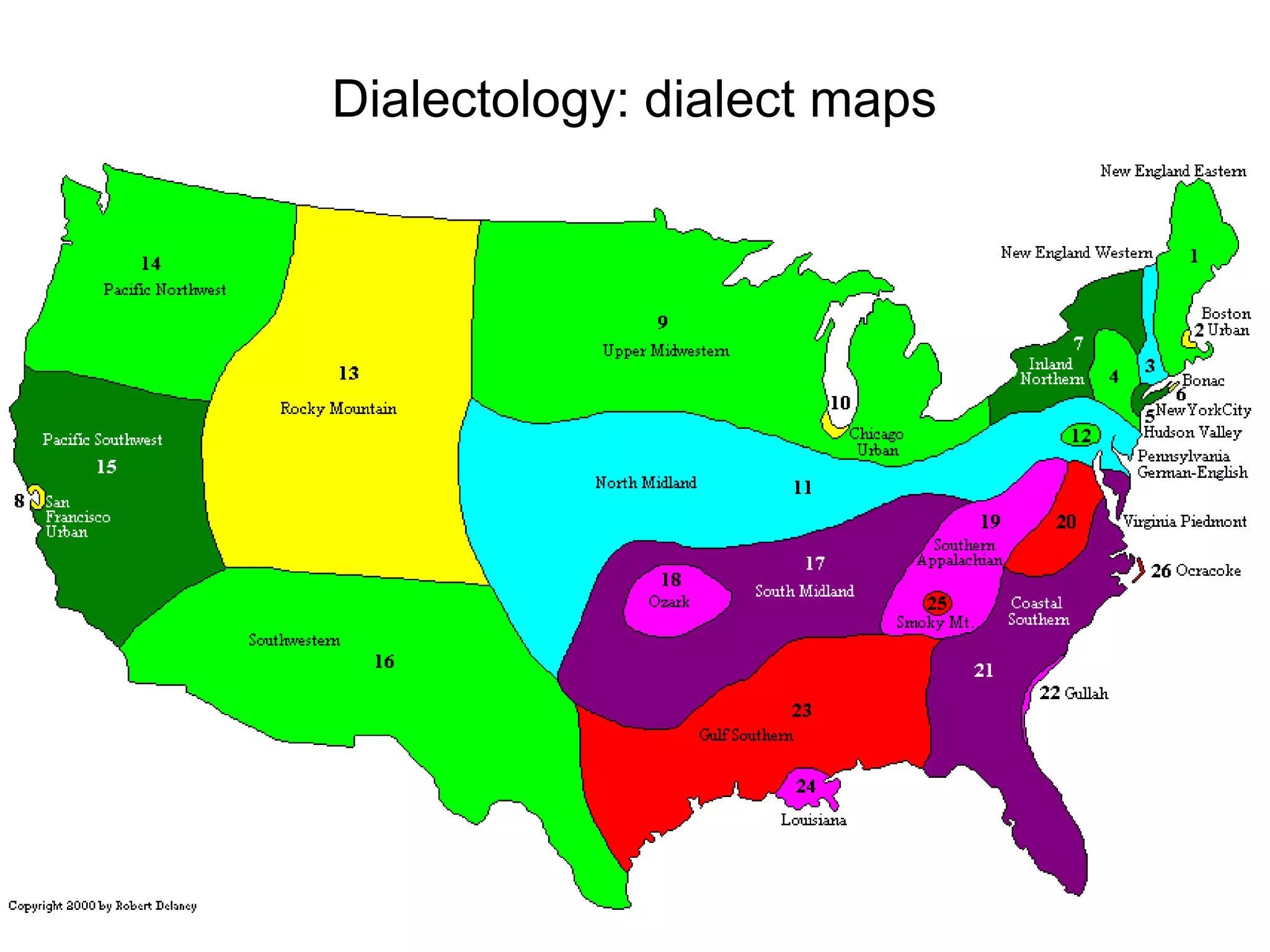
Dialectology: dialect maps
Idiolect


An idiolect is an individual’s unique way
of speech. Since no two people speak in
the same way, we say that each one of
them has an idiolect.
Accent


An accent is a person’s distinctive
way of pronouncing words, which is
typically associated with a particular
region, e.g., a Boston accent, a Brooklyn
accent, or a British accent.

It is also often used for the pronunciation
of non-natives speaking a foreign
language.
Lexical dialectal variation

If you ask for a tonic in Boston, you will
get a drink called soda or soda-pop in
LA; and a freeway in LA is a thruway in
NY, a parkway in New Jersey, a
motorway in England, and an
expressway or turnpike in other dialect
areas.
Dialect: Examples


REPEAT:
Pahk the cah in Hahvuhd yahd.

WHAT DOES THIS MEAN?
Phonological dialectal variation


Speaking of pronunciation, how do you say:

1. “caught” and “cot”?
2. “Will Mary marry in a merry wedding?”
3. Otter Creek? (a [krik] or a [krIk])
Morphological dialectal variation

In parts of Northern England and South
Wales, the morpheme -s is not just a third
person singular marker in present tense,
but a general present tense marker:

1. I likes him.
2. We goes.
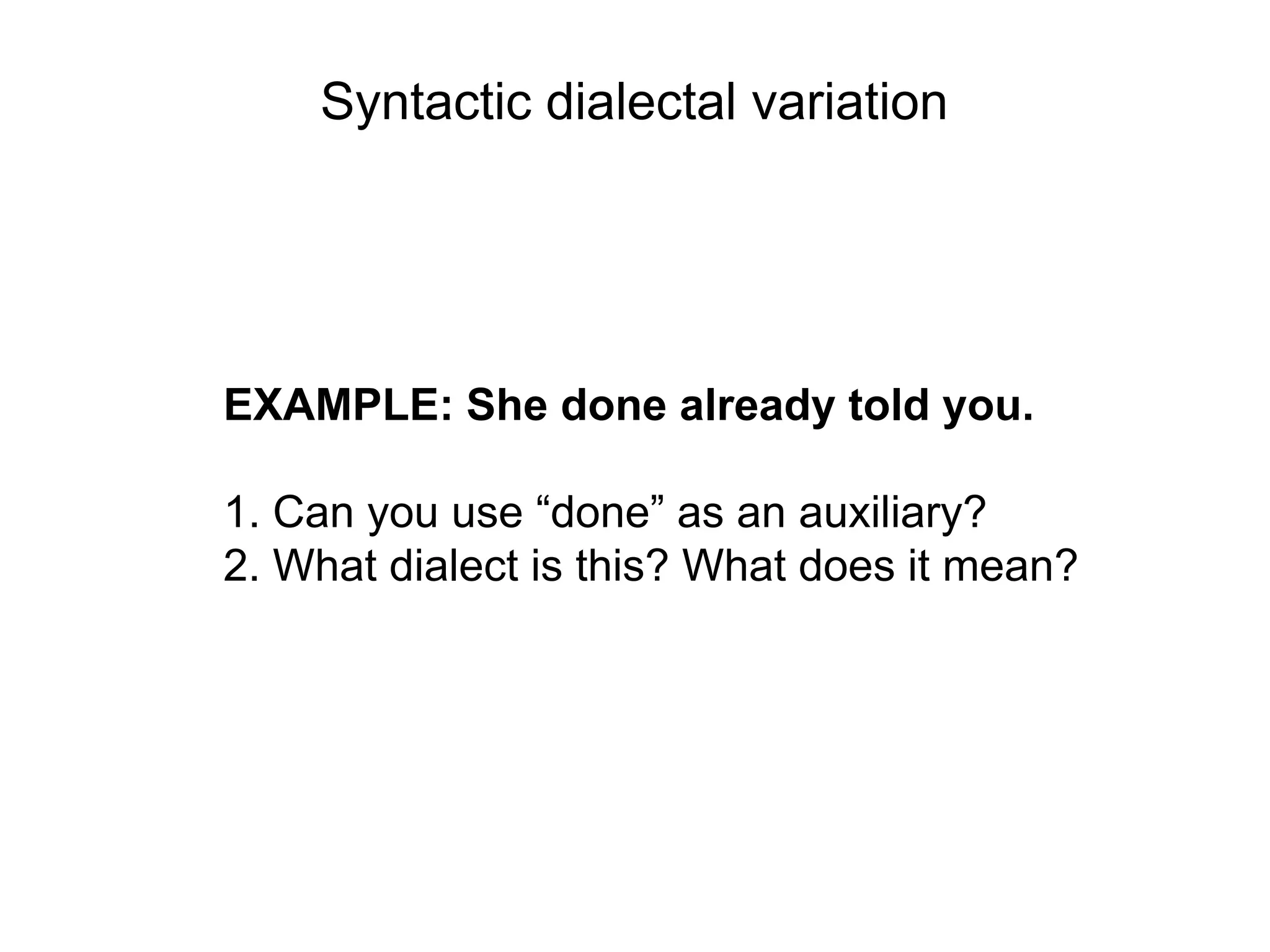
Syntactic dialectal variation


EXAMPLE: She done already told you.

1. Can you use “done” as an auxiliary?
2. What dialect is this? What does it mean?
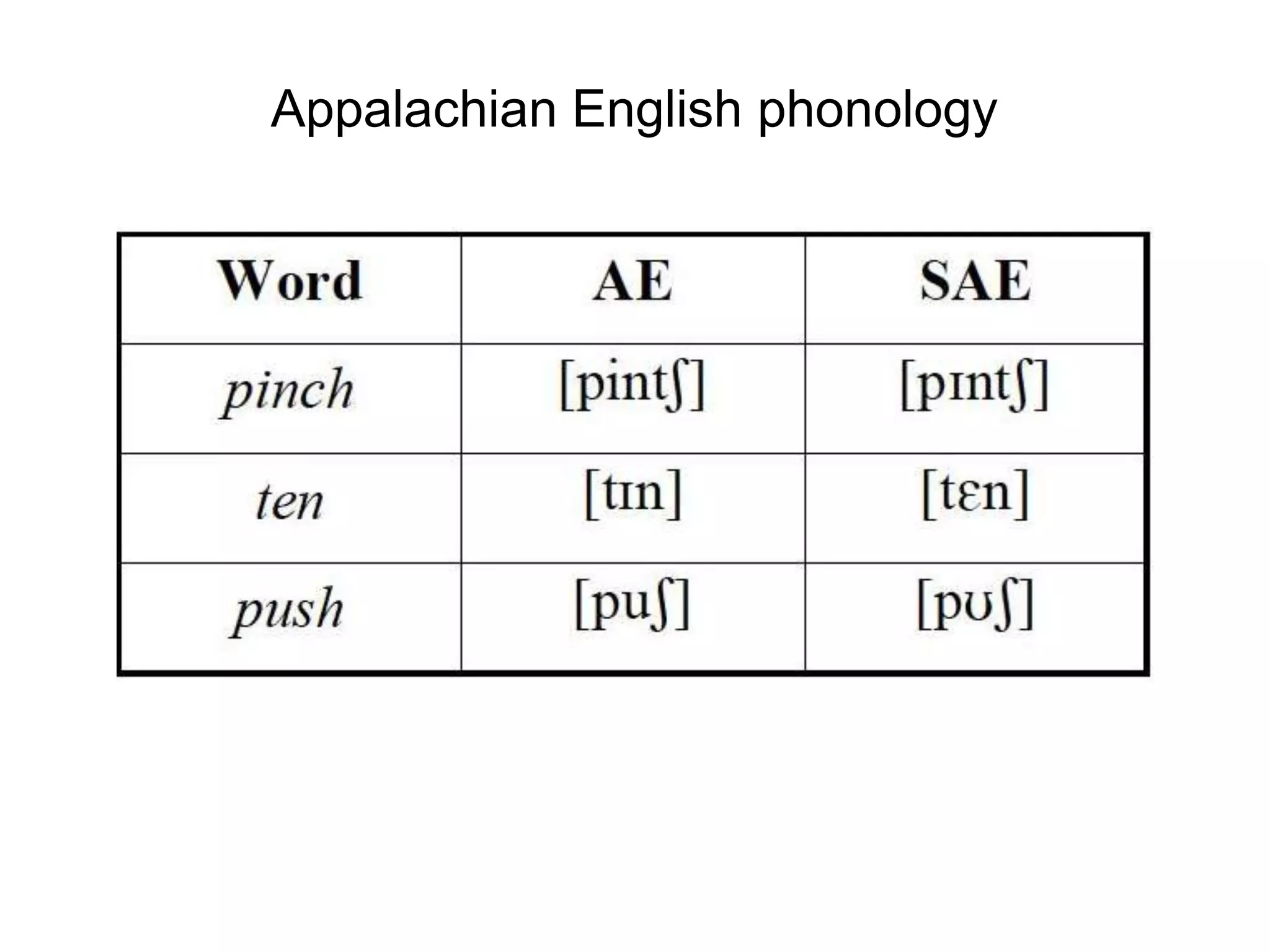
Appalachian English phonology
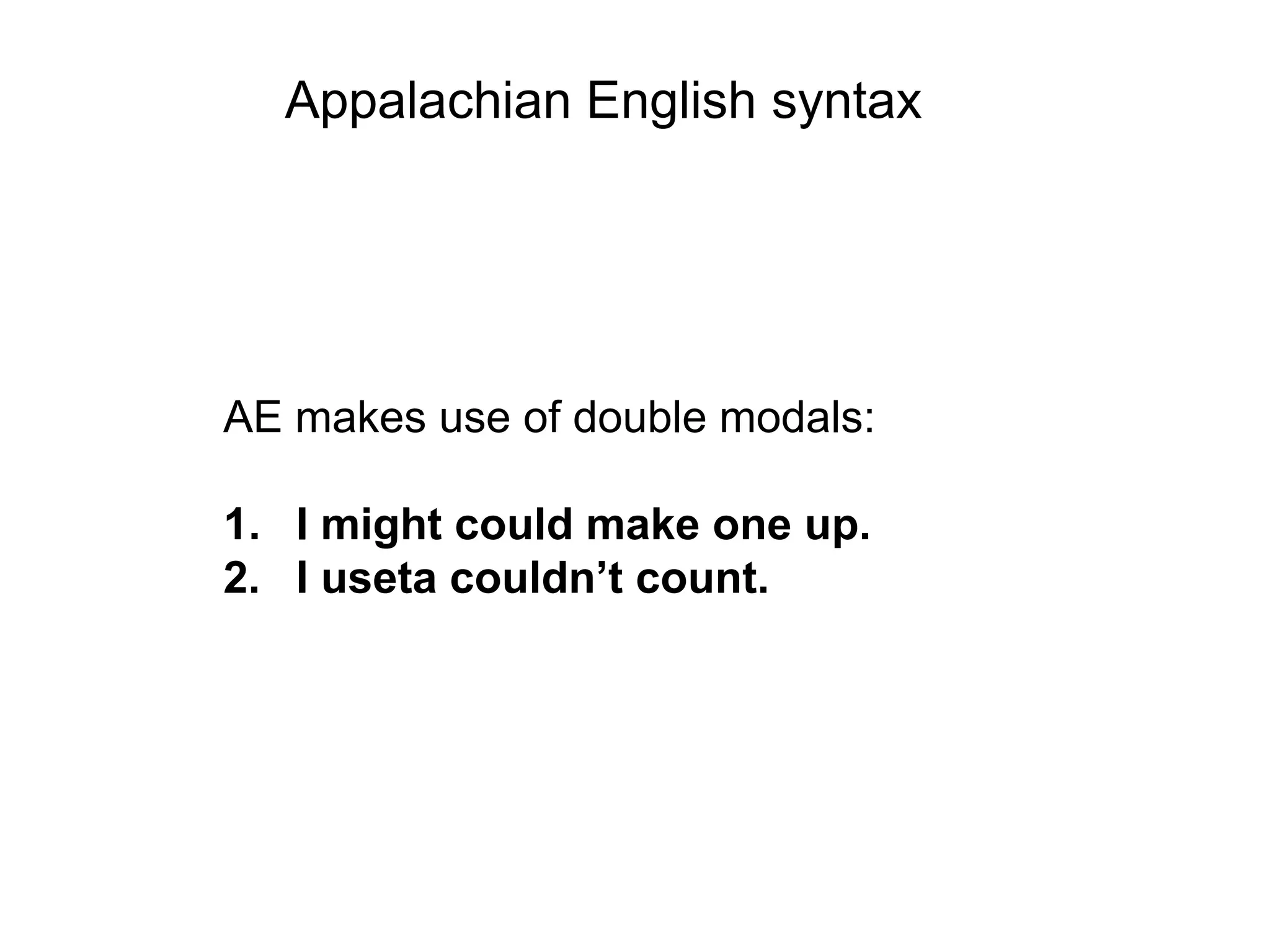
Appalachian English syntax


AE makes use of double modals:

1. I might could make one up.
2. I useta couldn’t count.
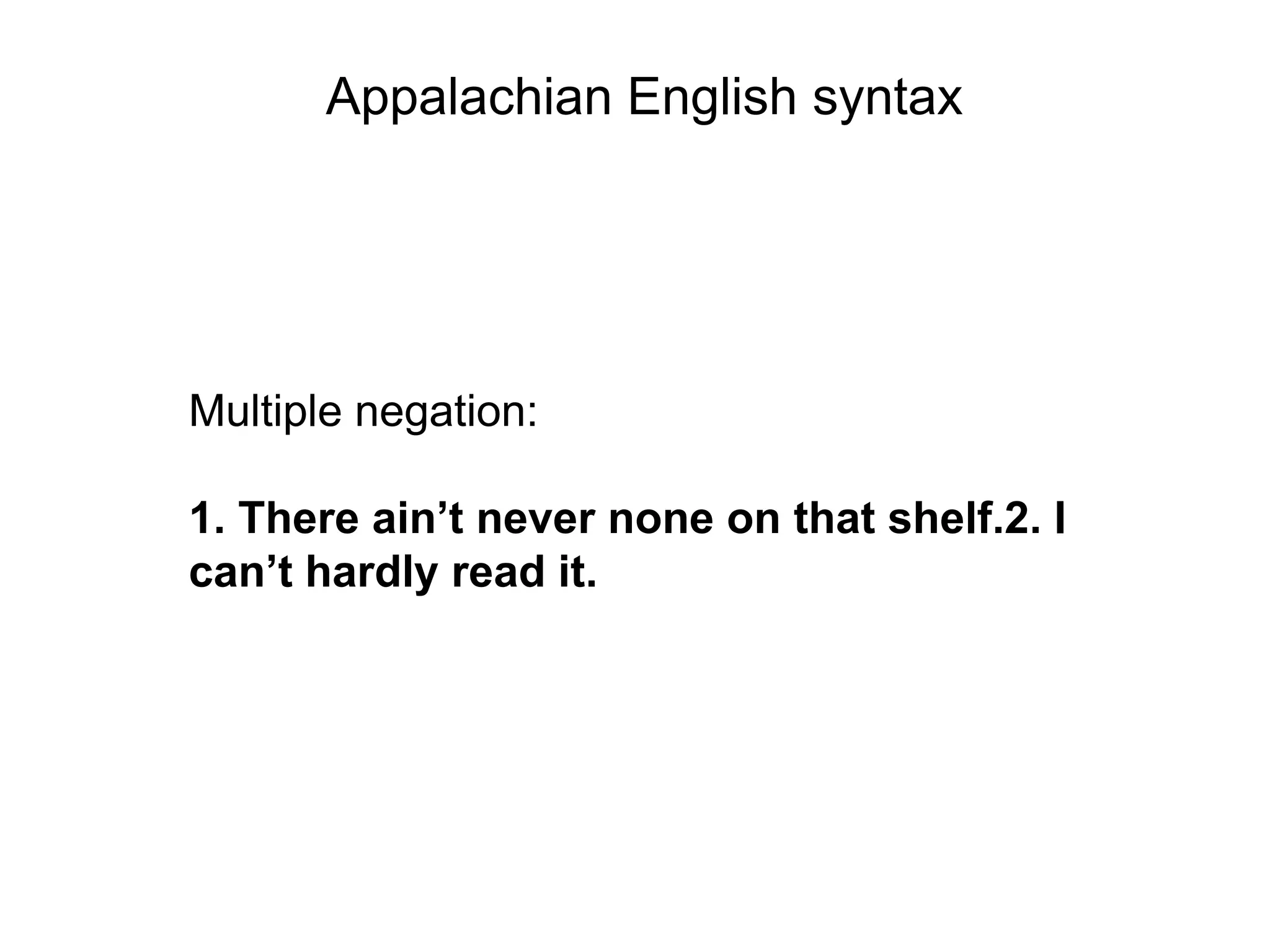
Appalachian English syntax


Multiple negation:

1. There ain’t never none on that shelf.2. I
can’t hardly read it.
Appalachian English syntax


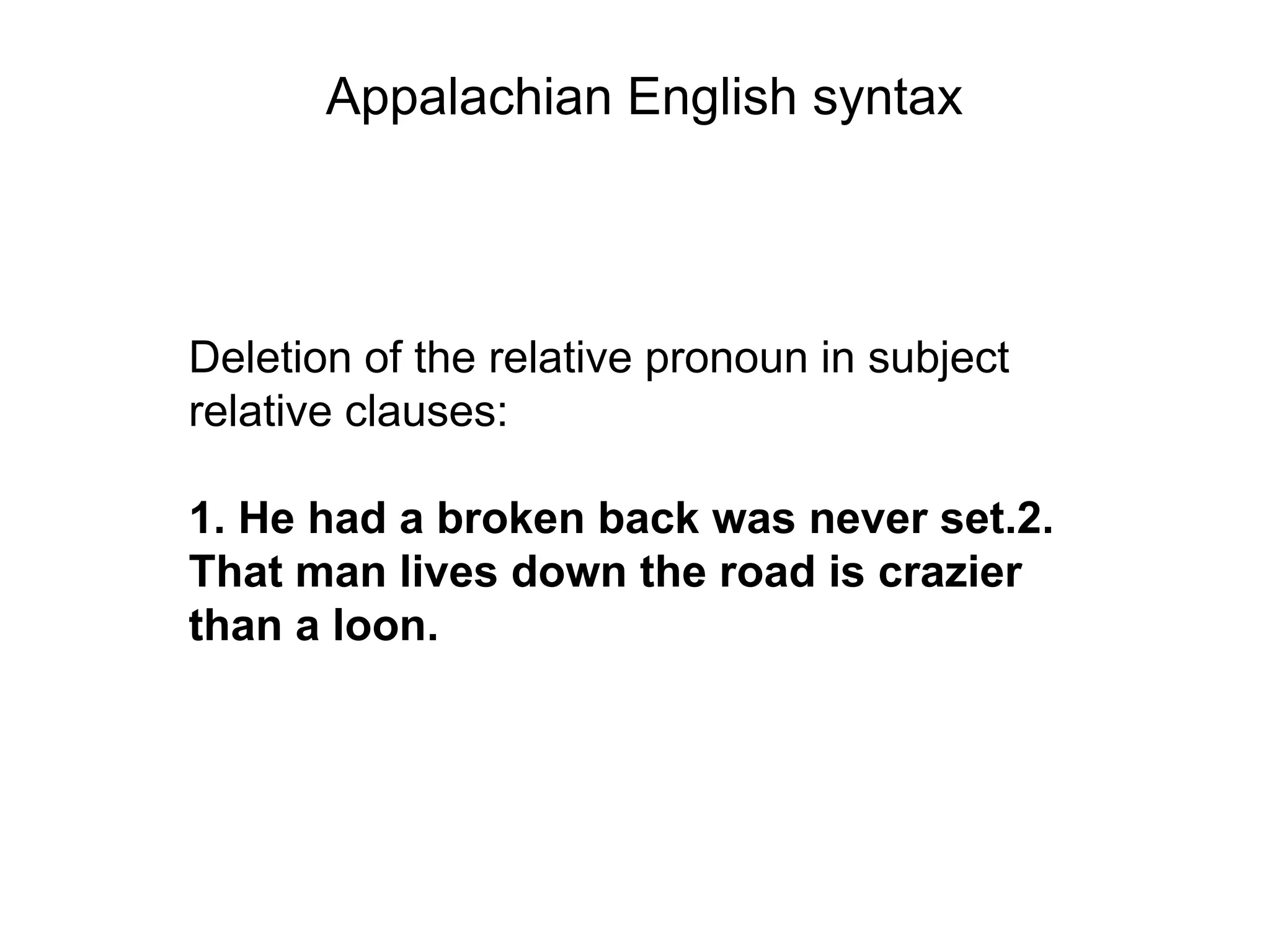
Deletion of the relative pronoun in subject
relative clauses:

1. He had a broken back was never set.2.
That man lives down the road is crazier
than a loon.
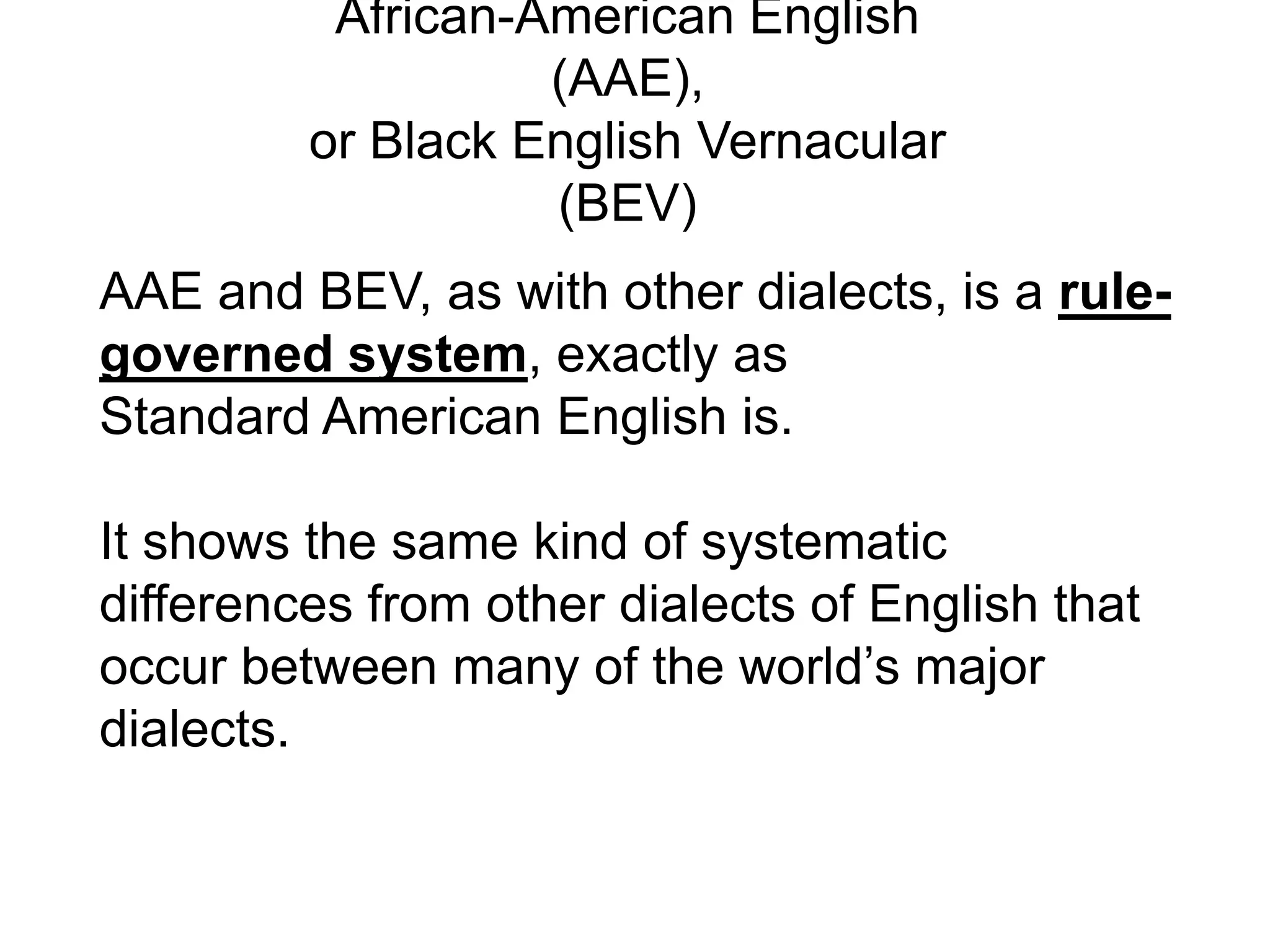
African-American English
                   (AAE),
         or Black English Vernacular
                   (BEV)
AAE and BEV, as with other dialects, is a rule-
governed system, exactly as
Standard American English is.

It shows the same kind of systematic
differences from other dialects of English that
occur between many of the world’s major
dialects.
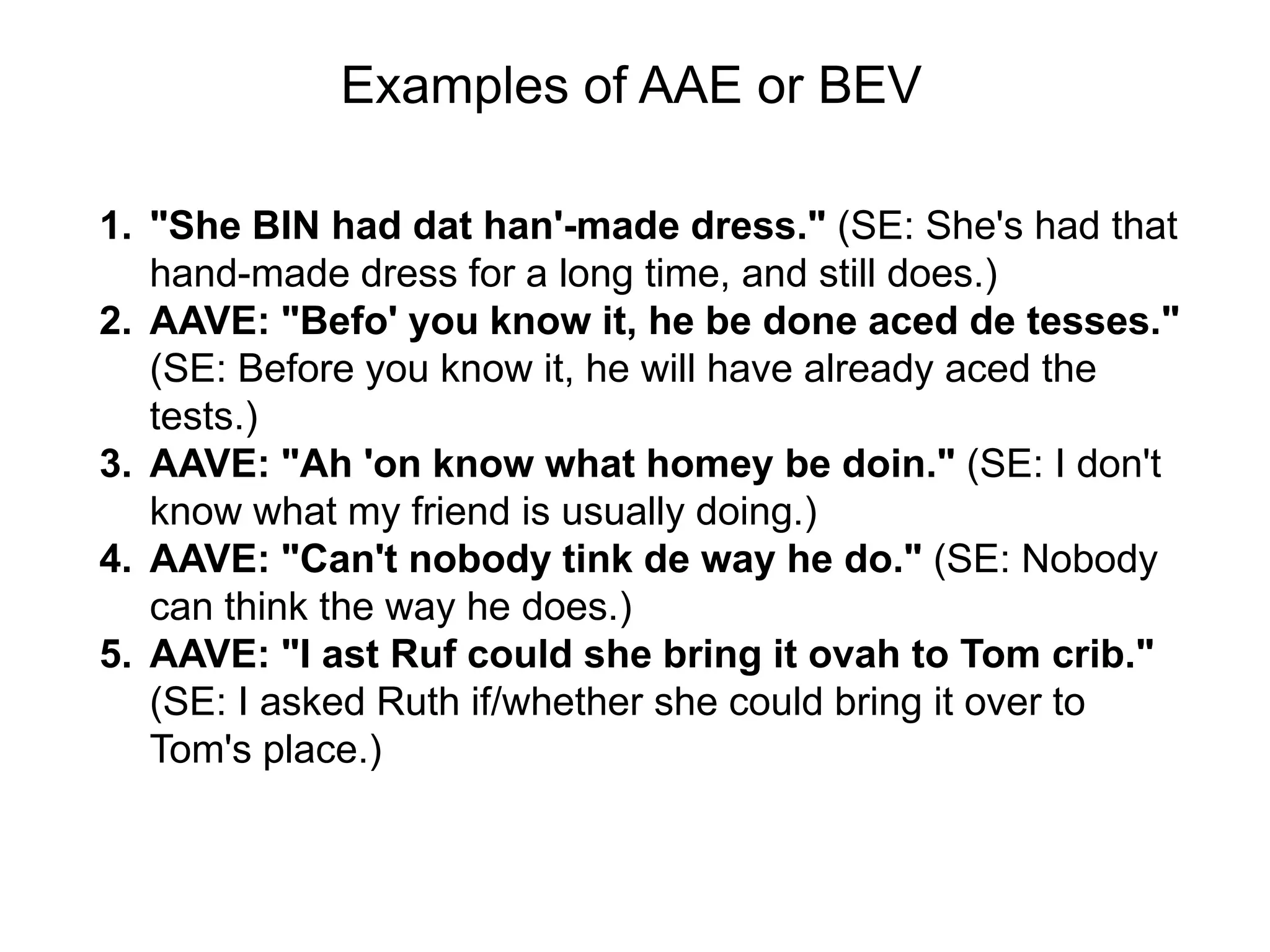
Examples of AAE or BEV

1. "She BIN had dat han'-made dress." (SE: She's had that
   hand-made dress for a long time, and still does.)
2. AAVE: "Befo' you know it, he be done aced de tesses."
   (SE: Before you know it, he will have already aced the
   tests.)
3. AAVE: "Ah 'on know what homey be doin." (SE: I don't
   know what my friend is usually doing.)
4. AAVE: "Can't nobody tink de way he do." (SE: Nobody
   can think the way he does.)
5. AAVE: "I ast Ruf could she bring it ovah to Tom crib."
   (SE: I asked Ruth if/whether she could bring it over to
   Tom's place.)
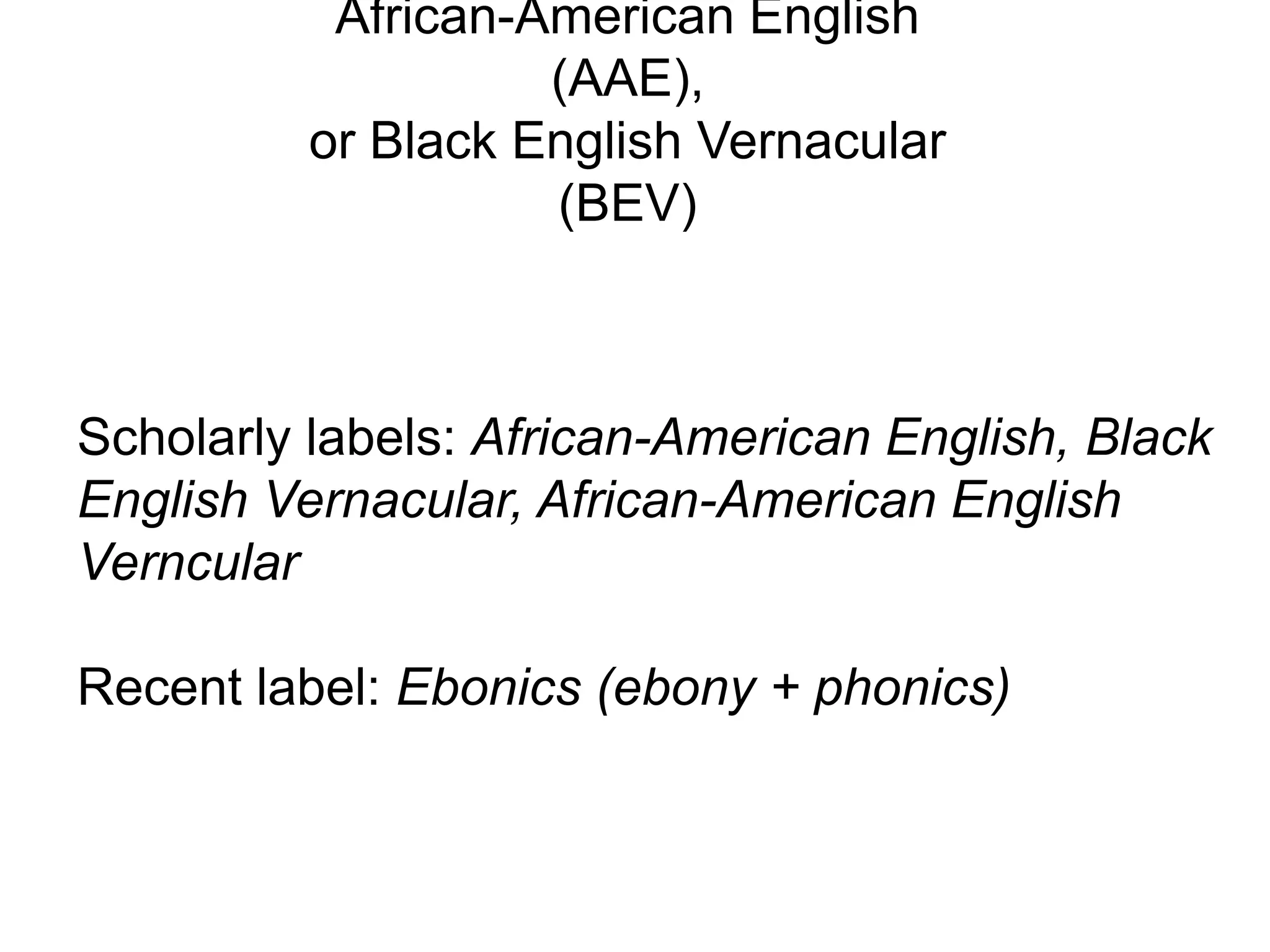
African-American English
                    (AAE),
          or Black English Vernacular
                    (BEV)


Scholarly labels: African-American English, Black
English Vernacular, African-American English
Verncular

Recent label: Ebonics (ebony + phonics)
African-American English
                    (AAE),
          or Black English Vernacular
                    (BEV)

IMPORTANT POINT:

“African-American English” is not specific to
African-Americans; it is a scholarly label that
refers to a language variation that at first was
largely shared by African-Americans historically. It
still thrive todays in many speech communities.
.
The Ebonics Controversy (1996: Oakland,
                   CA)


“Black writers from Paul Laurence Dunbar to Zora
Neale Hurston to August Wilson have made extensive
use of it in their work, and some, like James Baldwin
("this passion, this skill, ... this incredible music."), Toni
Morrison, and June Jordan have praised it explicitly.
Black preachers and comedians and singers,
especially rappers, also use it for dramatic or realistic
effect…”
The Ebonics Controversy (1996: Oakland,
                   CA)

“But many other people, black and white, regard it as a
sign of limited education or sophistication, as a legacy
of slavery or an impediment to socioeconomic mobility.
Some deny its existence. Others deprecate it (like
Maya Angelou, who found the Oakland School Board's
1996 Ebonics resolutions "very threatening" although
she uses Ebonics herself in her poems, e.g. "The
Pusher").”

                                           - John
Rickford
African-American English
                    (AAE),
          or Black English Vernacular
                    (BEV)


Possible origins:

AAE derives from language structures and
patterns of West African languages, British
languages and dialects, and Carribean
creoles
African-American English
                   (AAE),
         or Black English Vernacular
                   (BEV)


Other linguists suggest AAE was the historical
result of the creolization process (the process
of creating a new “language” from the
multigenerational contact and mixing between
two or more incompatible languages).
African-American English
                    (AAE),
          or Black English Vernacular
                    (BEV)


Whatever its possible origins, AAE has evolved
as a language variety with its own linguistically-
rich features and functions over several hundred
years.
African-American English
                   (AAE),
         or Black English Vernacular
                   (BEV)

The following examples and taxonomies are
taken from actual conversations of
individuals talking with one another in
everyday life from a variety of linguists and
folklorists for decades.
African-American English
                    (AAE),
          or Black English Vernacular
                    (BEV)


Even though the following examples include a
list of common or regular linguistic features,
some of AAE’s “rules” are variedor optional
across the United States (as all dialectal forms
vary within each speech community or within
certain regions).
African American Phonology


r-deletion is fairly common in AAE, such that
the following words would come out the same:

1. guard [pronounced “god”]
2. sore [pronounced “saw”]
African American Phonology

Some speakers also drop their [l] in coda
position:

1. toll [tow]
2. all [aw]
3. help [hep]
African American Phonology


Loss of interdental fricative [T] and [D] :

mouth [mawf]
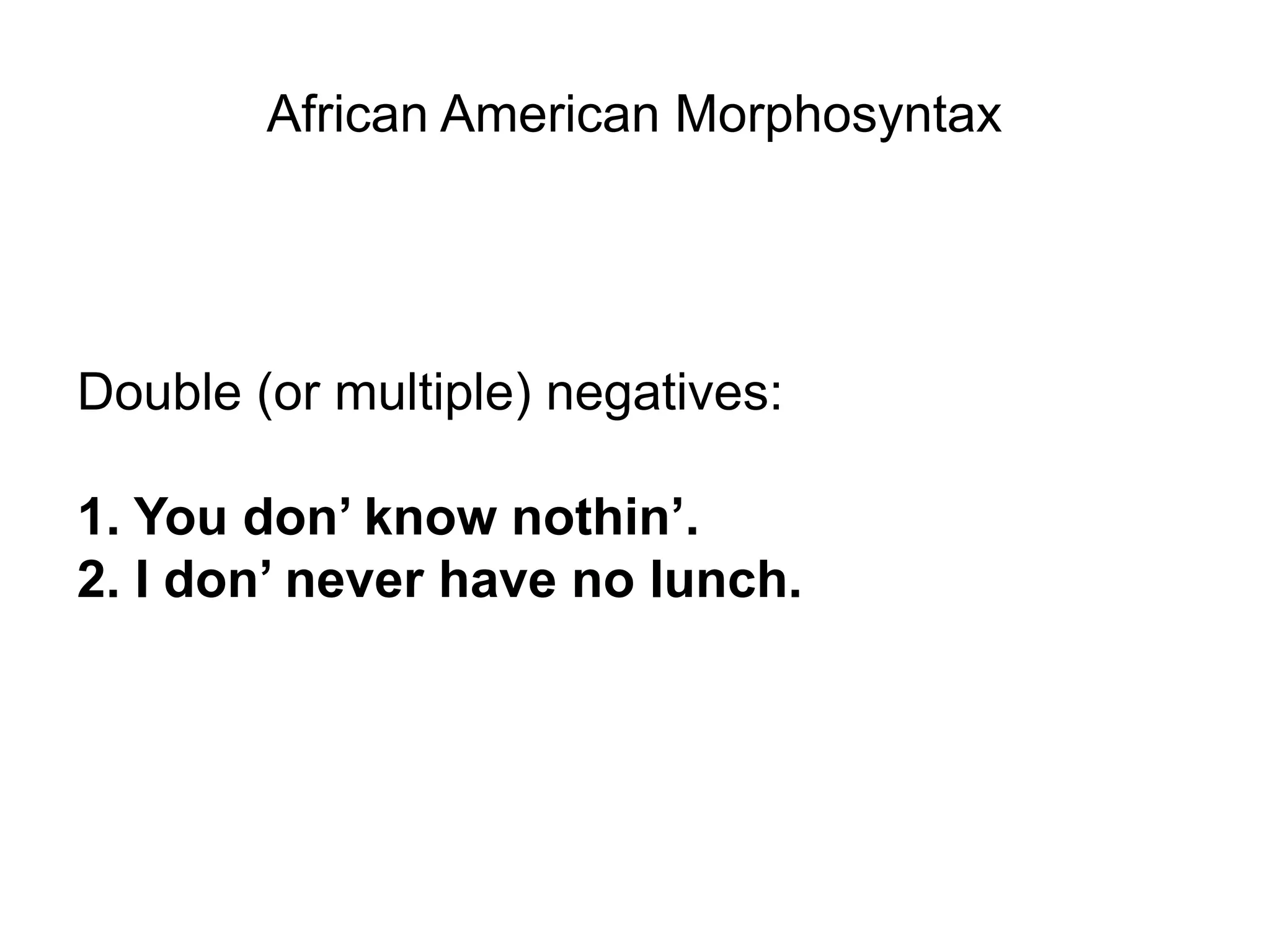
African American Morphosyntax


Double (or multiple) negatives:

1. You don’ know nothin’.
2. I don’ never have no lunch.
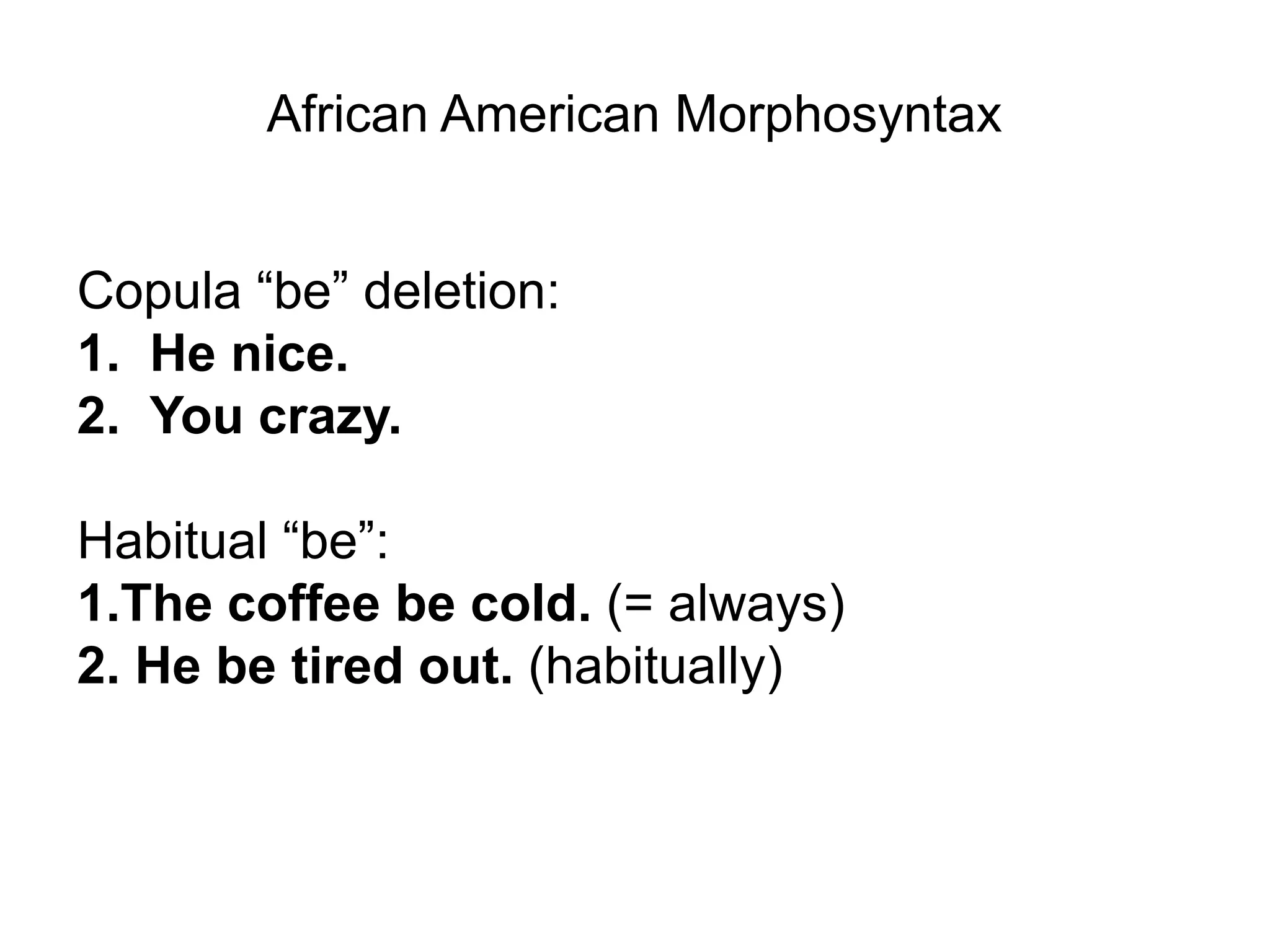
African American Morphosyntax


Copula “be” deletion:
1. He nice.
2. You crazy.

Habitual “be”:
1.The coffee be cold. (= always)
2. He be tired out. (habitually)
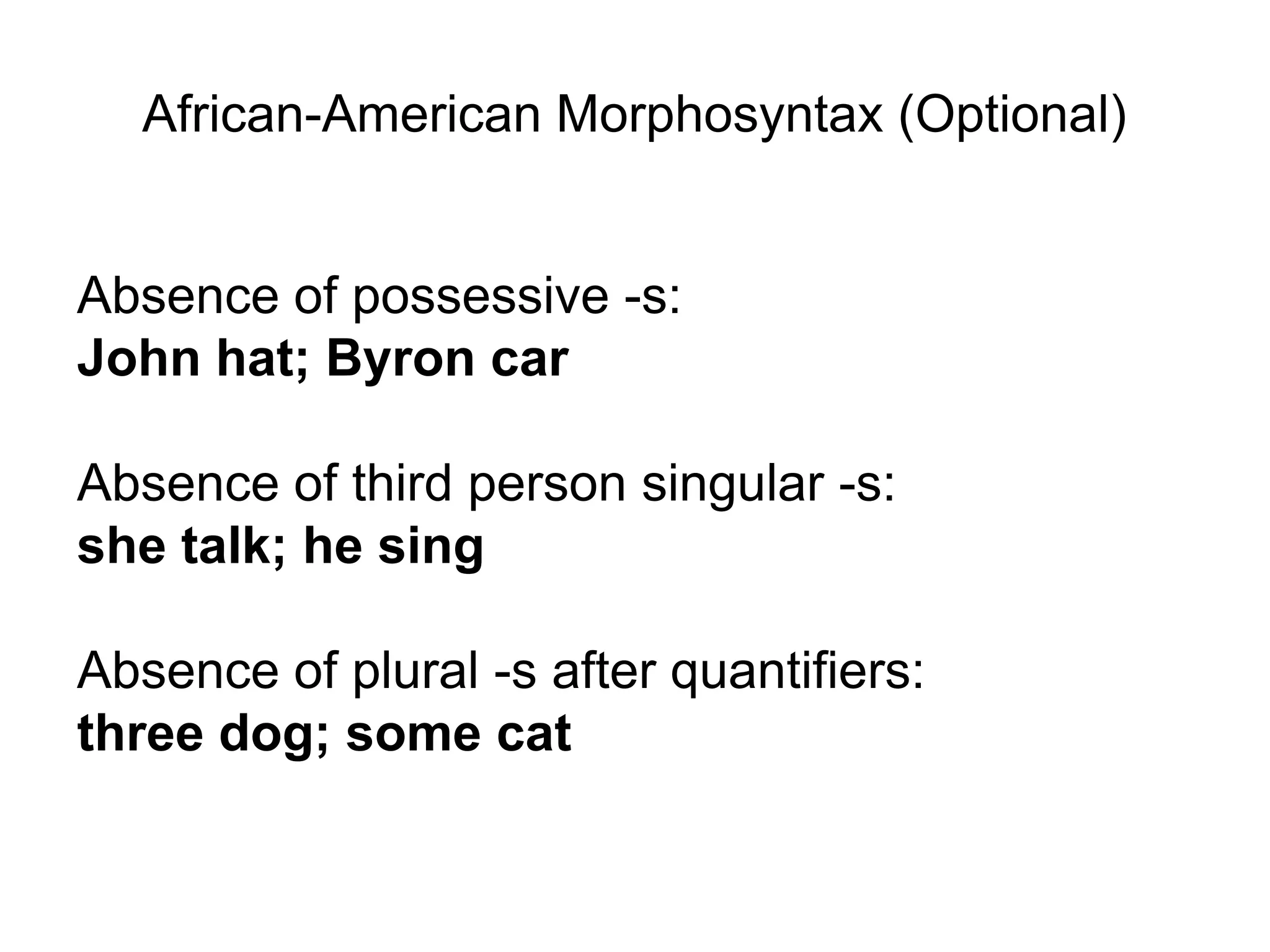
African-American Morphosyntax (Optional)


Absence of possessive -s:
John hat; Byron car

Absence of third person singular -s:
she talk; he sing

Absence of plural -s after quantifiers:
three dog; some cat
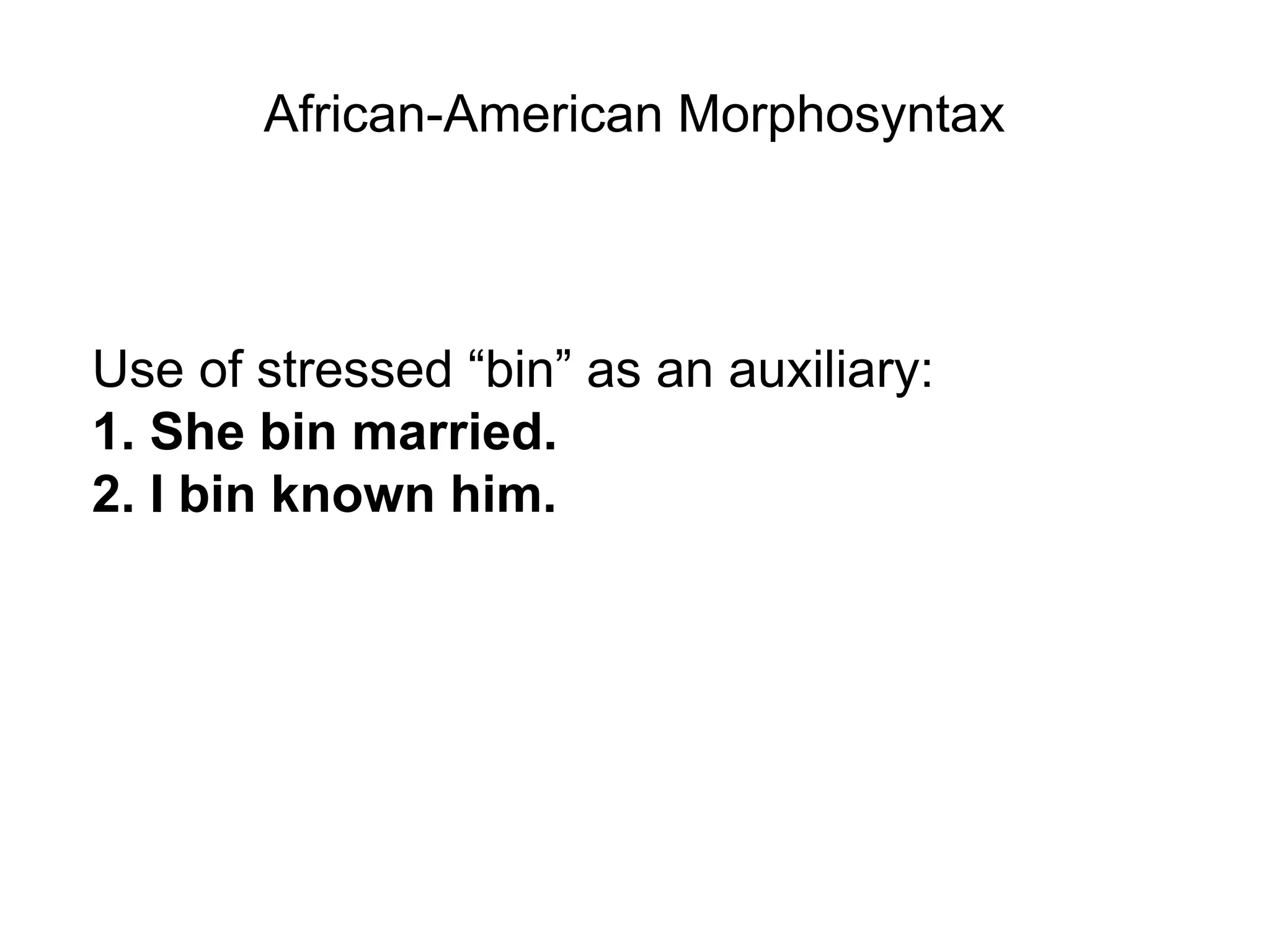
African-American Morphosyntax


Use of stressed “bin” as an auxiliary:
1. She bin married.
2. I bin known him.
AAE or BEV Is Just Another English Variety!


       Claims that AAE or BEV is
“ignorant,”“deficient,” “sloppy,” “broken
  English,” “incomplete,” “uneducated
    speech,” “illogical,” “ghetto,” or
“slang,” are incorrect from a scientific or
          linguistic perspective.
TO REPEAT…


AAE and BEV, as with other dialects, is a rule-
governed system, exactly as
Standard American English is.

It shows the same kind of systematic
differences from other dialects of English that
occur between many of the world’s major
dialects.
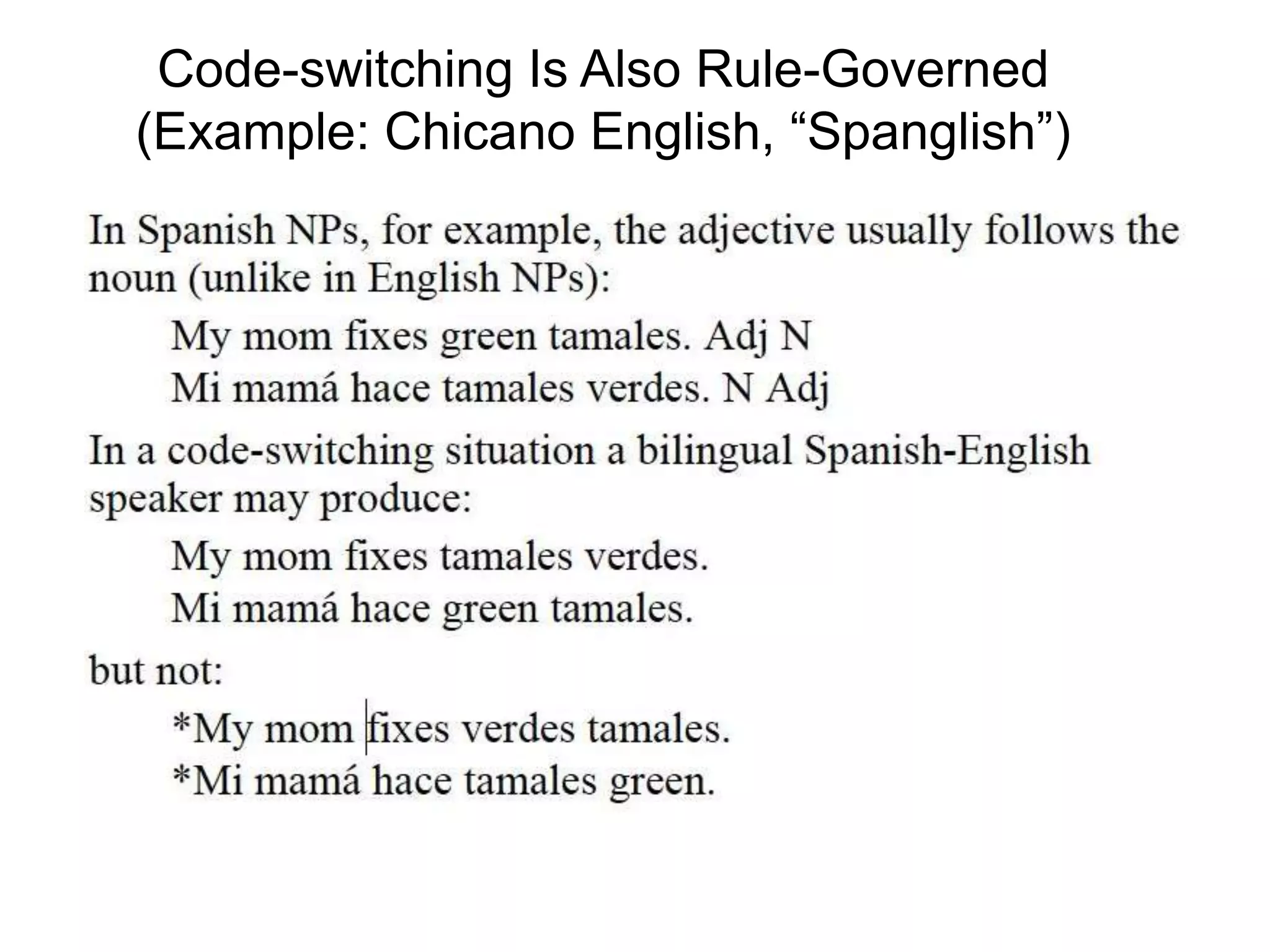
Code-switching


a speech behavior where
bilingual speakers typically
move back and forth
between two languages
Code-switching (“Spanglish”)


http://www.youtube.com/watch?v=Z13CVD0idrM
Code-switching Is Also Rule-Governed
(Example: Chicano English, “Spanglish”)
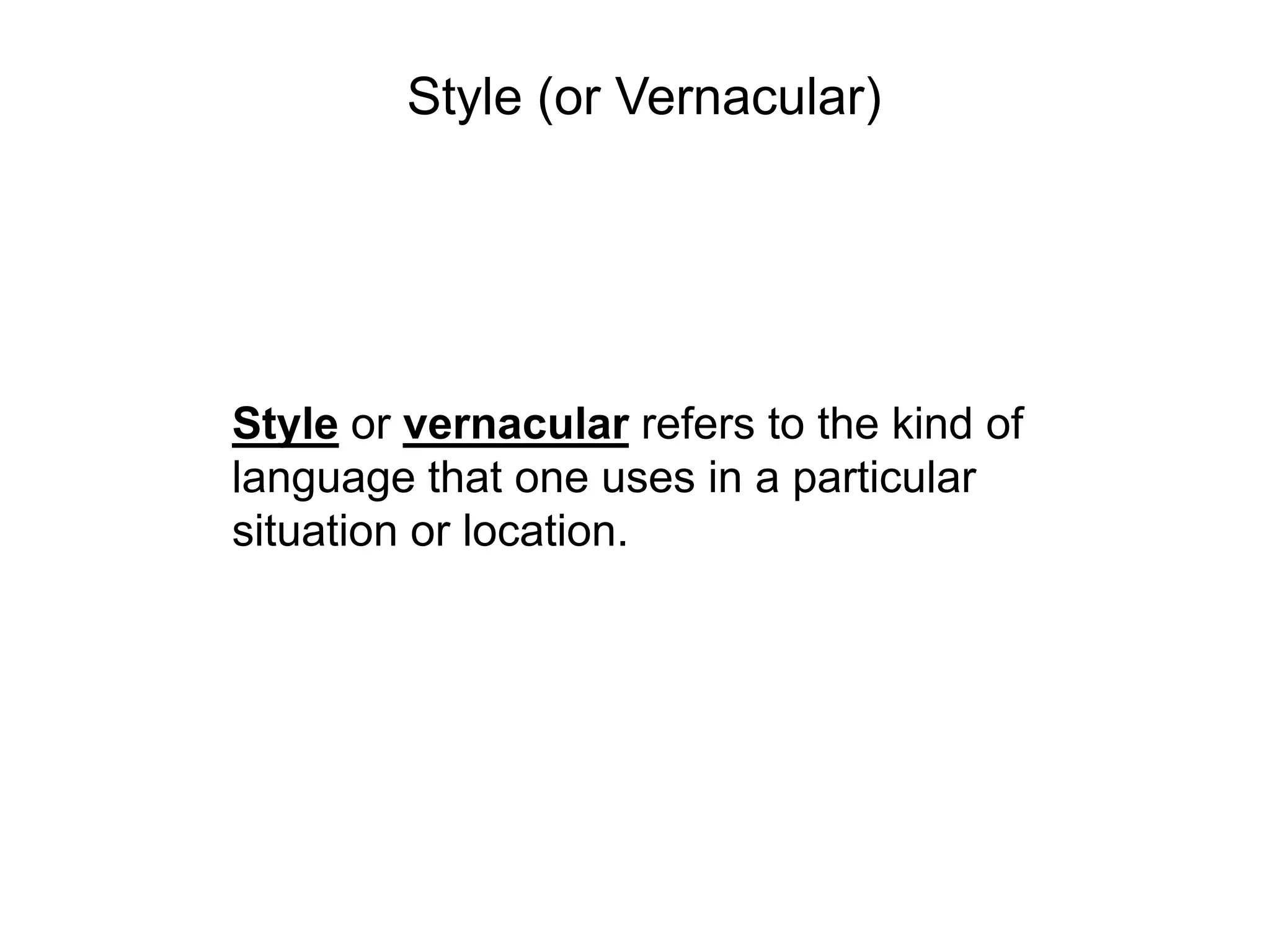
Style (or Vernacular)


Style or vernacular refers to the kind of
language that one uses in a particular
situation or location.
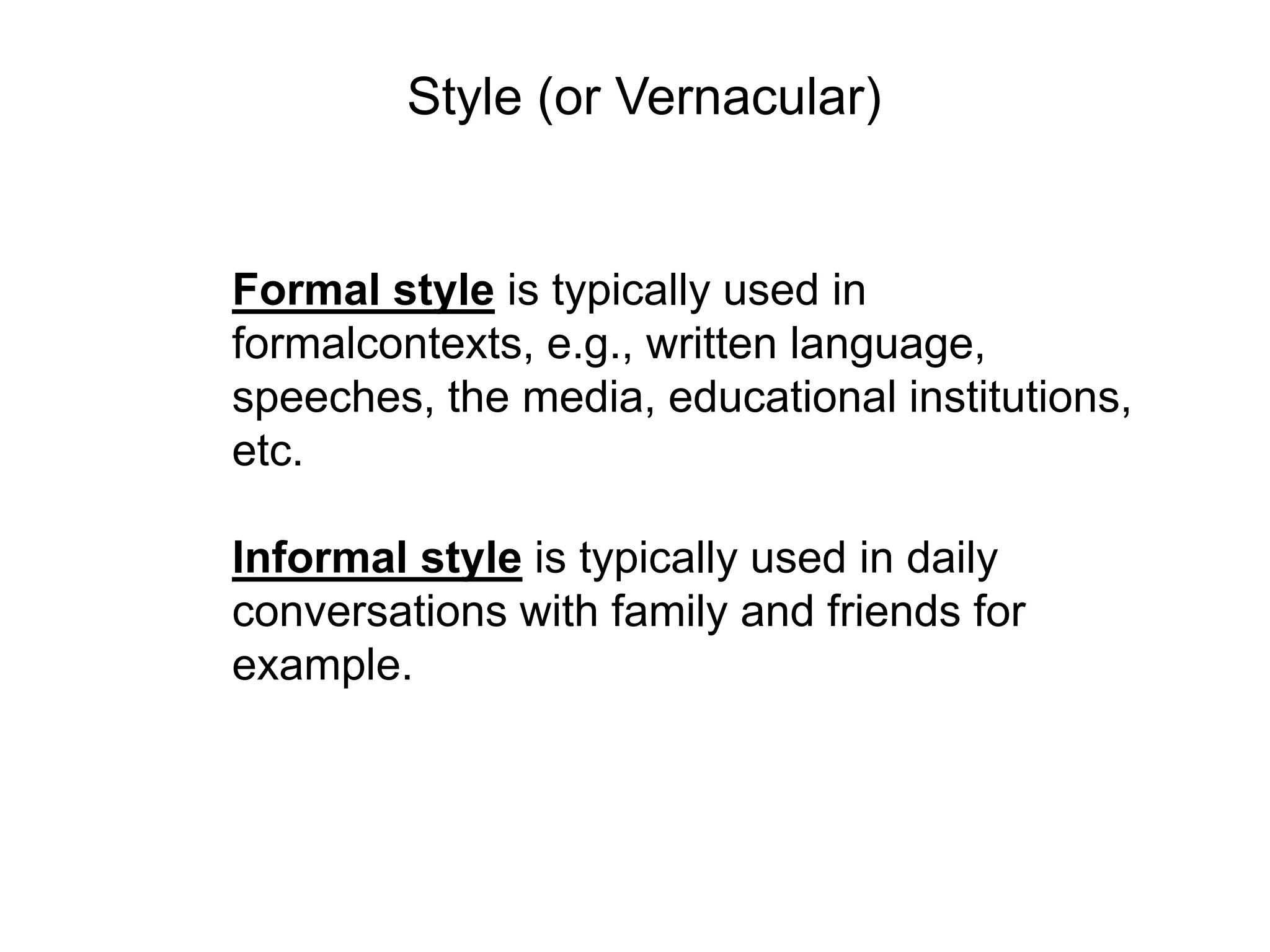
Style (or Vernacular)


Formal style is typically used in
formalcontexts, e.g., written language,
speeches, the media, educational institutions,
etc.

Informal style is typically used in daily
conversations with family and friends for
example.
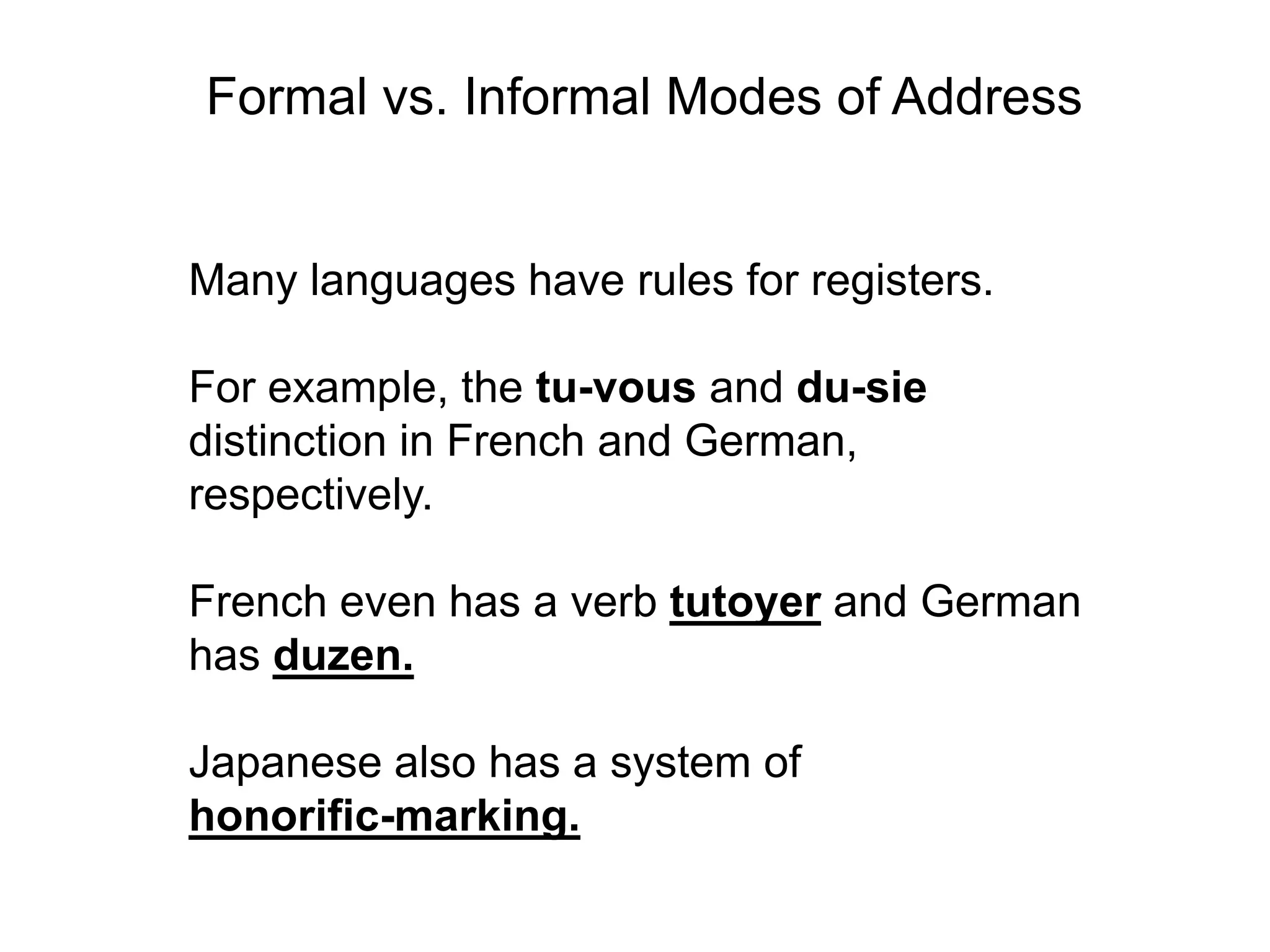
Formal vs. Informal Modes of Address


Many languages have rules for registers.

For example, the tu-vous and du-sie
distinction in French and German,
respectively.

French even has a verb tutoyer and German
has duzen.

Japanese also has a system of
honorific-marking.
Slang


Certain words used in informal styles that
change rapidly among groups (but may
eventually enter the lexicon) are called slang,
e.g.,

barf, flub, rave, ecstasy, pig, fuzz, hot dog,
TV, fan, phone, tight, clowning.
Slang


Slang is equivalent to lexical dialectal variation
(different words referring to the same object).
Slang


Some slang words originate within
underground subcultures or when we address
taboo topics:

crack (drug), sawbuck (money), to hang
paper (to write bad checks), con (to deceive
someone), brek (from breakfast), burn
(tobacco), screw (prison officer).
Jargon (or Argot)


Jargon or argot refers to the technical
language used in a particular domain.
Jargon (or Argot)


For example, in this course we have used a
lot of academic jargon, e.g., signifier,
signified, alea, ilinx, displacement, etc.
Computer jargon: PC, CPU, RAM, ROM,
modem, hacking, virus, download, etc.
The Lumbee Dialect:
          Group Reflection

Describe the lexical, phonological,
morphological, and syntactic variation
in this dialect.

http://www.youtube.com/watch?v=6cVnh
               WSMLn4
Endangered Languages: The Case of N/u

 http://hctv.humnet.ucla.edu/department
 s/linguistics/VowelsandConsonants/vo
         wels/chapter14/_xoo.html


http://hctv.humnet.ucla.edu/departments
/linguistics/VowelsandConsonants/cours
        e/chapter6/xong/!xong.html
Endangered Languages: The Case of N/u


Think about the following questions during this clip:

1. What are some of the central features of N/u?
2. How is the language perceived by insiders and
   outsiders? Why do you think this is the case?
3. How are these negative perceptions of particular
   languages found within the United States?
4. Why is this language “dying” in South Africa?
5. What are ways to revive or preserve these
   endangered languages?
Sign Languages: 8-Minutes

In groups of two, come up with a set of signs for the
following sentences. Illustrate gestures on one sheet
of paper with your names.

1.   I’m scared.
2.   You’re tall.
3.   Let’s swim.
4.   The lion is happy.
5.   Where’s the dog?
6.   How did you do that?
7.   Why do you think he got mixed up with her?
8.   What did your aunt say yesterday when you called
     her?
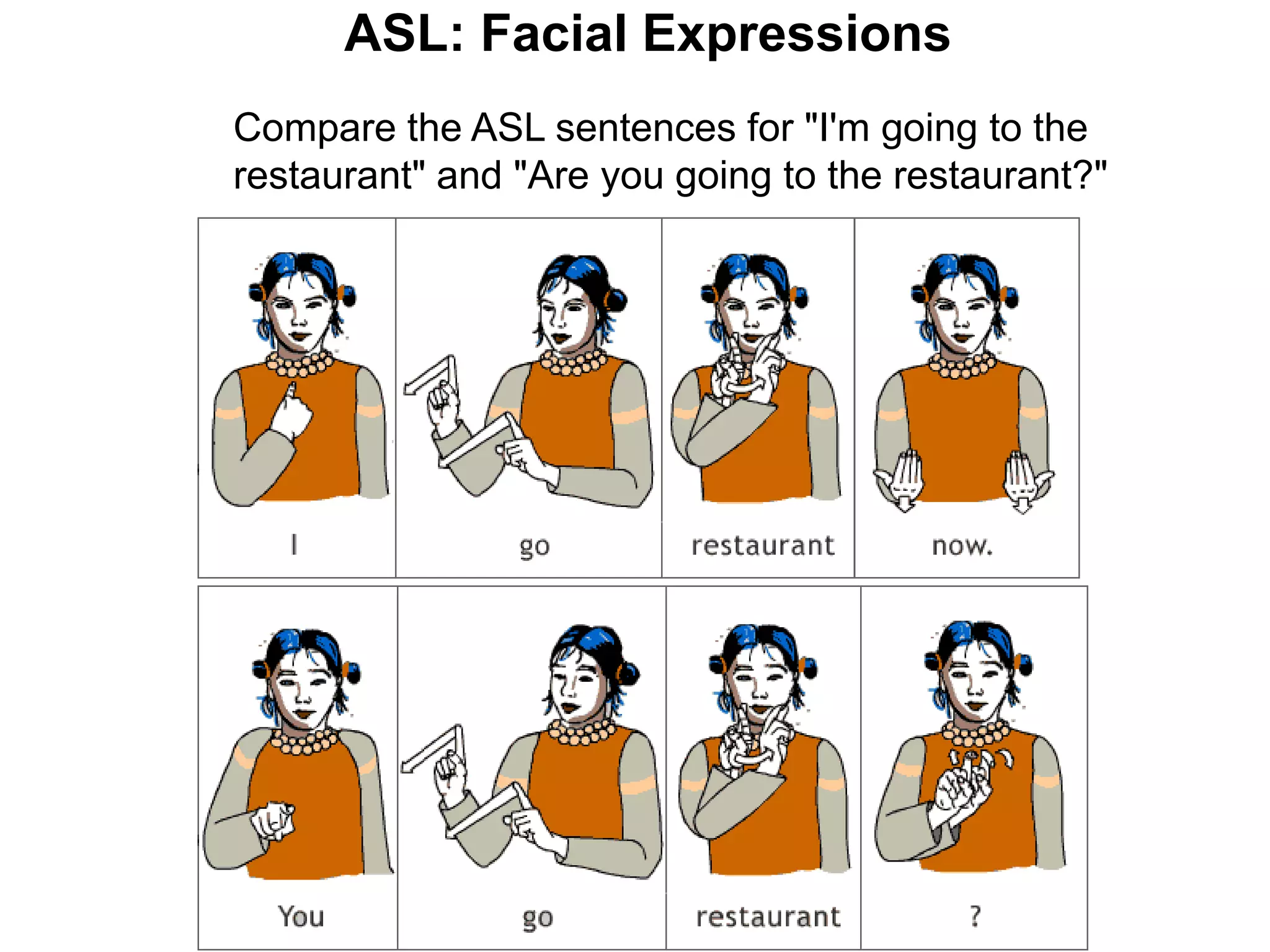
ASL: Facial Expressions
Compare the ASL sentences for "I'm going to the
restaurant" and "Are you going to the restaurant?"
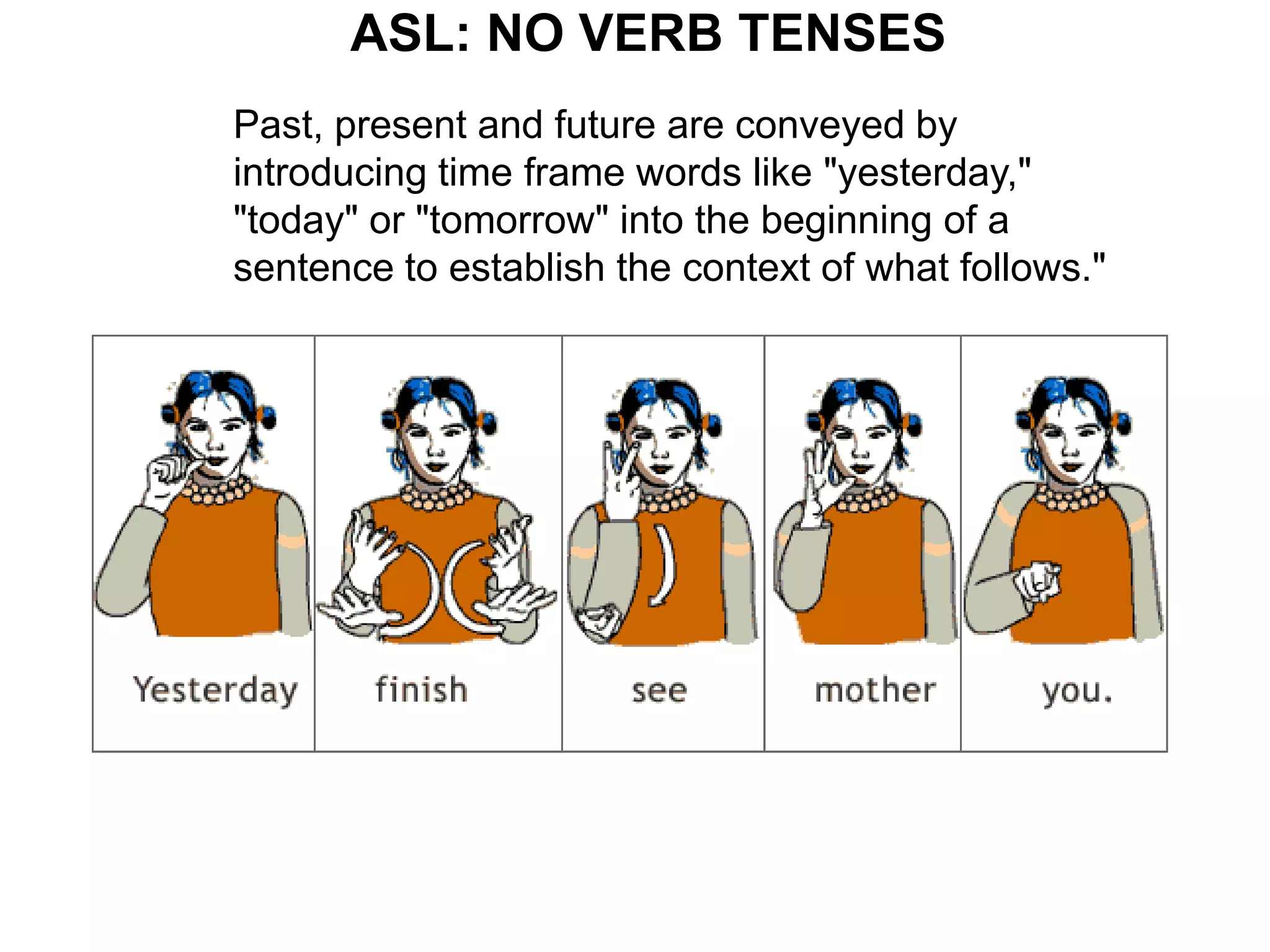
ASL: NO VERB TENSES
Past, present and future are conveyed by
introducing time frame words like "yesterday,"
"today" or "tomorrow" into the beginning of a
sentence to establish the context of what follows."
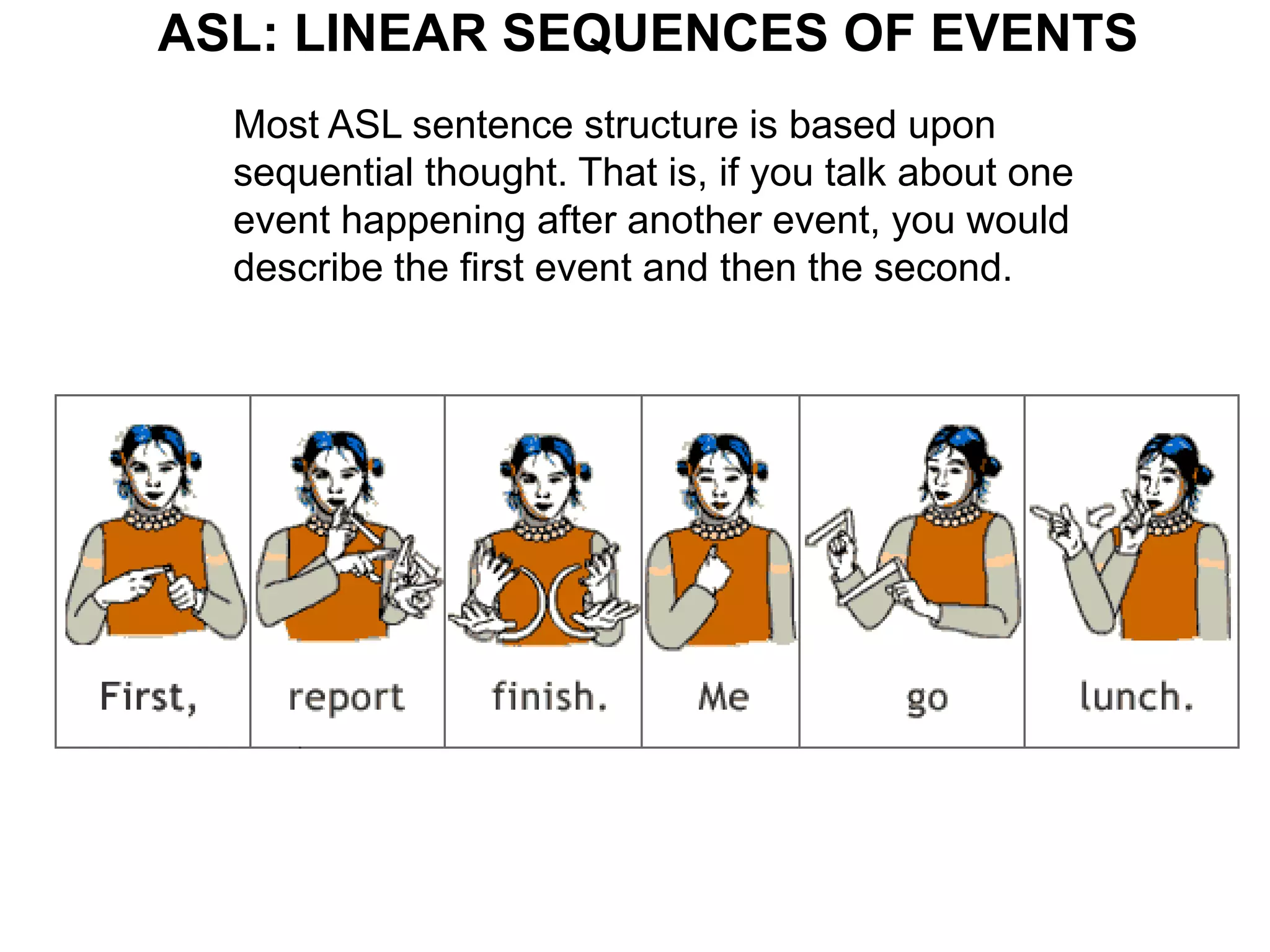
ASL: LINEAR SEQUENCES OF EVENTS
  Most ASL sentence structure is based upon
  sequential thought. That is, if you talk about one
  event happening after another event, you would
  describe the first event and then the second.
SIGN LANGUAGES: HISTORY

Charles Michel De L'Eppe (1712-1789):
Established the first free public school for the
deaf in France (1771)

Samuel Heinicke (1727-1790):         Established
the Oral method of teaching deaf children to
speak. Strongly opposed to the use of sign
language

Thomas Hopkins Gallaudet (1787-1851):
Visited Europe to study Deaf Education and
resumed to co-found the American School for
the Deaf with Laurent Clerc.
SIGN LANGUAGES: HISTORY


1690-1880: Martha's Vineyard, Massachusetts:
Settled by 200 immigrants from Kent County England,
an area known as "the Weald". Carried dominant and
recessive genes for deafness. By the mid-1700's a
sign language had developed on the island, used by
deaf and hearing islanders alike. Almost all inhabitants
signed and town meetings were signed for all.
SIGN LANGUAGES: HISTORY

1864: Gallaudet College founded
       in Washington, DC
SIGN LANGUAGES: HISTORY

1864: Gallaudet College founded
       in Washington, DC
SIGN LANGUAGES: HISTORY


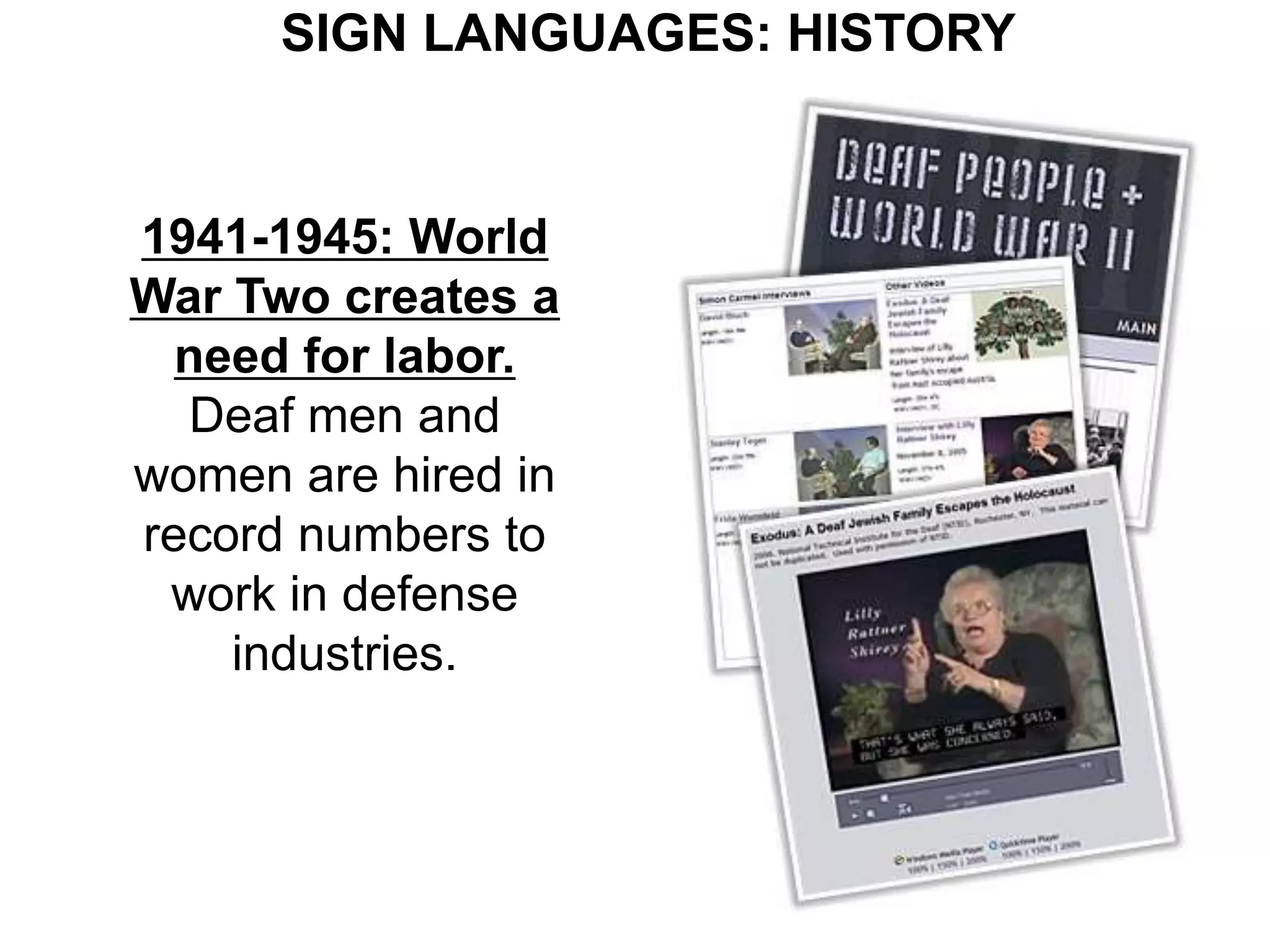
1941-1945: World
War Two creates a
  need for labor.
  Deaf men and
women are hired in
record numbers to
 work in defense
    industries.
SIGN LANGUAGES: HISTORY

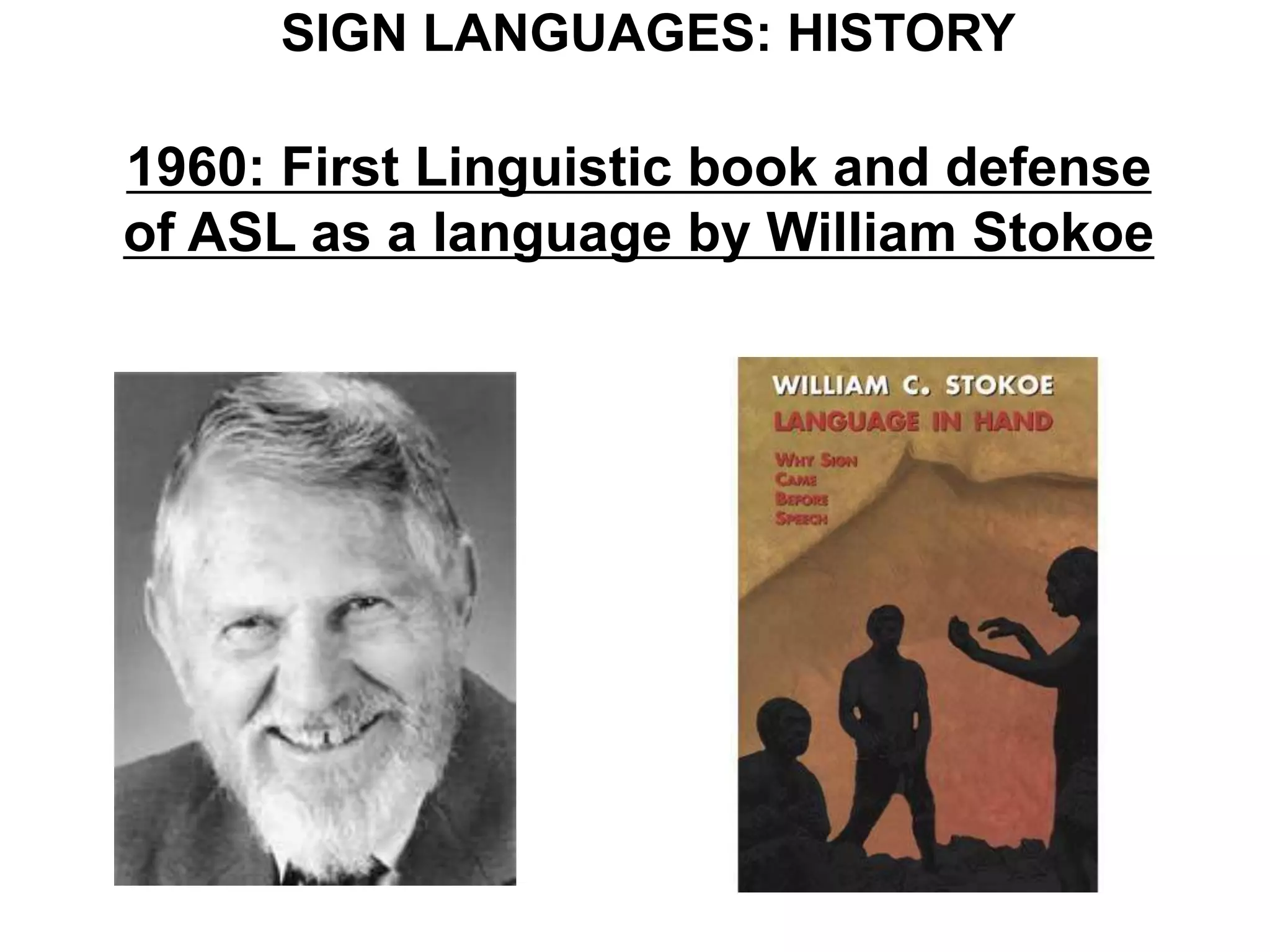
1960: First Linguistic book and defense
of ASL as a language by William Stokoe
SIGN LANGUAGES: HISTORY

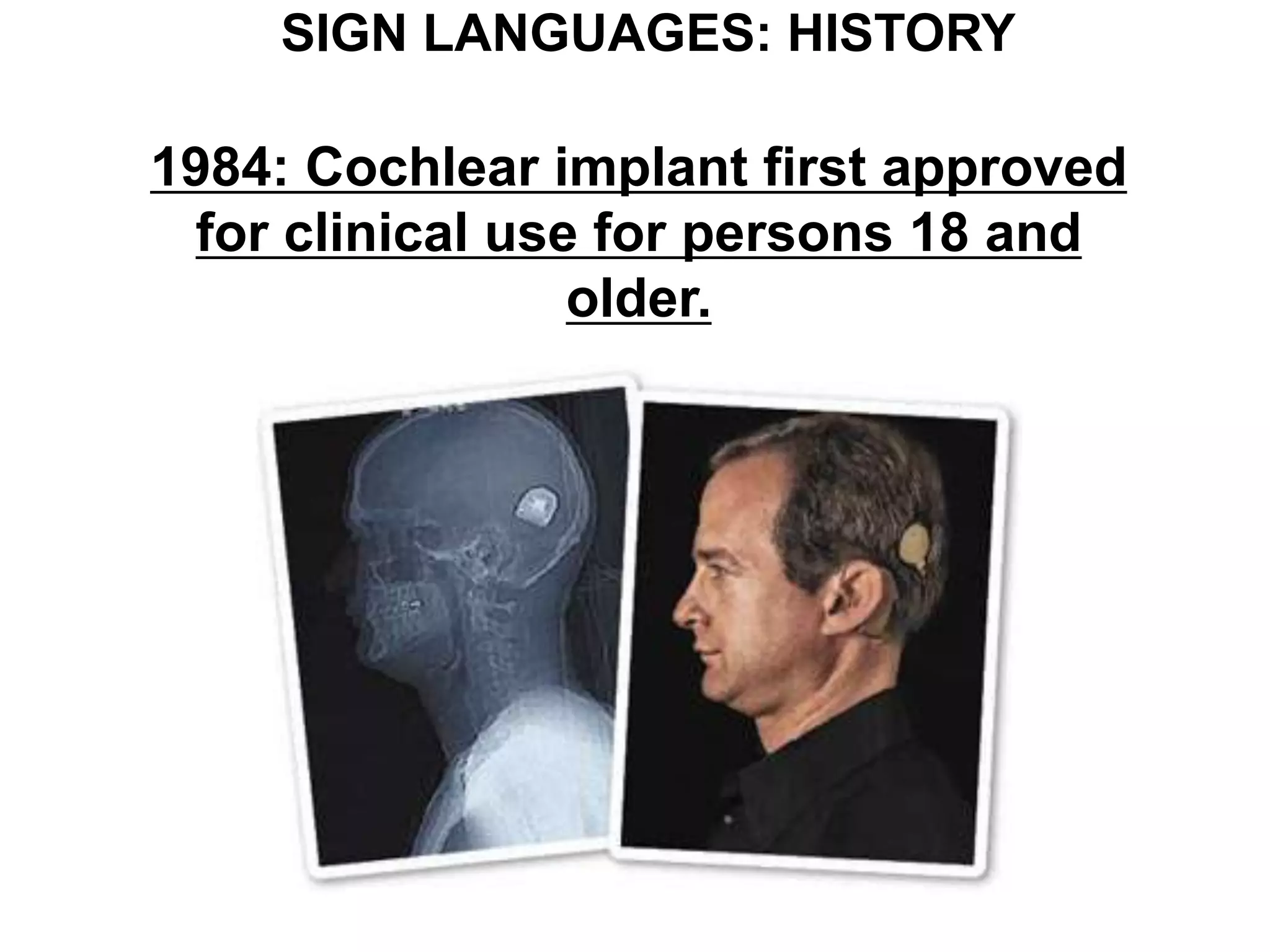
1984: Cochlear implant first approved
 for clinical use for persons 18 and
                 older.
SIGN LANGUAGES: HISTORY
    1993: Individuals with Disabilities
 Education Act (IDEA) is passed:           U.
 S. Department of Education establishes a
   Policy of Inclusion, giving all disabled
 students the right to attend neighborhood
schools in a "least restrictive environment."
SIGN LANGUAGES: HISTORY
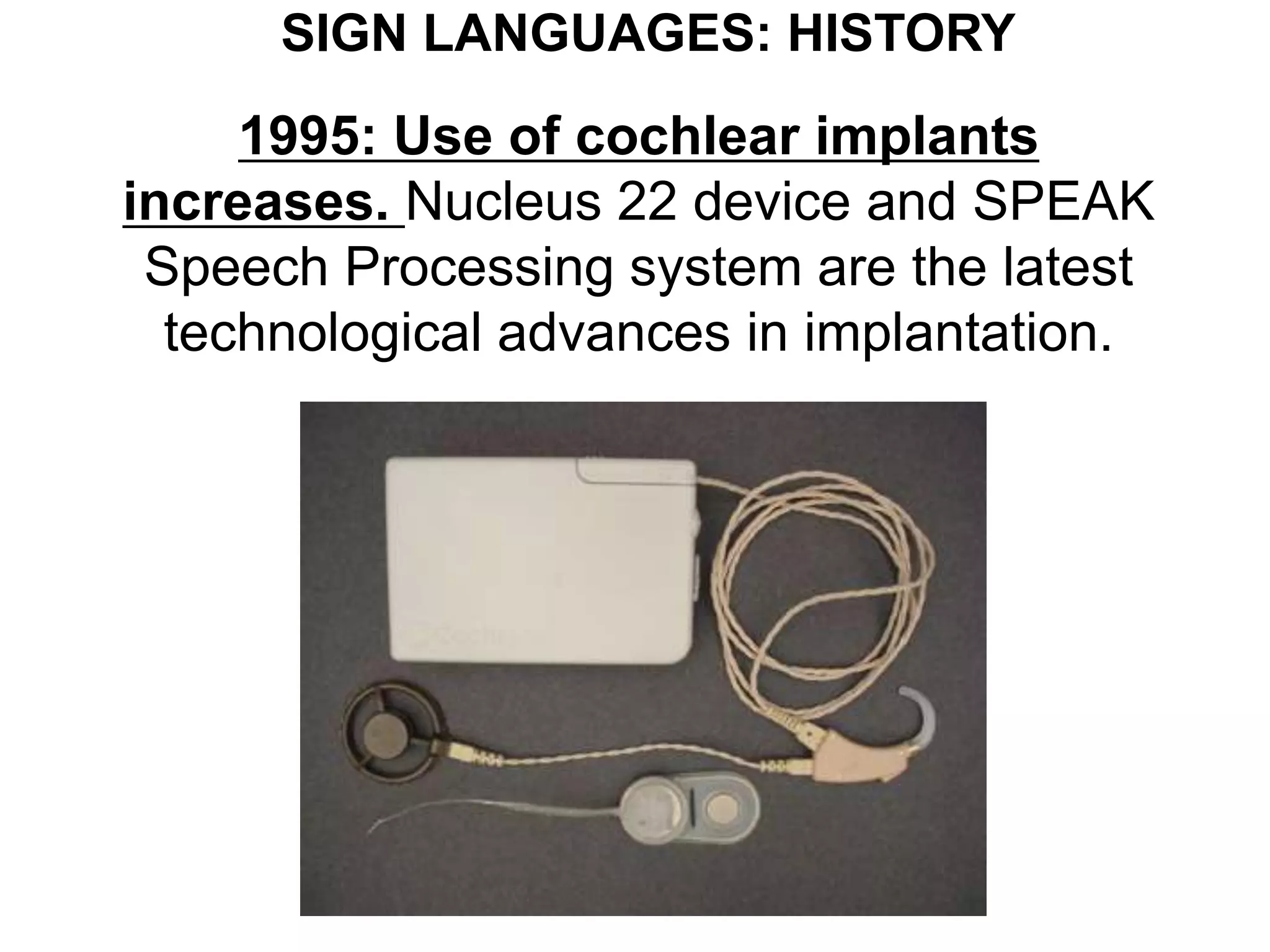
     1995: Use of cochlear implants
increases. Nucleus 22 device and SPEAK
 Speech Processing system are the latest
  technological advances in implantation.
DEAF CULTURE: QUESTIONS
                   .
1. What is “audism”?

2. How does each film represent this
   insider and outsider perspectives of
   deaf people?

3. Why did some members of the deaf
   community reject the notion of
   implants?

4. Would you give you child a cochlear
   implant if they were born deaf? Why or
   why not?
AUDISM


http://www.pbs.org/weta/throughdeafeyes/abo
             ut/filmmakers.html
SOUND AND FURY


http://www.youtube.com/w
atch?v=A61WvbVtIxE&fea
        ture=related


http://www.pbs.org/wnet/s
oundandfury/cochlear/co
     chlear_flash.html
Textual References
Abrahams, Roger D. 2009 [1964]. Deep Down in the Jungle: Black American Folklore from the Streets of Philadelphia.
New Jersey: Folklore Associates, Inc.

Baugh, John. 2000. Beyond Ebonics: Linguistic Pride and Racial Prejudice. Oxford: Oxford University Press.

Di Napoli, Lisa. 2007. Language Matters: A Guide to Everyday Questions About Language. Oxford University Press.

Green, Lisa. 2002. African American English: A Linguistic Introduction. Cambridge: Cambridge University Press.

Labov, William. 1973. Language in the Inner City: Studies in the Black English Vernacular. Philadelphia: University of
Pennsylvania Press.

Labov, William, Sharon Ash, and Charles Boberg. 2006. The Atlas of North American English. Mouton de Gruyter.

Pinker, Steven. 2007. The Language Instinct. New York: Harper Perennial Modern Classics.

Poplack, Shana, ed. 2000. The English History of African American English. Malden, MA, and Oxford, UK: Blackwell.

Rickford, John R. , and Russell J. Rickford. 2000. Spoken Soul: The Story of Black English. New York: John Wiley.

Smitherman, Geneva. 2000. Black Talk: Words and Phrases from the Hood to the Amen Corner. New York: Houghton
Mifflin.

Wolfram, Walt, and Erik R. Thomas. 2002. The Development of African American English. Malden, MA, and Oxford, UK:
Blackwell.
Internet References
Chicano English. Carmen Fought.
http://www.pbs.org/speak/seatosea/americanvarieties/chicano/

Deaf Culture. PBS.
http://www.pbs.org/wnet/soundandfury/culture/intro.html

Deaf Culture (Timeline).
http://www.aslinfo.com/trivia2.cfm

Ebonics Notes and Discussion. John Rickford.
http://www.stanford.edu/~rickford/ebonics/EbonicsExamples.html

The Features of Human Language. Charles Hockett.
http://people.exeter.ac.uk/bosthaus/Lecture/hockett1.htm

History through Deaf Eyes. Gallaudet
University.http://my.gallaudet.edu/bbcswebdav/institution/Deaf%20Eyes%20Exhibit/index.htm

Language and Linguistics: A Special Report. National Science Foundation.
http://www.nsf.gov/news/special_reports/linguistics/intro.jsp

Lumbee English.
http://www.learnnc.org/lp/multimedia/10157

Rickford, John, “What is Ebonics (African-American Vernacular English)?:
http://www.lsadc.org/info/ling-faqs-ebonics.cfm

“Saving Dying Languages,” Scientific American. W. Wayne Gibbs. 2002..http://www.language-
archives.org/documents/sciam.pdf

What is Appalachian English?
http://www9.georgetown.edu/faculty/zanuttir/Appalachian%20project/whatis.html

Hum1 podcast-week8-f11-language-online

  • 1.
    The Art &Science of Speaking: Languages, Dialects, and Vernaculars
  • 2.
  • 3.
    a distinctive featureof the human mind
  • 4.
    a system weuse to convey information
  • 5.
    a biological toolthat enables humans to communicate
  • 6.
    a mental constructwith rules and organizing principles
  • 7.
  • 8.
  • 9.
    Language Game 1 Constructa dialogue where each person is limited to one sentence, and each sentence must be a question.
  • 10.
    Language Game 2 Constructa dialogue where each person is limited to one sentence (question- answer format), and each sentence must begin with a successive letter.
  • 11.
    Language Game 3 Constructa dialogue where one person creates a line in Gibberish (random sounds) and the other person translates that line in English.
  • 12.
    Differences between humansand animals? 1. Vocal tract 2. Duality of patterning 3. Displacement 4. Open-endedness 5. Stimulus-freedom 6. Arbitrariness 7. FOXP2 Gene
  • 13.
    Team Quiz 1. Gatherin groups of four (find your respective card). 2. As a group, create one closed question and one open question on a separate sheet of paper with your names listed. 3. You have 5 minutes. REVIEW MATERIAL: Features of language (duality of patterning, displacement, open-endedness, stimulus-freedom, arbitrariness , etc.) Types of consonants and vowels Anatomy of language Sample film clip
  • 14.
    “Mother” and “father”words French 1. mère 1. père Welsh 2. mam 2. tad Turkish 3. ana 3. baba Hebrew 4. ima 4. aba Russian 5. mat 5. otyets Mongolian 6. eme 6. echige Crow Indian 7. masake 7. birupxe
  • 15.
  • 16.
    Human Vocal Tract Anelaborated language requires a highly sophisticated speech organ that will enable the speaker to produce the many differentiated sounds. Only humans are endowed with a speech organ of this complexity.
  • 17.
  • 22.
    Duality of patterning Becauseof the restricted capacity of our vocal tracts, we use a limited set of speech sounds (e.g., consonants and vowels, sometimes called phonemes). We can assemble and reassemble these sounds into larger units (“words”, “sentences,” “stories,” etc.). Thus our capacity to produce new vocabulary is infinite and unlimited.
  • 32.
    Displacement In contrast toother animals, humans have a sense of the past and the future. A gorilla, for example, cannot tell his fellows about his parents, his adventures in the jungle, or his experience of the past.
  • 33.
    Displacement The use oflanguage to talk about things other than "the here and now", is a characteristic of humans.
  • 34.
    Displacement . Displacement is ourability to convey a meaning that transcends the immediately perceptible sphere of space and time.
  • 35.
    Displacement EXAMPLES 1. I wasin Paris last week. 2. I want to be an astronomer when I grow up.
  • 36.
  • 37.
    Displacement Although some animalsseem to possess abilities approximating those of displacement, they lack the freedom to apply this to new contexts.
  • 38.
    Displacement The dance ofthe honey-bee, for instance, indicates the locations of rich deposits of food to other bees.
  • 39.
    Displacement The bee frequentlyrepeats the same patterns in its dance, whereas humans are able to invent ever new contexts.
  • 40.
    Open-endedness The ability tosay things that have never been said before, including the possibility to express invented things or lies, is also a peculiar feature of human language.
  • 41.
    Stimulus-freedom Humans have theability to say anything they like in any context.
  • 42.
    Stimulus-freedom This ability isonly restricted in certain ceremonial contexts such as church services, etc., where a fixed form is expected to be followed.
  • 43.
    Stimulus-freedom For example, thehoney-bee must perform its dance, the woodchuck must cry out in order to warn his fellows when it beholds an eagle.
  • 44.
    Arbitrariness Why is atable called "table” in English"? Why is the same object called “la mesa” in Spanish? Obviously, the thing never told us its name. And tables do not make a noise similar to the word. The same applies to most of the words of our language.
  • 45.
    Arbitrariness Language is notsimply motivated by its sound structure. In other words, we cannot tell from the sound structure which meaning is behind it. Hence, words and their meanings have no a prioriconnection (from theoretical deduction).
  • 46.
    Arbitrariness There are, however,exceptions to this rule: language can beiconic, which means that there is a direct correlation between form and meaning.
  • 47.
    Arbitrariness The length ofa phrase, for example, could represent a length of time the phrase refers to, like in “a long, long time ago.” Here, the extension serves to visually represent the semantic emphasis. Iconicity in language can be found frequently.
  • 48.
    Arbitrariness Another example fornonarbitrariness are onomatopoeia. These are words that seem to resemble sounds. There are many examples for onomatopoetic words, like splashor bang.
  • 49.
    Arbitrariness Another example fornonarbitrariness are Some names for animals are also onomatopoetic, for example, cuckoo. Still, since animals such as the bird are named differently in different languages, there can be no ultimate motivation for the name.
  • 50.
  • 55.
    The Field ofLinguistics 1. Phonetics 2. Phonology 3. Syntax 4. Morphology 5. Semantics 6. Pragmatics
  • 56.
  • 57.
    Nicaraguan Sign-Language: A Caseof Linguistic Creativity
  • 58.
    Language and Dialects 1.What do you think the differences are between a language and a dialect? 2. Give examples of each (teach each other three examples). Write on an index card.
  • 59.
    The Study ofLanguage 1. Where did you grow up? 2. How many languages do you speak? 3. Teach each other a word, phrase, or sentence in another language or regional form. 4. Write on an index card your group partner’s responses.
  • 60.
    Language Dialect Dialect Dialect Language Language Language
  • 61.
    dialect: a variation ofa particular language
  • 62.
    “A language isa dialect with an army.”
  • 63.
  • 64.
    The Language-Dialect Distinction 1.Folklorists and sociolinguists focus on linguistic diversity internal tospeech communities.
  • 65.
    The Language-Dialect Distinction 2.One such case of linguistic diversity is dialectal variation.
  • 66.
    The Language-Dialect Distinction 3.Most dialects are considered mutually intelligible varieties of a language that differ in systematic ways.
  • 67.
    The Language-Dialect Distinction So,if one of you grew up in New England and another one was born and raised in Georgia, you’re still able to understand one another, despite differences in the language variety each of you speaks.
  • 68.
    The Language-Dialect Distinction Wesay you both speak two dialects of the same language, that is, English.
  • 69.
    The Language-Dialect Distinction EXAMPLE Think of the recent evolving of “Serbian”,“Croatian”, and “Bosnian” languages in the former Yugoslavia.
  • 70.
    The Language-Dialect Distinction Priorto the disintegration of former Yugoslavia, people in this part of the world all spoke something they called “Serbo-Croatian.”
  • 71.
    The Language-Dialect Distinction Today,they still speak the same thing, but it’s not called Serbo-Croatian any more. It’s Serbian, Croatian, or Bosnian, depending on where you live.
  • 72.
    The Language-Dialect Distinction Folkloristsand sociolinguists focus on linguistic diversity internal tospeech communities.
  • 73.
    The Language-Dialect Distinction Wesay you both speak two dialects of the same language, that is, English.
  • 74.
  • 75.
    Idiolect An idiolect isan individual’s unique way of speech. Since no two people speak in the same way, we say that each one of them has an idiolect.
  • 76.
    Accent An accent isa person’s distinctive way of pronouncing words, which is typically associated with a particular region, e.g., a Boston accent, a Brooklyn accent, or a British accent. It is also often used for the pronunciation of non-natives speaking a foreign language.
  • 77.
    Lexical dialectal variation Ifyou ask for a tonic in Boston, you will get a drink called soda or soda-pop in LA; and a freeway in LA is a thruway in NY, a parkway in New Jersey, a motorway in England, and an expressway or turnpike in other dialect areas.
  • 78.
    Dialect: Examples REPEAT: Pahk thecah in Hahvuhd yahd. WHAT DOES THIS MEAN?
  • 79.
    Phonological dialectal variation Speakingof pronunciation, how do you say: 1. “caught” and “cot”? 2. “Will Mary marry in a merry wedding?” 3. Otter Creek? (a [krik] or a [krIk])
  • 80.
    Morphological dialectal variation Inparts of Northern England and South Wales, the morpheme -s is not just a third person singular marker in present tense, but a general present tense marker: 1. I likes him. 2. We goes.
  • 81.
    Syntactic dialectal variation EXAMPLE:She done already told you. 1. Can you use “done” as an auxiliary? 2. What dialect is this? What does it mean?
  • 82.
  • 83.
    Appalachian English syntax AEmakes use of double modals: 1. I might could make one up. 2. I useta couldn’t count.
  • 84.
    Appalachian English syntax Multiplenegation: 1. There ain’t never none on that shelf.2. I can’t hardly read it.
  • 85.
    Appalachian English syntax Deletionof the relative pronoun in subject relative clauses: 1. He had a broken back was never set.2. That man lives down the road is crazier than a loon.
  • 86.
    African-American English (AAE), or Black English Vernacular (BEV) AAE and BEV, as with other dialects, is a rule- governed system, exactly as Standard American English is. It shows the same kind of systematic differences from other dialects of English that occur between many of the world’s major dialects.
  • 87.
    Examples of AAEor BEV 1. "She BIN had dat han'-made dress." (SE: She's had that hand-made dress for a long time, and still does.) 2. AAVE: "Befo' you know it, he be done aced de tesses." (SE: Before you know it, he will have already aced the tests.) 3. AAVE: "Ah 'on know what homey be doin." (SE: I don't know what my friend is usually doing.) 4. AAVE: "Can't nobody tink de way he do." (SE: Nobody can think the way he does.) 5. AAVE: "I ast Ruf could she bring it ovah to Tom crib." (SE: I asked Ruth if/whether she could bring it over to Tom's place.)
  • 88.
    African-American English (AAE), or Black English Vernacular (BEV) Scholarly labels: African-American English, Black English Vernacular, African-American English Verncular Recent label: Ebonics (ebony + phonics)
  • 89.
    African-American English (AAE), or Black English Vernacular (BEV) IMPORTANT POINT: “African-American English” is not specific to African-Americans; it is a scholarly label that refers to a language variation that at first was largely shared by African-Americans historically. It still thrive todays in many speech communities. .
  • 90.
    The Ebonics Controversy(1996: Oakland, CA) “Black writers from Paul Laurence Dunbar to Zora Neale Hurston to August Wilson have made extensive use of it in their work, and some, like James Baldwin ("this passion, this skill, ... this incredible music."), Toni Morrison, and June Jordan have praised it explicitly. Black preachers and comedians and singers, especially rappers, also use it for dramatic or realistic effect…”
  • 91.
    The Ebonics Controversy(1996: Oakland, CA) “But many other people, black and white, regard it as a sign of limited education or sophistication, as a legacy of slavery or an impediment to socioeconomic mobility. Some deny its existence. Others deprecate it (like Maya Angelou, who found the Oakland School Board's 1996 Ebonics resolutions "very threatening" although she uses Ebonics herself in her poems, e.g. "The Pusher").” - John Rickford
  • 92.
    African-American English (AAE), or Black English Vernacular (BEV) Possible origins: AAE derives from language structures and patterns of West African languages, British languages and dialects, and Carribean creoles
  • 93.
    African-American English (AAE), or Black English Vernacular (BEV) Other linguists suggest AAE was the historical result of the creolization process (the process of creating a new “language” from the multigenerational contact and mixing between two or more incompatible languages).
  • 94.
    African-American English (AAE), or Black English Vernacular (BEV) Whatever its possible origins, AAE has evolved as a language variety with its own linguistically- rich features and functions over several hundred years.
  • 95.
    African-American English (AAE), or Black English Vernacular (BEV) The following examples and taxonomies are taken from actual conversations of individuals talking with one another in everyday life from a variety of linguists and folklorists for decades.
  • 96.
    African-American English (AAE), or Black English Vernacular (BEV) Even though the following examples include a list of common or regular linguistic features, some of AAE’s “rules” are variedor optional across the United States (as all dialectal forms vary within each speech community or within certain regions).
  • 97.
    African American Phonology r-deletionis fairly common in AAE, such that the following words would come out the same: 1. guard [pronounced “god”] 2. sore [pronounced “saw”]
  • 98.
    African American Phonology Somespeakers also drop their [l] in coda position: 1. toll [tow] 2. all [aw] 3. help [hep]
  • 99.
    African American Phonology Lossof interdental fricative [T] and [D] : mouth [mawf]
  • 100.
    African American Morphosyntax Double(or multiple) negatives: 1. You don’ know nothin’. 2. I don’ never have no lunch.
  • 101.
    African American Morphosyntax Copula“be” deletion: 1. He nice. 2. You crazy. Habitual “be”: 1.The coffee be cold. (= always) 2. He be tired out. (habitually)
  • 102.
    African-American Morphosyntax (Optional) Absenceof possessive -s: John hat; Byron car Absence of third person singular -s: she talk; he sing Absence of plural -s after quantifiers: three dog; some cat
  • 103.
    African-American Morphosyntax Use ofstressed “bin” as an auxiliary: 1. She bin married. 2. I bin known him.
  • 104.
    AAE or BEVIs Just Another English Variety! Claims that AAE or BEV is “ignorant,”“deficient,” “sloppy,” “broken English,” “incomplete,” “uneducated speech,” “illogical,” “ghetto,” or “slang,” are incorrect from a scientific or linguistic perspective.
  • 105.
    TO REPEAT… AAE andBEV, as with other dialects, is a rule- governed system, exactly as Standard American English is. It shows the same kind of systematic differences from other dialects of English that occur between many of the world’s major dialects.
  • 106.
    Code-switching a speech behaviorwhere bilingual speakers typically move back and forth between two languages
  • 107.
  • 108.
    Code-switching Is AlsoRule-Governed (Example: Chicano English, “Spanglish”)
  • 109.
    Style (or Vernacular) Styleor vernacular refers to the kind of language that one uses in a particular situation or location.
  • 110.
    Style (or Vernacular) Formalstyle is typically used in formalcontexts, e.g., written language, speeches, the media, educational institutions, etc. Informal style is typically used in daily conversations with family and friends for example.
  • 111.
    Formal vs. InformalModes of Address Many languages have rules for registers. For example, the tu-vous and du-sie distinction in French and German, respectively. French even has a verb tutoyer and German has duzen. Japanese also has a system of honorific-marking.
  • 112.
    Slang Certain words usedin informal styles that change rapidly among groups (but may eventually enter the lexicon) are called slang, e.g., barf, flub, rave, ecstasy, pig, fuzz, hot dog, TV, fan, phone, tight, clowning.
  • 113.
    Slang Slang is equivalentto lexical dialectal variation (different words referring to the same object).
  • 114.
    Slang Some slang wordsoriginate within underground subcultures or when we address taboo topics: crack (drug), sawbuck (money), to hang paper (to write bad checks), con (to deceive someone), brek (from breakfast), burn (tobacco), screw (prison officer).
  • 115.
    Jargon (or Argot) Jargonor argot refers to the technical language used in a particular domain.
  • 116.
    Jargon (or Argot) Forexample, in this course we have used a lot of academic jargon, e.g., signifier, signified, alea, ilinx, displacement, etc. Computer jargon: PC, CPU, RAM, ROM, modem, hacking, virus, download, etc.
  • 117.
    The Lumbee Dialect: Group Reflection Describe the lexical, phonological, morphological, and syntactic variation in this dialect. http://www.youtube.com/watch?v=6cVnh WSMLn4
  • 118.
    Endangered Languages: TheCase of N/u http://hctv.humnet.ucla.edu/department s/linguistics/VowelsandConsonants/vo wels/chapter14/_xoo.html http://hctv.humnet.ucla.edu/departments /linguistics/VowelsandConsonants/cours e/chapter6/xong/!xong.html
  • 119.
    Endangered Languages: TheCase of N/u Think about the following questions during this clip: 1. What are some of the central features of N/u? 2. How is the language perceived by insiders and outsiders? Why do you think this is the case? 3. How are these negative perceptions of particular languages found within the United States? 4. Why is this language “dying” in South Africa? 5. What are ways to revive or preserve these endangered languages?
  • 120.
    Sign Languages: 8-Minutes Ingroups of two, come up with a set of signs for the following sentences. Illustrate gestures on one sheet of paper with your names. 1. I’m scared. 2. You’re tall. 3. Let’s swim. 4. The lion is happy. 5. Where’s the dog? 6. How did you do that? 7. Why do you think he got mixed up with her? 8. What did your aunt say yesterday when you called her?
  • 121.
    ASL: Facial Expressions Comparethe ASL sentences for "I'm going to the restaurant" and "Are you going to the restaurant?"
  • 122.
    ASL: NO VERBTENSES Past, present and future are conveyed by introducing time frame words like "yesterday," "today" or "tomorrow" into the beginning of a sentence to establish the context of what follows."
  • 123.
    ASL: LINEAR SEQUENCESOF EVENTS Most ASL sentence structure is based upon sequential thought. That is, if you talk about one event happening after another event, you would describe the first event and then the second.
  • 124.
    SIGN LANGUAGES: HISTORY CharlesMichel De L'Eppe (1712-1789): Established the first free public school for the deaf in France (1771) Samuel Heinicke (1727-1790): Established the Oral method of teaching deaf children to speak. Strongly opposed to the use of sign language Thomas Hopkins Gallaudet (1787-1851): Visited Europe to study Deaf Education and resumed to co-found the American School for the Deaf with Laurent Clerc.
  • 125.
    SIGN LANGUAGES: HISTORY 1690-1880:Martha's Vineyard, Massachusetts: Settled by 200 immigrants from Kent County England, an area known as "the Weald". Carried dominant and recessive genes for deafness. By the mid-1700's a sign language had developed on the island, used by deaf and hearing islanders alike. Almost all inhabitants signed and town meetings were signed for all.
  • 126.
    SIGN LANGUAGES: HISTORY 1864:Gallaudet College founded in Washington, DC
  • 127.
    SIGN LANGUAGES: HISTORY 1864:Gallaudet College founded in Washington, DC
  • 128.
    SIGN LANGUAGES: HISTORY 1941-1945:World War Two creates a need for labor. Deaf men and women are hired in record numbers to work in defense industries.
  • 129.
    SIGN LANGUAGES: HISTORY 1960:First Linguistic book and defense of ASL as a language by William Stokoe
  • 130.
    SIGN LANGUAGES: HISTORY 1984:Cochlear implant first approved for clinical use for persons 18 and older.
  • 132.
    SIGN LANGUAGES: HISTORY 1993: Individuals with Disabilities Education Act (IDEA) is passed: U. S. Department of Education establishes a Policy of Inclusion, giving all disabled students the right to attend neighborhood schools in a "least restrictive environment."
  • 133.
    SIGN LANGUAGES: HISTORY 1995: Use of cochlear implants increases. Nucleus 22 device and SPEAK Speech Processing system are the latest technological advances in implantation.
  • 134.
    DEAF CULTURE: QUESTIONS . 1. What is “audism”? 2. How does each film represent this insider and outsider perspectives of deaf people? 3. Why did some members of the deaf community reject the notion of implants? 4. Would you give you child a cochlear implant if they were born deaf? Why or why not?
  • 135.
  • 136.
    SOUND AND FURY http://www.youtube.com/w atch?v=A61WvbVtIxE&fea ture=related http://www.pbs.org/wnet/s oundandfury/cochlear/co chlear_flash.html
  • 137.
    Textual References Abrahams, RogerD. 2009 [1964]. Deep Down in the Jungle: Black American Folklore from the Streets of Philadelphia. New Jersey: Folklore Associates, Inc. Baugh, John. 2000. Beyond Ebonics: Linguistic Pride and Racial Prejudice. Oxford: Oxford University Press. Di Napoli, Lisa. 2007. Language Matters: A Guide to Everyday Questions About Language. Oxford University Press. Green, Lisa. 2002. African American English: A Linguistic Introduction. Cambridge: Cambridge University Press. Labov, William. 1973. Language in the Inner City: Studies in the Black English Vernacular. Philadelphia: University of Pennsylvania Press. Labov, William, Sharon Ash, and Charles Boberg. 2006. The Atlas of North American English. Mouton de Gruyter. Pinker, Steven. 2007. The Language Instinct. New York: Harper Perennial Modern Classics. Poplack, Shana, ed. 2000. The English History of African American English. Malden, MA, and Oxford, UK: Blackwell. Rickford, John R. , and Russell J. Rickford. 2000. Spoken Soul: The Story of Black English. New York: John Wiley. Smitherman, Geneva. 2000. Black Talk: Words and Phrases from the Hood to the Amen Corner. New York: Houghton Mifflin. Wolfram, Walt, and Erik R. Thomas. 2002. The Development of African American English. Malden, MA, and Oxford, UK: Blackwell.
  • 138.
    Internet References Chicano English.Carmen Fought. http://www.pbs.org/speak/seatosea/americanvarieties/chicano/ Deaf Culture. PBS. http://www.pbs.org/wnet/soundandfury/culture/intro.html Deaf Culture (Timeline). http://www.aslinfo.com/trivia2.cfm Ebonics Notes and Discussion. John Rickford. http://www.stanford.edu/~rickford/ebonics/EbonicsExamples.html The Features of Human Language. Charles Hockett. http://people.exeter.ac.uk/bosthaus/Lecture/hockett1.htm History through Deaf Eyes. Gallaudet University.http://my.gallaudet.edu/bbcswebdav/institution/Deaf%20Eyes%20Exhibit/index.htm Language and Linguistics: A Special Report. National Science Foundation. http://www.nsf.gov/news/special_reports/linguistics/intro.jsp Lumbee English. http://www.learnnc.org/lp/multimedia/10157 Rickford, John, “What is Ebonics (African-American Vernacular English)?: http://www.lsadc.org/info/ling-faqs-ebonics.cfm “Saving Dying Languages,” Scientific American. W. Wayne Gibbs. 2002..http://www.language- archives.org/documents/sciam.pdf What is Appalachian English? http://www9.georgetown.edu/faculty/zanuttir/Appalachian%20project/whatis.html

Editor's Notes

  • #34 Black preachers and comedians and singers, especially rappers, also use it for dramatic or realistic effect. But many other people, black and white, regard it as a sign of limited education or sophistication, as a legacy of slavery or an impediment to socioeconomic mobility. Some deny its existence (like the black Chicagoan whose words "Ain't nobody here talkin' no Ebonics" belied his claim). Others deprecate it (like Maya Angelou, who found the Oakland School Board's 1996 Ebonics resolutions "very threatening" although she uses Ebonics herself in her poems, e.g. "The Pusher")..