Universidad central del ecuador

Facultad de filosofía letras y ciencia de
              la educación

          Carrera de idiomas

             Viviana Socasi

         5to Semestre Francés
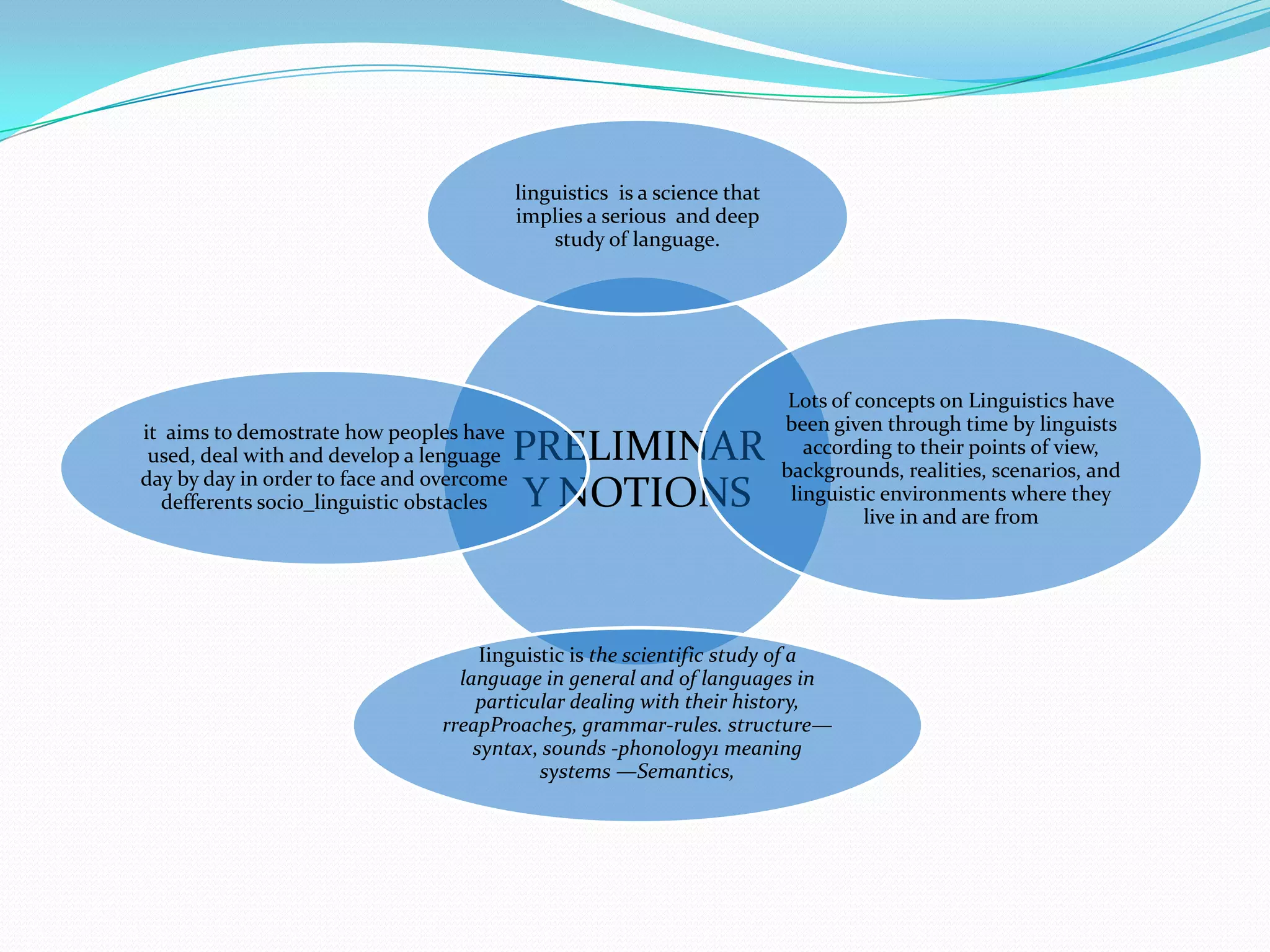
linguistics is a science that
                                           implies a serious and deep
                                               study of language.


                                                                            Lots of concepts on Linguistics have
it aims to demostrate how peoples have                                     been given through time by linguists
 used, deal with and develop a lenguage    PRELIMINAR                         according to their points of view,
                                                                           backgrounds, realities, scenarios, and
day by day in order to face and overcome
  defferents socio_linguistic obstacles    Y NOTIONS                        linguistic environments where they
                                                                                     live in and are from


                                     Iinguistic is the scientific study of a
                                  language in general and of languages in
                                    particular dealing with their history,
                                rreapProache5, grammar-rules. structure—
                                    syntax, sounds -phonology1 meaning
                                            systems —Semantics,
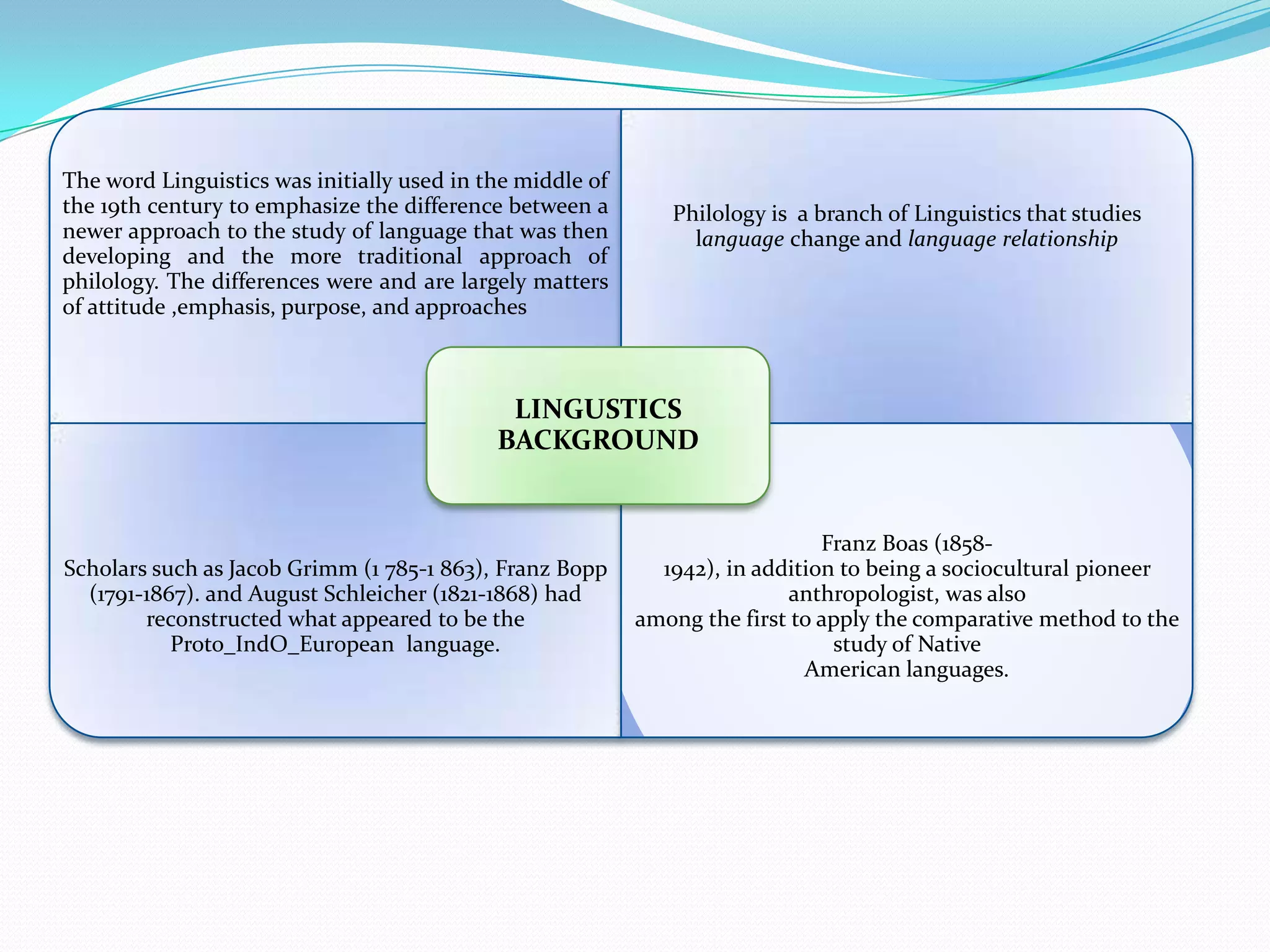
The word Linguistics was initially used in the middle of
the 19th century to emphasize the difference between a        Philology is a branch of Linguistics that studies
newer approach to the study of language that was then           language change and language relationship
developing and the more traditional approach of
philology. The differences were and are largely matters
of attitude ,emphasis, purpose, and approaches


                                             LINGUSTICS
                                            BACKGROUND


                                                                              Franz Boas (1858-
Scholars such as Jacob Grimm (1 785-1 863), Franz Bopp       1942), in addition to being a sociocultural pioneer
  (1791-1867). and August Schleicher (1821-1868) had                      anthropologist, was also
        reconstructed what appeared to be the              among the first to apply the comparative method to the
           Proto_IndO_Eur0pean language.                                       study of Native
                                                                            American languages.
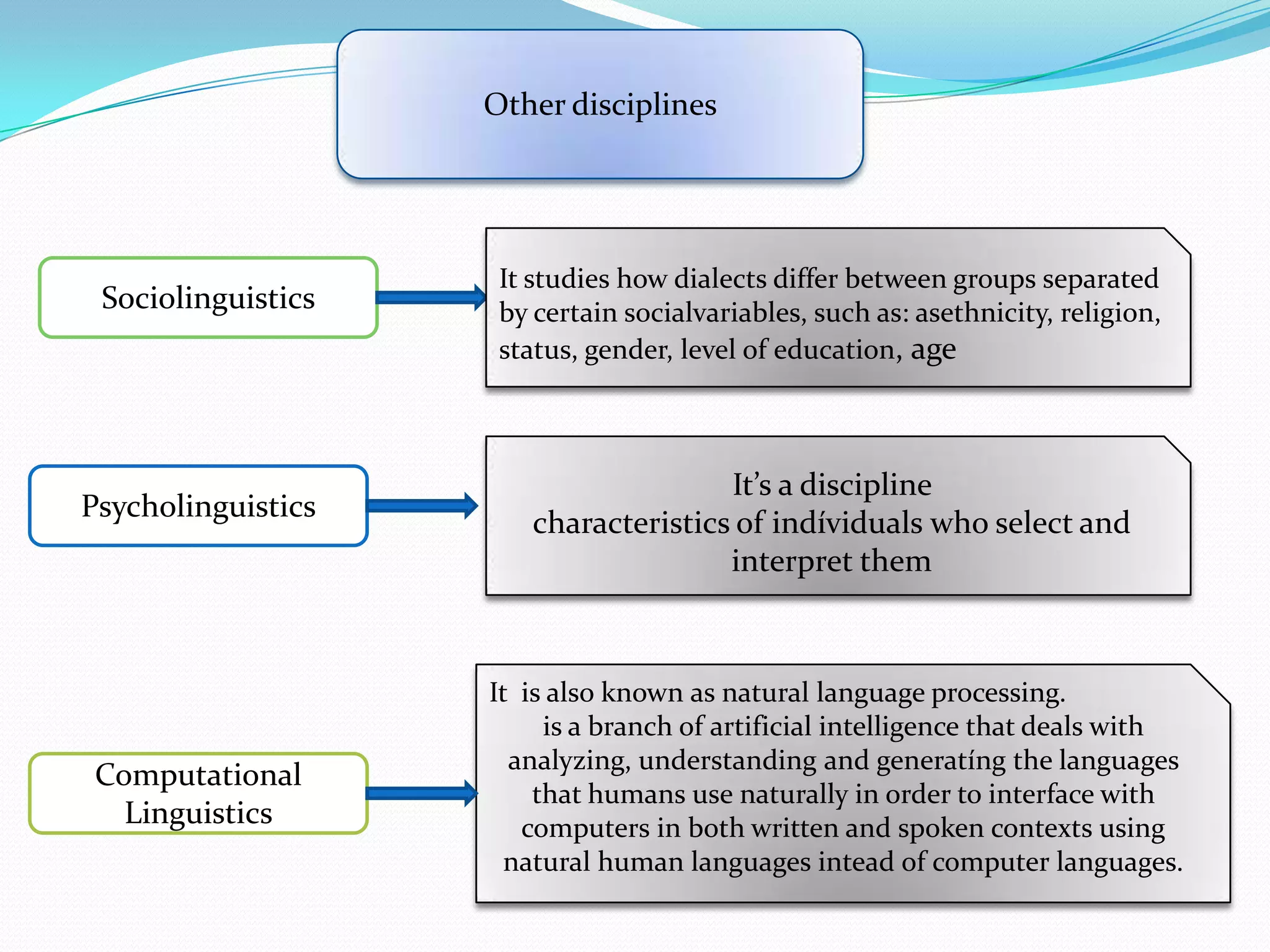
Other disciplines


                     It studies how dialects differ between groups separated
 Sociolinguistics    by certain socialvariables, such as: asethnicity, religion,
                     status, gender, level of education, age


                                       It’s a discipline
Psycholinguistics
                        characteristics of indíviduals who select and
                                       interpret them


                    It is also known as natural language processing.
                         is a branch of artificial intelligence that deals with
                      analyzing, understanding and generatíng the languages
 Computational
                        that humans use naturally in order to interface with
   Linguistics         computers in both written and spoken contexts using
                      natural human languages intead of computer languages.
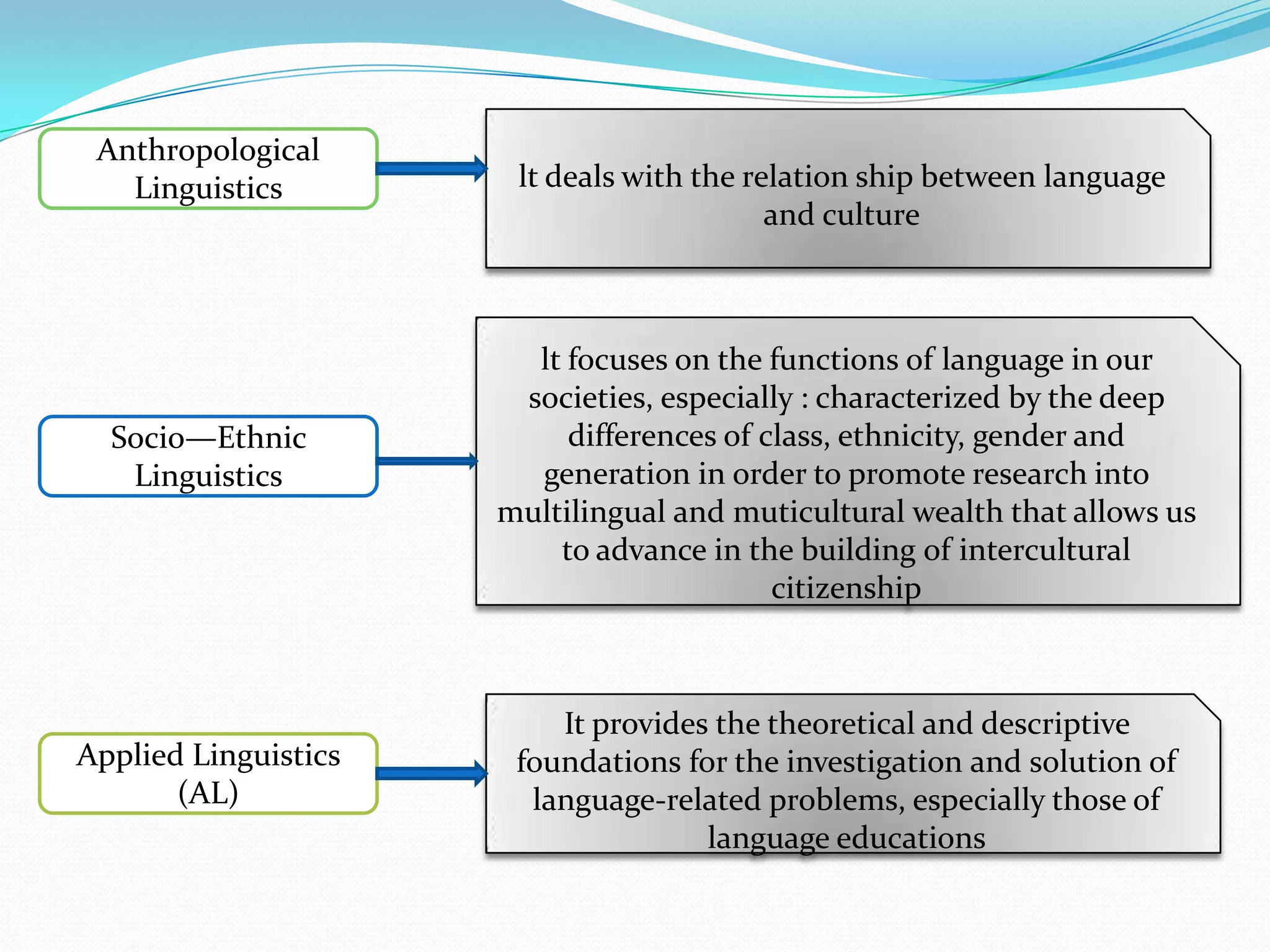
Anthropological
   Linguistics         lt deals with the relation ship between language
                                           and culture


                        lt focuses on the functions of language in our
                       societies, especially : characterized by the deep
  Socio—Ethnic             differences of class, ethnicity, gender and
   Linguistics          generation in order to promote research into
                      multilingual and muticultural wealth that allows us
                          to advance in the building of intercultural
                                           citizenship


                          It provides the theoretical and descriptive
Applied Linguistics    foundations for the investigation and solution of
       (AL)             language-related problems, especially those of
                                     language educations
CONTRASTIVE or
          COMPARATIVE
          LINGUISTICS?


     Some terminological remark
             are needed


COMPARATIVE               Originally Know as comparative
 LINGUISTICS              philogy is a branch of historical
                             or diachronic linguistics


                             Certainly studies , analyzes,
                             and compares two or more
CONTRASTIVE                languages descriptively in order
 INGUISTICS                  to find out similarities and
                           differences among them during
                            the language learning process
FUNDAMENTALS FOR TEACHING CL


                      Carl James states that CL is a
                     relevant and rewarding study
                    area for certain types of student


    CONTRASTIVE LLNGULSTICS SYLLABUS

   The exposition of CL proceeds level—by-level, and the
                traditional three levels :
Lexis: (language, terminology: terms, expressions.)
Sound: (utterances)
Syntax: (grammar, sentence structure. language rules)
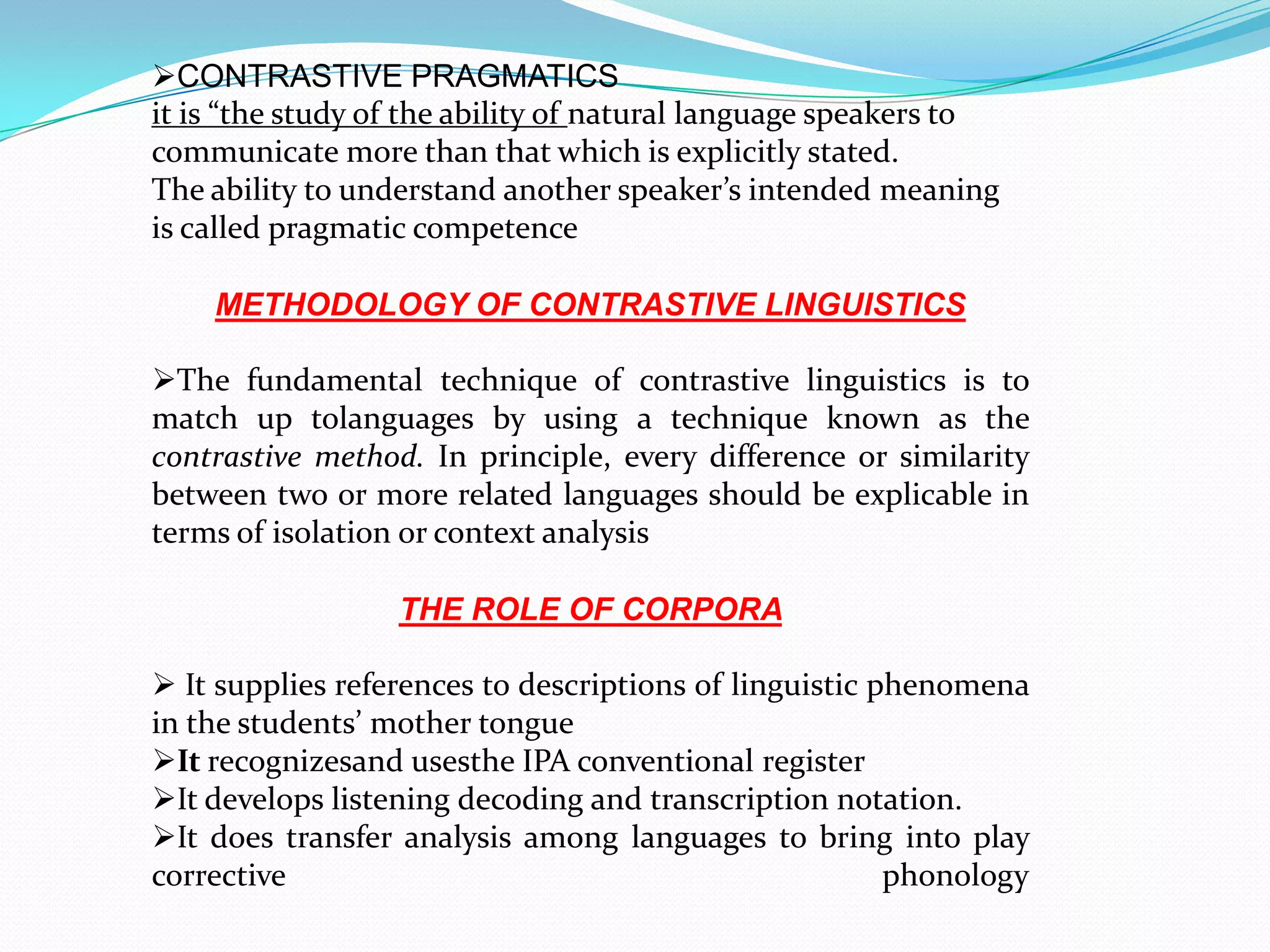
CONTRASTIVE PRAGMATICS
it is “the study of the ability of natural language speakers to
communicate more than that which is explicitly stated.
The ability to understand another speaker’s intended meaning
is called pragmatic competence

    METHODOLOGY OF CONTRASTIVE LINGUISTICS

The fundamental technique of contrastive linguistics is to
match up tolanguages by using a technique known as the
contrastive method. In principle, every difference or similarity
between two or more related languages should be explicable in
terms of isolation or context analysis

                  THE ROLE OF CORPORA

 It supplies references to descriptions of linguistic phenomena
in the students’ mother tongue
It recognizesand usesthe IPA conventional register
It develops listening decoding and transcription notation.
It does transfer analysis among languages to bring into play
corrective                                              phonology
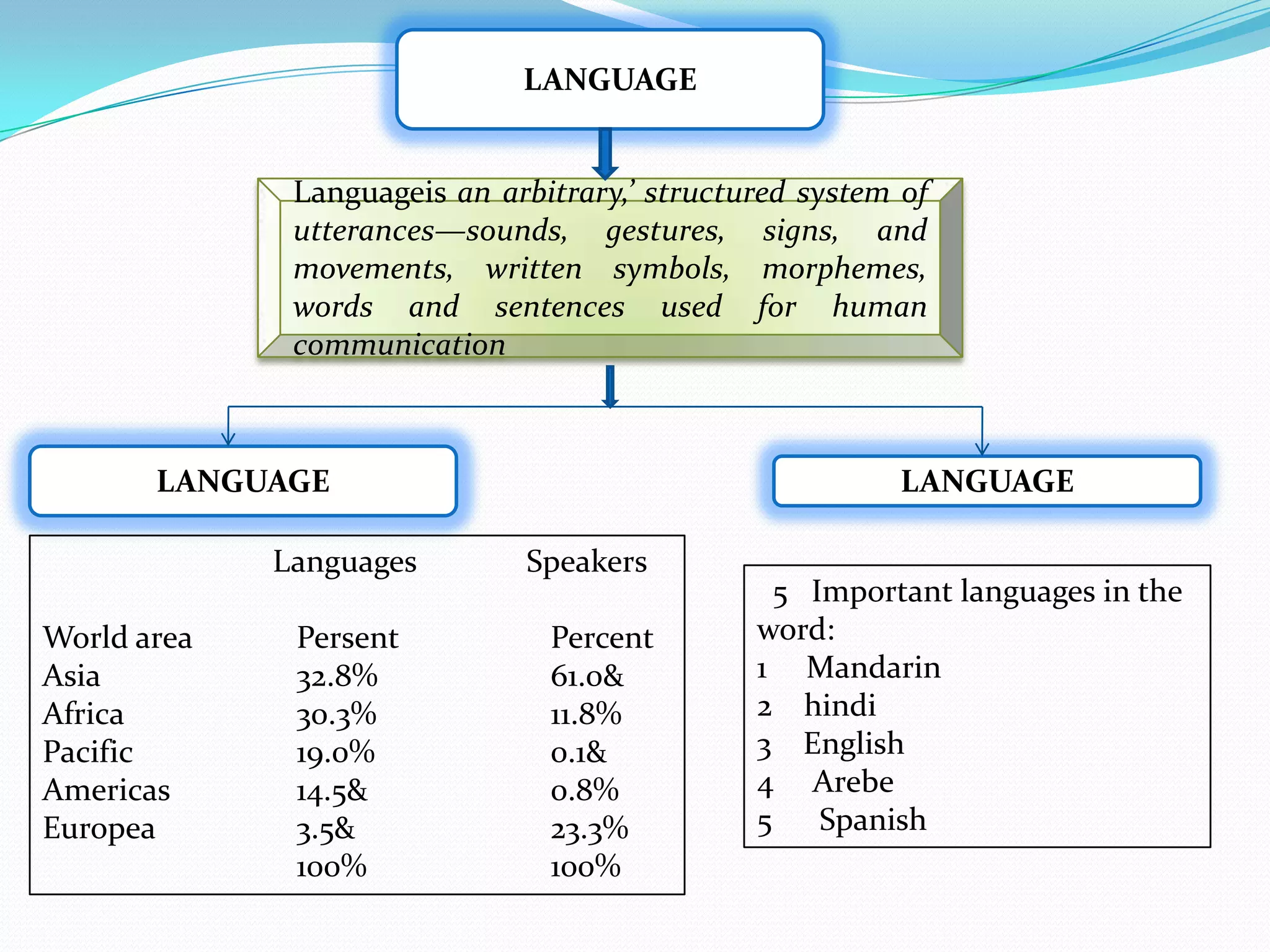
LANGUAGE


              Languageis an arbitrary,’ structured system of
              utterances—sounds, gestures, signs, and
              movements, written symbols, morphemes,
              words and sentences used for human
              communication


       LANGUAGE                                           LANGUAGE

             Languages        Speakers
                                                5 Important languages in the
World area    Persent           Percent        word:
Asia          32.8%             61.0&          1 Mandarin
Africa        30.3%             11.8%          2 hindi
Pacific       19.0%             0.1&           3 English
Americas      14.5&             0.8%           4 Arebe
Europea       3.5&              23.3%          5 Spanish
              100%              100%
BRIEF CLASSIFICATION OF LANGUAGES

                   VERBAL LANGUAGE

  Language family: It is a group of languages related by descent from
  a common ancestor called the proto –language of that family.
  Individual languages : It is a language as a whole from the same
  family .
  Extinct languages : They are the language that are no longer living.
  A language is listed as extinct if it has gone extinct in recen times .
  Dialect: Particular way of using a language regional and social.
   Indialect : It is individual as expressed by the way a person speak,
  voice quiality,
  Jargon: Use by people who work in a particular area or who have a
  particular interes . Eg. lawyer.
  Colloquialism: It is informal expression
  Slang: It is an informal use of the language is rude is non standar
BRIEF CLASSIFICATION OF LANGUAGES
                      NON VERBAL LANGUAGE


Ideographic written       Alphabetic written   Syllabic written


        Use                      Sound           Use symbols
   ideographip              pronunciation,       but syllable
      simbol                use alphabetical     by syllable
   Eg. Chinese                 symbol eg.
                              Spanish and
                             english letters
ARTICULATE LANGUAGE


    Writing systems


  Based on alphabets


   Foneting alphabets


       designed


      Utterances
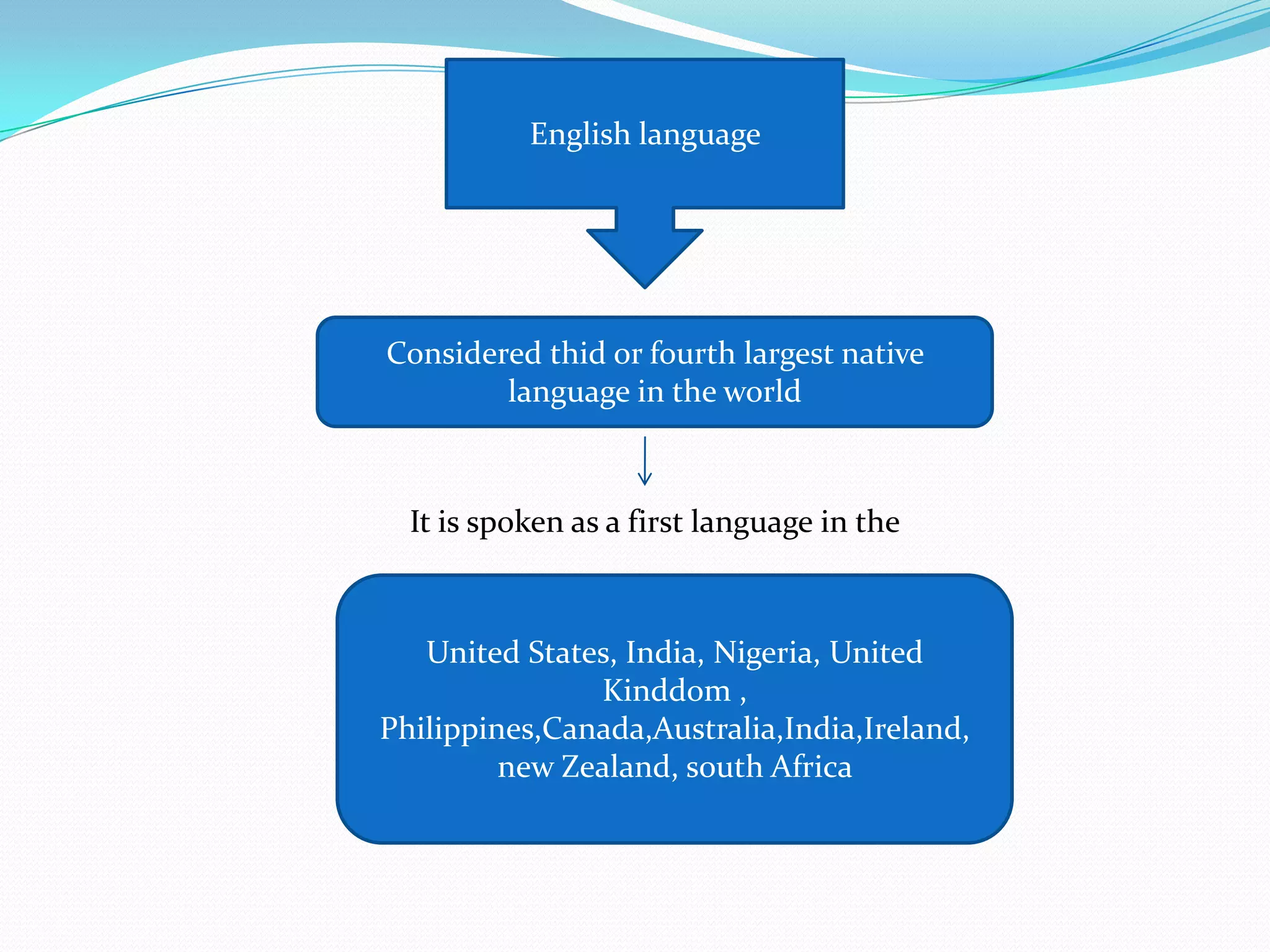
English language


Considered thid or fourth largest native
        language in the world


  It is spoken as a first language in the


   United States, India, Nigeria, United
               Kinddom ,
Philippines,Canada,Australia,India,Ireland,
         new Zealand, south Africa
SPANISH LANGUAGE


                   It is spoken as a
Spanish belongs    first language by
                   about 352 million
 to the romance    earliest people or
  branch of the    by 417 million          Spanish is the
 indo-european     including second     official language of
language family    lamguage speakers.       22 countries
LANGUAGE INCONSISTENCIES


It is hte incompatibility, it is the quelity or state of being inconsistent lack of
concordance with a structural patten, these inconsistences happen due to 1,2,3,.


   1             The same letter or letter combination can refer to different sounds


       Spanish                          English                         Françe


Cine [ sine ]                      Gymnasium
Cama [ káma ]                      [dʒɪmneɪzɪəm]
                                   Gynecology
                                   [gainəkalədʒɪ]
The same sounds can be written with diffrent
 2                          letters or letters combinations


SPANISH                          ENGLISH                        FRANÇE


Bonito                       Gypsy [ dʒɪpsɪ]                Risquer   [riske]
[ bo 'ni to ]                Canjugate [ kandʒ ə get ]      Kenya     [kenja]
Vacaciones
[ ba ka 'θjo nes ]
Diffrent dialects pronounce the same worl
   3                              differently


  SPANISH                   ENGLISH                           FRANÇE


Mismo   [mísmo] s.e-     Milk [mɪlk ]   britanico        Crime   [kRim]
Mismo   [míhmo] c.e      Mik [məlk]     ingles           Crime   [krim]
VOWEL CLUSTERS


          ORTHOGRAPHIES                    PHONEMIC


SPANISH    <piedad>                        /pye’dad/
ENGLISH    <eat>                           /Iyt/
FRANÇE     <boat>                          /bowt/
CONSONANT CLUSTERS


ORTHOGRAPHIES                        PHONEMIC


  INITIAL             MIDDLE            FINAL
INITIAL CLUSTERS


                                               /r/
CCV       a) /p,b,k,g,f,/ + /l/
           b) /p,t,k,b,d,g,f/ + R sound


       E                 S                FR
ccv    SI                SI               SI
cccv   SI                X                SI
MEDIAL CLUSTERS


                            S             E                   FR
         VCCV               SI            SI                  SI
         VCCCV              SI            SI                  SI
         VCCCCV             SI            SI                  SI
         VCCCCCV            X             SI                  SI


INTRASYLLABIC MEDIAL CLUSTER:                  INTRASYLLABIC MEDIAL CLUSTER: It is
When it belongs to the second of the           when once consonant of the cluster belongs to
two syllable pèaks between which they          the first syllable and the other(s) to the
appear as medial                               second, so syllable division occurs between
                                               the members
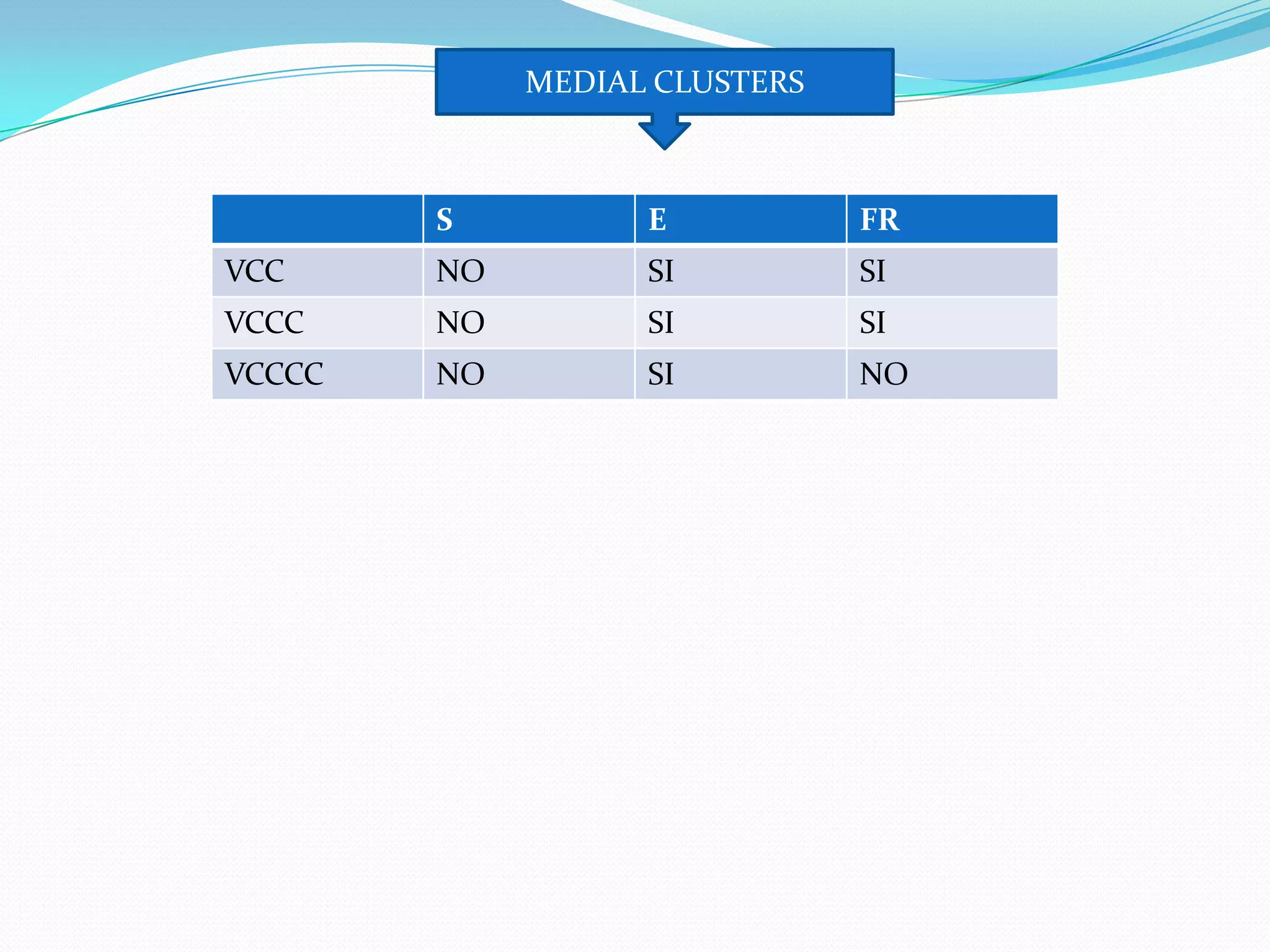
MEDIAL CLUSTERS


        S          E           FR
VCC     NO         SI          SI
VCCC    NO         SI          SI
VCCCC   NO         SI          NO
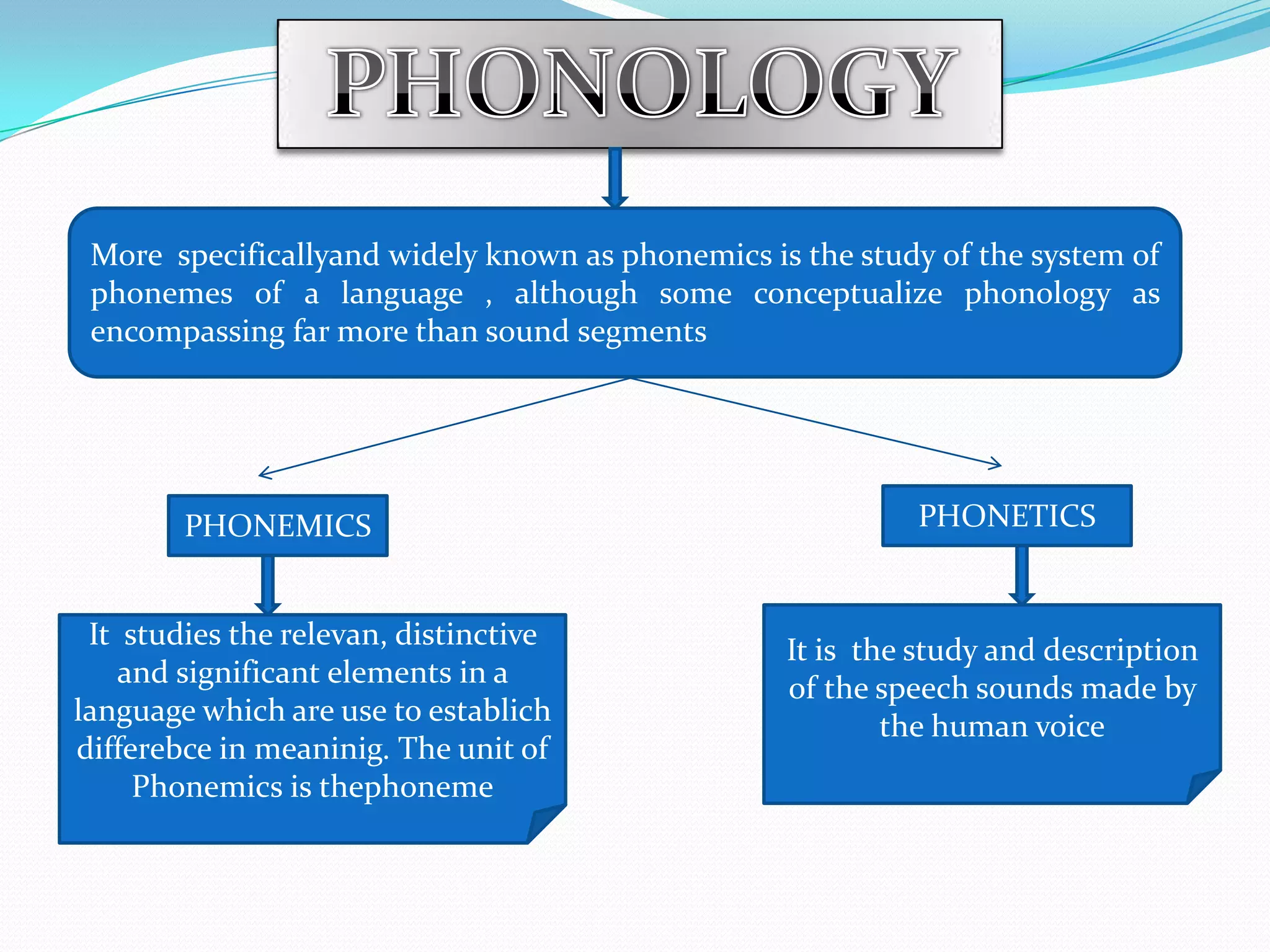
More specificallyand widely known as phonemics is the study of the system of
 phonemes of a language , although some conceptualize phonology as
 encompassing far more than sound segments


        PHONEMICS                                          PHONETICS


 It studies the relevan, distinctive              It is the study and description
    and significant elements in a                 of the speech sounds made by
language which are use to establich                       the human voice
differebce in meaninig. The unit of
     Phonemics is thephoneme
THE INTERNATIONAL
    PHONETIC ALPHABETH(IPA)


This alphabet was proposed (IPA)and mainly
accepted by Linguists, Phonetitians,Language
Teachers and currently dictionary makers. This
alpahbet was created by the International
Phonetic     Association      (Whose    original
members were language teachers in France in
1886. This association published officially the
first
Version in 188. It has the acronym IPA
TRANSCRIPTION:
                  It is a systems of notation that represents utterances or partial
                  utterrances of a language pronounced by people in general


BROAD          TRANSCRIPTION:        Also              PE DAGOGICAL HINTS: Marking stress in booth
identified as Phonemic Trascription, its               monosyllabic and       multisyllabic words issome
the notation that represent utterances of              didactic advice for students to be able to use and
language by indicating only the significat             pronounce properly thestressed syllables in words.
and underlying sounds (phonemes) that
make up a word


                            NARROW TRANSCRIPTION: It is written
                            between square brackets (phonetic bracket): []
SYMBOLS USED FOR TRASCRIPTION


Stress mark                               It shows the following syllable is
                                          stressed.
                                ´

Angle brackets                            They are used to enclose the
                                          spelling of the orthographic
                               < >        notation.


Slant brackets                            Phonemic trascriptionuses
                                          them.
                                //

Square brackets                           They are used arounddetailed
                                          phonetic trascription.
                               []


Vertical line                             It shows a pause in phonetic
                                          trascription.
Division marker                 .         It shows the boundaries
                                          between syllables.
Diacritics                                It shows the variation in the
                                          vowel or consonant quality.
                                          Nasal or dark quality.

CONTRASTIVE LINGUISTIC por VIVIANA SOCASI

  • 1.
    Universidad central delecuador Facultad de filosofía letras y ciencia de la educación Carrera de idiomas Viviana Socasi 5to Semestre Francés
  • 2.
    linguistics is ascience that implies a serious and deep study of language. Lots of concepts on Linguistics have it aims to demostrate how peoples have been given through time by linguists used, deal with and develop a lenguage PRELIMINAR according to their points of view, backgrounds, realities, scenarios, and day by day in order to face and overcome defferents socio_linguistic obstacles Y NOTIONS linguistic environments where they live in and are from Iinguistic is the scientific study of a language in general and of languages in particular dealing with their history, rreapProache5, grammar-rules. structure— syntax, sounds -phonology1 meaning systems —Semantics,
  • 3.
    The word Linguisticswas initially used in the middle of the 19th century to emphasize the difference between a Philology is a branch of Linguistics that studies newer approach to the study of language that was then language change and language relationship developing and the more traditional approach of philology. The differences were and are largely matters of attitude ,emphasis, purpose, and approaches LINGUSTICS BACKGROUND Franz Boas (1858- Scholars such as Jacob Grimm (1 785-1 863), Franz Bopp 1942), in addition to being a sociocultural pioneer (1791-1867). and August Schleicher (1821-1868) had anthropologist, was also reconstructed what appeared to be the among the first to apply the comparative method to the Proto_IndO_Eur0pean language. study of Native American languages.
  • 4.
    Other disciplines It studies how dialects differ between groups separated Sociolinguistics by certain socialvariables, such as: asethnicity, religion, status, gender, level of education, age It’s a discipline Psycholinguistics characteristics of indíviduals who select and interpret them It is also known as natural language processing. is a branch of artificial intelligence that deals with analyzing, understanding and generatíng the languages Computational that humans use naturally in order to interface with Linguistics computers in both written and spoken contexts using natural human languages intead of computer languages.
  • 5.
    Anthropological Linguistics lt deals with the relation ship between language and culture lt focuses on the functions of language in our societies, especially : characterized by the deep Socio—Ethnic differences of class, ethnicity, gender and Linguistics generation in order to promote research into multilingual and muticultural wealth that allows us to advance in the building of intercultural citizenship It provides the theoretical and descriptive Applied Linguistics foundations for the investigation and solution of (AL) language-related problems, especially those of language educations
  • 6.
    CONTRASTIVE or COMPARATIVE LINGUISTICS? Some terminological remark are needed COMPARATIVE Originally Know as comparative LINGUISTICS philogy is a branch of historical or diachronic linguistics Certainly studies , analyzes, and compares two or more CONTRASTIVE languages descriptively in order INGUISTICS to find out similarities and differences among them during the language learning process
  • 7.
    FUNDAMENTALS FOR TEACHINGCL Carl James states that CL is a relevant and rewarding study area for certain types of student CONTRASTIVE LLNGULSTICS SYLLABUS The exposition of CL proceeds level—by-level, and the traditional three levels : Lexis: (language, terminology: terms, expressions.) Sound: (utterances) Syntax: (grammar, sentence structure. language rules)
  • 8.
    CONTRASTIVE PRAGMATICS it is“the study of the ability of natural language speakers to communicate more than that which is explicitly stated. The ability to understand another speaker’s intended meaning is called pragmatic competence METHODOLOGY OF CONTRASTIVE LINGUISTICS The fundamental technique of contrastive linguistics is to match up tolanguages by using a technique known as the contrastive method. In principle, every difference or similarity between two or more related languages should be explicable in terms of isolation or context analysis THE ROLE OF CORPORA  It supplies references to descriptions of linguistic phenomena in the students’ mother tongue It recognizesand usesthe IPA conventional register It develops listening decoding and transcription notation. It does transfer analysis among languages to bring into play corrective phonology
  • 9.
    LANGUAGE Languageis an arbitrary,’ structured system of utterances—sounds, gestures, signs, and movements, written symbols, morphemes, words and sentences used for human communication LANGUAGE LANGUAGE Languages Speakers 5 Important languages in the World area Persent Percent word: Asia 32.8% 61.0& 1 Mandarin Africa 30.3% 11.8% 2 hindi Pacific 19.0% 0.1& 3 English Americas 14.5& 0.8% 4 Arebe Europea 3.5& 23.3% 5 Spanish 100% 100%
  • 10.
    BRIEF CLASSIFICATION OFLANGUAGES VERBAL LANGUAGE Language family: It is a group of languages related by descent from a common ancestor called the proto –language of that family. Individual languages : It is a language as a whole from the same family . Extinct languages : They are the language that are no longer living. A language is listed as extinct if it has gone extinct in recen times . Dialect: Particular way of using a language regional and social. Indialect : It is individual as expressed by the way a person speak, voice quiality, Jargon: Use by people who work in a particular area or who have a particular interes . Eg. lawyer. Colloquialism: It is informal expression Slang: It is an informal use of the language is rude is non standar
  • 11.
    BRIEF CLASSIFICATION OFLANGUAGES NON VERBAL LANGUAGE Ideographic written Alphabetic written Syllabic written Use Sound Use symbols ideographip pronunciation, but syllable simbol use alphabetical by syllable Eg. Chinese symbol eg. Spanish and english letters
  • 12.
    ARTICULATE LANGUAGE Writing systems Based on alphabets Foneting alphabets designed Utterances
  • 13.
    English language Considered thidor fourth largest native language in the world It is spoken as a first language in the United States, India, Nigeria, United Kinddom , Philippines,Canada,Australia,India,Ireland, new Zealand, south Africa
  • 14.
    SPANISH LANGUAGE It is spoken as a Spanish belongs first language by about 352 million to the romance earliest people or branch of the by 417 million Spanish is the indo-european including second official language of language family lamguage speakers. 22 countries
  • 15.
    LANGUAGE INCONSISTENCIES It ishte incompatibility, it is the quelity or state of being inconsistent lack of concordance with a structural patten, these inconsistences happen due to 1,2,3,. 1 The same letter or letter combination can refer to different sounds Spanish English Françe Cine [ sine ] Gymnasium Cama [ káma ] [dʒɪmneɪzɪəm] Gynecology [gainəkalədʒɪ]
  • 16.
    The same soundscan be written with diffrent 2 letters or letters combinations SPANISH ENGLISH FRANÇE Bonito Gypsy [ dʒɪpsɪ] Risquer [riske] [ bo 'ni to ] Canjugate [ kandʒ ə get ] Kenya [kenja] Vacaciones [ ba ka 'θjo nes ]
  • 17.
    Diffrent dialects pronouncethe same worl 3 differently SPANISH ENGLISH FRANÇE Mismo [mísmo] s.e- Milk [mɪlk ] britanico Crime [kRim] Mismo [míhmo] c.e Mik [məlk] ingles Crime [krim]
  • 18.
    VOWEL CLUSTERS ORTHOGRAPHIES PHONEMIC SPANISH <piedad> /pye’dad/ ENGLISH <eat> /Iyt/ FRANÇE <boat> /bowt/
  • 19.
    CONSONANT CLUSTERS ORTHOGRAPHIES PHONEMIC INITIAL MIDDLE FINAL
  • 20.
    INITIAL CLUSTERS /r/ CCV a) /p,b,k,g,f,/ + /l/ b) /p,t,k,b,d,g,f/ + R sound E S FR ccv SI SI SI cccv SI X SI
  • 21.
    MEDIAL CLUSTERS S E FR VCCV SI SI SI VCCCV SI SI SI VCCCCV SI SI SI VCCCCCV X SI SI INTRASYLLABIC MEDIAL CLUSTER: INTRASYLLABIC MEDIAL CLUSTER: It is When it belongs to the second of the when once consonant of the cluster belongs to two syllable pèaks between which they the first syllable and the other(s) to the appear as medial second, so syllable division occurs between the members
  • 22.
    MEDIAL CLUSTERS S E FR VCC NO SI SI VCCC NO SI SI VCCCC NO SI NO
  • 23.
    More specificallyand widelyknown as phonemics is the study of the system of phonemes of a language , although some conceptualize phonology as encompassing far more than sound segments PHONEMICS PHONETICS It studies the relevan, distinctive It is the study and description and significant elements in a of the speech sounds made by language which are use to establich the human voice differebce in meaninig. The unit of Phonemics is thephoneme
  • 25.
    THE INTERNATIONAL PHONETIC ALPHABETH(IPA) This alphabet was proposed (IPA)and mainly accepted by Linguists, Phonetitians,Language Teachers and currently dictionary makers. This alpahbet was created by the International Phonetic Association (Whose original members were language teachers in France in 1886. This association published officially the first Version in 188. It has the acronym IPA
  • 26.
    TRANSCRIPTION: It is a systems of notation that represents utterances or partial utterrances of a language pronounced by people in general BROAD TRANSCRIPTION: Also PE DAGOGICAL HINTS: Marking stress in booth identified as Phonemic Trascription, its monosyllabic and multisyllabic words issome the notation that represent utterances of didactic advice for students to be able to use and language by indicating only the significat pronounce properly thestressed syllables in words. and underlying sounds (phonemes) that make up a word NARROW TRANSCRIPTION: It is written between square brackets (phonetic bracket): []
  • 27.
    SYMBOLS USED FORTRASCRIPTION Stress mark It shows the following syllable is stressed. ´ Angle brackets They are used to enclose the spelling of the orthographic < > notation. Slant brackets Phonemic trascriptionuses them. // Square brackets They are used arounddetailed phonetic trascription. [] Vertical line It shows a pause in phonetic trascription. Division marker . It shows the boundaries between syllables. Diacritics It shows the variation in the vowel or consonant quality. Nasal or dark quality.