Session #7.
    Encountering the
 Prophetic Books (Part 1)
     Covering the books of
Isaiah, Jeremiah & Lamentations.
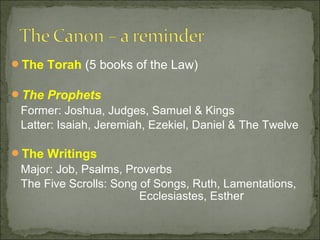
The Torah (5 books of the Law)

The Prophets
 Former: Joshua, Judges, Samuel & Kings
 Latter: Isaiah, Jeremiah, Ezekiel, Daniel & The Twelve

The Writings
 Major: Job, Psalms, Proverbs
 The Five Scrolls: Song of Songs, Ruth, Lamentations,
                        Ecclesiastes, Esther
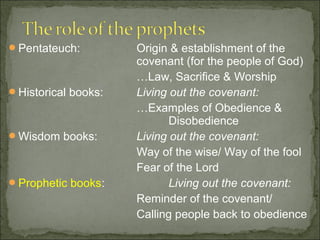
Pentateuch:         Origin & establishment of the
                     covenant (for the people of God)
                     …Law, Sacrifice & Worship
Historical books:   Living out the covenant:
                     …Examples of Obedience &
                            Disobedience
Wisdom books:       Living out the covenant:
                     Way of the wise/ Way of the fool
                     Fear of the Lord
Prophetic books:           Living out the covenant:
                     Reminder of the covenant/
                     Calling people back to obedience
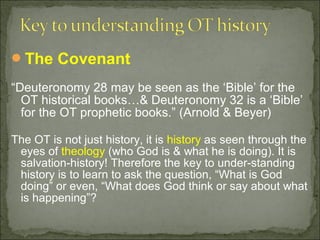
The Covenant

“Deuteronomy 28 may be seen as the ‘Bible’ for the
  OT historical books…& Deuteronomy 32 is a ‘Bible’
  for the OT prophetic books.” (Arnold & Beyer)

The OT is not just history, it is history as seen through the
 eyes of theology (who God is & what he is doing). It is
 salvation-history! Therefore the key to under-standing
 history is to learn to ask the question, “What is God
 doing” or even, “What does God think or say about what
 is happening”?
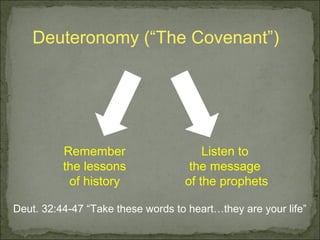
Deuteronomy (“The Covenant”)


          Remember                     Listen to
          the lessons               the message
           of history              of the prophets

Deut. 32:44-47 “Take these words to heart…they are your life”
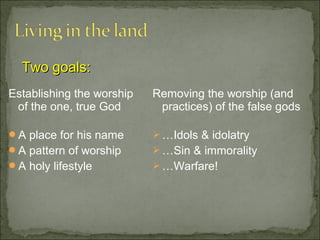
Two goals:
Establishing the worship   Removing the worship (and
 of the one, true God       practices) of the false gods

A place for his name       …Idols & idolatry
A pattern of worship       …Sin & immorality
A holy lifestyle           …Warfare!
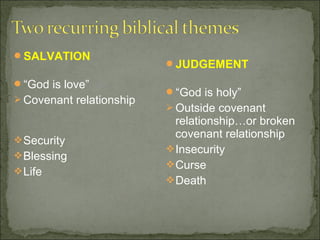
SALVATION
                          JUDGEMENT

“God is love”
                          “God is holy”
 Covenant relationship
                           Outside covenant
                            relationship…or broken
 Security
                            covenant relationship
                           Insecurity
 Blessing
                           Curse
 Life
                           Death
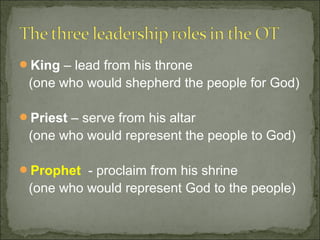
King – lead from his throne
 (one who would shepherd the people for God)

Priest – serve from his altar
 (one who would represent the people to God)

Prophet - proclaim from his shrine
 (one who would represent God to the people)
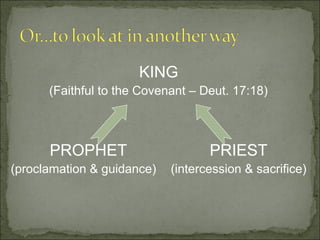
KING
      (Faithful to the Covenant – Deut. 17:18)


      PROPHET                      PRIEST
(proclamation & guidance)   (intercession & sacrifice)
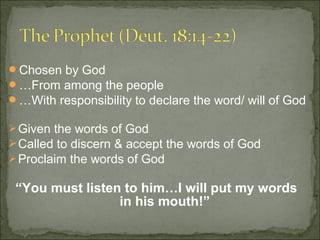
Chosen by God
…From among the people
…With responsibility to declare the word/ will of God

 Given the words of God
 Called to discern & accept the words of God
 Proclaim the words of God

 “You must listen to him…I will put my words
                 in his mouth!”
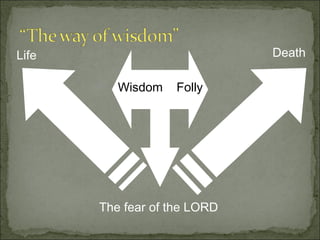
Life                          Death

          Wisdom    Folly


       The fear of the LORD
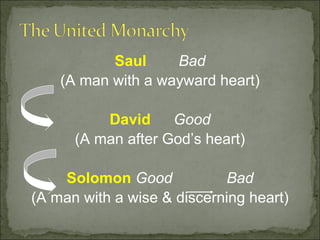
Saul     Bad
    (A man with a wayward heart)

          David     Good
      (A man after God’s heart)

    Solomon Good            Bad
(A man with a wise & discerning heart)
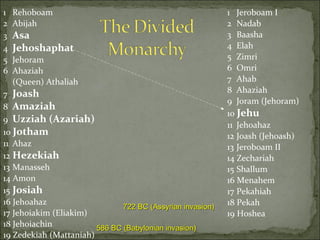
1   Rehoboam                                                1 Jeroboam I
2   Abijah                                                  2 Nadab
3   Asa                                                     3 Baasha
4   Jehoshaphat                                             4 Elah
5   Jehoram                                                 5 Zimri
6   Ahaziah                                                 6 Omri
    (Queen) Athaliah                                        7 Ahab
7 Joash                                                     8 Ahaziah
                                                            9 Joram (Jehoram)
8 Amaziah
                                                            10 Jehu
9 Uzziah (Azariah)
                                                            11 Jehoahaz
10 Jotham                                                   12 Joash (Jehoash)
11 Ahaz                                                     13 Jeroboam II
12 Hezekiah                                                 14 Zechariah
13 Manasseh                                                 15 Shallum
14 Amon                                                     16 Menahem
15 Josiah                                                   17 Pekahiah
16 Jehoahaz                                                 18 Pekah
                               722 BC (Assyrian invasion)
17 Jehoiakim (Eliakim)                                      19 Hoshea
18 Jehoiachin           586 BC (Babylonian invasion)
19 Zedekiah (Mattaniah)
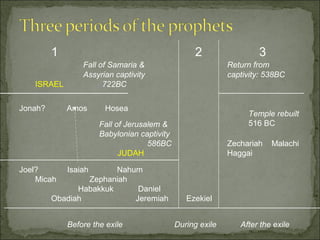
1                                        2                 3
                 Fall of Samaria &                          Return from
                 Assyrian captivity                         captivity: 538BC
   ISRAEL              722BC


Jonah?       Amos      Hosea
                                                                 Temple rebuilt
                      Fall of Jerusalem &                        516 BC
                      Babylonian captivity
                                    586BC                   Zechariah   Malachi
                            JUDAH                           Haggai

Joel?        Isaiah     Nahum
    Micah        Zephaniah
               Habakkuk      Daniel
         Obadiah            Jeremiah            Ezekiel


             Before the exile                During exile      After the exile
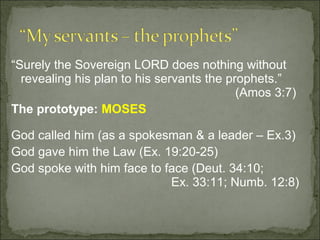
“Surely the Sovereign LORD does nothing without
  revealing his plan to his servants the prophets.”
                                           (Amos 3:7)
The prototype: MOSES

God called him (as a spokesman & a leader – Ex.3)
God gave him the Law (Ex. 19:20-25)
God spoke with him face to face (Deut. 34:10;
                            Ex. 33:11; Numb. 12:8)
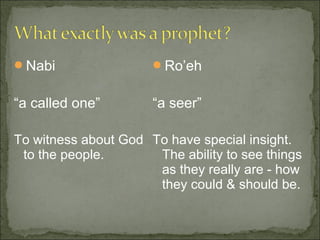
Nabi                 Ro’eh


“a called one”        “a seer”

To witness about God To have special insight.
 to the people.       The ability to see things
                      as they really are - how
                      they could & should be.
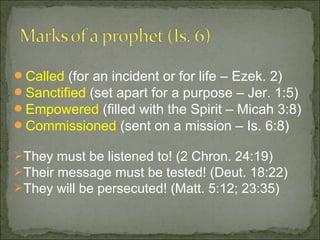
Called (for an incident or for life – Ezek. 2)
Sanctified (set apart for a purpose – Jer. 1:5)
Empowered (filled with the Spirit – Micah 3:8)
Commissioned (sent on a mission – Is. 6:8)

 They must be listened to! (2 Chron. 24:19)
 Their message must be tested! (Deut. 18:22)
 They will be persecuted! (Matt. 5:12; 23:35)
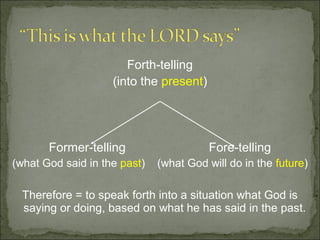
Forth-telling
                    (into the present)


       Former-telling                    Fore-telling
(what God said in the past)   (what God will do in the future)

  Therefore = to speak forth into a situation what God is
  saying or doing, based on what he has said in the past.
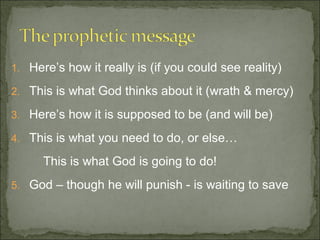
1. Here’s how it really is (if you could see reality)

2. This is what God thinks about it (wrath & mercy)

3. Here’s how it is supposed to be (and will be)

4. This is what you need to do, or else…

      This is what God is going to do!
5. God – though he will punish - is waiting to save
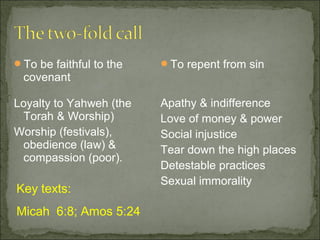
To be faithful to the   To repent from sin
 covenant

Loyalty to Yahweh (the   Apathy & indifference
 Torah & Worship)        Love of money & power
Worship (festivals),     Social injustice
 obedience (law) &       Tear down the high places
 compassion (poor).
                         Detestable practices
                         Sexual immorality
Key texts:
Micah 6:8; Amos 5:24
Proclamation (“This is what the Lord says”) x 170

 Visions (Is. 6; Amos 7; Ezek. 37)
 Symbolic actions (Jer. 18-19; Ezek.4-5; Hos.1)
 Miracles (1 Kings 18; 2 Kings 4)
 Parables/ illustrations (Is. 5)
 Laments & songs (Is. 10; Mic. 7)
Enoch (Gen. 5:21-24; Jude 14-15)          Noah
Nathan (2 Sam. 7, 12)                     David
Ahijah & Shemaiah (1 Kings 11-13)         Jeroboam
Elijah (1 Kings 17-19, 21; 2 Kings 1-2)   Ahab-Jehu
Micaiah (1 Kings 22)                      Ahab
Elisha (2 Kings 2-9, 13)              Jehoram-Jehoash

Huldah (2 Kings 22:14)                           Josiah
– cf. also Miriam (Ex. 15:20) & Deborah (Judges 4:4)
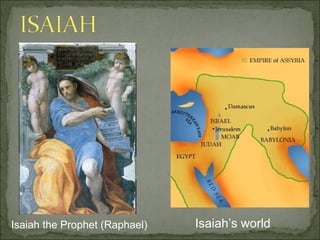
Isaiah the Prophet (Raphael)   Isaiah’s world
“Just as Colorado river, 280 miles long, between
  4-18 miles wide and over a mile deep, has many
  gorges, so too the Book of Isaiah is majestic
  because of the breadth of its teachings, the
  importance of its message and the sweep of its
  subject matter…It beckons to the reader to revel
  in its beauty and plumb its message again and
  again.” (Ronald Youngblood)
Isaiah = “The Lord has saved”
 (name is related to Joshua & Jesus)

 Served in Judah’s royal court (spoke to Northern
  Kingdom)
 Ministered during the reigns Uzziah, Jotham, Ahaz,
  Hezekiah & Manasseh (c. 739- late 600’s)
 Commenced ministry c.20 years before the fall of
  Israel to the Assyrians (722 BC)
“One of greatest theologians of all time”
“The king of all the prophets”
“The eagle among the prophets”
“The evangelist of the Old Covenant”
“The evangelical prophet”
“The St. Paul of the OT”


“He knew God intimately, obeyed him faithfully, under-
  stood his will clearly & proclaimed it fearlessly.”
                                    (Youngblood)
Born c. 762 BCE
Father = Amoz (acc. to Jewish tradition, the brother
 of Amaziah, who was father to Uzziah)
 …therefore acc to tradition = cousin to King Uzziah
Married (wife was a prophetess, 8:3)
Two children:
 Shear-Jashub (“a remnant will return”)
 Maher-shalal-hash-baz (“quick to the plunder,
                             swift to the spoil”
Family’s names = “signs & symbols in Israel from
                             the LORD” (8:18)
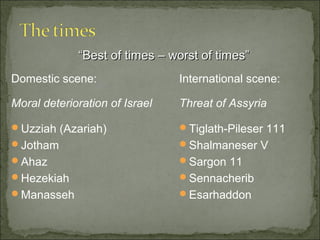
“Best of times – worst of times”
Domestic scene:                 International scene:

Moral deterioration of Israel   Threat of Assyria

Uzziah (Azariah)               Tiglath-Pileser 111
Jotham                         Shalmaneser V
Ahaz                           Sargon 11
Hezekiah                       Sennacherib
Manasseh                       Esarhaddon
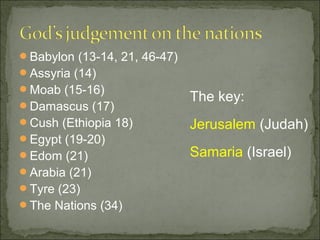
Babylon (13-14, 21, 46-47)
Assyria (14)
Moab (15-16)
                              The key:
Damascus (17)
Cush (Ethiopia 18)           Jerusalem (Judah)
Egypt (19-20)
Edom (21)                    Samaria (Israel)
Arabia (21)
Tyre (23)
The Nations (34)
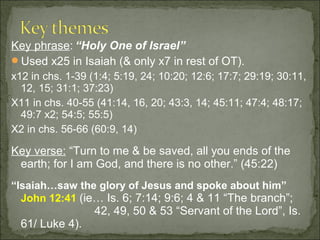
Key phrase: “Holy One of Israel”
Used x25 in Isaiah (& only x7 in rest of OT).
x12 in chs. 1-39 (1:4; 5:19, 24; 10:20; 12:6; 17:7; 29:19; 30:11,
  12, 15; 31:1; 37:23)
X11 in chs. 40-55 (41:14, 16, 20; 43:3, 14; 45:11; 47:4; 48:17;
  49:7 x2; 54:5; 55:5)
X2 in chs. 56-66 (60:9, 14)

Key verse: “Turn to me & be saved, all you ends of the
 earth; for I am God, and there is no other.” (45:22)
“Isaiah…saw the glory of Jesus and spoke about him”
  John 12:41 (ie… Is. 6; 7:14; 9:6; 4 & 11 “The branch”;
                  42, 49, 50 & 53 “Servant of the Lord”, Is.
  61/ Luke 4).
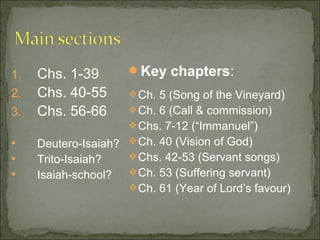
1.   Chs. 1-39        Key chapters:
2.   Chs. 40-55        Ch. 5 (Song of the Vineyard)
3.   Chs. 56-66        Ch. 6 (Call & commission)
                       Chs. 7-12 (“Immanuel”)
    Deutero-Isaiah?  Ch. 40 (Vision of God)
    Trito-Isaiah?    Chs. 42-53 (Servant songs)
    Isaiah-school?  Ch. 53 (Suffering servant)
                      Ch. 61 (Year of Lord’s favour)
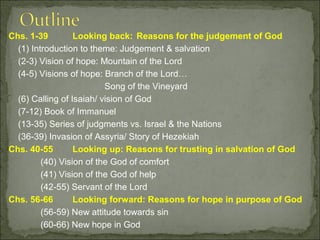
Chs. 1-39         Looking back: Reasons for the judgement of God
  (1) Introduction to theme: Judgement & salvation
  (2-3) Vision of hope: Mountain of the Lord
  (4-5) Visions of hope: Branch of the Lord…
                          Song of the Vineyard
  (6) Calling of Isaiah/ vision of God
  (7-12) Book of Immanuel
  (13-35) Series of judgments vs. Israel & the Nations
  (36-39) Invasion of Assyria/ Story of Hezekiah
Chs. 40-55        Looking up: Reasons for trusting in salvation of God
         (40) Vision of the God of comfort
         (41) Vision of the God of help
         (42-55) Servant of the Lord
Chs. 56-66        Looking forward: Reasons for hope in purpose of God
         (56-59) New attitude towards sin
         (60-66) New hope in God
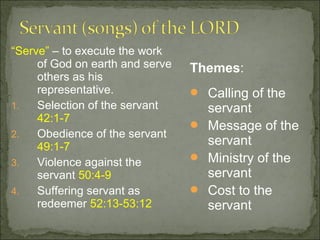
“Serve” – to execute the work
     of God on earth and serve   Themes:
     others as his
     representative.              Calling of the
1.   Selection of the servant      servant
     42:1-7
                                  Message of the
2.   Obedience of the servant
     49:1-7                        servant
3.   Violence against the         Ministry of the
     servant 50:4-9                servant
4.   Suffering servant as         Cost to the
     redeemer 52:13-53:12          servant
OT Session 7 Major Prophets (Part 1)

  • 1.
    Session #7. Encountering the Prophetic Books (Part 1) Covering the books of Isaiah, Jeremiah & Lamentations.
  • 2.
    The Torah (5books of the Law) The Prophets Former: Joshua, Judges, Samuel & Kings Latter: Isaiah, Jeremiah, Ezekiel, Daniel & The Twelve The Writings Major: Job, Psalms, Proverbs The Five Scrolls: Song of Songs, Ruth, Lamentations, Ecclesiastes, Esther
  • 3.
    Pentateuch: Origin & establishment of the covenant (for the people of God) …Law, Sacrifice & Worship Historical books: Living out the covenant: …Examples of Obedience & Disobedience Wisdom books: Living out the covenant: Way of the wise/ Way of the fool Fear of the Lord Prophetic books: Living out the covenant: Reminder of the covenant/ Calling people back to obedience
  • 4.
    The Covenant “Deuteronomy 28may be seen as the ‘Bible’ for the OT historical books…& Deuteronomy 32 is a ‘Bible’ for the OT prophetic books.” (Arnold & Beyer) The OT is not just history, it is history as seen through the eyes of theology (who God is & what he is doing). It is salvation-history! Therefore the key to under-standing history is to learn to ask the question, “What is God doing” or even, “What does God think or say about what is happening”?
  • 5.
    Deuteronomy (“The Covenant”) Remember Listen to the lessons the message of history of the prophets Deut. 32:44-47 “Take these words to heart…they are your life”
  • 6.
    Two goals: Establishing theworship Removing the worship (and of the one, true God practices) of the false gods A place for his name  …Idols & idolatry A pattern of worship  …Sin & immorality A holy lifestyle  …Warfare!
  • 7.
    SALVATION JUDGEMENT “God is love” “God is holy”  Covenant relationship  Outside covenant relationship…or broken  Security covenant relationship  Insecurity  Blessing  Curse  Life  Death
  • 8.
    King – leadfrom his throne (one who would shepherd the people for God) Priest – serve from his altar (one who would represent the people to God) Prophet - proclaim from his shrine (one who would represent God to the people)
  • 9.
    KING (Faithful to the Covenant – Deut. 17:18) PROPHET PRIEST (proclamation & guidance) (intercession & sacrifice)
  • 10.
    Chosen by God …Fromamong the people …With responsibility to declare the word/ will of God  Given the words of God  Called to discern & accept the words of God  Proclaim the words of God “You must listen to him…I will put my words in his mouth!”
  • 11.
    Life Death Wisdom Folly The fear of the LORD
  • 12.
    Saul Bad (A man with a wayward heart) David Good (A man after God’s heart) Solomon Good Bad (A man with a wise & discerning heart)
  • 13.
    1 Rehoboam 1 Jeroboam I 2 Abijah 2 Nadab 3 Asa 3 Baasha 4 Jehoshaphat 4 Elah 5 Jehoram 5 Zimri 6 Ahaziah 6 Omri (Queen) Athaliah 7 Ahab 7 Joash 8 Ahaziah 9 Joram (Jehoram) 8 Amaziah 10 Jehu 9 Uzziah (Azariah) 11 Jehoahaz 10 Jotham 12 Joash (Jehoash) 11 Ahaz 13 Jeroboam II 12 Hezekiah 14 Zechariah 13 Manasseh 15 Shallum 14 Amon 16 Menahem 15 Josiah 17 Pekahiah 16 Jehoahaz 18 Pekah 722 BC (Assyrian invasion) 17 Jehoiakim (Eliakim) 19 Hoshea 18 Jehoiachin 586 BC (Babylonian invasion) 19 Zedekiah (Mattaniah)
  • 14.
    1 2 3 Fall of Samaria & Return from Assyrian captivity captivity: 538BC ISRAEL 722BC Jonah? Amos Hosea Temple rebuilt Fall of Jerusalem & 516 BC Babylonian captivity 586BC Zechariah Malachi JUDAH Haggai Joel? Isaiah Nahum Micah Zephaniah Habakkuk Daniel Obadiah Jeremiah Ezekiel Before the exile During exile After the exile
  • 15.
    “Surely the SovereignLORD does nothing without revealing his plan to his servants the prophets.” (Amos 3:7) The prototype: MOSES God called him (as a spokesman & a leader – Ex.3) God gave him the Law (Ex. 19:20-25) God spoke with him face to face (Deut. 34:10; Ex. 33:11; Numb. 12:8)
  • 16.
    Nabi Ro’eh “a called one” “a seer” To witness about God To have special insight. to the people. The ability to see things as they really are - how they could & should be.
  • 17.
    Called (for anincident or for life – Ezek. 2) Sanctified (set apart for a purpose – Jer. 1:5) Empowered (filled with the Spirit – Micah 3:8) Commissioned (sent on a mission – Is. 6:8)  They must be listened to! (2 Chron. 24:19)  Their message must be tested! (Deut. 18:22)  They will be persecuted! (Matt. 5:12; 23:35)
  • 18.
    Forth-telling (into the present) Former-telling Fore-telling (what God said in the past) (what God will do in the future) Therefore = to speak forth into a situation what God is saying or doing, based on what he has said in the past.
  • 19.
    1. Here’s howit really is (if you could see reality) 2. This is what God thinks about it (wrath & mercy) 3. Here’s how it is supposed to be (and will be) 4. This is what you need to do, or else… This is what God is going to do! 5. God – though he will punish - is waiting to save
  • 20.
    To be faithfulto the To repent from sin covenant Loyalty to Yahweh (the Apathy & indifference Torah & Worship) Love of money & power Worship (festivals), Social injustice obedience (law) & Tear down the high places compassion (poor). Detestable practices Sexual immorality Key texts: Micah 6:8; Amos 5:24
  • 21.
    Proclamation (“This iswhat the Lord says”) x 170  Visions (Is. 6; Amos 7; Ezek. 37)  Symbolic actions (Jer. 18-19; Ezek.4-5; Hos.1)  Miracles (1 Kings 18; 2 Kings 4)  Parables/ illustrations (Is. 5)  Laments & songs (Is. 10; Mic. 7)
  • 22.
    Enoch (Gen. 5:21-24;Jude 14-15) Noah Nathan (2 Sam. 7, 12) David Ahijah & Shemaiah (1 Kings 11-13) Jeroboam Elijah (1 Kings 17-19, 21; 2 Kings 1-2) Ahab-Jehu Micaiah (1 Kings 22) Ahab Elisha (2 Kings 2-9, 13) Jehoram-Jehoash Huldah (2 Kings 22:14) Josiah – cf. also Miriam (Ex. 15:20) & Deborah (Judges 4:4)
  • 23.
    Isaiah the Prophet(Raphael) Isaiah’s world
  • 24.
    “Just as Coloradoriver, 280 miles long, between 4-18 miles wide and over a mile deep, has many gorges, so too the Book of Isaiah is majestic because of the breadth of its teachings, the importance of its message and the sweep of its subject matter…It beckons to the reader to revel in its beauty and plumb its message again and again.” (Ronald Youngblood)
  • 25.
    Isaiah = “TheLord has saved” (name is related to Joshua & Jesus)  Served in Judah’s royal court (spoke to Northern Kingdom)  Ministered during the reigns Uzziah, Jotham, Ahaz, Hezekiah & Manasseh (c. 739- late 600’s)  Commenced ministry c.20 years before the fall of Israel to the Assyrians (722 BC)
  • 26.
    “One of greatesttheologians of all time” “The king of all the prophets” “The eagle among the prophets” “The evangelist of the Old Covenant” “The evangelical prophet” “The St. Paul of the OT” “He knew God intimately, obeyed him faithfully, under- stood his will clearly & proclaimed it fearlessly.” (Youngblood)
  • 27.
    Born c. 762BCE Father = Amoz (acc. to Jewish tradition, the brother of Amaziah, who was father to Uzziah) …therefore acc to tradition = cousin to King Uzziah Married (wife was a prophetess, 8:3) Two children: Shear-Jashub (“a remnant will return”) Maher-shalal-hash-baz (“quick to the plunder, swift to the spoil” Family’s names = “signs & symbols in Israel from the LORD” (8:18)
  • 28.
    “Best of times– worst of times” Domestic scene: International scene: Moral deterioration of Israel Threat of Assyria Uzziah (Azariah) Tiglath-Pileser 111 Jotham Shalmaneser V Ahaz Sargon 11 Hezekiah Sennacherib Manasseh Esarhaddon
  • 29.
    Babylon (13-14, 21,46-47) Assyria (14) Moab (15-16) The key: Damascus (17) Cush (Ethiopia 18) Jerusalem (Judah) Egypt (19-20) Edom (21) Samaria (Israel) Arabia (21) Tyre (23) The Nations (34)
  • 30.
    Key phrase: “HolyOne of Israel” Used x25 in Isaiah (& only x7 in rest of OT). x12 in chs. 1-39 (1:4; 5:19, 24; 10:20; 12:6; 17:7; 29:19; 30:11, 12, 15; 31:1; 37:23) X11 in chs. 40-55 (41:14, 16, 20; 43:3, 14; 45:11; 47:4; 48:17; 49:7 x2; 54:5; 55:5) X2 in chs. 56-66 (60:9, 14) Key verse: “Turn to me & be saved, all you ends of the earth; for I am God, and there is no other.” (45:22) “Isaiah…saw the glory of Jesus and spoke about him” John 12:41 (ie… Is. 6; 7:14; 9:6; 4 & 11 “The branch”; 42, 49, 50 & 53 “Servant of the Lord”, Is. 61/ Luke 4).
  • 31.
    1. Chs. 1-39 Key chapters: 2. Chs. 40-55  Ch. 5 (Song of the Vineyard) 3. Chs. 56-66  Ch. 6 (Call & commission)  Chs. 7-12 (“Immanuel”)  Deutero-Isaiah?  Ch. 40 (Vision of God)  Trito-Isaiah?  Chs. 42-53 (Servant songs)  Isaiah-school?  Ch. 53 (Suffering servant)  Ch. 61 (Year of Lord’s favour)
  • 32.
    Chs. 1-39 Looking back: Reasons for the judgement of God (1) Introduction to theme: Judgement & salvation (2-3) Vision of hope: Mountain of the Lord (4-5) Visions of hope: Branch of the Lord… Song of the Vineyard (6) Calling of Isaiah/ vision of God (7-12) Book of Immanuel (13-35) Series of judgments vs. Israel & the Nations (36-39) Invasion of Assyria/ Story of Hezekiah Chs. 40-55 Looking up: Reasons for trusting in salvation of God (40) Vision of the God of comfort (41) Vision of the God of help (42-55) Servant of the Lord Chs. 56-66 Looking forward: Reasons for hope in purpose of God (56-59) New attitude towards sin (60-66) New hope in God
  • 33.
    “Serve” – toexecute the work of God on earth and serve Themes: others as his representative.  Calling of the 1. Selection of the servant servant 42:1-7  Message of the 2. Obedience of the servant 49:1-7 servant 3. Violence against the  Ministry of the servant 50:4-9 servant 4. Suffering servant as  Cost to the redeemer 52:13-53:12 servant