Foundations (Year Two)


“Encountering the New Testament”

    Session #6. Encountering
   1 & 2 TIMOTHY and TITUS.
Written earlier:
    The NT Writings             Letter of James (40’s/50’s)


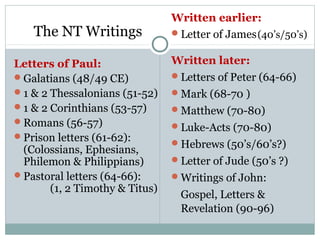
Letters of Paul:                Written later:
Galatians (48/49 CE)           Letters of Peter (64-66)
1 & 2 Thessalonians (51-52)    Mark (68-70 )
1 & 2 Corinthians (53-57)      Matthew (70-80)
Romans (56-57)                 Luke-Acts (70-80)
Prison letters (61-62):
                                Hebrews (50’s/60’s?)
 (Colossians, Ephesians,
 Philemon & Philippians)        Letter of Jude (50’s ?)
Pastoral letters (64-66):      Writings of John:
       (1, 2 Timothy & Titus)
                                 Gospel, Letters &
                                 Revelation (90-96)
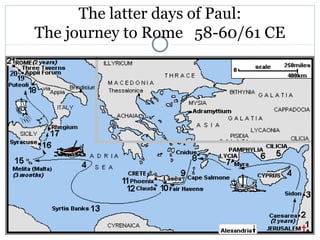
The latter days of Paul:
The journey to Rome 58-60/61 CE
The end of Acts

“When we got to Rome, Paul was allowed to live by
 himself, with a soldier to guard him... For two
 whole years Paul stayed there in his own rented
 house and welcomed all who came to see him.
Boldly and without hindrance he preached the
 kingdom of God and taught about the Lord Jesus
 Christ.” (28:16, 30-31)
But what happened next?
Imprisonment in Rome ends 62/63 CE
“Prison letters” written and sent out
 cf. Phil. 1:19, 25-26; 2:24 & Philemon 22 62/63 CE
Off to Spain? (Romans 15:19-24, 28)
Back to Macedonia/ Greece? (1 Tim. 1:3)
A visit to Crete? (Titus 1:5)
Winter in Nicopolis (Titus 3:12) – by which time he
 has written 1 Timothy & Titus.
Arrest & 2nd Roman imprisonment         65 CE
2 Tim. 4:6-8 (The end is near)
Death (beheaded) under Nero             66/67 CE
Pastoral Letters?
1 & 2 Timothy; Titus
Context: Roman imprisonment 60/61-62/63 CE
  Subsequent release & period of ministry:
 1 Tim. c. 65-66 CE (From Macedonia?)
 Titus c.65-66 CE (From Macedonia?)
 2 Tim. c.67 CE (From prison in Rome)

“Together, they form an early manual for pastoral
  theology and church discipline.”
Pastoral Letters - Distinctives
The final letters of Paul
Addressed to individuals (closest friends)
Many instructions & very personal
Charge to teach/ keep “the faith”
Instructions to “pass on” to the next    generation
 of leaders (2 Tim. 2:2)
Faithful sayings & rules of faith
Instructions on leadership structures
The Purpose

“I am writing you these instructions so that, if I am
  delayed, you will know how people ought to
  conduct themselves in God's household,
  which is the church of the living God, the pillar and
  foundation of the truth.” (1 Tim. 3:14-15)

“Watch your life and doctrine closely”
                                          (1 Tim. 4:16)
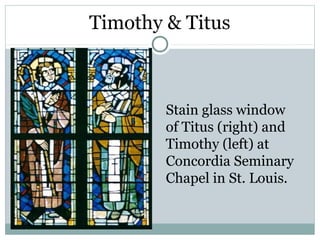
Timothy & Titus


        Stain glass window
        of Titus (right) and
        Timothy (left) at
        Concordia Seminary
        Chapel in St. Louis.
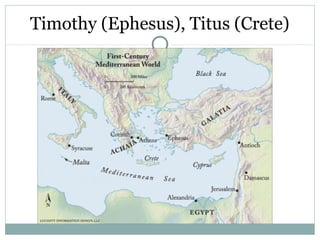
Timothy (Ephesus), Titus (Crete)
Who was Timothy?
A convert from Lystra (1st miss. journey)
Mother (Eunice) & Grandmother (Lois) Jewish/
 believers, father a Greek. Taught the scriptures “from
 infancy” (Acts 16:1; 2 Tim. 3:15)
“my true son in the faith” (1 Tim.1:2, 18; 2 Tim.1:2; 2:1)
Joins the mission team (2nd miss. journey – Acts 16:1)
Circumcised (by Paul)! – Acts 16:3
Received spiritual gifts for ministry (1 Tim.4:14/ 2 Tim.1:6)
Paul’s trusted co-worker (Phil.2:22; 1 Thess.3:2; 1 Cor.16:10)
Experiences in Ephesus (3rd miss. Journey Acts 18-19)
Commissioned to Ephesus (1 Tim. 1:3)
Who was Titus?
A Greek convert (from Antioch?)
“my true son in our common faith” (Titus 1:4)
Accompanies Paul to Jerusalem Council (Gal. 2:1)
Though, not circumcised! – Gal. 2:3
Connections to Corinth: “my brother Titus”
 (2 Cor. 2:2; 7:6, 13-15; 8:6, 16-24; 12:18)
“my partner and co-worker” (2 Cor. 8:23)
Mission to Crete (remains there) – Titus 1:5
Sent to Dalmatia (NE of Macedonia/ modern Croatia)
     by Paul near end of life (2 Tim. 4:10)
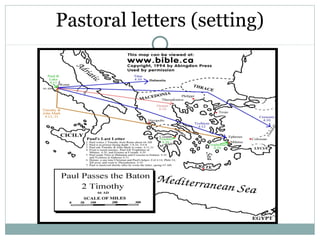
Pastoral letters (setting)
Pastoral letters

Basic problems:

Increasing threat of false teaching (mix of
 Jewish Legalism & Early Gnosticism)

Need to establish mature leadership &
 orderly structure within the churches
What is Gnosticism?

‘Gnostic’ = from Gk. gnosis (knowledge)
A synthesis of religion, philosophy & myth
The second major heresy to confront Christianity
 (2nd Century)
Yet it was already starting to emerge in the 1 st
 Century (ie. Colossians, the Pastoral letters & the
 Writings of John)
Because the gospel had penetrated pagan culture
 (infiltration – transformation – contamination)
Origins of Gnosticism

Confusing, varied & debatable.

From an ancient Oriental religion?
    Persian (Zoroastrian/ Mesopotamian), Indian.
From pre-Christian Judaism?
    Apocalyptic, mystical (Yahweh, angels, salvation).
From non-orthodox Christianity?
    Jesus & “Christian” terminology.
From late Hellenistic (Greek) philosophy?
    Plato (d. 348 BCE) & Dualism.
Gnosticism Characterized
1.   This world (inc. the body) is unredeemably bad.
2.   God is completely transcendent (& unknowable).
3.   Between God & the world are numerous
     intermediate spirit-beings, called aeons,
     one (or more) of whom made this world.
4.   Somehow, some of the divine spark was trapped in
     the world and remains in (some) humans.
5.   The Redeemer (last aeon) came down to give
     knowledge by which some humans may be saved.
6.   Salvation = escaping from the world, by means of
     self-knowledge & access to secret mysteries.
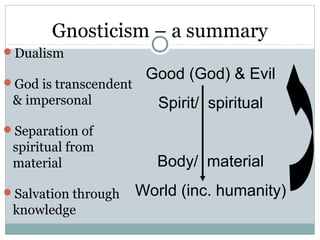
Gnosticism – a summary
Dualism

God is transcendent
                        Good (God) & Evil
 & impersonal             Spirit/ spiritual
Separation of
 spiritual from
 material                 Body/ material
Salvation through     World (inc. humanity)
 knowledge
Categories of humanity
Humans are divided into 3 classes:
    Hylic – earthly, material
      Incapable of salvation
    Psychic – animal, soulish, spiritual
      Capable of salvation
        Need to accept Gnostic teachings
        Usually orthodox Christians are put in this class
    Pneumatic – spiritual
      Already saved by   nature of being “spiritual”
        Typically, the Gnostic leaders
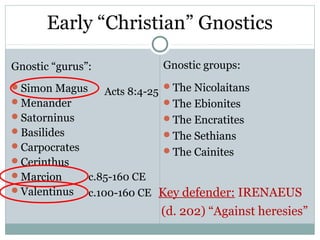
Early “Christian” Gnostics

Gnostic “gurus”:              Gnostic groups:
Simon Magus       Acts 8:4-25 The Nicolaitans
Menander                      The Ebionites
Satorninus                   The Encratites
Basilides                    The Sethians
Carpocrates
                              The Cainites
Cerinthus
Marcion       c.85-160 CE
Valentinus    c.100-160 CE Key defender: IRENAEUS
                             (d. 202) “Against heresies”
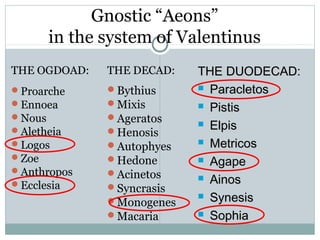
Gnostic “Aeons”
      in the system of Valentinus
THE OGDOAD:   THE DECAD:   THE DUODECAD:
Proarche     Bythius      Paracletos
Ennoea       Mixis        Pistis
Nous         Ageratos
                            Elpis
Aletheia     Henosis
Logos        Autophyes    Metricos
Zoe          Hedone       Agape
Anthropos    Acinetos     Ainos
Ecclesia     Syncrasis
                            Synesis
              Monogenes
              Macaria      Sophia
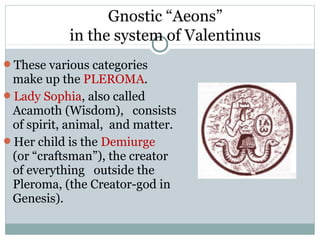
Gnostic “Aeons”
           in the system of Valentinus
These various categories
 make up the PLEROMA.
Lady Sophia, also called
 Acamoth (Wisdom), consists
 of spirit, animal, and matter.
Her child is the Demiurge
 (or “craftsman”), the creator
 of everything outside the
 Pleroma, (the Creator-god in
 Genesis).
Christ = the answer to our hunger

“For God was pleased to have all his fullness
 (pleroma) dwell in him” Colossians 1:19
“For in Christ all the fullness of deity lives in
 bodily form, and in Christ you have been brought
 to fullness. He is the head over every power and
 authority.” Col. 2:9
 see also John 1:1-18 (“from the fullness of his grace
 we have received one blessing after another”)
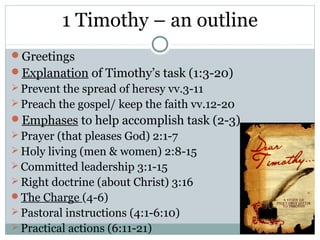
1 Timothy – an outline
Greetings
Explanation of Timothy’s task (1:3-20)
 Prevent the spread of heresy vv.3-11
 Preach the gospel/ keep the faith vv.12-20
Emphases to help accomplish task (2-3)
 Prayer (that pleases God) 2:1-7
 Holy living (men & women) 2:8-15
 Committed leadership 3:1-15
 Right doctrine (about Christ) 3:16
The Charge (4-6)
 Pastoral instructions (4:1-6:10)
 Practical actions (6:11-21)
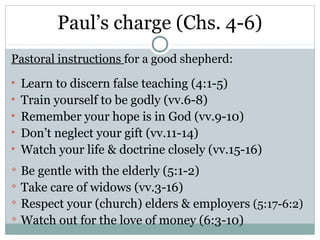
Paul’s charge (Chs. 4-6)
Pastoral instructions for a good shepherd:
•   Learn to discern false teaching (4:1-5)
•   Train yourself to be godly (vv.6-8)
•   Remember your hope is in God (vv.9-10)
•   Don’t neglect your gift (vv.11-14)
•   Watch your life & doctrine closely (vv.15-16)
   Be gentle with the elderly (5:1-2)
   Take care of widows (vv.3-16)
   Respect your (church) elders & employers (5:17-6:2)
   Watch out for the love of money (6:3-10)
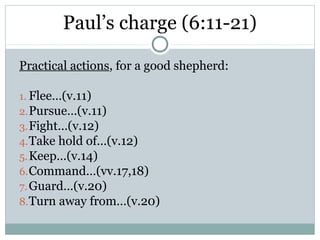
Paul’s charge (6:11-21)

Practical actions, for a good shepherd:

1. Flee…(v.11)
2. Pursue…(v.11)
3. Fight…(v.12)
4. Take hold of…(v.12)
5. Keep…(v.14)
6. Command…(vv.17,18)
7. Guard…(v.20)
8. Turn away from…(v.20)
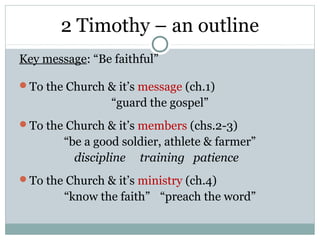
2 Timothy – an outline
Key message: “Be faithful”

To the Church & it’s message (ch.1)
                 “guard the gospel”
To the Church & it’s members (chs.2-3)
        “be a good soldier, athlete & farmer”
          discipline training patience
To the Church & it’s ministry (ch.4)
        “know the faith” “preach the word”
Titus – an outline
Greetings (1:1-4)
 “Finish what was started” (1:5-16)
 “Teach what is good” (2:1-15)
 “Do what is right” (3:1-11)
Closing remarks (3:12-15)


Christian living: “the truth that leads to godliness” (1:1)
 Theological basis (“The grace of God”)
 Ethical outworking (“Be ready to do whatever is good”)
How to spot a heresy and what to do about it.

Heresy = (GK. haeresis “ a choice, course of
 action…leads to a school of thought”)
Orthodoxy = (ortho – straight; doxa – belief)


Therefore a heresy = a deliberate choice to
 deviate from an accepted belief, and continue to
 pursue that choice until it leads to an
 entrenched unorthodox position.
How the early church dealt with heresy

The place of scripture - 2 Tim. 3:16-17


The rule of faith - 1 Tim. 3:16


The role of the bishop (episcopos) & pastor/priests
 (presbyter) - 1 Tim. 3/ Titus 1
The early Christians

“Then Jesus came to them and said, ‘All authority in
 heaven and on earth has been given to me. Therefore
 having gone, make disciples of all nations,
 baptizing them in the name of the Father and of
 the Son and of the Holy Spirit, and teaching them
 to obey everything I have commanded you.’”

“They devoted themselves to the apostles'
 teaching/doctrine.” (Acts 2:42)
Emergence of right theology

The rule of faith      The faithful sayings


Short summary of        Short statements of
 doctrine to shape or    truth to shape our
 knowledge and           attitudes and values.
 beliefs.
The “Rule of faith”

Keep the pattern of sound teaching/
 doctrine (2 Tim. 1:13)
The time will come when people will not put
 up with sound doctrine. (2 Tim. 4:3)
Watch your life and doctrine closely.  (1
 Tim. 4:16)
You must teach what is in accord with
 sound doctrine. (Titus 2:1)
Sound doctrine/ teaching

What we believe about God, the trinity
 Father Jesus the Christ Holy Spirit

What we believe about salvation
 Past      Present     Future

What we believe about the people of God
 One people (Israel-Church)
 One, holy, catholic & apostolic body of Christ
The mystery of godliness

The heart of good theology:

“He appeared in a body,
  was vindicated by the Spirit,
 was seen by angels,
  was preached among the nations,
 was believed on in the world,
  was taken up in glory.” (3:16)
Church leaders & good theology

They (overseers) must hold firmly to the trust-
 worthy message as it has been taught, so that
 they can encourage others by sound doctrine
 and refute those who oppose it. (Titus 1:9)
Deacons, likewise...must keep hold of the deep
 truths of the faith with a clear conscience.
                                         (1 Tim.3:9)
CHURCH
LEADERSHIP
LEADERSHIP

Biblical terms for leaders:

ELDER (presbuteros)


OVERSEER/ BISHOP (episkopos)


SHEPHERD/PASTOR (poimen)


SERVANT/ DEACON (diakonos – not doulos)
Qualifications for leaders

Character       cf. Acts 14:23
                       Acts 20:27, 28
Competence            1 Tim. 3:1-7
                       1 Tim. 5:17-20
Commitment            Titus 1:4-9
                       1 Peter 2:25
Chemistry             1 Peter 5:1-4
                       James 5:14-16
“Overseers”
1. “If anyone sets their heart on      They must manage their own family well
  being an overseer, they desires a            and see that their children obey
  noble task”                                  them with proper respect.
                                      (If anyone does not know how to manage
2. above reproach
                                               their own family, how can they
3. the husband of but one wife                 take care of God's church?)
4. temperate
5. self-controlled                     They must not be a recent convert,

6. respectable                                 or they may become conceited
                                               and fall under the same judgment
7. hospitable                                            as the devil.
8. able to teach
9. not given to drunkenness            They must also have a good reputation

10.not violent but gentle                     with outsiders,
                                              so that he will not fall into
11.not quarrelsome
                                        disgrace and into the devil's trap.
12.not a lover of money
They must keep hold of the deep
           “Deacons”                        truths of the faith
                                            with a clear conscience
Deacons, likewise, are to be:            They must first be tested;
                                            and then if there is nothing against
1. worthy of respect
                                            them, let them serve as deacons.
2. sincere                               In the same way, their wives are to be
3. not indulging in much wine               women worthy of respect,
                                            not malicious talkers
4. not pursuing dishonest gain
                                            but temperate and trustworthy in
                                            everything.
Summary:
                                         A deacon must be the husband of but
I am writing you these instructions so
                                            one wife
   …you will know how people ought
   to conduct themselves in God's           and must manage his children and
                                            his household well
   household, which is the church of
   the living God, the pillar and        Those who have served well gain
   foundation of the truth. (vv.14-15)      an excellent standing and
                                            great assurance in their faith in
                                            Christ Jesus.
Women in leadership?

“A woman should learn in quietness and full
 submission. I do not permit a woman to teach
 or to have authority over a man; she must be
 silent. For Adam was formed first, then Eve.
 And Adam was not the one deceived; it was the
 woman who was deceived and became a sinner.
 But women will be saved through childbearing
 —if they continue in faith, love and holiness
 with propriety.” (1 Tim. 2:11-15)
Women in leadership?
Principles:
1. Get the big picture first.
2. Start at the beginning (Genesis 1-2).
3. Remember we are fallen (Gen. 3:16).
4. Look for the norm (& exceptions) in the OT.
5. How did Jesus treat/ teach women.
6. The Spirit has come/ the church is formed (Acts 2).
7. “In Christ there is no male or female” (Gal. 3:28).
8. The list of Paul’s “co-workers” (Romans 16).
9. Interpret the unclear in light of the clear.
10.Where is scripture heading?
Women in leadership?
A woman should learn with a quiet disposition and
 complete submission (to those gifted to teach). I am
 not permitting a woman to teach or to assume (for
 herself) authority over a man; such a woman must
 be quiet.
For Adam was formed first, then Eve. And Adam was
 not the one deceived; it was the woman who was
 deceived and became a sinner.
But they (women) will be saved through the childbirth
 —if she continues in faith, love and holiness with
 propriety. (1 Tim. 2:11-15)
Women in leadership?
“As in all the congregations of the saints, women
 should remain silent in the churches. They are
 not allowed to speak, but must be in submission,
 as the Law says. If they want to inquire about
 something, they should ask their own husbands
 at home; for it is disgraceful for a woman to speak
 in the church.” (1 Cor. 14:33b-35)

“Every women who prays or prophesies…”
                 (1 Cor. 11:5)
“
 What then shall we say, brothers and sisters? When you come together, everyone
     has a hymn, or a word of instruction, a revelation, a tongue or an interpretation.
     All of these must be done for the strengthening of the church. 27If anyone speaks in
     a tongue, two—or at the most three—should speak, one at a time, and someone
     must interpret. 28If there is no interpreter, the speaker should keep quiet in the
     church and speak to himself and God. 29Two or three prophets should speak, and
     the others should weigh carefully what is said. 30And if a revelation comes to
     someone who is sitting down, the first speaker should stop. 31For you can all
     prophesy in turn so that everyone may be instructed and encouraged. 32The spirits
     of prophets are subject to the control of prophets. 33For God is not a God of
     disorder but of peace, as in all the congregations of the saints.
34
   Women should remain silent in the churches. They are not allowed to speak, but
     must be in submission, as the Law says. 35If they want to inquire about something,
     they should ask their own husbands at home; for it is disgraceful for a woman to
     speak in the church. 36Did the word of God originate with you? Or are you the
     only people it has reached? 37If anyone thinks they are a prophet or spiritually
     gifted, let them acknowledge that what I am writing to you is the Lord's
     command. 38If they ignore this, they themselves will be ignored.
 39
    Therefore, my brothers and sisters, be eager to prophesy, and do not forbid
     speaking in tongues. 40But everything should be done in a fitting and orderly way.
     (1 Cor. 14:26-40)
THE FAITHFUL
  SAYINGS
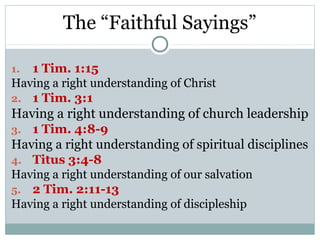
The “Faithful Sayings”

1. 1 Tim. 1:15
Having a right understanding of Christ
2. 1 Tim. 3:1
Having a right understanding of church leadership
3. 1 Tim. 4:8-9
Having a right understanding of spiritual disciplines
4. Titus 3:4-8
Having a right understanding of our salvation
5. 2 Tim. 2:11-13
Having a right understanding of discipleship
#1. 1 Tim.1:15

“Here is a trustworthy saying that
 deserves full acceptance:
 Christ Jesus came into the world to save
 sinners - of whom I am the worst.”
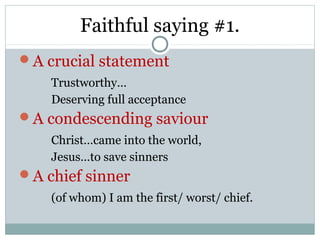
Faithful saying #1.
A crucial statement
    Trustworthy…
    Deserving full acceptance
A condescending saviour
    Christ…came into the world,
    Jesus…to save sinners
A chief sinner
    (of whom) I am the first/ worst/ chief.
#2. 1 Tim. 3:1

“Here is a trustworthy saying:
 Whoever aspires to be an overseer
 desires a noble task.”

This is a true saying, if a man desire the
 office of a bishop, he desireth a good
 work. (KJV)
#3. 1 Tim. 4:8-9

Bodily exercise profiteth little: but godliness is
 profitable unto all things…(KJV)

For physical training is of some value, but godliness has
 value for all things, holding promise for both the
 present life and the life to come. This is a trustworthy
 saying that deserves full acceptance (NIV)

Exercise daily in God—no spiritual flabbiness, please!
 Workouts in the gymnasium are useful, but a
 disciplined life in God is far more so, making you fit
 both today and forever. You can count on this. Take
 it to heart. (The Message)
#4. Titus 3:4-8
But when the kindness and love of God our Savior
 appeared, he saved us, not because of righteous
 things we had done, but because of his mercy. He
 saved us through the washing of rebirth and renewal
 by the Holy Spirit, whom he poured out on us
 generously through Jesus Christ our Savior, so that,
 having been justified by his grace, we might become
 heirs having the hope of eternal life.
This is a trustworthy saying. And I want you to stress
 these things, so that those who have trusted in God
 may be careful to devote themselves to doing what
 is good. These things are excellent and profitable
 for everyone.
#5. 2 Tim. 2:11-13

Here is a trustworthy saying:

 If we died with him,
     we will also live with him;
 if we endure,
     we will also reign with him.
 If we disown him,
     he will also disown us;
 if we are faithless,
     he remains faithful,
     for he cannot disown himself.

NT Session 6 Pastoral Letters

  • 1.
    Foundations (Year Two) “Encounteringthe New Testament” Session #6. Encountering 1 & 2 TIMOTHY and TITUS.
  • 2.
    Written earlier: The NT Writings Letter of James (40’s/50’s) Letters of Paul: Written later: Galatians (48/49 CE) Letters of Peter (64-66) 1 & 2 Thessalonians (51-52) Mark (68-70 ) 1 & 2 Corinthians (53-57) Matthew (70-80) Romans (56-57) Luke-Acts (70-80) Prison letters (61-62): Hebrews (50’s/60’s?) (Colossians, Ephesians, Philemon & Philippians) Letter of Jude (50’s ?) Pastoral letters (64-66): Writings of John: (1, 2 Timothy & Titus) Gospel, Letters & Revelation (90-96)
  • 3.
    The latter daysof Paul: The journey to Rome 58-60/61 CE
  • 4.
    The end ofActs “When we got to Rome, Paul was allowed to live by himself, with a soldier to guard him... For two whole years Paul stayed there in his own rented house and welcomed all who came to see him. Boldly and without hindrance he preached the kingdom of God and taught about the Lord Jesus Christ.” (28:16, 30-31)
  • 5.
    But what happenednext? Imprisonment in Rome ends 62/63 CE “Prison letters” written and sent out cf. Phil. 1:19, 25-26; 2:24 & Philemon 22 62/63 CE Off to Spain? (Romans 15:19-24, 28) Back to Macedonia/ Greece? (1 Tim. 1:3) A visit to Crete? (Titus 1:5) Winter in Nicopolis (Titus 3:12) – by which time he has written 1 Timothy & Titus. Arrest & 2nd Roman imprisonment 65 CE 2 Tim. 4:6-8 (The end is near) Death (beheaded) under Nero 66/67 CE
  • 6.
    Pastoral Letters? 1 &2 Timothy; Titus Context: Roman imprisonment 60/61-62/63 CE Subsequent release & period of ministry:  1 Tim. c. 65-66 CE (From Macedonia?)  Titus c.65-66 CE (From Macedonia?)  2 Tim. c.67 CE (From prison in Rome) “Together, they form an early manual for pastoral theology and church discipline.”
  • 7.
    Pastoral Letters -Distinctives The final letters of Paul Addressed to individuals (closest friends) Many instructions & very personal Charge to teach/ keep “the faith” Instructions to “pass on” to the next generation of leaders (2 Tim. 2:2) Faithful sayings & rules of faith Instructions on leadership structures
  • 8.
    The Purpose “I amwriting you these instructions so that, if I am delayed, you will know how people ought to conduct themselves in God's household, which is the church of the living God, the pillar and foundation of the truth.” (1 Tim. 3:14-15) “Watch your life and doctrine closely” (1 Tim. 4:16)
  • 9.
    Timothy & Titus Stain glass window of Titus (right) and Timothy (left) at Concordia Seminary Chapel in St. Louis.
  • 10.
  • 11.
    Who was Timothy? Aconvert from Lystra (1st miss. journey) Mother (Eunice) & Grandmother (Lois) Jewish/ believers, father a Greek. Taught the scriptures “from infancy” (Acts 16:1; 2 Tim. 3:15) “my true son in the faith” (1 Tim.1:2, 18; 2 Tim.1:2; 2:1) Joins the mission team (2nd miss. journey – Acts 16:1) Circumcised (by Paul)! – Acts 16:3 Received spiritual gifts for ministry (1 Tim.4:14/ 2 Tim.1:6) Paul’s trusted co-worker (Phil.2:22; 1 Thess.3:2; 1 Cor.16:10) Experiences in Ephesus (3rd miss. Journey Acts 18-19) Commissioned to Ephesus (1 Tim. 1:3)
  • 12.
    Who was Titus? AGreek convert (from Antioch?) “my true son in our common faith” (Titus 1:4) Accompanies Paul to Jerusalem Council (Gal. 2:1) Though, not circumcised! – Gal. 2:3 Connections to Corinth: “my brother Titus” (2 Cor. 2:2; 7:6, 13-15; 8:6, 16-24; 12:18) “my partner and co-worker” (2 Cor. 8:23) Mission to Crete (remains there) – Titus 1:5 Sent to Dalmatia (NE of Macedonia/ modern Croatia) by Paul near end of life (2 Tim. 4:10)
  • 13.
  • 14.
    Pastoral letters Basic problems: Increasingthreat of false teaching (mix of Jewish Legalism & Early Gnosticism) Need to establish mature leadership & orderly structure within the churches
  • 15.
    What is Gnosticism? ‘Gnostic’= from Gk. gnosis (knowledge) A synthesis of religion, philosophy & myth The second major heresy to confront Christianity (2nd Century) Yet it was already starting to emerge in the 1 st Century (ie. Colossians, the Pastoral letters & the Writings of John) Because the gospel had penetrated pagan culture (infiltration – transformation – contamination)
  • 16.
    Origins of Gnosticism Confusing,varied & debatable. From an ancient Oriental religion?  Persian (Zoroastrian/ Mesopotamian), Indian. From pre-Christian Judaism?  Apocalyptic, mystical (Yahweh, angels, salvation). From non-orthodox Christianity?  Jesus & “Christian” terminology. From late Hellenistic (Greek) philosophy?  Plato (d. 348 BCE) & Dualism.
  • 17.
    Gnosticism Characterized 1. This world (inc. the body) is unredeemably bad. 2. God is completely transcendent (& unknowable). 3. Between God & the world are numerous intermediate spirit-beings, called aeons, one (or more) of whom made this world. 4. Somehow, some of the divine spark was trapped in the world and remains in (some) humans. 5. The Redeemer (last aeon) came down to give knowledge by which some humans may be saved. 6. Salvation = escaping from the world, by means of self-knowledge & access to secret mysteries.
  • 18.
    Gnosticism – asummary Dualism God is transcendent Good (God) & Evil & impersonal Spirit/ spiritual Separation of spiritual from material Body/ material Salvation through World (inc. humanity) knowledge
  • 19.
    Categories of humanity Humansare divided into 3 classes:  Hylic – earthly, material  Incapable of salvation  Psychic – animal, soulish, spiritual  Capable of salvation  Need to accept Gnostic teachings  Usually orthodox Christians are put in this class  Pneumatic – spiritual  Already saved by nature of being “spiritual”  Typically, the Gnostic leaders
  • 20.
    Early “Christian” Gnostics Gnostic“gurus”: Gnostic groups: Simon Magus Acts 8:4-25 The Nicolaitans Menander The Ebionites Satorninus The Encratites Basilides The Sethians Carpocrates The Cainites Cerinthus Marcion c.85-160 CE Valentinus c.100-160 CE Key defender: IRENAEUS (d. 202) “Against heresies”
  • 21.
    Gnostic “Aeons” in the system of Valentinus THE OGDOAD: THE DECAD: THE DUODECAD: Proarche Bythius  Paracletos Ennoea Mixis  Pistis Nous Ageratos  Elpis Aletheia Henosis Logos Autophyes  Metricos Zoe Hedone  Agape Anthropos Acinetos  Ainos Ecclesia Syncrasis  Synesis Monogenes Macaria  Sophia
  • 22.
    Gnostic “Aeons” in the system of Valentinus These various categories make up the PLEROMA. Lady Sophia, also called Acamoth (Wisdom), consists of spirit, animal, and matter. Her child is the Demiurge (or “craftsman”), the creator of everything outside the Pleroma, (the Creator-god in Genesis).
  • 23.
    Christ = theanswer to our hunger “For God was pleased to have all his fullness (pleroma) dwell in him” Colossians 1:19 “For in Christ all the fullness of deity lives in bodily form, and in Christ you have been brought to fullness. He is the head over every power and authority.” Col. 2:9  see also John 1:1-18 (“from the fullness of his grace we have received one blessing after another”)
  • 24.
    1 Timothy –an outline Greetings Explanation of Timothy’s task (1:3-20)  Prevent the spread of heresy vv.3-11  Preach the gospel/ keep the faith vv.12-20 Emphases to help accomplish task (2-3)  Prayer (that pleases God) 2:1-7  Holy living (men & women) 2:8-15  Committed leadership 3:1-15  Right doctrine (about Christ) 3:16 The Charge (4-6)  Pastoral instructions (4:1-6:10)  Practical actions (6:11-21)
  • 25.
    Paul’s charge (Chs.4-6) Pastoral instructions for a good shepherd: • Learn to discern false teaching (4:1-5) • Train yourself to be godly (vv.6-8) • Remember your hope is in God (vv.9-10) • Don’t neglect your gift (vv.11-14) • Watch your life & doctrine closely (vv.15-16)  Be gentle with the elderly (5:1-2)  Take care of widows (vv.3-16)  Respect your (church) elders & employers (5:17-6:2)  Watch out for the love of money (6:3-10)
  • 26.
    Paul’s charge (6:11-21) Practicalactions, for a good shepherd: 1. Flee…(v.11) 2. Pursue…(v.11) 3. Fight…(v.12) 4. Take hold of…(v.12) 5. Keep…(v.14) 6. Command…(vv.17,18) 7. Guard…(v.20) 8. Turn away from…(v.20)
  • 27.
    2 Timothy –an outline Key message: “Be faithful” To the Church & it’s message (ch.1) “guard the gospel” To the Church & it’s members (chs.2-3) “be a good soldier, athlete & farmer” discipline training patience To the Church & it’s ministry (ch.4) “know the faith” “preach the word”
  • 28.
    Titus – anoutline Greetings (1:1-4)  “Finish what was started” (1:5-16)  “Teach what is good” (2:1-15)  “Do what is right” (3:1-11) Closing remarks (3:12-15) Christian living: “the truth that leads to godliness” (1:1)  Theological basis (“The grace of God”)  Ethical outworking (“Be ready to do whatever is good”)
  • 29.
    How to spota heresy and what to do about it. Heresy = (GK. haeresis “ a choice, course of action…leads to a school of thought”) Orthodoxy = (ortho – straight; doxa – belief) Therefore a heresy = a deliberate choice to deviate from an accepted belief, and continue to pursue that choice until it leads to an entrenched unorthodox position.
  • 30.
    How the earlychurch dealt with heresy The place of scripture - 2 Tim. 3:16-17 The rule of faith - 1 Tim. 3:16 The role of the bishop (episcopos) & pastor/priests (presbyter) - 1 Tim. 3/ Titus 1
  • 31.
    The early Christians “ThenJesus came to them and said, ‘All authority in heaven and on earth has been given to me. Therefore having gone, make disciples of all nations, baptizing them in the name of the Father and of the Son and of the Holy Spirit, and teaching them to obey everything I have commanded you.’” “They devoted themselves to the apostles' teaching/doctrine.” (Acts 2:42)
  • 32.
    Emergence of righttheology The rule of faith The faithful sayings Short summary of Short statements of doctrine to shape or truth to shape our knowledge and attitudes and values. beliefs.
  • 33.
    The “Rule offaith” Keep the pattern of sound teaching/ doctrine (2 Tim. 1:13) The time will come when people will not put up with sound doctrine. (2 Tim. 4:3) Watch your life and doctrine closely. (1 Tim. 4:16) You must teach what is in accord with sound doctrine. (Titus 2:1)
  • 34.
    Sound doctrine/ teaching Whatwe believe about God, the trinity  Father Jesus the Christ Holy Spirit What we believe about salvation  Past Present Future What we believe about the people of God  One people (Israel-Church)  One, holy, catholic & apostolic body of Christ
  • 35.
    The mystery ofgodliness The heart of good theology: “He appeared in a body, was vindicated by the Spirit, was seen by angels, was preached among the nations, was believed on in the world, was taken up in glory.” (3:16)
  • 36.
    Church leaders &good theology They (overseers) must hold firmly to the trust- worthy message as it has been taught, so that they can encourage others by sound doctrine and refute those who oppose it. (Titus 1:9) Deacons, likewise...must keep hold of the deep truths of the faith with a clear conscience. (1 Tim.3:9)
  • 37.
  • 38.
    LEADERSHIP Biblical terms forleaders: ELDER (presbuteros) OVERSEER/ BISHOP (episkopos) SHEPHERD/PASTOR (poimen) SERVANT/ DEACON (diakonos – not doulos)
  • 39.
    Qualifications for leaders Character cf. Acts 14:23 Acts 20:27, 28 Competence 1 Tim. 3:1-7 1 Tim. 5:17-20 Commitment Titus 1:4-9 1 Peter 2:25 Chemistry 1 Peter 5:1-4 James 5:14-16
  • 40.
    “Overseers” 1. “If anyonesets their heart on  They must manage their own family well being an overseer, they desires a and see that their children obey noble task” them with proper respect. (If anyone does not know how to manage 2. above reproach their own family, how can they 3. the husband of but one wife take care of God's church?) 4. temperate 5. self-controlled  They must not be a recent convert, 6. respectable or they may become conceited and fall under the same judgment 7. hospitable as the devil. 8. able to teach 9. not given to drunkenness  They must also have a good reputation 10.not violent but gentle with outsiders, so that he will not fall into 11.not quarrelsome disgrace and into the devil's trap. 12.not a lover of money
  • 41.
    They must keephold of the deep “Deacons” truths of the faith with a clear conscience Deacons, likewise, are to be: They must first be tested; and then if there is nothing against 1. worthy of respect them, let them serve as deacons. 2. sincere In the same way, their wives are to be 3. not indulging in much wine women worthy of respect, not malicious talkers 4. not pursuing dishonest gain but temperate and trustworthy in everything. Summary: A deacon must be the husband of but I am writing you these instructions so one wife …you will know how people ought to conduct themselves in God's and must manage his children and his household well household, which is the church of the living God, the pillar and Those who have served well gain foundation of the truth. (vv.14-15) an excellent standing and great assurance in their faith in Christ Jesus.
  • 42.
    Women in leadership? “Awoman should learn in quietness and full submission. I do not permit a woman to teach or to have authority over a man; she must be silent. For Adam was formed first, then Eve. And Adam was not the one deceived; it was the woman who was deceived and became a sinner. But women will be saved through childbearing —if they continue in faith, love and holiness with propriety.” (1 Tim. 2:11-15)
  • 43.
    Women in leadership? Principles: 1.Get the big picture first. 2. Start at the beginning (Genesis 1-2). 3. Remember we are fallen (Gen. 3:16). 4. Look for the norm (& exceptions) in the OT. 5. How did Jesus treat/ teach women. 6. The Spirit has come/ the church is formed (Acts 2). 7. “In Christ there is no male or female” (Gal. 3:28). 8. The list of Paul’s “co-workers” (Romans 16). 9. Interpret the unclear in light of the clear. 10.Where is scripture heading?
  • 44.
    Women in leadership? Awoman should learn with a quiet disposition and complete submission (to those gifted to teach). I am not permitting a woman to teach or to assume (for herself) authority over a man; such a woman must be quiet. For Adam was formed first, then Eve. And Adam was not the one deceived; it was the woman who was deceived and became a sinner. But they (women) will be saved through the childbirth —if she continues in faith, love and holiness with propriety. (1 Tim. 2:11-15)
  • 45.
    Women in leadership? “Asin all the congregations of the saints, women should remain silent in the churches. They are not allowed to speak, but must be in submission, as the Law says. If they want to inquire about something, they should ask their own husbands at home; for it is disgraceful for a woman to speak in the church.” (1 Cor. 14:33b-35) “Every women who prays or prophesies…” (1 Cor. 11:5)
  • 46.
    “ What thenshall we say, brothers and sisters? When you come together, everyone has a hymn, or a word of instruction, a revelation, a tongue or an interpretation. All of these must be done for the strengthening of the church. 27If anyone speaks in a tongue, two—or at the most three—should speak, one at a time, and someone must interpret. 28If there is no interpreter, the speaker should keep quiet in the church and speak to himself and God. 29Two or three prophets should speak, and the others should weigh carefully what is said. 30And if a revelation comes to someone who is sitting down, the first speaker should stop. 31For you can all prophesy in turn so that everyone may be instructed and encouraged. 32The spirits of prophets are subject to the control of prophets. 33For God is not a God of disorder but of peace, as in all the congregations of the saints. 34 Women should remain silent in the churches. They are not allowed to speak, but must be in submission, as the Law says. 35If they want to inquire about something, they should ask their own husbands at home; for it is disgraceful for a woman to speak in the church. 36Did the word of God originate with you? Or are you the only people it has reached? 37If anyone thinks they are a prophet or spiritually gifted, let them acknowledge that what I am writing to you is the Lord's command. 38If they ignore this, they themselves will be ignored. 39 Therefore, my brothers and sisters, be eager to prophesy, and do not forbid speaking in tongues. 40But everything should be done in a fitting and orderly way. (1 Cor. 14:26-40)
  • 47.
  • 48.
    The “Faithful Sayings” 1.1 Tim. 1:15 Having a right understanding of Christ 2. 1 Tim. 3:1 Having a right understanding of church leadership 3. 1 Tim. 4:8-9 Having a right understanding of spiritual disciplines 4. Titus 3:4-8 Having a right understanding of our salvation 5. 2 Tim. 2:11-13 Having a right understanding of discipleship
  • 49.
    #1. 1 Tim.1:15 “Hereis a trustworthy saying that deserves full acceptance: Christ Jesus came into the world to save sinners - of whom I am the worst.”
  • 50.
    Faithful saying #1. Acrucial statement Trustworthy… Deserving full acceptance A condescending saviour Christ…came into the world, Jesus…to save sinners A chief sinner (of whom) I am the first/ worst/ chief.
  • 51.
    #2. 1 Tim.3:1 “Here is a trustworthy saying: Whoever aspires to be an overseer desires a noble task.” This is a true saying, if a man desire the office of a bishop, he desireth a good work. (KJV)
  • 52.
    #3. 1 Tim.4:8-9 Bodily exercise profiteth little: but godliness is profitable unto all things…(KJV) For physical training is of some value, but godliness has value for all things, holding promise for both the present life and the life to come. This is a trustworthy saying that deserves full acceptance (NIV) Exercise daily in God—no spiritual flabbiness, please! Workouts in the gymnasium are useful, but a disciplined life in God is far more so, making you fit both today and forever. You can count on this. Take it to heart. (The Message)
  • 53.
    #4. Titus 3:4-8 Butwhen the kindness and love of God our Savior appeared, he saved us, not because of righteous things we had done, but because of his mercy. He saved us through the washing of rebirth and renewal by the Holy Spirit, whom he poured out on us generously through Jesus Christ our Savior, so that, having been justified by his grace, we might become heirs having the hope of eternal life. This is a trustworthy saying. And I want you to stress these things, so that those who have trusted in God may be careful to devote themselves to doing what is good. These things are excellent and profitable for everyone.
  • 54.
    #5. 2 Tim.2:11-13 Here is a trustworthy saying: If we died with him, we will also live with him; if we endure, we will also reign with him. If we disown him, he will also disown us; if we are faithless, he remains faithful, for he cannot disown himself.