Session # 4: Encountering the
       Historical Books
  “Living out the covenant”

     Covering the books of
   Samuel, Kings & Chronicles
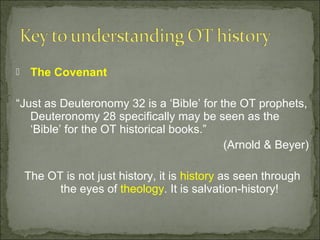
    The Covenant

“Just as Deuteronomy 32 is a ‘Bible’ for the OT prophets,
   Deuteronomy 28 specifically may be seen as the
   ‘Bible’ for the OT historical books.”
                                          (Arnold & Beyer)

    The OT is not just history, it is history as seen through
          the eyes of theology. It is salvation-history!
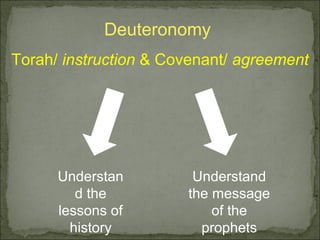
Deuteronomy
Torah/ instruction & Covenant/ agreement


      Understan         Understand
         d the         the message
      lessons of           of the
        history          prophets
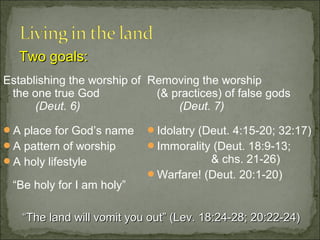
Two goals:
Establishing the worship of Removing the worship
 the one true God            (& practices) of false gods
      (Deut. 6)                  (Deut. 7)

A place for God’s name     Idolatry (Deut. 4:15-20; 32:17)
A pattern of worship       Immorality (Deut. 18:9-13;
A holy lifestyle                      & chs. 21-26)
                            Warfare! (Deut. 20:1-20)
 “Be holy for I am holy”

   “The land will vomit you out” (Lev. 18:24-28; 20:22-24)
“Soon you will cross the River, and if you
  obey the laws and teachings I'm
  giving you today, you will be strong
  enough to conquer the land that the
  LORD promised your ancestors and
  their descendants. It's rich with milk and
  honey, and you will live there and enjoy
  it for a long time.” (Deut.11:8-9 CEV)
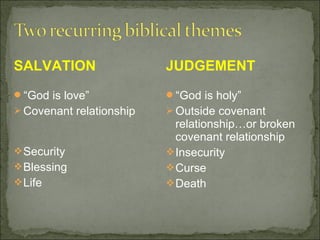
SALVATION                 JUDGEMENT
“God is love”            “God is holy”
 Covenant relationship    Outside covenant
                            relationship…or broken
                            covenant relationship
 Security                 Insecurity
 Blessing                 Curse
 Life                     Death
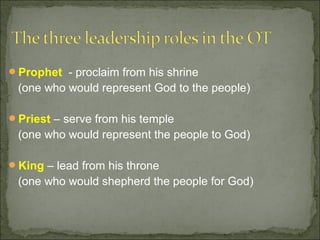
Prophet - proclaim from his shrine
 (one who would represent God to the people)

Priest – serve from his temple
 (one who would represent the people to God)

King – lead from his throne
 (one who would shepherd the people for God)
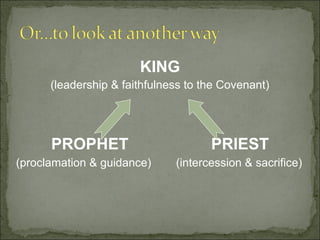
KING
      (leadership & faithfulness to the Covenant)


      PROPHET                        PRIEST
(proclamation & guidance)     (intercession & sacrifice)
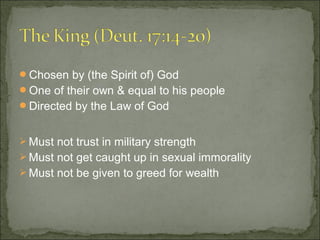
Chosen by (the Spirit of) God
One of their own & equal to his people
Directed by the Law of God


 Must not trust in military strength
 Must not get caught up in sexual immorality
 Must not be given to greed for wealth
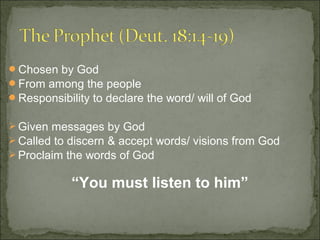
Chosen by God
From among the people
Responsibility to declare the word/ will of God

 Given messages by God
 Called to discern & accept words/ visions from God
 Proclaim the words of God


            “You must listen to him”
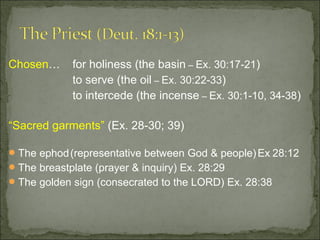
Chosen…     for holiness (the basin – Ex. 30:17-21)
            to serve (the oil – Ex. 30:22-33)
            to intercede (the incense – Ex. 30:1-10, 34-38)

“Sacred garments” (Ex. 28-30; 39)

 The ephod (representative between God & people) Ex. 28:12
 The breastplate (prayer & inquiry) Ex. 28:29
 The golden sign (consecrated to the LORD) Ex. 28:38
(HEB) Former Prophets: Joshua, Judges, Samuel, Kings
 (LXX) Samuel/ Kings becomes 1 book (1-4 Kingdoms)
 (Vulgate) 1-4 Kings
Author = an anonymous editor (1 Chron. 29:29)
 The records of Samuel, Nathan, Gad…Jasher (2 Sam . 1:18)
Theme = “The events of David’s reign” (cf. Ruth 4:13-22)
     (Prelude: Saul… Postlude: Solomon)
 God’s promise & covenant with David (2 Sam. 7;
 2 Chron. 21:7 - cf. Psalm 89:3-4; Is. 55:3; Jer. 33:14-22)
Time period: Monarchy 1050 - Divided monarchy 930 –
                   Exiles 722 & 586 BCE (just over 460 yrs.)
Days of the judges: Philistine oppression (1095-1055)
      Samson (1095/75-1055) / Samuel (c.1100-1000)

Saul anointed king (1050)

David anointed king (1010)

Solomon anointed king (970)
      Construction of temple begins (966)

Kingdom divided into Israel/ north & Judah/ south (930)
(1st historical record)
 1 Samuel: Birth of Samuel – Death of Saul
 2 Samuel: Reign of David
 1 Kings: Reign of Solomon – Passing of Elijah
 2 Kings: Ministry of Elisha – Fall of Jerusalem

(2nd historical record)
 1 Chronicles: Genealogy of Adam - Death of David
 2 Chronicles: Reign of Solomon – Fall of Jerusalem
 Priest (2:18; 9:12-13; 13:8-13)
  …anoints Saul (10:1) & David (16:13) as kings
  …records the responsibilities for the king (10:25)
 Prophet (3:20-21; 9:19 “the seer”; 19:20; ie.13:14; 15:22-23)
 Judge (ie. charismatic leader - 7:6, 15-17)

 Contemporary of Samson
 Second greatest prophet (after Moses)
           cf. Jer. 15:1; Acts 13:20; Hebrews 11:32
 Pivotal role in transition from confederacy to monarchy
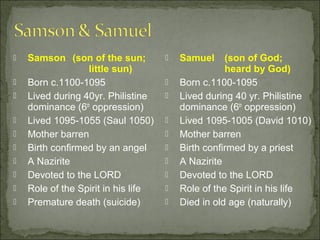
   Samson (son of the sun;             Samuel     (son of God;
                  little sun)                       heard by God)
   Born c.1100-1095                    Born c.1100-1095
   Lived during 40yr. Philistine       Lived during 40 yr. Philistine
    dominance (6th oppression)           dominance (6th oppression)
   Lived 1095-1055 (Saul 1050)         Lived 1095-1005 (David 1010)
   Mother barren                       Mother barren
   Birth confirmed by an angel         Birth confirmed by a priest
   A Nazirite                          A Nazirite
   Devoted to the LORD                 Devoted to the LORD
   Role of the Spirit in his life      Role of the Spirit in his life
   Premature death (suicide)           Died in old age (naturally)
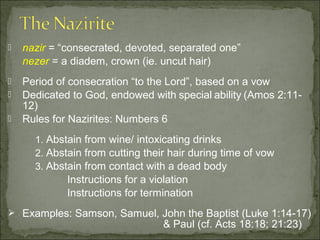
   nazir = “consecrated, devoted, separated one”
    nezer = a diadem, crown (ie. uncut hair)
   Period of consecration “to the Lord”, based on a vow
   Dedicated to God, endowed with special ability (Amos 2:11-
    12)
   Rules for Nazirites: Numbers 6
      1. Abstain from wine/ intoxicating drinks
      2. Abstain from cutting their hair during time of vow
      3. Abstain from contact with a dead body
             Instructions for a violation
             Instructions for termination
 Examples: Samson, Samuel, John the Baptist (Luke 1:14-17)
                                  & Paul (cf. Acts 18:18; 21:23)
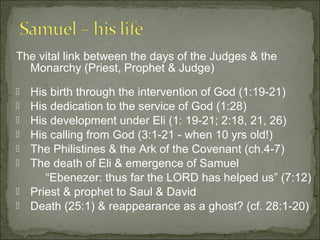
The vital link between the days of the Judges & the
  Monarchy (Priest, Prophet & Judge)
 His birth through the intervention of God (1:19-21)
 His dedication to the service of God (1:28)
 His development under Eli (1: 19-21; 2:18, 21, 26)
 His calling from God (3:1-21 - when 10 yrs old!)
 The Philistines & the Ark of the Covenant (ch.4-7)
 The death of Eli & emergence of Samuel
     “Ebenezer: thus far the LORD has helped us” (7:12)
 Priest & prophet to Saul & David
 Death (25:1) & reappearance as a ghost? (cf. 28:1-20)
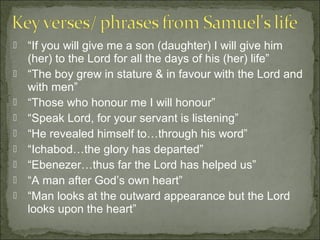
   “If you will give me a son (daughter) I will give him
    (her) to the Lord for all the days of his (her) life”
   “The boy grew in stature & in favour with the Lord and
    with men”
   “Those who honour me I will honour”
   “Speak Lord, for your servant is listening”
   “He revealed himself to…through his word”
   “Ichabod…the glory has departed”
   “Ebenezer…thus far the Lord has helped us”
   “A man after God’s own heart”
   “Man looks at the outward appearance but the Lord
    looks upon the heart”
The request for “Monarchy”?
 (Compare to Deut. 17)
The rejection of “Theocracy”?
 (A king…“like the other nations”)

The King (1 Sam. 9)
 Chosen by God                  Always remember the
                                 king (or a leader) is a
 Anointing by the Spirit
                               representative of God not
 Commissioned to lead          a replacement for God!
Saul: Bad
    (A man with a wayward heart)
           David: Good
      (A man after God’s heart)
     Solomon: Good          Bad
(A man with a wise & discerning heart)
 His potential (1 Sam. 9:2; 10:6-7; 13:13)
 His failure – why?
 …he never learned patience (13:11-12)
 …he never learned simple obedience (15:11, 22-23)
 …he never learned repentance (15:12)
 His outcome
 …he sought to oppose the will of God (22:6-19)
 …he became incredibly devious & jealous (18:9)
 …he was oppressed by an evil spirit (16:14-16;18:10; 19:9)
 …he was rejected by God (15:26)
 …he became utterly weak & desperate (chs. 28, 31)
His   early years & selection by God
His   victory over Goliath
His   relationship with Saul
His   friendship with Jonathan
His   anointing to be king
His   military victories (& compassion)
His   capture of Jerusalem
His   covenant with God (& life of prayer)
His   sin with Bathsheba
His   heart for worship (Psalms cf. 72:20)
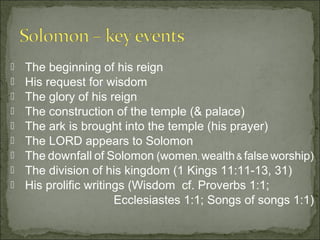
   The beginning of his reign
   His request for wisdom
   The glory of his reign
   The construction of the temple (& palace)
   The ark is brought into the temple (his prayer)
   The LORD appears to Solomon
   The downfall of Solomon (women, wealth & false worship)
   The division of his kingdom (1 Kings 11:11-13, 31)
   His prolific writings (Wisdom cf. Proverbs 1:1;
                       Ecclesiastes 1:1; Songs of songs 1:1)
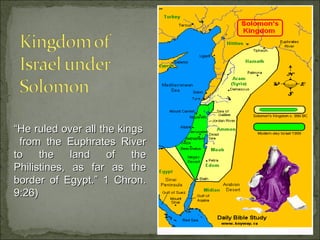
“He ruled over all the kings
 from the Euphrates River
to    the    land    of   the
Philistines, as far as the
border of Egypt.” 1 Chron.
9:26)
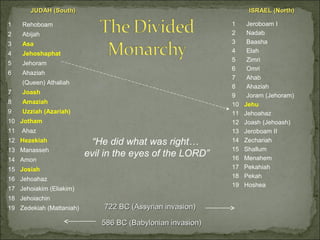
JUDAH (South)                                               ISRAEL (North)

1    Rehoboam                                                1     Jeroboam I
2    Abijah                                                  2     Nadab
3    Asa                                                     3     Baasha
4    Jehoshaphat                                             4     Elah
                                                             5     Zimri
5    Jehoram
                                                             6     Omri
6    Ahaziah
                                                             7     Ahab
     (Queen) Athaliah
                                                             8     Ahaziah
7    Joash
                                                             9     Joram (Jehoram)
8    Amaziah                                                 10   Jehu
9    Uzziah (Azariah)                                        11   Jehoahaz
10 Jotham                                                    12   Joash (Jehoash)
11   Ahaz                                                    13   Jeroboam II
12 Hezekiah                “He did what was right…           14   Zechariah
13 Manasseh                                                  15   Shallum
                          evil in the eyes of the LORD”      16   Menahem
14 Amon
15 Josiah                                                    17   Pekahiah
16 Jehoahaz                                                  18   Pekah
                                                             19   Hoshea
17 Jehoiakim (Eliakim)
18 Jehoiachin
19 Zedekiah (Mattaniah)       722 BC (Assyrian invasion)

                              586 BC (Babylonian invasion)
Hezekiah       2 Kings 18-20/ 2 Chron. 29-32
Manasseh       2 Kings 21/ 2 Chron. 33
Josiah         2 Kings 22-23/ 2 Chron. 34-35

Identify some of the key actions they did.
How did they view God, themselves & others?
What made them good or bad?

OT Session #4 Monarchy

  • 1.
    Session # 4:Encountering the Historical Books “Living out the covenant” Covering the books of Samuel, Kings & Chronicles
  • 2.
    The Covenant “Just as Deuteronomy 32 is a ‘Bible’ for the OT prophets, Deuteronomy 28 specifically may be seen as the ‘Bible’ for the OT historical books.” (Arnold & Beyer) The OT is not just history, it is history as seen through the eyes of theology. It is salvation-history!
  • 3.
    Deuteronomy Torah/ instruction &Covenant/ agreement Understan Understand d the the message lessons of of the history prophets
  • 4.
    Two goals: Establishing theworship of Removing the worship the one true God (& practices) of false gods (Deut. 6) (Deut. 7) A place for God’s name Idolatry (Deut. 4:15-20; 32:17) A pattern of worship Immorality (Deut. 18:9-13; A holy lifestyle & chs. 21-26) Warfare! (Deut. 20:1-20) “Be holy for I am holy” “The land will vomit you out” (Lev. 18:24-28; 20:22-24)
  • 5.
    “Soon you willcross the River, and if you obey the laws and teachings I'm giving you today, you will be strong enough to conquer the land that the LORD promised your ancestors and their descendants. It's rich with milk and honey, and you will live there and enjoy it for a long time.” (Deut.11:8-9 CEV)
  • 6.
    SALVATION JUDGEMENT “God is love” “God is holy”  Covenant relationship  Outside covenant relationship…or broken covenant relationship  Security  Insecurity  Blessing  Curse  Life  Death
  • 7.
    Prophet - proclaimfrom his shrine (one who would represent God to the people) Priest – serve from his temple (one who would represent the people to God) King – lead from his throne (one who would shepherd the people for God)
  • 8.
    KING (leadership & faithfulness to the Covenant) PROPHET PRIEST (proclamation & guidance) (intercession & sacrifice)
  • 9.
    Chosen by (theSpirit of) God One of their own & equal to his people Directed by the Law of God  Must not trust in military strength  Must not get caught up in sexual immorality  Must not be given to greed for wealth
  • 10.
    Chosen by God Fromamong the people Responsibility to declare the word/ will of God  Given messages by God  Called to discern & accept words/ visions from God  Proclaim the words of God “You must listen to him”
  • 11.
    Chosen… for holiness (the basin – Ex. 30:17-21) to serve (the oil – Ex. 30:22-33) to intercede (the incense – Ex. 30:1-10, 34-38) “Sacred garments” (Ex. 28-30; 39)  The ephod (representative between God & people) Ex. 28:12  The breastplate (prayer & inquiry) Ex. 28:29  The golden sign (consecrated to the LORD) Ex. 28:38
  • 12.
    (HEB) Former Prophets:Joshua, Judges, Samuel, Kings (LXX) Samuel/ Kings becomes 1 book (1-4 Kingdoms) (Vulgate) 1-4 Kings Author = an anonymous editor (1 Chron. 29:29) The records of Samuel, Nathan, Gad…Jasher (2 Sam . 1:18) Theme = “The events of David’s reign” (cf. Ruth 4:13-22) (Prelude: Saul… Postlude: Solomon) God’s promise & covenant with David (2 Sam. 7; 2 Chron. 21:7 - cf. Psalm 89:3-4; Is. 55:3; Jer. 33:14-22) Time period: Monarchy 1050 - Divided monarchy 930 – Exiles 722 & 586 BCE (just over 460 yrs.)
  • 13.
    Days of thejudges: Philistine oppression (1095-1055) Samson (1095/75-1055) / Samuel (c.1100-1000) Saul anointed king (1050) David anointed king (1010) Solomon anointed king (970) Construction of temple begins (966) Kingdom divided into Israel/ north & Judah/ south (930)
  • 14.
    (1st historical record) 1 Samuel: Birth of Samuel – Death of Saul  2 Samuel: Reign of David  1 Kings: Reign of Solomon – Passing of Elijah  2 Kings: Ministry of Elisha – Fall of Jerusalem (2nd historical record)  1 Chronicles: Genealogy of Adam - Death of David  2 Chronicles: Reign of Solomon – Fall of Jerusalem
  • 15.
     Priest (2:18;9:12-13; 13:8-13) …anoints Saul (10:1) & David (16:13) as kings …records the responsibilities for the king (10:25)  Prophet (3:20-21; 9:19 “the seer”; 19:20; ie.13:14; 15:22-23)  Judge (ie. charismatic leader - 7:6, 15-17)  Contemporary of Samson  Second greatest prophet (after Moses) cf. Jer. 15:1; Acts 13:20; Hebrews 11:32  Pivotal role in transition from confederacy to monarchy
  • 16.
    Samson (son of the sun;  Samuel (son of God; little sun) heard by God)  Born c.1100-1095  Born c.1100-1095  Lived during 40yr. Philistine  Lived during 40 yr. Philistine dominance (6th oppression) dominance (6th oppression)  Lived 1095-1055 (Saul 1050)  Lived 1095-1005 (David 1010)  Mother barren  Mother barren  Birth confirmed by an angel  Birth confirmed by a priest  A Nazirite  A Nazirite  Devoted to the LORD  Devoted to the LORD  Role of the Spirit in his life  Role of the Spirit in his life  Premature death (suicide)  Died in old age (naturally)
  • 17.
    nazir = “consecrated, devoted, separated one” nezer = a diadem, crown (ie. uncut hair)  Period of consecration “to the Lord”, based on a vow  Dedicated to God, endowed with special ability (Amos 2:11- 12)  Rules for Nazirites: Numbers 6 1. Abstain from wine/ intoxicating drinks 2. Abstain from cutting their hair during time of vow 3. Abstain from contact with a dead body Instructions for a violation Instructions for termination  Examples: Samson, Samuel, John the Baptist (Luke 1:14-17) & Paul (cf. Acts 18:18; 21:23)
  • 18.
    The vital linkbetween the days of the Judges & the Monarchy (Priest, Prophet & Judge)  His birth through the intervention of God (1:19-21)  His dedication to the service of God (1:28)  His development under Eli (1: 19-21; 2:18, 21, 26)  His calling from God (3:1-21 - when 10 yrs old!)  The Philistines & the Ark of the Covenant (ch.4-7)  The death of Eli & emergence of Samuel “Ebenezer: thus far the LORD has helped us” (7:12)  Priest & prophet to Saul & David  Death (25:1) & reappearance as a ghost? (cf. 28:1-20)
  • 19.
    “If you will give me a son (daughter) I will give him (her) to the Lord for all the days of his (her) life”  “The boy grew in stature & in favour with the Lord and with men”  “Those who honour me I will honour”  “Speak Lord, for your servant is listening”  “He revealed himself to…through his word”  “Ichabod…the glory has departed”  “Ebenezer…thus far the Lord has helped us”  “A man after God’s own heart”  “Man looks at the outward appearance but the Lord looks upon the heart”
  • 20.
    The request for“Monarchy”? (Compare to Deut. 17) The rejection of “Theocracy”? (A king…“like the other nations”) The King (1 Sam. 9)  Chosen by God Always remember the king (or a leader) is a  Anointing by the Spirit representative of God not  Commissioned to lead a replacement for God!
  • 21.
    Saul: Bad (A man with a wayward heart) David: Good (A man after God’s heart) Solomon: Good Bad (A man with a wise & discerning heart)
  • 22.
     His potential(1 Sam. 9:2; 10:6-7; 13:13)  His failure – why?  …he never learned patience (13:11-12)  …he never learned simple obedience (15:11, 22-23)  …he never learned repentance (15:12)  His outcome  …he sought to oppose the will of God (22:6-19)  …he became incredibly devious & jealous (18:9)  …he was oppressed by an evil spirit (16:14-16;18:10; 19:9)  …he was rejected by God (15:26)  …he became utterly weak & desperate (chs. 28, 31)
  • 23.
    His early years & selection by God His victory over Goliath His relationship with Saul His friendship with Jonathan His anointing to be king His military victories (& compassion) His capture of Jerusalem His covenant with God (& life of prayer) His sin with Bathsheba His heart for worship (Psalms cf. 72:20)
  • 24.
    The beginning of his reign  His request for wisdom  The glory of his reign  The construction of the temple (& palace)  The ark is brought into the temple (his prayer)  The LORD appears to Solomon  The downfall of Solomon (women, wealth & false worship)  The division of his kingdom (1 Kings 11:11-13, 31)  His prolific writings (Wisdom cf. Proverbs 1:1; Ecclesiastes 1:1; Songs of songs 1:1)
  • 25.
    “He ruled overall the kings from the Euphrates River to the land of the Philistines, as far as the border of Egypt.” 1 Chron. 9:26)
  • 26.
    JUDAH (South) ISRAEL (North) 1 Rehoboam 1 Jeroboam I 2 Abijah 2 Nadab 3 Asa 3 Baasha 4 Jehoshaphat 4 Elah 5 Zimri 5 Jehoram 6 Omri 6 Ahaziah 7 Ahab (Queen) Athaliah 8 Ahaziah 7 Joash 9 Joram (Jehoram) 8 Amaziah 10 Jehu 9 Uzziah (Azariah) 11 Jehoahaz 10 Jotham 12 Joash (Jehoash) 11 Ahaz 13 Jeroboam II 12 Hezekiah “He did what was right… 14 Zechariah 13 Manasseh 15 Shallum evil in the eyes of the LORD” 16 Menahem 14 Amon 15 Josiah 17 Pekahiah 16 Jehoahaz 18 Pekah 19 Hoshea 17 Jehoiakim (Eliakim) 18 Jehoiachin 19 Zedekiah (Mattaniah) 722 BC (Assyrian invasion) 586 BC (Babylonian invasion)
  • 27.
    Hezekiah 2 Kings 18-20/ 2 Chron. 29-32 Manasseh 2 Kings 21/ 2 Chron. 33 Josiah 2 Kings 22-23/ 2 Chron. 34-35 Identify some of the key actions they did. How did they view God, themselves & others? What made them good or bad?