INTRODUCTION
• Organizations, likeliving organisms, evolve over time. Their growth,
development, and sometimes decline follow a natural cycle known as
the Organizational Life Cycle (OLC). Organizational design refers to the
structure and systems an organization puts in place to achieve its
goals and coordinate efforts. These two concepts—organizational life
cycle and design—are intertwined, as the life cycle of an organization
often dictates the need for changes in its design and structure.
Understanding these cycles and designs is essential for leaders,
managers, and scholars in making informed decisions about how to
grow, restructure, or renew an organization.
3.
ORGANIZATIONAL LIFE CYCLE(OLC)
• Definition and Overview
• The Organizational Life Cycle (OLC) refers to the stages that an
organization goes through from its inception to its potential decline or
renewal. These stages are often compared to the life cycle of a living
organism, with growth, maturity, and potential death being part of
the process. The life cycle helps explain the challenges organizations
face as they evolve and provides insights into how they need to adjust
their strategy, structure, and operations at different points in time.
4.
Stages of theOrganizational Life Cycle
• 1. Startup or Entrepreneurial Stage
• Key Characteristics:
The organization is in its infancy, often focusing on survival and
establishing its presence in the market. Decision-making is highly
centralized, and roles may be informal or ambiguous.
• Challenges:
Limited resources, finding customers, and establishing a viable
product or service.
• Organizational Focus:
Innovation, flexibility, and rapid decision-making.
5.
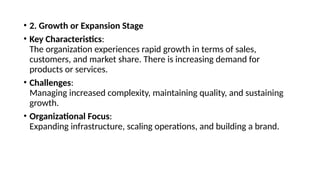
• 2. Growthor Expansion Stage
• Key Characteristics:
The organization experiences rapid growth in terms of sales,
customers, and market share. There is increasing demand for
products or services.
• Challenges:
Managing increased complexity, maintaining quality, and sustaining
growth.
• Organizational Focus:
Expanding infrastructure, scaling operations, and building a brand.
6.
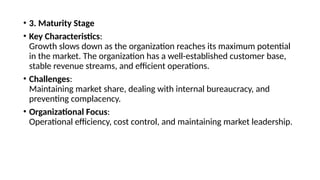
• 3. MaturityStage
• Key Characteristics:
Growth slows down as the organization reaches its maximum potential
in the market. The organization has a well-established customer base,
stable revenue streams, and efficient operations.
• Challenges:
Maintaining market share, dealing with internal bureaucracy, and
preventing complacency.
• Organizational Focus:
Operational efficiency, cost control, and maintaining market leadership.
7.
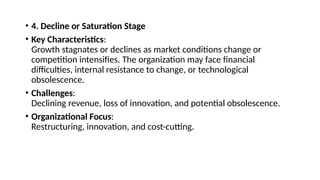
• 4. Declineor Saturation Stage
• Key Characteristics:
Growth stagnates or declines as market conditions change or
competition intensifies. The organization may face financial
difficulties, internal resistance to change, or technological
obsolescence.
• Challenges:
Declining revenue, loss of innovation, and potential obsolescence.
• Organizational Focus:
Restructuring, innovation, and cost-cutting.
8.
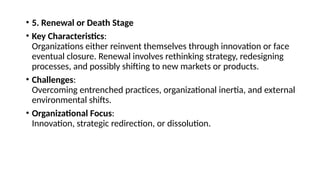
• 5. Renewalor Death Stage
• Key Characteristics:
Organizations either reinvent themselves through innovation or face
eventual closure. Renewal involves rethinking strategy, redesigning
processes, and possibly shifting to new markets or products.
• Challenges:
Overcoming entrenched practices, organizational inertia, and external
environmental shifts.
• Organizational Focus:
Innovation, strategic redirection, or dissolution.
9.
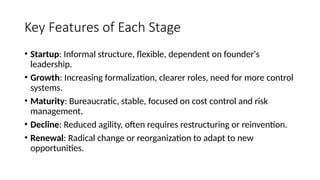
Key Features ofEach Stage
• Startup: Informal structure, flexible, dependent on founder's
leadership.
• Growth: Increasing formalization, clearer roles, need for more control
systems.
• Maturity: Bureaucratic, stable, focused on cost control and risk
management.
• Decline: Reduced agility, often requires restructuring or reinvention.
• Renewal: Radical change or reorganization to adapt to new
opportunities.
10.
Organizational Design
• Definitionand Overview
• Organizational design is the process of structuring an organization's
roles, responsibilities, systems, and processes in a way that supports
its strategy and goals. It involves decisions about how to divide work,
how to coordinate efforts, how to allocate resources, and how to
manage relationships between different parts of the organization.
• Effective organizational design ensures that an organization can
respond flexibly to changes, manage its internal resources efficiently,
and achieve its objectives. Poor design can lead to inefficiencies, poor
communication, and a lack of accountability.
11.
Types of OrganizationalDesigns
• 1. Functional Structure
• Organizes employees based on specialized roles or functions (e.g.,
marketing, finance, operations).
• Advantages: Clear roles, efficient specialization, expertise
development.
• Disadvantages: Poor communication between functions, slow
decision-making.
12.
• 2. DivisionalStructure
• Divides the organization based on products, services, or geographic
regions.
• Advantages: Focus on specific markets or products, autonomy for
divisions.
• Disadvantages: Duplication of resources, potential conflict between
divisions.
13.
• 3. MatrixStructure
• Combines elements of both functional and divisional structures,
where employees report to both a functional manager and a project
or product manager.
• Advantages: Flexibility, efficient use of resources, improved
communication.
• Disadvantages: Confusion over authority, potential for conflict
between reporting lines.
14.
• 4. FlatStructure
• Fewer hierarchical levels with greater autonomy for employees.
• Advantages: Increased communication, faster decision-making,
empowerment.
• Disadvantages: Potential lack of clarity in roles and responsibilities,
overload for managers.
15.
• 5. Team-basedStructure
• Organizes work around teams that are responsible for specific tasks or
projects.
• Advantages: Innovation, flexibility, collaboration.
• Disadvantages: Lack of formal authority, potential for inefficiencies if
teams are not well coordinated.
16.
• 6. NetworkStructure
• Emphasizes outsourcing and partnerships, where the organization
relies on external resources for specific tasks.
• Advantages: Flexibility, access to external expertise, cost efficiency.
• Disadvantages: Loss of control, dependency on external partners.
17.
Factors Influencing OrganizationalDesign
• Size: Larger organizations require more formalized structures and
processes.
• Environment: External factors such as market dynamics and regulatory
conditions affect design.
• Technology: Advances in technology often lead to the adoption of new
structures or systems (e.g., digital transformation).
• Culture: Organizational culture influences how roles are defined and
how communication flows.
• Leadership: The leadership style and philosophy play a significant role
in shaping the organization’s design.
18.
Relationship Between LifeCycle and Design
• As organizations progress through different stages of their life cycle,
their design must evolve to meet the changing demands of the
environment. For example:
• In the startup stage, the organization may have a simple, informal
structure with a strong emphasis on innovation and agility.
• In the growth stage, the organization needs to implement more
formal structures and systems to manage increased complexity and
volume of work.
• During the maturity stage, bureaucratic structures and standardized
procedures become necessary to maintain control and efficiency.
19.
• In thedecline or renewal stage, the organization may need to change
its design to reassert its competitive position, which could involve
restructuring, decentralization, or even adopting a completely new
design model.
Effective management of the organizational life cycle requires an
understanding of how organizational design needs to adapt at each
stage, and how misalignment between the two can hinder progress or
even lead to failure.
20.
Challenges Across OrganizationalLife Cycles
• Resistance to Change: As organizations mature, employees and leaders may
become resistant to the changes necessary for survival, especially in the
decline stage.
• Over-centralization or Over-delegation: During the growth phase, the
balance between centralized decision-making and the need for delegation
can become difficult to manage.
• Innovation Fatigue: Constant restructuring or reinvention during the
renewal stage can lead to burnout and disengagement among employees.
• Silos and Communication Breakdowns: As organizations grow, departments
or functions may become more isolated, leading to communication issues
and a lack of coordination.
21.
Conclusion
Understanding organizational lifecycles and design is critical for both short-
term performance and long-term success. As organizations move through
different stages of their life cycle, they must continuously adapt their
structure and operations to meet the demands of the market, internal
stakeholders, and external environments. A well-designed organization that
aligns with its life cycle stage will be more agile, efficient, and capable of
sustaining growth or overcoming decline.
By examining the dynamics of life cycles and design, organizations can
navigate their evolutionary path more effectively and create strategies that
support their long-term goals.



![Final Powerpoint[1]](https://cdn.slidesharecdn.com/ss_thumbnails/finalpowerpoint1-1213130555438697-8-thumbnail.jpg?width=640&height=640&fit=bounds)


