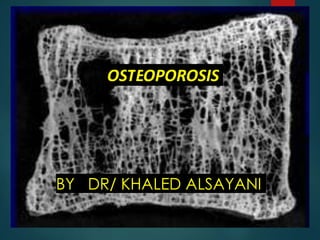
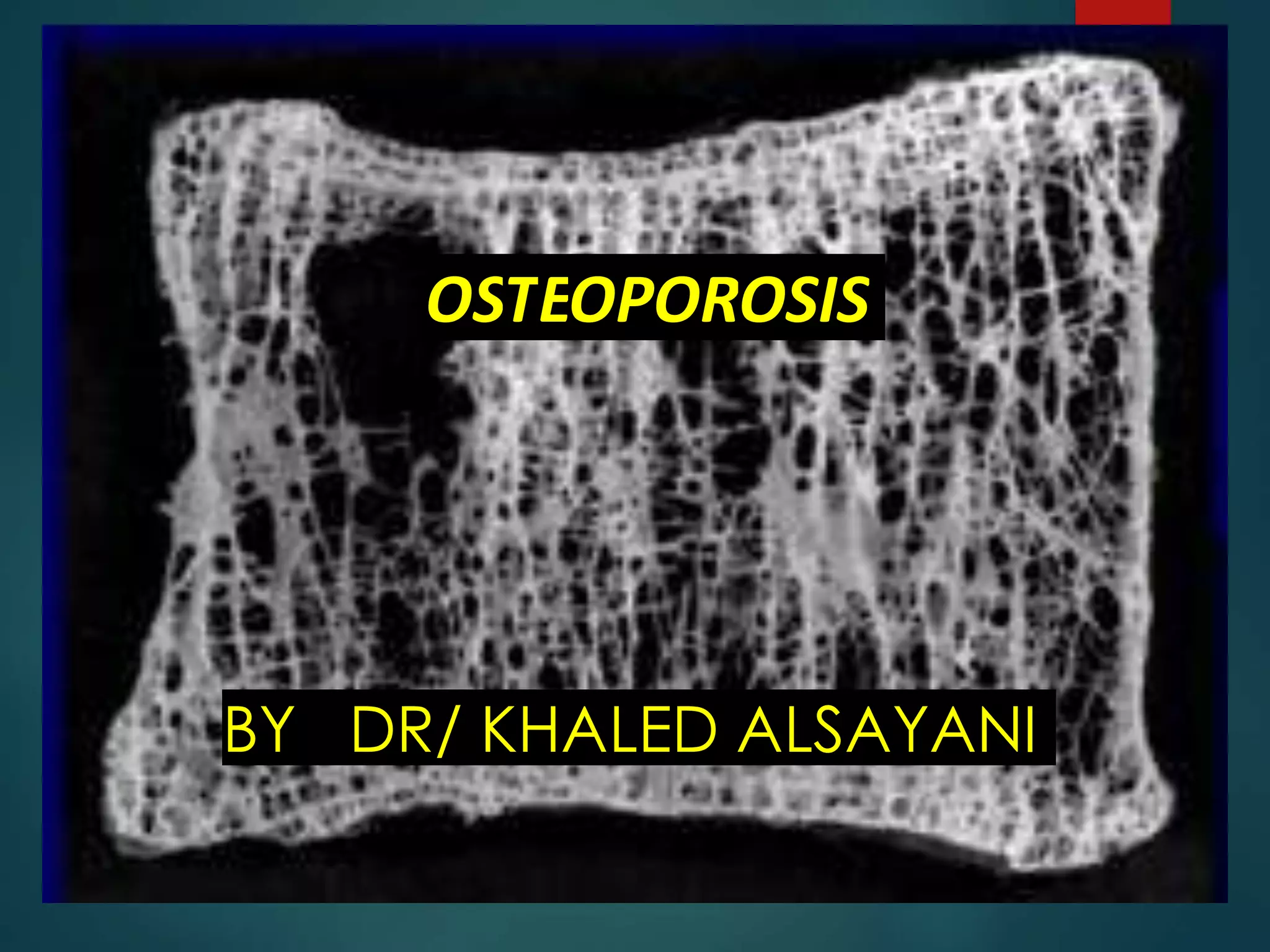
OSTEOPOROSIS
BY DR/ KHALED ALSAYANI
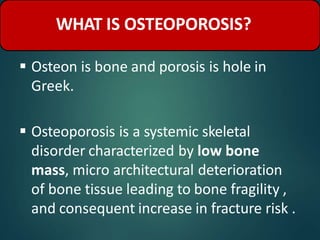
 Osteon is bone and porosis is hole in
Greek.
 Osteoporosis is a systemic skeletal
disorder characterized by low bone
mass, micro architectural deterioration
of bone tissue leading to bone fragility ,
and consequent increase in fracture risk .
WHAT IS OSTEOPOROSIS?
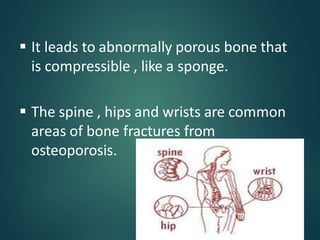
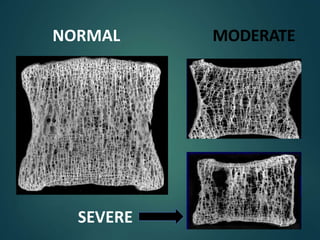
 It leads to abnormally porous bone that
is compressible , like a sponge.
 The spine , hips and wrists are common
areas of bone fractures from
osteoporosis.
NORMAL MODERATE
SEVERE
•Osteoporosis is the most prevalent bone
disease in the world.
•According to the International
Osteoporosis Foundation, 1 in 3 women
over 50 may experience osteoporotic
fractures, and 1 in 5 men .
• Female to male ratio 6 : 1
PREVALENCE
2 TYPES :-
a) PRIMARY OSTEOPOROSIS
I. Type-1 : Postmenopausal osteoporosis
II. Type-2 : Age – associated osteoporosis
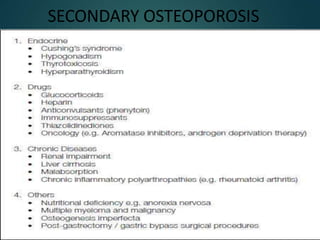
b) SECONDARY OSTEOPOROSIS
Loss of bone is caused by an identifiable agent or
disease process such as inflammatory disorder , bone
marrow cellularity disorder and corticosteroid use.
TYPES OF OSTEOPOROSIS
SECONDARY OSTEOPOROSIS
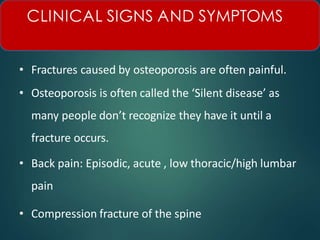
• Fractures caused by osteoporosis are often painful.
• Osteoporosis is often called the ‘Silent disease’ as
many people don’t recognize they have it until a
fracture occurs.
• Back pain: Episodic, acute , low thoracic/high lumbar
pain
• Compression fracture of the spine
CLINICAL SIGNS AND SYMPTOMS
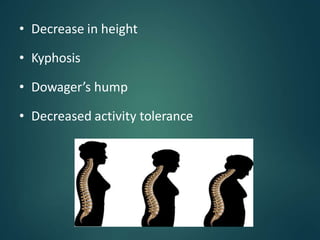
• Decrease in height
• Kyphosis
• Dowager’s hump
• Decreased activity tolerance
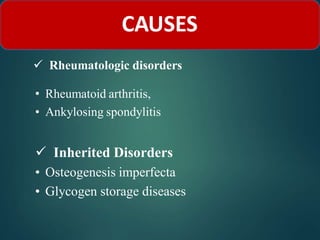
 Rheumatologic disorders
• Rheumatoid arthritis,
• Ankylosing spondylitis
 Inherited Disorders
• Osteogenesis imperfecta
• Glycogen storage diseases
CAUSES
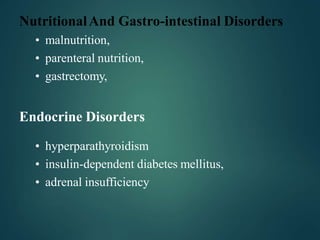
NutritionalAnd Gastro-intestinal Disorders
• malnutrition,
• parenteral nutrition,
• gastrectomy,
Endocrine Disorders
• hyperparathyroidism
• insulin-dependent diabetes mellitus,
• adrenal insufficiency
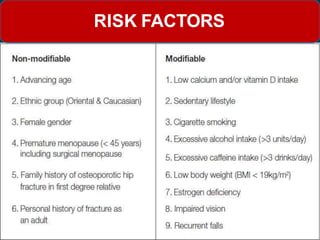
RISK FACTORS
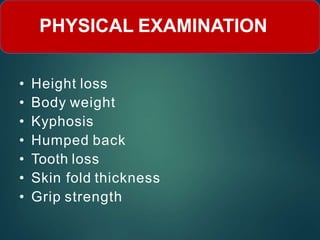
• Height loss
• Body weight
• Kyphosis
• Humped back
• Tooth loss
• Skin fold thickness
• Grip strength
PHYSICAL EXAMINATION
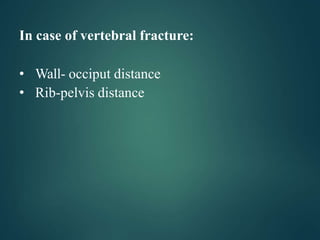
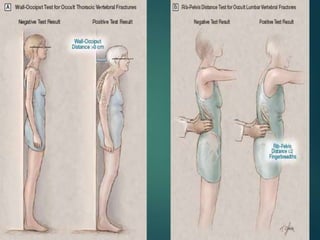
In case of vertebral fracture:
• Wall- occiput distance
• Rib-pelvis distance
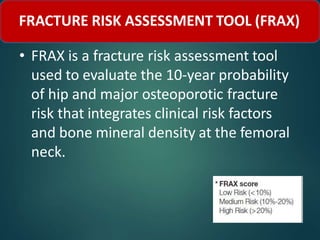
FRACTURE RISK ASSESSMENT TOOL (FRAX)
• FRAX is a fracture risk assessment tool
used to evaluate the 10-year probability
of hip and major osteoporotic fracture
risk that integrates clinical risk factors
and bone mineral density at the femoral
neck.
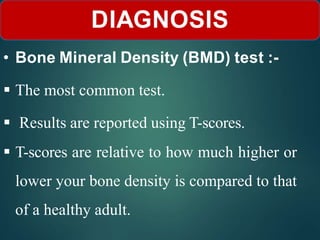
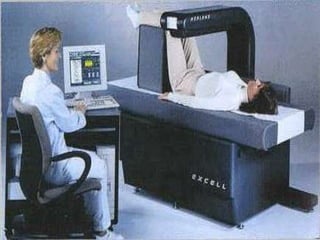
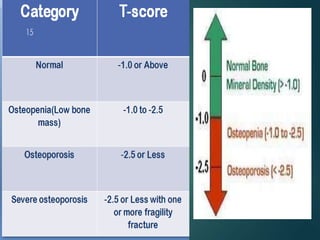
• Bone Mineral Density (BMD) test :-
 The most common test.
 Results are reported using T-scores.
 T-scores are relative to how much higher or
lower your bone density is compared to that
of a healthy adult.
DIAGNOSIS
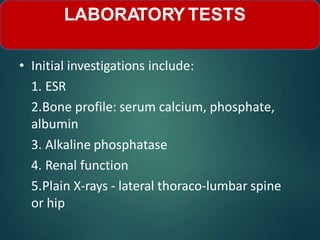
• Initial investigations include:
1. ESR
2.Bone profile: serum calcium, phosphate,
albumin
3. Alkaline phosphatase
4. Renal function
5.Plain X-rays - lateral thoraco-lumbar spine
or hip
LABORATORY TESTS
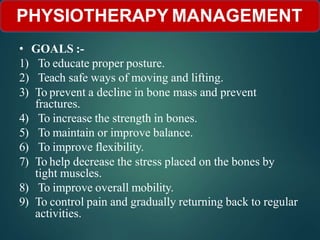
• GOALS :-
1) To educate proper posture.
2) Teach safe ways of moving and lifting.
3) To prevent a decline in bone mass and prevent
fractures.
4) To increase the strength in bones.
5) To maintain or improve balance.
6) To improve flexibility.
7) To help decrease the stress placed on the bones by
tight muscles.
8) To improve overall mobility.
9) To control pain and gradually returning back to regular
activities.
PHYSIOTHERAPY MANAGEMENT
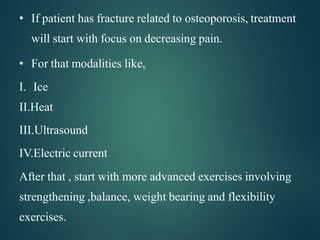
• If patient has fracture related to osteoporosis, treatment
will start with focus on decreasing pain.
• For that modalities like,
I. Ice
II.Heat
III.Ultrasound
IV.Electric current
After that , start with more advanced exercises involving
strengthening ,balance, weight bearing and flexibility
exercises.
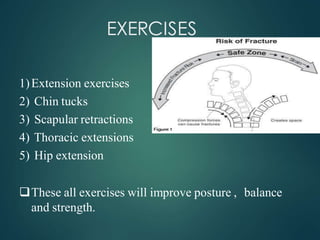
EXERCISES
1)Extension exercises
2) Chin tucks
3) Scapular retractions
4) Thoracic extensions
5) Hip extension
These all exercises will improve posture , balance
and strength.
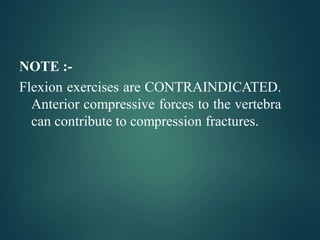
NOTE :-
Flexion exercises are CONTRAINDICATED.
Anterior compressive forces to the vertebra
can contribute to compression fractures.
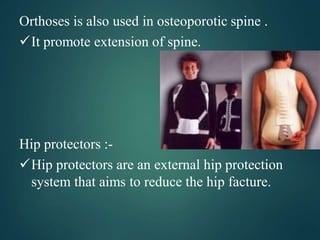
Orthoses is also used in osteoporotic spine .
It promote extension of spine.
Hip protectors :-
Hip protectors are an external hip protection
system that aims to reduce the hip facture.
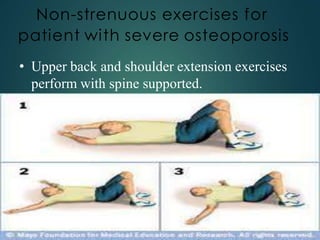
Non-strenuous exercises for
patient with severe osteoporosis
• Upper back and shoulder extension exercises
perform with spine supported.
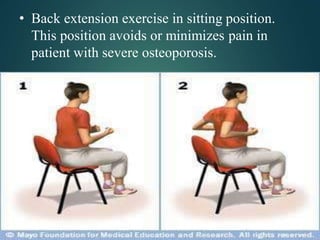
• Back extension exercise in sitting position.
This position avoids or minimizes pain in
patient with severe osteoporosis.
Maintain Posture
• Goal :- To get body lined up from head to toe,
with weight going through hips.
• Physical therapist role :- Give instruction that
all times to try to “ BE TALL “.
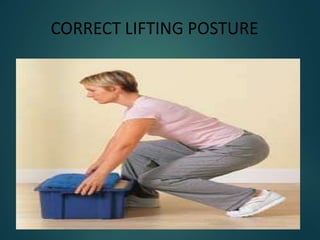
CORRECT LIFTING POSTURE
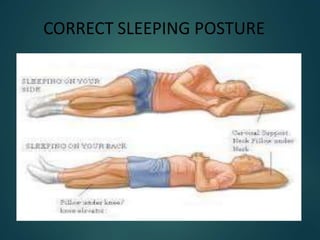
CORRECT SLEEPING POSTURE
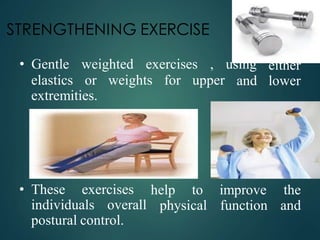
STRENGTHENING EXERCISE
elastics or weights for upper
• Gentle weighted exercises , using
and
either
lower
extremities.
• These exercises help to
physical
improve the
function and
individuals overall
postural control.
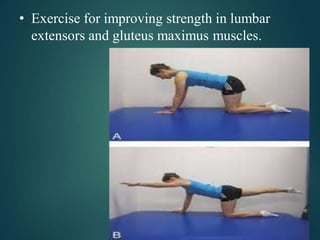
• Exercise for improving strength in lumbar
extensors and gluteus maximus muscles.
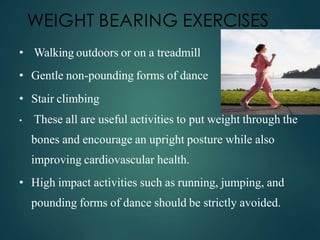
WEIGHT BEARING EXERCISES
• Walking outdoors or on a treadmill
• Gentle non-pounding forms of dance
• Stair climbing
• These all are useful activities to put weight through the
bones and encourage an upright posture while also
improving cardiovascular health.
• High impact activities such as running, jumping, and
pounding forms of dance should be strictly avoided.
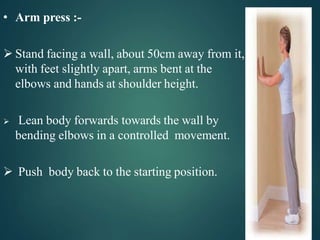
• Arm press :-
 Stand facing a wall, about 50cm away from it,
with feet slightly apart, arms bent at the
elbows and hands at shoulder height.
 Lean body forwards towards the wall by
bending elbows in a controlled movement.
 Push body back to the starting position.
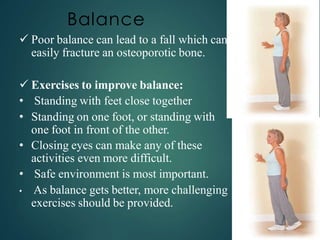
Balance
 Poor balance can lead to a fall which can
easily fracture an osteoporotic bone.
 Exercises to improve balance:
• Standing with feet close together
• Standing on one foot, or standing with
one foot in front of the other.
• Closing eyes can make any of these
activities even more difficult.
• Safe environment is most important.
• As balance gets better, more challenging
exercises should be provided.
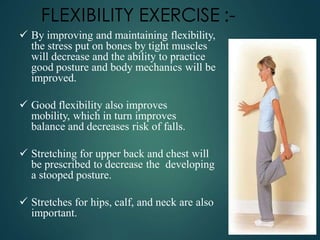
FLEXIBILITY EXERCISE :-
 By improving and maintaining flexibility,
the stress put on bones by tight muscles
will decrease and the ability to practice
good posture and body mechanics will be
improved.
 Good flexibility also improves
mobility, which in turn improves
balance and decreases risk of falls.
 Stretching for upper back and chest will
be prescribed to decrease the developing
a stooped posture.
 Stretches for hips, calf, and neck are also
important.
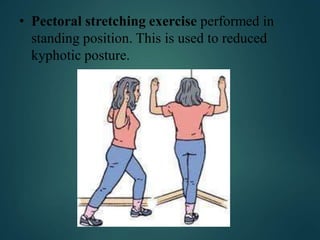
• Pectoral stretching exercise performed in
standing position. This is used to reduced
kyphotic posture.
ALTERNATIVE/HOLISTIC MANAGEMENT
• Alternative management of osteoporosis includes
diet, vitamin supplementation, and herbal
supplementation.
• Diet has a direct correlation to bone growth and
as an individual ages, he/she may not be
absorbing the adequate amount of calcium.
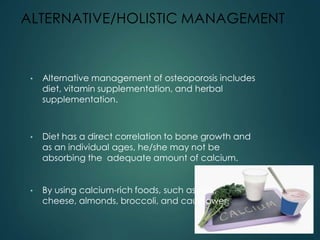
• By using calcium-rich foods, such as milk,
cheese, almonds, broccoli, and cauliflower.
• Leafy green vegetables are a great addition to
the diet with osteoporosis it has been shown
that oxalate acid that is found in spinach
prevents absorption of calcium in the stomach.
• Vitamin supplements may also be necessary
when managing osteoporosis.
• According to the University of Maryland
Medical Center (UMMC), 1,500 milligrams of
calcium, taken in 3 doses of 500 milligrams
per day, is an effective supplement to
strengthen the bones and prevent further bone
loss.
• Other vitamins that are recommended to retain
bone strength are vitamins D and K.
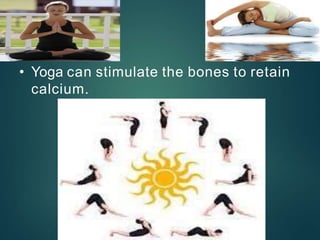
YOGA
• Yoga can stimulate the bones to retain
calcium.
DO’S AND DON’T
It is important not to rush into unaccustomed
exercise too quickly.
 Exercise must be done regularly to have benefit.
Avoid combining flexion and rotation of the
trunk to reduce stress on vertebra.
Think carefully about undertaking activities that
may increase the chance of a fall.
 Always maintain an upright posture.

osteoporosis.pdf

  • 1.
  • 2.
     Osteon isbone and porosis is hole in Greek.  Osteoporosis is a systemic skeletal disorder characterized by low bone mass, micro architectural deterioration of bone tissue leading to bone fragility , and consequent increase in fracture risk . WHAT IS OSTEOPOROSIS?
  • 3.
     It leadsto abnormally porous bone that is compressible , like a sponge.  The spine , hips and wrists are common areas of bone fractures from osteoporosis.
  • 4.
  • 5.
    •Osteoporosis is themost prevalent bone disease in the world. •According to the International Osteoporosis Foundation, 1 in 3 women over 50 may experience osteoporotic fractures, and 1 in 5 men . • Female to male ratio 6 : 1 PREVALENCE
  • 6.
    2 TYPES :- a)PRIMARY OSTEOPOROSIS I. Type-1 : Postmenopausal osteoporosis II. Type-2 : Age – associated osteoporosis b) SECONDARY OSTEOPOROSIS Loss of bone is caused by an identifiable agent or disease process such as inflammatory disorder , bone marrow cellularity disorder and corticosteroid use. TYPES OF OSTEOPOROSIS
  • 8.
  • 9.
    • Fractures causedby osteoporosis are often painful. • Osteoporosis is often called the ‘Silent disease’ as many people don’t recognize they have it until a fracture occurs. • Back pain: Episodic, acute , low thoracic/high lumbar pain • Compression fracture of the spine CLINICAL SIGNS AND SYMPTOMS
  • 10.
    • Decrease inheight • Kyphosis • Dowager’s hump • Decreased activity tolerance
  • 11.
     Rheumatologic disorders •Rheumatoid arthritis, • Ankylosing spondylitis  Inherited Disorders • Osteogenesis imperfecta • Glycogen storage diseases CAUSES
  • 12.
    NutritionalAnd Gastro-intestinal Disorders •malnutrition, • parenteral nutrition, • gastrectomy, Endocrine Disorders • hyperparathyroidism • insulin-dependent diabetes mellitus, • adrenal insufficiency
  • 13.
  • 14.
    • Height loss •Body weight • Kyphosis • Humped back • Tooth loss • Skin fold thickness • Grip strength PHYSICAL EXAMINATION
  • 15.
    In case ofvertebral fracture: • Wall- occiput distance • Rib-pelvis distance
  • 17.
    FRACTURE RISK ASSESSMENTTOOL (FRAX) • FRAX is a fracture risk assessment tool used to evaluate the 10-year probability of hip and major osteoporotic fracture risk that integrates clinical risk factors and bone mineral density at the femoral neck.
  • 18.
    • Bone MineralDensity (BMD) test :-  The most common test.  Results are reported using T-scores.  T-scores are relative to how much higher or lower your bone density is compared to that of a healthy adult. DIAGNOSIS
  • 21.
    • Initial investigationsinclude: 1. ESR 2.Bone profile: serum calcium, phosphate, albumin 3. Alkaline phosphatase 4. Renal function 5.Plain X-rays - lateral thoraco-lumbar spine or hip LABORATORY TESTS
  • 22.
    • GOALS :- 1)To educate proper posture. 2) Teach safe ways of moving and lifting. 3) To prevent a decline in bone mass and prevent fractures. 4) To increase the strength in bones. 5) To maintain or improve balance. 6) To improve flexibility. 7) To help decrease the stress placed on the bones by tight muscles. 8) To improve overall mobility. 9) To control pain and gradually returning back to regular activities. PHYSIOTHERAPY MANAGEMENT
  • 23.
    • If patienthas fracture related to osteoporosis, treatment will start with focus on decreasing pain. • For that modalities like, I. Ice II.Heat III.Ultrasound IV.Electric current After that , start with more advanced exercises involving strengthening ,balance, weight bearing and flexibility exercises.
  • 24.
    EXERCISES 1)Extension exercises 2) Chintucks 3) Scapular retractions 4) Thoracic extensions 5) Hip extension These all exercises will improve posture , balance and strength.
  • 25.
    NOTE :- Flexion exercisesare CONTRAINDICATED. Anterior compressive forces to the vertebra can contribute to compression fractures.
  • 26.
    Orthoses is alsoused in osteoporotic spine . It promote extension of spine. Hip protectors :- Hip protectors are an external hip protection system that aims to reduce the hip facture.
  • 27.
    Non-strenuous exercises for patientwith severe osteoporosis • Upper back and shoulder extension exercises perform with spine supported.
  • 28.
    • Back extensionexercise in sitting position. This position avoids or minimizes pain in patient with severe osteoporosis.
  • 29.
    Maintain Posture • Goal:- To get body lined up from head to toe, with weight going through hips. • Physical therapist role :- Give instruction that all times to try to “ BE TALL “.
  • 30.
  • 31.
  • 32.
    STRENGTHENING EXERCISE elastics orweights for upper • Gentle weighted exercises , using and either lower extremities. • These exercises help to physical improve the function and individuals overall postural control.
  • 33.
    • Exercise forimproving strength in lumbar extensors and gluteus maximus muscles.
  • 34.
    WEIGHT BEARING EXERCISES •Walking outdoors or on a treadmill • Gentle non-pounding forms of dance • Stair climbing • These all are useful activities to put weight through the bones and encourage an upright posture while also improving cardiovascular health. • High impact activities such as running, jumping, and pounding forms of dance should be strictly avoided.
  • 35.
    • Arm press:-  Stand facing a wall, about 50cm away from it, with feet slightly apart, arms bent at the elbows and hands at shoulder height.  Lean body forwards towards the wall by bending elbows in a controlled movement.  Push body back to the starting position.
  • 36.
    Balance  Poor balancecan lead to a fall which can easily fracture an osteoporotic bone.  Exercises to improve balance: • Standing with feet close together • Standing on one foot, or standing with one foot in front of the other. • Closing eyes can make any of these activities even more difficult. • Safe environment is most important. • As balance gets better, more challenging exercises should be provided.
  • 37.
    FLEXIBILITY EXERCISE :- By improving and maintaining flexibility, the stress put on bones by tight muscles will decrease and the ability to practice good posture and body mechanics will be improved.  Good flexibility also improves mobility, which in turn improves balance and decreases risk of falls.  Stretching for upper back and chest will be prescribed to decrease the developing a stooped posture.  Stretches for hips, calf, and neck are also important.
  • 38.
    • Pectoral stretchingexercise performed in standing position. This is used to reduced kyphotic posture.
  • 39.
    ALTERNATIVE/HOLISTIC MANAGEMENT • Alternativemanagement of osteoporosis includes diet, vitamin supplementation, and herbal supplementation. • Diet has a direct correlation to bone growth and as an individual ages, he/she may not be absorbing the adequate amount of calcium. • By using calcium-rich foods, such as milk, cheese, almonds, broccoli, and cauliflower.
  • 40.
    • Leafy greenvegetables are a great addition to the diet with osteoporosis it has been shown that oxalate acid that is found in spinach prevents absorption of calcium in the stomach. • Vitamin supplements may also be necessary when managing osteoporosis.
  • 41.
    • According tothe University of Maryland Medical Center (UMMC), 1,500 milligrams of calcium, taken in 3 doses of 500 milligrams per day, is an effective supplement to strengthen the bones and prevent further bone loss. • Other vitamins that are recommended to retain bone strength are vitamins D and K.
  • 42.
    YOGA • Yoga canstimulate the bones to retain calcium.
  • 43.
    DO’S AND DON’T Itis important not to rush into unaccustomed exercise too quickly.  Exercise must be done regularly to have benefit. Avoid combining flexion and rotation of the trunk to reduce stress on vertebra. Think carefully about undertaking activities that may increase the chance of a fall.  Always maintain an upright posture.