Essentials of Anatomy and Physiology
Fifth edition
Seeley, Stephens and Tate
Slide 2.1
Copyright © 2003 Pearson Education, Inc. publishing as Benjamin Cummings
Chapter 17: Cellular Metabolism
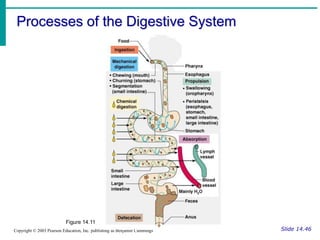
Processes of the Digestive System
Slide 14.46
Copyright © 2003 Pearson Education, Inc. publishing as Benjamin Cummings
Figure 14.11
Control of Digestive Activity
Slide 14.47a
Copyright © 2003 Pearson Education, Inc. publishing as Benjamin Cummings
 Mostly by reflexes via the
parasympathetic division
 Chemical and mechanical receptors
trigger reflexes
Control of Digestive Activity
Slide 14.47b
Copyright © 2003 Pearson Education, Inc. publishing as Benjamin Cummings
 Stimuli include:
Stretch of the organ
pH of the contents
Presence of breakdown products
Control of Digestive Activity
Slide 14.47b
Copyright © 2003 Pearson Education, Inc. publishing as Benjamin Cummings
 Reflexes include:
Activation or inhibition of glandular
secretions
Smooth muscle activity
Digestion and Absorption in the
Stomach
Slide 14.55
Copyright © 2003 Pearson Education, Inc. publishing as Benjamin Cummings
 Proteases act on:
Pepsin –protein digestion
Rennin –milk protein digestion
 Absorption of:
Water, alcohol and aspirin
Digestion in the Small Intestine
Slide 14.57a
Copyright © 2003 Pearson Education, Inc. publishing as Benjamin Cummings
 Pancreatic enzymes provide…
Complete digestion of starch
Amylase
Other carbohydrases
About half protein digestion (trypsin, etc.)
Digestion in the Small Intestine
Slide 14.57b
Copyright © 2003 Pearson Education, Inc. publishing as Benjamin Cummings
 Pancreatic enzymes, cont…
Fat digestion (lipase)
Nucleic acid digestion (nucleases)
Alkaline content neutralizes acidic chyme
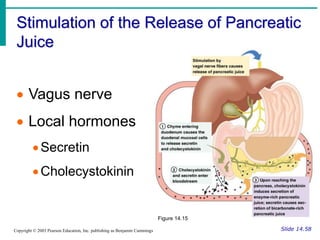
Stimulation of the Release of Pancreatic
Juice
Slide 14.58
Copyright © 2003 Pearson Education, Inc. publishing as Benjamin Cummings
 Vagus nerve
 Local hormones
Secretin
Cholecystokinin
Figure 14.15
Absorption in the Small Intestine
Slide 14.59
Copyright © 2003 Pearson Education, Inc. publishing as Benjamin Cummings
 Water
 Products of digestion
Most molecules absorbed by active
transport
Lipids absorbed by diffusion
 Nutrients transported to the liver
Nutrition
Slide 14.63
Copyright © 2003 Pearson Education, Inc. publishing as Benjamin Cummings
 Nutrient – substance used by the body
for growth, maintenance, and repair
 Categories of nutrients
Carbohydrates
Lipids
Proteins
Vitamins
Mineral
Water
Cellular Metabolism
Slide 14.67
Copyright © 2003 Pearson Education, Inc. publishing as Benjamin Cummings
 “All the chemical reactions necessary to
maintain life”
Anabolism: a constructive process during
which larger molecules are built from
smaller ones
Usually involves condensation
AKA dehydration synthesis
Cellular Metabolism, con’t…
Slide 14.67
Copyright © 2003 Pearson Education, Inc. publishing as Benjamin Cummings
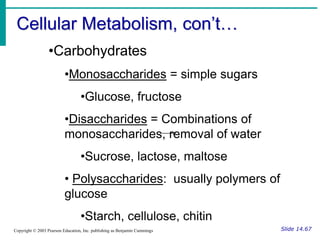
•Carbohydrates
•Monosaccharides = simple sugars
•Glucose, fructose
•Disaccharides = Combinations of
monosaccharides, removal of water
•Sucrose, lactose, maltose
• Polysaccharides: usually polymers of
glucose
•Starch, cellulose, chitin
Cellular Metabolism, con’t…
Slide 14.67
Copyright © 2003 Pearson Education, Inc. publishing as Benjamin Cummings
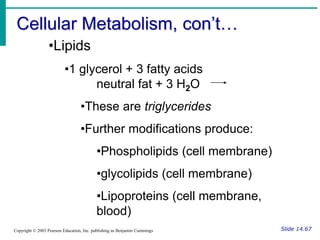
•Lipids
•1 glycerol + 3 fatty acids
neutral fat + 3 H2O
•These are triglycerides
•Further modifications produce:
•Phospholipids (cell membrane)
•glycolipids (cell membrane)
•Lipoproteins (cell membrane,
blood)
Cellular Metabolism, con’t…
Slide 14.67
Copyright © 2003 Pearson Education, Inc. publishing as Benjamin Cummings
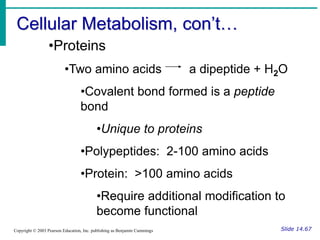
•Proteins
•Two amino acids a dipeptide + H2O
•Covalent bond formed is a peptide
bond
•Unique to proteins
•Polypeptides: 2-100 amino acids
•Protein: >100 amino acids
•Require additional modification to
become functional
Cellular Metabolism, con’t…
Slide 14.67
Copyright © 2003 Pearson Education, Inc. publishing as Benjamin Cummings
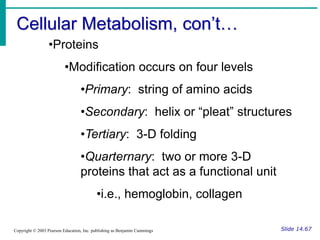
•Proteins
•Modification occurs on four levels
•Primary: string of amino acids
•Secondary: helix or “pleat” structures
•Tertiary: 3-D folding
•Quarternary: two or more 3-D
proteins that act as a functional unit
•i.e., hemoglobin, collagen
Cellular Metabolism, con’t…
Slide 14.67
Copyright © 2003 Pearson Education, Inc. publishing as Benjamin Cummings
•Proteins
•Recall from Chemistry: 
•Proteins each have a unique 3-D
shape
•Shape determines function
•Loss of shape leads to loss of
function
•“denaturing” proteins with heat, pH
changes
Cellular Metabolism, con’t…
Slide 14.67
Copyright © 2003 Pearson Education, Inc. publishing as Benjamin Cummings
•Proteins
•May be structural or functional
•Structural:
•Play a role in cellular architecture
•Collagen, fibrin, actin, myosin, etc.
•Functional:
•Play a role in cell metabolism
•Enzymes, neurotransmitters,
antibodies, etc.
Cellular Metabolism, con’t…
Slide 14.67
Copyright © 2003 Pearson Education, Inc. publishing as Benjamin Cummings
•Enzymes:
•Biological catalysts
•Highly specific for a substrate
•Substrate: substance upon which an
enzyme acts
• i.e., peptidases act only on
peptide bonds in small polypeptides
•Produced only in presence of substrate
Cellular Metabolism, con’t…
Slide 14.67
Copyright © 2003 Pearson Education, Inc. publishing as Benjamin Cummings
•Enzymes:
•Huge protein molecules
•Alter shape to conform to shape of
substrate (“wrap around” effect)
•Average 1500/cell (>5000 in liver cells)
•Most require co-enzymes
Cellular Metabolism, con’t…
Slide 14.67
Copyright © 2003 Pearson Education, Inc. publishing as Benjamin Cummings
•Enzymes:
•Recognize substrate by shape of
binding site
•Serve to lower energy required for
reaction to occur (activation energy)
•therefore speed up reactions
•Not changed or used up during reaction
Cellular Metabolism, con’t…
Slide 14.67
Copyright © 2003 Pearson Education, Inc. publishing as Benjamin Cummings
•Co-Enzymes:
•Required to activate enzymes
•Facilitate enzymatic reactions
•May be a metal ion (Zn++, Cu++, Fe++)
•May be a vitamin
•Vitamins are co-enzymes
•Only function if “their” enzyme is
available
Cellular Metabolism
 Catabolism: substances are broken down into
molecules
 “destructive” process
 Large molecules broken down into smaller
molecules
 Usually by hydrolysis
 “splitting with water”
 Adds H2O back into molecule
 Breaks covalent bonds
Cellular Metabolism
 Catabolism
Energy is released when bonds break
Reverse of dehydration synthesis
(condensation)
Hydrolysis = chemical digestion
Occurs simultaneously (and
continuously) with anabolism
Processes controlled by enzymes
Cellular Energy
 Cellular energy is chemical energy
Derived from breaking chemical
bonds
~ ½ Energy is stored as ATP
~ ½ Energy is released as heat
 Helps maintain body temperature
Enzymes control in the process
Cellular Energy
• All nutrient molecules are ultimately
degraded or converted to glucose
• Only glucose can be used to make
ATP
• Oxidation: cellular process of
chemically breaking apart a glucose
molecule to release energy
Cellular Energy
• Glucose oxidation occurs in 2 phases
• Anerobic metabolism
• Occurs in cytoplasm
• Without oxygen
• AKA glycolysis
• Splits glucose into two 3-Carbon
molecules: pyruvate
Cellular Energy
• Glycolysis
• Process also produces 2 ATPs
• In yeast, plant cells:
• Pyruvate can undergo alcoholic
fermentation
• In bacteria, animal cells:
• Pyruvate can produce lactic acid
Cellular Energy
• Aerobic metabolism
• Uses oxygen
• AKA Kreb’s Cycle or Citric Acid
cycle or Tricarboxylic Acid (TCA)
Cycle
• Occurs in mitochondria
• Makes more ATP than anerobic
processes
Cellular Energy
• Aerobic metabolism
• CO2 and H2O are waste products
• CO2:
• Diffuses out of cells
• Dissolves in plasma
• Produces HCO3
- in blood
• Exhaled from lungs
Cellular Energy
• Aerobic metabolism
• H2O:
• “metabolic” water
• Exhaled from lungs
• Final products of glucose oxidation:
• CO2, H2O, ATP
Cellular Energy
• Aerobic metabolism
• For each molecule of glucose:
• 2 ATP formed in glycolysis
• 36 ATP formed in TCA cycle
• Energy stored in phosphate
bonds
• A reversible reaction
Metabolic Pathways
• “A particular sequence of enzymatic
reactions”
• Such as glycolysis, TCA cycle
• Carbohydrate pathways
• Carbos should comprise most of
our diet (~ 50% complex carbs)
• Used as a primary energy source
• Produce 4kcal/gm
Metabolic Pathways
• Carbohydrate pathways
• Excess carbs converted to energy
storage forms
• Glycogen (muscle, liver)
• Adipose tissue (hips)
• Process is anabolism
Metabolic Pathways
• Lipid pathways
• Metabolism controlled by liver
• Should comprise <30% of calories
in diet
• Get 9 kcal/gm (more ATP!)
• Must be degraded into glycerol,
fatty acids, then pyruvate
• A reversible catabolic process
Metabolic Pathways
• Protein pathways
• Proteins should comprise ~30% of
diet
• Get 4 kcal/gm
• Catabolism is more complex
• Proteins contain nitrogen
Metabolic Pathways
• Protein pathways
• Deamination: removal of nitrogen
from amino acids
• Occurs in liver
• Nitrogen is converted to urea
» A nitrogenous waste product
• Sent to kidneys for excretion
Metabolic Pathways
• Protein pathways
• After deamination:
• amino acid “skeleton” is
processed
• in TCA cycle
• May produce CO2, H2O, ATP
• May form glucose or fat
Metabolic Pathways
• Protein pathways
• Glucose formed from amino acid
skeletons may be re-converted to
amino acids
• “Essential” amino acids:
• Body cannot make these
• Must obtain in the diet
Regulation of Metabolic
Pathways
• Enzyme “saturation”
• Too much substrate for number of
enzyme molecules
• Reaction rate cannot increase
• A single enzyme can control an
entire metabolic pathway
• “rate limiting” enzyme
Digestive System: Disorders
Slide 14.92b
Copyright © 2003 Pearson Education, Inc. publishing as Benjamin Cummings
 Ulcers: bacterial infection with H. pylori
 Vomiting: controlled by center in medulla
oblongata
 Activity of tract slows in old age
Fewer digestive juices
Peristalsis slows
Diverticulosis and cancer more common
Digestive System: Disorders
Slide 14.92b
Copyright © 2003 Pearson Education, Inc. publishing as Benjamin Cummings
 IBS: irritable bowel syndrome
 Crohn’s disease (autoimmune)
 Constipation
 Diarrhea
 Colitis
 Colon polyps/cancers

Bio221Lec28_Metabolism.ppt

  • 1.
    Essentials of Anatomyand Physiology Fifth edition Seeley, Stephens and Tate Slide 2.1 Copyright © 2003 Pearson Education, Inc. publishing as Benjamin Cummings Chapter 17: Cellular Metabolism
  • 2.
    Processes of theDigestive System Slide 14.46 Copyright © 2003 Pearson Education, Inc. publishing as Benjamin Cummings Figure 14.11
  • 3.
    Control of DigestiveActivity Slide 14.47a Copyright © 2003 Pearson Education, Inc. publishing as Benjamin Cummings  Mostly by reflexes via the parasympathetic division  Chemical and mechanical receptors trigger reflexes
  • 4.
    Control of DigestiveActivity Slide 14.47b Copyright © 2003 Pearson Education, Inc. publishing as Benjamin Cummings  Stimuli include: Stretch of the organ pH of the contents Presence of breakdown products
  • 5.
    Control of DigestiveActivity Slide 14.47b Copyright © 2003 Pearson Education, Inc. publishing as Benjamin Cummings  Reflexes include: Activation or inhibition of glandular secretions Smooth muscle activity
  • 6.
    Digestion and Absorptionin the Stomach Slide 14.55 Copyright © 2003 Pearson Education, Inc. publishing as Benjamin Cummings  Proteases act on: Pepsin –protein digestion Rennin –milk protein digestion  Absorption of: Water, alcohol and aspirin
  • 7.
    Digestion in theSmall Intestine Slide 14.57a Copyright © 2003 Pearson Education, Inc. publishing as Benjamin Cummings  Pancreatic enzymes provide… Complete digestion of starch Amylase Other carbohydrases About half protein digestion (trypsin, etc.)
  • 8.
    Digestion in theSmall Intestine Slide 14.57b Copyright © 2003 Pearson Education, Inc. publishing as Benjamin Cummings  Pancreatic enzymes, cont… Fat digestion (lipase) Nucleic acid digestion (nucleases) Alkaline content neutralizes acidic chyme
  • 9.
    Stimulation of theRelease of Pancreatic Juice Slide 14.58 Copyright © 2003 Pearson Education, Inc. publishing as Benjamin Cummings  Vagus nerve  Local hormones Secretin Cholecystokinin Figure 14.15
  • 10.
    Absorption in theSmall Intestine Slide 14.59 Copyright © 2003 Pearson Education, Inc. publishing as Benjamin Cummings  Water  Products of digestion Most molecules absorbed by active transport Lipids absorbed by diffusion  Nutrients transported to the liver
  • 11.
    Nutrition Slide 14.63 Copyright ©2003 Pearson Education, Inc. publishing as Benjamin Cummings  Nutrient – substance used by the body for growth, maintenance, and repair  Categories of nutrients Carbohydrates Lipids Proteins Vitamins Mineral Water
  • 12.
    Cellular Metabolism Slide 14.67 Copyright© 2003 Pearson Education, Inc. publishing as Benjamin Cummings  “All the chemical reactions necessary to maintain life” Anabolism: a constructive process during which larger molecules are built from smaller ones Usually involves condensation AKA dehydration synthesis
  • 13.
    Cellular Metabolism, con’t… Slide14.67 Copyright © 2003 Pearson Education, Inc. publishing as Benjamin Cummings •Carbohydrates •Monosaccharides = simple sugars •Glucose, fructose •Disaccharides = Combinations of monosaccharides, removal of water •Sucrose, lactose, maltose • Polysaccharides: usually polymers of glucose •Starch, cellulose, chitin
  • 14.
    Cellular Metabolism, con’t… Slide14.67 Copyright © 2003 Pearson Education, Inc. publishing as Benjamin Cummings •Lipids •1 glycerol + 3 fatty acids neutral fat + 3 H2O •These are triglycerides •Further modifications produce: •Phospholipids (cell membrane) •glycolipids (cell membrane) •Lipoproteins (cell membrane, blood)
  • 15.
    Cellular Metabolism, con’t… Slide14.67 Copyright © 2003 Pearson Education, Inc. publishing as Benjamin Cummings •Proteins •Two amino acids a dipeptide + H2O •Covalent bond formed is a peptide bond •Unique to proteins •Polypeptides: 2-100 amino acids •Protein: >100 amino acids •Require additional modification to become functional
  • 16.
    Cellular Metabolism, con’t… Slide14.67 Copyright © 2003 Pearson Education, Inc. publishing as Benjamin Cummings •Proteins •Modification occurs on four levels •Primary: string of amino acids •Secondary: helix or “pleat” structures •Tertiary: 3-D folding •Quarternary: two or more 3-D proteins that act as a functional unit •i.e., hemoglobin, collagen
  • 17.
    Cellular Metabolism, con’t… Slide14.67 Copyright © 2003 Pearson Education, Inc. publishing as Benjamin Cummings •Proteins •Recall from Chemistry:  •Proteins each have a unique 3-D shape •Shape determines function •Loss of shape leads to loss of function •“denaturing” proteins with heat, pH changes
  • 18.
    Cellular Metabolism, con’t… Slide14.67 Copyright © 2003 Pearson Education, Inc. publishing as Benjamin Cummings •Proteins •May be structural or functional •Structural: •Play a role in cellular architecture •Collagen, fibrin, actin, myosin, etc. •Functional: •Play a role in cell metabolism •Enzymes, neurotransmitters, antibodies, etc.
  • 19.
    Cellular Metabolism, con’t… Slide14.67 Copyright © 2003 Pearson Education, Inc. publishing as Benjamin Cummings •Enzymes: •Biological catalysts •Highly specific for a substrate •Substrate: substance upon which an enzyme acts • i.e., peptidases act only on peptide bonds in small polypeptides •Produced only in presence of substrate
  • 20.
    Cellular Metabolism, con’t… Slide14.67 Copyright © 2003 Pearson Education, Inc. publishing as Benjamin Cummings •Enzymes: •Huge protein molecules •Alter shape to conform to shape of substrate (“wrap around” effect) •Average 1500/cell (>5000 in liver cells) •Most require co-enzymes
  • 21.
    Cellular Metabolism, con’t… Slide14.67 Copyright © 2003 Pearson Education, Inc. publishing as Benjamin Cummings •Enzymes: •Recognize substrate by shape of binding site •Serve to lower energy required for reaction to occur (activation energy) •therefore speed up reactions •Not changed or used up during reaction
  • 22.
    Cellular Metabolism, con’t… Slide14.67 Copyright © 2003 Pearson Education, Inc. publishing as Benjamin Cummings •Co-Enzymes: •Required to activate enzymes •Facilitate enzymatic reactions •May be a metal ion (Zn++, Cu++, Fe++) •May be a vitamin •Vitamins are co-enzymes •Only function if “their” enzyme is available
  • 23.
    Cellular Metabolism  Catabolism:substances are broken down into molecules  “destructive” process  Large molecules broken down into smaller molecules  Usually by hydrolysis  “splitting with water”  Adds H2O back into molecule  Breaks covalent bonds
  • 24.
    Cellular Metabolism  Catabolism Energyis released when bonds break Reverse of dehydration synthesis (condensation) Hydrolysis = chemical digestion Occurs simultaneously (and continuously) with anabolism Processes controlled by enzymes
  • 25.
    Cellular Energy  Cellularenergy is chemical energy Derived from breaking chemical bonds ~ ½ Energy is stored as ATP ~ ½ Energy is released as heat  Helps maintain body temperature Enzymes control in the process
  • 26.
    Cellular Energy • Allnutrient molecules are ultimately degraded or converted to glucose • Only glucose can be used to make ATP • Oxidation: cellular process of chemically breaking apart a glucose molecule to release energy
  • 27.
    Cellular Energy • Glucoseoxidation occurs in 2 phases • Anerobic metabolism • Occurs in cytoplasm • Without oxygen • AKA glycolysis • Splits glucose into two 3-Carbon molecules: pyruvate
  • 28.
    Cellular Energy • Glycolysis •Process also produces 2 ATPs • In yeast, plant cells: • Pyruvate can undergo alcoholic fermentation • In bacteria, animal cells: • Pyruvate can produce lactic acid
  • 29.
    Cellular Energy • Aerobicmetabolism • Uses oxygen • AKA Kreb’s Cycle or Citric Acid cycle or Tricarboxylic Acid (TCA) Cycle • Occurs in mitochondria • Makes more ATP than anerobic processes
  • 30.
    Cellular Energy • Aerobicmetabolism • CO2 and H2O are waste products • CO2: • Diffuses out of cells • Dissolves in plasma • Produces HCO3 - in blood • Exhaled from lungs
  • 31.
    Cellular Energy • Aerobicmetabolism • H2O: • “metabolic” water • Exhaled from lungs • Final products of glucose oxidation: • CO2, H2O, ATP
  • 32.
    Cellular Energy • Aerobicmetabolism • For each molecule of glucose: • 2 ATP formed in glycolysis • 36 ATP formed in TCA cycle • Energy stored in phosphate bonds • A reversible reaction
  • 33.
    Metabolic Pathways • “Aparticular sequence of enzymatic reactions” • Such as glycolysis, TCA cycle • Carbohydrate pathways • Carbos should comprise most of our diet (~ 50% complex carbs) • Used as a primary energy source • Produce 4kcal/gm
  • 34.
    Metabolic Pathways • Carbohydratepathways • Excess carbs converted to energy storage forms • Glycogen (muscle, liver) • Adipose tissue (hips) • Process is anabolism
  • 35.
    Metabolic Pathways • Lipidpathways • Metabolism controlled by liver • Should comprise <30% of calories in diet • Get 9 kcal/gm (more ATP!) • Must be degraded into glycerol, fatty acids, then pyruvate • A reversible catabolic process
  • 36.
    Metabolic Pathways • Proteinpathways • Proteins should comprise ~30% of diet • Get 4 kcal/gm • Catabolism is more complex • Proteins contain nitrogen
  • 37.
    Metabolic Pathways • Proteinpathways • Deamination: removal of nitrogen from amino acids • Occurs in liver • Nitrogen is converted to urea » A nitrogenous waste product • Sent to kidneys for excretion
  • 38.
    Metabolic Pathways • Proteinpathways • After deamination: • amino acid “skeleton” is processed • in TCA cycle • May produce CO2, H2O, ATP • May form glucose or fat
  • 39.
    Metabolic Pathways • Proteinpathways • Glucose formed from amino acid skeletons may be re-converted to amino acids • “Essential” amino acids: • Body cannot make these • Must obtain in the diet
  • 40.
    Regulation of Metabolic Pathways •Enzyme “saturation” • Too much substrate for number of enzyme molecules • Reaction rate cannot increase • A single enzyme can control an entire metabolic pathway • “rate limiting” enzyme
  • 41.
    Digestive System: Disorders Slide14.92b Copyright © 2003 Pearson Education, Inc. publishing as Benjamin Cummings  Ulcers: bacterial infection with H. pylori  Vomiting: controlled by center in medulla oblongata  Activity of tract slows in old age Fewer digestive juices Peristalsis slows Diverticulosis and cancer more common
  • 42.
    Digestive System: Disorders Slide14.92b Copyright © 2003 Pearson Education, Inc. publishing as Benjamin Cummings  IBS: irritable bowel syndrome  Crohn’s disease (autoimmune)  Constipation  Diarrhea  Colitis  Colon polyps/cancers