OSIMODEL
Course:VP-CTL
NE7-2
MousakadhemAlsaeed
202624003
Assessor:Mr.MohammedElmaghari
SubmittingDate:26/10/2017
1. Introduction
2. (LO1) Define the OSI models.
3. (LO2) Understand why are layering.
4. (LO3) Describe the 7-layers.
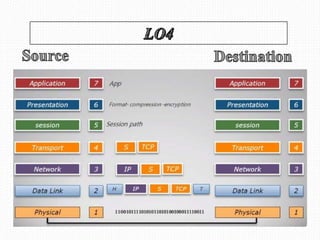
5. (LO4) Understand each layer and the
encapsulation process.
6. (LO5) list the different between TCP & UDP
protocols
7. Review
8. summary
• What is OSI model stands for?
• Who established OSI model
• What is the main porous for OSI?
• For represent a perfect network.
• For organize the network into well defined,
documented, functional modules, in the layered
network.
• Each layer provides specific functionality or
services to the neighboring layer.
• Allows different hardware and software to work
together.
• Essay for Troubleshooting. [1]
• DO YOU TINK TERE IS ANOTHER BENIFT FOR OSI MODEL?
What are the 7-layers?
7 Application
6 Presentation
5 Session
4 Transport
1 Physical
2 Data Link
3 Network
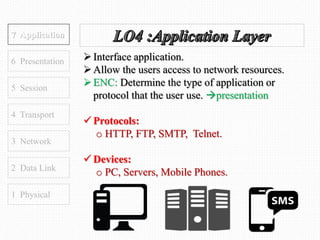
Interface application.
Allow the users access to network resources.
ENC: Determine the type of application or
protocol that the user use. presentation
 Protocols:
o HTTP, FTP, SMTP, Telnet.
 Devices:
o PC, Servers, Mobile Phones.
7 Application
6 Presentation
5 Session
4 Transport
1 Physical
2 Data Link
3 Network
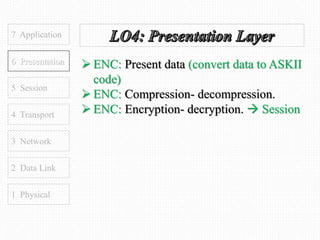
 ENC: Present data (convert data to ASKII
code)
 ENC: Compression- decompression.
 ENC: Encryption- decryption.  Session
7 Application
6 Presentation
5 Session
4 Transport
1 Physical
2 Data Link
3 Network
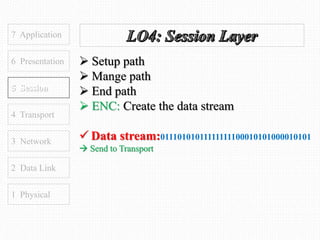
 Setup path
 Mange path
 End path
 ENC: Create the data stream
 Data stream:01110101011111111100010101000010101
 Send to Transport
7 Application
6 Presentation
5 Session
4 Transport
1 Physical
2 Data Link
3 Network
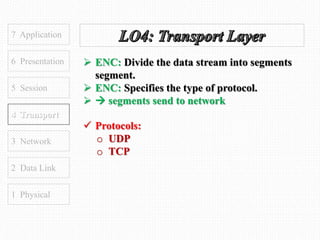
 ENC: Divide the data stream into segments
segment.
 ENC: Specifies the type of protocol.
  segments send to network
 Protocols:
o UDP
o TCP
7 Application
6 Presentation
5 Session
4 Transport
1 Physical
2 Data Link
3 Network
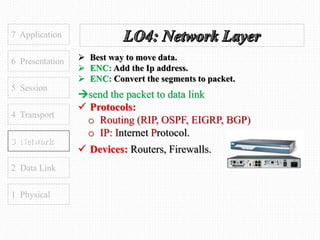
 Best way to move data.
 ENC: Add the Ip address.
 ENC: Convert the segments to packet.
send the packet to data link
 Protocols:
o Routing (RIP, OSPF, EIGRP, BGP)
o IP: Internet Protocol.
 Devices: Routers, Firewalls.
7 Application
6 Presentation
5 Session
4 Transport
1 Physical
2 Data Link
3 Network
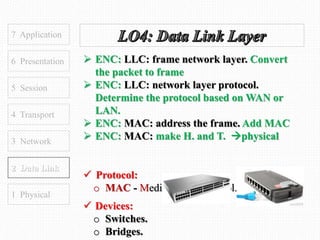
 ENC: LLC: frame network layer. Convert
the packet to frame
 ENC: LLC: network layer protocol.
Determine the protocol based on WAN or
LAN.
 ENC: MAC: address the frame. Add MAC
 ENC: MAC: make H. and T. physical
 Protocol:
o MAC - Media Access Control.
 Devices:
o Switches.
o Bridges.
7 Application
6 Presentation
5 Session
4 Transport
1 Physical
2 Data Link
3 Network
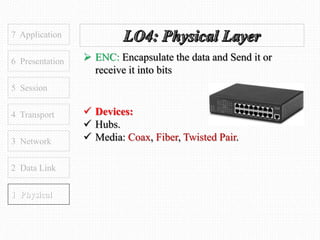
 ENC: Encapsulate the data and Send it or
receive it into bits
 Devices:
 Hubs.
 Media: Coax, Fiber, Twisted Pair.
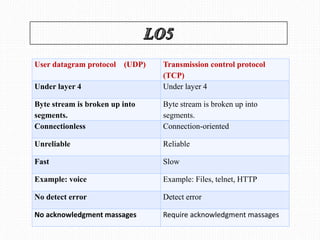
User datagram protocol (UDP) Transmission control protocol
(TCP)
Under layer 4 Under layer 4
Byte stream is broken up into
segments.
Byte stream is broken up into
segments.
Connectionless Connection-oriented
Unreliable Reliable
Fast Slow
Example: voice Example: Files, telnet, HTTP
No detect error Detect error
No acknowledgment massages Require acknowledgment massages
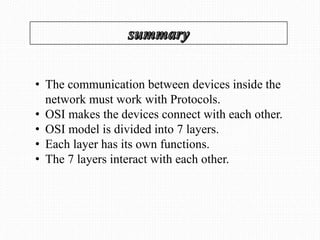
• The communication between devices inside the
network must work with Protocols.
• OSI makes the devices connect with each other.
• OSI model is divided into 7 layers.
• Each layer has its own functions.
• The 7 layers interact with each other.
[1] Zimmermann, H. (1980). OSI reference model--The ISO model of
architecture for open systems interconnection. IEEE Transactions on
communications, 28(4), 425-432.
[2] Handel, T. G., & Sandford, M. T. (1996, May). Hiding data in the OSI
network model. In International Workshop on Information Hiding (pp.
23-38). Springer, Berlin, Heidelberg.
[3] Jacobson, V. (1990). Compressing TCP/IP headers for low-speed
serial links.

OSI MODEL

  • 1.
  • 2.
    1. Introduction 2. (LO1)Define the OSI models. 3. (LO2) Understand why are layering. 4. (LO3) Describe the 7-layers. 5. (LO4) Understand each layer and the encapsulation process. 6. (LO5) list the different between TCP & UDP protocols 7. Review 8. summary
  • 4.
    • What isOSI model stands for? • Who established OSI model • What is the main porous for OSI?
  • 5.
    • For representa perfect network. • For organize the network into well defined, documented, functional modules, in the layered network. • Each layer provides specific functionality or services to the neighboring layer. • Allows different hardware and software to work together. • Essay for Troubleshooting. [1] • DO YOU TINK TERE IS ANOTHER BENIFT FOR OSI MODEL?
  • 6.
    What are the7-layers?
  • 7.
    7 Application 6 Presentation 5Session 4 Transport 1 Physical 2 Data Link 3 Network Interface application. Allow the users access to network resources. ENC: Determine the type of application or protocol that the user use. presentation  Protocols: o HTTP, FTP, SMTP, Telnet.  Devices: o PC, Servers, Mobile Phones.
  • 8.
    7 Application 6 Presentation 5Session 4 Transport 1 Physical 2 Data Link 3 Network  ENC: Present data (convert data to ASKII code)  ENC: Compression- decompression.  ENC: Encryption- decryption.  Session
  • 9.
    7 Application 6 Presentation 5Session 4 Transport 1 Physical 2 Data Link 3 Network  Setup path  Mange path  End path  ENC: Create the data stream  Data stream:01110101011111111100010101000010101  Send to Transport
  • 10.
    7 Application 6 Presentation 5Session 4 Transport 1 Physical 2 Data Link 3 Network  ENC: Divide the data stream into segments segment.  ENC: Specifies the type of protocol.   segments send to network  Protocols: o UDP o TCP
  • 11.
    7 Application 6 Presentation 5Session 4 Transport 1 Physical 2 Data Link 3 Network  Best way to move data.  ENC: Add the Ip address.  ENC: Convert the segments to packet. send the packet to data link  Protocols: o Routing (RIP, OSPF, EIGRP, BGP) o IP: Internet Protocol.  Devices: Routers, Firewalls.
  • 12.
    7 Application 6 Presentation 5Session 4 Transport 1 Physical 2 Data Link 3 Network  ENC: LLC: frame network layer. Convert the packet to frame  ENC: LLC: network layer protocol. Determine the protocol based on WAN or LAN.  ENC: MAC: address the frame. Add MAC  ENC: MAC: make H. and T. physical  Protocol: o MAC - Media Access Control.  Devices: o Switches. o Bridges.
  • 13.
    7 Application 6 Presentation 5Session 4 Transport 1 Physical 2 Data Link 3 Network  ENC: Encapsulate the data and Send it or receive it into bits  Devices:  Hubs.  Media: Coax, Fiber, Twisted Pair.
  • 15.
    User datagram protocol(UDP) Transmission control protocol (TCP) Under layer 4 Under layer 4 Byte stream is broken up into segments. Byte stream is broken up into segments. Connectionless Connection-oriented Unreliable Reliable Fast Slow Example: voice Example: Files, telnet, HTTP No detect error Detect error No acknowledgment massages Require acknowledgment massages
  • 17.
    • The communicationbetween devices inside the network must work with Protocols. • OSI makes the devices connect with each other. • OSI model is divided into 7 layers. • Each layer has its own functions. • The 7 layers interact with each other.
  • 20.
    [1] Zimmermann, H.(1980). OSI reference model--The ISO model of architecture for open systems interconnection. IEEE Transactions on communications, 28(4), 425-432. [2] Handel, T. G., & Sandford, M. T. (1996, May). Hiding data in the OSI network model. In International Workshop on Information Hiding (pp. 23-38). Springer, Berlin, Heidelberg. [3] Jacobson, V. (1990). Compressing TCP/IP headers for low-speed serial links.